Off-topic, but I feel we rarely capture and talk about moments of grief. Between facilitation sessions today I listened to the final episode of Radio 3’s year-long Composer of the Week series on Beethoven, the episode in which he dies. And now I am streaming tears: because it is a sad story, yes; because he wrote music that can make you cry, also yes. But more so because I really, really miss the all-encompassing world of live music. To hear that full orchestral sound now would be such a joy. I miss going to see my Dad play in an orchestra. I miss the joy of giving shared attention to creative spectacles, be they small or large. I can stream whatever music I want, but I want to see human beings playing, making the noise. That’s all.
Category: Entertainment
-
Are you doing a French Mazurka?
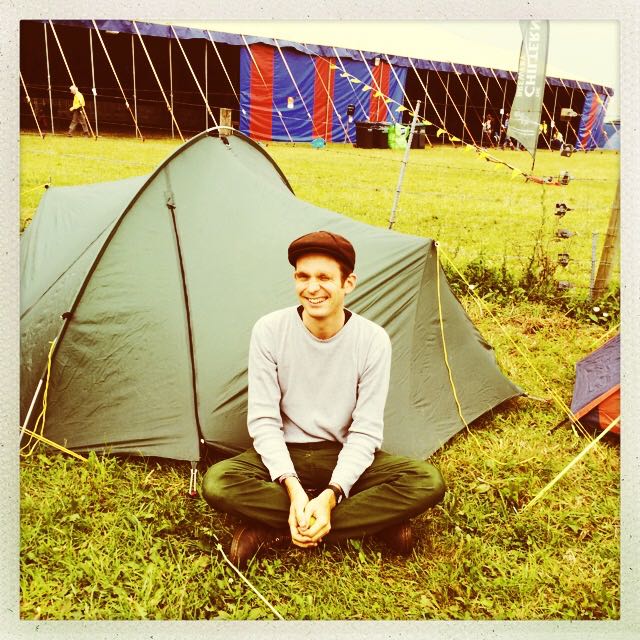
I’m writing this on the train home from Towersey Festival to which I had been invited by my friends Nat and Sophie to help out with some swing teaching and performing for the Shooting Roots line-up. Towersey was my introduction to folk festivals, and it felt like a gateway to a fascinating world of music and dancing to discover. Nat and I were there to teach a 1 hour Lindy hop class and to do some dancing with a band in the evening (see the gig notes below for info).
Towersey felt quite unlike any festival I’d been to before, and I think the main difference is the way in which people are engaged with the music and dance that is being performed. The crowds are attentive; they really listened in our lesson; they were really paying attention in the band performances. People are having a great time but there is none of the rowdiness, (except for being kept awake by a choir singing in four part harmony at 1am in the campsite). I love the way people carry around instruments, and there is space for people to jam. There was also the largest selection of real ales I’ve seen at any festival. And what’s more people walk around with their own tankards, which as far as I’m concerned is the best way yet to reducing festival waste.
-
Teaching le Charleston Stroll – the Port Sainte Marie Method
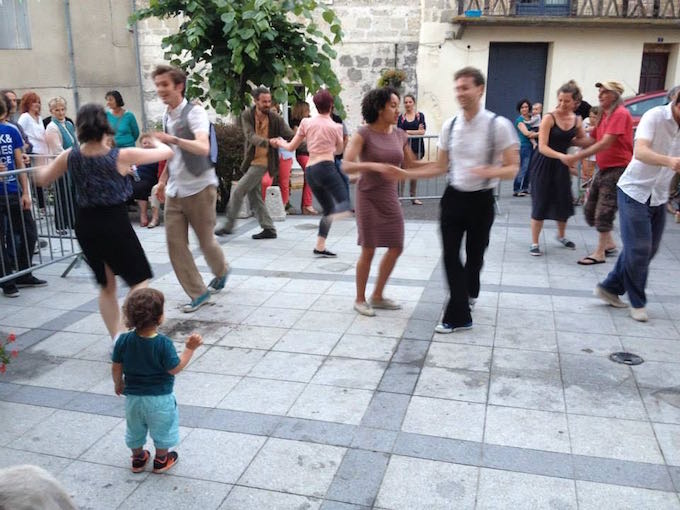
Teaching the Charleston Stroll has become the mainstay of the Mudflappers’ festival swing dance teaching. I think there’s three reasons why it is so popular with crowds: the footwork is easy to pick up, which means that people can quickly overcome their fear of not being able to dance; the fantastic feeling you get from being in a large group of people all moving in sync with each other and the music; and finally there’s the snowball effect whereby a group of people dancing together keeps drawing more and more people in.
This year, the Mudflappers performed in the village of Port Sainte Marie in the south-west of France as part of the country’s national Fete de la Musique. We had already performed four routines and the crowd wanted a lesson. Le Charleston Stroll was the obvious choice. But rather than teach the usual set of variations (fearing being incomprehensible after one-too-many peach juice-infused presssions) we came up with a cunning teaching method. We prominently stationed one Mudflapper on each of the four corners of the crowd, standing on, say, a bench. The crowd did the basic routine facing me and then turned to face the bank, where that Mudflapper would do a variation and everyone would copy. They would then turn to face the town hall where another dancer demoed another variation, and so on, until we faced the front again. Holding the microphone, all I had to do was shout, ‘vers la banque’, ‘vers la mairie’, ‘vers la route’ and ‘vers la Garonne’ – using my best beginner French.
And it worked. At 11:30pm in the heart of a sleepy French village in which in all my life I have never seen more than four people congregate, we had 50-odd people doing the Charleston Stroll. The Port Sainte Marie technique as it will henceforth be called is now standard issue in the Mudflappers manual – coming soon to a festival/soirée musicale near you.
-
Building the Forth Bridge on Stage
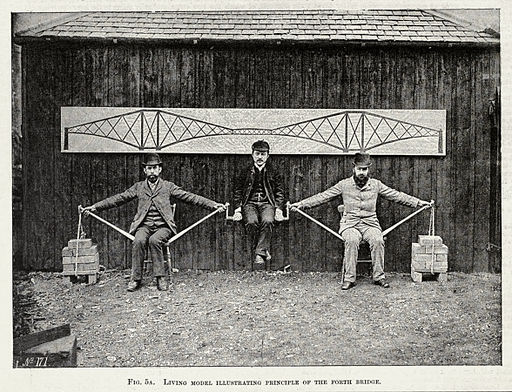
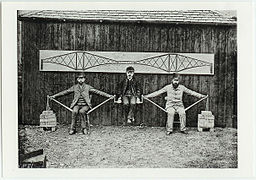
For my first time on stage at Science Showoff back in November 2011, I decided to recreate the famous public demonstration conducted by engineer Benjamin Baker to reassure the public that his planned Forth Rail Bridge would stand up. For me, this demonstration captures both the engineering daring-do and the showmanship of the period.
In Baker’s experiment, two stout volunteers sitting several metres apart represent the enormous pylons of the Forth Bridge, their arms out-stretched to represent the top chords of the structure, broom sticks stretching from hand to foot representing the bottom chords of the structure. On a seat suspended between the human pylons a slighter fellow sits representing the weight of a train passing from one structure to the next. What stops the two human pylons from see-sawing in towards the middle under the weight of the central load are the brick counterweights attached to their outer arms. These counterweights represent the massive weight of the approach gateways on either side of the bridge, and show how these gateways play an integral to the stability of the bridge.
The demonstration is beguilingly simple; recreating it on stage was not. Given the restricted performance space, I had to align the human bridge on the diagonal. Whereas the original experiment was conducted against a wall, mine was done mid-stage, without the benefit of the lateral stability that a wall would have offered. In placed of the broom sticks I created four wooden armatures to represent the bottom booms of the truss so that I could make the necessary connection with the pub chairs – these wooden arms were less sturdy than I had hoped. Finally, as I had arrived at the venue by bicycle, I needed on-site counterweights. The pub were unhappy about me using beer kegs, so one end of the structure was tied down to the underside of the stage, while the other was attached to a hefty base amp.
The rules of Science Showoff are clear: 9 minutes only on stage. Without the benefit of any rehearsal time, I took to the stage. Three volunteers were selected; all were given fake moustaches for authenticity. Everything was in position, but it all looked very shaky. With a few seconds left, the volunteer in the middle riding the bridge nervously lifted her feet from the floor. Without any wall to lean against, the whole structure began to wobble out of plane, but for a few seconds at least the span was achieved.
Sadly no photos were taken, but it is a moment I won’t easily forget. I would love to repeat this experiment, but next time I’d build more sturdy armatures designed to actually fit the seats at the venue, I’d do it on a wider stage…and I’d do it against a wall.
I didn’t know the Science Showoff team at the time, but they have since told me they were scared. Daring do indeed.
-
Babbling about Babel: penning a new routine for Science Showoff
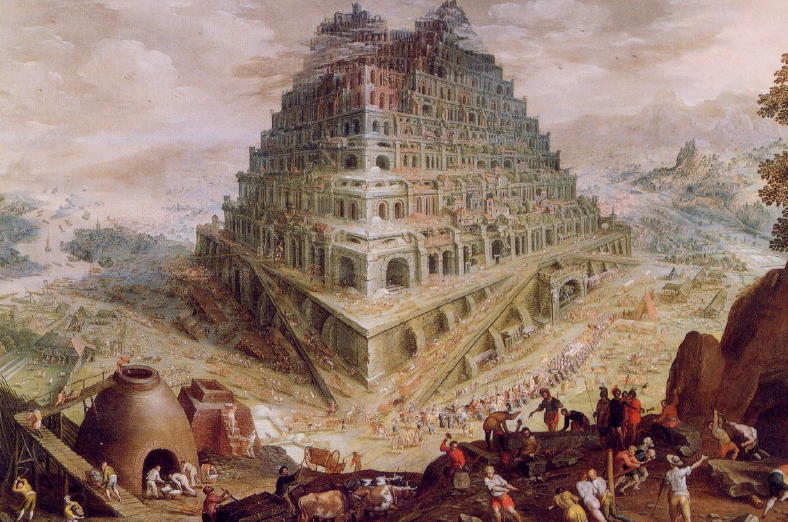
I’ve just signed up to do a slot at the final Science Showoff to be held at the Wilmington Arms on Tuesday June 4th. I haven’t written any new material since January’s Structural Elements song, but the cogs are now whirling. The theme will be how an engineer would go about designing the Tower of Babel. A tall order, indeed.
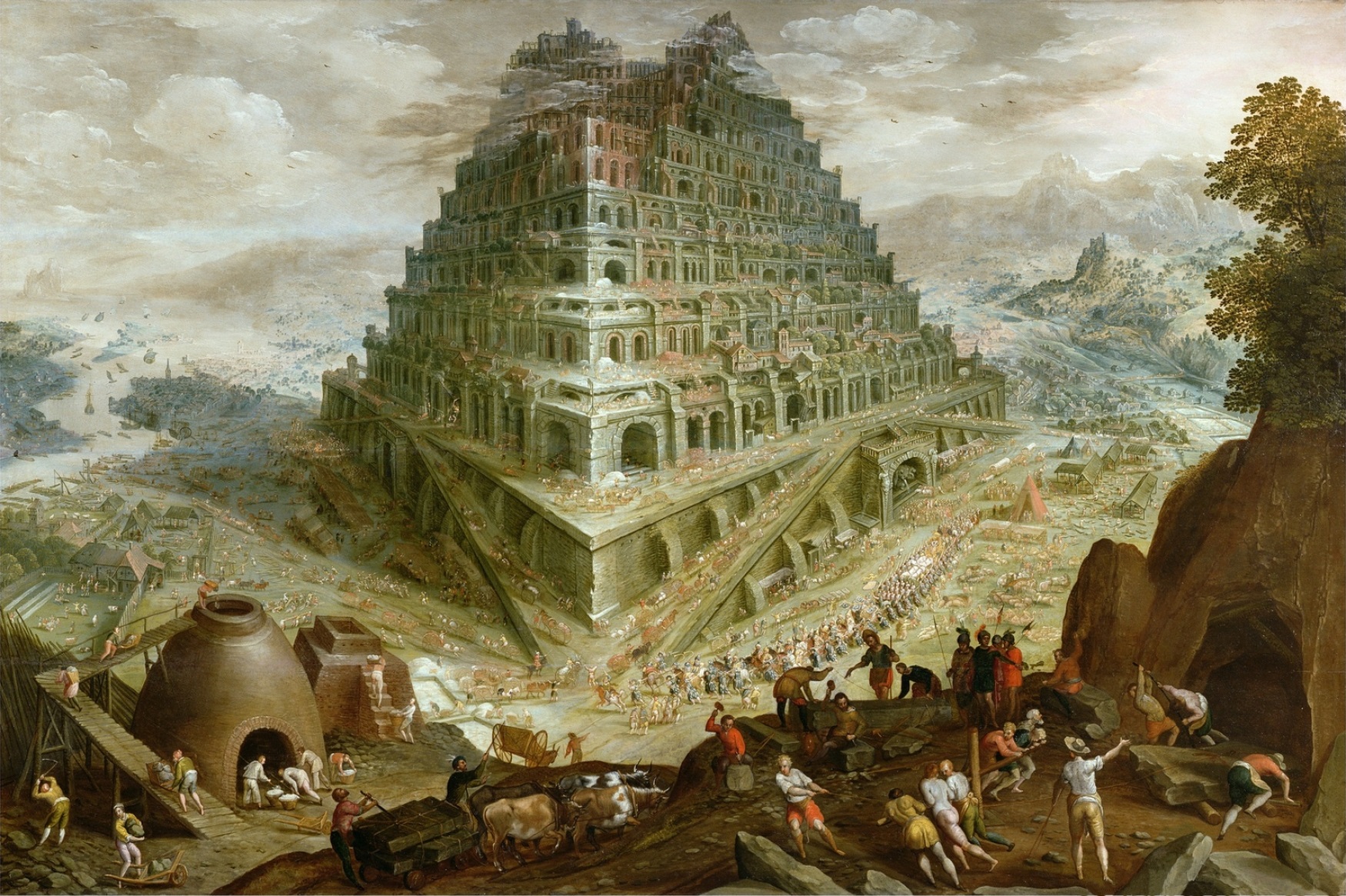
English: Tower of Babel (Photo credit: Wikipedia)

