I find that when I am memorising any sort of sequence – song lyrics, dance moves, lines for a presentation – I usually over rehearse the beginning and spend hardly any time on the end. (more…)
Category: Music and dance
-
Good times at Shambala
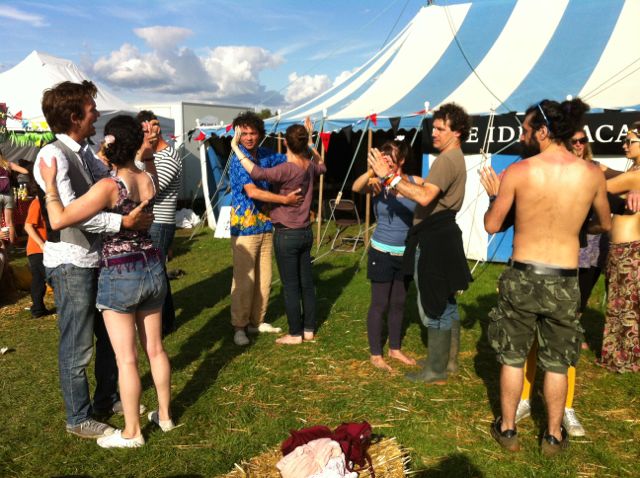 I think I often say this when I come back from a music festival, but Shambala is one of the best festivals I’ve been to. It could be the post-festival giddiness that makes me say this; or that festivals are getting better. (Or even it could be that I’m getting better at choosing what to go to. Unfortunately this can’t be true as I was invited by someone else to help with swing dance teaching.) In any case, I was only at Shambala for 24 hours, so it must be doing something right. A few highlights:
(more…) -
A rockabilly festival and a 2CV convention – an extraordinary night out in rural France
 At some point in the future I would like to spend some time living in the area of rural South West France where the French side of my family is from. The idea is especially appealing when on holiday in that part of the world. But I often wonder, what would day-to-day life be like?
During our recent stay at my grandmother’s house, we went out on a Saturday night. As I drove down the dark and empty Route Nationale, I thought, is this what a big weekend night out might feel like, somewhat downbeat about the prospect.
Our first stop was a community centre situated above our local river beach. We had seen advertised that there would be a night of live swing music. The roads en route had been empty, and the town centre equally so, so we were surprised to find the venue packed with groups of people of all ages eating piles of moulles frites around long tables. The band came on – a manouche ensemble – and they played a lively set, although my flip flops and the empty dance floor made me disinclined to want to bust out any moves.
On the way in we’d seen there was a campsite and we went to check it out. At the entrance were parked two 2CVs; another was parked in the car park. Unusual – almost like a 2CV convention I thought. Exactly like a 2CV convention it turns out: every car in the camping site was a 2CV. They came in all models and colours, with modifications, some in classic colours. Large groups of people sat around gas lights, or the full beams from the cars, eating and drinking together. 2CV drivers seem to be happy people!

Coming home we thought we’d check out the next village where we’d heard there was a weekend-long rockabilly festival. Not expecting to find much (I am ashamed to say – who am I to be sceptical?) we could barely enter the village for the lines of cars parked down either side of the busy Route Nationale – some even parked down the middle. We came upon the school field and found hundreds of people gathered wearing rockabilly finery, lit by the sideways glare of flood lights and the lamps of dozens and dozens of Harley Davidsons parked up in rows. In the big tent that rockabilly band was jumpin’, the crowds were dancing, and we dived in, flip-flops and all.
At the exit there was a souvenir stand selling posters and tins of the local confit de canard.
Every time I return to this part of France I find more and more things going on, and only partly I think, because I wasn’t looking hard enough before! And while there would be obvious differences between a night out there and just hoping on the Victoria line, there is plenty to do, and perhaps even more opportunities to make your own fun.
-
Compressing my ‘cello
Yesterday I compressed my ‘cello

– that is, I turned the tuning pegs, winding up the slack in the strings and gradually started to increase their tension. At first the strings wouldn’t make any noise; and then gradually, as the tension increased, they became audible. At the same time, the wood in the main body of the ‘cello started to creak and groan, and I have to confess I became a little scared.
I started playing the ‘cello when I was five and gave up at sixteen, finding the guitar a much more exciting prospect. During those eleven years of playing, I had given little thought to the forces that the instrument must withstand. Since then I have completed an engineering degree, and so now when I look at the fragile wooden structure I find it surprising that it should be able to resist the forces that the strings place on it.
I remember being told that as instruments in the violin family age they improve because the effect of the tensioned strings is to compress the structure. The strings are stretched from the tuning pegs, over the bridge and loop over the bottom edge and around the sound peg, effectively squeezing the whole box together. This is in contract to a classical guitar, in which the strings stretch from the tuning pegs but stop at the bridge. When guitar strings are tightened, rather than squeezing the box together, the effect is to pull up on the bridge, effectively pulling the front off the sound box. Guitars are therefore said to decrease in quality with age.
I learned the hard way about the physics of guitars at age fifteen when I decided to replace the nylon strings on my mother’s acoustic guitar with steel strings to create a brighter, more jangley sound. Unfortunately the only sound I got was a cracking noise just before I ripped the bridge off of the front of the instrument.
So with that experience in mind, and some engineering under my belt, I was getting increasingly nervous as I upped the tension on my dusted-off ‘cello. The other reason why I was nervous was that until recently this ‘cello had been a collapsed bag of bits in the corner of a basement. The instrument has belonged to my Aunt. Many years ago it got consigned to the cellar, forgotten about, squashed and ultimately broken. About five years ago, it was dug out and my Dad kindly had it restored for me. My end of the bargain was that I would do a little practice now and then. The instrument was reassembled by the late Geoff Crease, the instrument mender that had supplied my first 1/8th-size ‘cello from when I was five. His parting words to me were that though fixed it remained very fragile. That was five years ago. Almost immediately the fingerboard fell off and I lost it, only it to find it again six months ago hiding in the back of the ‘cello case. It has since been stuck back on, and so it was yesterday following a trip with my Dad that I decided to give it ago.
With all that in mind that I found it excruciating to tune the strings up those final few semitones: the strings driving the back of the finger board down on to the instruments shoulders, which in turn put the thin front and back into compression. With every turn of the screw I expected to hear that cracking noise, followed by the implosion of my fragile instrument. And so it was with great relief that the A string reached 440Hz, and I could begin playing – well, scraping.
Since then I have managed two half-our practice sessions. My aim is to get good enough this summer to audition in September for the Angel Orchestra, which M plays in. Whilst tuning up for me was excruciating, I am sure it will be even more so for my neighbours who will have to hear me preparing for that audition. Does anyone have a practice mute?
-
Belly dancing, Charleston and keepy-uppies – civic participation in action
[youtube=http://www.youtube.com/watch?v=3gooD14xRh4&hl=en_US&fs=1&border=1]
This morning I was delving further into Bowling Alone (more notes to follow); by this evening I found myself performing at the Charity Gala, Oak View School – part of the Loughton Festival, and the sort of charity event that this book both celebrates and of which it reports the decline.
I had long had this evening’s dancing gig in my diary but I hadn’t really found out anything about it until I arrived. We cobbled together our routine in the car park – which provoked a few stares) and then went in for the show. I was quite astounded by how eclectic the mix was. We were preceeded by a belly dancing troupe, a folk group who sang about dismembered limbs, and a mandolin player (that we didn’t see because we were busy rehearsing our moves). Ours was the Charleston routine that we have used to tread the boards of a fair few Essex venues now; nevertheless I am glad we got that car park rehearsal in – it paid off. But the show stopper was the guy after us who did endless keepy-uppies to music. It’s amazing what hidden talents people have. The world is a better place for them!
I won’t know what Joseph Putman says about how to reverse the decline in social and charitable events until I get to the final section of his book; I would like to think that belly dancing, Charleston and keepy-uppies have a role to play.
-
Hello St.Pancras

For all the publicity in London about the opening of the new Eurostar terminal at St Pancras, passengers leaving Paris on its inaugural day wouldn’t have been any the wiser. The lack of Parisian interest in the new London terminal was underlined by the ticket prices: while it would have cost me over £100 to book a place on a train leaving St.Pancras that day, the cost of a ticket in the other direction was just £29! I can forgive the lack of excitement from that end of the line however. When it comes to high speed train networks, France’s is in its late twenties whilst Britain’s is still teething.

Until yesterday, once the tunnel had been crossed and England reached, passengers were treated to a short stretch of tantalizing high-speed rail (the first part of the new link has been in use for some time now) before the trains slowed to a dismal trundle on the old line. Well, no more. Unfortunately it was dark so I did not get to see all that pristine Kent countryside that had seen routes for the line changed so many times. Before I knew it, a tunnel under the Thames, then we appeared to be over-ground and then back under again. We popped up for air again at what I guess was the building site for Stratford International before tunneling our way under North London. I remember five years ago a friend of mine living in Highbury had complained of rumbling under his basement flat for a period of about a week or so. He found out, from the council I believe, that those noises had been the tunnel digging machines digging those very tunnels that I was zooming through significantly faster.

The train popped of the ground one last time and we were cruising into the magnificently lit train station. Words do not do justice to what an amazing site the new station is. Passengers off the train for the first time on these platforms walked in eerie gob-smacked silence. The train shed, with its arches of ‘heritage Barlow blue’ which soar over the tracks to support 18 000 panes of self cleaning glass, makes for quite a destination. Indeed there were plenty of people there who had just come for the opening. At the end of the platforms they posed for photos beneath the 9m tall sculpture of a couple kissing. Europe’s longest champagne bar was not long enough to accommodate the masses who came to toast the new station.

I was grabbed for an interview by BBC Radio London who were broadcasting live from the concourse. I think I ticked a few of their boxes: not only had I just stepped off a train from Paris, but I was an enthusing engineer (and, as a bonus, someone whose father had arranged the medley of French songs played that afternoon by the LSO Brass section as part of the opening celebrations). On air, I was asked about how long it must have taken to paint the roof, a question to which I had no answer but assured them that it must take less time than that for the Forth Rail Bridge.

For me, St Pancras represents the first completed major engineering project university colleagues of mine have been involved with during their summer placements. St Pancras celebrates the engineering of a bygone era, is a fine example of how old can become new, and puts international rail travel back into the national consciousness. Not a bad start!

-
Gergiev and the LSO at the Salle Playel for a spot of Stravinski and Ravel

Last night I was lucky enough to get tickets to see the LSO perform at the Salle Playel. The auditorium was reopened back in September after being fully refurbished. The art deco styling of the fixtures and fittings is evident throughout, even including the overhead lighting gantries.
The programme, conducted by Valery Gergiev, included Debussy’s La Mer and Prélude à l’après-midi d’un faune as well Stravinsky’s Rite of Spring: the charismatic Gergiev bringing new energy to these repetoire pieces. From the front row, it is difficult to hear the full sound of the orchestra, but instead you get the expression on the faces of the violinists as well as the sound and sweat of Gergiev conducting. This is what I mean when I say I went to see the LSO play. The Stravinsky was earth-shattering, played with unstoppable momentum right until the penultimate note which Gergiev left hanging what felt like an age before the final bang.
-
The Metropolisians

My mate Ronan is in a band called the Metropolisians. A month or so ago they won their heat in a battle of the bands contest for which the ultimate prize is a gig at the Elysée de Montmartre (Paris’ Astoria for the Londonners amongst you) and a record deal. With their brit-pop charm, stomping rhythms and oodles of charisma, they brought the house down with their second round performance last Friday night.
Appropriately for this second stage the competition was harder to beat, but not in terms of quality but rather the number of people clapping. Bands are rated on the basis of how many raised hands a man at the front can count at the end of each set. There were some pretty ropey high school bands and it looked at one point that one of these bands might have won, having brought half the high school with them for support. But in the end, it was the Metropolisians who got the last laugh with 189 votes to 99 for the band in second place.
Check out their website and if you hear “winkle-pickers” in one of the lyrics, it’s thanks to your friendly engineering correspondant in Paris.

