Category: Practical philosophy

  • Embodied perception and the Bristol Swing Festival

    Embodied perception and the Bristol Swing Festival

    Bristol Swing Festival is unique among swing dancing festivals because it offers the chance to learn circus skills alongside learning to dance. One of the things that I love about coming to Bristol for the swing festival every year is the way it makes me feel grounded in myself and the connection it gives me to other people and the world around me. In the past, I haven’t had a philosophical framework to help me interpret these experiences. But this year I think I found it in Matthew Crawford’s book The World Beyond Your Head. Reading the second chapter, ‘Embodied Perception’, I recognise many of the phenomena that he describes in my experiences here at the festival.
    The key idea Crawford introduces is that we think through our bodies: our bodies are an integral part of our thinking process and thinking doesn’t occur just within the confines of our skulls. Before I think about the consequences of this idea I want to first relate the pieces of evidence that he puts forward for this notion of embodied perception to the experiences I have here at the festival. Before we go on I should just say a little more about what goes on at this festival. As the name suggests people coming to this festival to learn to swing dance but what what makes it unusual is that you also learn circus skills alongside those dance skills. On a typical day you’ll spend the morning and early afternoon learning dance steps and then the rest of the afternoon trying out different circus techniques such as tumbling, handstands, tight rope walking, juggling and clowning. It is therefore a very physical environment and one in which you make a lots of physical and mental contact with other people.
    The first piece of evidence that Crawford sites in support of embodied perception is what happens when we use a stick held in the hand to explore a space we can’t see. When we use the stick to rummage around in the unseen space, we are aware of the stick jostling around in our hand as the other end moves over the contours of the hidden space; however, after a while we stop noticing the stick’s pressure against our hands changing and focus instead on what is happening at the tip of the stick. As he describes, it is as if we see through the stick right to the tip. Our awareness has shifted from our hands and is focused instead on what is happening at the tip of the stick. To use his words the probe itself has become transparent – it disappears. He goes on that the crucial fact that makes this integration of the prosthetic possible is it there is a closed loop between action and perception: “what you perceive is determined by what do you, just as when we make use of our own hands.
    You can see this happening as people start to develop dancing and circus skills. The stiltwalkers are initially very aware of the contraptions they have strapped to their legs but as they gain confidence and familiarity with the sensations they receive through these prosthetics about their relationship to the physical world on the ground it is as if the stilts disappear from view. They have become incorporated into the body from an attentional perspective and what the stiltwalker senses is the ground at the at the bottom of the stilts and not the stilts themselves. I think the same can be said of the sensations that two people feel when they learn to dance with one another. When they begin they are very aware of all the places where their two bodies touch: the connection between their arms, between the sides of their bodies. To beginners this connection with the other dancer is something that they think about a lot. But as the familiarity with this dance hold increases it is if the notion that there are two separate bodies holding onto each other disappears and they experience the dance as one conjoined unit. To re-emphasise Crawford’s words this integration of the stilt or the other dancer into our own bodies is only possible because there is a feedback loop between action and perception. The sensory information we receive when we are dancing with someone is that associated with a four-legged organism with a centre of gravity that exists at some imaginary point between the two dancers’ ribcages and so based on this sensory information we no longer perceive ourselves to be two separate beings but rather one entity.
    So that was the first piece of evidence in support of extended perception:tThe way we integrate tools and prosthetics and even other people into our bodies. The second set of evidence relates to how we interpret the world around us based on sensory information. He explains that the traditional model of perception has it that our eyes supply our brains with a two dimensional representations of the world. When I look at the beer can in front of me what I see is a 2-D representation. But from memory I have images of the can from other perspectives. What my brain does is a sort of three-dimensional rendering in order to create a 3-D model of the can in front of me. This model seems to imply a great deal of processing happens in the head whenever we wish to perceive a 3-D object.  That model however, as Crawford explains is being challenged by and alternative approach. That approach takes as its starting point the fact that our eyes are located in eye sockets in which they can swivel. Those eye sockets are located in a head seated up on a neck that can look from left to right up and down. Those eyes, head and neck are attached to a body that is connected to legs that can propel the body forwards, backwards, left and right and up-and-down. To repeat the quote that Crawford uses, vision is not the purely mental processing of sensory inputs but rather the way in which we use our body to extract invariants from the stimulus flux. In other words, we explore and understand the world around us by moving through it and seeing things from different perspectives and critically this allows us to identify things that remain the same from different perspectives. Movement through the world is therefore critical to understanding it.
    Here at the festival we learn lots about movement and moving in different ways, so it is possible that this altered locomotion offers us new perspectives on the world. In the handstand classes we spent time moving around on all fours and connecting our hands to the ground. In solo jazz we learn to slide, hop and skip through a space, filling it in new ways. In tumbling classes we run, we jump and we fall (gracefully). All of these activities reveal the world to us from new perspectives, and remind us how narrowly we perceive the environments that we commonly inhabit.
    When I look out of the window from the cafe at which I am writing this post at the streams of people walking to work, walking the same direction as each other, walking the same way as each other, to go and sit in office environments that are probably very similar to one another. If we move through (or rather remain sedentary) in very similar ways, what does that say about diversity of thought?
    Crawford concludes this part of the chapter with a reflection on how toddlers learn to walk. When they are learning they are experimenting to see what movements of their bodies produce what effects. Initially this takes lots of concentration, but eventually the commands can be carried out with thinking about them. The child’s attention shifts away from the body toward the world that can now be explored through movement. Through mastering a new skill, their world has grown, and their attention and perception reaches out beyond the body. Invoking Nietzsche, Crawford says that joy is the sense of one’s power increasing. As we master a new physical skill, frustration gives way – their attention shifts from their body to the world beyond – and they feel a sense of joy.
    So what do I take from all of this? Why does going to the Swing Festival feel so good. I think that there are four things at play here:
    The first is that for many, myself included, our primary stimuli during the day are visual and audio – all from the head and little from the body. At the festival, the stimuli are much more physical. This gives our brains a break, and perhaps puts us back into a sensory environment to which are perhaps better evolutionarily suited.
    The second is that many of the skills we learn at the festival allow us to move through the world in new ways, giving us new ways of perceiving it and understanding it. Turning upside down may seem a trivial thing to do, but when we do so much of our thinking the right way round, flipping things provides a refreshing change.
    A third thing I’ve noticed is that spending a few hours a day doing bodily-focused classes seems to make people more physically playful outside those classes. It’s as if we are given permission to rediscover our world through physical play, to rediscover that intrinsic joy that children find when they run around, swing from branches, balance on walls, wrestle with one another or just give each other hugs.
    And finally, the festival gives us a tiny taste of the power we could feel if we could master a circus skill: when we might one day stop looking at our hands and watch the juggling balls dancing in front of us; when we might one day feel the lightness that comes with the perfect handstand.
    To conclude with one of Crawford’s phrases, ‘we think through our bodies’. Bristol Swing Festival gives me new ways to think through my body, and that’s why I enjoy being there so much.

    Related posts

  • Analogue skills: fogotten powers

    Analogue skills: fogotten powers

    We live in a time of rapid and accelerating technological change. It is the age of digital, big data and smart technology. The digital zeitgeist is presented with a benign face: faster, more connected, more megapixels, do more, see more. But over the last couple of years I’ve had a feeling that in the race to embrace these new digital tools we are forgetting pre-digital ways of doing things which might turn out to have been more useful, more sustainable and better for us. Things like how to communicate face-to-face, how to communicate in written long-form (even the long email is a thing of the past), how to read a map, how to spell, how to sketch, how to make an appointment and keep to it, how to concentrate, how to make things, and even how to take notice of our physical environment.
    The name I am giving to this pre-digital ways of doing things is ‘analogue skills’. As an on-going project, I plan to explore what analogue skills it would be worthwhile keeping hold of, and to interrogate the digital tools at our disposal to see how to make good use of those without detriment impact to our well-being or to the planet. I hope the outcomes of this project will be to produce some suggestions for how we can use the tools at our disposal, both analogue and digital to improve our experience and quality of life.
    Of course, there are many ways in which digital tools empower us: wide-spread and long-distance communication; access to information and knowledge sharing; access to an almost unlimited range of media; online commerce and sharing economies; increased connectivity through social media – and I benefit from all of these.
    But there are also costs. More screen time means less time experiencing the physical environment.The flip side to the benefits of social media is the social anxiety in can cause, fear of missing out – so called FOMO. The huge choice of media that the Internet offers can lead to a sense of being overwhelmed and lower levels of engagement with the content. Digital consumption is dependent on technologies over which consumers have decreasing amounts of control – no longer are we necessarily the masters of our tools – and with built-in obsolescence, these technologies have a large environmental impact.
    Around me, I increasingly see the signs of digitial discontent. Friends talk about digital detoxes and commit ‘Facebook suicide’. At Hazel Hill Wood, where I co-lead conservation weekends, there is no mobile phone reception. Most participants are relieved for this enforced time offline. But there are usually one or two users per group who anxiously spend time at the one spot in the wood where they can get a feint signal and wave their handsets around in the air, like some ritual dance to the digital deity, in a desperate attempt to connect.
    At this point I need to make a full disclosure: I write this post on an laptop, using notes that I made while walking along the street on the memo app on my iPhone, cross-referencing that with notes that I made in Evernote almost a year ago, which I will post to a website, which I will then share on social media. So yes, I am fully-signed up user of digital technologies. But there are plenty of digital things that I don’t use. For example, for the last year I have been trying to minimise the distractions of social media by removing notifications from my phone, and by limiting my screen time. For certain, I’ve been sceptical for some time about the digital panacea. This project is an attempt to martial these thoughts, to change my skills and habits and hopefully to help other people along the way.
    I am fascinated by really cutting edge technology, the innovation that goes into it and the possibility it offers. But I do think that older technologies allow us to interrogate the new; indeed one of the most fascinating things about older technologies is finding out how the engineers of the day were using great ingenuity to extend what was possible within the limits of the technology of the time.  Of course, digital technologies are here to stay, and in many ways for the better. What I think is important is making sure that is us who are smart and not just the technology.

    Related posts

  • The Margherita Principle for decision-making

    The Margherita Principle for decision-making

    Pizza
    Pizza (altough not quite a Margarita)

    I’ve been promising friends this post for some time, especially those that have eaten in a restaurant with me recently. In the season of good will and consumption, this rule of thumb helps us make better menu choices. But as a decision-making tool, it goes much deeper, helping us (re)discover the real value in things.

    The principle is simple: the best value pizza in a restaurant is the one at the top of the list, usually the Margherita.

    This realisation first came to me last year at a pizza restaurant by the Canal St Martin in Paris. The 6€ Margherita offered: a delicious and filling meal – the prototypical pizza; a nice warm place to sit; the atmosphere of the restaurant; banter with the waiter; a view over the canal; a small basket of bread and a bottle of tap water; and chilli oil.

    The next pizza on the menu was the Fungi. At 7.50€ I was getting everything the Margherita offered plus a chopped mushroom. At 1.50€ that’s a bad value-for-money mushroom. And from there on down – Fiorentina, Vegetarian, Quatro Staggione – the value just keeps on going down.

    The cheapest thing on the menu usually gives you the most, the rest are opportunities to spend more money with diminishing returns. (Incidentally, as Tim Harford explains in his book ‘the Undercover Economist’, menus are usually structured in ways to give customers the opportunity to spend as much money as they want to.)

    The benefits of the principle

    • By applying the Margarita principle not just to pizza but also drinks and coffee, I was able to have a pizza, a glass of house red and a shot of espresso for 10€ all in.
    • It’s a training in simplicity, which as Thoreau argues in Walden, is the route of happiness.
    • It’s a training in looking for the real value in things.

    What about non-linear effects?

    My colleague David pointed out to me that the principle may not be applicable if the combination of extra ingredients amounted to a taste that was greater than the sum of it’s parts – a sort of non-linear taste progression.

    I concede that this sort of topping alchemy may be possible, but in reality it would have to deliver significant extra value to be anywhere near as valuable as the initial Margherita. Besides, another colleague of mine, who is also Italian, claims the Margarita is the best tasting pizza anyway – so why add anything more?

    Broader application

    The Margaherita Principle is a sort of mix of the Pareto Principle and the Law of Diminishing returns, and has applications beyond pizza choice. It helps get greater clarity of thought when making decisions.

    For example, I was recently agonising over the order in which to publish various blog posts. But then a realised that the greatest value outcome was just to get the post published. There may be some marginal benefit to publicising them in a certain order; however that was much less than the value of just getting the material online and circulated. Worse, the time I was spending worrying about the order to publication was time that I wasn’t spending writing – and I might have ended up publicising nothing at all.

    Another example related to the branding of a training course that I am involved with developing. At this stage, we are not sure how the course is going to evolve, and so it was difficult to decide what direction to take the branding. But, applying the Margarita Principe, I realised that the most important thing is to at least get something published, which we could then revisit as started to run and iteratively develop the course.

    The fallacy of menu choices

    As I write, I realise that we often have less control over our experiences than we think. A restaurant is probably quite a high control scenario: we choose what we want to eat and drink; choose our company; and with care, the topic of conversation; and things usually go to plan. In reality, we often have less control over the projects that we manage than we think. The branding example above illustrates this. It is very hard to know what the best way to describe a training course is until you run it and see how the content evolves in practice. With this sort of thing, the best approach is make quick decisions, see how they work in practice, and then re-evaluate along the way.

    In a restaurant situation, this is akin to not ordering your main course until you have finished your starter, and then waiting until later to order dessert. This is decision making on the basis of feedback – literally!

    The horror of advanced menu choices

    Given all of the above, the worst possible decision-making scenario with regards to menus is when you are sent dinner options for a conference or a corporate meal a month in advance and you have to choose then. How on earth are you going to know what you want to order that far in advance?

    In these situations, Margheritas are rarely available, so here I apply the Tiramisu principle: always choose the first option as long as it is vegetarian, and along is it isn’t Tiramisu, which is the food of the devil and should be avoided at all costs.

  • The Happy Grid: prioritise your action list in a more fulfilling way

    The Happy Grid: prioritise your action list in a more fulfilling way

    The Happy Grid is a technique I devised a few months ago to help me use short and long-term happiness as a guide for daily decision making. Since I’ve been using it, it has had a hugely positive impact on me: I am better at prioritising work that makes me more fulfilled, and hopefully the people I collaborate with get more out of working with me.

    In this post I’ll explain how to set up your own Happy Grid. I’ll also go through the four different task types that make up the grid, and what these can tell you about the pressures that influence how you use your time. It’s a long post, but stick with it as I think there’s a lot of useful stuff here.

    Background

    The story begins at the end of a busy week. I had ticked off all the most important actions on all my major projects. I should have been feeling happy, but I felt quite depressed and that depression extended into the weekend. It was confusing because this was supposed to feel good – to have not sucumbed to distraction and to have done the things on which other people were depending on me.  Yet I didn’t feel any payback for getting to the end of the list.

    A few weeks before I had been on holiday. One of the things that I do when I have some time away is write two lists in my journal: the first, a list of goals for the year ahead; the second a list of things I feel happy doing – a list of things that bring happiness in the moment.

    I decided to map my ‘done’ list against my lists of goals and things I enjoy doing. The result was very revealing.

    The Happy Grid Diagnostic Test

    To help you get the most out of reading this post, I suggest you do the following quick diagnostic test right now. Do it quickly on a piece of paper. You can always go back and do it more thoroughly. I am going to ask you to write down four lists.

    Current goals

    First, write down a list of your current goals. Think of goals on a say a 3- to 6-month horizon. Include in your list the sort of state you want to find yourself in. So for instance one of my goals was to spend more time doing face-to-face teaching. Another is to spend time with people who positively influence my thinking. Neither of these goals are to do with attaining some kind of status. Think broadly. Do you want to spend more time inside or out? Are there things you want to learn?

    Anti-goals

    The second list of of things you don’t want to achieve. Think of these as anti goals. For instance I don’t want to spend more time in front of a computer screen. I don’t really want to get involved with teaching projects where I don’t have influence over the content. I don’t really want to get involved in building a new knowledge management system for the business, even though this is something I’ve done before. Knowing what you don’t want to do is as important as what you do, but is sometimes harder to elucidate.

    Enjoy doing

    The third list to write down is a list of things you enjoy doing.. Think of things that make you go into a state of ‘flow’ when you do them, when time just flies by because you are enjoying yourself, but equally which keep you challenged. Think of things that you get a buzz out of because you enjoy doing them. My list includes things like teaching and coaching, writing new teaching material. But it also includes travelling by train, cycling, spending time with family and friends, spending time outside.

    Drag list

    The fourth list to write down is things that you don’t enjoy. These are things that feel like a drag. For me that list includes small-scale management of projects. This is something that I don’t enjoy and recognise that there are other people who do this much better than me. It also includes the opposites to the things I enjoy doing – so I don’t enjoy being inside all the time, I don’t enjoy being alone for too long.
    You are now ready to create your own Happy Grid.

    The four types of tasks

    I reasoned that the tasks on my to-do list fitted into one of four categories, which I labelled and described as follows:

    • Type-1 tasks – Tasks that are goal-aligned and enjoyable. These are things we should prioritise because they feel good to do, and because they are contributing to a goal.
    • Type-2 tasks – Tasks that are not goal aligned, but nevertheless enjoyable. It feels good to do them but it doesn’t help us reach one of our goals.
    • Type-3 tasks – Tasks that are goal-aligned but unenjoyable. We generally need to do them for long-term happiness but doing so doesn’t feel good.
    • Type-4 tasks – Tasks that are neither goal-aligned nor enjoyable. Doing these doesn’t feel good in the short- nor the long-term.

    Creating your Happy Grid

    Create a 2×2 grid and label the four quadrants as follows.
    Type 1     Type 2
    Type 3     Type 4

    Now, go through each entry in your current to-do list, and write it down in the quadrant of the grid to which it corresponds.

    When I categorised and wrote down my list of completed tasks for the previous week, I found that the majority of what I had got done were Type 4 tasks: tasks that are neither enjoyable nor contribute towards longer-term aims, with a smattering of Type 3s and Type 2s. Revealingly I didn’t have anything written down in the Type 1 quadrant, the one that feel good to do and contribute towards some positive goal.

    I felt I had landed upon a key prioritisation tool for the week ahead.

    Understanding the four tasks categories

    Clearly we don’t have the luxury of only doing Type-1 things. But categorising things in this way can at least help us be more aware of the nature of the list of tasks before us, and can help us make more fulfilling choices about what we do. And beyond being simply aware, we can actively make decisions to help us spend more time doing things that we enjoy.

    Let’s explore each of these categories in turn.

    Type-1 tasks – goal-aligned, enjoyable tasks

    In an ideal world, we’d spend the majority of our time doing these sorts of tasks. Half the trouble is simply knowing what these goal-aligned, enjoyable tasks are. The aim of the happy grid is to help us identify the sorts of things we enjoy doing and that are goal-aligned, and to make sure we are spending at least some of everyday doing things that are likely to make us happy.

    By regularly repeating the diagnostic exercise described at the start of this post, you can start to recognise  Type-1 tasks. Identifying and writing down type-1 tasks is the first step to making sure you spend more time doing what makes you happy. The second step is managing and steadily reducing the time you spend doing Type-2, Type-3 and Type-4 tasks.

    Type-2 tasks – non-goal-aligned, enjoyable tasks

    Type-2 tasks are enjoyable in the moment but don’t necessarily contribute to what you want to achieve long-term. The worst Type-2s are tasks that you enjoy doing but that lead you towards anti-goals, the things you really don’t want to be achieving.

    Browsing the web, flicking through social media and sharpening your pot of colouring pencils generally fall into this category. Another word for this type of Type-2 task is procrastination. For procrastination Type-2s, you would be better off doing something from your Type-1 list. If you set up your Type-1 list appropriately, you will always have something more enjoyable to do. But also falling into this category without being procrastination are Type-2 tasks that you might enjoy doing in their own right, but that doing too often will steer you off course from the goals you do want to be aiming towards.

    To give a personal example, I enjoy developing concepts for online learning tools, but it would be a non-goal to build a career in which I end up having to spend more time in front of a computer. On the contrary, my goal is to spend more time doing more face-to-face teaching and to minimise screen time, and so spending time developing proposals for online learning tools, while enjoyable in the moment, is not necessarily getting me any closer to where I want to be.

    This is a very common scenario in the workplace. The organisations that we work for tend to reward us for doing things that help the organisation meet its aims. Less enlightened organisations do it by fiduciary means; more enlightened organisations might try to align individual goals with organisational goals, but in practice this is hard, and in reality tasks get allocated on the basis of best person for the job, rather than best job for the person.

    As Peter Drucker points out in his book, ‘How to manage oneself’, it is up to us as individuals to tell managers what work we do well and how we do it best, and not up to our managers to guess.

    By definition, Type-2 tasks are enjoyable, and so on any particular day, doing lots of Type-2 tasks isn’t a problem. But over time, time spent on Type-2s is at the expense of time on Type-1 tasks. So how should we reduce the Type 2s?

    Minimising the Type-2 tasks

    For the procrastination Type-2s there are lots of options for reducing distraction, which I will cover in another post. As for the more structured work-based Type-2 tasks you can:
    • Avoid taking them on in the first place. Before you take on a new task, look at where it will go on your Happy Grid. If it’s a type 2, consider politely turning it down.
    • Try delegating – after all, just because a task doesn’t align to one of your goals, it might align to someone else’s.
    • Try to find a way to recast the task so that it does align to one of your goals.

    Type-3 tasks – goal-aligned, unenjoyable tasks

    If you don’t get Type-3 tasks done then you won’t meet your goals. But the chances are you are unlikely to do Type-3 tasks because, by definition, you don’t enjoy doing them.

    Here you have two options: either delegate the task, or set up a regular routine that ensures you get them done reliably and in as short a time as possible in order to liberate your time for Type-1 tasks. A personal example of such a routine is that time I set aside each week to deal with expenses. I don’t enjoy it, I need to do it, and I do it the same time on Wednesdays without fail. Then the rest of the week I don’t have to think about it.

    It is important to be disciplined about carrying out the routine so that you be confident the rest of the time that these Type-3 tasks can wait until the next time you carry out your routine.

    Type-4 tasks – non-goal-aligned, unenjoyable tasks

    These are the tasks that we want to minimise. We don’t enjoy doing them and they aren’t getting us any closer to any of our goals. As I discovered, a week full of Type-4 tasks is an unhappy week.

    As well as not making us feel good, Type-4 tasks come with an opportunity cost: they are preventing us doing any of the other 3 types of task, all of which would make us happier, not least of all, Type-1 tasks. We should make it our business to try and reduce as far as possible the Type-4 tasks on our list.

    Minimising the Type-4 tasks

    We can start the Type-4 purge using the techniques we used for Type-3s and Type-2, in decreasing order of preference:

    • Avoid taking them on in the first place – once we know what counts as Type-4, we can spot it before we say yes.
    • Try delegating – as above, there may be someone else for whom the task is more enjoyable or for whom the task is more goal-aligned.
    • Set up a strict routine for getting this type of task done quickly. See the notes above for Type-3 tasks. If you take this approach, experiment with running the routine as infrequently as possible so you don’t let the time spent doing it creep up too much.
    • Just don’t do the task and see what happens. It is very easy to think that a task is important when we are caught up in the moment, but given some distance and time, some tasks can just go away. Either someone else does them, or, because it isn’t done, alternative options open up. You may well end up being thought of as unreliable, but better that than being reliable at doing something you don’t want to.

    If having worked through the above options, and you decide you can’t’ simply not do the task, then it is time to start asking some serious questions about the sort of activities that you do. But saying that is not so gloomy as this process gives you a constructive way to talk about what it is you do want to do.

    Prioritisation using the Happy Grid

    Setting up your first Happy Grid should be revealing in itself. But it is also meant to be a decision-making tool. Having distributed your tasks into the grid, what should you do first?

    For grown-ups, I don’t think the get-your-homework-done-before-you-go-out-to-play approach counts any more because there are so many factors influencing us to get things done to meet other people’s aims. You need to start prioritising your own goals. So I would recommend starting the day with either a Type-1 or Type-3 task. Let the happiness that you derive from getting that thing done first then set the tone for the day ahead.

    Reflective use of the Happy Grid

    I am finding that the more times I use the grid, the better I am getting at understanding my own motivations and goals, and the more adept I am becoming at making sure I am not getting lumbered with things that I don’t enjoy doing.

    I believe being more aware of these things is better for everyone. As Peter Drucker says, we are much more likely to perform well doing work that we enjoy and that we are motivated to do. More philosophically, Seneca said ‘Life is long if you know how to use it’. It is up to us to positively decide how to use our time in a way that will make us happy.

  • Packing lists are sexy

    Packing lists are sexy

    I love packing. But until four years ago, I hated it. I would put off packing my bags, leave it to the last minute, forget things, bring the wrong things, and make the same mistake again next time. Packing became a lot more complicated when I started to pack for a child too.

    Then one day I realised I needed to create a master list, a go-to reference that could be honed over time. From that day, I started writing, collecting and comparing my packing lists. Fifteen festivals, a dozen trips abroad and countless weekends away later, I have arrived at something pretty solid, which I share now for people who hate packing as much as I did, or who agree with the lifestyle design principle of improving situations which regularly annoy us.

    It is probably worth mentioned a couple of drivers in the choices I have made:

    • I usually travel car-less – in fact I actively seek out ways of not going by car to take me off the beaten track – so I like to travel light.
    • Wherever I go, I often end up teaching swing dancing, which means that even in my regular kit I have some dance paraphernalia.
    • These previous two points mean there is usually a mixture between high-tech lightweight stuff, and heavy vintage stuff. Lightweight vintage stuff is the holy grail.
    • I hate luggage that you tow. Just saying.

    As Seneca said, ‘May your faults die before you do’. I’ve got many left to fix, but being bad at packing is now safely interred. I even enjoy it.

    The master packing list

    This list is made up of a core which rarely changes, then a series of bolt-ons, which are groupings of things I commonly find I have to add for certain types of trip. There is some duplication between different bolt-ons so beware.

    The core

    Clothes

    (Starting from the top)

    • A flat cap – I used prefer a wide-brimmed number like a Panama but it just gets in the way and falls off when dancing.
    • Sunglasses – usually really cheap ones so I don’t get annoyed when I lose them.
    • Coat (eiher a ski jacket or waterproof + fleece)
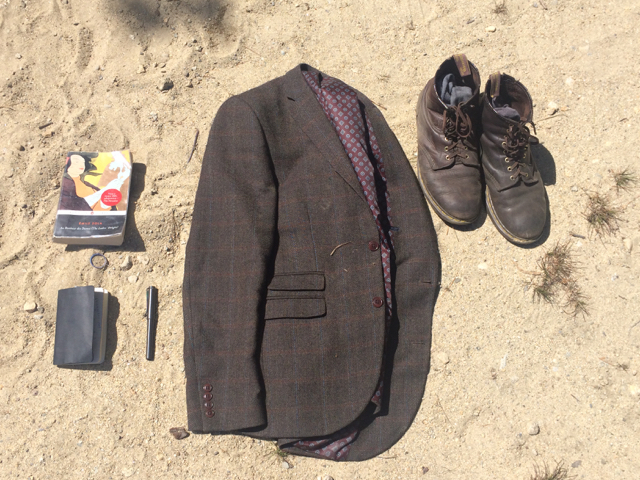
    • Tweed suit jacket – works for work, and for swing teaching. Really handy for docs when travelling.
    • Long-sleeved lightweight smart shirt.
    • Tie
    • Cravat (good accessory for swing gigs)
    • 2x t-shirts.
    • Thin jumper.
    • Belt
    • Underwear
    • Swimming/running shorts
    • Jeans – lightweight Rohan jeans – dry super quickly. Work for smart/casual.
    • Lightweight trousers – only sometimes – something light to perform in, or hang around a festival.
    • Thermal underear – takes no room, can use for PJs or to keep warm in sleeping bag.
    • Waterproof trousers – sometimes.
    • Socks
    • DMs/converse
    • Flip flops.

    Equipment

    • Diary + pen&ink, pencil.
    • Book
    • Phone + charger
    • Wallet
    • Computer/iPad + charger
    • Headphones
    • Speaker for teaching
    • Water bottle
    • Coffee cup.
    • Washbag
    • Wipes
    • Credit card swiss army tool
    • Travel towel.
    • Mudflappers business card

    Swing teaching bolt-on

    • Garland
    • Hawaiian shirtWhite short-sleeved shirt (Mudflappers standard issue)
    • Brown smart waist coat
    • Dancing waist coat
    • Big grey trousers + braces
    • Big black trousers – possibly
    • Dancing shoes – possibly
    • Cable for connecting ipod to soundsystem.

    Cycling bolt-on

    • Helmet
    • Gloves
    • Pump
    • Repair kit + multitool
    • Lights
    • Locks
    • iPhone holster
    • Bungee

    Camping bolt-on

    • Tent
    • Sleeping mat
    • Sleeping bag
    • Liner – sometimes
    • Hot water bottle – sometimes
      Torch

    Camping cooking bolt-on

    • Large collapsable water carrier
    • Plastic bowl
    • Plastic spork
    • Mini chopping board
    • Sharp knife
    • Bag for left-overs
    • Trave wash and scrubber
    • Jet boil, cafetiere plunger, gas and stand.
    • Coffee

    Three-year-old daughter

    • Hats – sun hat for the day and warm hat for the evening
    • Festival headphones
    • Jumper
    • Hoody
    • Fleece
    • T-shirts
    • Long-sleeved t-shirt
    • Leggings
    • Trousers
    • Underwear
    • Dress
    • Shorts
    • Tights
    • Wellies
    • Crocs
    • Onezee for sleeping in/evenings.
    • Sun glasses
    • Swimming costume
    • Nappies
    • Wipes
    • Face paints
    • Lego
    • Books
    • Sticker book, pens
    • Colouring book
    • Fancy dress stuff
    • PensBubbles

    Happy travels everyone!

  • 3 safety valves for high-pressure decisions

    3 safety valves for high-pressure decisions

    IMG_0374

    One of the things that I’m learning through the design and creativity coaching sessions that I am running with engineers is that it is not a lack of design skills but rather other factors which impede their ability to do good design. One such factor is making decisions under pressure. So I’ve put together this three-part process to help relieve the pressure. It is written with engineers in mind but as you can see this approach is much more widely applicable.

    Decision-making, of course, is an important part of design: a designer has to continually choose between multiple options; to decide whether an idea is an appropriate response to a brief; to decide whether or not to proceed. But beyond the design process itself, our decisions also affect how much time we have to do design, or do to do anything else we want to spend our time on.

    In the workplace, we are often forced to make decisions under pressure: “Can you make a quick decision for me so that we can move ahead?” “I know it’s not what we originally agreed, but could you just a spend a bit of time working out how to do this for me?” “This situation has arisen, I need you to quickly decide which of these two options to go for. If we get this wrong, we will be pouring money down the plughole, blocking sewers and causing effluent to back up and flood streets with a tide of… ” Sound familiar?

    So here are three pressure valves to try. They won’t work all the time, but hopefully something in here will serve as a reminder to help you buy more time.

    1. Change the rules of the game in your favour

    This is the pre-emptive bit. Is there anything you can do to avoid being put into a situation where you have to make high-pressure decisions in the first place? Here are some things to think about.

    • Create the rules – in many organisational contexts there are usually rules in place to dictate how much time you have to respond to a query. These are there in part to ensure quality of service, but also, to make sure you have the time to think carefully about your response. Is it always necessary to respond straight away?
    • Be clear about response times – you can often look ahead in a project and see when people are going to be asking you make decisions. Pre-empt the process by being clear about how much time you will need to respond to queries, and perhaps even set a time after which you won’t be able to accept any more.
    • Limit access – are you being asked to make the decision because you are the most available person? If you were less available, would the people asking you to make a decision actually figure out the problem for themselves? When I spent a year working in a research laboratory for my Masters degree, as hand-in time loomed, the leader of the research group made it very clear when he would be answering queries and when we wouldn’t, and we made very sure we carefully prepared our questions for him before his door would shut.
    • Avoid making decisions altogether – decisions are hard work. Maybe if we made fewer of them, we might have more energy to make the important ones correctly? For more on this theme I highly recommend Tim Ferris’s post ‘The Choice-Minimal Lifestyle: 6 Formulas for More Output and Less Overwhelm

    2. Unload the emotional baggage

    We are not fully rational beings. Our brain functions evolved in a very different environment. (Sometimes I wonder how we might have evolved had natural selection taken place in the modern open-plan workplace – maybe a blog post for the future?). Naturally, emotions influence our decision-making.

    As Daniel Goleman explains in his book Emotional Intelligence, the part of our brain which engages with higher level thinking is also the part that has the job of suppressing our more deep-seated emotional reactions. If that pre-frontal cortex is busy surpressing that little voice in our head that is telling us we are in trouble, then it is not available to work on problem solving. He suggests that this is the original of the phenomenon of not being able to think straight. Here’s some things to try out to help unload the emotional baggage that is stopping us from thinking straight.

    • Is this really your problem? – before you start exercising your decision-making faculties, ask if this is even your decision to make in the first place. Sometimes all the person asking needs is someone to talk to about the situation, afterwhich they can make the decision themselves.
    • Be upfront about the emotional angle – sometimes it is best to be upfront about the emotional consequences of being asked to make a decision. For example, when a client asks you to make a difficult decision on a job, you could just say, look, this decision is going to be difficult for me because I feel this or that. Your interlocutor may have had no idea about the way you were feeling about the situation and may easily be able to offer much more clarity or even change what they are asking.
    • Is the decision reversible? – If it is, then don’t get stressed over it, especially if it frees up your mind to think about the things that really are important to you (see again the Tim Ferris post mentioned above).
    • Talk through your concerns with someone – talking through the situation with someone can help you more objectively assess the issues at hand and perhaps diffuse some of the emotional content of the decision. I often find that when I have a mental block about a decision, it is often because I am scared of consequences that I have conjured up which, on talking it through, I realise are imaginary.
    • Is it just bad luck that the decision has landed on your desk? – sometimes, despite the best planning, fortune is not smiling on you and you have to make a difficult decision. This realisation can at least remove the guilt factor so that you can get on with thinking about the right solution.
    • Perhaps there is no right answer, and that’s not your fault – I have just started reading Senneca’s Letters from a Stoic, and it immediately reminds me that we are sometimes faced with situations which are just outside our control. It takes emotional discipline, but if we can recognise when we are faced with such a situation, we can get over the emotional reaction and try to think about what the best, or least worst, solution is.

    3. Open the decision-making toolbox

    Unnecessary decisions avoided, emotional baggage checked in, here are some of my favourite tools to help with making decisions.

    • Ask someone else what they would do – this sounds obvious, but something that I have observed recently is that this technique helps even if you disagree with what they propose. I recently had a difficult work decision to make regarding a customer. I had a roughly formed view, and wanted a second opinion. My colleauge argued a different course of action, but when I heard their reasoning, I was more convinced that my own approach was the right one.
    • Go back to the brief – the brief or the project objectives are there to provide guidelines on how to make decisions in the project – use them.
    • How would you feel about this in the future – this comes straight from Chip and Dan Heath’s book Decisive, which has a range of great decision-making tools in it. They suggest trying to take the long view on a decision. Thinking how you might regard your decision in ten years’ time helps to remove you from your daily milieu and encourages you to think about broader factors which might influence the decisions.
    • Invert the problem – Ask yourself what decision would lead to the worst possible outcome for everyone. Sometimes thinking about problems from the opposite way round can give you insights which you never saw from the other side.

    If you have any suggestions of your own about how to take the pressure out of high-pressure decisions, then please share them with other readers by commenting below.

    Related posts

  • Hazel vs. Hornbeam (the fate of best-laid plans)

    Hazel vs. Hornbeam (the fate of best-laid plans)


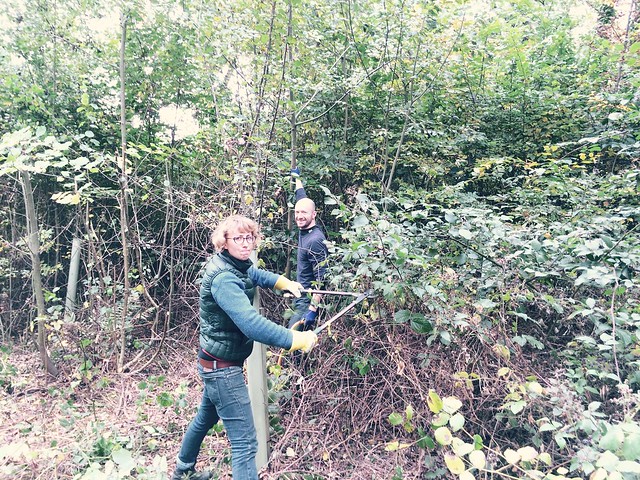
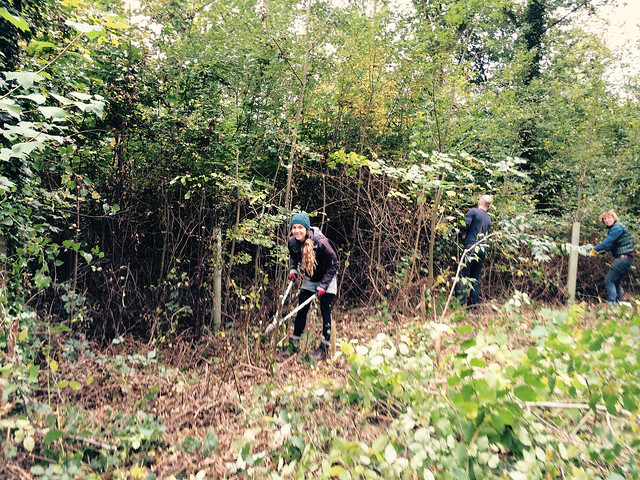
    Cutting back the Brambles at Hazel Hill Woods

    A recent weekend of conservation work Hazel Hill Woods has revealed to me another woodland analogy for the struggles of daily life, and how we might overcome them. I am calling the analogy, Hazel vs. Hornbeam (the Fate of Best-laid plans).

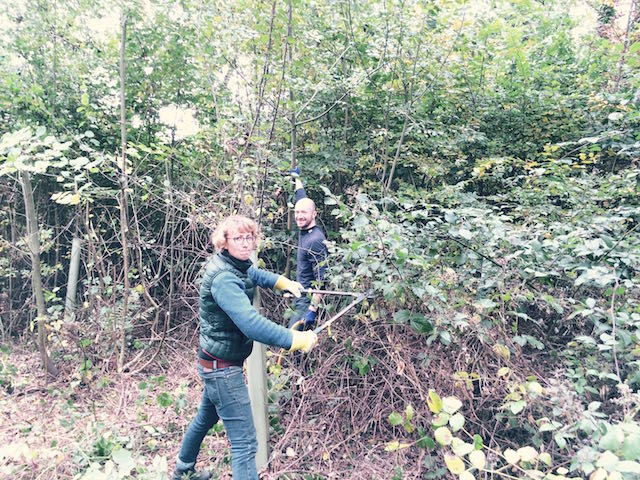
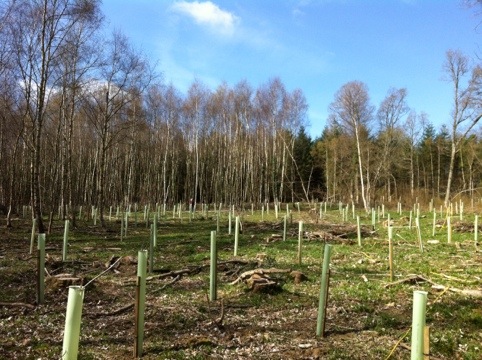
    It emerged when a team of us at the woods were cutting back an area of regenerating hornbeam trees in a clearing. In this patch the hornbeam had shot up to a dense crowd of 6ft-tall finger-thick stems, knitted together with a head-height mat of bramble. Our conservation aim had been to cut these back to chest height to stop them from encroaching on an important butterfly corridor through the woods.

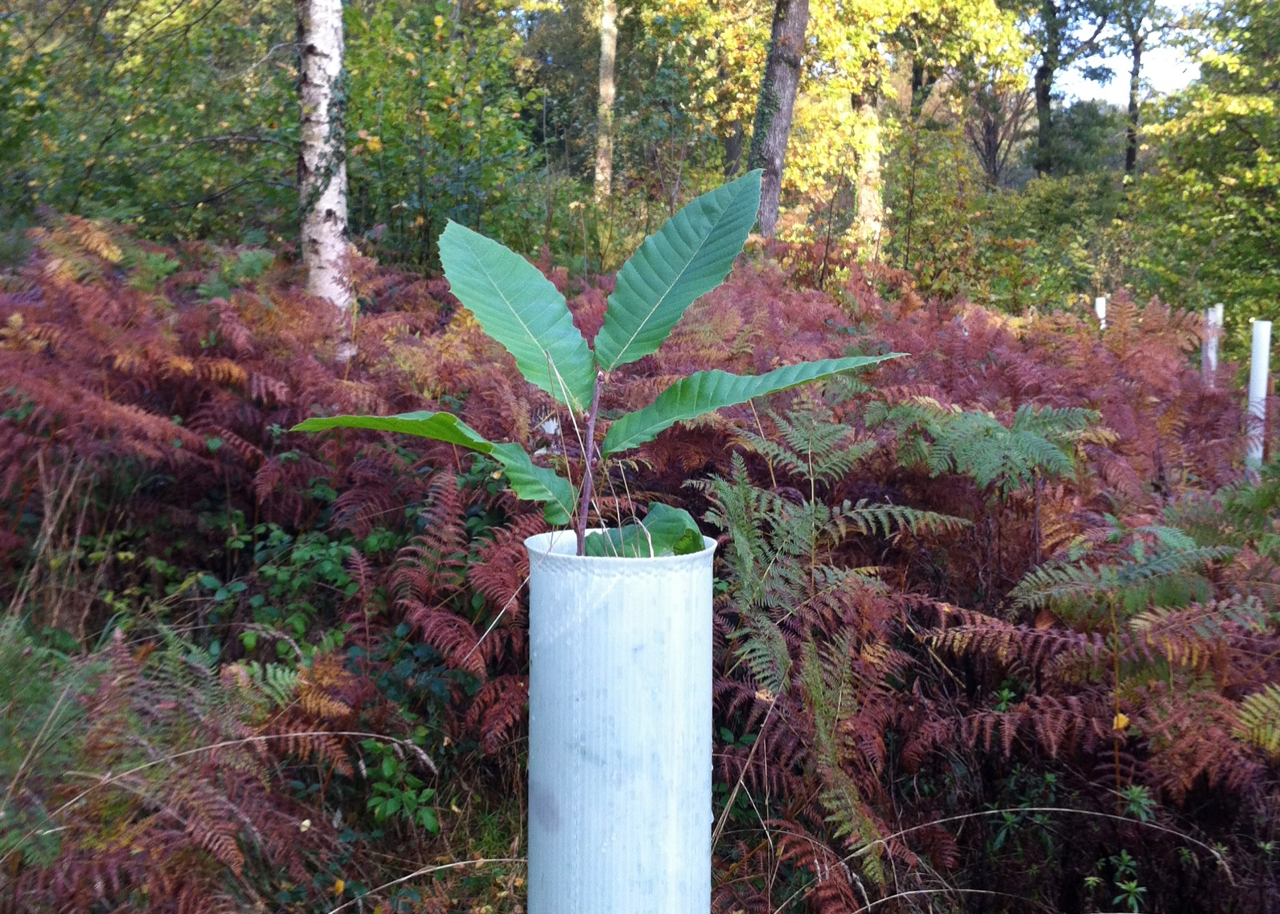
    As we slowly cut our way into the dense thicket we started to discover small trees in protective tubes that were being crowded out by the hornbeam and strangled by the bramble. As we uncovered more hidden trees in tubes, we realised that there was a whole array of them that had once been planted. We found hazel, oak, ash, holy and blackthorn struggling to grow in their protective tubes. They had been planted on another conservation weekend years ago but had been forgotten about, and were now being smothered by the naturally regenerating growth.

    The woodland context

    There is a hundred-year plan at Hazel Hill to transform the forest ecosystem from that of a commercial wood, in which just a few species grow, into a much more biodiverse environment, which is much more likely to be resilient to changes in climate. The area in which we were working had previously been occupied by sycamore trees. This undesirable species had been cleared with a grant from the forestry commission, and in the clearing created, a range of broadleaf species had been planted (the hazel, oak and ash), along with shrubs (the holly and the blackthorn) to create ground-level growth, which had been absent in the commercial forest.

    Left to its own devices however, naturally regenerating hornbeam and bramble had quickly grown up and overtaken the planted trees. The former were on the way to winning, the battle for light, already killing some of the latter , and leaving the others struggling. In the short-run there is nothing wrong with hornbeam and bramble, but their short-term success was putting at risk the long-term resilience of the wood by preventing the development of a diverse tree species.

    Best laid plans

    For me, those broadleaf trees in their little tubes represent best laid plans that were being left unattended because of short-term factors. There are competing conservation priorities in the woods, and these planted trees had been left unattended. Our attention is the light that enables our best-laid plans to flourish. But too often we are forced to direct our attention towards short-term priorities: the deadlines that need to be met, the clothes that need to be folded, the colleagues that need to be briefed, the clients that need to be satisfied.

    In the short-term these more immediate matters flourish as they benefit from our attention, but they don’t necessarily lead us to where we want to be. As you wade into the thicket of regrowth, all is lush and green at the top, benefiting as it does from the light of the forest clearing, but underneath, all is brown – there is no diversity. Down there is where our best-laid plans languish.

    The feeling of being surrounded

    At one point, four of us were working simultaneously and in close proximity in the same thicket. Though we were probably only a few metres apart we couldn’t see each other for all the hornbeam branches and briars that surrounded us. At times, our repeated cuts didn’t seem to be making a difference. I’d turn around and the path that I had driven would have closed in behind me.

    This is what it can be like when we feel overwhelmed with matters competing for our attention. After some struggling, my strategy became to just to keep going in one direction. After a sustained, focused effort the lattice of branches and brambles would suddenly give way. A sense of being surrounded turned into a sense of direction; of liberation: I felt freer, able to pause and choose where to go next.

    Cutting back our brambles

    As I type, I still have some small scratches on my arms from cutting back the brambles. Clearing away some of the things which grab our attention can hurt. There is the pain of letting someone down, or the fear of getting into trouble. But what I noticed as I cut through barbed branches was that they fell away to nothing; untangled and trampled they lost all of their strength, freeing a way through to the trees in tubes.

    Personal conservation strategies

    Conservation work gives you time to think, and so I set my mind to thinking up strategies for protecting our best-laid plans.

    Log what you planted

    It sounds simple, but creating a map of what trees we planted where might help us to remember to tend to them every so often. During conservation weekends in which we are planting trees, getting the trees in the ground is a big achievement. It seems unnecessary to create a map of where we planted them. Surely we won’t forget? Inevitably we do. Simply noting down our plans gives us a fighting chance of remembering what we intended.

    Regular tending

    Once we know what we planted, one strategy is to make time to regularly tend our saplings. It would only take a small amount of systematic attention to keep the hornbeam and brambles in these area in check.

    Occasional clearouts

    Sometimes though, we don’t have the luxury of being able to provide these things with regular attention. The alternative is to do what we did this weekend – every so often, go in there and cut back all the distractions and bathe our best laid plans with the totality of our attention. In daily life this might amount to a digital detox. Or, for a more substantial clear out, we might consider taking what Daniel Pink calls ‘Sagmeisters’ – regular sabbaticals interspersed in our working lives.

    Get real

    Our aim wasn’t to clear out all the hornbeam and bramble. Hornbeam regeneration is a natural part of the woodland ecosystem, as are the brambles that weave their way amongst them. We just need to create a bit of space for those slower-growing but ultimately very beneficial species to establish themselves. Similarly, short-term matters are part of the humdrum of daily life – we just need to carve out enough time to give our long-term plans the attention they deserve.

    Get things established

    Ocourse, the aim of all this cutting back is to enable the hazel, ash, oak, holly and blackthorn to establish themselves. As they start to mature they can look after themselves, and the hornbeam and brambles will subside. This is the point that Steven Covey makes in his book ‘The Seven Habits of Highly Successful People’ when he talks about what happens when we prioritise the important over the urgent. If we make time for the important things, we should see the number of urgent things we need to deal with reduce.


    One day, decades after the scratches on my arms have healed, we’ll be able to sit under the shade of these broadleaf trees and know that our efforts to tend to them were worth it.

  • Are you doing a French Mazurka?

    Are you doing a French Mazurka?

    I’m writing this on the train home from Towersey Festival to which I had been invited by my friends Nat and Sophie to help out with some swing teaching and performing for the Shooting Roots line-up. Towersey was my introduction to folk festivals, and it felt like a gateway to a fascinating world of music and dancing to discover. Nat and I were there to teach a 1 hour Lindy hop class and to do some dancing with a band in the evening (see the gig notes below for info).

    Towersey felt quite unlike any festival I’d been to before, and I think the main difference is the way in which people are engaged with the music and dance that is being performed. The crowds are attentive; they really listened in our lesson; they were really paying attention in the band performances. People are having a great time but there is none of the rowdiness, (except for being kept awake by a choir singing in four part harmony at 1am in the campsite). I love the way people carry around instruments, and there is space for people to jam. There was also the largest selection of real ales I’ve seen at any festival. And what’s more people walk around with their own tankards, which as far as I’m concerned is the best way yet to reducing festival waste.

    (more…)

  • Follow the deer tracks, who knows where they’ll lead

    Follow the deer tracks, who knows where they’ll lead

    Searching for deer tracks at Hazel Hill Wood

    Every time I go to the woods I find new insight or inspiration that I can use in my teaching. Today’s comes from deer tracks.

    I know the main tracks that criss cross Hazel Hill Wood well. I could probably draw a reasonably accurate map of the place from memory. In a sense, I’m a bit sad that as I have got to know the wood better, I don’t get lost there any more.

    But there’s a whole different level on which the wood can be explored, and on which I can lose myself. If you pay attention as you wander down any of the main tracks, you’ll see thin paths going off into the undergrowth. They are easy to miss at first because no sooner than they are off the main path they dive off under low branches. These are in fact deer tracks, and they criss-cross the wood on a different plane – about two feet high. When you start to look for them you’ll spot them everywhere.

    For me these deer tracks are an invitation to go off track, to go into the unknown and see to where you end up.

    I followed such a track this morning and it led me through dark pine trees and then suddenly I was into a patch of widely-spaced silver birch pushing up through a carpet of lush muss. The place had a sort of magical green light. I had been to this place once before but would not have known how to find it.

    To follow deer tracks you have to go off course, you have to pay attention – it’s not the easiest path. The tracks take you via unknown, sometimes-secret places, and bring by new routes to places you already know. And because the journey is different, the destination is not the same.

  • A systems engineering approach to parenting

    A systems engineering approach to parenting

    In 2012, as I was preparing to begin my parental leave, one of my colleagues told me about an engineer he knew in New Zealand who quit their job in order to become a full-time parent. As the story goes, within a few months that engineer had all the household systems optimised freeing up lots of time to play golf. Now, knowing very little about the circumstances of the parent in question, their parenting style or their support network, so I took the story with a pinch of salt, but it did plant the seed of the idea in mind that all those processes and routines that make a household tick can be thought of as a series of systems which can be optimised.

    One of the big changes I’ve noticed in becoming a parent is a shift in mindset from one in which it is possible to complete a task and move on to the next, to one in which you are constantly in the middle of getting lots of things done. The GANTT chart for being a parent would show a series of overlapping tasks that repeat for years at time within a programme time-frame that lasts around twenty. You are always planning the next thing, or two things ahead, at the same time as clearing up the last.

    It is a paradigm shift. You are constantly in operational mode, with very little downtime – tiny variances can cause the system to wobble; winter vomiting bugs can send the plant into meltdown – but you do have some freedom in how you operate that system. And that is what the engineer in me muses on, usually when doing the washing up or hanging out wet nappies. Of course any optimisation process requires a target variable to minimise or maximise. It is tempting to assume, as the anecdote above implies, that target variable should be free time; however I think that fulfilment is a better thing to aim for, because there is plenty in parenting that is enjoyable. The system optimisation should take things that are unenjoyable and either reduce time spent on them, or make them more enjoyable. The system optimisation should also increase time spent on more fulfilling tasks.

    In short becoming a parent replaces unstructured time with routine. The aim is to make that routine as enjoyable as possible for you, and to make it resilient enough so that you can every so often throw it to the wall and go to the seaside for the day. Now before I go any further, I don’t mean to say that our system is fully optimised, although I think we are doing ok! But I do want to chalk up a minor victory today, which has prompted me to write this post.

    Monday is washday

    I noticed a few months back that we were always doing washing. There was always some to wash; some to hang out on the line; some to bring in; some to put away. So, wearing my systems hard hat a few months ago, I decided I would try and crack this nut. Here are the parameters:

    • The volume flow-rate is about five washing machine loads per week, sometimes six depending on the number of nappies we use.
    • The fixed time factor is the wash time, roughly 2 hours per load.
    • Drying time is a variable factor, especially if we put it on the washing line. In the summer washing can be dried in an afternoon, in the winter it can take a few days, or may never dry at all. Then there is the hanging out time, which is enjoyable in the summer, but less so in the winter, in the dark.

    I’m a firm believer in batching things to do them more efficiently, so I decided that my Mondays at home with my daughter would become wash day. The idea was to line up all the loads of washing back-to-back in the washing machine, with no downtime between loads, and then to take the whole lot to the launderette for drying in the winter. In the summer there will be a washing line version of this plan.

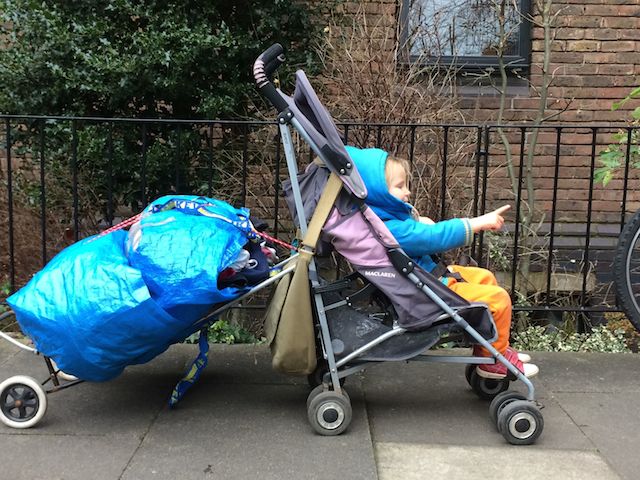
    While the washing bit works fine, the plan throws up a considerable transport challenge: how to get five loads of washing to and from the launderette with a toddler in tow at about 5pm when the clock is ticking before bedtime. I’ve been struggling to overcome this challenge for weeks now, and not for want of trying different approaches:

    • I’ve tried waddling down the road with two laden Ikea bags and a pushchair but the bags are so heavy that this is actually quite painful. A few weeks ago one of the bags split spilling clean washing onto the wet pavement. Sub-optimal.
    • I’ve strapped my daughter into the bike trailer and piled washing up around her, but the capacity is quite limited, so it defeats the object (but she loves being surrounded by warm washing on the way home)
    • Rather than using a push chair, I’ve tried tried to let the little one go by scooter, with me following behind with my laden bags, but the little bean is so slow on her three-wheeled mobile that it took us an age to get there and I had to completely abandon dinner at home and get a pizza next to the launderette.
    • My most extravagant approach: to load all the washing up in the trailer, to attach a separate bike seat to my bike to carry S, and then for us to set off like a mighty laundry tractor trailer down the streets of Highbury. It was fun but it took ages to set up, lock up, unlock, reload and come home.

    Then, the solution emerged in two parts. One of the stressful bits is doing all of this to-ing and fro-ing close to the little one’s bedtime. So now I do all the washing on Sunday night and early Monday morning so that we can take it up around 10am. While it is whirling round and round we go off to a music session in Finsbury Park. When the music’s done, the washing is dry.

    But the real winner came today when I brought an old shopping caddy into my service. I can just about bag up all the washing and fix it to the caddy with bungees. It is then a doddle to push the pushchair with one hand, and tow the trailer with the other.

    So, system improved, which means I’ve got a little more time to spend doing things like writing blog posts.

    Related posts

  • Setting my landfill targets for the year ahead

    Setting my landfill targets for the year ahead

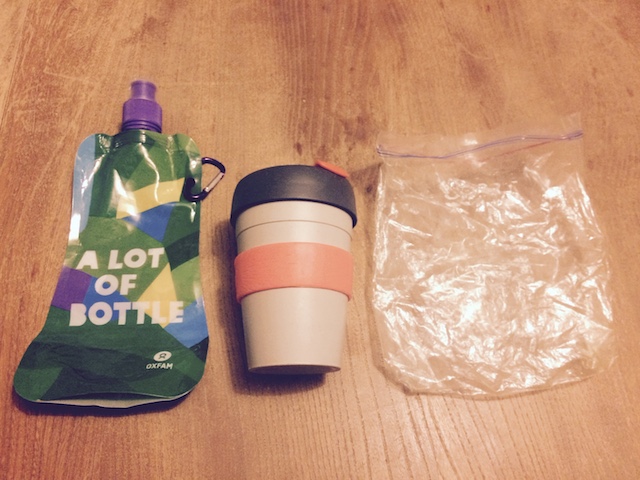
    By carrying these three items with me a save loads of waste. The water bottle and coffee cup should be obvious. The plastic bag is for food waste which is hard to get rid of on the go. This way I can bring it home and feed it to the worms.
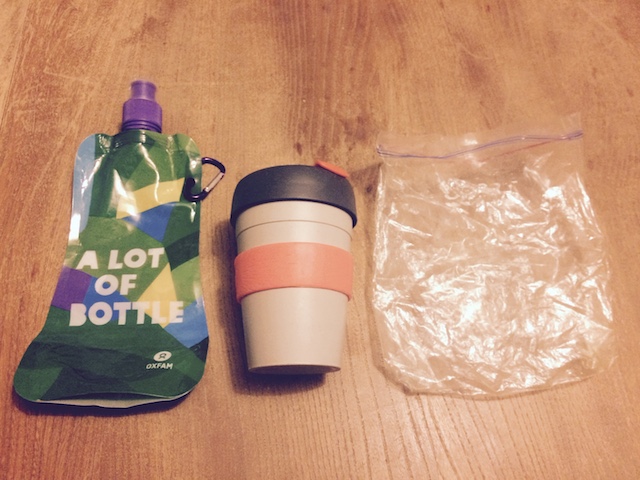
    By carrying these three items with me a save loads of waste. The water bottle and coffee cup should be obvious. The plastic bag is for food waste which is hard to get rid of on the go. This way I can bring it home and feed it to the worms.

    My New Year’s resolution for 2015 is to reduce my waste to landfill. I realised as soon as I came up with this resolution that I didn’t really know what I meant by reduce because I had no idea how much waste I produce in the first place. So I have been spending January measuring and observing, and now I can set myself some targets. But before I do, here are some my ‘rubbish observations’.

    – You can’t observe something without changing it. And so the mere act of being mindful of the waste that I generate is making me alter my behaviour, so my benchmark is already likely to be at a lower level than say my typical waste production was last year.

    – I realised very quickly that I produce far more waste than what goes in my kitchen bin. The waste that I produce at home is relatively small compared to what I generate consuming food and drink at work, particularly on work trips. Even if those bits of food packaging are recyclable, that only happens if you actually recycle them, which is not always easy to do. At home, it is much easier to make sure that the materials are reused, or correctly recycled. From an ecological perspective, this makes sense: the more removed we are from our local ecosystems (as we are when on a work trip) the more waste we generate.

    – somebody once asked my hairdresser if she could keep the hair that was cut from her head (the hair is usually thrown in the bin). Apparently hair cuttings are good for spreading around roses in the garden.

    – What’s in and what’s out? I realise I need to determine the edges of this problem. Obviously, waste is produced at every stage in the production of most things we consume. What I want to focus on is the waste that I directly generate, be that at home, or at work. Nevertheless I am sure that in the process embodied waste will be something I at least think about.

    – If you are prepared, you can easily reduce the amount of waste you generate on the road. Three things I now carry with me have almost entirely irradiated the waste I generate while on work trips: a reusable coffee cup (I have a KeepCup. A cool design and has the right balance of keeping your hands warm and your coffee warm); a collapsable reusable water bottle; and a plastic bag for putting food waste and other things that I can deal with when I get home.

    – Funny numbers. Those numbers that tell you what a plastic is are actually called ‘Resin Identification Numbers’ – and I almost have them committed to heart.

    – Does any of my waste go to landfill in any case? Looking into this a little (and I need to delve much deeper), my waste collected from home is taken to an incinerator where, once valuable elements are removed the waste stream, it is burnt and energy is recovered from the heat. That said this shouldn’t deter me, as this approach surely must be the last option once all other reduction and reuse options have been considered. Nevertheless I want to find out more – and I am hoping that finding out more will involve a visit to an incinerator.

    – This exercise is already informing my shopping choices. I have ordered different food for a large meeting at work in order to reduce the packaging waste generated, and I brought home the waste from the meeting where I would have more time to sort the waste properly!

    – That portion of chips and pitta I had on New Year’s Eve is probably the last of those I will be having this year unless I can think of something else to transport it in -though surely the pitta is a good enough vessel without the need for a polystyrene box.

    – And finally, as the following numbers reveal, may landfill isn’t my biggest challenge, because, if you forget about the nappies, the weight of recycling I produce is X times more than the amount of waste for landfill I produce. Don’t get me wrong, I am all for recycling, but I could try to do a bit more reducing and reusing before resorting to the recycling bucket. Maybe that is something I should address later in the year.

    The numbers

    I weighed the waste that went into our three bins: kitchen, bathroom and garden. Since each waste stream is distinct, I kept them separate as I want to set a separate target for each. The kitchen waste is mainly packaging and wet waste that can’t be fed to our wormery or put in the compost. The main contents of the bathroom bin is the night-time disposable nappies that we use for our daughter (she is in washables during the day at home). The garden waste bin is mainly for packaging of stuff we buy for outside.

    • Kitchen – 1kg/month
    • Bathroom – 13.9kg/month
    • Garden – 0.25kg/month

    Based on these numbers, clearly the single biggest difference I can make to our waste stream is to potty train our daughter, which is something we are doing. I should add in defence of this number that for most of her life she has been in washable nappies, and this weight is a fraction of what it would be were we using disposables all the time. Having looked at the kitchen waste stream, I feel this is something that could be reduced mainly by being more careful about what we buy. The garden waste stream is hard to say much about because it is winter, and we are not doing much out there.

    And so, on the basis of what I have observed this month, I am setting myself the target of generating less than 1/2kg of waste/month. This includes all the waste we generate as a household, except the nappies, which fingers crossed, we are going to be able to phase out in the next few months altogether. It also includes all the waste that I generate through my day-to-day activities at work and when on holiday.

    I’ll let you know in a month’s time how I am getting on!

  • 2015 New Year’s Resolution – Zero waste, or as close to

    2015 New Year’s Resolution – Zero waste, or as close to

    Pedal-powered washing machine*
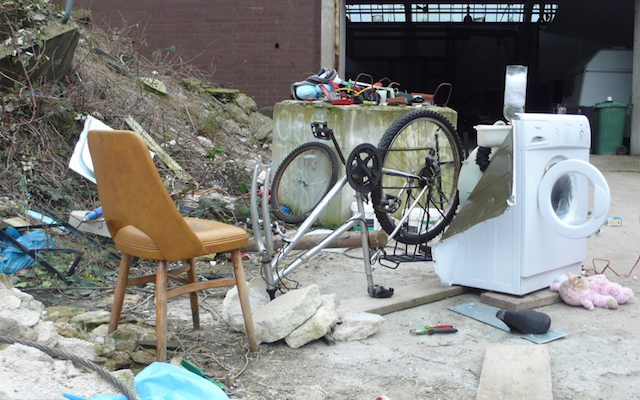
    Pedal-powered washing machine – created as part of a TV demo I took part in which we tried imagine making machines from waste in post-apocalyptic Britain

    My New Year’s resolution for 2015 is it to try and send as little waste to landfill as possible. (Read my end of January update). The idea popped into my mind a few weeks ago, and since then I have been thinking of more and more reasons why I should give this a go.

    1. Waste is such a waste – I look at piles of waste, big or small – in bins, on building sites, in front gardens – I think, wow, what a waste! It seems crazy to me that given everything we can do with modern technology we still live in such a throw-away way.
    2. I like a challenge
    3. I have actually given versions of this challenge a go, but usually only for a week, and not since starting a family, so it is time to revisit.
    4. Recycling is great, and there’s more of it around, but what about the stuff that can’t be recycled? Is it ok to to buy something knowing it’s going to landfill? I want to experiment with having to adopt ‘no’ as the answer to that question. What does it mean I can’t buy or do?
    5. I think this is something lots of people will have a view on, and I am interested to hear what they have to say.
    6. It’s a great chance to find out what’s in stuff, how things are made.
    7. Finding ingenious uses for things I don’t want to throw away.
    8. Experimenting with keystone habits – I read about ‘keystone habits’ in the book ‘the Power Habit’ and I don’t know it is a common term, but basically the idea that if people develop certain habits, then other habits follow suit. I’d be interested to see what other habits the habit of reducing waste develops.
    9. Hopefully out of all of this I can develop practical ways to reduce my waste which might be useful to other people (this reason is inspired by ‘Walden’, one of my best reads of 2014, in which one of the key themes is finding ways to develop a ‘practical philosophy for life’, which I really like).
    10. To challenge the status quo.
    11. Personal supply chain management – I put this in because I have recently been running training for corporations on sustainable supply chain management, and one of the key ideas in the training is to encourage buyers to talk to sellers about ways to reduce waste in production. Perhaps by engaging with the people I buy stuff from I can find ways to reduce waste in my ‘supply chain’.
    12. It is a chance to assess how compatible low-impact living is with working four-days-a-week and looking after a child. Is zero waste a full time job?

    So there are the reasons. Achieving the aim is going to take some time. For starters, ‘as little waste as possible’ to landfill is not really an aim, so January is going to be a benchmarking month on the basis of which I hope to be able to set myself a reasonable target. I also need to think a bit more time to think about the parameters. Measuring kitchen waste is one thing, but what about all the waste I produce out and about, or doing my job. Hopefully come then end of January, I will have some answers.

    I am looking for co-travellers on this journey, either to join me on the challenge, or just to ask me how’s it going every so often. If either appeal, I look forward to hearing from you.


  • Seedling analogy for organisational change

    Seedling analogy for organisational change

    A couple of time in the last year or so I have used what I call the ‘seedling analogy’ to explain what I believe to be is a sustainable approach to organisational change. My inspiration came during a conservation weekend that I was involved with at Hazel Hill Wood several years ago (see my post about that weekend here).

    One of the main aims of the conservation activities at the wood is to reintroduce  hardwood trees. Hardwoods were common here before the site was cleared for commercial forestry. For many years, conversation groups had been spending weekends planting new trees. But only a small number took root and flourished. However, on the weekend in quesiton, the conservation team were trying a new approach. Rather than planting new trees, they were looking for places where the seedlings of the desired species had already sprung up from the floor. Having found the seedlings, they protected them from browsing deer by putting a tube around them.

    (more…)

  • 5 months of paternity leave – the highlights

    5 months of paternity leave – the highlights

    Since April, through a mixture of parental leave and part-time working, I’ve been the primary carer for our daughter. Tomorrow I resume (almost) full time office work so I thought I’d take a moment to write down some of the highlights of being a full-time stay-at-home Dad.

    1. Getting to spend extended periods of time in the company of my daughter, getting to know her, her getting to know me, and creating the kind of bond that could never have formed had I stayed behind my desk.
    2. Confidence – before I went on parental leave, I would need a list of instructions just to look after the little one for the afternoon. Five months of responding to a baby’s needs is a great confidence builder – and teaches you to improvise.
    3. Cooking – I’ve been doing lots of cooking – sometimes four meals a day. – and its been really enjoyable. I have tried my hand at loads of new dishes, but perhaps more importantly I have a few tricks up my sleeve for when there’s a tired hungry baby at the table and the cupboards are all but bare.
    4. Time outside – weather-wise I couldn’t have chosen a better five months to be on parental leave. Our baby seems to thrive on being outside, so I’ve been making the most of the opportunity to get outdoors. In the early days she’d only nap in a buggy on the move – never in her cot – so I’d walk some times ten kilometres in a day interspersing naps with playgrounds we’d find along the way. More recently things flipped, and she’d only sleep at home, but that just means we spend more time in local parks. The thought of spending winter indoors is daunting.
    5. Getting to know local people and the neighbourhood. Like it or not (for some people this is a surprise): having a baby immediately connects you to your neighbourhood and the people in it. I like it – I can’t walk out the door anymore without recognising a parent out and about. The funny thing about taking over as primary carer is that lots of people already knew our baby but had no idea who I was – luckily the little bean does introductions (see below).
    6. Seeing the world through a different set of eyes – this is quite a parenting cliché so I’ll just illustrate one small example of it. Our baby waves at complete strangers. She smiles at them and elicits a response. Before I know it, strangers are waving back, and I end up talking to people I never would have otherwise. For her there are no social barriers. People are just people, and they are all fair game for a wave and a smile – even if they are combat-ready paratroopers holding enormous machine guns doing security patrols of French train stations.
    7. Witnessing step-by-step developmental changes – it is amazing to have watched our little one become less little. The change over five months – from a sitting grunting baby to an all-waving furniture-surfing toddler with an ever-growing repertoire of gestures to communicate what she wants – has happened through so many increments. A highlight of these last few months has been being able to watch so many of these little changes happen.
    8. Time to think – all that walking around parks, hanging out washing and long lunchtimes have given me plenty of time to think – valuable time that I wouldn’t have had behind my desk.
    9. Time out from my office job – having had lots of time to think, I return to my office job with new ideas and ambitions.

    Of course there have been low points. There have been some afternoons when I have looked at the clock at 2pm and wondered how I’m ever going to get to bedtime. Norro virus was the nadir. But you get through. Overall though, these last five months of parental leave have been fantastically rewarding.

    I am delighted to see more parents sharing the parental leave. I now ask prospective Dads not if they are taking parental leave but rather how much. The question still comes as a surprise to some, but I hope that one day, shared parenting is the norm.

  • Day 3 at the RDI Summer School 2013

    Day 3 at the RDI Summer School 2013

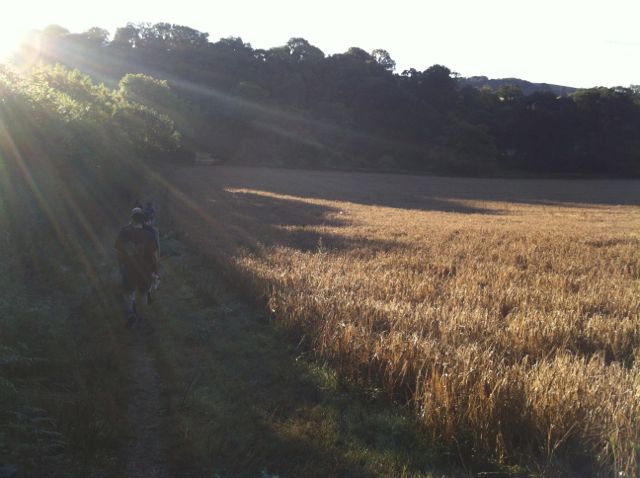
    Sun shining across corn field
    Off for an early morning swim in the Dart

    7am: ten of us met for an early morning swim in the Dart. The water was so cold it began to burn, but the sensation was incredible. Whether they had been swimming or not, by impression from the people I interviewed that morning was that everyone felt refreshed – charged with renewed energy.

    The instructions were to continue the journey begun yesterday. Unlike the day before, there seemed to be a greater feeling of coalescence in each of the working groups. Perhaps a trust was forming; people began to be quite secretive. I decided it would be difficult to learn about what was going on by skipping from group to group so I joined one.

    Stratocumulus Dartington Park
    Stratocumulus over the tilting field at Dartington

    For several hours, we walked and explored the gardens. The brief remained wide open. Ideas emerged and disappeared just as quickly – but without judgement. We found our way to High Cross House, and it was there that, like the fleck of dust that is needed to begin the crystallisation of a solute from solution, something stuck around which ideas started to emerge. We wanted to create something that responded to the landscape – a giant puppet or mobile suspended from one side of the tilting yard to the other. We needed a rope, but all the rope had been taken by other groups.

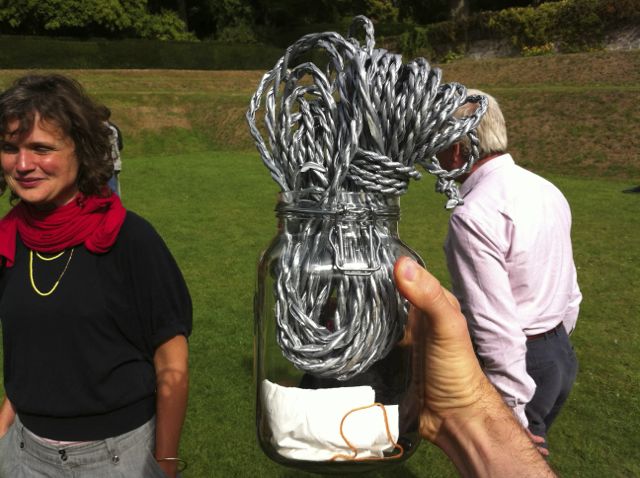
    We decided to create our own rope from the only remaining material in the stores, gaffer tape. Then began wonderful process of collaboration and learning as we crafted our own 25m-long rope by spinning the tape around itself. Engaged in this physical task our spirits were soaring. The storm clouds that had been threatening all weekend finally broke, but we stayed out in the rain, spinning our rope.

    Gaffer tape rope
    A rope hand-woven from gaffer tape

    When the rain stopped we tested our idea – to explore emotion by creating a giant tug-o-war spanning the great valley of the tilting field. It didn’t work – the rope failed under the stress of two people pulling – but it drove us to something better: to create a giant skipping rope. The next hour was brimful with joy as we leaped in and out of the skipping rope. We showed each other how to do it, we created games – we played. We returned to dinner with spring in our step aware that we had touched upon something profound, perhaps the satisfaction of craft…the beauty in simplicity…the joy in play.

    Later we returned to the wish sculpture begun on the day two. Here is what Co-Director Chris Wise had to say about he happened.

    Related posts

    External links

  • Notes from Day Two of the RSA RDI Summer School – sort of

    Notes from Day Two of the RSA RDI Summer School – sort of

    Cumulonimbus at Dartington Hall
    Storm clouds brewing at RDI Summer School

    My aim for this reportage has been to tell a live story from the Summer School. This is tricky to do because, as I said in my first day post, part of the appeal – and perhaps the impact – of the Summer School is that the participants know so little about what is going to happen. Summer School co-director Chris Wise told me that this mystery intends to put participants on a level playing field without preparation, preconception or prejudice. I understand the importance of what he is saying, but this leaves me, as a storyteller, little story to tell other than descriptions of historic buildings and landscape gardening. I have decided therefore to use the hindsight of what actually happened to help judge what I can include in my reportage of this Summer School without jeopardising the experience for future participants. So, if you are sitting comfortably…

    Dartington Hall is a fantastic place to hold the summer school. The ancient rooms inside and the cascading garden outside, with its wide open spaces and nooks and crannies provide endless spaces for people to stop, think, explore, assemble and create.

    We gathered in one of these rooms for our first activity of the day. Having all been asked to bring a small object that represented a precious wish, we suspended our wishes from tiny threads within a giant cube structure. Our wishes floating before us (check potter Billy Lloyd’s wish here, and more pics here), we were then instructed to ask others about what they had brought, and if we felt some connection to that person’s wish, to connect our two wishes together with more string. Gradually forty-eight individuals and their wishes – many very profound and personal – became interlinked and co-supported in a fine matrix – a beautiful manifestation of the webs that were already starting to spin around and between us.

    Assembled around this wish sculpture we listened to a compilation of interviews from Mike Dempsey’s RDInsights podcasts. As the collection included excerpts from interviews with many of the RDIs present, it allowed something quite personal to be revealed about these designers without anyone having to speak a word. For me this process of opening up began here, and became an important part of our stay at Dartington.

    At eleven, the Co-Directors of the Summer School briefed the participants on what was to become the main activity of the Summer School. The participants were instructed to carry out a sequence of tasks, the means and mechanics of which I won’t go into, designed to set us off on a journey exploring human emotion. The journey would end on the last day of the Summer School when everyone would report back to say what they had found.

    While the Directors’ briefing focused on the mechanics of the exercise, they were ambiguous about their expectations. With hindsight, this ambiguity set up an important tension that would eventually propel each of the groups to go far on their journeys of exploration. I witnessed this growing tension while I moved from group to group, interviewing participants along the way. Initially, everyone participated in good faith, but over a few hours unease grew. Two camps emerged. Some participated in the exercises placing their full faith in the mysterious programme that would somehow guide them to some sort of epiphany. Others found the exercises opaque and a barrier to meaningful discussion.

    Then over dinner something snapped. The Directors stood up and effectively told everyone to stop being so polite and to take responsibility for themselves. It felt like a dressing down, but it was enough to suddenly propel everyone forwards. I think that for those who had been following instructions it was a shock: the instructions were no-longer trustworthy; the only people they could trust were themselves. And I think for those that had felt shackled, they were suddenly released. I may be wrong about those last two sentences, but I am certain by the end of day two a threshold had been crossed.

    Related posts

    External links

  • RDI Summer School – Day One

    RDI Summer School – Day One

    First encounters at the RDI Summer School
    First encounters at the RDI Summer School

    What is remarkable about the RDI Summer School is how so many people applied on the basis on personal recommendation, and yet how little any of the attendees know about what they are going to happen or who they are going to meet. There is a shroud of secrecy around the event that none of the previous attendees want to unveil – as clear an indicator as possible that this event is about the journey and not the destination. The journey began at 7:30am where a mixture of RDIs, young designers and ‘wild cards’ boarded the magical mystery coach. The RDIs are senior designers who have been awarded the title of Royal Designers for Industry in honour of achieving sustained design excellence, aesthetic value, and significant benefit to society. The RDIs are here to inspire, guide and inform the young designers, the largest constituency here – tactfully named to suggest people less advanced in career and age than the RDIs. The wildcards are professionals who are not designers and generally do not work with designers per se but may be touched by design, either as civil servants, commissioners, etc. They too can inspire and guide the young designers, but for this latter group it is also a chance to learn about how to build better collaborations with designers.

    As the charabanc advanced westwards, curious conversation began to unfold between clusters on the bus. People began to discover who their co-travellers are. Somewhere outside Bristol the bus disgorged its contents into a service station. All of a sudden some the UK’s leading designers – architects, potters, stage designers, engineers – were all in the queue at the tiny coffee stand. It was like some 21st century recreation of the 19th century coffee shop encounters of Josiah Wedgwood, James Watt, James Bolton and Erasmus Darwin. By mid-afternnon we arrived in the glorious ground of Dartington Hall. We disembarked, ate and went straight into our first activity. Blackberries, iPhones and laptops were thrown aside, space was created, contact was made, and connections began to form.

    My job on board this journey is to tell a story that it seems must remain secret. From four hours of moving from seat to seat on the coach, I am getting a clearer idea who the characters are and what their backstory is. This is a gang of people who all do useful stuff, and to do that well, they seek in one form or another, a creative recharge. I look forward to witnessing that.

    Related posts

    External links

  • Off to the RDI Summer School

    For the next few days, I will be down at the RDI Summer School. Over four days and three nights, the School inspires, challenges, and provokes designers and those who use design, sharing experiences and searching for insight. For the participants, the Summer School is a journey, and my job is to capture that journey in a series of short videos and blog posts.

    Contrary to current trends in event organisation, there will be no official live blogging or tweeting from the site. The organisers feel that clarity of thought at the school (maintained by minimising distraction from the outside world) is more important than any minute-by-minute account of the event, and I completely agree. The odd tweet that does spin out may use the hashtag #RSARDIsummerschool. So, watch this space, but don’t hold your breath.

    It promises to be a fantastic few days!

  • The difference between what you plan and what actually happens

    The difference between what you plan and what actually happens

    Photo of students taking to facilitator at the Big Rig
    Students speak to a facilitator at the Winter Warmer Big Rig

    I spend a lot of time at Think Up working on the design of high-impact construction training events (for examples: Constructionarium, Big Rig, Build Camp and Nuclear Island 1 & 2). What I find curious is that some things that feature strongly in the event design process never materialise on the ground; and some things that were never planned turn out to be the event highlights. Here are some of my thoughts, written on the way home from the pilot of one of our recent events, on why some things that are planned don’t actually happen, and why some of the best moments are completely unplanned.

    1. Vision – you have to have a powerful vision for the event should look and feel. This gives you a yardstick against which to can measure your own decisions, and is also essential for motivating and guiding the many other people you’ll need to work with. Where the vision gets lost, the components of the event that make it special tend to get lost as well.
    2. Confidence of the design team and the delivery team. My father’s words ring loud here, ‘a thing is only difficult if you can’t do it’. One of the factors in making our events high-impact is that they are unusual. The consequence is that the designers are often working with unfamiliar domains or approaches; the same is true for delivery partners. The low confidence that follows can lead to design decisions that chip away at the vision. The easy way to get a shot of confidence is to bring the necessary expertise into the team.
    3. Bolt-ons that fall off. I find that elements added to an event late in the design process are the first to fall away. They just don’t have the staying power.
    4. A delivery partner with a can-do attitude is invaluable. They help to breach the confidence gap (see point 2) and bring creative ideas into the design process.
    5. Sort the tech. There is nothing more tedious than faulty tech. As more and more of the events that I am involved with use a tech component, faulty tech is an increasingly important factor in why events don’t go to plan.
    6. Get the ground ready before you start. Once the event has begun, all attention is on facilitation, and the chances of completing unfinished preparatory tasks are almost nil.
    7. Serendipity, the secret member of the design team. You can’t plan for everything. A better approach is to be ready to turn issues into learning opportunities as they crop up.
    8. It’s happening under your nose. I’ve stated the importance of vision in creating a high-impact event, but for some the most valuable learning outcome may not what you planned it to be. Being to fixated on your own vision may blind you from seeing other people’s lightbulb moments.
    9. It takes concentration There’s always lots to think about when planning and running a learning event. In my experience, how well the event goes to plan is significantly impacted by the levels of confidence of the lead facilitator. Things don’t grind to a halt if you don’t concentrate, but corners start to get cut, participants revert to more traditional behaviours, and the vision is weakened.
    10. The effect of event entropy – I think there is a connection between the tendency for a high-impact event to lose quality over several repetitions, and the second law of thermodynamics, that a system will always tend towards greater disorder. It is as if the event vision is some sort of ordering process. Over time, the vision is eroded, the quality is lost. Increasing the order in a system requires energy. Maintaining the vision requires injection of energy – of another sort – and it is easy to forget that.
  • Diary – Feral/Flora and Forna/Hook, Line and Singer

    [pe2-image src=”http://lh5.ggpht.com/-MY6w8huA6Ic/UchQA4uxxhI/AAAAAAAAAbU/Fi8B9PgfMl8/s144-c-o/13%252520-%2525201.jpg” href=”https://picasaweb.google.com/101339256689884186918/62413?authkey=Gv1sRgCN3nl-Dng7iRGw#5893048088573101586″ caption=”Gillespie Park” type=”image” alt=”13 – 1″ ]

    I’m now several chapters into George Monbiot’s book Feral, and I’m enjoining it immensely. It is already making me think differently about the ways in which I choose to engage with my surrounding environment. It also makes me realise my vocabulary of flora and fauna is really very limited – it hardly seems to extend further than the words in the picture books I read our daughter (and many of those animals aren’t native to South East England!) This ignorance worries me: if I don’t have the words, then how can I have the ideas?

    Inspired, I took a walk down to wonderful Gillespie Park, and wandered round the meadow. The info panel told me I’d find wild lupins, which I did – not a new word, br a moment’s appreciation of a plant I’d never stopped to see growing in that space.

    I’ve written previously about participating in conservation weekends at Hazel Hill wood. This week the opportunity has arisen to be involved with helping to shape the educational programme at the wood. It is a place I greatly enjoy visiting, and so I look forward to the chance of getting more involved.

    This afternoon we sang two engineering themed songs from Cerys Matthews’s book, Hook, Line and Singer: London Bridge is Falling Down; and The Runaway Train. This week I’ve been listening to Britten arrangements of folk songs, and an idea for a new engineering song, based on one of these tunes, is buzzing round my head – a cross between Boris Vian’s ‘La Java des Bombes Atomiques‘ and the ‘Emperor’s New Clothes’. Watch this space.

  • Diary of a contact day

    During my parental leave I am doing one ‘keeping in touch’ day a week. On that day, I deal with important queries on Think Up projects. Since my time in the office is very short, these keeping in touch days are an intense snap shot of lots of the stuff we are working on at the moment. Here are some highlights:

    • I was asked to put together a proposal for using web technology to help engineering students raise their levels of background engineering knowledge. Think Codeacademy meets Top Trumps, available through Workshed. I am particularly excited about this project because it will complement the work I will be doing at UCL as part of their teaching innovation scheme.
    • Today we finalised the detailed content of the Nuclear Island Big Rig. All the places on the event have now been allocated. We have been working on this project for over a year – it is fantastic to think that it kicks off on 1st July.
    • Following on from the sustainability teaching seminars that Think Up has been facilitating this year, I have been invited to speak at the Engineering Education for Sustainable Development conference in September.
    • We are gearing up to facilitate the next Imperial/Expedition Constructionarium week.
    • The lovely-sounding people at the Litmus Test got in touch to see if I would be the first engineer to perform at their show – I’d be happy to.

    I’ve heard that becoming a parent makes you more productive in the office. So far, keeping in touch days prove this to be true.


  • An end to ‘nailing the start but messing up the finish’

    I find that when I am memorising any sort of sequence – song lyrics, dance moves, lines for a presentation – I usually over rehearse the beginning and spend hardly any time on the end. (more…)

  • Notes from Hazel Hill/Slow Learning for teaching sustainability

    Notes from Hazel Hill/Slow Learning for teaching sustainability

    I recently returned from a conservation weekend at Hazel Hill wood, the sixth such weekend in which I have participated, and a visit that prompted some more thoughts on ways we can teach sustainability in universities.

    20120401-154142.jpg
    (more…)

  • Ideas on the theme of ‘fun-for-free’

    Hold your own mini-Olympics

    We did this last weekend down at my grandmother’s house. We had had plans to go to the local river where there is a lovely beach but the grey skies put paid to that. Then from somewhere the idea sprung to mind of the five of us staying in and holding a track-and-field tournament.

    We assembled the props: a parasol stand for a javelin; a boule for a shot put; an old plate for the discus; some beach bats for tennis; a rope between two trees for volleyball; and fruit packing cases for the dressage. My grandmother was the judge.

    Poles were thrown; shots were put; a plate was smashed; points were won; tempers were lost – and found again with administration of tea; and medals were presented.

    Next up – our own winter Olympics?

    (The discus that got away – two others were not so lucky)

    Learn to tight-rope walk

    With a few props, practicing circus skills seems like something you can do pretty much anywhere. Here the prop was the rope that we had used for the volleyball net in our mini-Olympics. Pulled tight between two trees at about two feet off the ground, it was hardly death-defying, especially when, under my own weight, the rope stretched, lowering me to ground-level. I fear a lot more practice (using stiffer rope) will be required before I become a funambuliste.

  • “The late worm avoids the bird” and other stories…

    I have my cousin Ralph (of Stringfever fame – see link to the left, under music) to thank for that piece of advice, which makes me laugh each time I think of it. Were I a worm, I would quite likely have been eaten by birds of prey at the market this morning. I was there before eight so that I could get some shopping in before breakfast (this is the sort of behaviour that my Marston Street house mates might associate with me when I was sitting finals). It was such a beautiful morning and, well, I like the market. It’s better however, when all the sellers are actually at their stalls rather than in the café. The bio-lady (who has not been treated with any chemical fertilizers) had evidently nipped off for one, and the lady who sells bags of chicory and apples ideal for juicing, opposite, probably went with her. In that spot, the only person left was a man selling bras, who sheepishly refused to take any money on behalf of his neighbour for a bag of her produce.

    And now from before breakfast time, to lunchtime, which is an event here at work. At noon, people start milling around the office talking about going down to the canteen (a quick survey of the people in my team confirms rather unscientifically what I have been told, that people here for breakfast have a coffee and a dried biscuity thing at most, so they must be starving by noon). A big group made up of anyone from the director to the draghtsmen (though interestingly not the secretaries) go down in the lift to the underbelly of the building that is the canteen. This vast underground space has a buffet down one side then rows upon rows of tables and benches. The food is very good if you are into meat, and while not cheap, it is still subsidised by the company. And then everyone eats together. Slowly. Several courses are taken, even if one might only consist of an apple or yoghurt. Only when everyone on the table has had their final spoon of Yoplait does anyone get up. The trays go off on the conveyor belt where they get taken to invisible people who magically clear them and make them nice for the next engineer. En masse, we leave one windowless room for another, this time with a coffee counter at one end. Espressos are gulped down at breathtaking speed. Quick as a flash we are back up in the elevators and at our desks without ever having the inconvenience of seeing sunlight or talking to anyone who doesn’t have a diploma from Les Ponts (insert other grand ecole name here if you like). That’s efficiency for you.

    Speaking of efficiency, two separate personnel departments are now in a race to see who can get me a social security number first. I still have not been paid for my teaching work at the University of Marne la Vallée. I am sure I mentioned this at the time, but just to recap, the university wouldn’t give me a contract without a social security number, and the social security wouldn’t give me a number without a contract. Someone had to give in, and rightly so it was the university. That was back in November. Now in March and my new job, I need a social security number so that I can get paid at work. Here, they gave me a contract straightaway and are now applying for the number. Given that the university are still faffing around, it looks likely that my new job will get me the number and that I will then give that number to my old employees who should then be able to pay me. That’s inefficiency for you. And before anyone thinks I am having a go at French bureaucracy, I am not. It’s just the university being rubbish.