Some things we notice because we are looking for them. I have lost my keys; I look around the house, my brain is scanning for the keys; I spot the keys. But in that search what I fail to notice is that the pot plant above my desk hasn’t been watered for weeks and is about to die.
Then there’s another kind of noticing, an awareness that isn’t driven by a specific task. It’s a more open awareness, in which we we may be able to see things that we were not necessarily looking for.
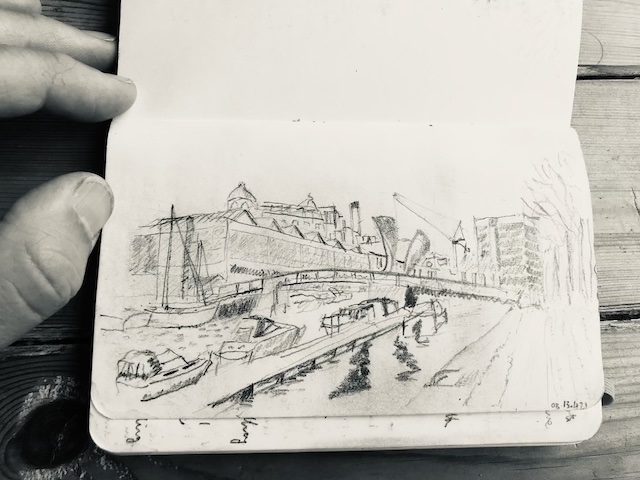
For me, the starting point in design is observation. And not just the laser-focused, looking-for-a-thing type of observation, but a more open, breathing-in-of-the-situation kind. What does a place feel like? What is the energy of a group of people? What am I drawn towards or away from?
Our brains are incredible at spotting patterns, but only when we let them. Hyper-focused attention, while useful, often comes at the cost of perceiving the bigger picture.
For many in the built-environment sector, work is a hyper-focused, task-orientated space. Deadlines don’t leave mush space for stepping back. But taking a break from work gives us the opportunity to look up and have a more general awareness.
If you have holidays coming up, then I invite you to simply notice what you notice when you aren’t looking for anything in particular. What you see might reveal be the wider patterns of place, of community, of life that we aim to serve in our work as engineers (and other humans).
Imagine a system of design team communication that supplies the right level of information and enables the appropriate level of understanding within a suitable timeframe. A way of communicating with our work colleagues that is effective. A process that doesn’t overwhelm us.
With the digital and analogue tools at our disposal, such a way of communicating is entirely possible. But it takes time to propose, implement, and improve.
As Cal Newport argues in World Without Email, what usually happens is we don’t make time for this work, and so we revert to the lowest common denominator – in the case of his book, it’s email. However, I think that the lowest common denominator of communication, email has been surpassed by WhatsApp.
Now, WhatsApp works so well because of its ubiquity – setting up a shared channel is quick, and communication can start almost immediately. But by my counts for successful design team communication, it falls short because:
The quality and quantity of information shared vary wildly.
There is no checking of understanding (the blue ticks just confirm receipt).
Information can arrive at any time (including in the middle of the night or at the weekend).
There is rarely any protocol agreed about how the information should be shared, organised, and responded to.
Messages come in a stream along with updates from a dozen other projects – not to mention the four other corners of your life. And as it is vastly easier to send group messages than to read them all, we have a recipe for information overwhelm.
At the start of a project, the quick answer to the question of how to communicate is to set up a WhatsApp channel.
However, probably the more effective answer is to spend time thinking about and testing a good process for communicating – in other words, designing your design team’s communication.
If, as a result of that design process, you discover specific cases when a team WhatsApp is a good answer (see my post tomorrow), that answer should be the result of a design process, rather than the default.
I am a connoisseur of email-reduction strategies, so I share this for friends and colleagues of mine who I know are struggling with this at the moment. The best way of dealing with having too many emails is never ‘answer all the emails’. Email overload is a systems problem. It manifests itself as an overflowing inbox but it is rooted in the way the system is set up. Answer all the emails and new ones will appear. We have to fix the system.
I will start by saying that I still have too many emails. But I don’t feel bad about it because I am trying to work on the system. And some of my system changes have been helpful and I can see are working. This post is not supposed to be a definitive guide but a few things to get you started.
Deleting apps and leaving your phone at home could be analogous to dismantling urban highways.
I read earlier this week about the research that established a direct link between building more roads and the level of traffic in a system. The researches established a directly proportional link. Increase road capacity by 10% and traffic increases by 10%. The causal link is that when you increase road capacity, you make it easier for more people to make more journeys. And so more people drive until the new road reaches capacity. At which point the traffic stops growing until new roads are built.
Go to the station. Stand in the queue. Look at all the people and wonder where they are going. See leaflets in the rack for places you hadn’t thought of going before. Look up at the station architecture, notice how drab it is, notice where someone has made an effort.
Talk to the person at the window. Smile at them. You might be the first person to do this today. Engage in life-affirming transaction. You want to buy a ticket and they want to help. Ask an expert. What’s the best route? What’s the best time to travel? Find out if there is a different way. Find out if there really aren’t any spaces available for your bike (or was the computer lying?).
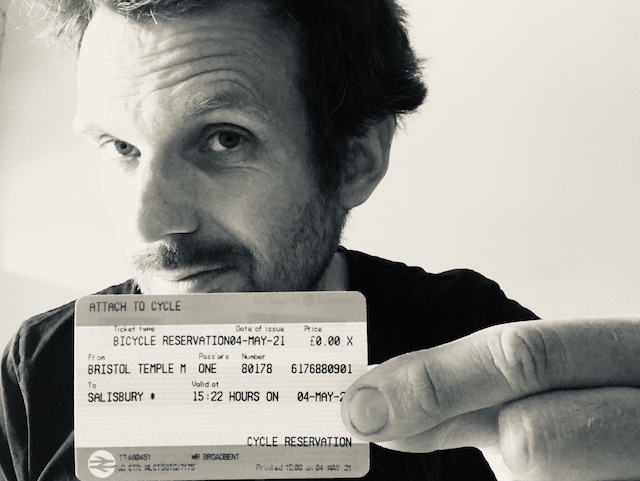
Leave, ticket in hand, a malleable scrap of evidence that you are going somewhere and you didn’t just imagine it. A ticket that won’t run out of power.
You are in a state of flow. The next action flows from the previous. You are in the moment. Then boom, in comes an email that sets off a chain reaction of anxiety and worry. At least that’s what just happened to me. Your creative surplus – time and attention – gets burned on managing your personal response to that email. You are back to zero. What do you do next?
When then there’s too much going on to do your creative work then merely create something. I picked up this term ‘merely’ concept from Seth Godin in this interview with Tim Ferris.
Sometimes not doing something takes up more effort than quickly doing it. As Godin explains, there’s a voice that says what we might produce might not be good enough. We spend time and direct our attention towards worrying about not being able to do something good.
Creative surplus is what you invest in order to create new ideas. Like operating surplus – or profit – it is what is left over when an organisation or individual’s basic operating needs are met, which is available to invest in growth of the next project. Rather than pounds and resources, creative surplus is the mental space and energy available to you to think creatively. Unlike profit, I see that creative surplus is something that most organisations spend little time thinking about.
A recent weekend of conservation work Hazel Hill Woods has revealed to me another woodland analogy for the struggles of daily life, and how we might overcome them. I am calling the analogy, Hazel vs. Hornbeam (the Fate of Best-laid plans).
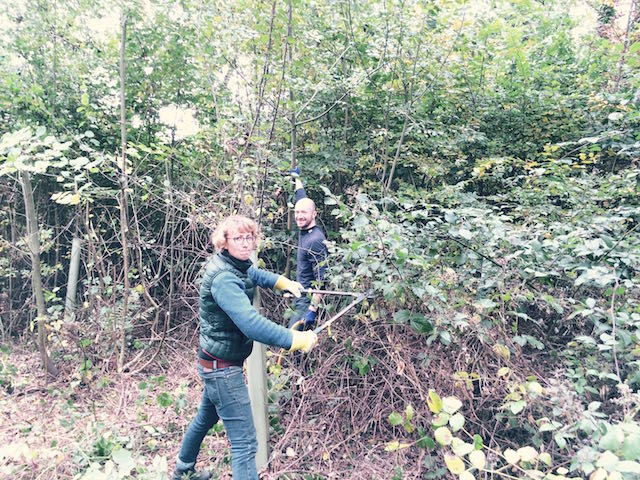
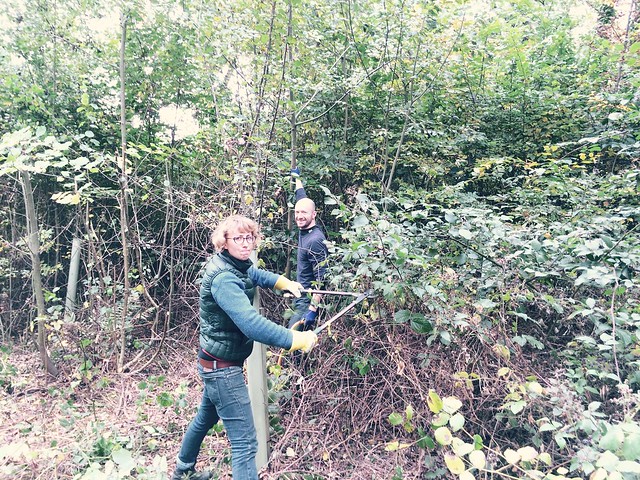
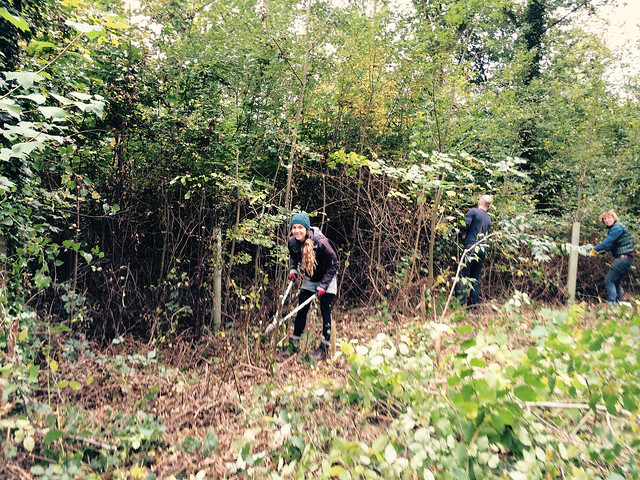
It emerged when a team of us at the woods were cutting back an area of regenerating hornbeam trees in a clearing. In this patch the hornbeam had shot up to a dense crowd of 6ft-tall finger-thick stems, knitted together with a head-height mat of bramble. Our conservation aim had been to cut these back to chest height to stop them from encroaching on an important butterfly corridor through the woods.
As we slowly cut our way into the dense thicket we started to discover small trees in protective tubes that were being crowded out by the hornbeam and strangled by the bramble. As we uncovered more hidden trees in tubes, we realised that there was a whole array of them that had once been planted. We found hazel, oak, ash, holy and blackthorn struggling to grow in their protective tubes. They had been planted on another conservation weekend years ago but had been forgotten about, and were now being smothered by the naturally regenerating growth.
The woodland context
There is a hundred-year plan at Hazel Hill to transform the forest ecosystem from that of a commercial wood, in which just a few species grow, into a much more biodiverse environment, which is much more likely to be resilient to changes in climate. The area in which we were working had previously been occupied by sycamore trees. This undesirable species had been cleared with a grant from the forestry commission, and in the clearing created, a range of broadleaf species had been planted (the hazel, oak and ash), along with shrubs (the holly and the blackthorn) to create ground-level growth, which had been absent in the commercial forest.
Left to its own devices however, naturally regenerating hornbeam and bramble had quickly grown up and overtaken the planted trees. The former were on the way to winning, the battle for light, already killing some of the latter , and leaving the others struggling. In the short-run there is nothing wrong with hornbeam and bramble, but their short-term success was putting at risk the long-term resilience of the wood by preventing the development of a diverse tree species.
Best laid plans
For me, those broadleaf trees in their little tubes represent best laid plans that were being left unattended because of short-term factors. There are competing conservation priorities in the woods, and these planted trees had been left unattended. Our attention is the light that enables our best-laid plans to flourish. But too often we are forced to direct our attention towards short-term priorities: the deadlines that need to be met, the clothes that need to be folded, the colleagues that need to be briefed, the clients that need to be satisfied.
In the short-term these more immediate matters flourish as they benefit from our attention, but they don’t necessarily lead us to where we want to be. As you wade into the thicket of regrowth, all is lush and green at the top, benefiting as it does from the light of the forest clearing, but underneath, all is brown – there is no diversity. Down there is where our best-laid plans languish.
The feeling of being surrounded
At one point, four of us were working simultaneously and in close proximity in the same thicket. Though we were probably only a few metres apart we couldn’t see each other for all the hornbeam branches and briars that surrounded us. At times, our repeated cuts didn’t seem to be making a difference. I’d turn around and the path that I had driven would have closed in behind me.
This is what it can be like when we feel overwhelmed with matters competing for our attention. After some struggling, my strategy became to just to keep going in one direction. After a sustained, focused effort the lattice of branches and brambles would suddenly give way. A sense of being surrounded turned into a sense of direction; of liberation: I felt freer, able to pause and choose where to go next.
Cutting back our brambles
As I type, I still have some small scratches on my arms from cutting back the brambles. Clearing away some of the things which grab our attention can hurt. There is the pain of letting someone down, or the fear of getting into trouble. But what I noticed as I cut through barbed branches was that they fell away to nothing; untangled and trampled they lost all of their strength, freeing a way through to the trees in tubes.
Personal conservation strategies
Conservation work gives you time to think, and so I set my mind to thinking up strategies for protecting our best-laid plans.
Log what you planted
It sounds simple, but creating a map of what trees we planted where might help us to remember to tend to them every so often. During conservation weekends in which we are planting trees, getting the trees in the ground is a big achievement. It seems unnecessary to create a map of where we planted them. Surely we won’t forget? Inevitably we do. Simply noting down our plans gives us a fighting chance of remembering what we intended.
Regular tending
Once we know what we planted, one strategy is to make time to regularly tend our saplings. It would only take a small amount of systematic attention to keep the hornbeam and brambles in these area in check.
Occasional clearouts
Sometimes though, we don’t have the luxury of being able to provide these things with regular attention. The alternative is to do what we did this weekend – every so often, go in there and cut back all the distractions and bathe our best laid plans with the totality of our attention. In daily life this might amount to a digital detox. Or, for a more substantial clear out, we might consider taking what Daniel Pink calls ‘Sagmeisters’ – regular sabbaticals interspersed in our working lives.
Get real
Our aim wasn’t to clear out all the hornbeam and bramble. Hornbeam regeneration is a natural part of the woodland ecosystem, as are the brambles that weave their way amongst them. We just need to create a bit of space for those slower-growing but ultimately very beneficial species to establish themselves. Similarly, short-term matters are part of the humdrum of daily life – we just need to carve out enough time to give our long-term plans the attention they deserve.
Get things established
Ocourse, the aim of all this cutting back is to enable the hazel, ash, oak, holly and blackthorn to establish themselves. As they start to mature they can look after themselves, and the hornbeam and brambles will subside. This is the point that Steven Covey makes in his book ‘The Seven Habits of Highly Successful People’ when he talks about what happens when we prioritise the important over the urgent. If we make time for the important things, we should see the number of urgent things we need to deal with reduce.
One day, decades after the scratches on my arms have healed, we’ll be able to sit under the shade of these broadleaf trees and know that our efforts to tend to them were worth it.
I have just read an interesting piece on the Stanford university website, ‘Stanford study finds walking improves creativity’ (article found via this news piece on the Hazel Hill Wood website). The article describes research that has for the first time investigated the impact of ‘non-aerobic walking on the simultaneous creative generation of new ideas and then compared it against sitting’. I had an intuitive idea that going for a walk improves the quality of my ideas – an example that springs to mind is a catchy tune I wrote on short walk back from the library at college. This research shows that ‘creativity levels were consistently and significantly higher for those walking compared to those sitting.’ What’s more, they stayed high for a short period after sitting back down again.
But the striking thing revealed by this research is that the walking environment doesn’t seem to make a difference. I had assumed that going for a walk outdoors in the woods would be good for my creative thinking, but this study shows that the boost to creative thinking is just as powerful when you take a walk on a treadmill in a featureless indoor room!
This result has obvious implications for how we set ourselves up to do good design, but there is another significant finding reported further down in this news article that also has important implications for design. While walking helps to boost divergent thinking, it is shown in this study to impede ‘more focussed thinking, characteristic of insight’.
So how can we use these findings when think about how we do design work?
In the design training that we have been developing at Think Up, we describe design as a process that starts with identifying a need and establishing a brief, that moves through idea generation and testing, and moves on to choosing the best ideas. These stages are linked by iterative loops which take you back through the process many times.
The obvious place for divergent thinking is in the idea generation phase, but there are others. Right at the start when we are identifying the need, we often need to think around the problem to check if it has been framed properly. We also need to have an open-minded view of the client brief if we are to unpick the unwritten and implied elements of what the client wants. We also need to apply some divergent thinking to enable us to think of all the factors that are going to determine whether our ideas are good ones, rather than simply relying on the usual tests we apply.
There is also an obvious place for convergent thinking: at the part of the design process where we are refining our ideas, and when we are testing them for adequacy against the brief. But there are other places where we need insight: when we are trying to choose the factors in the brief that are going to dominate the design; and when we are trying to make a decision based on hard-to-compare factors.
So there is a place for walking and a place for sitting in design.
Unfortunately, from what I have observed in design offices, we tend to do too little of the latter and not enough of the former. What we could learn from this research is to be more mindful of the type of thinking that is required at any one time and to move or stay still as appropriate.
We should also beware of metaphorical trip hazards. There’s no use in going for a divergent thinking walk if we are distracted by our smart phone en route. Turn it off! And our creative reverie stands a good chance of being extinguished if when we return to our desks we find a set of monthly sales figures demanding our attention. In other words it is probably a good idea to think about that environment you will be returning to at the end of your walk.