Tag: books

  • Patterns versus words

    Patterns versus words

    In my exploration of regenerative design I’m often struck by how language is a barrier to exploring regenerative thinking. I can see two things at play here. The first that we may not have the words to fully describe what we imply by regenerative design. The second is that defining being regenerative using the terms of the growth-extraction paradigm (ie our current economic pattern) risks keeping the whole philosophy bound by that original pattern.

    In my application to become an 1851 Regenerative Design Fellow I said I wanted to create a ‘pattern book’ for understanding regenerative design. It was an idea that drew on pattern books in manufacture and it was also a nod to the new pattern for construction that Joseph Paxton ushered in with his sketch for Crystal Palace. But it was also an acknowledgment that words alone may not be enough.

    This week I’m reading ‘The Patterning Instinct’ by Jeremy Lent. As he puts it

    The idea that language- and its corresponding cultural framework – affects the way we think is a key premise of this book.

    Jeremy Lent

    In it he described how humans create new words to describe a particular set of ideas. My example might be the word ‘optioneering’ (which I I dislike but hear often). In one word we combine the ideas of there being a set of options, that they are assessed, and that this be done in a systematic way. Once this new word is developed it is far easier to use it than to create a different term to link together these ideas.

    These words are a way to make thinking easier. All the wisdom of these ideas combined into a single word. Our language is built up of multiple layers of words that contain ideas of deep cultural meaning. This can make it hard to change the way we think. Our existing words are already doing lots of conceptual work and new words have to work hard for adoption if they go against the grain.

    Lent situates his work in the domain of neo-Whorfian linguistics, which takes as it’s starting premise that the way we speak affects how we think.

    The weak-Whorfian approach says that some thinking patterns can be changed by changing the language that we use.

    These insights lead me to think that there may be more to the idea of a pattern book than I had realised. I foresee patterns as a way to transcend words that may be locking us into a certain way of thinking. If so could we use a set of patterns to communicate regenerative design? That’s what I’m thinking about.

    As Lent writes later (pg213)

    If our cultural inheritance compels us to think in certain ways – strong Whorfianism – then there’s nothing we can do about it. If, however, our cultural framing merely encourages us to think in certain patterns – weak Whorfianism – then, by becoming conscious of those patterns, we may have the power to change them.

    Jeremy Lent
  • Travelling by high-speed glacier

    Travelling by high-speed glacier

    On a recent trip to the Alps I took Robert MacFarlane‘s breathtaking ‘Mountains of the Mind‘. In it I found this delightful tale about Mark Twain taking his family up on to a glacier in the Alps – a fashionable thing to do in the mid-nineteenth century. In short:

    (more…)
  • Book notes: What if we stopped pretending

    I originally wrote this post for the ‘Training on what to do After Declaring a Climate Emergencyalumni network, and I’m sharing it here too. For some start-the-week inspiration I’m sharing some thoughts after reading Jonathan Franzen’sWhat If We Stopped Pretending‘. Thank you to James Norman for lending this to me a week a go. 

    (more…)
  • Proust, constructivism and listening to clients

    This week I underlined this sentence from Proust’s Finding Time Again. 

    “Even at the moments when we are the most disinterested onlookers of nature, of society, of love, or art itself, since every impression comes in two parts, half of it contained within the object, and the other half, which we alone will understand, extending into us, we are quick to disregard this latter half, which ought to be the sole object of our attention, and take notice only of the first, which being external and therefore impossible to study in any depth, will not impose any strain on us: we find it too demanding a task to try to perceive the little furrow that the sight of a hawthorn or a church has made on us.”

    Proust, M. (1927). Le Temps Retrouvé (Finding Time Again) (C. Prendergast (ed.); Ian Patterson tranlation). Penguin Classics.

    This sentence comes in the middle of Proust’s revelation about what his work as a writer should be: to translate his inner world to the outside. He finds much greater richness in understanding the impression that the world makes on individuals than understanding the surface, objective qualities of what is being observed.

    Things I take away:

    (more…)
  • Proust’s antidote to endless scrolling

    Proust’s antidote to endless scrolling

    The fault I find in our journalism is it forces us to engage with some fresh triviality every day whereas only three or four books give us anything that is of any importance.

    Charles Swann, in Swann’s Way, In Search of Lost Time Vol.1
    (more…)
  • Reading Proust – volume 5 update

    Reading Proust – volume 5 update

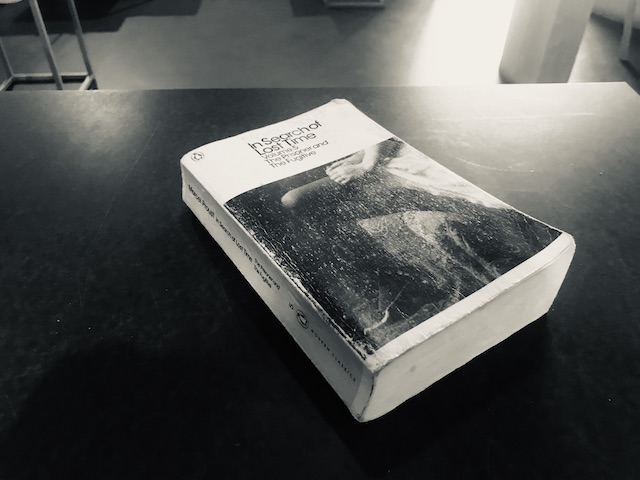
    It wasn’t what I was expecting but volume 5 of Proust’s In Search of Lost Time ends on a cliff-hanger. It is incredible how such separate threads from five previous volumes are starting to brought together: a narrative arc that I could never see converging has in fact been much closer to convergence than I expected.

    I’ve been reading In Search of Lost Time – Proust’s epic explorationg of memory, art, adolescence and decisre – on and off since 2007. It is one of those books that lots of people have heard of, some know two things about it (the long sentances and the flood of memories provoked by dipping a madeliene cake in his tea) but I’ve hardly found anyone who has actually read it. So in 2007 I decided to give it a go (in English!).

    (more…)
  • Book notes – The Hidden Life of Trees

    Book notes – The Hidden Life of Trees

    It feels right as I take on my new role at Hazel Hill Wood to read the Hidden Life of Trees. This is an evolving post based on notes I take as I read through the book.

    From the foreward: ‘The author’s deep understanding of the lives of trees, reached through decasdes of careful observation and study, reveals a world so astonishing that if you read his book, I believe that forests will become magical places for you too.’

    (more…)

  • Reading fast and slow

    Reading fast and slow

    I’m a slow reader. The problem is I can’t seem to retain things unless I write them down or sketch them out. It means that I read very few books each year, but it also means those ones I do read I know really well. This is great when you want to be able to recall a concept while standing in front of a workshop, but it is not so good for reading new content. The pile of books I now want to read is now far greater than I’ll ever get through. The smartest stuff I’ve read about productivity tells me that doing things quicker is a fool’s game. So maybe I need a different aproach.

    (more…)

  • The perils of false modesty

    The perils of false modesty

    I just read this great paragraph on the debilitating impact of false modesty on judgement.

    (more…)