Tag: embodied cognition

  • New developments in ‘i’

    Engineers have announced today some astounding new breakthroughs in their latest version of i.

    • Empathy – the ability to see the world from the perspective of another. To have a genuine, shared sense of pain. This ability is developed through twenty-year long training process called ‘childhood and adolescence’.
    • Embodied cognition – a way to develop understanding that emerges through the unique physical characteristics of each ‘i’ and how it moves through and experiences the world.
    • Music – audio signals organised into patterns and created by individual or groups of ‘i’s to communicate information that can’t be captured in a .txt file.
    • Culture – a collective intelligence that emerges when several i operating systems do things together.
    • Gut-feeling – a parallel processor providing checks and balances against the logic board.
    • Sleep – a remarkable sub-routine that both repairs the operating system and identifies new patterns.
    • Love – a higher order circuit that guides priorisation, builds system resilience and provides additional energy when resources are low.

    This technology is completely free and open-source.
  • Act it out – embody your ideas

    ‘Act it Out’ is my favourite technique for shifting creative thinking from the mind to the body. This post is another in my series on Turning the Kalideascope, ways to form new connections in the creative process.

    Engineering has important roots in Enlightenment thinking. The Enlightenment put us firmly in our heads, as abstract, rational thinkers. We take inputs from the outside world, process them and develop a reasoned response. Through this approach, humans have made great progress on some fronts. But this separation from our bodies and our environment comes at a cost. We forget that we are not apart from but in and part of a physiology that itself is situated in an ecosystem.

    (more…)
  • Analogue Skill 009: Sketch what you see

    Analogue Skill 009: Sketch what you see

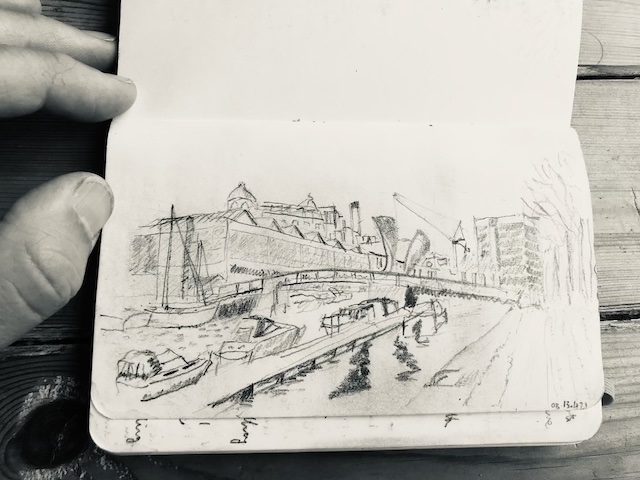
    Take out a piece of paper and draw a sketch of what you can see. You will notice more than you ever would by taking a photograph.

    Sketching could easily fall into two categories in my collection of analogue skills: Remembering Things and Spending Time Alone.

    (more…)
  • Filling the Kalideascope – go to site

    This post is another in my series about inputs to the creative process, what I call ‘Filling the Kalideascope‘. Today’s input is visiting the site, and it cuts the heart of what it means to be a human designer.

    (more…)
  • Curating information for creativity

    Curating information for creativity

    In this third video in my series on creative thinking, I go into the concept of curating inputs to the creative process. The combination of our brain and body makes for an awesomely powerful creative machine. We can use our bodies to explore and gather a wide range of inputs and then we can use our arms and fingers to manipulate and rearrange elements within our wide field of vision, and yet much of our creative work is blinkered by computer screens, or worse reduced to the width of a phone. In this video I ask viewers to think about how they can arrange their creative inputs to make full use of their creative faculties.

    (more…)
  • Good enough for now: the philosophy of Lego sorting

    Good enough for now: the philosophy of Lego sorting

    With our household suddenly in self-isolation pending results of a Covid test, my daughter and I are back playing lego together and I’m revisiting that recurring question: how best to sort our Lego? But this time I think I have landed on a method that is standing the test of time, and one which has wider philosophical benefits.

    (more…)
  • The left-right game – experiments in navigation, embodiment and control

    The left-right game – experiments in navigation, embodiment and control

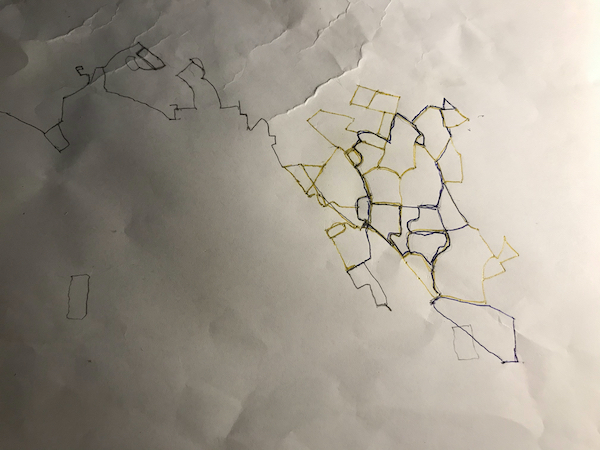
    Yesterday my daughter and I left the house and flipped a coin. Heads for left, tails for right. Right it was, then left, then left again, et cetera. A random journey along the roads, cyclepaths and alleyways of our neighbourhood ensued. It became a fun home-schooling lesson in probability. It revealed to me the habits that stop me from noticing so much of what surrounds me. And it was a fascinating experiment in not having a plan.

    (more…)
  • Imprisoned with the infinite – the philosophical implications of an imaginary visit to Sweden

    Imprisoned with the infinite – the philosophical implications of an imaginary visit to Sweden

    Yesterday our household returned home from an imaginary holiday. Despite being in lockdown, we realised that we could imagine going on a trip anywhere in the world. Our daughter suggested our Sweden. Too far to easily get to under normal circumstances without flying, with that constraint removed we thought, why not? Now back home, I have been using this visit as an opportunity to explore some philosophical arguments about how we deal with choice and how this affects our creativity.

    (more…)
  • Olafur Eliasson at the Tate + reflections on my own work

    Olafur Eliasson at the Tate + reflections on my own work

    This week I have had the feeling that I have been struggling recently to find focus on my creative work. I have lots of projects on at the moment, and I am not satisfied that I am being able to draw a cohesive thread between them. I think this is important because I subscribe to the idea that to have impact on your work, you need to be regularly adding to it in a disciplined way – always adding momentum to the fly-wheel, as Jim Collins puts it.

    (more…)
  • The experience of distance

    Marseille
    A morning walk up the steep hill to the Basilica of Notre Dame de la Gard granted me panoramic views of the city of Marseille and the sea. I love the peaceful hum that can be extracted from high up of a limbering up for a day of activity.

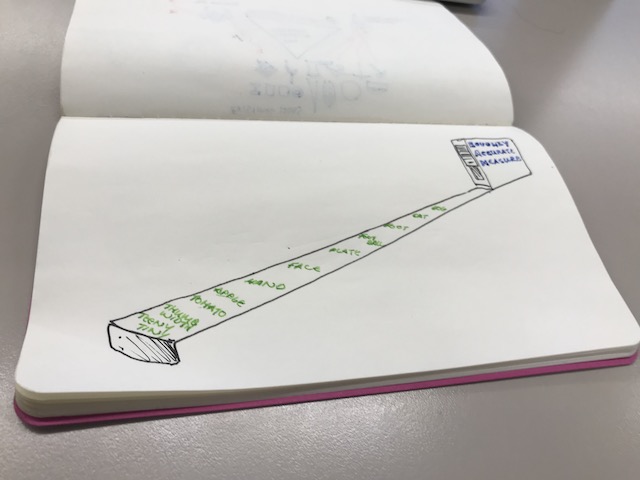
    I underlined these words yesterday in ‘In Search of Lost Time’. The narrator is talking about how his perception of distance was changed when, instead of travelling by rail, he starts to go by car.

    ‘We express the difficulty we have in getting to a place in a system of leagues and kilometres, which becomes false the moment that difficulty decreases. The art of distance, too, is modified, since a village that had seemed to be in a different world from some other village, becomes its neighbour in a landscape whose dimensions have altered.’

    Proust, M. (1921). In Search of Lost Time, Vol 4. Sodom and Gomorrah. (C. Prendergast, Ed.) (Penguin Cl). Penguin Books.
    (more…)