Tag: focus

  • The Schedule

    I am sharing today a schedule I use in my work every time the noise from distractions gets too much and/or I don’t actually think I am making any progress in what I do. It was inspired by reading ‘The Secrets of Productive People’ by Mark Forster, a book which, while labelled productivity, has a lot to do with creativity.

    I call my process simply ‘the schedule’ and it has served me well for the last six years. Feeling stretched? Time to return to the Schedule. The aim is to keep work focused on a single task but also to allow structured time where the brain can wander and new ideas can come into the flow. 

    • 09:10 – 09:50
    • 10mins break
    • 10:00 – 10:40
    • 30mins break
    • 11:10 – 11:50
    • 10mins break
    • 12:00 – 12:40
    • 1h10 break
    • 13:50 – 14h30
    • 10mins break
    • 14:40 – 15:20
    • 30mins break
    • 15:50 – 16:30
    • 10mins break
    • 16:40 – 17:20

    The breaks are as important as the focus time. Both count as work. Both count towards time on a job. Often we only value the active brain time, but sometimes our best thinking happens in between. 

    One rule of the Schedule is to stop the task at break time, even if the task is almost complete. The temptation is to carry on, but as it usually turns out, an almost finished task is never quite as finished as you think. What ensues is a period of dwindling concentration and diminishing returns. Better to take the break, come back with fresh eyes and finish the task quickly, and move on.

    Of course, few days fully work out like this. There’s fitting in with other people’s schedules. And there’s caring responsibilities. But when things start to feel a bit chaotic (see my post on the Chaos Field), re-establishing some order can help me think clearly again. 

    My recommendation is not that you follow my schedule (by all means do if you wish) but to establish a pattern of work that works for your cycle of energy and attention, gives you time to think, provides structure and is something that you just do automatically without devoting mental energy to. 
  • Does going for a walk improve design?

    Does going for a walk improve design?

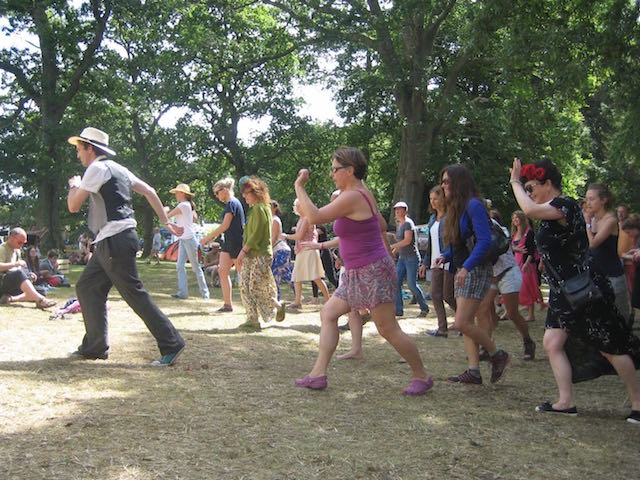
    Taking a walk at Port Eliot Festival

    I have just read an interesting piece on the Stanford university website, ‘Stanford study finds walking improves creativity’ (article found via this news piece on the Hazel Hill Wood website). The article describes research that has for the first time investigated the impact of ‘non-aerobic walking on the simultaneous creative generation of new ideas and then compared it against sitting’. I had an intuitive idea that going for a walk improves the quality of my ideas – an example that springs to mind is a catchy tune I wrote on short walk back from the library at college. This research shows that ‘creativity levels were consistently and significantly higher for those walking compared to those sitting.’ What’s more, they stayed high for a short period after sitting back down again.

    But the striking thing revealed by this research is that the walking environment doesn’t seem to make a difference. I had assumed that going for a walk outdoors in the woods would be good for my creative thinking, but this study shows that the boost to creative thinking is just as powerful when you take a walk on a treadmill in a featureless indoor room!

    This result has obvious implications for how we set ourselves up to do good design, but there is another significant finding reported further down in this news article that also has important implications for design. While walking helps to boost divergent thinking, it is shown in this study to impede ‘more focussed thinking, characteristic of insight’.

    So how can we use these findings when think about how we do design work?

    In the design training that we have been developing at Think Up, we describe design as a process that starts with identifying a need and establishing a brief, that moves through idea generation and testing, and moves on to choosing the best ideas. These stages are linked by iterative loops which take you back through the process many times.

    The obvious place for divergent thinking is in the idea generation phase, but there are others. Right at the start when we are identifying the need, we often need to think around the problem to check if it has been framed properly. We also need to have an open-minded view of the client brief if we are to unpick the unwritten and implied elements of what the client wants. We also need to apply some divergent thinking to enable us to think of all the factors that are going to determine whether our ideas are good ones, rather than simply relying on the usual tests we apply.

    There is also an obvious place for convergent thinking: at the part of the design process where we are refining our ideas, and when we are testing them for adequacy against the brief. But there are other places where we need insight: when we are trying to choose the factors in the brief that are going to dominate the design; and when we are trying to make a decision based on hard-to-compare factors.

    So there is a place for walking and a place for sitting in design.

    Unfortunately, from what I have observed in design offices, we tend to do too little of the latter and not enough of the former. What we could learn from this research is to be more mindful of the type of thinking that is required at any one time and to move or stay still as appropriate.

    We should also beware of metaphorical trip hazards. There’s no use in going for a divergent thinking walk if we are distracted by our smart phone en route. Turn it off! And our creative reverie stands a good chance of being extinguished if when we return to our desks we find a set of monthly sales figures demanding our attention. In other words it is probably a good idea to think about that environment you will be returning to at the end of your walk.

    Related posts