Tag: InfrastructureDesign

  • Signs of bad design

    Signs of bad design

    Warning signs interest me. In some instances warning signs are necessary and appropriate, but in my experience they are often the mitigation measure of last resort for an issue that probably could have been solved by a different conceptual design.

    Take this example, one of the entrances to the Elizabeth Line at Paddington Station, London.
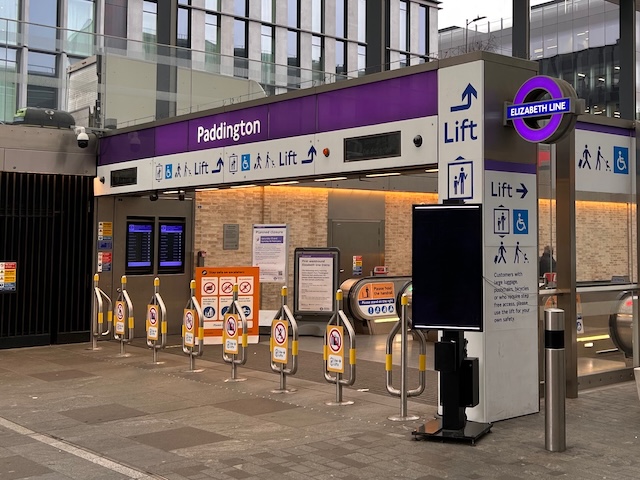
    In this image I count six different classes of sign directing people to the lifts with their luggage. And, what’s more, in addition to all the signs you can see, there is an additional innovation. The black TV screen is connected to a camera that scans for passengers who are towing suitcases towards the escalators. Guilty parties spotted, it displays an image of their suitcase along with an arrow pointing to the lift.

    In addition to the signs there are physical barriers to suitcases, which must not be working otherwise the signs would not be necessary.

    As I recall, when the station opened, there were no barriers and hardly any signs. All of these measures are therefore an attempt to solve a problem that has emerged since the station has opened.

    Clearly the station managers are dealing with a real, operational safety challenge. And with limited options for re-design of the physical infrastructure, they are using the levers available to them: signs, barriers and sophisticated surveillance. This isn’t a criticism of station managers – rather a provocation for conceptual designers in the built environment:

    How often do we use signs and barriers to fix problems that better design could prevent?

  • Indistinguishable from magic

    The renowned scientist fiction writer and futurist Arthur C Clarke said “any sufficiently advanced technology is indistinguishable from magic”. 

    I think the same can be said of well functioning public transport infrastructure. 

  • Stuffed crust geometry

    At some point in my childhood, Pizza Hut introduced the stuffed crust pizza. The idea was simple: stuff the crust with a ring of gooey cheese. It was fine when you had a slice from a large pizza, but on a small pizza, the balance was off—too much crust and not enough topping.

    I haven’t thought about stuffed crust pizzas in decades, but they help illustrate an important point in geometry. As a pizza gets bigger, the ratio of crust to surface area gets smaller. So a small pizza has lots of crust, while a large pizza has relatively less crust per unit of topping.

    In general, this is expressed as the ratio of a circle’s circumference to its area, which decreases as the radius grows. A small circle has far more edge per unit area than a large one. This is why my small stuffed crust pizza tasted too crusty.

    But this post isn’t just about childhood pizza or geometry. It’s about the importance of edges in systems. How much “edge” we have shapes how we interact with the wider environment and how systems function internally. It affects the design of buildings, cities, and infrastructure. 

    But that’s more than I can stuff into this post—more tomorrow.