Tag: regenerative design

  • I’m back (with a book)

    I’m back (with a book)

    It’s been 47 days since my last entry on For Engineers and Other Humans, and since then I’ve been working on something that feels pretty big. 

    So here’s the announcement: I’ve written a book. It’s called The Pattern Book for Regenerative Design—a practice guide for engineers (and other humans).

    This book weaves together thinking from the Regenerative Design Lab, facilitation notes, posts from this blog and reflections from across my 1851 Fellowship in Regenerative Design. And now it is all in one place. 

    The first release of the book will be for readers of this blog, so stay tuned — you are in the right place. The book will then be on sale directly through the Constructivist website. 

    Why are we doing it this way? Because our aim is to build momentum. The work that started in the Regenerative Design Lab now needs to go further, and the Pattern Book is the manual for doing that. Our intention is to grow this book iteratively. This is iteration one. 

    Iteration two will be informed by how people get on with using the tools, exercises and sequences within. 

    More soon.

  • Seeing the pattern in the strands

    In 2022 I founded the Regenerative Design Lab with the intention of helping to figure out what regenerative design might mean for the construction industry, and how we might shift theory into practice. 

    Over the past four years this has been a shared journey, one shaped by more than 70 participants we have had in the Lab programme, by my Lab co-facilitator Ellie Osborne and the hundreds of conversations we have had along the way. 

    At the start, we realised that was lots we didn’t know. Regenerative design felt like a like a tangled web of many different strands, including themes as diverse as: philosophy, technology, systems thinking, Indigenous wisdom, ecosystems, social justice, biomimicry and community organising. 

    Our first aim was to simply hold space for these conversations and create a framework for reflective exploration and application of these strands of thinking.

    At a similar time, James and I started writing a book. Our job was to take this emerging theory of regenerative design and present it to an audience of structural engineers in a way that was both inspirational and also routed in the realities of projects.

    I have to be honest, that at times, across all these initiatives, the weave of these conversations had been very confusing and I regularly tied myself in knots.

    But over time, patterns had begun to emerge. Certain ways of structuring the conversation worked better for some participants in the Lab than others. Some approaches led to more reflection and introspection, others led to people taking action. And there are clear patterns emerging in what helps to bring different audiences on a journey.

    James and I rewrote the Regenerative Structural Engineer three times before we found a way of sequencing our arguments that seemed to work. That the book has now been sold in over 26 countries – a sign that this pattern resonated. 

    In the two years since then, I’ve had many more conversations, both inside the Lab and out, and learnt more about the different ways to hold a conversation about regenerative design.

    One of the questions I get most often is usually a variation of: how do I talk about this with my clients/can you just give me the slides?

    But it’s not as simple as that. You have to take people on a journey. The journey depends on who you are and who they are. But if you can find a formula that works, you can create a pattern that you can repeat, from conversation to conversation, from projects to project, so that over time we can gradually shift our industry.

    This book is my attempt to guide people in finding their own patterns for exploring and talking about regenerative design. It is an attempt to stitch together what we’ve learnt from all this work and create repeatable patterns that can spin out into practice. 

  • Want to fix the future? Try fixing something today

    The question came up at a recent roundtable: how do we inspire designers to act regeneratively. And I said, train to be a plumber.

    But instead of plumber I could have inserted, carpenter, tree surgeon, blacksmith, cycle mechanic, gardener, food grower, repairer – in fact any sort of useful role that works with real materials and real systems.

    I don’t pretend these are quick paths to take. But I think too often in conversations around regenerative design we spend lots of time imagining the future we want to create (which is indeed one of the roles of the regenerative designer), but not nearly enough time deeply involving ourselves with the challenges of the existing systems.

    Making things in our existing system embeds us deeper into it. It grounds our thinking in physical and social reality. It helps us recognise the barriers but also the untapped potential in places and communities. We gain trust by offering services of genuine use now, and from those relationships open up new possibilities that are much more closely related to both reality and emergent opportunities.

    Regenerative design isn’t only about imagining the future – it’s about rooting our thinking in the challenges and opportunities of today. 

    (For more on this line of thinking check out ‘The Case for Working with Your Hands’, by Matthew Crawford)

  • Where we make but also where we take

    When it comes to regenerative design, it’s not just where we make but also where we take that matters.

    For the last two decades, engineers (and other humans) have become more conscious of reducing their impact. Of how energy efficient our buildings are. Of reducing pollution from our sites into the surrounding environment.

    These are ways of reducing our impact where we build buildings and infrastructure. In the places where we make.

    (more…)
  • Construction as an act of healing

    Construction as an act of healing

    What if, every time we designed a building, the world got better? This post explores the transformative potential of regenerative design, a paradigm shift from construction that contributes to carbon emissions and ecosystem destruction, to one that leave people and planet in better health.

    Whereas sustainability seeks to limit damage, regenerative design aims to return human and living systems to a state of thriving within the limits of the planet’s boundaries. It’s a process akin to healing, requiring attentive listening, a holistic approach, and mindful consideration of all affected places, including the often-overlooked ‘Second Site’ of material sourcing and manufacturing. The post argues for a need to reevaluate scale and focus, suggesting that like patient care, construction should focus on individual attention and localized interventions, forming a mosaic of healing actions. This vision calls for a systemic transformation, reimagining the construction industry as a nationwide, network of specific, place-based healing processes, tailored to meet the unique needs of each environment.

    (more…)
  • Seeking abundance in the Cambridge Fens

    Seeking abundance in the Cambridge Fens

    An abundance mindset is a key tool for the regenerative engineer. It gives three things.

    The first is the ability to see the richness of the situations we are in. The wealth that we have which may go unnoticed. The unused materials that could be worked with. The richness of the harvest.

    The second is the possibility of seeing the potential of a place. What could this place be. What could happen here if we unlock the latent capacity of community and ecosystem to make something better.

    And the third is the ability to see the missing richness of a place. Where a system may be in a desertified state, what it could like where it returned to its previous flourishing state.

    It is this third kind of abundance that I see in the project to return 9000 acres of the Fens in East Anglia to nature. Where this was once a habitat deep in peat and rich in diverse species, draining of the land and intensive farming have left the fens in a decertified state in which 2cm of peat is eroded ever year. Near my cousin’s house the land is four metres lower than it was before draining started in the Victorian period. Soon there will be none left.

    But purchase of large swathes of land by the Wildlife Trusts is enabling the return of wetter forms of farming in this land. This alternative approach aims to restore the peatland habitat, increase biodiversity and create a shift to alternative crops that can thrive in these wetter environments.

    This abundant vision creates the potential for humans and the rest of the living world to thrive together.

  • Time for new patterns

    Time for new patterns

    We see patterns. We think in patterns. We create patterns.

    A pattern is something that repeats. A drum beat. An oscillation.

    Patterns make things regular and therefore intelligible. Patterns help us predict what will happen next. Out of a sea of random events a pattern can feel like a life raft. Or pieces from which we can assemble together to create a boat.

    The OED says the word comes from the Middle English ‘patron’ meaning something to be followed.

    This is interesting. What if the patterns we are following are no-longer serving us? What if the drumbeat is no-longer leading us in the right direction. What if the oscillations are going out of control?

    Then we need to learn to see new patterns. We need to learn to think in new patterns. And we need to create new patterns.

    That is why at Constructivist I am starting to build the Pattern Book for Regenerative Design. It is a guide for engineers (and other humans) for thinking in new, regenerative patterns. At the moment it is lots of pieces, but my hope is that these pieces can be assembled to create a useful boat for designers to clamber aboard.

  • Vision for a regenerative programme of forestry and building maintenance at Hazel Hill Wood

    Vision for a regenerative programme of forestry and building maintenance at Hazel Hill Wood

    This afternoon I met with two trustees of Hazel Hill Wood to develop some ideas for a funding bid to support more regenerative use of timber to maintain our off-grid buildings. I said at the end of the call I’d write up some thoughts on a what a five-year plan could look like. Here is what I wrote down – stimulated by a very thought-provoking conversation with my excellent trustee colleagues. I’m putting it here rather than on the Hazel Hill website as this is by no means policy! Just a set of ideas, captured to enable further discussion.

    Five-year vision for developing Hazel Hill as a centre for regenerative forest management and traditional construction skills.

    At Hazel Hill Wood we have a unique combination of sustainably managed forest, off-grid buildings and a charity with a mission is to use timber from the wood as part of a regenerative cycle of building repair. Our ambition is to work with these gifts to increase local biodiversity and woodland thriving, build community resilience and wellbeing of all who come into contact with the wood.

    While we reach all of these ambitions to some extent through our current charitable activities, we see the opportunity to unlock greater benefits for the ecosystem and local community by establishing the wood as a centre for learning about how timber can be used as part of a regenerative local construction material. We describe this process as regenerative because it has the potential to have zero negative externalities: harvesting timber in the right places can actually increase woodland health and biodiversity; the timber we harvest can be used to re-establish a range of historical, rural practices, including coppicing, hurdle-making, horse-drawn timber extraction and traditional green-wood construction. Training local people in using these skills can help to enhance the rural economy while helping to maintain the heritage of local buildings. And the wellbeing of all is enhanced through extended contact with the living world through nature connection. 

    To shift to this mode of operation we envisage taking three phases over five years. 

    Phase one – from seed to seedling

    In this first phase we assess the state of the current system and create some of the infrastructure to enable this new activity to happen at the wood. 

    • Forest survey – establishing the health of the ecosystem, possible timber for harvest now and possible timber for future extraction and opportunities to enhance biodiversity through timber harvest.
    • Building survey – establishing the long-term maintenance needs and priorities of our heritage timber buildings.
    • Skills survey – understanding the local skills landscape and how training at Hazel Hill wood could enhance the local economy.
    • Re-establishing connection with rural construction tradespeople.
    • Creating working area – wood seasoning shed, tools shed and outdoor classroom
    • Initiation of volunteer programme for simple construction skills using timber in the forest.
    • Initial harvest of coppiced timber
    • Initial harvest of roundwood poles for seasoning.

    Phase two – from seedling to sapling

    In this phase we increase the scale of our regenerative work, starting to work with wood harvested and seasoned in Phase one while increasing our harvest of timber from the wood. In this phase we grow our education programme around how we see the wood and the buildings as part of a continuum, a process of which we are the stewards, adapting to the needs of the ecosystem and the people who we bring here to heal and learn through connection with the living world.

    • On-going habitat creation and monitoring in areas where timber has been harvested.
    • Maintenance forestry – In order to grow trees for timber, some tree pruning needs to be done to create timber of good quality. We need to develop local skills in how to plan and carry out tree maintenance.
    • Running courses in green wood construction skills.
    • Using seasoned, sawed timber to carry out major upgrades to the structure of our heritage buildings, including new decking for the Oak House and Forest Ark.
    • Invitation to other local crafts people to run training courses at our site.
    • Growing programme of volunteer activities engaged in a range of conservation and heritage construction projects.
    • Growing education programme, offering training in the thinking behind the regenerative principles on site.

    Phase three – from sapling to tree

    In this third phase the operations are more self-sustaining. The process of continuous cover forestry is well-established in the wood, with timber harvested at a rate of 1% per year providing a steady rate of firewood and construction materials for the charity as well as surplus for sale into the local economy. The programme of rural forestry and heritage construction skills training is self-sustaining and as well as bringing in revenue for the charity, is part of the active continuous maintenance of our unique heritage buildings. The site will be well known as a demonstrator project for regenerative principles that can be replicated more widely.

  • Downhill to the weekend – time for writing

    I’m just noticing that I’m entering that perfect groove of Friday afternoon. I’ve stopped travelling for the week and I’m back at my desk. My head is buzzing with ideas from the week’s accumulated activities. I have got Fip.fr on the radio and for a precious few moments, there’s no barrier between me and the page.

    I talk quite often in my creativity training about finding the right moment to do the right kind of work. A few years ago I heard Tim Ferris interview Dan Pink about his book ‘When’. Pink was writing about trends in what kind of work suits what times of day for different people. If memory serves correctly, he was suggesting that for many people, the morning is a more analytical time, the early afternoon is a post-lunch slump (ideal in my mind for doing expenses) and the late afternoon and early evening are ideal for more creative thinking.

    He doesn’t say this is true of everyone, but says it is a common for many.

    In my thinking about regenerative design, the idea of working with living cycles comes up often. I see this tuning into what work suits what time of day as another manifestation of this idea of a living cycle. Right now as I settle into my Friday afternoon groove I know that I’m working with the cycle, everything aligns and it is little extra effort to carry on moving forwards.

    For me the questions are: where are we working with the direction of a system and when are we working against it. Sometimes we need to against the flow to make change. But working constantly against the flow is hard work and comes with an energy cost that one day we must repay.

    The only problem I have with listening to Fip.fr in the afternoon is that the times are in French and every so often I forget and think it is one hour later than it really is.

  • Regenerative Design Tetris Blocks

    There’s lots of regenerative design thoughts bubbling around between my ears. I often get to a point in my creative process where I feel I can’t write something down because I haven’t written down the previous thing. But I can’t wait to write down the foundation stuff because the new ideas keep coming in. Like blocks in Tetris, they are soon gonna bump again the ceiling of my head. Time to clear some of the shapes in my head and store them here in case they are useful. In my out-tray are:

    Stand by for posts on these.

  • A myriad of questions about regenerative design

    In my post earlier last week I made the case for regenerative design as a response to the range of systemic ecological, social and climatic challenges that we are facing. As soon as we start talking about regenerative design, a myriad of questions pop up. 

    After six months of co-facilitating the first Constructivist Regenerative Design Lab, I can see these questions settling into three categories. Sorting these questions into groups hopefully gives us a way through them. They are as follows:

    • What do we mean by regenerative design?
    • How do we do it?
    • How do we create the conditions for it to happen?

    I find this separation brings clarity. The first question sets the terms for the answer to the next two. Regenerative design requires a conceptual leap – a paradigm shift in how we see our role as designers. It requires us to think very differently about how design works. It is likely to feel very inconvenient, not to mention counter-cultural, which is why it is important we separate the question of what we are trying to achieve from the ‘how’. I have seen that when we start the conversation with ‘how’, then the concept gets watered down.

    When we can be clear about our aims – and I think the literature is clear, although the concepts are not widely enough understood for them to be mainstream yet – we can start to think about how we do it.

    The answers to questions two and three are likely to be iterative and related. Gaining the opportunity to do regenerative design will inform practice; practice will enable more chances to make the case for regenerative design.

    More blog posts about regenerative design

    My work on regenerative design is generously supported by the Royal Commission for the Exhibition of 1851. Read more about my Fellowship in Regenerative Design.

  • The incredible system that will save us

    Good news. There is an incredible system that can save humanity and will enable us to thrive on planet Earth.

    Here’s how it works. 

    • It is entirely powered by the effect of the sun and the moon.
    • Using simple elements it can establish itself in new locations and in a few iterations it can rapidly scale up, complexifying and adapting to meet its operating conditions. 
    • The system produces no waste at all – all outputs from one process are inputs to others.
    • It creates incomprehensibly complex structures from a small palette of abundant, local materials.
    • The system purifies and circulates water. 
    • It keeps the air in the atmosphere breathable, and maintains levels of greenhouse gases at a level appropriate for system survival.
    • It even screens out harmful rays from the sun.
    • It creates food and nutrients.
    • It even creates abundant construction materials.
    • The system has built-in resilience to enable it to respond to shocks. 
    • It has the capacity to learn and to develop new designs. These designs are optimised to ensure the health of the whole system, not just the individual element within it.

    It is the system of life in the biosphere of planet Earth. If we step back and think about it, there is no system that humans have created that can compete in terms of its resilience, life-giving potential and ability to adapt. 

    This life giving system is out there, it surrounds us, and it is still just about intact. This is good news.

    There is more good news. 

    We, human beings, have been evolved as part of that system, and it is interwoven with us. As I heard fellow Regenerative Design Fellow Michael Pawlyn describe, there are more microbial cells than human cells in our bodies. So there is no meaningful separation between us and this system. 

    And if all parts of the system have evolved to increase the health of the system, then we too have been created by that system to fulfil a role. 

    So, there is this incredible life giving system that we are in extricable part of. So far so good.

    Now some not so good news. Since the Enlightenment, in the Global North we have started to see ourselves as separate from that system. That same school of thought which used reason to take power away from the divine, placed rational ‘man’ at the top of the hierarchy of life. 

    We became separate the system and then we started exploiting it. Initially the system had enough elastic capacity to respond to the damage being rendered by its human population.

    But having become separated from that wider living system ourselves, we no-longer paid attention to the feedback loops that might otherwise have limited our behaviour.

    Enraptured by our our own reason, we lost sight of the incredible power of the capacity of the wider living world to heal us, for it to be important for us, and so we devalue it even more. Dazzled by the spectacle of our own creations, we lose sight of the incredible, overwhelming, delicate, powerful and fragile system that we are part of.

    Now to the really bad news.

    We are like engineers working for a foolish developer who asks us to take bricks out of the foundations to build extra storeys at the top. We have extracted, depleted and destroyed so much of this system that it is about to collapse. Without this life-giving support system, we stand little chance of surviving on this rock in the solar system. 

    And so, what do we do now? Clearly we need to revive the health of our life-support system.

    We can think of our ailing living system on planet Earth as a sick patient displaying multiple symptoms. Without being doctors, we can probably see that if we treat one symptom at a time we may never treat the underlying cause of the disease. Holistic medicine in contrast seeks to consider factors that enable the health of the whole person. Things like diet, sleep, exercise, living environment. Adjusting these factors to increase overall patient health can increase the patient’s ability to respond to illness. Long-term observation of the patient can help work out what factors are having the best effect. 

    This approach recognises the body as a complex system that is not fully knowable and so needs cycles of careful intervention and observation. This approach also recognises that when this system is thriving it is much more resilient and therefore able to respond to shocks and recover. 

    Applying this same logic to the living system on planet earth, if we can enable the conditions within which it can flourish again, then the system can do what it needs to heal. The questions we should be asking are what are the equivalents to diet, sleep, exercise and living environment for our living system on Earth, and what can we do adjust these conditions to bring the system back into a healthy state?

    Creating the conditions for flourishing is an example of intervening higher in the system. Rather than treating the individual elements in the system we are seeking to change the relationships that dictate how the system behaves. 

    But there is one fundamental relationship that we need to change. And that is the one between humans and the rest of the living world. Its decline has led to our almost total separation from the ecosystem that supports us – physically, culturally, psychologicically and in relation to our concept of power. 

    In the analogy above we treated the Earth’s living systems as a patient that we are treating. To change that fundamental relationship between humans and this wider living system, we have to see ourselves as the patient. We are part of that living system. We are inextricably linked to it. When it is healthy, we are healthy. When it is sick, we are sick. 

    So, how can we conclude this news bulletin?

    • We are part of an incredible system. 
    • If we want to heal it we need to treat it holistically. 
    • We need to rediscover our role – not as controllers, not all-seers, but as a unique part of the system that can help the system bounce back and change course where it needs to. 
    • We are new on the planetary scene. We have evolved incredible brain powers, very recently we have seen that, used unwisely, our powers can be hugely destructive, but re-tuned to the system we have evolved in, humans could add terrific resilience to our living world. 
    • If we can create the conditions for the system to thrive, then the system will take care of the rest.
    • And if we help it thrive we will, by dint of being part of that system, be thriving too.

    More blog posts about regenerative design

    My work on regenerative design is generously supported by the Royal Commission for the Exhibition of 1851. Read more about my Fellowship in Regenerative Design.

  • Regenerative design as a response to the systemic challenges we face

    In the construction industry we are focused on tackling anthropogenic carbon emissions. But this focus misses two wider points. 

    Firstly, that the climate crisis is just one of a series of outcomes of wider system collapse. Others include massive species loss, social injustice, health, war. 

    Secondly, that the restoration of our biosphere could tackle all of these crises. A thriving socio-ecological system would sequester carbon at the same time as reducing emissions, would create the conditions for a great return of dwindling species, create the conditions for a more socially just society, in which humans can be healthy and thrive. And in which we are not competing with each other for resources.

    So why don’t we just get on with the mission of restoring habitats ourselves?  

    The problem is that setting ourselves that mission does nothing to change the fundamental relationship between humans and the wider living world. 

    Since the Enlightenment, in the Global North we have come to see the living world as something that we can fully know and control. But what we can now see is that the net outcome of humankind’s intervention in the living world is system degredation. 

    From systems theory, we know that if you want to change the outcome of a system, you need to change the rules and relationships in it. 

    As we witness the collapse of our life-supporting ecosystem as a consequence of our actions, many people are starting to realise that it is our relationship to the living world that is at the heart of the problem. Unless we tackle that, and therefore the actions we take as humans, the system will continue to collapse. 

    Instead of seeing ourselves as controllers of nature – separate to nature, what if we instead saw ourselves as part of a wider living system, and having the unique capacity to unlock the potential of that system. In this framing humans act like a keystone species, one that has a disproportionately positive benefit on its ecosystem – a species that increases the potential of all to thrive around it. 

    It is in this philosophy that regenerative design is framed. Regenerative design seeks to intervene at a socio-ecological system level (in other words, the system that includes people and wider living world) to increase the capacity of that system to survive, thrive and evolve.

    By adopting a regenerative approach, we fundamentally change our relationship to the rest of the system – with the aim of changing overall system behaviour, from one of system collapse to one of system thriving.

    When our socio-ecological system is thriving, carbon is sequestered in soils, plants and oceans, species can recover, our use of resources stays within the renewable limits of the local system, resilience returns to our living system, social injustice by definition disappears and the health of our population improves.

    We don’t have to solve these problems one by one – nor can we. Instead we need to create the conditions within which our socio-ecological system can flourish, and these other benefits will follow.

    Regenerative design provides the lens for seeing how we can intervene in a way that seeks to work with life-giving capacity of living systems, and in doing so, transforming our role from instigators of collapse to a keystone species that unlocks living potential. 

    More blog posts about regenerative design

    My work on regenerative design is generously supported by the Royal Commission for the Exhibition of 1851. Read more about my Fellowship in Regenerative Design.

  • Targets for regenerative design

    Rather than look at a design process and ask ‘is that regenerative’, I find it more insightful to look for where a design process is enabling a living system to thrive and adapt. 

    The advantage of this approach is that it enables us to find regenerative qualities to the design work that we are already doing. (This is an example of looking for the future in the present, one of the techniques in the Three Horizons approach). 

    So for instance, we can look at where an abundant local, natural material is being used as a part of a new structure and we can see that it is enabling of many of the qualities of a thriving living system:

    • Use of abundant renewable materials
    • Feedback – connection between people and the resources they depend upon, building local resilience. 
    • Self-organisation – design that uses local materials better lends itself to local adaptation.
    • Appropriate structure – in this case a smaller scale supply chain that can adapt according to material availability. 

    Design that enables these qualities  of a thriving living system to emerge is regenerative. 

    But what if those renewable elements are only a decorative feature on the front of a brand new building made of virgin, non-renewable materials, then is that design process regenerative?

    Instinctively the regenerative design elements feel massively outweighed by the degenerative design of the superstructure. And there is an emergent risk here that regenerative ‘elements’ will be introduced to a project as a cover up for business-as-norma.

    But getting into assessing how regenerative something is feels like an intellectual trap that misses the point. 

    The goals remain to massively increase the health of the biosphere at the same time as reversing the anthropogenic release of carbon dioxide into the atmosphere.

    The point about regenerative design is that it gives us a means to achieve these aims in a holistic way. 

    The real question is not how regenerative the design process is, but how has the overall process contributed to meeting these global goals.

    That isn’t to say we should celebrate regenerative processes where we see them – we can learn a great deal from what people are already doing, and by sharing these stories we can start to build a regenerative culture that enables more regenerative design in the future.

    More blog posts about regenerative design

    My work on regenerative design is generously supported by the Royal Commission for the Exhibition of 1851. Read more about my Fellowship in Regenerative Design.

    My work on regenerative design is generously supported by the Royal Commission for the Exhibition of 1851. Read more about my Fellowship in Regenerative Design.

  • Salt harvesting in Brittany – engineering and commoning

    Salt harvesting in Brittany – engineering and commoning

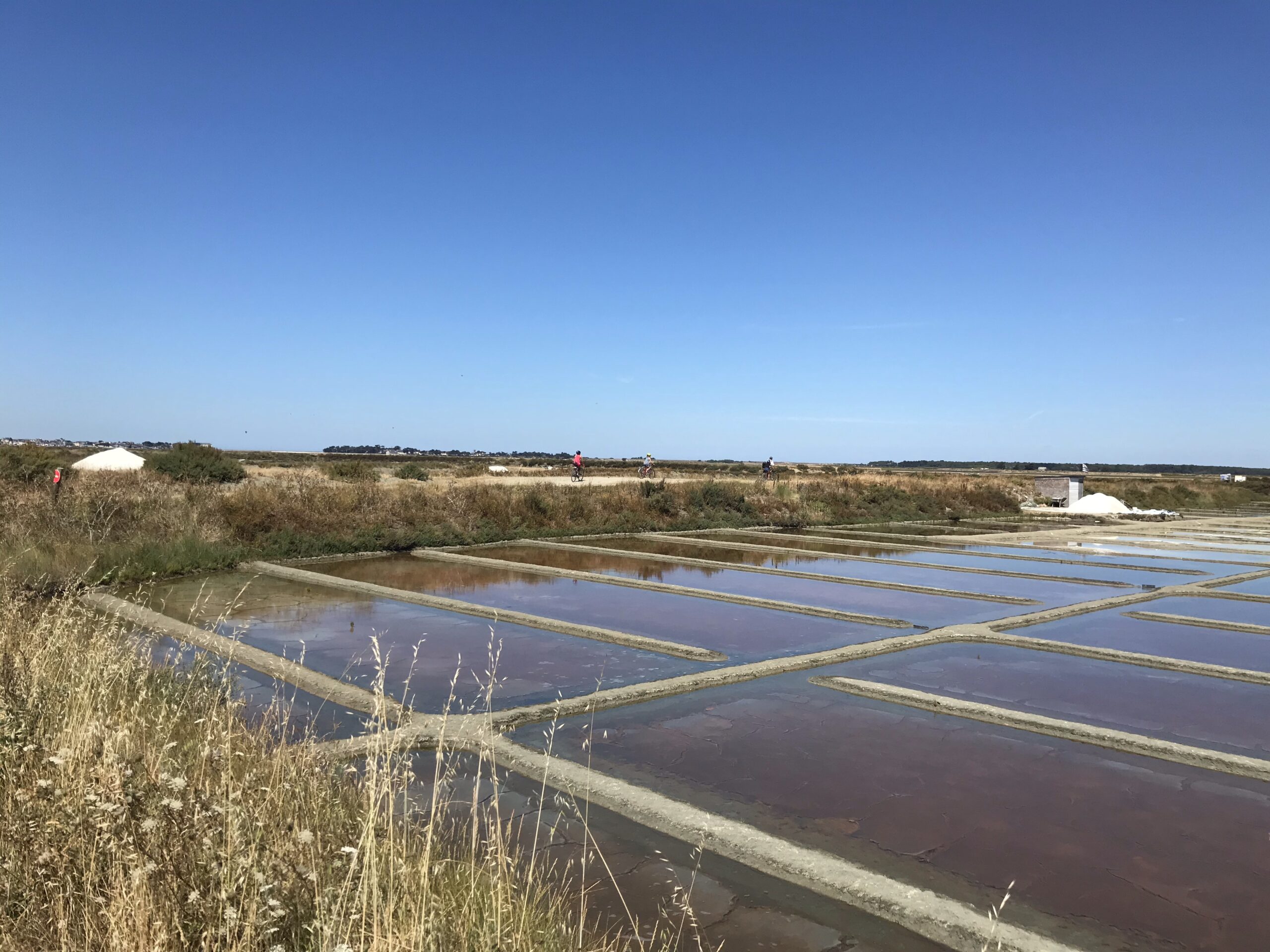
    Salt has been harvested in the bay between Le Croisic and Guérance on the edge of Brittany for centuries. The industry had been in decline but in more recent decades has started to grow again with the local attainment of a ‘red label’ quality status for its salt products.

    We had the privilege of getting a tour of the salt beds with my old friend from Paris days, Ronan when we stayed with his family in the house he grew up in in Batz-sur-Mer. It was a welcome two-day stop on our Summer Tour.

    As Ronan explained:

    • At high tide, sea water flows into reservoirs that stock the water for the day of salt harvesting.
    • This salt water is then directed by an intricate network of channels to blocks of salt beds.
    • Each salt bed is about the size of a typical English allotment. In a salt bed the water from the channels flows in and the flow reduced to almost a stand-still.
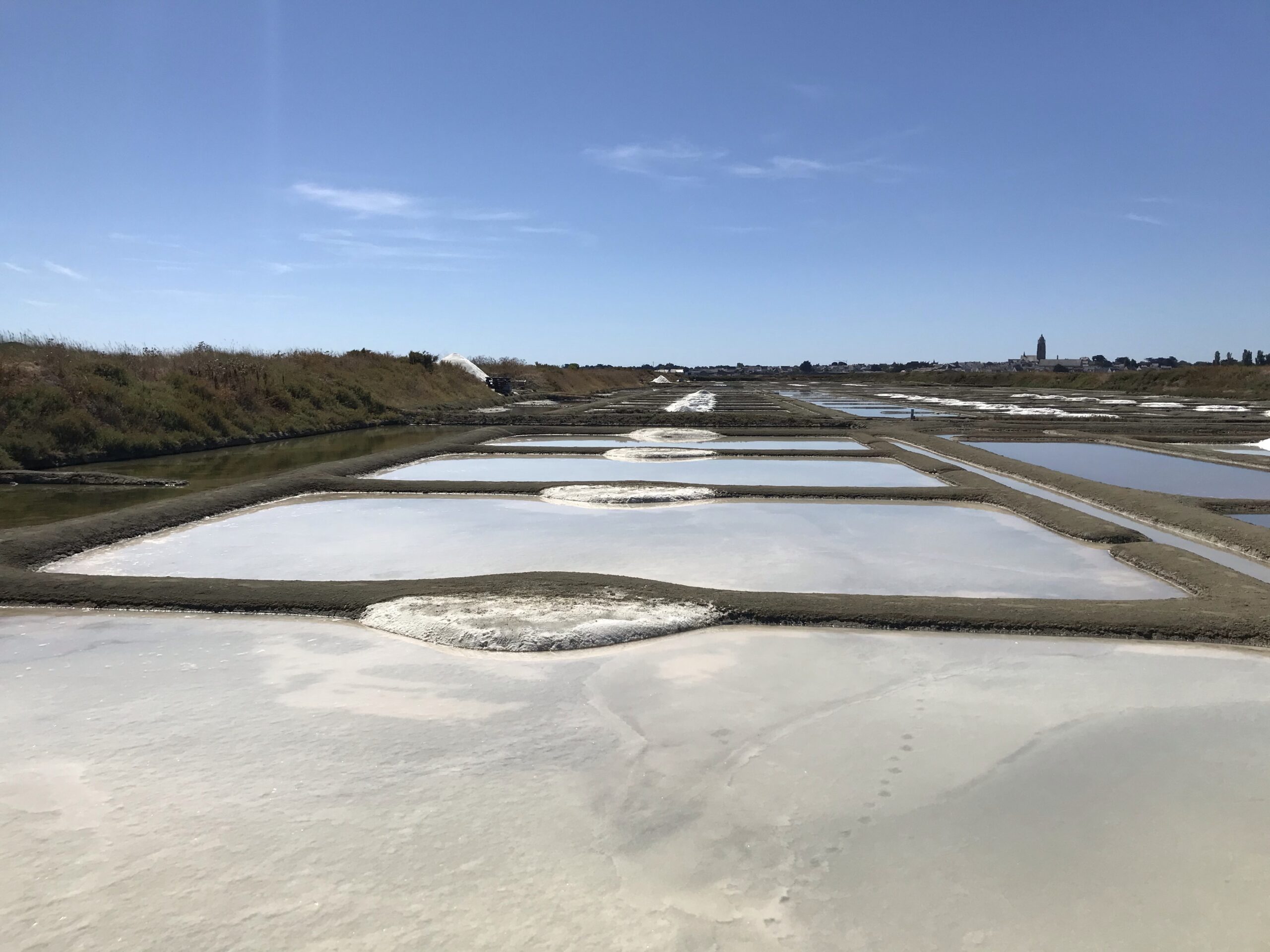
    • During the heat of the day, the water evaporates and salt crystals form. There are two salt products: the purer ‘fleur de sel’, which accumulates on the surface; and the darker ‘sel gris’ which accumulates on the bottom.
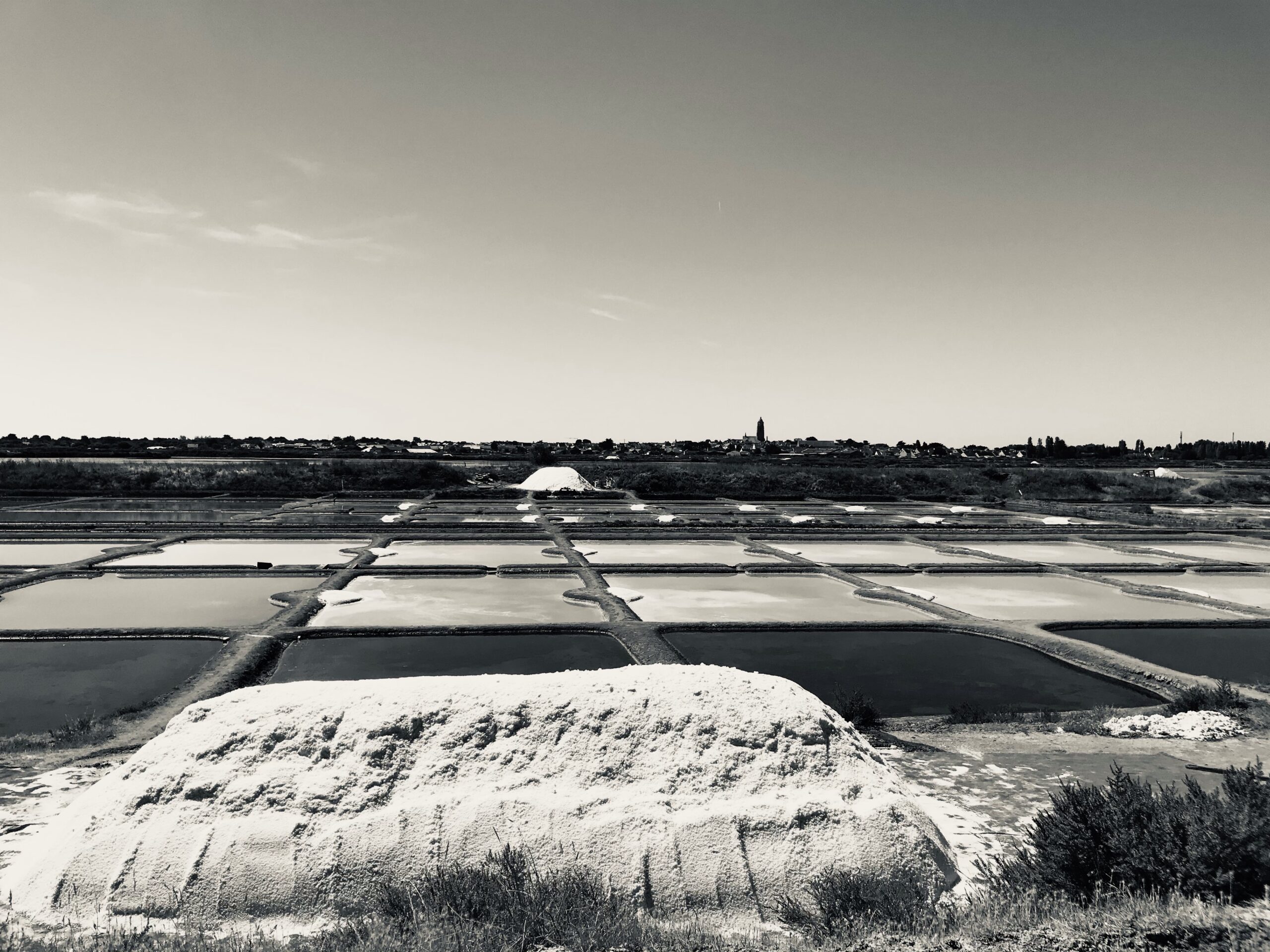
    • Morning and evening salt harvesters walk out to their salt beds and gently scrape the two types of salt out of the beds and pile them up on the side. Single bed can produce a wheelbarrow-full every day in high summer.
    • The salt harvesters transfer their salt to larger communal salt piles, which are then taken to the town cooperative.
    • Individuals and families have harvesting rights over a specific beds.

    I find the salt beds a fascinating example of engineering and commoning. This is a common resource which requires shared infrastructure to harvest. What we take out is bountiful, but requires a shared responsibility for preserving the purity of the resource. Similar to the water irrigation channels that I saw in Mirenna in Spain many years ago.

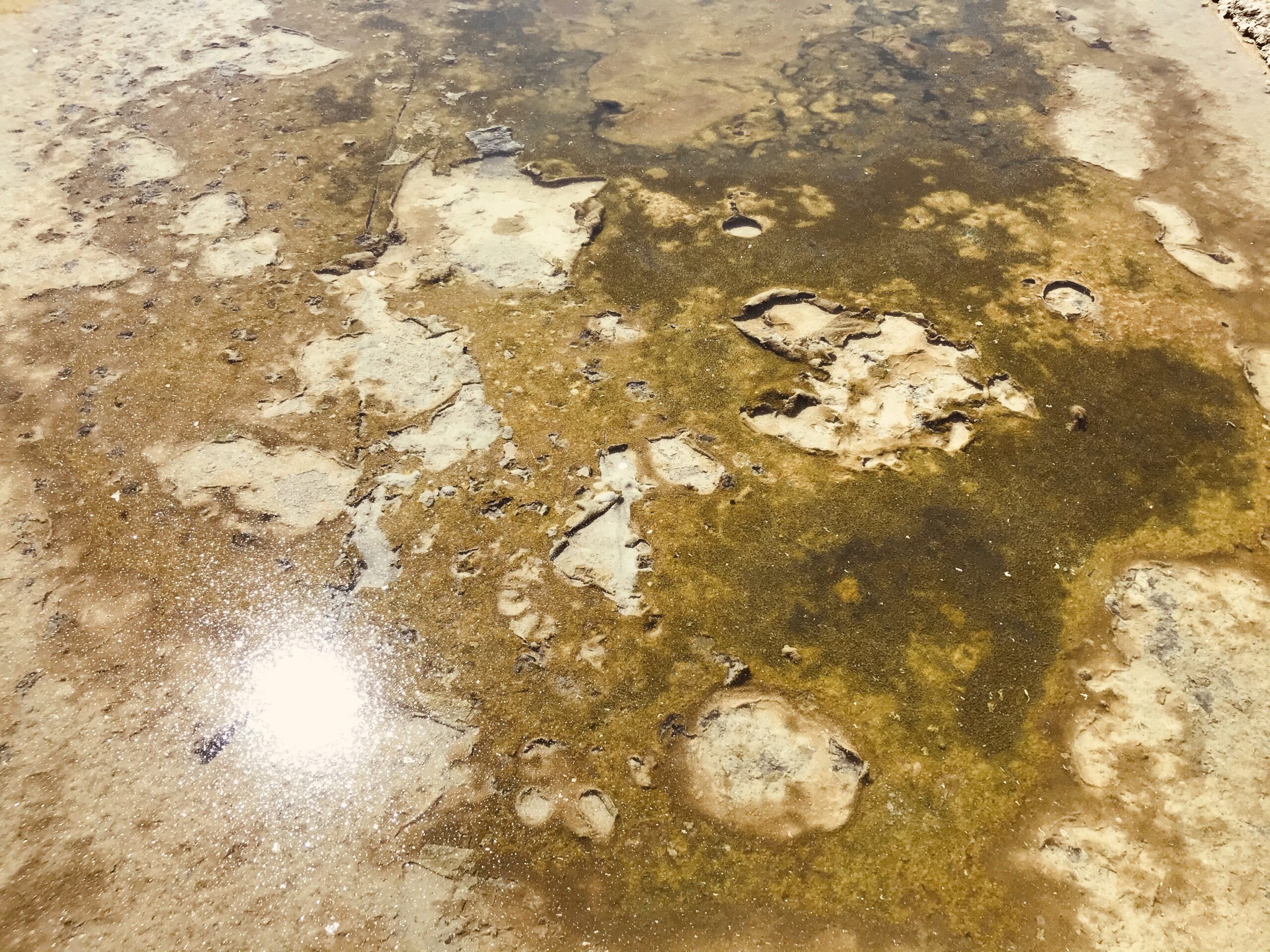
    The salt beds also create wonderful colours. The colour depends on the salt concentration and the angle of the sun.

    A group of salt beds at Batz-sur-Mer
    The morning’s harvest of fleur de sel is gathered up against the wall
    The individual harvests are collected together
    The colours of a salt bed
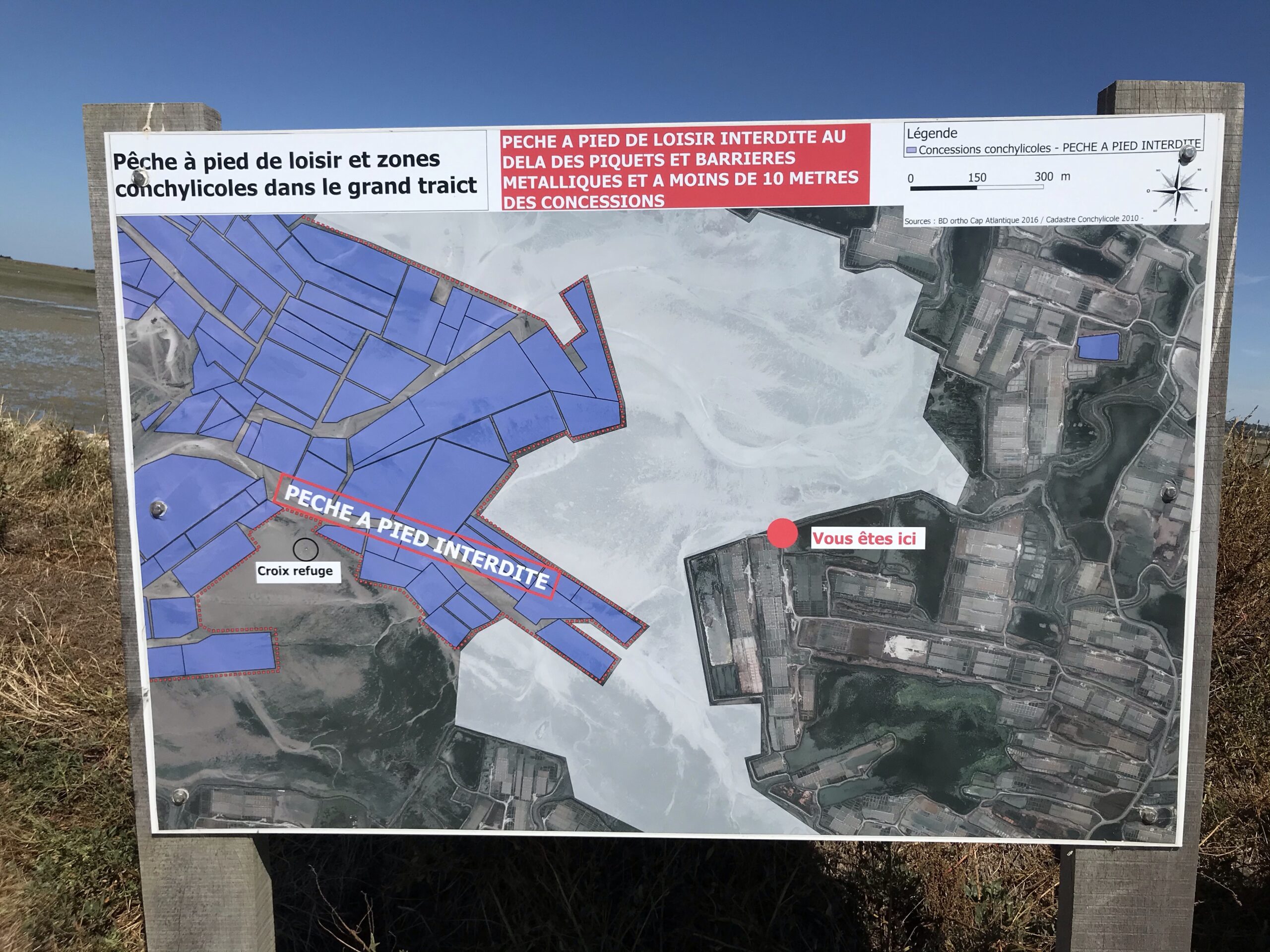
    Map of the salt beds of Batz-sur-Met
    The very slow flow of water through the salt beds – watch carefully.

  • Muides sur Loire – Blois – Amboise

    Muides sur Loire – Blois – Amboise

    The second day of cycling along the Loire. A relatively flat 70km that would get steadily heavier going as the day heated up. The cycle path along the Loire is well signed, well routed through towns and villages to ensure you can get provisions. It also has lots of attractive river-side places to stop for a beer and for kids to play in a playground.

    Our day began in Loir-et-Cher and at some point we crossed into Indre-et-Cher. French départements were created to enable a horse rider to reach any part from the central préfecture in a day. It’s probably the same distance as if you were travelling by bicycle.

    This has been a day of castles. First, Chambord, the famous opulent palace. Then Blois, situated on its battlements in the town centre over looking the river. Finally Amboise, an astonishing fortress which is also where Leonardo Da Vinci is buried.

    My recent reading about commons and land ownership means that I can’t see these places and not think about how the wealth needed to create them is made in part from confiscating land and taxing them local populations. This isn’t news, but these sights are often held in isolation from the story of their creation. At Chambord Europe’s longest stone wall kept the locals out of the forest to stop them hunting and foraging on land that would have been theirs on pain of death.

    These are of course stories of rulers and social injustice from 100s of years ago. Arguably France had a conversation about this imbalance of land ownership in through the Revolution, but in the UK we never have. Consequently we still have owners of massive parcels of land who derive this ownership from William the Conqueror. As we think about how we use local resources to support local economies, we need to have a conversation about returning common land to them communities that surround them.

  • Self-learning in systems, hair engineering + Idler Festival Day 1

    Self-learning in systems, hair engineering + Idler Festival Day 1

    A day of two halves: book writing this morning and then swing dance teaching at the Idler festival this evening, with some hair engineering in the middle.

    Enabling systems to self learn

    I have about ten days to finish the first draft of the two chapters I am writing for James and my book on regenerative design for structural engineers. Today I was writing one of 12 principles for thinking about regenerative design. This one is about enabling systems to self-learn, adapt and evolve.

    As ever, with regenerative design, we are thinking about how to enable healthy system qualities to emerge. It is difficult to write about because for one thing we are not talking about directly doing something ourselves, but thinking about how to set the conditions for a certain desirable quality to arise. The second is it doesn’t always feel close to structural engineering. But with our writing, we are not attempting to fully resolve the picture, rather to show what the arguments are and how they might intersect with structural engineering.

    The question I keep coming back to to guide the writing is, how can we move away from seeing the design of buildings as the ends in itself, and instead as the means of creating a society that thrives within ecosystem boundaries.

    In the built environment context, this idea of self-learning in the system could manifest itself as communities being better able to design and adapt their own buildings. And that that process can put them in greater harmony with their supporting ecosystems. The barriers to this process I wrote today were:

    • A design process that starts too late and stops too soon
    • Specialist knowledge not being distributed in the system
    • Lack of local systems knowledge
    • Discomfort with uncertainty
    • The challenge of hearing our nature responds to our plans.

    Tomorrow I will be writing about how design can enable the emergence of a healthy socio-ecological system structure.

    Hair Engineering

    I have a phenomenal amount of hair. When ever I get it cut, it renews at an astonishing rate. You could say it is an abundant natural system. I am impressed with how tall she was able to make it. You could say I have a High Barnet.

    Idler Festival Day One

    For the first time in two years it feels great to be back teaching at a Festival. This time it is back with my friends at the Idler, for their Idler Festival at Fenton House.

    This evening I was second on the bill, teaching a group of about 30 a solo taster Charleston class. On the playlist:

    Around the World (Daft Punk)/I’ve Got That Tune (Chinese Man)/A Cool Cat in Town – Aerophon Mix (Tape Five)/Booty Swing (Parov Stelar)/Lone Digger (Caravan Palace). Link here to playlist.

    Halfway through the class I spotted someone who had been there in the classroom when I had my first swing dancing classes 18 years ago.

    I was happy to see my friend, dancer Constructivist collaborator, Peter Ayres. Looking forward to spending more time together on the Idler lawn over the next two days.

    Three more classes tomorrow.

  • Notes from RESTORE report Sustainability, Restorative to Regenerative

    Here are my notes from reading the RESTORE report ‘ (REthinking Sustainability TOwards a Regenerative Economy) Sustainability, Restorative to Regenerative – edited by Martin Brown and Edeltraud Haselsteiner – as my part of my regenerative design research. Thanks Emma Crichton for the link.

    On regenerative design

    This is probably the most useful part for me.

    ‘Regenerative design, relates to holistic approaches that support the co-evolution of human and natural systems in a partnered relationship.’

    (more…)
  • Exploring regenerative practice for engineers

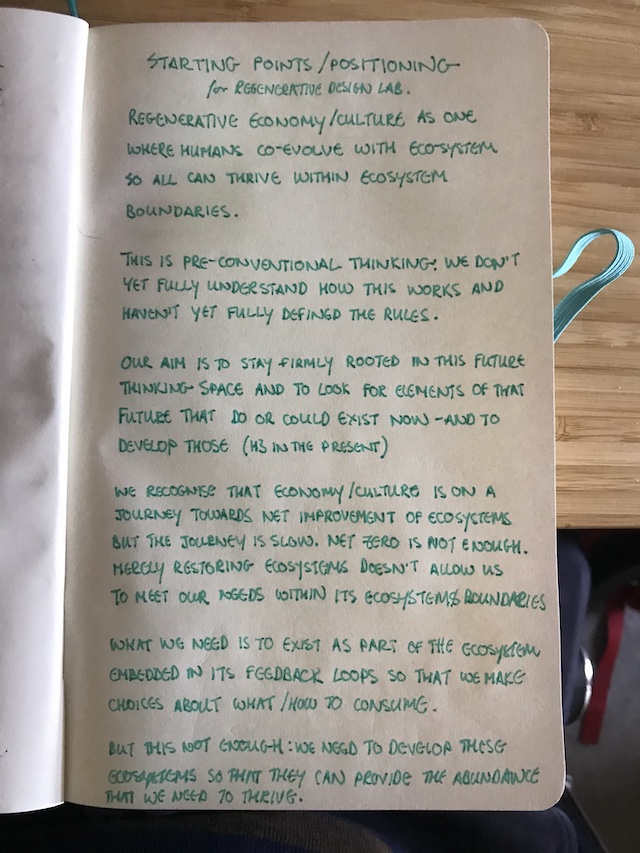
    As James and I start to delve into the writing for our book on regenerative design for structural engineers, I am gathering my thoughts on what regenerative practice might look for an engineer. This is a working-out-loud post to help develop and share my thoughts.

    The challenge with regenerative design is that we are reaching for something that doesn’t yet exist. But if we wait for the answer to be fully formed, the natural systems that we seek to regenerate – ourselves included – may be destroyed beyond repair.

    And so we have to work with what we’ve got:

    (more…)
  • Notes on building local

    This month I am writing an article on that explores what if we restricted construction material use to those from a local catchment. Rather than a global supply chain of materials that is disconnected between source and use, what if we could use materials that were a more locally relevant, resilient and regenerative resource?

    Today at the third of James Norman and my sessions exploring regenerative design with Buro Happold in Bath, we heard about the example of the machine shed at Westonburt Arboretum that was built only timber from the site.

    (more…)
  • Restorative versus regenerative design

    Restorative and regenerative are two words I am hearing used interchangeably. Both are relevant to engineering and design. Both are approaches to design that are valuable. But they need differentiating.

    (more…)
  • Recognise the desert to return it to life

    When renewable systems are over exploited they fall into a desertlike state. In this state the system population is too low to support regrowth and the system structures break down. But given the right conditions and encouragement, regrowth can return. The seeds are all there. The self-organising ecosystem can return to recreate resilience, complexity and diversity associated with rich life.

    (more…)
  • Bristol: from rainforest to desert

    Where I live, coal was so abundant near the surface that you could have dug a hole in your garden and found it lying there. This coal was laid down during the carboniferous period when Bristol was somewhere over the Equator and the ecosystem was abundant with life. This coal is fossilised life.

    Yet walk a few streets north-west and you find a band of red sandstone. By this time in its geological history, Bristol had drifted north towards the Tropic of Cancer and the area had become desert. No more fossilised life, no more coal – just scorched sand. Carry on further north and carbonate limestones return. The desert receded and life came back.

    (more…)
  • Four characteristics of regenerative systems

    Four characteristics of regenerative systems

    Work on regenerative thinking progresses on all fronts. Book writing with my friend James on Monday (read his excellent blog on this process), developing regenerative practice at Hazel Hill Wood Tuesday and short-listing candidates for the Regenerative Design Lab Wednesday. I love that all of these initiatives inform each other.

    To aid all three I have synthesised my understanding of how regenerative systems operate. This framing is informed in large-part by Donnella Meadows’s book ‘Thinking in Systems’, which is helping to understand the conversations are having across all these fronts.

    (more…)
  • Start by lighting the fire

    Start by lighting the fire

    It’s the first thing we do at Hazel Hill Wood. Light the fire for everyone else. A clutch of tiny twigs, a handful of finger-thick branches, and some small logs. I can do this because other have prepared the materials.

    A year ago someone felled a tree and cut its trunk into lengths that fit the stove. Others took these logs and arranged them into seasoning stacks in the forest, where for a year or so they lose their moisture. More people have transferred the partially seasoned timber to the wood stores, where they get bone dry. Finally, someone has filled the baskets with twigs, branches and logs so that I can light it this morning.

    When the room is warm I meet people, and we talk amongst other things about how to manage the forest that provides us with this renewable source of fuel.

    There’s lots that I like about this human-natural system. Every stage is visible, which makes me much more aware of where the things I use come from. The stock levels in each of the stages are easy to monitor, providing me with feedback about how the system is operating.

    I like the long time frame. We have to make decisions now about how many trees to fell in order to meet demand in two to three years. Over an even longer time frame, we need to think about how to manage the forest to ensure there is sufficient regrowth to provide firewood in thirty years time.

    Rather than destructive, this process of carefully felling trees seems to create life: making openings in the forest canopy that form new habitats for plants, for invertebrates and the animals and birds that live on them.

    Most importantly for me, it is a brilliant example of how we can manage human-natural systems that regenerate to meet our needs with little more than the energy of the sun.

    When I start by lighting the fire, I am engaged with this human-natural system. It primes me to think, what work do I need to put into the system today to ensure it continues to regenerate.

    Photo credit: Joseph Watts

  • Think resilience to observe and enhance a system’s restorative powers

    I underlined these words in Meadows’s Thinking in Systems primer. ‘Thinking about resilience enables us to observe and enhance a system’s restorative powers.’ As with so much in this book it is an efficient sentence that carries so much meaning. This is my thinking-out-loud (not so efficiently written, but I find it helpful).

    This quote that I have pulled out is at the end of a section of the book on the characteristics on well functioning systems. The three ingredients are resilience, self-organisation and hierarchy. Natural systems are very good at using these three ingredients to build ever more complex systems that can respond to a range of scenarios in a self-organising way.

    (more…)
  • Regenerative Design: a process not a thing

    Regenerative Design: a process not a thing

    As I continue my exploration of regenerative design in engineering, correspondents have said it would be helpful to gather examples of regenerative design. Templates that we can look at, imitate and integrate.

    From my reading of Wahl (see my recent post), I’m increasingly understanding regenerative design to be a process rather than a thing.

    Regenerative practice of any sort (in design, in education, in living…) is practice that leaves the ecosystem richer and better able to heal itself. It is practice that sees humans as a keystone species that play a unique role in helping their ecosystems thrive.

    (more…)
  • Reflections on transformational innovation

    These are my reflective notes as I work through chapter two of Daniel Wahl’s ‘Designing Regenerative Cultures‘. My aim in this reading is to find clues as to what a set of principles for regenerative design for engineers could look like.

    Wahl introduces three types of innovation:

    • Sustaining innovation – that which keeps the current system working
    • Disruptive innovation – that which introduces new operating systems
    • Transformative innovation – that which is the ‘long-term innovation process of fundamental changes in culture and identity.

    He argues that if we want to achieve a transition towards a regenerative culture, it is this third kind of innovation that we need.

    (more…)
  • Updates from a regenerative system

    Updates from a regenerative system

    Our nearby allotments are my local source of food and regenerative inspiration. Sharing my thoughts from this weekend’s visit when I was helping with apple pressing.

    While Bristol is well served by local a scene of craft breweries, if you really want to get local alcohol, then cider is the hyper local choice. Whereas the ingredients for beer are gathered from around the world to be brewed in here, in Bristol you can drink cider under the tree that the apples came from.

    (more…)