Tag: traffic

  • Smoothing things out

    One of earliest childhood memories of travel is riding in the back of the car driving along a motorway in mountains in the north of Italy. To traverse a terrain of deep valleys and high ridges the engineers had taken a midline. The road leaps across the ravines on high viaducts, plunging straight into a tunnel only to fly out again across the next bridge. With the sea glistening deep below it was an exhilarating journey. (Did this sow the seed of going into civil engineering?)

    Faced with a series of peaks and troughs the engineers flattened the journey. They saved journey time and energy on every single car journey on that route, every day for over half a century.

    Smoothing things out is something that engineers seem to be generally good at. For example we’ve been straightening rivers to make them more navigable for centuries. 

    But building faster, straighter roads also increases traffic. Straightening rivers increases flood risk. 

    When we start to consider the unintended consequences smoothing things out we might find that working with the ups and downs and twists and turns is better. The friction slows down the flow. People or water, in these examples, spend longer in each place. There is greater interaction and opportunity exchange and creation of wealth in its many forms.

    Next time I cross the Italian Alps hopefully I can do it on a bicycle, following the contours of the river valleys.

  • Recognise the desert to return it to life

    When renewable systems are over exploited they fall into a desertlike state. In this state the system population is too low to support regrowth and the system structures break down. But given the right conditions and encouragement, regrowth can return. The seeds are all there. The self-organising ecosystem can return to recreate resilience, complexity and diversity associated with rich life.

    (more…)
  • What if the screen you are now using is your last?

    What if the screen you are now using is your last?

    One day I hope this article will be printed in a book. But until then I can be fairly sure that you will be reading it on a screen. In 2021, that is most likely to be a phone, a tablet or a desktop, or possibly some sort of wearable device. In the future, that list could include countless other devices: a web table, a car dashboard, smart glasses, digital wall paper – even a hologram? Such is the speed of technological development that it is only natural to assume that whatever device we have now it will be renewed and upgraded to the next thing at some point. But what if that weren’t true?

    (more…)
  • More lanes = more cars. More apps = more things to do?

    More lanes = more cars. More apps = more things to do?

    Deleting apps and leaving your phone at home could be analogous to dismantling urban highways.

    I read earlier this week about the research that established a direct link between building more roads and the level of traffic in a system. The researches established a directly proportional link. Increase road capacity by 10% and traffic increases by 10%. The causal link is that when you increase road capacity, you make it easier for more people to make more journeys. And so more people drive until the new road reaches capacity. At which point the traffic stops growing until new roads are built.

    (more…)
  • Universal Cycle Flyover

    Universal Cycle Flyover

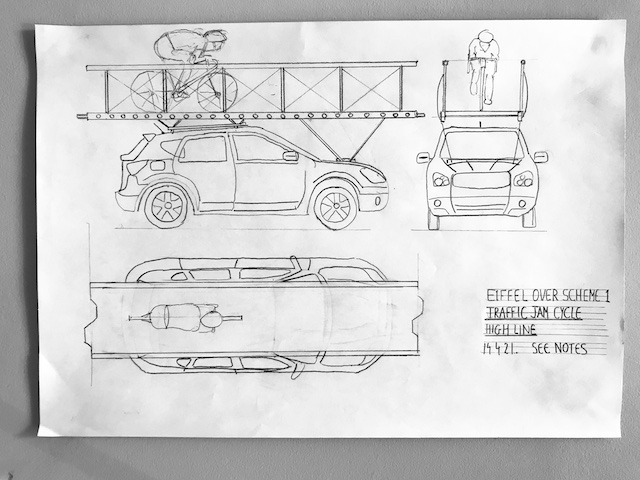
    The daily traffic jam on my local high street has inspired me to think about a way to turn a traffic jam into an opportunity to a way to create safer cycling. This solution is win-win: car drivers get to stay in their cars while facilitating the creation of more traffic-free cycle routes in and out of our cities.

    The concept is for all cars to be fitted with a light-weight section of Universal Cycle Flyover, designed to fit most any vehicle. Cars approaching a traffic jam simply park close enough to the next car to to enable a continuous connection for the cycle deck.

    (The scheme shows a cyclist on a racing bicycle. Of course other types of bicycle would be encouraged, I just started the sketch too close to the top of the page to fit a more upright riding position.)

  • On traffic

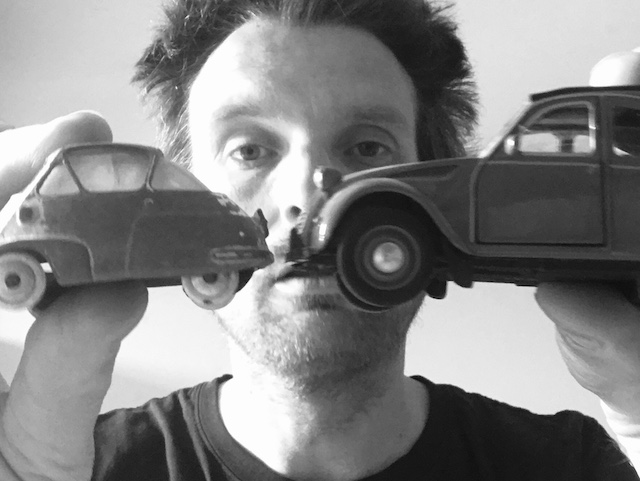
    Drivers, please don’t complain about the traffic: you are the traffic

    Broadbent, O. (2019). Internal monologue everytime I hear a driver complain about the traffic. Bristol.