I am sitting at the Kit Kat Cafe, perched on the dune at the back of Camber Sands, a vast stretch of sandy beach in East Sussex. The beach is full of people enjoying the warm Autumn sun. In the distance there are kite surfers, and along the shoreline riders are galloping their horses in the shallow water.
Author: mazda
-
Good laughs at Science Showoff
I went down to Science Showoff last night at the Wilmington arms, ‘an open mic night for all communicators of science’. The spectrum of material covered was rather large: from shining infra red light through the skulls of babies, to the biochemistry of baking; from the sad world of lonely neutrinos to the history of the space shuttle programme as told through a mash up of archive footage.
-
Notes on ‘The Art of Doing Nothing’ by Tom Hodgkinson
This post is for the Front Row gang (you know who you are). Since we were talking about the concept of Fun for Free at the last Front Row session, here is a rough-and-ready summary of the essay where I first heard of the concept, ‘The Art of Doing Nothing’ by Tom Hodgkinson. The essay appears in a book called ‘Do Good Lives Have to Cost the Earth’, edited by Andrew Simms and Joe Smith.
(more…) -
Resisting Ikea – preparing for Monday’s sustainability conference
I spent most of last weekend preparing for a sustainability conference that we ran on Monday (post about that event appearing shortly). I know from experience that the last few days of organising any event like this always involve a mad dash to the shops, and this time was no different.
[slideshow]
(more…) -
Half a million pounds to save Roald Dahl’s hut?
This morning the Today programme ran with the headline “£1/2Million to save Roald Dahl’s writing hut”. I woke up thinking ‘how can that be’?
(more…) -
Using the Flipped Classroom model with Expedition Workshed
It’s been one of those days where everything comes together. I have spent the day working on Expedition Workshed site, in particular a new blog aimed helping us have a better dialogue with the teachers who are using the resource in their teaching (I will post a link to the blog when it is ready in a couple of days). At the same time, I have been contributing to discussions related to a new paper that we will be publishing that sets out a model for understanding how structural engineers learn.
And now this evening I have been reading this interesting blog post (http://usergeneratededucation.wordpress.com/2011/06/13/the-flipped-classroom-model-a-full-picture/#entry)about the Flipped Classroom model for teaching, in which material usually delivered during the lecturers and in class is instead delivered via online resources, freeing up classroom time for problem solving, group work, debating, creating and communicating. The post has some overlap with the paper that we are working on, and has got my cognitives whirling away thinking about how Workshed can be used to deliver the at home content.
The post sets out a cycle of learning with four stages:
1. Experimental engagement through hands-on activities, games etc
2. Concept exploration through content-rich website, pod-casts, online chats etc
3. Meaning making through reflective blogging, podcasts
4. Demonstration and application through creative personalised projects and presentations.So here’s my idea (and hopefully before too long I will be able to try it out). I would like to create a lesson plan for s series of activities that teach school children about construction materials and the fabric of their school.
The first stage would be a series of games and discovery activities using the fabric of the school is a stimulus. Learners could for example try to make a model of their school building out of paper, and see what they need to do to make it stronger.
In stage two they would go away and find out about materials and basic structural forms using the resources on Workshed.
In stage three would answer quiz questions about materials and simple structural forms using the interactive tools on Workshed.
In stage four, they would come back to the classroom and work in groups to develop their own design for a new school building, creating a poster or a model, and presenting their proposal to their classmates.
Whilst I have developed teacher packs before based around the design-and-build methodology, this post on Flipped Classrooms has motivated me to think about how the design-and-build can be more thoroughly split out and developed. I look forward to giving it a go.
-
Ideas on the theme of ‘fun-for-free’
Hold your own mini-Olympics
We did this last weekend down at my grandmother’s house. We had had plans to go to the local river where there is a lovely beach but the grey skies put paid to that. Then from somewhere the idea sprung to mind of the five of us staying in and holding a track-and-field tournament.
We assembled the props: a parasol stand for a javelin; a boule for a shot put; an old plate for the discus; some beach bats for tennis; a rope between two trees for volleyball; and fruit packing cases for the dressage. My grandmother was the judge.
Poles were thrown; shots were put; a plate was smashed; points were won; tempers were lost – and found again with administration of tea; and medals were presented.
Next up – our own winter Olympics?
 (The discus that got away – two others were not so lucky)
Learn to tight-rope walk
With a few props, practicing circus skills seems like something you can do pretty much anywhere. Here the prop was the rope that we had used for the volleyball net in our mini-Olympics. Pulled tight between two trees at about two feet off the ground, it was hardly death-defying, especially when, under my own weight, the rope stretched, lowering me to ground-level. I fear a lot more practice (using stiffer rope) will be required before I become a funambuliste.
-
A rockabilly festival and a 2CV convention – an extraordinary night out in rural France
 At some point in the future I would like to spend some time living in the area of rural South West France where the French side of my family is from. The idea is especially appealing when on holiday in that part of the world. But I often wonder, what would day-to-day life be like?
During our recent stay at my grandmother’s house, we went out on a Saturday night. As I drove down the dark and empty Route Nationale, I thought, is this what a big weekend night out might feel like, somewhat downbeat about the prospect.
Our first stop was a community centre situated above our local river beach. We had seen advertised that there would be a night of live swing music. The roads en route had been empty, and the town centre equally so, so we were surprised to find the venue packed with groups of people of all ages eating piles of moulles frites around long tables. The band came on – a manouche ensemble – and they played a lively set, although my flip flops and the empty dance floor made me disinclined to want to bust out any moves.
On the way in we’d seen there was a campsite and we went to check it out. At the entrance were parked two 2CVs; another was parked in the car park. Unusual – almost like a 2CV convention I thought. Exactly like a 2CV convention it turns out: every car in the camping site was a 2CV. They came in all models and colours, with modifications, some in classic colours. Large groups of people sat around gas lights, or the full beams from the cars, eating and drinking together. 2CV drivers seem to be happy people!

Coming home we thought we’d check out the next village where we’d heard there was a weekend-long rockabilly festival. Not expecting to find much (I am ashamed to say – who am I to be sceptical?) we could barely enter the village for the lines of cars parked down either side of the busy Route Nationale – some even parked down the middle. We came upon the school field and found hundreds of people gathered wearing rockabilly finery, lit by the sideways glare of flood lights and the lamps of dozens and dozens of Harley Davidsons parked up in rows. In the big tent that rockabilly band was jumpin’, the crowds were dancing, and we dived in, flip-flops and all.
At the exit there was a souvenir stand selling posters and tins of the local confit de canard.
Every time I return to this part of France I find more and more things going on, and only partly I think, because I wasn’t looking hard enough before! And while there would be obvious differences between a night out there and just hoping on the Victoria line, there is plenty to do, and perhaps even more opportunities to make your own fun.
-
Looking back from the future: Useful Simple Trust’s first decade, as told in the year 2020
As part of the Useful Simple Trust Away Day in June 2011, eight Trustees and Directors were each asked to compose and present a five-minute piece giving an overview of the Useful Simple Trust in the year 2020. These pieces, in various formats, from a virtual 3D Skype teleconference to an epistemological exchange were presented to the audience from within a hanging shroud of black material – an opaque tent representing a barrier between the future and the present. Below is an approximate transcription of what I said.

“Hello, can everyone see me? Looks like it. Good. This 3D Skyping system is incredible: it feels like we are in a room together when in fact we are all of us is in different parts of the world. So, greetings to the team of consultants working on the 2020 Qatar Olympics. Hello to the team working at the UN’s floating HQ for climate change mitigation strategy, currently moored somewhere over Norfolk. And of course, hello to the team of engineers in Belgium working on the infrastructure reconstruction programme following the recent civil war out there. I will begin.
“I have been asked to say a few words to characterise the way the Trust works, and describe the key moves that we made over the last decade to get us to where we are now.
“I would say that the environment in which we work is firstly characterised by extensive and complex overlapping networks of personal and professional contacts. We use these networks to learn, to share information, to collaborate on work and to market our services. We make far more use of our personal social capital than we ever did before, and our communication using these networks is completely decentralised.
“The second characteristic relates to where we add value. Information is cheap, and with the development of automated Google research projects, there is a phenomenal amount of data available at our finger tips. At the same time, much of the process work that we used to carry out in the UK is now carried out for a fraction of the price abroad. Our skill as an organisation has therefore become the assimilation of information and the creative design of strategic solutions to problems, on which we must then collaborate with other partners internationally to deliver.
“Thirdly I would like to characterise how we work as individuals within the organisation. Seeking to avoid specifics, I describe the staff as being made up of ‘omni-workers’, apprentice ‘omni-workers’ and mentors. The omni-workers have the key trinity of skills: assimilation, creative problem solving and business sense. Plying the avenues of their complex personal networks, these members of staff work as individuals, collaborate with other organisations, or collaborate with other omni-workers wherever the work may be. They are accompanied by apprentices who are learning their trade, and they are guided by mentors who offer up their own experience by way of training.
“To conclude a description of the working landscape, I will describe where it is we work. The short answer is wherever the work needs to be done. We are a highly decentralised interconnected workforce but with robust links to centralised online resources and administrative functions that support us.
” I will now describe the five decisions that the Trust made that were key to getting us to where we are now:
1. We recognised long ago that specialism would increasingly become a liability, and that the asset would be the skill of information assimilation and collaboration with others.
2. We also recognised the immense social capital of the organisation, and the power of an individual’s personal and professional networks to share information, to collaborate on projects and to promote our activity.
3. We decided to identify a number of key societal challenges that we would seek to collaborate on and work towards solving in our projects – thus developing a polemic for the organisation.
4. We recognised the need to raise the level of overall business strategy awareness of the organisation, and set up an internal business school to do so.
5. We packed up our bags and left Morley House, our former HQ in Oxford Circus, and we followed the work.
“As for any regrets over the last decade? I would have to admit to at least three: working far too hard in those early years – not recognising the need to prioritise; not identifying the key societal challenges that would be the focus of our work; and only taking one sabbatical in the last ten years and not two.
“Thank you very much”
-
Showreal – Millennium Bridge Micro Documetary
Early this year I was filmed presenting a short clip about the Millennium Bridge by a TV production company developing a concept for a new engineering show. We did the shoot on a freezing January lunchtime. Producer/Director Nick Watson has just posted the clip on YouTube. Thanks Nick!
http://www.youtube.com/watch?v=bJoCc3OyCwA
-
Excited about resource scarcity
I just found myself getting quite excited about resource scarcity. Not the fact of depleting the earth’s resources, but that the subject is relevant to three things that I can claim to know something about: engineering, chemistry and explaining science.

Yesterday I was doing some background research for a new teaching resource that we are exploring developing at Think Up related to resource scarcity and material choice. The resource could become part of Workshed. The starting point for my work Michael Ashby’s book “Material and the Environment, Eco-informed Material Choice”
All the time I was reading I was thinking how interesting it would be to create ways of explaining some of these complex and multidisciplinary issues in an engaging way – from the maths required to understand the economics of resource scarcity, through to understanding how to optimise the design for the whole life of the product.
Here are some choice facts that struck me from the first chapter:
– in 1930 it was estimated that the world would exhaust its stock of copper in thirty years; in 2008, the remaining reserves of copper will still estimated to be exhausted in thirty years.
– the global annual consumption of steel is greater than that of all other metals combined
– the weight of wood used annually in construction is greater than the weight of steel
– the weight of concrete consumed in construction annually exceeds the weight of all other construction materials combined.
The book then goes into detail about the economics of resource depletion and processes for assessing the environmental impact of one material over another during the design process.
Watch is space for teaching resources of this flavour.
-
Compressing my ‘cello
Yesterday I compressed my ‘cello

– that is, I turned the tuning pegs, winding up the slack in the strings and gradually started to increase their tension. At first the strings wouldn’t make any noise; and then gradually, as the tension increased, they became audible. At the same time, the wood in the main body of the ‘cello started to creak and groan, and I have to confess I became a little scared.
I started playing the ‘cello when I was five and gave up at sixteen, finding the guitar a much more exciting prospect. During those eleven years of playing, I had given little thought to the forces that the instrument must withstand. Since then I have completed an engineering degree, and so now when I look at the fragile wooden structure I find it surprising that it should be able to resist the forces that the strings place on it.
I remember being told that as instruments in the violin family age they improve because the effect of the tensioned strings is to compress the structure. The strings are stretched from the tuning pegs, over the bridge and loop over the bottom edge and around the sound peg, effectively squeezing the whole box together. This is in contract to a classical guitar, in which the strings stretch from the tuning pegs but stop at the bridge. When guitar strings are tightened, rather than squeezing the box together, the effect is to pull up on the bridge, effectively pulling the front off the sound box. Guitars are therefore said to decrease in quality with age.
I learned the hard way about the physics of guitars at age fifteen when I decided to replace the nylon strings on my mother’s acoustic guitar with steel strings to create a brighter, more jangley sound. Unfortunately the only sound I got was a cracking noise just before I ripped the bridge off of the front of the instrument.
So with that experience in mind, and some engineering under my belt, I was getting increasingly nervous as I upped the tension on my dusted-off ‘cello. The other reason why I was nervous was that until recently this ‘cello had been a collapsed bag of bits in the corner of a basement. The instrument has belonged to my Aunt. Many years ago it got consigned to the cellar, forgotten about, squashed and ultimately broken. About five years ago, it was dug out and my Dad kindly had it restored for me. My end of the bargain was that I would do a little practice now and then. The instrument was reassembled by the late Geoff Crease, the instrument mender that had supplied my first 1/8th-size ‘cello from when I was five. His parting words to me were that though fixed it remained very fragile. That was five years ago. Almost immediately the fingerboard fell off and I lost it, only it to find it again six months ago hiding in the back of the ‘cello case. It has since been stuck back on, and so it was yesterday following a trip with my Dad that I decided to give it ago.
With all that in mind that I found it excruciating to tune the strings up those final few semitones: the strings driving the back of the finger board down on to the instruments shoulders, which in turn put the thin front and back into compression. With every turn of the screw I expected to hear that cracking noise, followed by the implosion of my fragile instrument. And so it was with great relief that the A string reached 440Hz, and I could begin playing – well, scraping.
Since then I have managed two half-our practice sessions. My aim is to get good enough this summer to audition in September for the Angel Orchestra, which M plays in. Whilst tuning up for me was excruciating, I am sure it will be even more so for my neighbours who will have to hear me preparing for that audition. Does anyone have a practice mute?
-
New Year’s Day – Gauguin: Maker of Myth

M and I have been meaning to go and see the ‘Gauguin: maker of Myth‘ exhibition at the Tate Modern for some time. The reviews have been great, the main criticism the huge crowds. With the exhibition due to finish soon these crowds were only likely to get worse. On New Year’s Eve I remembered I previous NYE when we were on a skiing holiday. Fresh snow had fallen during the night and so we had set our alarm clocks painfully early on New Year’s Day to make the most of the virgin snow. We were the first people on the slopes and it was magical – well worth the effort. Inspired by this halcyon vision, I booked us in for a 10am slot at the Gauguin on New Year’s Day. It was only slightly painful and well worth it.
The exhibition is arranged around a number of themes, such as treatment of women, or religion; and not in chronological order. For me the effect was to focus my attention not on the painting and sculpture but on the man himself – something which I imagine Gauguin would have been pleased with.
I was moved and fascinated by a great number of the paintings- particularly in the way that the colours seem to sizzle; and in the way that some of these paintings seem to open the door to artists such as Matisse.
But what really surprised me was the remorseless pursuit of his own agenda. Nothing (including a wife and five kids) would stop him pursuing the romantic primitive ideal that he seems to have got a flavour for at the colonial exhibitions that he visited in Paris, which eventually took him to Tahiti. And when he got there and found it not as primitive as he had hoped, he just painted what he had wanted it to look like, and spread syphilis in the process- classy.
A very interesting exhibition and morning out. By lunchtime a Bloody Mary and a delicious veggie breakfast at Bill‘s offset the creeping return of the New Year’s hangover. Toast and curry for dinner: not a bad start to the year.
-
Hamlet at the National Theatre – what an epic!
Today I saw Hamlet for the first time. The production that M and I went to was at the National Theatre. Perhaps I shouldn’t be so surprised, but what an epic play it is! There’s murder, deceit, revenge, love, pirates, Denmark and swash-buckling sword fights. I particularly enjoyed the way that this modern production turned the King of Denmark’s speeches into press conferences complete with press advisors and secret service guards. I also liked the mic hidden in the Bible – nice touch.
-
Belly dancing, Charleston and keepy-uppies – civic participation in action
[youtube=http://www.youtube.com/watch?v=3gooD14xRh4&hl=en_US&fs=1&border=1]
This morning I was delving further into Bowling Alone (more notes to follow); by this evening I found myself performing at the Charity Gala, Oak View School – part of the Loughton Festival, and the sort of charity event that this book both celebrates and of which it reports the decline.
I had long had this evening’s dancing gig in my diary but I hadn’t really found out anything about it until I arrived. We cobbled together our routine in the car park – which provoked a few stares) and then went in for the show. I was quite astounded by how eclectic the mix was. We were preceeded by a belly dancing troupe, a folk group who sang about dismembered limbs, and a mandolin player (that we didn’t see because we were busy rehearsing our moves). Ours was the Charleston routine that we have used to tread the boards of a fair few Essex venues now; nevertheless I am glad we got that car park rehearsal in – it paid off. But the show stopper was the guy after us who did endless keepy-uppies to music. It’s amazing what hidden talents people have. The world is a better place for them!
I won’t know what Joseph Putman says about how to reverse the decline in social and charitable events until I get to the final section of his book; I would like to think that belly dancing, Charleston and keepy-uppies have a role to play.
-
Social capital – Reading Bowling Alone No.1
The concept of Social Capital came up during my research for Expedition Think Up Mondays. It was in the midst of a conversation about values. The individuals in that group quickly identified that they each bring the value of their personal networks to the group. On a rainy Monday a week later in Islington Central Library I explored this theme, and quickly came upon the notion of Social Capital, and Robert Putman’s highly regarded book ‘Bowling Alone – the Collapse and Revival of American Community’. The book explores the theories relating to social capital, its rise, decline and possible resurrection in America.

The Expedition Think Up Monday programme is long finished, but understanding and growing social capital seems to be at the core of what I am doing with Think Up, the Useful Simple Trust and through my volunteer role at the Institution of Civil Engineers. I have decided therefore to read Putman’s book and log my notes here, with the hope that rearranged, with some retained and some discarded, they can help with the formulation of a vision for how these organisations could work.
Bowling Alone – Chapter 1 Thinking about Social Change in America – notes
Putman notes a general trend that up until the mid-sixties there was an ever increasing involvement of citizens in civic life, be it in sports and social clubs, benevolent societies or in public office; since then however, there has been a considerable decline.
“In recent years social scientists have framed concerns about the changing character of American society in terms of the concept of “social capital”. By analogy with notions of physical capital and human capital – tools and training that enhance individual productivity – the core idea of social capital theory is that social networks have value. Just as a screwdriver (physical capital) or a college education (human capital) can increase productivity (both individual and collective), so too social contacts affect the productivity of individuals and groups.”
Some social capital results in personal benefit, as in when any reciprocity is specific – I’ll scratch your back if you scratch mine”; more valuable to society however is generalized reciprocity: “I’ll do this for you without expecting anything specific back from you in the confident expectation that someone else will do something for me down the road.
On reciprocity, “‘If you don’t go to somebody’s funeral, they won’t go to yours.’ – Yogi Berra”
Frequent interaction among a society of individuals tends to cause more generalised reciprocity. [pg 21]
Your social capital comes in many different shapes and sizes – eg sunay schools, family, internet chat groups.
The external effects of social capital are not always good. Terrorist groups depend on social capital.
‘Therefore it is important to ask how the positive consequences of social capital – mutual support, cooperation, trust, institutional effectiveness – can be maximised and the negative manifestations – sectarianism, ethnocentrism, corruption – minimized. Towards this end many different form of social capital have been distinguished.’ Pg 22
There is a distinction between bridging capital and bonding capital.
Bridging (Inclusive) capital
Outward looking and encompassing people across diverse social cleavages. Eg. civil rights movement, youth service groups.
Good for establishing specific reciprocity and mobilizing solidarity.
A socialogical superglue
Good for getting ahead
Bonding (exclusive) capital
By choice of necessity, inward looking and tend to reinforce exlcusive identities and homogeneous groups. Eg Ethnic fraternal organisations, country clubs.
Better for linking external assets for information diffusion.
A socialogical WD40
Good for getting by
Many people bond in some dimensions (class, race) and bridge in others.
Putman’s maxim for evidence in his book is similar to the jounralist’s two source rule: never report anything unless two independent sources confirm it.
The last page of the chapter reveals the inspiration for the books name: two people from quite different socio-economic backgrounds come into contact with one-another through a bowling team. The aquaintance leads to the younger of the two offering to give his kidney to the older of the two who has been on a waiting list for three years.
Comments
The Useful Simple Trust exists to blaze a trail in the integrated, intelligent and humane provision of the human environment. Freed from the traditional contraints of serving the aquisition of financial capital, the beneficiaries should be look at (and already are, although not necessarily framed in these terms) look at what social capital they have between them, and look to unlock and stimulate the social capital. One idea for Think Up in this instance is to run an event that helps everyone realise our collective social capital, and explore what good we can do with it, and examine how we can grow it.
At first sight, the Institution of Civil Engineers is an organisation that consolidates bonding capital but that wants to create bridging capital. This very concise observation I feel help me shape my input into the ICE London Region’s strategic direction.
-
Touring the Capital with ICE President Paul Jowitt

Article written for the ICE London’s newsletter in my capacity as Chair of the London Graduates and Students.
Touring the Capital with ICE President Paul Jowitt
ICE President Paul Jowitt’s visit to the London Region.
At the beginning of March I was invited to tour the Capital with ICE President Paul Jowitt. The day long tour was his formal visit to the London Region. I always find the President’s visit to the London Region a funny thing because the President inevitably spends a large portion of his time in the area anyway; nevertheless the President’s visit is intended to be the time at which he or she is formally given a tour of the London Region to hear about the work that this region of the ICE has been up to, as well as to find out about the engineering projects taking shape at the moment. The story of the day was two-fold: great engineering works, and great work being carried out by the ICE London Region volunteers and staff.
The day started with a tour of the Olympic Site. We met at the View Tube, the Olympic Park’s luminous visitor centre from where all the main stadia can be seen whilst munching on the most up-market breakfast butty (read ciabatta) in town. Touring the site in a bus, our tour guides went to great lengths to tell the story of the engineering that we couldn’t see: the park’s extensive infrastructure and enabling works, which were up for an award at the evening’s ICE Merit Awards.
A sprint across town took us to the BBC for lunchtime where we met a group teenagers taking part in an ICE/BBC/Collaboration. The group had been filming interviews with members of the public about Crossrail. We joined them while they were making edits to their films in the BBC’s edit suite designed specifically for school groups. All were amazed by just how the students came alive on camera. One participant didn’t realise that he had managed to coller former Controller of BBC One Alan Yentob into doing an interview. That same student said to me later that it had been the best day of his life. Full credit then to Susan Clements at the ICE who had put this event together.
After lunch in the notorious BBC canteen (do people still make jokes about it? If they do, I don’t see why: it was at least as upmarket as the view tube), another sprint took us back to ICE Headquarters for the President’s meeting with representatives from the ICE London’s Graduate and Students Committee. The session, organised by G&S Vice Chair Kiran Gowda, focused international development, one of the President’s special interest topics for the year, and the role that graduates and students can take in development. The session was a discussion between experts from the field including representatives from Engineers Without Borders and Practical Action, and graduates and students who had secured their place by writing in beforehand with questions that they would like to ask.
The finale to the day was the ICE London Merit Awards, held at the London Transport Museum. The museum made for an exciting venue. This high-profile event celebrated the best of the capital’s recent engineering. Of course the Shards and the Olympic Parks of the line-up did very well – impressive engineering that deserves celebrating – but I was especially glad to see the work of council engineers being celebrated. The judges gave a special award to a small group of local authority engineers who had improved the pedestrian spaces in Woolwich town centre – as important, if not more so, than than structural gymnastics of sky scrapers.
All in all a fascinating, enjoyable and thoroughly exhausting day. A big thank you to Miranda and her team for putting together such a great programme of events.
-
An ode to my bookmark
It slipped away from between the pages as I pushed my way down Oxford Street. It was a present, given to me by my house mate Rose. At that time in 2002 we were house mates while teaching in the States. Rose had been on a trip to Atlanta and brought me back the long oval almost fish-like metal bookmark. Along its body was inscribed, “nothing was ever achieved without enthusiasm”, which I took as a compliment rather than a criticism.
In those early days of multicoloured security alerts I was held for half an hour at Newark airport while the security staff debated whether or not it could be a terrorising implement.It has parted the pages of many books, and has been lost and found many a time. But this time I fear it is gone forever. Goodbye old friend. I hope you are picked up and used by someone else and are not swept up to an early grave.
-
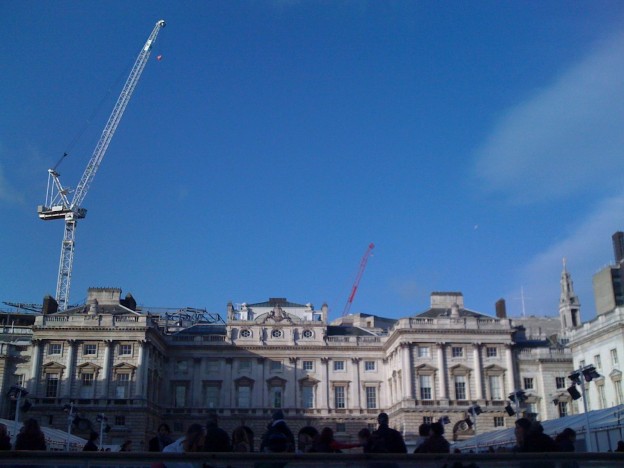
Frank Auerbach: London Building Sites 1952-1962

This afternoon M took me as part of my Christmas present to the Courtauld Gallery to see the exhibition ‘Frank Auerbach: London Building Sites 1952-1962. Quite how I have managed to live in London and work in the built-environment sector all these years without ever having taken a look at the Courtauld I just don’t know.
This collection of Auerbach’s work explores the striking and immense construction sites to be found in post-war London. But unlike the clean-cut lines of the modern architecture that rose from the sites, Auerbach’s work is all about the excavations. This is an artist that is painting the world of the civil engineer: the deep excavations for the Shell Building on the Southbank, the basement for the John Lewis headquarters on Oxford Street, the girders of One New Change adjacent to St Paul’s.
Auerbach layers the paint on in spades – up to an inch thick in some works. This is the result of repeatedly reapplying the paint and reworking each piece. The result is a rich texture that evokes the physicality of the building site. The walls ooze and seem almost to weep water; you can almost smell the unearthed depths. The images have been rendered and rerendered so many times on the same canvas that the original image is almost completely obscured and is only identifiable by reference to the preparatory sketches that accompany some of the works. But as a friend put it, you can get so much more out of the paintings but reflecting on the sensations they evoke rather than trying to pick out any particular detail. The reworking of the paint makes a striking resemblance to the movement of materials on site.
“Through his labours with paint, Auerback vividly translated the chasms of mud, shored-up earth and equipment into works which express the creation and distruction inherent in London’s post-war building sites” – exhibition introduction
‘Building site near St. Paul’s: winter’ situates the observer inside the construction site of One New Change, a building which has since been redemolished and is currently being rebuilt again. Unlike many images of the cathedral painted during the war in which the dome is seen to rise above the flames of the Blitz, in this painting St Paul’s cowers away in the corner submitting to this new architecture.
‘Shell Building Site: from the Festival Hall’ is one of set of works peering into the excavations for London’s first skyscraper. What’s struck me about these paintings is that while these are images of the construction of London’s modern era buildings, the viewer could be looking at a site centuries earlier – medieval even.
Probably most inspirational however was the collection of quick hand sketch studies of the sites that feature in some of the works. The lines are very simple but very powerful. Over the last two years I have been on a couple of building drawing classes, and have sketched many buildings: sketches that are about a finished product. But these works are much more about the process than the result. 50 years later another gaping hole has opened up on Oxford Street, a building demolished by developers rather than bombs. I find myself reaching for my sketchbook…
-
In the can
In the can: the Useful Simple Trust launch film. I don’t quite remember how I got briefed to make this film. It probably went something along the lines of:
“the launch should have a cinema off to the side- maybe the Smallest Cinema in the World. And we should get Oli to make a film to go in it about things that are Useful and Simple”Over the year I have been involved with making a film about Think Up Mondays. It turns out that making fly-on-the-wall documentaries is difficult- it’s hard to get people to say the right thing! It’s also difficult to get high quality images from the poor camera that we’ve been using. And it’s not cost effective to edit at work. So we got a producer-director in to develop the concept for a number of films with the intention that he will help to a greater or lesser extent produce them. It was about this time that the above conversation was had about making a film for the launch of the trust.
And so last Monday I met Caius to choose locations: Primrose Hill, the Regent’s Canal by Camden Lock, Chalk Farm Tube and in the print room at Thomas Matthews.
On Tuesday we filmed the majority of the small clips where people talk about useful or simple things. For the shoot we had both Caius and a cameraman, Mike. It was really interesting to see how the two of them composed shots, as well as how they lit them. Some people just reeled off their lines smoothly- others needed quite a few takes. I really enjoyed writing their lines with them. It’s much better to see how something sounds when someone says it rather than trying to judge the words on paper. With the clocks having gone back the weekend before, we ran out of light surprisingly quickly. We filmed the last few people in the print studio. By the end of the day we’d got nine people in film.
On Wednesday we filmed Ed’s commentary, which originally didn’t feature in the film. It’s only when I realised that there would be no formal
announcement at the launch that the need to put some explanation into the film became apparent. Whils at the time this felt like quite a shift in the film’s feel, it also gave the film a raison d’être. In the end the extra day we booked to film Ed was invaluable for assembling enough footage for the film.
Ed is an old hand at TV filming and he has worked with Caius before and so it was interesting to see the two work together to develop a dialogue and then film it: the greatest contribution in terms of camera time captured in the shortest time. Ed effectively got his lines right first time, but Caius always seem to ask for a second take- just for luck. With hindsight, these second takes were always more relaxed and usually used in the final edit rather than the first take.Persuading Alex to film a take holding a worm was not as challenging as I thought it might be. Clement’s take was TV gold- by far the best bit of the film. The low-light of the filming was having to traipse out to Chiswick to hire the turntable used in the filming of the useful simple objects but the results were worth it.
And so to today when I joined Caius at the editing suite where he has been working with an editor to cut the film. I received a rough cut after one day of editing which I was nervous to watch. I showed it to Chris today and the list of changes was enormous. I didn’t know how we would get them all done. And the most challenging of all was to find a new sound track. Conscience that I only had an hour to trawl the whole of music for a tune I was relieved when Chris came up trumps with a sort of Calypso jazz guitar number. Compared with the twelve bar blues we had before, it gives the whole thing a lift.
See the finished article on the news part of usefulsimple.co.uk
-
Joint Best Loser

Apparently it was too close to call. The judges deliberated for three hours as to which of the six shortlisted finalists should be given the prestigious title of NCE Graduate of the Year 2008. In the end, the very deserving winner was Emma Kent and Eiffelover was relegated to joint runner up: i.e. Joint Best Loser – which has all the advantages of being a finalist without the obligations of being the winner. So congratulations to the winner, thanks to the NCE, and thank you to the judges, who, through their choice, allowed me to retain my anonymity when shopping in the supermarket.
-
The Smallest Cinema in the World

The Smallest Cinema in the World is now open. The Cinema, conceived by artist Annika Eriksson as a venue for films that she is making about Regent’s Park, was designed by a team from Hopkins Architects and Expedition Engineering. The Cinema is mobile so that visitors will have to penetrate deep into the park to find it.
-
Do Schools Kill Creativity?
This videocast by Sir Ken Robinson is from the TED series.
-
Other mobile structures in London this summer
The Smallest Cinema in the World will be a mobile structure. It will be towed to different locations in Regent’s Park throughout the summer. This is possible because the base of the cinema, hidden behind those beautiful shells, is a trailer.
I want to compile a list of other mobile or demountable structures that will be in London this summer. I will start the ball rolling with:
Tonkin Liu’s signature pavilion for this year’s London Festival of Architecture.

-
Richard Rogers Exhibition – Pompidou centre
The Richard Rogers exhibition at the Pompidou centre is now over. I went once and meant to go back as there was so much to take in (and I seem to get exhibition fatigue after about an hour and a half) but alas I didn’t get the chance.
Highlights were the 1:2 scale bright pink models of one of the Heathrow T5 connections, the exquisite 3d-printed model of the Barcelona Bullring and the original competition drawings for the Pompidou – how apt to see them in the finished building.
A few belated few pickies then:-

Antwerp Law Courts
3D Print of Barcelona Bullring
Credits -
A few quotes about cities
I am currently preparing a presentation about the density of cities and in particular, how housing should be organised. Here are a some snippets gathered here for my research…
From Rogers’ ‘Cities for a Small Planet‘
(Rogers and Gumuchdjian, 1997, Faber)
“To being our position-fixing aboard our Spacesip Earth wemust first acknowledge that the abundance of immediately consumable, obviously disarable or utterly essential resources have been sufficient until now to allow us to carry on despite our ignorance. Being eventually exhaustible and spoilable, they have been adequate only up to this critical moment. This cushion-for-error of humanity’s survival and growth up to now was apparently provided just as a bird inside of the egg is provided with liquid nutriment to develop it to a certain point” Buckminster Fuller, Operation Manual for Planet Earth (Pg1/1)
”We will leave this city not less but greater, etter and more beautiful than it was left to us” – Athenian oath pledged by new citizens (Pg 1/16)
-
It’s not just architects who make great buildings
 Over the last couple of weeks the Guardian has been publishing their Great Modern Buildings pullout. In each issue, there are photos, blue prints and articles about the structure of the day. The articles go into some depth about the architects, but the engineers seem to have been forgotten. In the case of the Pompidou centre, who’s design has as much to do with the structural engineer Peter Rice as it does to do with the architects Renzo Piano and Richard Rogers, the omission of the engineer was the subject of a column today in the Guardian co-authored Rice’s son Kieran who is President of RFR, the company that the late Rice senior cofounded.
I think it is great that the Guardian is championning some great pieces of design in these daily supliments. I only wish that they would also champion the designers.
-
Moet et Chandon vs Mercier

This weekend I took a visit to Eperney in Champagne where I found many of the caves that produce that region’s local tipple. I went on a tour of two champagne houses, Moët et Chandon and Mercier. During a visit to the first, we were assured of Moët’s credentials with stories of the fonder’s patronage by Napoleon I along with other impressive customers. We were led down into the wine caves, 25m underground and some 31km of them dug by hand into the chalk beneath the beautiful buildings above. Tipsy after a dégustation hosted by black clad experts, we were lead upstairs to the boutique where, surrounded by posters of the uber-glamourous drinking Moet, we were subliminally persuaded to buy champagne in bottles with unpronounceable names.
Then it was up the road to Mercier’s altogether less stuffy-looking building. If Mr Moët was the Wright brothers of champagne (in an incredible 2 for 1 offer) – making champagne in the early days, then Mr Mercier was the Richard Branson, joining the scene much later in the second half of the 19th century, but making waves for himself much later using clever marketing. He commissioned the Lumière brothers to make was to be the world’s first commercial. In another act of embracing new technology, he invited the willing and the curious at the Great Exhibition of 1889 to taste his brew while floating high over Paris in a tethered hot air balloon. But it was to be his 200,000 bottle barrel that stole the show. This enormous construction which took over ten years to build (and presumably to fill!). It was dragged to Paris by 28 oxen, requiring five bridges along the route to be strengthened and the purchase and demolition of several houses in order to make way. At the show, Mercier’s enormous barrel was a huge success, and he would have one the first place medal had it not been for a certain Mr Eiffel and his tower.

Mercier has long been pushing up grape vines but his cellars still have that technological flare: whereas the Moët tout guide was keen to point out the painstakingly laborious process of turning the bottles of fermenting champagne by hand, on display at Mercier’s was the cunning robot that did all this turning automatically; and rather than walking the galleries we were driven round in a lazer guided train. Now to my monochrome palette, the champagne at both houses tastes pretty similar (I’m no expert and I certainly couldn’t afford the bottles where the difference in taste starts to become noticeable) but Mercier’s trail blazing approach and embrace of modern technology caught my attention far more than Moët’s ‘natural ascendancy’ approach. And besides, who can beat a laser-guided train?


