Category: Analogue Skills

  • Full Circle

    Here’s a simple experiment. Take a wine glass and place it on a city map. With a pencil, draw around the base. Follow the circle as closely as you can and see what you discover.

    These instructions are the basis of a psychoderive, an approach to rediscovering the city, proposed by Situationist philosopher Guy Debord.

    Debord wants us to see the city anew. To break the matrix of familiarity, the hierarchies of roads, the boundaries of commerce. And instead to see again the underlying contours of place and community.

    Familiarity dims the senses. The circle forces us onto new paths. This uncertainty sharpens our awareness again. To notice the gaps between buildings. The pockets of life thriving in forgotten spaces. Not knowing if there is a way through.

    This act—forcing us to see the familiar in a new way—is a perfect analogy for how regenerative design begins. That starting point is deep observation of place. In places we think we know, it’s about peeling back the skin that habit forms and seeing what lies beneath. Then we can connect more deeply with community and ecosystem. To see what ingredients we already have to work with. To spot potential we can help unlock. To recognise the successful patterns of place.

    To do all of that, we need to learn to look again. Guy Debord’s wine glass gives us a good starting point. What do you notice when you follow the circle?

    Further reading

    • It turns out I did my first psychoderives in 2018 – Read Derive#2, about a circle I tried to squash into the Square Mile.
    • And continuing on the theme of games that change the way we experience the city, check out the Left-Right game, which my daughter and I invented during lockdown.
  • Clunch

    You read that right. No it is not an abbreviation of pack lunch. Clunch is a type of limestone, and one of the wonderful pieces of vocabulary I learnt this week from Mark, the stonemason who is renovating the front of our house.

    I asked Mark where he thought the Bath stone used in the surrounds to the windows and doors on our house came from. He pointed to a window jamb (another great word) and said which quarry he thought it came from, and not only that, but also whether it came from the top of the quarry of the bottom. All from the way the rock feels and can be worked.

    Here I am in my office writing about localising supply chains. And outside is someone who lives and breathes (literally I suspect from the dust) local supply. Who knows where rocks came from. Who can tell a story about why a block was placed one way or another. Who can find new uses for old pieces (a broken lintel has become a keystone elsewhere on the facade).

    He laughs at me and my Zoom calls. Fair enough. Thank you Mark for all your local wisdom, and your amazing work.

  • New developments in ‘i’

    Engineers have announced today some astounding new breakthroughs in their latest version of i.

    • Empathy – the ability to see the world from the perspective of another. To have a genuine, shared sense of pain. This ability is developed through twenty-year long training process called ‘childhood and adolescence’.
    • Embodied cognition – a way to develop understanding that emerges through the unique physical characteristics of each ‘i’ and how it moves through and experiences the world.
    • Music – audio signals organised into patterns and created by individual or groups of ‘i’s to communicate information that can’t be captured in a .txt file.
    • Culture – a collective intelligence that emerges when several i operating systems do things together.
    • Gut-feeling – a parallel processor providing checks and balances against the logic board.
    • Sleep – a remarkable sub-routine that both repairs the operating system and identifies new patterns.
    • Love – a higher order circuit that guides priorisation, builds system resilience and provides additional energy when resources are low.

    This technology is completely free and open-source.

  • Women and men’s Tour de France

    Women and men’s Tour de France

    One of the anchor points for our trip this summer is to catch the start of the Tour de Femmes, which coincides with the end of the Tour de France.

    It is so exciting to be able to see the first women’s tour, of proper scale, kickoff. following the tour feels like a bit of a family guilty pleasure, that a guilt subdued a bit now that there is a women’s tour of decent scale, but there’s still a long way to go. Interestingly it seems some of the women’s teams were set up by pro-men who wanted decent cycling opportunities for their daughters.

    From the Rue de Rivoli we stood on the railings to watch the eight laps of the women’s peleton, struggling to identify who was whom, relying mostly on the live updates from the website. Despite my preference for analogue experiences, it really is a sporting day out that is enhanced by having a live feed in your pocket.

    When the women had gone by we crossed the Jardin de Tuileries to the Orangerie to wait for the Men’s peloton. Having watched the men’s tour on the TV for so many years it was really exciting to be seeing the spectacle close up. It’s like with anything that you have watched on television the scale of things looks very different in real life. Things are at once much smaller because you don’t get the close-up camera shots, and then very large when people do get close.

    The Tour de France peleton on its penultimate lap of the Tuileries

    It’s such a thrill to see these riders who have been up and down mountains all around France, not to mention their excursion to Denmark, end up right in front of us. It is quite a spectacle. We enjoyed having it with a group of British cycling fans, and were interested to see how little our Paris friends cared for the race. This corroborates a newspaper article yesterday about the Tour’s growing international reputation and the increasing ambivalence for it among the French.

    Tomorrow we head out into Ile de France to see stage two of the Tour de Femmes. It’ll be interesting to see how the atmosphere changes on a smaller stage in a more rural spot.

    Tips for watching the Tour de France in Paris

    This is what we did in 2022 and what we’d do again. Both the women’s and men’s Tour do loops of the Jardin de Tuileries and the Champs Elysées. Access to metro stations in the area is limited. So we arrived an hour early and entrees the area via Metro Palais Royale Louvre. From there you can walk straight in to the gardens. There was also an access point by the Pont Solferino.

    We watched the Women’s Tour from behind the railings along the Rue de Rivoli, which is where the close up photo I took above is taken from. A good shady spot but you don’t get long-distance views.

    We watched the Men’s Tour from the terrace outside the Orangerie. This was well shaded while waited during the day but was in full sun for the last hour wait and during the laps. Come prepared if you go there.

    Next time we’d go to the banks of the Seine opposite the Orangerie which stayed in shade throughout but which had a good view. Note this area had a police bag check point as it is closer to the track and we didn’t think we’d get through with our picnic knives!

  • Too many emails – the Eiffel Over guide

    Too many emails – the Eiffel Over guide

    I am a connoisseur of email-reduction strategies, so I share this for friends and colleagues of mine who I know are struggling with this at the moment. The best way of dealing with having too many emails is never ‘answer all the emails’. Email overload is a systems problem. It manifests itself as an overflowing inbox but it is rooted in the way the system is set up. Answer all the emails and new ones will appear. We have to fix the system.

    I will start by saying that I still have too many emails. But I don’t feel bad about it because I am trying to work on the system. And some of my system changes have been helpful and I can see are working. This post is not supposed to be a definitive guide but a few things to get you started.

    (more…)
  • Storm’s coming: go to the cinema

    Storm’s coming: go to the cinema

    In times gone by, people went to the cinema to stay warm. The movie theatre offers a place of shelter from the elements and also an escape from reality for a couple of hours. Last week, when storms huffed and puffed and infrastructure bent and buckled, Great Western Railway suspended all services from London to Bristol. I was stranded in the capital amid a maelstrom of conflicting information about when services would resume. So rather than stare at the blank departure screen, I headed for the silver screen instead.

    I felt liberated. Give me a ticket for the next film, I said. The next feature was Pedro Almodóvar’s latest film ‘Parallel Mothers’. For the next two hours and three minutes I was transported away from the rain and the wind to sunny Madrid and the tale of two who give birth on the same day.

    By the time I emerged the information storm had settled down. There would be no trains today, and probably none tomorrow morning. Decision made for me: I would need to stay another night in London.

    Incompatible and incomplete information

    In a situation like this, when a system that usually runs in a steady state is knocked off course, then the information about that system is likely to be incompatible or incomplete. For instance, National Rail Enquiries showed some trains leaving Paddington, GWR said none leaving Paddington for now, others had simply crashed.

    (more…)
  • Updates from a regenerative system

    Updates from a regenerative system

    Our nearby allotments are my local source of food and regenerative inspiration. Sharing my thoughts from this weekend’s visit when I was helping with apple pressing.

    While Bristol is well served by local a scene of craft breweries, if you really want to get local alcohol, then cider is the hyper local choice. Whereas the ingredients for beer are gathered from around the world to be brewed in here, in Bristol you can drink cider under the tree that the apples came from.

    (more…)
  • Analogue Skills for Design at the University of Bath

    Analogue Skills for Design at the University of Bath

    Today at the University of Bath I am running a workshop on Analogue Skills for Design. This workshop fuses material from my conceptual design teaching with my observations from the Analogue Skills project, my attempt to collect and curate less digital ways of doing things in case we need to use them again.

    Creativity and design as human skills

    A key thread that runs through my design and creativity teaching is that these are very human processes, which are deeply impacted by individual’s connection to themselves, each other and the environment which supports them. 

    At the individual level, creativity is hugely influenced by our emotional and physiochemical state, the relationship between our conscious and subconscious and our unique combination of lived experience. At a group level, how ideas emerge in a collective consciousness and become the work of many is influenced by relationships, accessibility and the many facets of working culture. And of course we all live in the physical world, the world that we are trying to shape. How we move through and experience that physical world – not in our heads but as moving inhabitants of space – influences how we respond to and act in that space.

    All of these factors are features of how we design, not as purely rational, reason engines, but as emotional, physical human beings.

    Analogue Skills

    Another ability of humans – although not unique to humans – is the ability to create tools. Taking a lever as both an example and a metaphor, our tools enable us to multiply our efforts. The tools we use shape our perception of what is possible, and so influence how we perceive the world. 

    Over the last five years or so I have become increasingly interested in how our tools, and in particular our newer, digital tools influence how we think and live. Because while we have always been influenced by our tools, the rate of introduction of new, digital tools has become so rapid that in less than a generation, our tools have transformed the way we think, feel and behave. 

    I experience this personally because I am a Xennial, someone from a sub-generation that grew up without internet enabled computers but who has spent their whole working life with one. Xennials are halfway between digital natives and digital immigrants. I feel this timing of my up-bringing gives me insight into two different ways of thinking, what I loosely call the more analogue and the more digital. These two ways of thinking can be very different. Take the simple example how to organise information. In the analogue world, information is carefully indexed and prized because it may not be possible to find it again. It is a paradigm of scarcity but also care. In the digital world, the natural assumption is the information is searchable and always available and so information itself is de-valued. This is a paradigm of abundance but also of less care. 

    From this perspective,  individuals become more and more dependent on these new technologies, I see that what once was a tool that served us, these technologies have become a tool to manipulate us. From user to used. With dependency comes fear. How could I ever live without it? But so ubiquitous is our internet-enabled world that we risk forgetting the ways we could live and flourish without computers in our pockets.

    The Analogue Skills Project is my attempt to record less-digital ways of doing things before they get forgotten so that we can use these to evaluate what technology we do and don’t want. It is an attempt to build resilience and reduce dependence on technology that may not always be there to help us. It is my hope to find a more human balance between the analogue and the digital.

    See my collection of analogue skills so far.

    Human operating system

    I see each analogue skill as a way of liberating ourselves from digital dependency and to discover something that it turns out we can do ourselves as humans: each one is a clue to the workings of the human operating system.

    To accompany the growing list of skills I have also created the Analogue Skills Manifesto, which is an invitation to resist the digital pull and rediscover what you can do as a human being:

    • Don’t delegate autonomy to the machines
    • Resist a mediated experience
    • Resist life as content
    • Re-discover old tech
    • Much less is much more
    • Welcome uncertainty
    • Don’t get things done
    • Share, swap and learn from others
    • Relish company
    • Seek nourishment in time alone
    • Embrace friction, embrace inconvenience
    • Forget the unimportant and remember the valuable
    • Ground yourself and find your bearings
    • Use your hands and your senses
    • Concentrate
    • You have everything you need.

    Analogue Skills in Design

    Bringing these two themes of work together, what are the analogue skills that we bring to design that we risk forgetting if we don’t use them, and are worth rediscovering if they have already slipped away?

    Looking through my design teaching deck, there are many concepts which are already analogue, and so I am putting them together here:

    These are skills that we are going to experiment with today. These are things that you can do because you are human. There isn’t going to be a software upgrade. You don’t have to pay a license fee. You can share these tools with whoever you like, and when the internet goes down, you will still be designing. I should also add that these tools don’t stop you from using digital tools – they are here to help you choose.


  • What happened when I tried to use an old iPod

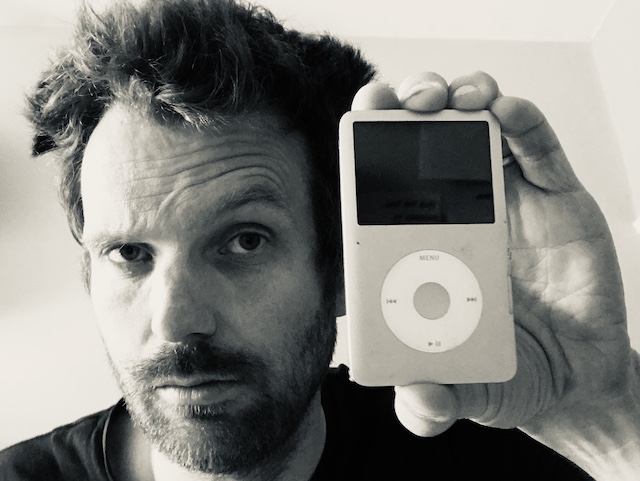
    Once upon a time the offer of 1000 songs in your pocket – the slogan for the iPod – was so enticing. But in 2014 Apple discontinued the iPod Classic. Today the zeitgeist is all the songs in your pocket, courtesy of streaming services. So what happens when you try to boot up some old tech, like a discontinued iPod? I have found it to be a lesson in interesting lesson in feeling how our expectations are set by tech companies, and appreciating less is more.

    (more…)
  • Analogue Challenge 001: look for the time

    Analogue Challenge 001: look for the time

    On other people’s wrists, on clock towers, outside the jewellers, inside shops, at the station, on the scrolling news, from the position of the sun. Ask someone or make do not knowing, leaving plenty of time not to worry.

    Here’s the challenge. Spend a day getting by without checking the time on any device of your own. Of course the more analogue way is to use a watch, but the aim of the challenge here is to sharpen a range of other analogue skills that will make you more comfortable with be more self-sufficient and less reliant on devices to get you through the day.

    (more…)
  • Analogue Skill 009: Sketch what you see

    Analogue Skill 009: Sketch what you see

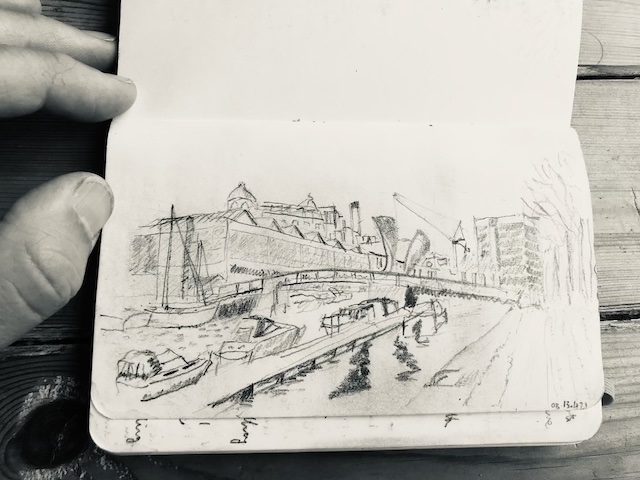
    Take out a piece of paper and draw a sketch of what you can see. You will notice more than you ever would by taking a photograph.

    Sketching could easily fall into two categories in my collection of analogue skills: Remembering Things and Spending Time Alone.

    (more…)
  • Analogue Skill 008: Be happy not knowing

    Analogue Skill 008: Be happy not knowing

    There’s a gap between certainty and doubt, and that is being happy not knowing. In this gap is space for discovery, serendipity, delight and the opportunity to grow confidence that you have everything you need. 

    I see the ability to be happy not knowing as a keystone analogue skill that supports other analogue skills and behaviours. Not knowing the weather, what’s on at the cinema, what your friends are doing, the headlines, what’s on TV, the fastest way to get there. Once we can wean ourselves off this need for certainty, we can become less dependent on our devices and more confident in encountering the world as we find it. 

    (more…)
  • Analogue Skill 007: Print out photos of your friends

    Analogue Skill 007: Print out photos of your friends

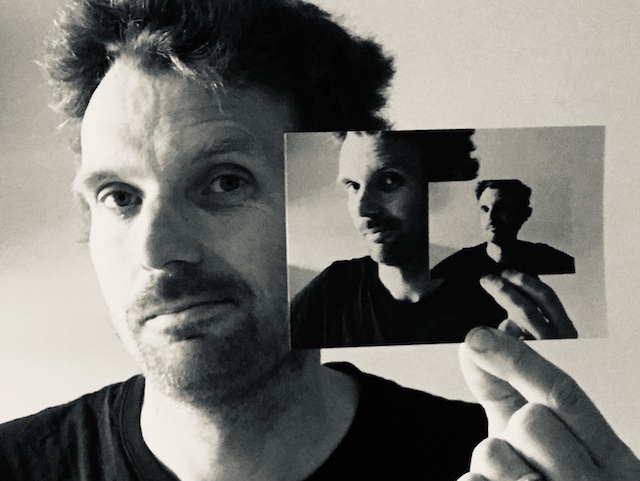
    Print out photos of your friends. Stick them on your wall. What are they doing? How can you support them? A regular reminder to give them a call.

    Printing out photos of your friends speaks to at least five points on the Analogue Skills manifesto:

    • Don’t delegate responsibility to the machines/ Resist life as content
    • Much less is much more/ Embrace inconvenience
    • Share, swap and learn from others
    • Forget the unimportant and remember the valuable.
    (more…)
  • Analogue Skill 006: Sing songs with other people

    Analogue Skill 006: Sing songs with other people

    Songs to pass the time. Songs of celebration. Songs of nostalgia. Songs that mark the seasons. Songs of work. Travelling songs. Songs that tell a story. Songs of hope. 

    I’m thinking of that moment in Wayne’s World where Wayne, pulling out a cassette* from his shirt pocket, says ‘I’m going to propose a little Bohemian Rhapsody, gentlemen.’ And then what follows is a joyous scene of shared humanity. Losing themselves in the happiness of this time spent together. Singing with other people binds us together. 

    (more…)
  • Analogue Skill 005: Finding North

    Analogue Skill 005: Finding North

    Ways of finding north. The position of the sun. The angle of solar panels. The prevailing wind – either live or frozen in the bent and twisted shape of trees. The orientation of places of worship. The current of rivers. The flow of infrastructure. The weather vane on a steeple. The North Star and Southern Cross.

    The human operating system comes equipped with means of finding north. Without an inbuilt ferrous device, the system combines sensual data with geographic, scientific and social knowledge to determine direction. 

    (more…)
  • Analogue Skill 004: Become a regular

    Analogue Skill 004: Become a regular

    Anywhere versus somewhere. 

    Contactable versus findable.

    Interchangeable versus valuable. 

    Stranger versus friend.

    This analogue skill first emerged for me from asking a simple question. If you have left your phone at home, how can people find you? 

    (more…)
  • What if the screen you are now using is your last?

    What if the screen you are now using is your last?

    One day I hope this article will be printed in a book. But until then I can be fairly sure that you will be reading it on a screen. In 2021, that is most likely to be a phone, a tablet or a desktop, or possibly some sort of wearable device. In the future, that list could include countless other devices: a web table, a car dashboard, smart glasses, digital wall paper – even a hologram? Such is the speed of technological development that it is only natural to assume that whatever device we have now it will be renewed and upgraded to the next thing at some point. But what if that weren’t true?

    (more…)
  • Six motivations for collecting Analogue Skills

    Six motivations for collecting Analogue Skills

    Today I thought I’d share some of my motivations for the Analogue Skills project. 

    1 – An engineer’s fascination

    I am not anti-technology. I’m an engineer. I’m fascinated by how systems, machines and technology work, and how people use them. I am also fascinated by how technology changes the user and the user’s perception of the world. 

    2 – Tech awkward

    I’m also a bit awkward when it comes to tech. Sometimes I’m an early adopter – I got an iPhone before all my friends. Sometimes I’m an early rejector – I think I’m the only person I know who doesn’t have Google Maps on their mobile. Sometimes I’m a never adopter – for example, I don’t have an Amazon account. 

    The awkward bit is that I do have a smart phone (or phone, as they are now called), but I don’t assume I should use it for everything. Phone or no phone is a false dichotomy. I just don’t want my experience of life to mediated through a screen and potentially manipulated to meet corporate ends.

    (more…)
  • Analogue Skill 003: Watch the clouds – streaming now

    Analogue Skill 003: Watch the clouds – streaming now

    Watch the clouds. Streaming now. Telling a story of past, present and future. Of up there and down here.

    If you also live on the lump of rock that is Great Britain, then you will be fortunate enough to have a drama unfolding in the skies above you most days. The clouds are so familiar that it is easy not to notice them. But start to pay them attention and curiosity may get you hooked again.

    (more…)
  • What is real-world search in a digital world?

    What is real-world search in a digital world?

    What is real-world search, and why might it serve us in the digital world? The promise of a fully connected, digital paradigm is access to all the world’s information, at any time, everywhere. But there are some reasons why this ubiquity of access might not be a good thing. 

    • There is a risk that we become less confident in going out into the world without the information we need. 
    • We may lose the ability to find information other than by searching for it via a web browser. 
    • We may become less willing to seek information from people rather than machines.
    (more…)
  • Analogue Skill 002: Remember some phone numbers

    Analogue Skill 002: Remember some phone numbers

    Your loved ones. Your best friends. Your colleagues. Could you call them if you needed to? 

    This skill is an enabler for leaving the house with your phone. If you need to call home you can use a phone box but only if you know what number to dial. 

    Remembering phone numbers just takes practice. Find the rhythm. Find the pattern. Set them to song, if it helps. Practise recall by dialing the numbers rather than using the saved number.

    (more…)
  • More lanes = more cars. More apps = more things to do?

    More lanes = more cars. More apps = more things to do?

    Deleting apps and leaving your phone at home could be analogous to dismantling urban highways.

    I read earlier this week about the research that established a direct link between building more roads and the level of traffic in a system. The researches established a directly proportional link. Increase road capacity by 10% and traffic increases by 10%. The causal link is that when you increase road capacity, you make it easier for more people to make more journeys. And so more people drive until the new road reaches capacity. At which point the traffic stops growing until new roads are built.

    (more…)
  • Analogue Skill 001: Buy tickets at the station

    Analogue Skill 001: Buy tickets at the station

    Go to the station. Stand in the queue. Look at all the people and wonder where they are going. See leaflets in the rack for places you hadn’t thought of going before. Look up at the station architecture, notice how drab it is, notice where someone has made an effort.

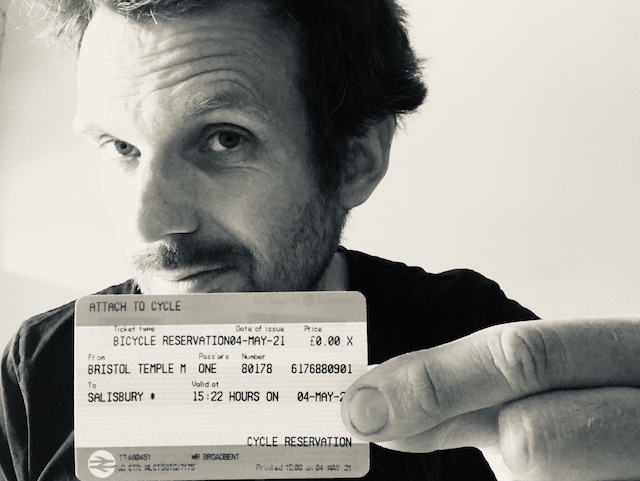
    Talk to the person at the window. Smile at them. You might be the first person to do this today. Engage in life-affirming transaction. You want to buy a ticket and they want to help. Ask an expert. What’s the best route? What’s the best time to travel? Find out if there is a different way. Find out if there really aren’t any spaces available for your bike (or was the computer lying?).

    Leave, ticket in hand, a malleable scrap of evidence that you are going somewhere and you didn’t just imagine it. A ticket that won’t run out of power.

  • Connection with nature through drawing

    Connection with nature through drawing

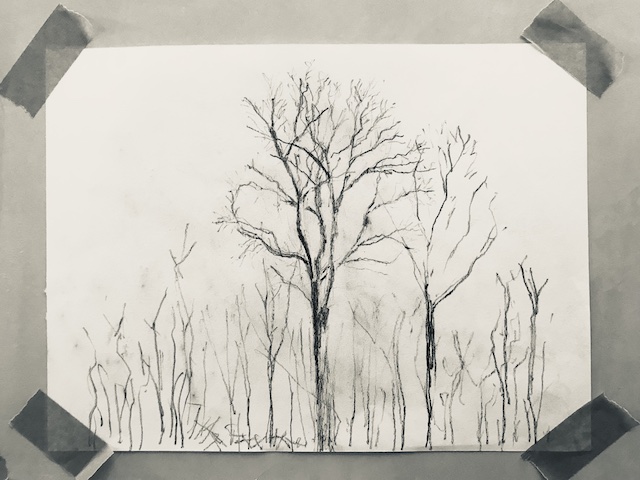
    I drew this ash tree at Hazel Hill Wood last weekend. Though it rises opposite a bench where I like to have a morning coffee, I have never paid it much attention. But doing a twenty-minute sketch I am discovering the tree. Climbing the trunk that rises without foothold for a third of its height. Noticing for the first time its rhythm – the trees spatial ordering. How one trunk becomes a thousand twigs, like a trachea transitioning to countless alveoli.

    As I draw I see a space in the canopy to the left, one that I would not have noticed otherwise. I presume it is a space left by another tree that is now fallen, on the ground but leaving its imprint in the sky.

    (more…)
  • Farewell Beethoven

    Farewell Beethoven

    Off-topic, but I feel we rarely capture and talk about moments of grief. Between facilitation sessions today I listened to the final episode of Radio 3’s year-long Composer of the Week series on Beethoven, the episode in which he dies. And now I am streaming tears: because it is a sad story, yes; because he wrote music that can make you cry, also yes. But more so because I really, really miss the all-encompassing world of live music. To hear that full orchestral sound now would be such a joy. I miss going to see my Dad play in an orchestra. I miss the joy of giving shared attention to creative spectacles, be they small or large. I can stream whatever music I want, but I want to see human beings playing, making the noise. That’s all.

  • Creative inspiration from December

    Creative inspiration from December

    A new month, new good intentions. Just like when I started a new exercise book at school, when I would commit to being extra neat (and then forgetting about it a few days later). It’s good time at least to think about how the advent of December can influence your creative work.

    (more…)
  • Creating contours in the flat landscape of lockdown

    Creating contours in the flat landscape of lockdown

    In the midst of lockdown we have created a new household tradition that brings a highlight to the week. On Saturday nights we dress for dinner, enjoy our meal, watch Strictly on our new TV, and then push back the furniture and dance. 

    With the household locked down, one day could easily look like the rest. To use Matthew Crawford‘s  language, the ‘affordances’ of one day look exactly like the rest: there are a fewer physical contours that shape how different parts of the week feel now that we are always at home. So you have to create that structure for yourself.

    (more…)
  • Proust, constructivism and listening to clients

    This week I underlined this sentence from Proust’s Finding Time Again. 

    “Even at the moments when we are the most disinterested onlookers of nature, of society, of love, or art itself, since every impression comes in two parts, half of it contained within the object, and the other half, which we alone will understand, extending into us, we are quick to disregard this latter half, which ought to be the sole object of our attention, and take notice only of the first, which being external and therefore impossible to study in any depth, will not impose any strain on us: we find it too demanding a task to try to perceive the little furrow that the sight of a hawthorn or a church has made on us.”

    Proust, M. (1927). Le Temps Retrouvé (Finding Time Again) (C. Prendergast (ed.); Ian Patterson tranlation). Penguin Classics.

    This sentence comes in the middle of Proust’s revelation about what his work as a writer should be: to translate his inner world to the outside. He finds much greater richness in understanding the impression that the world makes on individuals than understanding the surface, objective qualities of what is being observed.

    Things I take away:

    (more…)
  • Asking someone instead of Googling

    Asking someone instead of Googling

    What if you couldn’t look stuff up online? This is a question I keep returning to. One answer is that other people might become a more important source of information. You’d need to pay more attention. You’d probably look forward to the opportunity to speak to them more. And you’d remember more about what they said.

    The premise makes me think of books set in a time before tv and radio (let alone internet) when the arrival of a new visitor in the house represented the chance to mine a new seam of experience. 

    (more…)
  • New adventures with a television – part 1.

    New adventures with a television – part 1.

    Television, television television. Say it a few times in a row and it sounds a bit futuristic, of science fiction even. The ability to capture moving images and transmit them over space is incredible. Having not had a TV in the house for thirteen years I have been enjoying rediscovering this most twentieth century of media formats, and discovering, rather than futuristic, how out-of-date my expectations of the format are.

    (more…)