Category: Clowning

  • Everyday Creativity for Blues Dancers

    Everyday Creativity for Blues Dancers

    This is the second workshop I have run in the ‘Everyday Creativity for…’ series, this time for blues dancers in the London blues scene. A huge thank you to Ellie and the Sunday Shake Off crew for inviting me down.

    The premise is that blues dancing is an inherently creative activity (maybe even more so than lindy hop?), and by interrogating what we are doing when we are dancing blues we can find creative strategies and techniques that we can use in other parts of our lives, from personal projects to professional work.

    This workshop was a truncated version of the full workshop that I run for swing dancers. Into an hour we managed to squeeze in:

    • Thinking of creativity as a system, and understanding the parts of that system
    • The influences we draw upon in our swing dancing and in our professional work
    • Generating connection with your collaborators and your audience
    • Strategies for stimulating divergent thinking
    • The value of doing really silly things.

    Keep an eye out on this site for dates when I’m planning on running the full workshop again.

    Related posts

  • Pre-stressed concrete: lessons for swing dancers

    Pre-stressed concrete: lessons for swing dancers

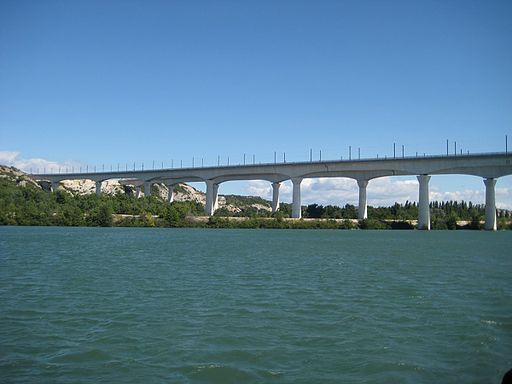
    TGV Bridge at Avignon by John is available under CC 3.0
    TGV Bridge at Avignon by John is available under CC 3.0

    Recently in beginner’s swing dancing classes I’ve described the connection between lead and follow when dancing side-by-side Charleston as being a bit like how pre-stressed concrete works. I promised a longer explanation. Here it is.

    Starting with reinforced concrete

    To begin we need to understand how reinforced concrete works.

    When you build a beam in a building and you stand in the middle of it, the beam sags, albeit ever so slightly. To understand what is happening, you can simulate a simple beam by interlacing your fingers in front of you, palms down. Now imagine what were to happen if someone were to balance a bag of sugar on your knuckles: your hands would sink down, the skin on the underside of your fingers would stretch, and the skin on the top would pucker up. That’s because the skin underneath is going into tension, and the skin that is on top is going into compression. This tension-compression couple is what supports the load resting on the back of your hands.

    For a video illiustration of this deomonstration, see this video I helped to script a few years ago at Think Up.

    Now let’s imagine what happens if we were to build that beam out of pure concrete instead. Concrete is strong in compression, and so would have no difficulty in resisting the compressive force in the top side of a bending beam. But it has virtually no tensile strength, and so as soon as the underside of that beam starts to stretch it would suddenly crack and catastrophically fail.

    So for about 130 years now, engineers have been embedding reinforcing steel in the bottom of concrete beams to carry that tension which arises when a beam bends. Steel is strong in tension (think of the steel cables in a suspension bridge). In a beam reinforced with steel, the steel rods act like stiff elastic bands which resist the tensile loads that are generated when the beam bends.

    The importance of depth

    Reinforced concrete is a popular building material. To work, the beams need to have a certain depth to them. To illustrate we can think what happens when we bend a 30cm ruler. If you hold the ruler out in front of you flat side facing down, and try to bend it downwards, it bends easily. But if you hold the ruler out in front of you edge-downwards, and try to bend it downwards, it is almost impossible. What’s the difference? It’s the difference in distance between the top and bottom fibre that determines the stiffness.

    So, deeper beams are stiffer, and can span further between supports.

    Pre-stressed concrete

    The problem with deeper beams is that they require a deeper floor void between the ceiling of one level and the floor the level above. Building designers usually want to minimise the floor depth so that they can fit in as many levels as possible within a given height. More levels means more rent.

    Pre-stressed concrete is an evolution of reinforced concrete which enables shallower beams and slabs to be used in buildings. In pre-stressed concrete, the steel bars of reinforced concrete are replaced with steel cables which run through the middle of the beam and are attached to a plate at either end. When the concrete is set, this steel cable up is tensioned up squeezing either end of the beam, putting the entire thing into compression.

    The effect is similar to when you pick up a row of books simply by squeezing from either end. If you squeeze hard enough, you can pick up say 15 paper backs without any of the middle ones slipping out.

    For an illustration of this principle, see another video that I helped to make a few years back at Think Up:

    Now imagine you were picking up a row of books in this way, squeezing from either end, and someone were to put a bag of sugar on top in the middle, as long as you were squeezing hard enough, you could probably support the weight of the bag of sugar.

    So what is happening here? In fact, the same thing is happening here as when the sugar was placed on our interlaced hands. The top of the books are squashed together, and the bottom split apart a bit. The difference is that because these bending forces are applied to a set of books that is already being compressed together from either end, the bottom edge never goes into tension: it is just a little less compressed. Similarly the top of the books are more compressed because of the sugar they are supporting.

    Putting pre-stressing cables into a concrete beam puts the whole thing into constant compression, making the whole thing stiffer.

    What’s that got to do with swing dancing?

    In teaching beginner swing dancing classes there often seems to come a point where we have to move learners from simply dancing a choreography to leaders leading and followers following. The key to that is the connection between them, which works in different ways depending on the dance.

    When dancing side-by-side Charleston, the leader has their arm around their follower’s waist. The follower needs to sit back into this arm slightly, and the lead needs to push against their follower’s back. This creates a slight compressive force between them, which is equal and opposite.

    To signal to the follower that the leader wants to move forwards, the leader moves forwards themselves, and in doing so, increase the compression in the connection, which causes the follower to accelerate forwards.

    To signal to the follower that the leader wants to move backwards again, the leader moves backwards themselves, and in theory, this reduction in compression should cause the follower to accelerate backwards.

    In practice, what we see is leaders moving backwards, and become disconnected from the followers. This disconnection reveals that they never had that matched compressive force in the first place: the pre-stress was missing.

    If that compression is there to start with, if one person reduces the compression by pulling away, the other starts moving towards them. If there is no compression, and one person reduces the compression by pulling way, the two simply separate from each other.

    So, to get the connection right, get the pre-stress right.

    Related posts

  • The Margherita Principle for decision-making

    The Margherita Principle for decision-making

    Pizza
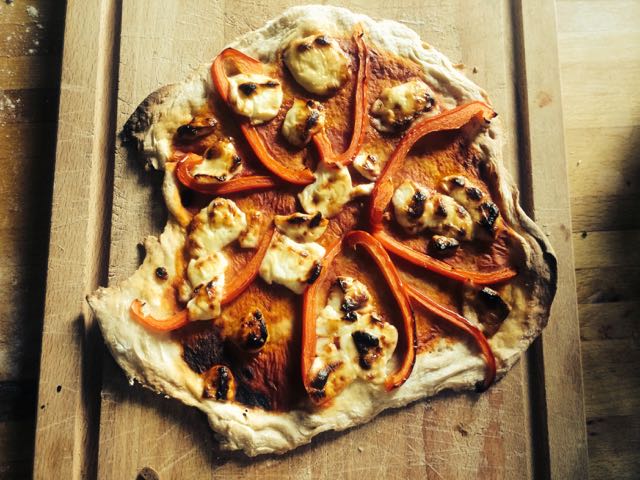
    Pizza (altough not quite a Margarita)

    I’ve been promising friends this post for some time, especially those that have eaten in a restaurant with me recently. In the season of good will and consumption, this rule of thumb helps us make better menu choices. But as a decision-making tool, it goes much deeper, helping us (re)discover the real value in things.

    The principle is simple: the best value pizza in a restaurant is the one at the top of the list, usually the Margherita.

    This realisation first came to me last year at a pizza restaurant by the Canal St Martin in Paris. The 6€ Margherita offered: a delicious and filling meal – the prototypical pizza; a nice warm place to sit; the atmosphere of the restaurant; banter with the waiter; a view over the canal; a small basket of bread and a bottle of tap water; and chilli oil.

    The next pizza on the menu was the Fungi. At 7.50€ I was getting everything the Margherita offered plus a chopped mushroom. At 1.50€ that’s a bad value-for-money mushroom. And from there on down – Fiorentina, Vegetarian, Quatro Staggione – the value just keeps on going down.

    The cheapest thing on the menu usually gives you the most, the rest are opportunities to spend more money with diminishing returns. (Incidentally, as Tim Harford explains in his book ‘the Undercover Economist’, menus are usually structured in ways to give customers the opportunity to spend as much money as they want to.)

    The benefits of the principle

    • By applying the Margarita principle not just to pizza but also drinks and coffee, I was able to have a pizza, a glass of house red and a shot of espresso for 10€ all in.
    • It’s a training in simplicity, which as Thoreau argues in Walden, is the route of happiness.
    • It’s a training in looking for the real value in things.

    What about non-linear effects?

    My colleague David pointed out to me that the principle may not be applicable if the combination of extra ingredients amounted to a taste that was greater than the sum of it’s parts – a sort of non-linear taste progression.

    I concede that this sort of topping alchemy may be possible, but in reality it would have to deliver significant extra value to be anywhere near as valuable as the initial Margherita. Besides, another colleague of mine, who is also Italian, claims the Margarita is the best tasting pizza anyway – so why add anything more?

    Broader application

    The Margaherita Principle is a sort of mix of the Pareto Principle and the Law of Diminishing returns, and has applications beyond pizza choice. It helps get greater clarity of thought when making decisions.

    For example, I was recently agonising over the order in which to publish various blog posts. But then a realised that the greatest value outcome was just to get the post published. There may be some marginal benefit to publicising them in a certain order; however that was much less than the value of just getting the material online and circulated. Worse, the time I was spending worrying about the order to publication was time that I wasn’t spending writing – and I might have ended up publicising nothing at all.

    Another example related to the branding of a training course that I am involved with developing. At this stage, we are not sure how the course is going to evolve, and so it was difficult to decide what direction to take the branding. But, applying the Margarita Principe, I realised that the most important thing is to at least get something published, which we could then revisit as started to run and iteratively develop the course.

    The fallacy of menu choices

    As I write, I realise that we often have less control over our experiences than we think. A restaurant is probably quite a high control scenario: we choose what we want to eat and drink; choose our company; and with care, the topic of conversation; and things usually go to plan. In reality, we often have less control over the projects that we manage than we think. The branding example above illustrates this. It is very hard to know what the best way to describe a training course is until you run it and see how the content evolves in practice. With this sort of thing, the best approach is make quick decisions, see how they work in practice, and then re-evaluate along the way.

    In a restaurant situation, this is akin to not ordering your main course until you have finished your starter, and then waiting until later to order dessert. This is decision making on the basis of feedback – literally!

    The horror of advanced menu choices

    Given all of the above, the worst possible decision-making scenario with regards to menus is when you are sent dinner options for a conference or a corporate meal a month in advance and you have to choose then. How on earth are you going to know what you want to order that far in advance?

    In these situations, Margheritas are rarely available, so here I apply the Tiramisu principle: always choose the first option as long as it is vegetarian, and along is it isn’t Tiramisu, which is the food of the devil and should be avoided at all costs.

  • The Happy Grid: prioritise your action list in a more fulfilling way

    The Happy Grid: prioritise your action list in a more fulfilling way

    The Happy Grid is a technique I devised a few months ago to help me use short and long-term happiness as a guide for daily decision making. Since I’ve been using it, it has had a hugely positive impact on me: I am better at prioritising work that makes me more fulfilled, and hopefully the people I collaborate with get more out of working with me.

    In this post I’ll explain how to set up your own Happy Grid. I’ll also go through the four different task types that make up the grid, and what these can tell you about the pressures that influence how you use your time. It’s a long post, but stick with it as I think there’s a lot of useful stuff here.

    Background

    The story begins at the end of a busy week. I had ticked off all the most important actions on all my major projects. I should have been feeling happy, but I felt quite depressed and that depression extended into the weekend. It was confusing because this was supposed to feel good – to have not sucumbed to distraction and to have done the things on which other people were depending on me.  Yet I didn’t feel any payback for getting to the end of the list.

    A few weeks before I had been on holiday. One of the things that I do when I have some time away is write two lists in my journal: the first, a list of goals for the year ahead; the second a list of things I feel happy doing – a list of things that bring happiness in the moment.

    I decided to map my ‘done’ list against my lists of goals and things I enjoy doing. The result was very revealing.

    The Happy Grid Diagnostic Test

    To help you get the most out of reading this post, I suggest you do the following quick diagnostic test right now. Do it quickly on a piece of paper. You can always go back and do it more thoroughly. I am going to ask you to write down four lists.

    Current goals

    First, write down a list of your current goals. Think of goals on a say a 3- to 6-month horizon. Include in your list the sort of state you want to find yourself in. So for instance one of my goals was to spend more time doing face-to-face teaching. Another is to spend time with people who positively influence my thinking. Neither of these goals are to do with attaining some kind of status. Think broadly. Do you want to spend more time inside or out? Are there things you want to learn?

    Anti-goals

    The second list of of things you don’t want to achieve. Think of these as anti goals. For instance I don’t want to spend more time in front of a computer screen. I don’t really want to get involved with teaching projects where I don’t have influence over the content. I don’t really want to get involved in building a new knowledge management system for the business, even though this is something I’ve done before. Knowing what you don’t want to do is as important as what you do, but is sometimes harder to elucidate.

    Enjoy doing

    The third list to write down is a list of things you enjoy doing.. Think of things that make you go into a state of ‘flow’ when you do them, when time just flies by because you are enjoying yourself, but equally which keep you challenged. Think of things that you get a buzz out of because you enjoy doing them. My list includes things like teaching and coaching, writing new teaching material. But it also includes travelling by train, cycling, spending time with family and friends, spending time outside.

    Drag list

    The fourth list to write down is things that you don’t enjoy. These are things that feel like a drag. For me that list includes small-scale management of projects. This is something that I don’t enjoy and recognise that there are other people who do this much better than me. It also includes the opposites to the things I enjoy doing – so I don’t enjoy being inside all the time, I don’t enjoy being alone for too long.
    You are now ready to create your own Happy Grid.

    The four types of tasks

    I reasoned that the tasks on my to-do list fitted into one of four categories, which I labelled and described as follows:

    • Type-1 tasks – Tasks that are goal-aligned and enjoyable. These are things we should prioritise because they feel good to do, and because they are contributing to a goal.
    • Type-2 tasks – Tasks that are not goal aligned, but nevertheless enjoyable. It feels good to do them but it doesn’t help us reach one of our goals.
    • Type-3 tasks – Tasks that are goal-aligned but unenjoyable. We generally need to do them for long-term happiness but doing so doesn’t feel good.
    • Type-4 tasks – Tasks that are neither goal-aligned nor enjoyable. Doing these doesn’t feel good in the short- nor the long-term.

    Creating your Happy Grid

    Create a 2×2 grid and label the four quadrants as follows.
    Type 1     Type 2
    Type 3     Type 4

    Now, go through each entry in your current to-do list, and write it down in the quadrant of the grid to which it corresponds.

    When I categorised and wrote down my list of completed tasks for the previous week, I found that the majority of what I had got done were Type 4 tasks: tasks that are neither enjoyable nor contribute towards longer-term aims, with a smattering of Type 3s and Type 2s. Revealingly I didn’t have anything written down in the Type 1 quadrant, the one that feel good to do and contribute towards some positive goal.

    I felt I had landed upon a key prioritisation tool for the week ahead.

    Understanding the four tasks categories

    Clearly we don’t have the luxury of only doing Type-1 things. But categorising things in this way can at least help us be more aware of the nature of the list of tasks before us, and can help us make more fulfilling choices about what we do. And beyond being simply aware, we can actively make decisions to help us spend more time doing things that we enjoy.

    Let’s explore each of these categories in turn.

    Type-1 tasks – goal-aligned, enjoyable tasks

    In an ideal world, we’d spend the majority of our time doing these sorts of tasks. Half the trouble is simply knowing what these goal-aligned, enjoyable tasks are. The aim of the happy grid is to help us identify the sorts of things we enjoy doing and that are goal-aligned, and to make sure we are spending at least some of everyday doing things that are likely to make us happy.

    By regularly repeating the diagnostic exercise described at the start of this post, you can start to recognise  Type-1 tasks. Identifying and writing down type-1 tasks is the first step to making sure you spend more time doing what makes you happy. The second step is managing and steadily reducing the time you spend doing Type-2, Type-3 and Type-4 tasks.

    Type-2 tasks – non-goal-aligned, enjoyable tasks

    Type-2 tasks are enjoyable in the moment but don’t necessarily contribute to what you want to achieve long-term. The worst Type-2s are tasks that you enjoy doing but that lead you towards anti-goals, the things you really don’t want to be achieving.

    Browsing the web, flicking through social media and sharpening your pot of colouring pencils generally fall into this category. Another word for this type of Type-2 task is procrastination. For procrastination Type-2s, you would be better off doing something from your Type-1 list. If you set up your Type-1 list appropriately, you will always have something more enjoyable to do. But also falling into this category without being procrastination are Type-2 tasks that you might enjoy doing in their own right, but that doing too often will steer you off course from the goals you do want to be aiming towards.

    To give a personal example, I enjoy developing concepts for online learning tools, but it would be a non-goal to build a career in which I end up having to spend more time in front of a computer. On the contrary, my goal is to spend more time doing more face-to-face teaching and to minimise screen time, and so spending time developing proposals for online learning tools, while enjoyable in the moment, is not necessarily getting me any closer to where I want to be.

    This is a very common scenario in the workplace. The organisations that we work for tend to reward us for doing things that help the organisation meet its aims. Less enlightened organisations do it by fiduciary means; more enlightened organisations might try to align individual goals with organisational goals, but in practice this is hard, and in reality tasks get allocated on the basis of best person for the job, rather than best job for the person.

    As Peter Drucker points out in his book, ‘How to manage oneself’, it is up to us as individuals to tell managers what work we do well and how we do it best, and not up to our managers to guess.

    By definition, Type-2 tasks are enjoyable, and so on any particular day, doing lots of Type-2 tasks isn’t a problem. But over time, time spent on Type-2s is at the expense of time on Type-1 tasks. So how should we reduce the Type 2s?

    Minimising the Type-2 tasks

    For the procrastination Type-2s there are lots of options for reducing distraction, which I will cover in another post. As for the more structured work-based Type-2 tasks you can:
    • Avoid taking them on in the first place. Before you take on a new task, look at where it will go on your Happy Grid. If it’s a type 2, consider politely turning it down.
    • Try delegating – after all, just because a task doesn’t align to one of your goals, it might align to someone else’s.
    • Try to find a way to recast the task so that it does align to one of your goals.

    Type-3 tasks – goal-aligned, unenjoyable tasks

    If you don’t get Type-3 tasks done then you won’t meet your goals. But the chances are you are unlikely to do Type-3 tasks because, by definition, you don’t enjoy doing them.

    Here you have two options: either delegate the task, or set up a regular routine that ensures you get them done reliably and in as short a time as possible in order to liberate your time for Type-1 tasks. A personal example of such a routine is that time I set aside each week to deal with expenses. I don’t enjoy it, I need to do it, and I do it the same time on Wednesdays without fail. Then the rest of the week I don’t have to think about it.

    It is important to be disciplined about carrying out the routine so that you be confident the rest of the time that these Type-3 tasks can wait until the next time you carry out your routine.

    Type-4 tasks – non-goal-aligned, unenjoyable tasks

    These are the tasks that we want to minimise. We don’t enjoy doing them and they aren’t getting us any closer to any of our goals. As I discovered, a week full of Type-4 tasks is an unhappy week.

    As well as not making us feel good, Type-4 tasks come with an opportunity cost: they are preventing us doing any of the other 3 types of task, all of which would make us happier, not least of all, Type-1 tasks. We should make it our business to try and reduce as far as possible the Type-4 tasks on our list.

    Minimising the Type-4 tasks

    We can start the Type-4 purge using the techniques we used for Type-3s and Type-2, in decreasing order of preference:

    • Avoid taking them on in the first place – once we know what counts as Type-4, we can spot it before we say yes.
    • Try delegating – as above, there may be someone else for whom the task is more enjoyable or for whom the task is more goal-aligned.
    • Set up a strict routine for getting this type of task done quickly. See the notes above for Type-3 tasks. If you take this approach, experiment with running the routine as infrequently as possible so you don’t let the time spent doing it creep up too much.
    • Just don’t do the task and see what happens. It is very easy to think that a task is important when we are caught up in the moment, but given some distance and time, some tasks can just go away. Either someone else does them, or, because it isn’t done, alternative options open up. You may well end up being thought of as unreliable, but better that than being reliable at doing something you don’t want to.

    If having worked through the above options, and you decide you can’t’ simply not do the task, then it is time to start asking some serious questions about the sort of activities that you do. But saying that is not so gloomy as this process gives you a constructive way to talk about what it is you do want to do.

    Prioritisation using the Happy Grid

    Setting up your first Happy Grid should be revealing in itself. But it is also meant to be a decision-making tool. Having distributed your tasks into the grid, what should you do first?

    For grown-ups, I don’t think the get-your-homework-done-before-you-go-out-to-play approach counts any more because there are so many factors influencing us to get things done to meet other people’s aims. You need to start prioritising your own goals. So I would recommend starting the day with either a Type-1 or Type-3 task. Let the happiness that you derive from getting that thing done first then set the tone for the day ahead.

    Reflective use of the Happy Grid

    I am finding that the more times I use the grid, the better I am getting at understanding my own motivations and goals, and the more adept I am becoming at making sure I am not getting lumbered with things that I don’t enjoy doing.

    I believe being more aware of these things is better for everyone. As Peter Drucker says, we are much more likely to perform well doing work that we enjoy and that we are motivated to do. More philosophically, Seneca said ‘Life is long if you know how to use it’. It is up to us to positively decide how to use our time in a way that will make us happy.
  • Packing lists are sexy

    Packing lists are sexy

    I love packing. But until four years ago, I hated it. I would put off packing my bags, leave it to the last minute, forget things, bring the wrong things, and make the same mistake again next time. Packing became a lot more complicated when I started to pack for a child too.

    Then one day I realised I needed to create a master list, a go-to reference that could be honed over time. From that day, I started writing, collecting and comparing my packing lists. Fifteen festivals, a dozen trips abroad and countless weekends away later, I have arrived at something pretty solid, which I share now for people who hate packing as much as I did, or who agree with the lifestyle design principle of improving situations which regularly annoy us.

    It is probably worth mentioned a couple of drivers in the choices I have made:

    • I usually travel car-less – in fact I actively seek out ways of not going by car to take me off the beaten track – so I like to travel light.
    • Wherever I go, I often end up teaching swing dancing, which means that even in my regular kit I have some dance paraphernalia.
    • These previous two points mean there is usually a mixture between high-tech lightweight stuff, and heavy vintage stuff. Lightweight vintage stuff is the holy grail.
    • I hate luggage that you tow. Just saying.

    As Seneca said, ‘May your faults die before you do’. I’ve got many left to fix, but being bad at packing is now safely interred. I even enjoy it.

    The master packing list

    This list is made up of a core which rarely changes, then a series of bolt-ons, which are groupings of things I commonly find I have to add for certain types of trip. There is some duplication between different bolt-ons so beware.

    The core

    Clothes

    (Starting from the top)

    • A flat cap – I used prefer a wide-brimmed number like a Panama but it just gets in the way and falls off when dancing.
    • Sunglasses – usually really cheap ones so I don’t get annoyed when I lose them.
    • Coat (eiher a ski jacket or waterproof + fleece)
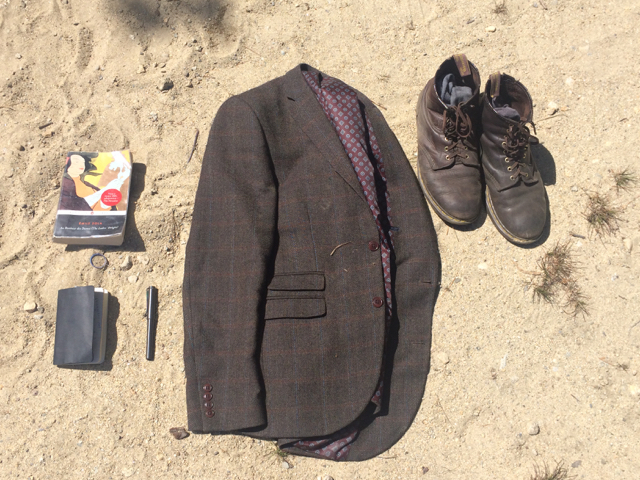
    • Tweed suit jacket – works for work, and for swing teaching. Really handy for docs when travelling.
    • Long-sleeved lightweight smart shirt.
    • Tie
    • Cravat (good accessory for swing gigs)
    • 2x t-shirts.
    • Thin jumper.
    • Belt
    • Underwear
    • Swimming/running shorts
    • Jeans – lightweight Rohan jeans – dry super quickly. Work for smart/casual.
    • Lightweight trousers – only sometimes – something light to perform in, or hang around a festival.
    • Thermal underear – takes no room, can use for PJs or to keep warm in sleeping bag.
    • Waterproof trousers – sometimes.
    • Socks
    • DMs/converse
    • Flip flops.

    Equipment

    • Diary + pen&ink, pencil.
    • Book
    • Phone + charger
    • Wallet
    • Computer/iPad + charger
    • Headphones
    • Speaker for teaching
    • Water bottle
    • Coffee cup.
    • Washbag
    • Wipes
    • Credit card swiss army tool
    • Travel towel.
    • Mudflappers business card

    Swing teaching bolt-on

    • Garland
    • Hawaiian shirtWhite short-sleeved shirt (Mudflappers standard issue)
    • Brown smart waist coat
    • Dancing waist coat
    • Big grey trousers + braces
    • Big black trousers – possibly
    • Dancing shoes – possibly
    • Cable for connecting ipod to soundsystem.

    Cycling bolt-on

    • Helmet
    • Gloves
    • Pump
    • Repair kit + multitool
    • Lights
    • Locks
    • iPhone holster
    • Bungee

    Camping bolt-on

    • Tent
    • Sleeping mat
    • Sleeping bag
    • Liner – sometimes
    • Hot water bottle – sometimes
      Torch

    Camping cooking bolt-on

    • Large collapsable water carrier
    • Plastic bowl
    • Plastic spork
    • Mini chopping board
    • Sharp knife
    • Bag for left-overs
    • Trave wash and scrubber
    • Jet boil, cafetiere plunger, gas and stand.
    • Coffee

    Three-year-old daughter

    • Hats – sun hat for the day and warm hat for the evening
    • Festival headphones
    • Jumper
    • Hoody
    • Fleece
    • T-shirts
    • Long-sleeved t-shirt
    • Leggings
    • Trousers
    • Underwear
    • Dress
    • Shorts
    • Tights
    • Wellies
    • Crocs
    • Onezee for sleeping in/evenings.
    • Sun glasses
    • Swimming costume
    • Nappies
    • Wipes
    • Face paints
    • Lego
    • Books
    • Sticker book, pens
    • Colouring book
    • Fancy dress stuff
    • PensBubbles

    Happy travels everyone!

  • Choppin’, loppin’, circus and swing – notes from Hazel Hill Autumn Conservation weekend 2015

    Choppin’, loppin’, circus and swing – notes from Hazel Hill Autumn Conservation weekend 2015

    Last weekend 38 people came down to Hazel Hill for our annual Autumn Conservation weekend for two days of woodland conservation and human restoration. We design the weekend to be a mixture of invigorating outdoor conservation work and relaxation in the woods, with a dose of entertainment thrown in too.

    Building on what we learnt from last year, we began the conservation work on the Saturday with a series of activities that would make an immediate and visible difference in the woods. An on-going conservation priority at Hazel Hill is the creation of butterfly rides, which serve two purposes. The first is to create the sort of wide path through the woods that enable the many rare species of butterflies that inhabit the surrounding fields to pass freely through the foerst. The second is to allow light in to the lower levels of the wood in order to increase the biodiversity.

    Widened butterfly ride leading to the Forest Ark

    This year we began our work by significantly widening the ride that runs from the forest ark to the southern cross, which had become significantly encroached upon by regenerating hornbeam. In the process we uncovered and liberated around twenty-five broadleaf trees in tubes that had previously been planted and which were being smothered by the hornbeam. I remember planting some of these trees myself on my first conservation weekend six years ago, and so I am pleased to see them being rescued. Any of this weekend’s participants returning to this spot in the wood in ten years time are now much more likely to find ash, oak and hazel trees maturing, thanks largely to their work this weekend.

    (more…)

  • Are you doing a French Mazurka?

    Are you doing a French Mazurka?

    I’m writing this on the train home from Towersey Festival to which I had been invited by my friends Nat and Sophie to help out with some swing teaching and performing for the Shooting Roots line-up. Towersey was my introduction to folk festivals, and it felt like a gateway to a fascinating world of music and dancing to discover. Nat and I were there to teach a 1 hour Lindy hop class and to do some dancing with a band in the evening (see the gig notes below for info).

    Towersey felt quite unlike any festival I’d been to before, and I think the main difference is the way in which people are engaged with the music and dance that is being performed. The crowds are attentive; they really listened in our lesson; they were really paying attention in the band performances. People are having a great time but there is none of the rowdiness, (except for being kept awake by a choir singing in four part harmony at 1am in the campsite). I love the way people carry around instruments, and there is space for people to jam. There was also the largest selection of real ales I’ve seen at any festival. And what’s more people walk around with their own tankards, which as far as I’m concerned is the best way yet to reducing festival waste.

    (more…)