How do you make sure you get the most out of the investment you are making in your professional development? First you have to commit to doing the hand work, which, in fact, comes in two parts. And then you need to create the conditions for your success. All is revealed in this video.
(more…)Category: Education and teaching
-

The power is in leaving a gap
So many things that I am working on at the moment lead me to the conclusion that there is power in the gaps. But I feel like for my much of my professional development I have been taught to fill in the gaps.
(more…) -
A reminder about the imminent climate catastrophe and how we should educate engineers to prepare for it
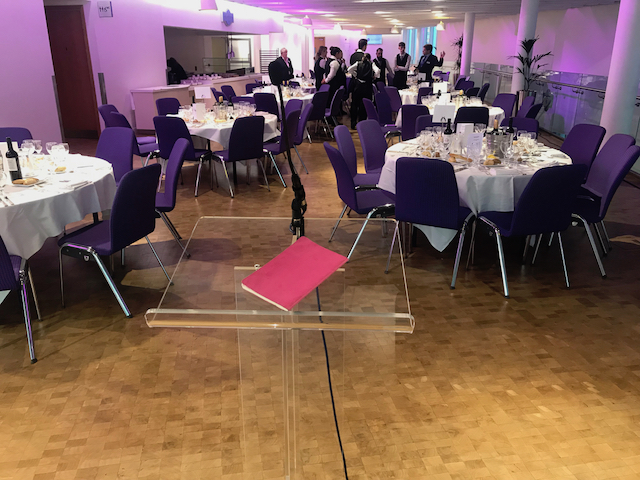
[The following text is adapted from the after-dinner speech I gave at the University of Edinburgh Engineering Faculty’s away day. It was originally titled ‘How problem-based learning can save the world and make you happy too’. But I have renamed it ‘A reminder about the imminent climate catastrophe and how we should educate engineers to prepare for it’]
Tonight’s engagement is my first since I took a summer sabbatical, which I planned to use to work on a book. Those plans changed in my first week away when I got involved in the Extinction Rebellion summer uprising in Bristol. That experience of direct action and the reaction it caused prompted me to read much more about climate breakdown, models for political change, the implications of societal collapse, the role of engineers to help minimise impacts and deal with upheaval in our own communities and the role of the people that teach engineers.
(more…) -

Secretly teaching design – notes from our curriculum planning day at Imperial
I am just back from taking part in a Design Thread workshop at Imperial College, the aim of which was to co-ordinate activity between the various design-relevant courses on the undergraduate civil engineering course at Imperial. Here are some reflective notes as I whiz home, during the writing of which I came up with the notion of ‘secretly teaching design‘. (more…)
-

Alt peer-to-peer feedback
Pear-to-pear (it was better than the images I got for peer-to-peer). As part of my Visiting Professorship at Imperial College I have been asked to think about how peer-to-peer assessment works in group works. Here are my thoughts.
One of the common features of the group-work-based learning experiences that I have been involved with is the need for the participants to be able to give each other feedback. Often in an undergraduate setting there is an emphasis on giving anonymous feedback. I have seen many colleagues cook up clever ways of gathering this anonymous feedback – I’ve conceived a few such systems myself – and processing this feedback in order to find out what is going on in student groups and to enable the teacher to be the arbiter of fairness. Managing such systems of peer-to-peer feedback can quickly become burdensome, and I am never really sure whether you really know what is going in the group or if the students are rigging the system.
As I become more and more involved in problem-based learning, I realise that this approach – anonymity and delegation of confrontation to the teacher – misses the point. If students feel that their peers aren’t pulling their weight in a teaching scenario, then they should be trained in how to confront these issues in themselves. And taking a more positive spin, students should also learn how to give positive feedback too.
I think it should be possible to give students the tools to handle these sorts of interactions themselves, and then for the teaching staff to coach students through the process where difficult situations arise. These are tools that my collaborator Nick Zienau uses in his ‘Leading and Influencing‘ course. The following is how I envisage this could work:
How it would work
The context is an extended student group design session in which a group of six to ten students spend a number of weeks collaborating to deliver a shared group output.
Skills development day: trust, confrontation and non-judgemental feedback.
I envisage a day-long training day for student groups. This would involve a series of group work exercises punctuated with whole-class briefing and feedback sessions.
Contracting – this is the process by which students agree with each other what they can each contribute to the team, what they want from the others, and how through their own actions they might jeopardise the group’s success. Students develop contracts for themselves, present them to one-another, and then agree a contract for the group.
The creation of contracts is a trust-building activity, and it creates a visible set of expectations by which the students can hold each-other to account.
Confrontation – in this session we provide a quick formula for confronting challenges. It involves naming a behaviour that they have seen and saying how it contravenes their individual or group contract. The reference to the contracts makes the terms of engagement very clear. Practising a formula for engagement makes the process something that people are familiar with.
Non-judgemental feedback – we walk students through process where they give each non-judgemental feedback, much of which comes down to language. We show students how to stick to facts, like ‘I have seen you do this’ or ‘when you do that it makes me feel like this’, rather than ‘what you have done is bad, or wrong’.
At the end of the training day, students have contracts for themselves and the group, a language for direct, open and kind confrontation and a mechanism for giving non-judgemental feedback.
Self-regulation during group work
After the initial training day students get on with their group work as normal. They are asked to have a quick daily group feedback session, where they appreciate each other’s efforts and identify any emerging issues. They are also expected to have a weekly structured feedback session, where they tell each other where they are contributing most to the group, and how they could contribute more.
Through the group work, it is expected that the contracts remain in view. They are intended to be a visual reminder to individuals of what they should be doing themselves, and also a way for people to understand other people’s behaviour.
Instructor Intervention
The course instructor makes themselves available say once a week to deal with any issues that students feel they can’t deal with in their own groups. The consultation happens with the whole group and the instructor will ask to see evidence that the teams have been meeting to review their contracts regularly and have been giving each other constructive feedback along the way.
Overall, I believe this approach would empower the students, give them useful life skills and improve the quality of their learning.
My thanks to Nick Zienau and Søren Willert who have significantly advanced my thinking on this topic.
‘Pear‘ by Augustus Binu, licensed under the Creative Commons Attribution-Share Alike 4.0 International license.
-
Problem-based learning – action learning from around Europe
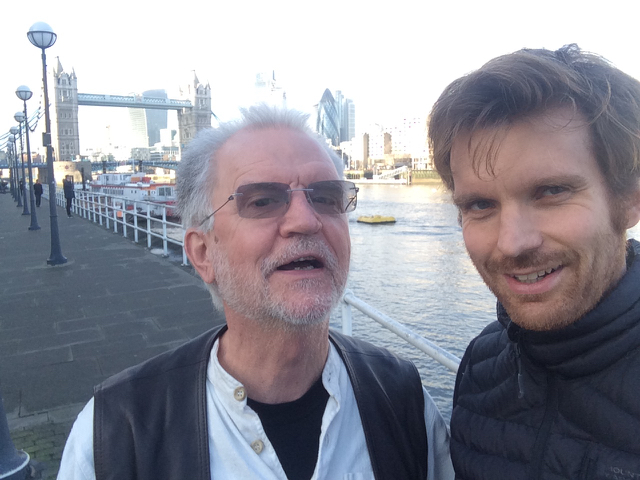
Today I have been reviewing the action learning diaries that half a dozen people have sent me from Greece and Cyprus. They are getting ready for training in problem-based learning that I will be co-leading here in London at Think Up with Prof Søren Willert from the University of Aalborg (see picture) as part of the EU ErasmusPlus-funded Enginite programme, and we have set them some problem-based learning of their own to do before they arrive.
The idea behind problem-based learning is that the student should own the problem and own the process of finding the solution. This approach is diamertrically opposed to the traditional direction of travel for learning. The aim of our approach is to get the participants to experience this problem-based approach for themselves before they start designing such experiences for their students.
The first set of reflective diaries that I have read reveal very different ways of working in our cohort. Some are applying problem-based learning with their students; others, who don’t teach, are adopting this approach with colleagues in their companies, and it is this latter group which is perhaps the most fascinating – because is in fact the sort of environment for which we are eventually preparing students.
At the moment problem-based learning feels like very rich territory to be farming in. The approach itself is a powerful philisophy that has many daily applications, and coaching other people in its use is gives me the chance to witness the daily strategies for sucess that other people use.
One of things that I really enjoy about this project is that is it is open – you can join in yourself if you follow the instructions below – and everyone is learning as they go. For my part I am learning what other people understand problem-based learning to be and become ever more aware of its applications. It is also terrific to be working with Søren, I feel like I learn so much from each of our interactions. Today it has been really interesting to see how he characterises the different types of PBL as described in the reflective diaries. To his words, it is enabling me to notice ‘exemplarities’ that I can look for in other people’s work.
To find out more about this project and get involved visit ‘Getting Started with Problem-based learning‘ on the Think Up website.
-
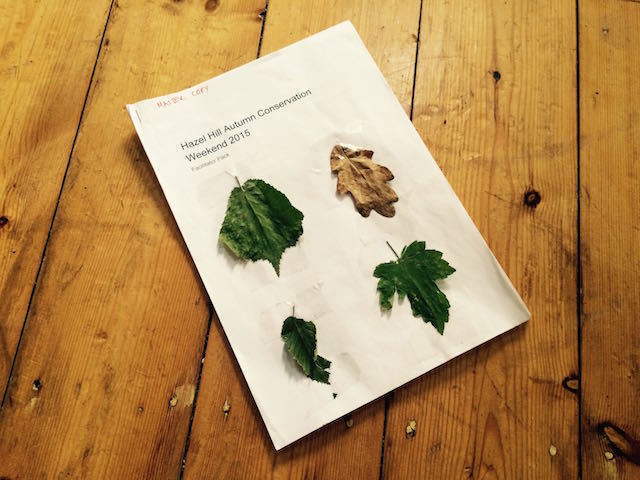
Choppin’, loppin’, circus and swing – notes from Hazel Hill Autumn Conservation weekend 2015
Last weekend 38 people came down to Hazel Hill for our annual Autumn Conservation weekend for two days of woodland conservation and human restoration. We design the weekend to be a mixture of invigorating outdoor conservation work and relaxation in the woods, with a dose of entertainment thrown in too.
Building on what we learnt from last year, we began the conservation work on the Saturday with a series of activities that would make an immediate and visible difference in the woods. An on-going conservation priority at Hazel Hill is the creation of butterfly rides, which serve two purposes. The first is to create the sort of wide path through the woods that enable the many rare species of butterflies that inhabit the surrounding fields to pass freely through the foerst. The second is to allow light in to the lower levels of the wood in order to increase the biodiversity.

Widened butterfly ride leading to the Forest Ark This year we began our work by significantly widening the ride that runs from the forest ark to the southern cross, which had become significantly encroached upon by regenerating hornbeam. In the process we uncovered and liberated around twenty-five broadleaf trees in tubes that had previously been planted and which were being smothered by the hornbeam. I remember planting some of these trees myself on my first conservation weekend six years ago, and so I am pleased to see them being rescued. Any of this weekend’s participants returning to this spot in the wood in ten years time are now much more likely to find ash, oak and hazel trees maturing, thanks largely to their work this weekend.
-

Reflections on video selfie training
Yesterday at Think Up I ran a workshop training engineers in how to use selfie movies to tell communicate to people about engineering. The aim of the workshop was to inspire and give the participants the skills to use video as a medium to share interesting engineering stories. The attendees were a group of engineering students from UCL and Imperial and a couple of graduate engineers from Expedition Engineering.
The content I had to deliver was in two parts: the technical skills – talking to camera, framing the shot, etc; and storytelling – figuring out what to say.
In my experience people are nervous to talk to camera, so I kicked off the workshop with asking people to film a selfie introducing themselves and sharing two surprising facts about themselves. It turned out to be a great way to kick off the exercise. I think it worked because people had to confront their fears straight away. We used these examples as a context for talking about what makes a good selfie. I then showed them a selfie I had made that morning, and asked them what was good and bad about it (below).
We then moved on to storytelling. I had thought that the participants would find the storytelling easier than the technical material, but it was the contrary. I asked individuals to think of a subject that they are passionate about, and to find one particular intriguing aspect of that subject that could form the kernel of their story. That bit was mostly easy, the challenge was finding the language that helped weave a compelling yarn. In the end the way round this was for me to suggest linking phrases or expressions and to show them how they could be used, and then for the individuals to weave those phrases into their stories.
The impact was stark: once they had a compelling story to tell, and they knew how to say it, even the least confident sounded a lot more confident on camera.
In the end I saw some really quite moving videos being produced. As homework I asked the participants to polish their performances and upload a video to the Think Up Facebook page. I’ll have more to write on this depending on whether they do or don’t post anything!
There are some important things that I take away from delivering this workshop:-
- This is another reminder that there is no substitute in learning for getting people to do. Forcing the participants to make a film straightaway was probably scary for most, but once they were ‘doing’ it was easier to talk about how to do it better. I had a similar experience in a communications workshop I ran last week on difficult conversations in engineering projects. We talked about the ideas, but it was only when I forced participants to role-play the scenarios (which they seemed reluctant to do at first) that the learning really seemed to sink in.
- I haven’t previously appreciated the value of good storytelling, though many of the people I work with do. Perhaps because it is something I think I’m good at, I don’t recognise how other people find it a challenge. This is a theme that I would like to develop in more training for engineers.
- This event was about confidence building, and I used a lot of the confidence building techniques I know from swing dance teaching – lots of applause for one-another’s efforts; keeping the momentum up and the tone positive – and it seemed to pay off.
-
Notes on ‘Teaching Design in the first years of a traditional mechanical engineering degree: methods, issues and future perspectives’
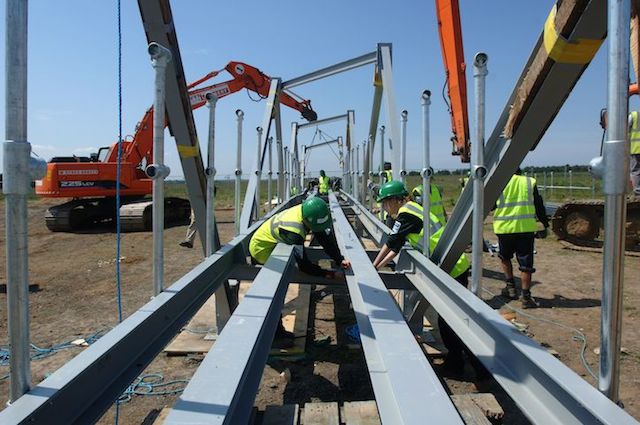
Constructionarium offers students the chance to build real civil engineeirng structures From the latest edition of the European Journal of Engineering Education (Vol 40 (1)) I have just read the very interesting paper ‘Teaching Design in the first years of a traditional mechanical engineering degree: methods, issues and future perspectives’ by Silva, Fontul and Henriques. This blog is to capture my thoughts.I am conscious that while I and my colleagues at Think Up have been involved for many years now in changing the way design is taught in civil engineering degree courses, we have written relatively little on what we have been up to. This paper is a good introduction to some the issues associated with integrating design teaching into the first year of mechanical engineering degree courses. It offers some parallels to civil engineering teaching (I will look in due course for papers directly related to civil engineering)The authors describe how mechanical engineering is traditionally taught through a series of separate courses with little cross-over and little opportunity for interdisciplinary design and open-ended problem solving. They describe a pilot project in which a design project is spread across three early modules in the course. Briefly, during two modules on technical drawing students design a simple innovative product, and create a prototype; and then in a subsequent course on materials they have to choose a material to manufacture it from. Some of the benefits are that learning is massively enhanced because students have to build something. Students learnt that iteration is a necessary and valuable process and not an admission of failure. And interestingly, students become aware of what they don’t know, which motivates them to learn in later courses. One of the challenges that this form of teaching throws up is that it takes much longer to facilitate.Reflections on relevance to civil engineering teaching- I haven’t yet seen a survey on how design is taught on civil engineering courses, but I have a reasonable idea. For the last ten years or so design has become a feature of most courses; however it seems often to exist as a stand-alone module at the end of the year, or a task within a module, tackled from the perspective of that course only. The innovation here is that one design project is taken as the common thread across three separate courses. During each course that design project is tackled from the perspective of that course but due attention needs to be given to the perspectives adopted by the other disciplines of the other courses. A parallel in civil engineering would be for instances to spread a hydroelectric dam design project across a geomatics, fluid mechanics and geotechnics course.
- The challenge with teaching design in civil engineering is that it is difficult to build what students design at a meaningful scale. I haven’t yet found the answer to this, but it regularly occupies my thoughts. It is possible at an elemental scale, for instance Ahmer Wadee’s plate girder make and break course at Imperial College; but harder at a greater scale. The Constructionarium is an example of a place where students get to build civil engineering structures at a meaningful scale, but students don’t get the chance to design what they are building.
- In the report which we wrote on experinece-led learning we strongly advocated taking an approach in which students try to define what knowledge they would need to know in order to become a professional engineer. As my experience with Engineering Knowledge Club has shown , the process needs a lot of facilitated discussion as students initially have very little idea of what information they need. Reading this paper it seems that setting a design project early in the course might be an alternative way of meeting this aim.
- I have previously written that interdisciplinary working is a skill that supports sustainable design, and this paper reminds me that interdisciplinary working can of course be achieved by running an interdisciplinary design course.
- The authors note that this type of project takes time. In my seminars with lecturers in civil engineering departments this factor is a common complaint. My response is that we have to look at course content and evaluate what is more important, the ability to solve open-ended problems and design more effectively, the skill which industry is looking for, or the mastery of specific technical skills to a high level, often higher than what is needed for practice.
The paper also points to a number of other publications that I want to check out. In particular:- Dym et al (2005) Engineering Design Thinking, Teaching and Learning – Journal of Engineering Education – A summary of designing thinking, teaching and learning, including an analysis of first-year cornerstone design courses and curriculum dispersed design courses.
- Marra, Palmer and Litzinger (2000) – The Effects of a First Year Engineering Design Course on Student Intellectual Development as Measured by the Perry Scheme – 2000 – Journal of Engineering Education.
- Haungs et al – 2001 – “Improving Engineering Education through Creativity, Collaboration and Context in a First Year Course” – ASEE Annual Conference & Exposition, Pittsburgh PA – Three major factors influencing negatively affecting creativity and retention rates in first year students:
- 1) hard for students to see how course material relates to real-world applications
- 2) students perceive engineering as an individual endeavour rather than an activity with peers
- 3) engineering assignments are overly constrained
- Bedard – 1999 – advocates a hands-onapproach to promote creativity in engineering education despite the risk of developing a reflex that trial and error can solve most problems and reduce student respect for the analytical component of engineering.
- “Enhancing Student Creativity and Respect for the Linkages between analysis and design in a first year engineering course.
- Hargreaves (2008) – Inherent balance between exposing students to challenge, and thus risk, and current higher education models of quality assurance that are risk-averse and thus potentially limit the scope of creative learning and teaching strategies.
- Meinel and Leifer 2011 – “Design Thinking: Understand – Improve – Apply. Berlin: Springer.- report on the HPI-Stanford Design Thinking Research Programme where students are taught the basic rules of design.
- Hirsch et al (2001) – “Engineering Design and Communication – the case for interdisciplinary collaboration” – International Journal of Engineering Education 2001 – How teaching design and communication at the same can enhance the students’ ability to tackle future engineering courses and career.
-
Stressed by stressed ribbons – teaching notes from Southampton
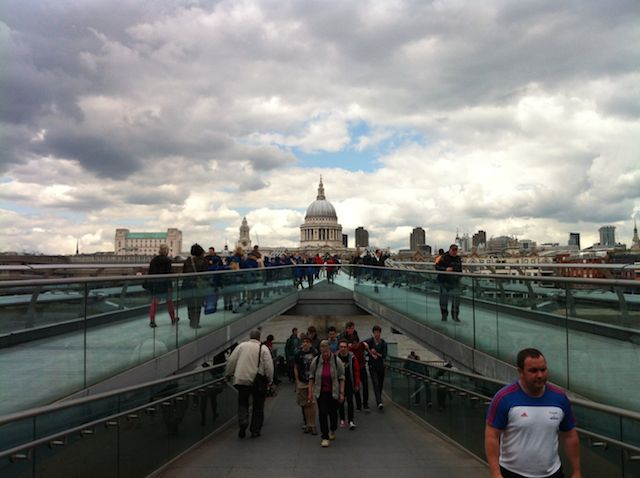
Long axis of the Millennium Bridge by Oliver Broadbent is licensed under CC BY-NC-SA 4.0 One of the groups of students that Ben Godber and I teach at the University of Southampton is designing a stressed ribbon footbridge as their entry for a design competition we’ve set them. A stressed ribbon is bridge is like a very shallow suspension bridge, the difference is that once the deck units are attached, the tension in the cables is ratcheted up, squashing the deck units together. The benefit of this post-tensioning is that it can greatly reduce the sag in the bridge, creating a much flatter bridge.
The students’ proposal is an elegant response to the site, but they have come up against the problem that they don’t know how to calculate the forces in the cables and so they can’t design the bridge. I was talking to my colleague Chris Wise about this problem of students not being able to design what they draw (a common student response apparently is that because they have seen a similar design online, they know it can be done: job done). But what Chris tells me he tells his students is that they should be able to justify every line that they draw. To help them, he provides students with an engineer’s toolbox, a handout full of rules of thumb that allow student engineers to draw engineering structures in roughly the right dimensions the first time around.
Returning to the case of our student’s stressed ribbon bridge, the bit of mechanics they need to understand is the equation that links the sag in a catenary cable with the horizontal force at the supports. For a static load on a single span bridge, this is easy to calculate, and is given by the equation Fh = wL^2/8s (where ‘w’ is the line load; ‘L’ is the length of the span; and ’s’ is the sag in the cable). Plugging the numbers into this equation gives what the horizontal pull of the cables at either end. The picture is however complicated when there are there are three unequal spans with the cables running continuously over the two supports in the river. If the cable is continuous, the tension in the cable must be equal either side of the support. If that is the case, then for a fixed load on the bridge, the sag in the spans needs to be adjusted to ensure the horizontal forces in the cables at the point where they go over the supports is equal on either side.
Were you to create a physical model of this scenario in which two people hold a chain that is draped across a pair of stools, the chain would adjust it’s own position until it finds its own equilibrium. To find this equilibrium in the design process, engineers do what’s called form-finding, an iterative process in which the parameters of the design are adjusted until all the forces are in equilibrium. For the purposes of a student project, a good-enough result can be obtained by setting up a spreadsheet to do the horizontal force calculations, and to iteratively adjust the sag in the cables until the forces balance.
There’s one final catch though. The process I’ve just described assumes the load on the bridge is constant; however, loads on a bridge change according to how people are using it. Engineers look for worse-case scenarios: the pattern of loading that would create the most difficult load for the bridge to carry. For instance, one worse-case scenario for a footbridge might be all the users standing against one edge watching a boat race, and then all at once, running to the other edge as the boats pass underneath. In the students’ scenario, the students need to think about how they will accommodate any difference in loading between the spans. If they were to leave the cables to free slide back and forth over the central supports, then as the loading changes the sags in the bridge spans would increase or decrease, which would be quite uncomfortable for the user! The alternative is to clamp the cables down on the tops of the supports. Any difference in the tension between the two spans due to unequal loading will then cause the column to be pulled sideways one way or another. The columns can be designed to resist these overturning forces. The challenge for the students is to work out what worse-case scenarios would exist to cause this unbalance in the cable forces.
Of course, everything above is greatly simplified. I don’t pretend to know the details of how to design a stressed ribbon bridge and I am grateful to my colleague Andrew Weir who helped me understand the mechanics of the problem in such a way that I can easily explain it to my students. The point is to illustrate what I think is one of the most important things that students can learn from design projects at university, and that is the ability to use their knowledge of mechanics and their experience of the world to develop a plausible response to a project. It is also one the areas of teaching that I enjoy the most because it best illustrates what an engineer can do: combining their own experience with an understanding of how things work to shape the world around them.
-
Experiments in content flipping
This year I have been experimenting with content flipping in my teaching. The idea of content flipping is that students first encounter the course material in their own time, so that teaching time can be spent discussing, applying or interpreting the material. The aim is to make more effective use of both time together and time apart.
I have had two opportunities this year to take a flipped approach. The first was as part of a Think Up commission at the University of Cambridge to assist in the coordination of a residential Masters module in innovation in construction engineering. It was my job to provide a theoretical framework that would weave together the themes of the week’s speakers. I decided it would be a better use of class time if the students could arrive at the residential week having already got to grips with conceptual ideas around notions of ‘future’ and ‘innovation’. These frameworks having been established before students arrive, we’d then be able to use our contact time to interpret what the course speakers had said against these frameworks.
The flipped exercises I sent out as two documents we called ‘Think Up Think Pieces’, one on ‘Future’ and one on ‘Innovation’. [link coming soon] These were sent to the students along with pre-reading papers from the more ‘traditional’ lecturers. In my first session with the students, I asked if anyone had covered the flipped content – only two out of twenty had. Not a great success – I’ll come on to my reflections on this in a moment.
Where I have had more success with flipping is with the graduate training programme I designed as part of a Think Up commission for a large construction management company. Here the aim was to introduce their first-year graduate intake to the key stages in the construction life-cycle of a building. The programme was to involve five intensive role-play-based workshops in which the graduates, working in teams, would take on the role of a team engineers as it managed the key stages in the construction process of a building. In order to have the maximum time available for role-play we decided to flip the theory. Two weeks before each workshop, we sent the participants a pre-briefing worksheet of activities and reading they needed to carry out to prepare them for the contact time.
In this instance, the majority of the students actually did the ‘flipped’ exercises. So what was the difference?
- In the Cambridge scenario, there was just one set of flipped exercise, followed by a back-to-back set of lectures and contact time. In the corporate training scenario, there were several sessions with long gaps in between when the participants could do their flipped work. In the latter case, the participants could see the benefits of doing the flipped work, and if they didn’t do so for the first workshop, they probably made sure they did for the second one.
- In the Cambridge scenario, my hopefully-interesting flipped exercises were bundled with more traditional reading lists sent out by the other lecturers. They weren’t to know there was something maybe a little different inside the material I’d sent over, and so probably didn’t look (I didn’t get the chance to ask students why they hadn’t read my material, or whether they had read anyone else’s)
- In the corporate training scenario, I got to brief the participants several weeks before the start of the course on the pedagogical model we were adopting, and in particular the importance of the flipped learning exercises. In other words, they knew what was expected of them, and so may have been more motivated to follow that learning scheme.
- Unfortunately I was not able to bring a reflective learning element into the work at Cambridge, but in the corporate training example, the teams were required to complete a reflective learning diary post after each workshop during which they were asked to reflect on the value of what they had learnt in the pre-briefing phase, which I am sure helped participants to see the value of this approach.
- Finally, in some of the flipped exercises in the corporate training example, I required participants to write a short summary of what they had learnt in the run-up to the session.
The flipped learning exercises were clearly of benefit to the graduate participants. They arrived at the role-play scenarios with a clearer idea of how they might be able to succeed at the tasks they were being set, and had more contact time with the facilitators to discuss the issues that they didn’t understand.
So what do I conclude about flipping? In the case where it worked I was very happy with the impact of the approach, and I will continue to adopt the approach where I can. To anyone else trying it, I would recommend:
- Being clear with the learners in advance that this is the approach you are going to take and why.
- Keep the reading or exercises concise and achievable rather than sending out a lengthy reading list that no one is capable of reading.
- Consider setting a short exercise to check participants have completed the flipped activities.
- If you are using a reflective learning approach, ask students to think about what they learnt from the flipped compoment of the teaching.
So, what do you think? Have you tried this approach? What are you experiences?
-
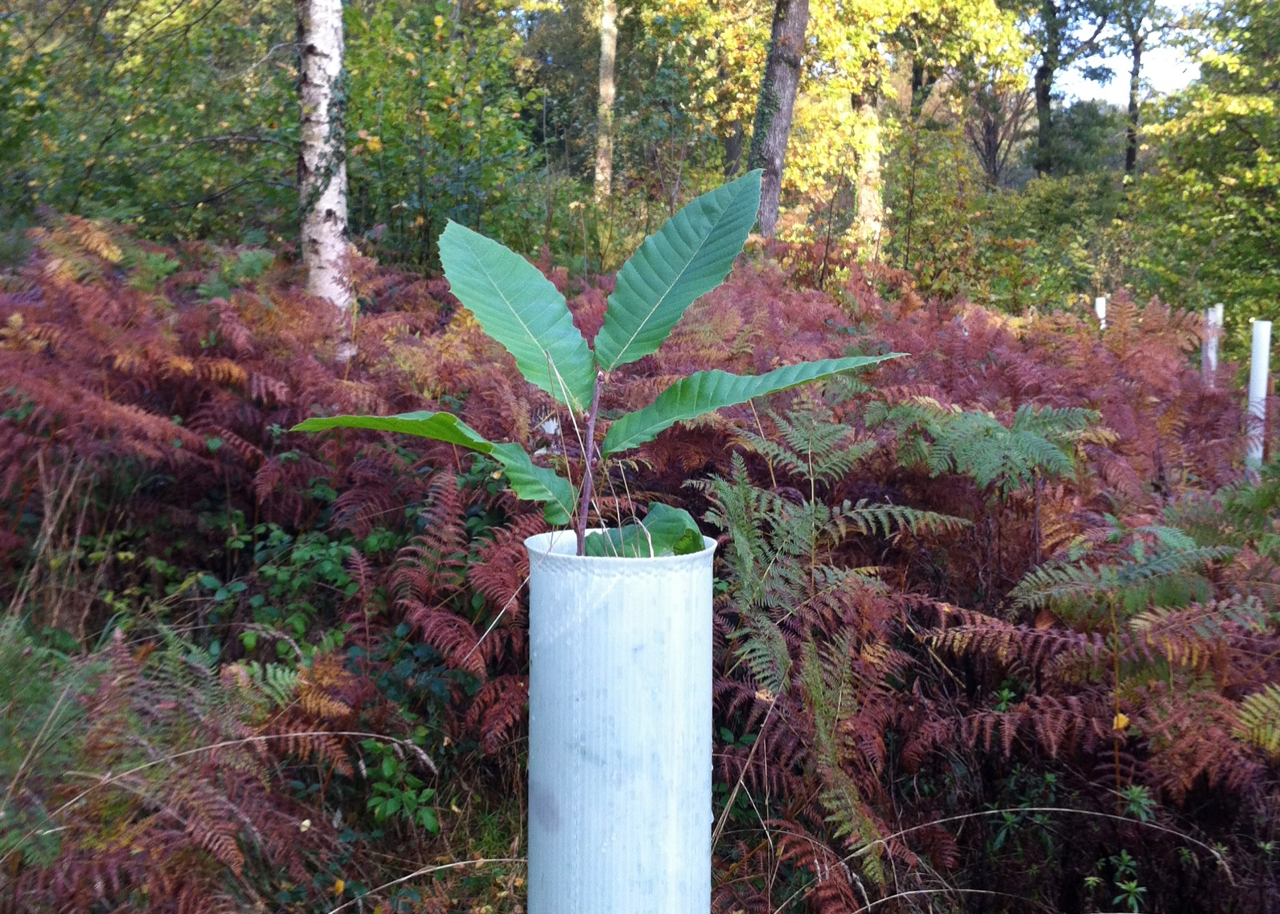
Seedling analogy for organisational change
A couple of time in the last year or so I have used what I call the ‘seedling analogy’ to explain what I believe to be is a sustainable approach to organisational change. My inspiration came during a conservation weekend that I was involved with at Hazel Hill Wood several years ago (see my post about that weekend here).
One of the main aims of the conservation activities at the wood is to reintroduce hardwood trees. Hardwoods were common here before the site was cleared for commercial forestry. For many years, conversation groups had been spending weekends planting new trees. But only a small number took root and flourished. However, on the weekend in quesiton, the conservation team were trying a new approach. Rather than planting new trees, they were looking for places where the seedlings of the desired species had already sprung up from the floor. Having found the seedlings, they protected them from browsing deer by putting a tube around them.
-
A sketch for the Big Idea
It was on a train to Bristol yesterday, travelling with my colleague Ben, that I articulated in I think the clearest terms yet the model of learning that through my various projects I would like to explore and develop practically. It goes something like this:
What do I want to know or be able to do?
What skills or knowledge do I need to have in order to meet this aim?
Which of these skills, knowledge or aptitudes do I already have?
How can I make up the deficit?
How will I know when I’ve got there?
The benefits of the approach are:
it starts with the needs of the individual, and values their own experience of the world. It is potentially empowering and rewarding. It could be self-sustaining if the individuals develop the skills necessary to adopt the approach.
Disadvantages or challenges I can see are:
Learners need to have developed a certain level of skill and maturity before they can adopt the approach. Learners need access to a whole different type of coach or teacher who can guide them through the process. The approach is not easily scalable, requiring a much more tailored relationship between coach or teacher and student.
I see these disadvantages as challenges to be overcome, and hopefully my projects can help contribute.
My motivations are:
A love of self-started learning and personal development; the astounding way that our brains can learn and a concern that our current formalised systems of learning are crude; the depressing sight of students motivated purely by grades and the hugely destructive fetch that summative assessment seems to have on the learning process.
Clearly these thoughts need refining, but I wanted to get these reflections written down while they are fresh. Clearly these are also big ideas to implement – perhaps impossible. In this respect I am inspired by the following from Rousseau’s Emile:
“People are always telling me to make practicable suggestions. You might as well tell me to suggest what people are doing already, or at least to suggest improvements which may be incorporated with the wrong methods currently in use. There are matters witch regard to which such a suggestion is far more chimerical than my own, for in such a connection the good is corrupted and the bad is none the better for it. I would rather follow the established method than adopt a better method by halves. There would be fewer contradictions in the man; he cannot aim at one and at the same time two objects.”
-
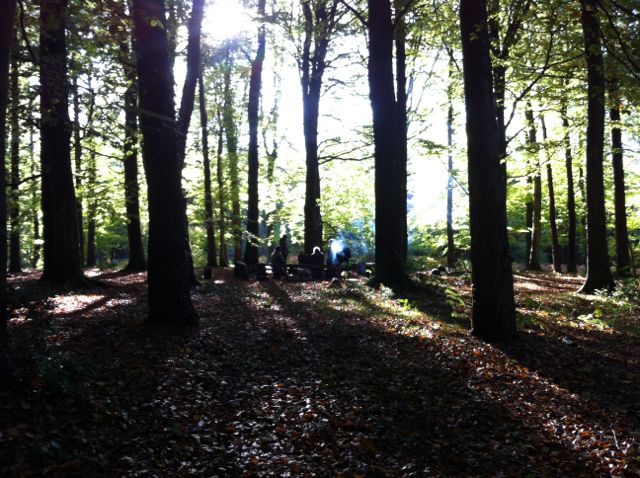
Adventures in the trees – planning under way
Camp fire at Hazel Hill Wood Planning is now in full swing for a Adventures in the Trees, a new project that I am excited to be involved with at Hazel Hill Wood. For this project the team at Hazel Hill Wood has teamed up with the team from Monkey Do to create two family weekends that give young people a taste for wild play in the woods.
Monkey-Do is a small non-profit social enterprise founded to promote tree climbing that runs free wild play activities for children in parks and woodlands, bringing people together with nature through play. At Hazel Hill, Alan Heeks interested in exploring how the wood can be used to prototype new ways of getting young people interested in woodland. The Adventures in the Trees weekends will bring Monkey Do’s experience of rigging aerial playgrounds to the magical woodland of Hazel Hill.
My job is to help design the event programme and to co-lead one of the weekends aimed at 7 to 13-year-olds.
More information and booking details will shortly be available through the Hazel Hill website.
Greater involvement with Hazel Hill
In 2014 I will be getting more involved with developing the programme of educational activities at Hazel Hill wood, in many ways inspired by reading George Monbiot’s ‘Feral’ last year. My role in the Adventures with Trees weekends is part of that programme. Another activity will be co-leading a conservation weekend at the wood in the Autumn. More details to follow…
Related posts
-

The Beginning of Engineering Knowledge Club

Engineering Knowledge Club Logo by Think Up is licensed under a Creative Commons Attribution-NonCommercial-ShareAlike 4.0 International License.
Permissions beyond the scope of this license may be available at info@thinkup.org.Almost nine months since we were awarded funding from UCL’s Teaching Innovation fund, Paul Greening and I kicked off ‘Engineering Knowledge Club‘. The idea is to encourage students to develop for themselves the engineering knowledge they need in order to be successful in the field of engineering they want to go into. We have set up a dedicated blog for Engineering Knowledge Club, which describes our aims for the project, so I won’t repeat them here.
But what I will say here is how excited I am about this project. The timing is particularly appropriate as I have been spending most of November co-writing a guide for the Royal Academy of Engineering on experience-led learning in engineering. Many of the ideas discussed in that report we can put in practice in Engineering Knowledge Club, for example:
Student–led learning – so much of the learning that I see happening in civil engineering courses seems to be motivated by grades, which probably stifles curiosity, intrinsic motivation and independence. I strongly believe that if learners were learning about what they were interested in, then they’d be self-motivated, perhaps work harder, and learn more effectively. Engineering knowledge club is about giving students the chance to define and drive their own learning.
Learning based on real-world stimuli – civil engineering is a subject that surrounds us, and so lends itself well to learning by observation. And yet, so much civil engineering education is based on text books, lecture notes and websites. Engineering knowledge club will encourage students to be inspired by, be curious about and learn from the environment which surrounds them.
Reflective learning – people tend to learn better when they think about how they are learning. Over the last two years I’ve experimented at UCL with Paul Greening and at Queens Belfast with Siobhan Cox on using private student blogs for reflective learning. While this has had some success, what’s been missing is students being able to learn from each others’ blog posts. Engineering Knowledge Club will give me the chance to experiment with using a public class blog. This will hopefully help to build a sense of community among the students, and should serve to demonstrate the concept to anyone interested.
Building a community of learning – I don’t feel that students are encouraged enough to support each other in their learning. I believe that a student cohort in which everyone is looking out for each other would be one that learns more. We hope to build a sense of community in Engineering Knowledge Club and be able to see its impact on learning.
We shall see!
-
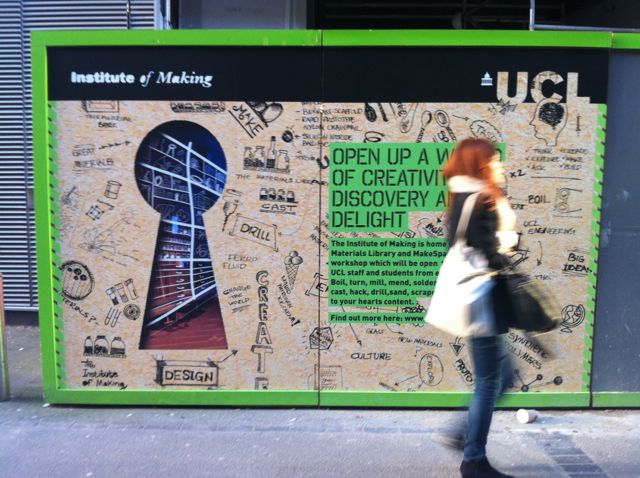
Now ‘lecturing’ at UCL
The letter came in the post yesterday. I can now call myself an Honorary Lecturer at UCL’s Department of Civil, Environmental and Geomatic Engineering. Obviously the ‘Honorary’ bit means that I still have my day job at Think Up, but it is great to have recognised a good and growing working relationship with the department through projects such as Knowledge Club and a re-run of Think Up’s Haiti Disaster Relief design project.
UCL and Think Up are on each other’s doorsteps, so I expect to find myself on campus much more. And now with access to EduRoam, any campus is my office.
-
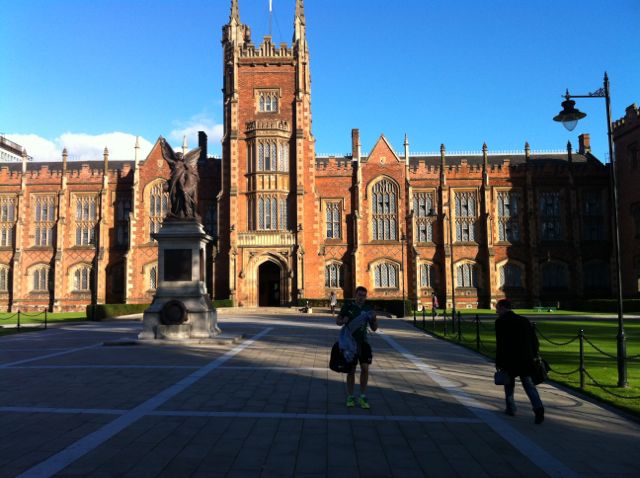
Teaching at Queens – part 1
Over the next couple of days I’ll be at Queens University Belfast to do two things: to kick off a new sustainability-themed student project, and to run a curriculum development session with staff on the theme of embedding sustainability.
Queens commissioned Think Up to design a sustainability-themed project for first year students. With this collaboration we plan to test three things: the idea of using a project early in the course to introduce the ‘basic building blocks’ of sustainable design; how this project can be used to introduce a topic that other teaching staff can build upon in later modules; and how a virtual learning environment (in this case Our in-house platform Student Studio) can be used to facilitate a better link between universities and industry.
Basic building blocks
Principle Two of our report Embedding Sustainability in the Undergraduate Civil Engineering Curriculum is to ‘establish the basic building blocks early on in the course’. Using Bloom’s Taxonomy as our theoretical basis, the higher order cognitive processes needed for sustainable design (analysis, assimilation, creation and evaluation) are founded upon the more basic cognitive processes (knowledge of, knowledge that). To enable students to make better judgements in the field of sustainable design, we need to establish the basics that will help them make those decisions.
The basics are widespread, and include: common terms and definitions; principles of simple analysis techniques; materials; exemplars. Communicating this material is not a great use of class time. The project that we are designing will provide a context within which the students can start to establish these basic building blocks.
Project brief
Student are asked to work in groups to answer the rather open-ended question, how sustainable is Titanic Quarter (a large new mixed commercial-residential-cultural development in Belfast)? To help them, we have suggested seven axes for investigation based on the twelve objectives for sustainable development on the Olympic Park. For each axis, we have suggested aspects of the development to investigate, analysis tools and techniques they might use, and technologies they should find out more about.
Over the coming week, students will go on a fact-finding tour, do online research and try to speak to people who know about the site. Once they have gathered their data, they need to agree as a group how they are going to answer this question. The task is deliberately designed to provoke debate, and to ask students to apply their judgement. We emphasise that there is no right answer, and what is important is the thinking process they go through.
To conclude the project, students will present their findings to other groups. In each pair of groups, one will the on the role of the developer, the other will take on the role of sustainability consultants answering this question. The students will choose which team they think have best answered-the question. That group will then present their findings to my colleague in the Useful Simple Trust, Dan Epstein, who was head of sustainability on the London Olympics.
Basis for our teaching modules
Our hope is that this project will enable other teaching staff to develop modules that build upon these foundations. Titanic Quarter is a development close to he Queens campus and it is likely to be under development for some years to come, so it makes sense to link teaching to reality by drawing on case studies from this project.
Using Student Studio
This project will be the second time that I have used Think Up’s virtual learning environment Student Studio to run a remote teaching module in a university. The platform is used to provide briefing information to the students, to provide an online space for a learning blog, and a forum space for discussion posting questions.
The plan is that I will be in Belfast to kick off the project and give the students an introductory lecture. I will brief them on how to use Student Studio. I will then go back to London, but I will be able to track students’ progress through the project remotely. Together with using Skype to deliver the final presentation, if successful, we hope this technique will demonstrate how industry can be connected to the teaching environment without necessarily having to be there all the time.
-
Build a nuclear power station in a week
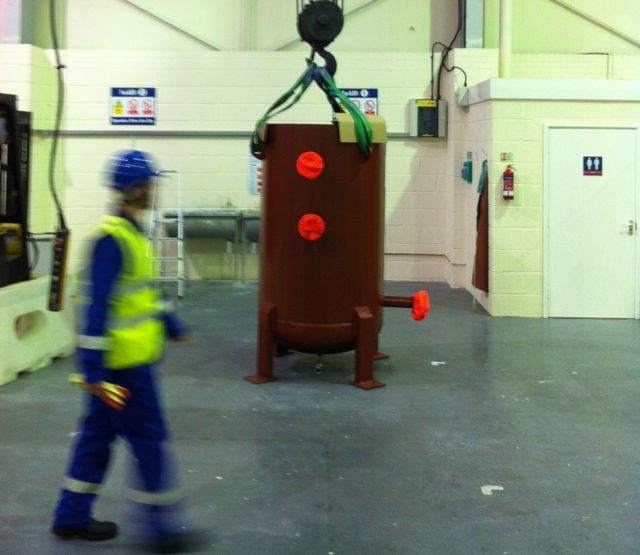
Student coordinates lifting of reactor into Nuclear Big Rig It was three years ago, standing in the middle of my first Big Rig structure that I first had the idea of getting engineering students to build their own nuclear reactor. Today I watched as a group of students lifted their ‘reactor’ into position on day two of the pilot of Nuclear Island Big Rig.
The Big Rig lends itself well to creating mock-ups of industrial plant and installations. The design and construction of a nuclear power station, with some significant alterations for practicality, is exactly the sort of exciting-sounding brief that we use at Think Up to inspire people to pursue a career in engineering.
The opportunity to put this idea into practice came when Think Up was approached by Cogent to design an event to inspire electrical, mechanical and chemical engineers to take up a career in the nuclear new-build sector. The result is Nuclear Island Big Rig, a week-long event in which a group of 16 engineering undergraduates and apprentices are challenged to assemble, operate, and dismantle a mock-up of the primary cooling circuit of a PWR.
I was not able to facilitate this event because of my paternity leave, but today I went down for the day to see how everyone is getting on. There I found a team of well motivated students working their way through the problems they were encountering. Some of the most the undergraduates – I had the impression they had a lot to learn from each other.
While I am not there all week, some of the features we are building into the event are making it easier for us to connect with learners directly from our head office. For instance, we are using our Student Studio online platform to host personal reflective blogs and a student forum for the event. We can use this tool to track the event remotely, and to gather lie feedback as the event progresses. Similarly we created a Facebook event page, which has already enabled us to connect more easily with participants, and allowed them to share practical information with one another.
I am looking forward to hearing how the students get on over the rest of the week, and to seeing how we can improve the event over future iterations based on what we have learned.
-
Taking inspiration from the Transcontinental Railroad
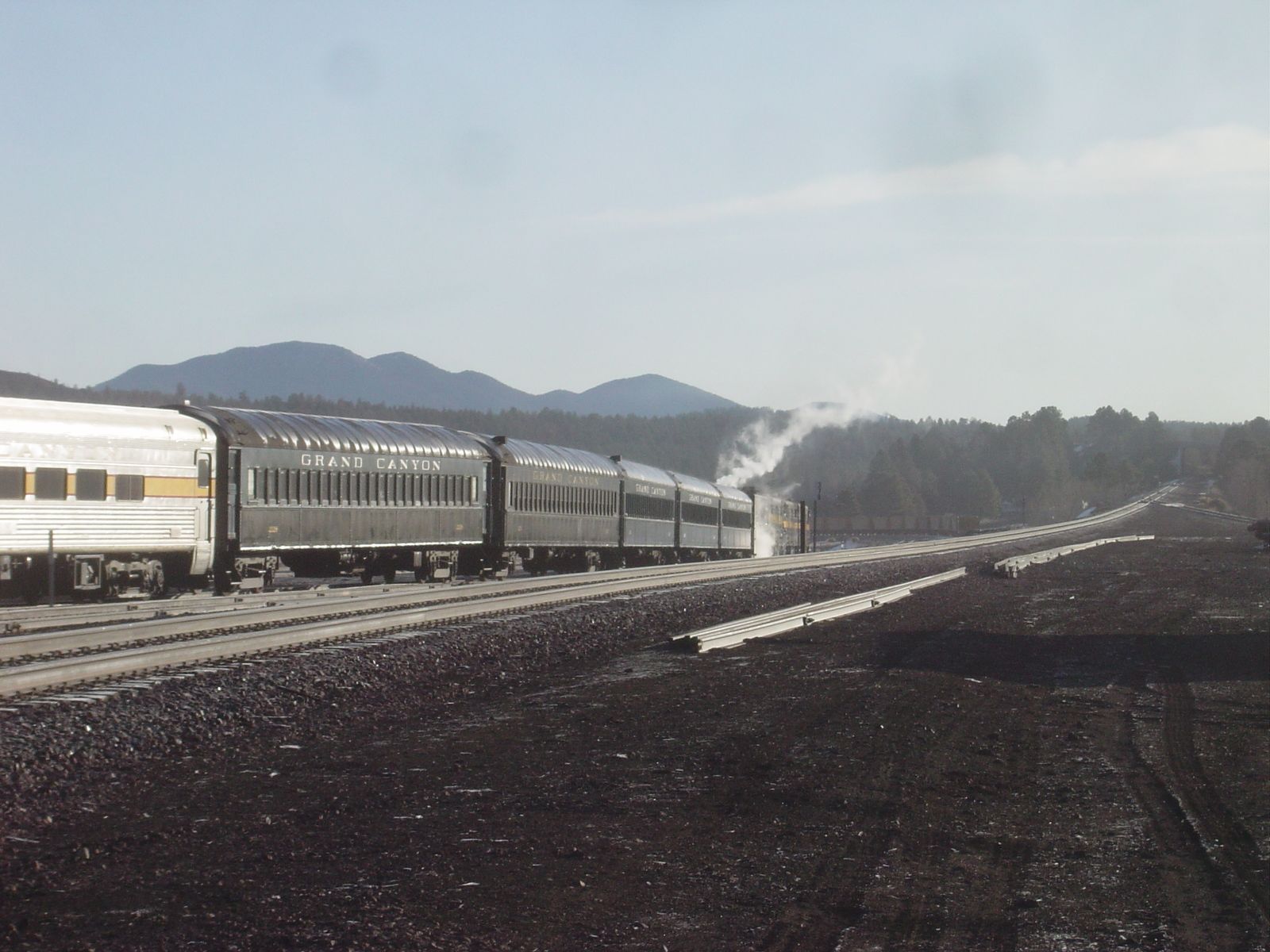
A train pulls of the Santa Fe railway at Williams Arizona to join the Grand Canyon Railroad As I tweeted earlier this morning, today at Think Up I have been working on Build Camp, a concept for a week-long hands-on learning event designed to encourage young people to take on a career in civil engineering. For some time now we have been proposing an event based around the idea of students designing and building their own railway in a week. Today we were looking at how to create a context for the event around which on-site role play activities can be built. Today’s idea was to use the construction of the first american transcontinental railroad as the context, for reasons explained in the following text, extracted from some my draft web copy for the soon-to-be-online Build Camp website.
Why the Pacific Railroad?
Learning about the construction of a railway line is an excellent introduction to the world of civil engineering because it embraces so many aspects of the discipline, including: planning and surveying: structural, geotechnical and fluid mechanics; construction management. This event is set in the context of the construction of the Pacific Railroad, the first railway to cross the United States. The construction of this pioneering railway line was led by a team of engineers operating at the railhead. Engineers were responsible for:* Surveying and choose a route through the unknown territory ahead.
* Designing cuttings, embankments, bridges, dams, causeways and tunnels as needed;* Sourcing local construction materials: fill for embankments; timber for sleepers; fuel for machinery;
* Overseeing construction works
* Organising the logistics of moving labour, materials and plant along the single-track line
* Establishing camps for workers, sourcing food, and paying wages.These engineers were working in the unknown; it was 2000 miles back to headquarters, and so they had to rely on their own ingenuity and engineering judgement to solve the problems they encountered. By setting the role play for this event in the context of the Pacific Railroad we aim to harness that visionary and pioneering spirit, and demonstrates the potential engineers have to shape the world for the better. We are also providing a baseline against which the advances of modern railway construction can be illustrated.
At present we are hoping to run a pilot of Build Camp in October. Keep an eye out for updates on the Think Up website for more information.
-
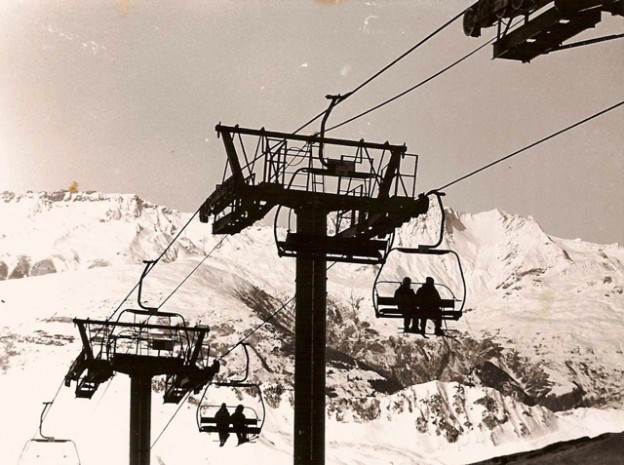
Archive photos/early attempts at developing/les arcs
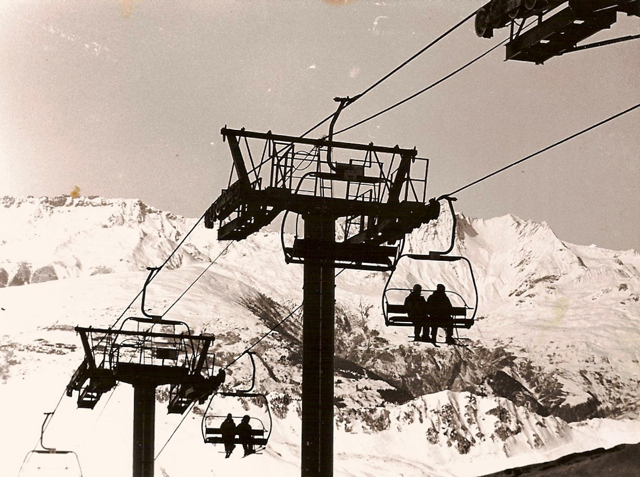
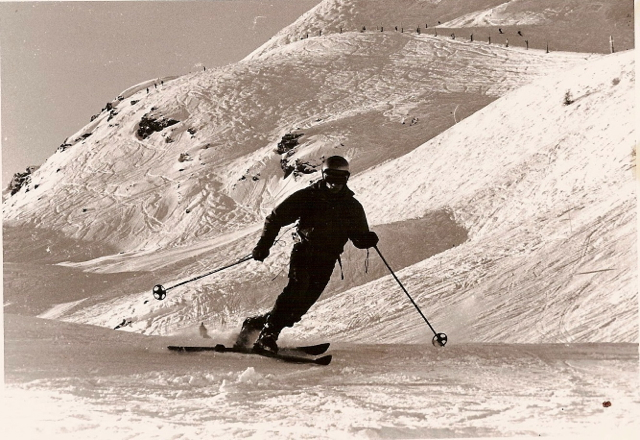

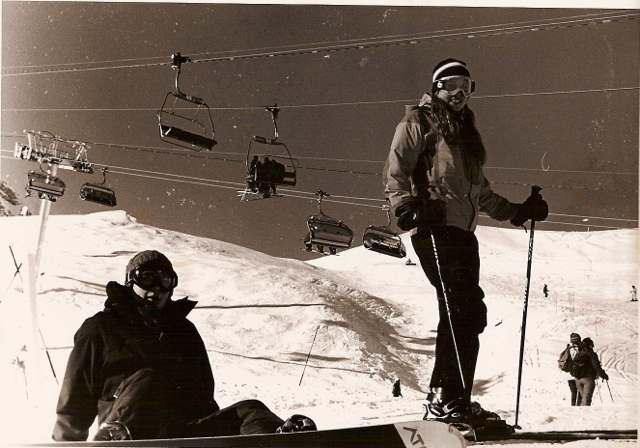
Probably the best module I studied during my year at ENPC was not engineering-themed – but photography. The module was run as an English language course: the subject of the lessons was photography, and the lessons were in English. Being a native English speaker I was not able to get any credits for the module, but I gained much more. I still vividly remember the magic of seeing images emerge on pieces of paper submerged in solution. In just a few short hours of teaching I learned somethings that have been much more valuable to me than the hours of lectures I sat through on other subjects.
These photos were taken on a weekend trip skiing at Les Arcs. Getting from Paris to the Alps by overnight train is easy by the way. The night train leaves from Gare d’Austerlitz, and arrives Bourg St Maurice, where there is a lift straight up to Les Arcs.
-
Using construction site notebooks as a teaching tool
Today the Expedition-Imperial team met to plan their week at this year’s Constructionarium.
The learning experience is intense on site at the Constructionarium, with students on their feet all day for five days building their projects. Along the way there is lots of background knowledge they can pick up about construction techniques, but it is easy for these nuggets to get lost in the blur of the overall experience.
My suggestion was that this year we give all students a site notebook in which they can plan their activities, note useful info along the way and write up their daily activities. Of course, giving students a notebook doesn’t necessarily mean they’ll use it, so perhaps we can guide them by showing extracts from real site engineers’ notebooks. These could be shared as a teaching resource on Workshed.
Earlier this year we bid for some innovation grant funding to develop methods for students to develop their general engineering knowledge. One of the ideas I was interested in exploring was the use of a site diary to develop this knowledge. This year’s Constructionarium looks like a good opportunity to test this approach.
-
Last day of teaching at Edinburgh
Today I made my last teaching visit to Edinburgh for the term. I will go back once more in the spring time to evaluate the work that I have been involved in, and then will be it for my current tenure as a RAE-sponsored teaching fellow; however, there is scope to extend the funding, and we help to do so for another year. (more…)
-
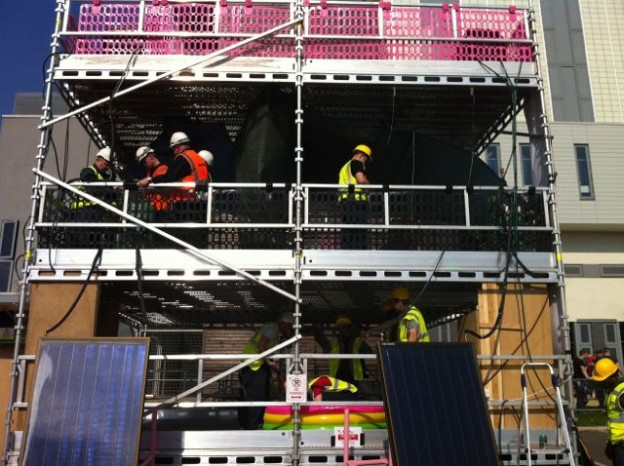
The Return of Low Carb
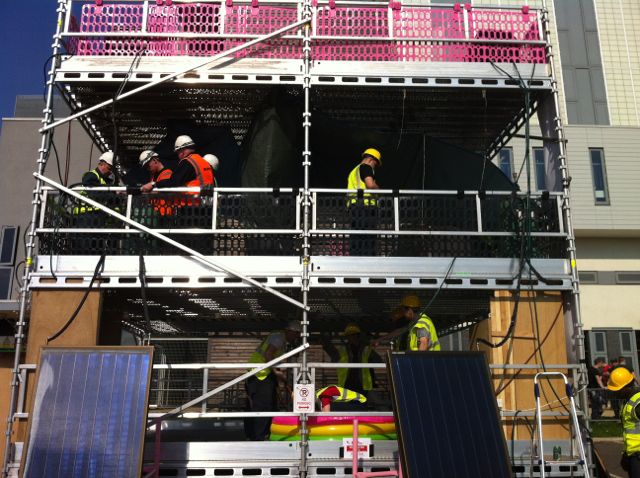
Installation of solar-thermal water heaters on the Big Rig Yesterday I was at the Big Rig facilitating the annual low-carbon skills challenge at the Big Rig. This is the fourth year in a row that Think Up has run the ‘Low Carb‘ event. I am very proud that since we came up with the Big Rig concept, 100s of students have taken part in Low Carb. (more…)
-
Facilitating the Global Grand Challenges Student Day
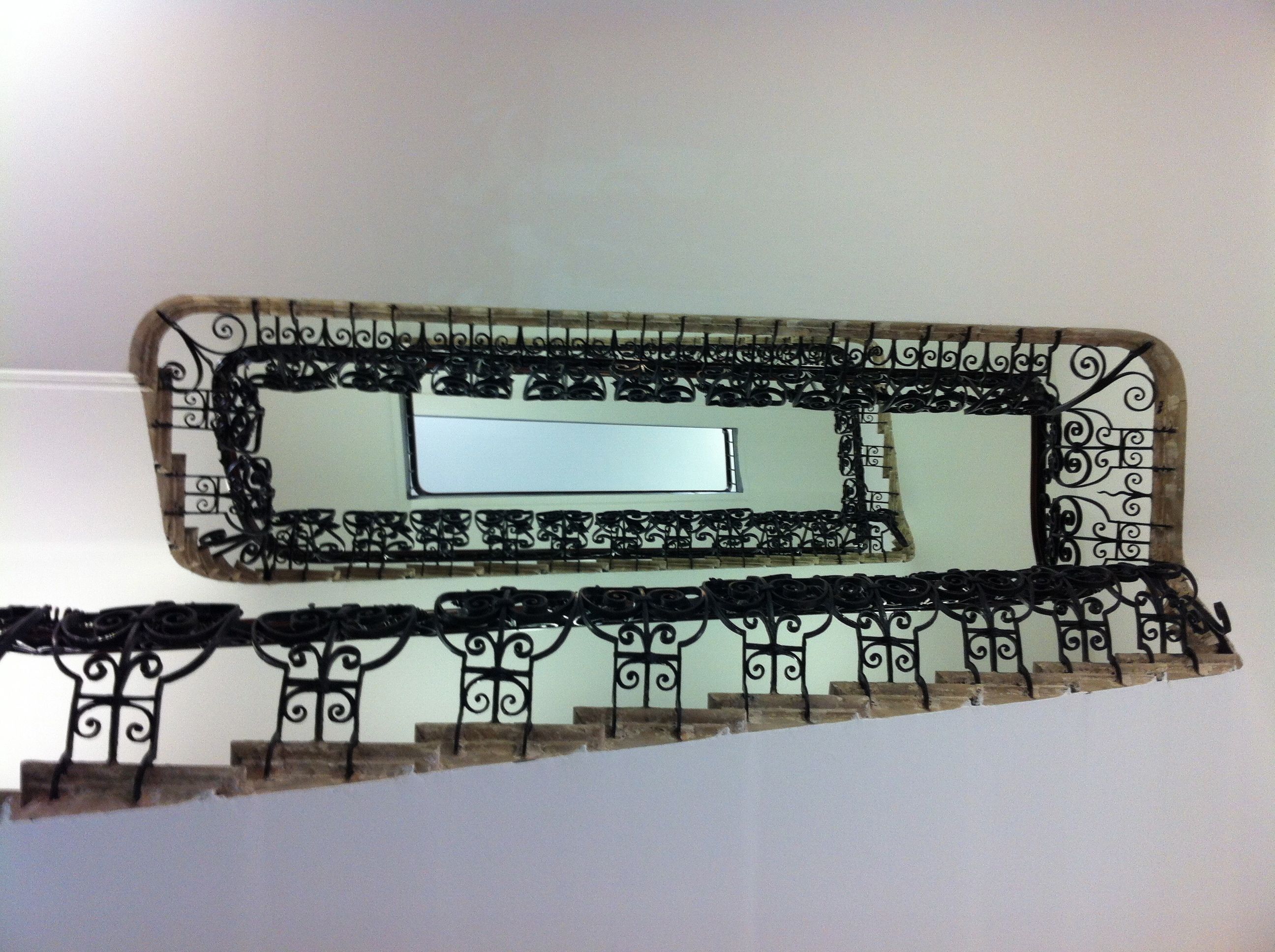
Spiral staircase at the Royal Academy Engineering, taken on the morning of the Microsoft Global Grand Challenges Summit Today Think Up facilitated the Global Grand Challenges Student Day at the Royal Academy of Engineering. The student day is a prelude to the main Global Grand Challenges Summit which starts tomorrow. Our brief for designing the event was to choreograph a day of activities in which students from engineering universities around the world would come together and collaborate to develop a solution to six of the Global Grand Challenges. Our response was a programme that sought to unpick the creative process, and to enable students to examine what skills they need to develop to be better designers, all in the context of solving a major societal challenge. (more…)
-
Thames Cable Car Student Design Workshop
Today I have been working on content for a new creative design workshop for civil engineering students based on the Emirates Airline. The workshop is part of my work with the civil engineering department at the University of Edinburgh. (more…)
-
Talking Sustainability in Bristol
I’m just back from the first of six workshops I will be facilitating at universities around the country about how to embed sustainability in undergraduate civil engineering courses. The ICE and Royal Academy of Engineering commissioned Think Up to design and deliver these workshops to disseminate the findings of our sustainability teaching report. (more…)
-
Pursuing general knowledge – not such a trivial pursuit
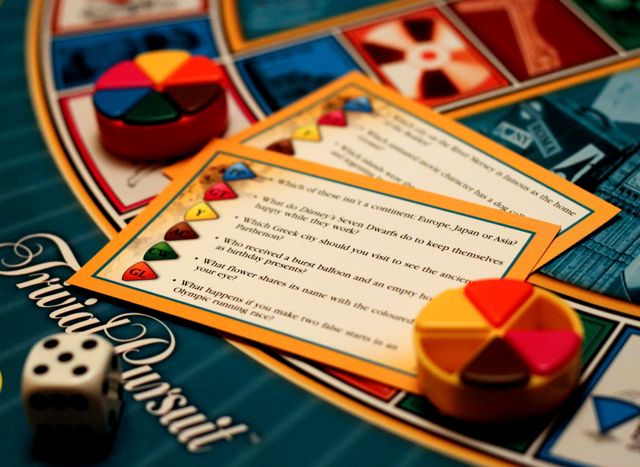
The ability to design arguably sits at the top of Bloom’s taxonomy of learning, requiring as it does decent doses of creativity and evaluation. The foundations therefore of good design must be a broad general knowledge base. This certainly seems true in civil engineering. In order to quickly think up possible solutions to an engineering problem requires knowledge of material properties and behaviour, construction methods, costs, precedents, laws and codes etc. (more…)
-
In praise of Fred Dibnah and Burt Munro
Most of my work this week has been around designing events that help engineering students develop problem-solving skills. My opposite number at a meeting today cited Fred Dibnah, the famous chimney feller, and Burt Munro, the pioneering motorcycle land speed record holder, as examples of people who didn’t need engineering degrees to solve engineering problems.
It’s too close to bed time to start writing about developing problem solving skills at undergraduate level. Instead, the stories of these two engineers make for a far more fascinating read.
-
Dipping into chemical engineering
For someone who has studied both chemistry and engineering, it is somewhat of a surprise that I have had so little exposure to the chemical engineering sector. I did go and meet the admissions tutor for chemical engineering at the University of British Columbia when I was 21, but was put off by the large format pictures of oil rigs. A year later, my fourth year chemistry research project ‘Solute Binding by Surfactant Molecules’ did have some application to the chemical engineering process of foam fractionation. Other than these flirtations over ten years ago, chemical engineering has been largely off my radar, until this afternoon. (more…)