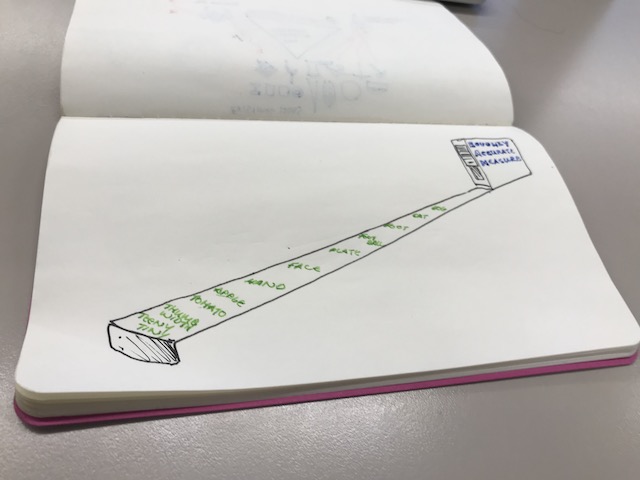
This week I have had the feeling that I have been struggling recently to find focus on my creative work. I have lots of projects on at the moment, and I am not satisfied that I am being able to draw a cohesive thread between them. I think this is important because I subscribe to the idea that to have impact on your work, you need to be regularly adding to it in a disciplined way – always adding momentum to the fly-wheel, as Jim Collins puts it.
(more…)Category: Exhibitions
-
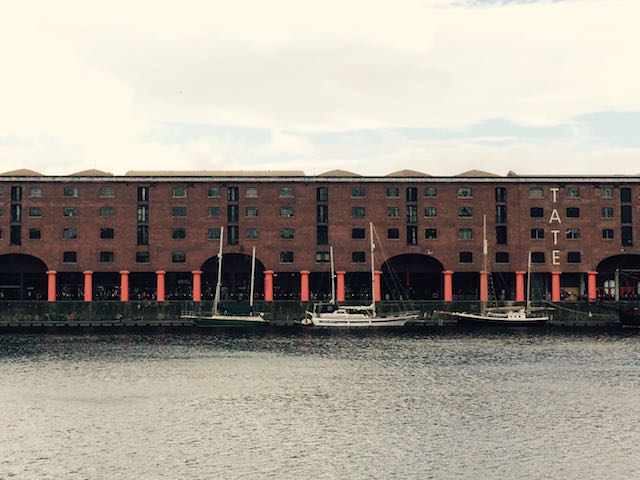
Workshop inspiration from Jackson Pollock
 Today I went on a recce to the Tate Liverpool for a course we are designing at Think Up for a client. As I left the event hosting space I was left to wander the Jackson Pollock exhibition. The show will still be running when we hold our event, which great because I can see three ways in which this exhibition can be used to support the learning on our course.
1. Working with the subconscious
One of the features of the model of idea generation that I will be introducing is the important role of the subconscious in creativity. In Daniel Goleman‘s book Focus, he describes (more elegantly than I am doing here) how the ‘active’ brain is always on the lookout for useful stuff that the wandering brain generates. On this theme, I picked up some useful quotes from the exhibition notes:‘Pollock’s aim to work directly from the subconscious led to a radical process of dripping and pouring paint over large canvasses placed flat on the studio floor…”the modern artist…is working and expressing an inner world – in other words expressing te energy, the motion, and other inner forces.”Then, this from another section:‘Although there was an element of chance Pollock frequently spoke of the importance of decisions over the merely accidental.’My intention is to use Pollock’s work to emphasise the link between the conscious and subconscious in creative work.2. Relating to your audience
Engineers often have to communicate ideas to audiences with different value sets. One place where there is commonly a clash of values is around aesthetics. Engineers typically get little training in aesthetics, compared, say, to architects. Therefore it is unsurprising that engineers can find themselves cut out of such conversations with the client when an architect is at the table. In the course that we are creating, we are not trying to run training on aesthetic appreciation, but simply intending to make the point that you need to understand the perspective of the audience you are dealing with.To help make this point, I think there is a role-play example that we can create that involves Pollock’s work, given the bumpy relationship he had with his audiences. One idea might be to get engineers to take on the role of Pollock’s agent, and to get them to persuade a critical viewer of the merits of his work.3. Thinking Hard
Pollock reflects that ‘his new works require a lot from the viewer’. I find this exhibiton forces me to think hard, and not merely to engage with the surface, and I think the same can be said of good creative thinking. You need to think hard.To conclude, as ever, I’ll have to see if there’s time in the programme to fit in these ideas. I hope that there is. -
Things to do in Berlin: go to the Museum of Things
On the to do list for my next visit to Berlin (which may not be for some time…*), the Museum of Things. See this link from the museum’s website on current exhibits (and this from the Guardian). The museum has recently added the Frankfurt Kitchen, a 1920s prototype of the modern kitchens with which we are familiar today. Reading about the Frankfurt Kitchen reminded me of an exhibition that I went to see on Charlotte Perriand (Design Museum profile), who was designing in the 30s the sorts of furniture that you’d recongise in Ikea today. From furniture design and architecture to music, I am always surprised just how old ‘modern’ is.
*maybe in the meantime I should make the time to go to the Design Museum, London.
-
Speaking with Pictures – Peter Ayres at Big Draw Big Make at the V&A
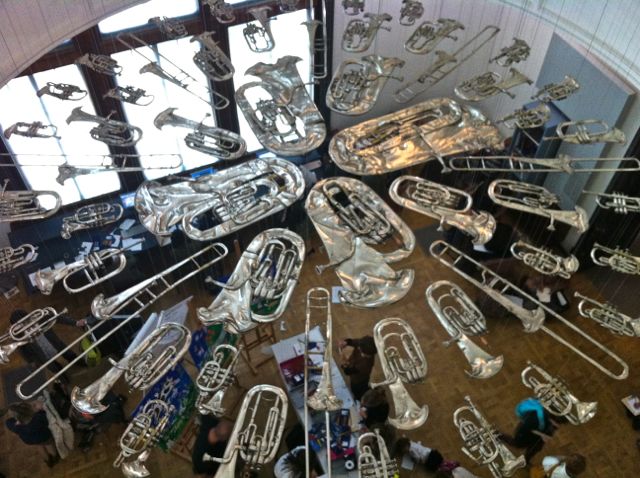
This afternoon M and I dropped in to the V&A to see what was happening at Big Draw, Big Make. The first talk that caught our eye was Speaking with Pictures, by Peter Ayres from Hetherwick Studio.
(more…) -
Notes from Migrations at the Tate Britain
Notes on a few things that caught my engineer’s eye at the Migrations exhibition at the Tate Britain today.
‘Quickly Away Thanks to Pneumatic Doors’ and ‘Soon in the Train by Escalator’, both by László Maholy-Nagy, 1937 are two eye-catching information posters that explain how new technologies will work to improve passenger journeys. The posters are clear, without being patronising. It makes me wonder why we don’t do the same now to explain the engineering that is being employed to build the latest additions to the Tube. Right now in London, we have one of the largest infrastructure projects ever undertaken in the capital underway, Crossrail, and yet the project feels hidden rather than celebrated. More public civil engineering information posters please – I am sure they would be avidly read by young and old.
-
New Year’s Day – Gauguin: Maker of Myth

M and I have been meaning to go and see the ‘Gauguin: maker of Myth‘ exhibition at the Tate Modern for some time. The reviews have been great, the main criticism the huge crowds. With the exhibition due to finish soon these crowds were only likely to get worse. On New Year’s Eve I remembered I previous NYE when we were on a skiing holiday. Fresh snow had fallen during the night and so we had set our alarm clocks painfully early on New Year’s Day to make the most of the virgin snow. We were the first people on the slopes and it was magical – well worth the effort. Inspired by this halcyon vision, I booked us in for a 10am slot at the Gauguin on New Year’s Day. It was only slightly painful and well worth it.
The exhibition is arranged around a number of themes, such as treatment of women, or religion; and not in chronological order. For me the effect was to focus my attention not on the painting and sculpture but on the man himself – something which I imagine Gauguin would have been pleased with.
I was moved and fascinated by a great number of the paintings- particularly in the way that the colours seem to sizzle; and in the way that some of these paintings seem to open the door to artists such as Matisse.
But what really surprised me was the remorseless pursuit of his own agenda. Nothing (including a wife and five kids) would stop him pursuing the romantic primitive ideal that he seems to have got a flavour for at the colonial exhibitions that he visited in Paris, which eventually took him to Tahiti. And when he got there and found it not as primitive as he had hoped, he just painted what he had wanted it to look like, and spread syphilis in the process- classy.
A very interesting exhibition and morning out. By lunchtime a Bloody Mary and a delicious veggie breakfast at Bill‘s offset the creeping return of the New Year’s hangover. Toast and curry for dinner: not a bad start to the year.
-
Frank Auerbach: London Building Sites 1952-1962

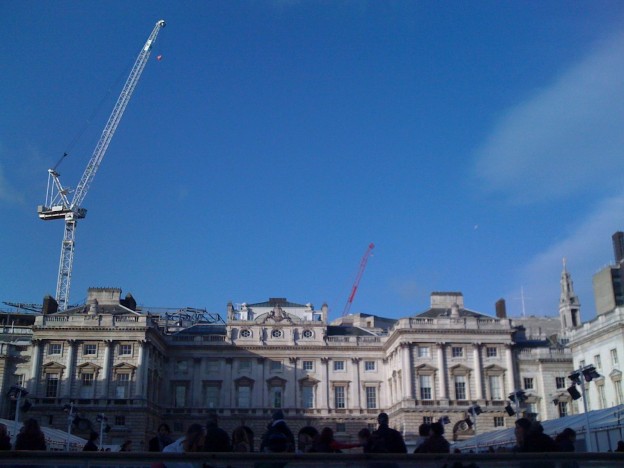
This afternoon M took me as part of my Christmas present to the Courtauld Gallery to see the exhibition ‘Frank Auerbach: London Building Sites 1952-1962. Quite how I have managed to live in London and work in the built-environment sector all these years without ever having taken a look at the Courtauld I just don’t know.
This collection of Auerbach’s work explores the striking and immense construction sites to be found in post-war London. But unlike the clean-cut lines of the modern architecture that rose from the sites, Auerbach’s work is all about the excavations. This is an artist that is painting the world of the civil engineer: the deep excavations for the Shell Building on the Southbank, the basement for the John Lewis headquarters on Oxford Street, the girders of One New Change adjacent to St Paul’s.
Auerbach layers the paint on in spades – up to an inch thick in some works. This is the result of repeatedly reapplying the paint and reworking each piece. The result is a rich texture that evokes the physicality of the building site. The walls ooze and seem almost to weep water; you can almost smell the unearthed depths. The images have been rendered and rerendered so many times on the same canvas that the original image is almost completely obscured and is only identifiable by reference to the preparatory sketches that accompany some of the works. But as a friend put it, you can get so much more out of the paintings but reflecting on the sensations they evoke rather than trying to pick out any particular detail. The reworking of the paint makes a striking resemblance to the movement of materials on site.
“Through his labours with paint, Auerback vividly translated the chasms of mud, shored-up earth and equipment into works which express the creation and distruction inherent in London’s post-war building sites” – exhibition introduction
‘Building site near St. Paul’s: winter’ situates the observer inside the construction site of One New Change, a building which has since been redemolished and is currently being rebuilt again. Unlike many images of the cathedral painted during the war in which the dome is seen to rise above the flames of the Blitz, in this painting St Paul’s cowers away in the corner submitting to this new architecture.
‘Shell Building Site: from the Festival Hall’ is one of set of works peering into the excavations for London’s first skyscraper. What’s struck me about these paintings is that while these are images of the construction of London’s modern era buildings, the viewer could be looking at a site centuries earlier – medieval even.
Probably most inspirational however was the collection of quick hand sketch studies of the sites that feature in some of the works. The lines are very simple but very powerful. Over the last two years I have been on a couple of building drawing classes, and have sketched many buildings: sketches that are about a finished product. But these works are much more about the process than the result. 50 years later another gaping hole has opened up on Oxford Street, a building demolished by developers rather than bombs. I find myself reaching for my sketchbook…
-
The Smallest Cinema in the World

The Smallest Cinema in the World is now open. The Cinema, conceived by artist Annika Eriksson as a venue for films that she is making about Regent’s Park, was designed by a team from Hopkins Architects and Expedition Engineering. The Cinema is mobile so that visitors will have to penetrate deep into the park to find it.
-
Other mobile structures in London this summer
The Smallest Cinema in the World will be a mobile structure. It will be towed to different locations in Regent’s Park throughout the summer. This is possible because the base of the cinema, hidden behind those beautiful shells, is a trailer.
I want to compile a list of other mobile or demountable structures that will be in London this summer. I will start the ball rolling with:
Tonkin Liu’s signature pavilion for this year’s London Festival of Architecture.

-
Richard Rogers Exhibition – Pompidou centre
The Richard Rogers exhibition at the Pompidou centre is now over. I went once and meant to go back as there was so much to take in (and I seem to get exhibition fatigue after about an hour and a half) but alas I didn’t get the chance.
Highlights were the 1:2 scale bright pink models of one of the Heathrow T5 connections, the exquisite 3d-printed model of the Barcelona Bullring and the original competition drawings for the Pompidou – how apt to see them in the finished building.
A few belated few pickies then:-

Antwerp Law Courts
3D Print of Barcelona Bullring
Credits -
Moet et Chandon vs Mercier

This weekend I took a visit to Eperney in Champagne where I found many of the caves that produce that region’s local tipple. I went on a tour of two champagne houses, Moët et Chandon and Mercier. During a visit to the first, we were assured of Moët’s credentials with stories of the fonder’s patronage by Napoleon I along with other impressive customers. We were led down into the wine caves, 25m underground and some 31km of them dug by hand into the chalk beneath the beautiful buildings above. Tipsy after a dégustation hosted by black clad experts, we were lead upstairs to the boutique where, surrounded by posters of the uber-glamourous drinking Moet, we were subliminally persuaded to buy champagne in bottles with unpronounceable names.
Then it was up the road to Mercier’s altogether less stuffy-looking building. If Mr Moët was the Wright brothers of champagne (in an incredible 2 for 1 offer) – making champagne in the early days, then Mr Mercier was the Richard Branson, joining the scene much later in the second half of the 19th century, but making waves for himself much later using clever marketing. He commissioned the Lumière brothers to make was to be the world’s first commercial. In another act of embracing new technology, he invited the willing and the curious at the Great Exhibition of 1889 to taste his brew while floating high over Paris in a tethered hot air balloon. But it was to be his 200,000 bottle barrel that stole the show. This enormous construction which took over ten years to build (and presumably to fill!). It was dragged to Paris by 28 oxen, requiring five bridges along the route to be strengthened and the purchase and demolition of several houses in order to make way. At the show, Mercier’s enormous barrel was a huge success, and he would have one the first place medal had it not been for a certain Mr Eiffel and his tower.

Mercier has long been pushing up grape vines but his cellars still have that technological flare: whereas the Moët tout guide was keen to point out the painstakingly laborious process of turning the bottles of fermenting champagne by hand, on display at Mercier’s was the cunning robot that did all this turning automatically; and rather than walking the galleries we were driven round in a lazer guided train. Now to my monochrome palette, the champagne at both houses tastes pretty similar (I’m no expert and I certainly couldn’t afford the bottles where the difference in taste starts to become noticeable) but Mercier’s trail blazing approach and embrace of modern technology caught my attention far more than Moët’s ‘natural ascendancy’ approach. And besides, who can beat a laser-guided train?
-
Fischli and Weiss at the Musée d’art moderne de la ville de Paris

Last night I went to the brilliant and rather amusing Fischli and Weiss exhibition “Flowers and Questions” at the Musée d’art moderne de la ville de Paris. To say rather amusing is somewhat of an understatement: I spent so much time smiling, if not laughing out loud, that if ever I left one of the exhibition rooms without the corners of my mouth turned up, I was inclined to feel it was a bit boring. In fact I think this happened only once.
This pair of artists play on our perceptions of materials and our sense of scale. One room was filled with jet black objects all apparently made from different materials: a tree trunk, a stone facia for a fireplace, a cutlery rack, a leather pouf. They were all in fact cast in rubber. More unbelievably, in another room which appeared to be an artists work shop filled with tools, rotting food, furniture, cargo pallets, razor blades, cigarette packets etc etc, I was stupefied to find out that every single object had been cast in plastic and then painstakingly painted. We were permitted to pick up a plank of “wood”. It was in fact a plank of plastic that seemed to float up with no effort. This illusionary game played with materials made apparently everyday objects unusually tactile.
In front of two video projections is where I spent most of my time. One was the ultimate childhood dream. It showed footage of one of those chain reaction sequences that kids dream of but apparently only grown ups get to build. Something falls over, it tips something else, a bowling ball rolls down a spiral etc. Only in this system, it wasn’t a ball that was kept moving, but a flame. Paraffin flows, and catches fire, balloons burst fireworks rocket up tubes and set off detonators, fire extinguisher foam dissolves blocks of sugar cube that support a vat of chemicals on the point of tipping over and so on and so on.
From the sublime to the ridiculous in the second video. A nature video but with our two heroes in a panda and mouse suit living out their animal existence.
In fact, I loved it so much that I am going to go back.
Showing in Paris until 13th May.
-
Opening of the Cité national de l’architecture et du Patirmoine


Last night Lorenzo (a fellow engineer from work) and I blagged our way into the opening of the permanent exhibition at the newly refurbished Cité National de l’architecture et du patrimoine, France’s national architecture museum. Neither of us had thought to check if this was and invite only event and indeed, it was. Luckily, a few charming smiles and a couple invitations made themselves available from the large group loitering outside the front door and then we were in.
The Cité is housed in one of the wings of the Palais de Chaillot, that splendidly curving art deco building opposite the Eiffel Tower on the other side of the Seine. Unlike any other architecture exhibit that I have visited, this one had not one model of a building. Instead, the main exhibition space, itself a long and wide curving corridor, was filled with fifty odd floor-to-ceiling screens onto which a series of short films were being projected. Every film was about a project, but every film had been shot differently: some showed in speeded-up time a building going up, others showed people flowing in and out, the building through the different seasons. There were images taken from satellites that showed whole areas being redeveloped. My favourite was a series of photos taken from a balcony, of an American city skyline. The photos start in the 60s and go on, lets say one a month until the present. As the images tick pass, the downtown skyscrapers grow like mushrooms after a rainstorm. One by one the pop up out of a hole in the ground, until eventually, one pops up right in front of the balcony and the view is completely obscured.
It is not just buildings that are showcased. One video was taken from a car driving across the Milau Viaduct. Another, from a helicopter flying over an offshore wind farm.
I think that the exhibition rather successfully shows the dynamic side to buildings. How they change, during their lifecycle, fro, construction, to use, to decay, to demolition and also how people interact with them. None of these aspects are static and so the moving image is an ideal medium for communicating them. My one criticism of the exhibit is that in the dark room where the videos are projected, it is difficult to read the programme that tells you what the projects are. Maybe you are just supposed to know already. I wonder?
The free lemony champagne was worth the effort it was to get through crowds of people in order to see the exhibit. It is hardly surprising that on the opening night I saw a lot of architects and not a lot of architecture. I shall therefore definitely be making another visit before too long.
-
Womb with a view

Paris is slowly encircling itself in tramways. The latest tramway to open, connecting the disparate ends of several metro lines is the T3, which skirts inner Paris’ southern border. As part of the project, the RATP commissioned a series of art installations on or in the vicinity of the route. So it was with travel card in hand that I went, albeit a little too late, one Saturday afternoon, to see what I could see, so to speak.
The trip became somewhat of an art-hunt for all I had to help me was a cutting from a newspaper giving some approximate locations, and a metro map. Unfortunately, I was not able to experience the murmuring benches as the park they were in had shut. And I simply couldn’t find the installation called “Mirage” (even though Mary swears blind that she did). One of the best installations, in my opinion, was realised using just light. Where the tramway passes under the TGV lines coming out of Montparnasse, the bridge’s beams and columns are lit up in orange and blue at night time reclaiming an otherwise threatening space (and showing off the beautiful metalwork on the columns which must have been lost in darkness even during the day).
The tour finished with a sculpture on the middle of the bridge. This installation is by Sophie Calle and Frank Gehry (with RFR as engineers) and consists of a twisted metal alcove or shelter with a telephone inside. According to a sign inside, only Sophie Calle has the number and she occasionally calls the number and to talk with whoever maybe passing by. The sculpture is a a shelter from the wind, a womb high up over the river, isolated, yet connected. If you have a few hours to spare in the south of Paris, I recommend taking the time to take the tram.