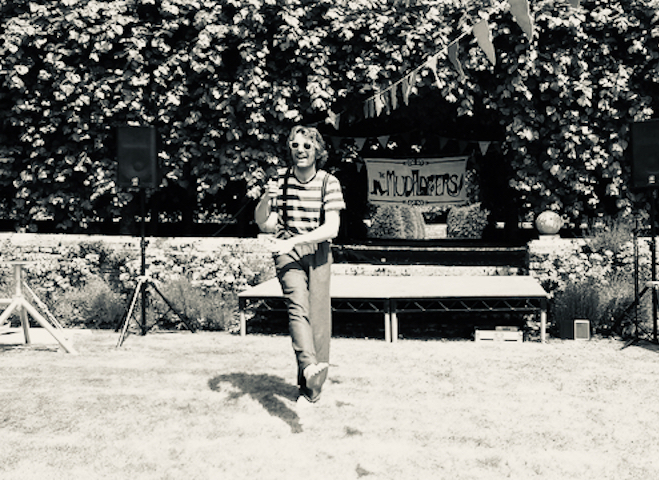
Serendipitously, as I was preparing for my first dance teaching workshop this morning at the Idler Festival, I spotted a quote in one of my other open browser tabs a quote from David Flemming.
Commons are cooperative enterprises; they therefore depend on trust, on reciprocity, and on social capital. The market economy can get by, for a time, with a gravely-weakened culture and social capital, but the commons cannot. If you really want to save the planet and to give human society a decent chance of living on it, the first thing you should do is to join a choir. Or have dancing lessons, or both. That is not quite the hyperbole it seems: in enduring communities, the thing which defines and distinguishes them is their culture of dance, music, story and tradition—so intertwined with trust that it is hard to tell cause from effect.
David Flemming, in ‘Lean Logic – A DICTIONARY for the FUTURE and HOW to SURVIVE IT’
We always said in the Mudflappers that our mission was to make the world slightly better through the medium of dance. Well here is some compelling philosophical underpinning to back that up. I shared this quote with the dance workshop today and it was well received.
The tools you use define your work. They lock in choices about what you turn your attention to, what you can do and what you can’t. Before you choose a new productivity tool, define what they work is that you do and don’t want to do, then find the tool for the job.
With our household suddenly in self-isolation pending results of a Covid test, my daughter and I are back playing lego together and I’m revisiting that recurring question: how best to sort our Lego? But this time I think I have landed on a method that is standing the test of time, and one which has wider philosophical benefits.
I am speaking to more and more people who are disillusioned with their work. Often what is in the balance is a purpose-led career versus job security and status. These conversations have led me to revisit the Happy Grid post I wrote in 2016. It is when I realised that no-one else is going to tell you what to do with you career.
So many things that I am working on at the moment lead me to the conclusion that there is power in the gaps. But I feel like for my much of my professional development I have been taught to fill in the gaps.
This is a really boring post about something I find myself doing lots and lots: setting up an event on Zoom, selling tickets for it and promoting it. My hope is that by sharing these steps you will need to spend less time figuring it all out yourselves.
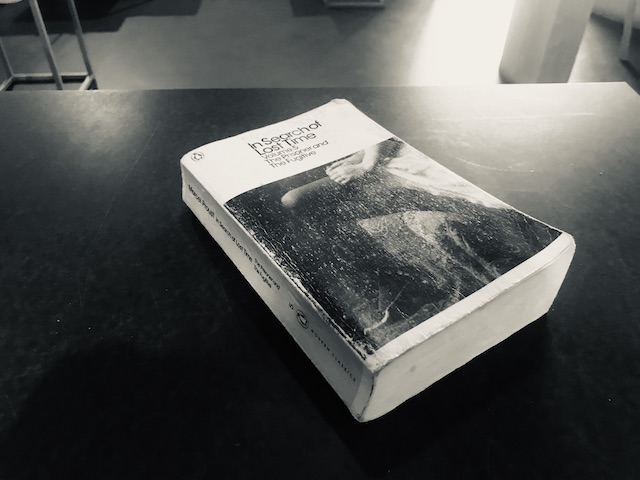
It wasn’t what I was expecting but volume 5 of Proust’s In Search of Lost Time ends on a cliff-hanger. It is incredible how such separate threads from five previous volumes are starting to brought together: a narrative arc that I could never see converging has in fact been much closer to convergence than I expected.
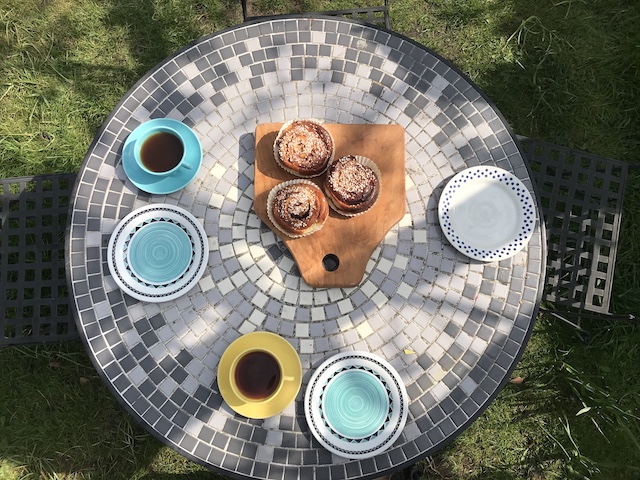
I’ve been reading In Search of Lost Time – Proust’s epic explorationg of memory, art, adolescence and decisre – on and off since 2007. It is one of those books that lots of people have heard of, some know two things about it (the long sentances and the flood of memories provoked by dipping a madeliene cake in his tea) but I’ve hardly found anyone who has actually read it. So in 2007 I decided to give it a go (in English!).
I sit in my current preferred cafe bolthole and the jacket of the person opposite me catches my eye. It’s a slightly faded turquoise, not unlike a jacket I recently got in the sale. Hang on a second, it is the same jacket, maybe slightly older. I zoom out and notice their whole clothing combination is familiar: a stripey top, dark blue jeans, converse, set off with a dark grey panier.
These are the clothes that I wear, or at least I think I wear – only better. I look down at my own sartorial combination and I realise it is a poor approximation to my self image. I start to take notes for self improvement – cream converse, turned up jeans – but then my alter-wardrobe is gone.
I have long been in pursuit of the one outfit to rule them all. There are a few inspirations.
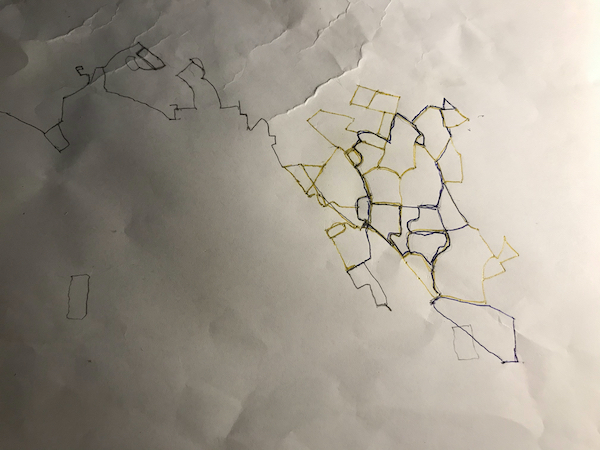
Yesterday my daughter and I left the house and flipped a coin. Heads for left, tails for right. Right it was, then left, then left again, et cetera. A random journey along the roads, cyclepaths and alleyways of our neighbourhood ensued. It became a fun home-schooling lesson in probability. It revealed to me the habits that stop me from noticing so much of what surrounds me. And it was a fascinating experiment in not having a plan.
Yesterday our household returned home from an imaginary holiday. Despite being in lockdown, we realised that we could imagine going on a trip anywhere in the world. Our daughter suggested our Sweden. Too far to easily get to under normal circumstances without flying, with that constraint removed we thought, why not? Now back home, I have been using this visit as an opportunity to explore some philosophical arguments about how we deal with choice and how this affects our creativity.
Across all the of the projects I’m involved with we are working out what can go ahead and what must be postponed. A significant factor in whether to proceed is whether the activity can go ahead virtually. While the ability to move online is a blessing for business and job continuity, I think it represents an irriversible step for industry and society away from the phyical to the virtual – a click of the ratchet – that will have long-lasting impacts on our freedom and how we interact with other people.
It’s hard to know where to start. So much has changed in the last fortnight and there is so much that I feel compelled to write about. But now that our house has also become a remote workplace, a homeschool and playground and locus for all entertainment and time-passing activities, it is hard to find the time to write in an ordered way, so I will capture things as they emerge and look to see the patterns over time. I hope you will bear with me, reader. On my mind today:
I met with a friend earlier in the week to talk about setting some life goals. It’s a conversation we had had five years ago and then did nothing about, but this time I came prepared with the Eiffel Over Action Learning Template.
I’m a slow reader. The problem is I can’t seem to retain things unless I write them down or sketch them out. It means that I read very few books each year, but it also means those ones I do read I know really well. This is great when you want to be able to recall a concept while standing in front of a workshop, but it is not so good for reading new content. The pile of books I now want to read is now far greater than I’ll ever get through. The smartest stuff I’ve read about productivity tells me that doing things quicker is a fool’s game. So maybe I need a different aproach.
I am reminded this morning of much I like working out what all the buttons do on a machine. Quite often the machines we use, be they an oven, a sports watch or a computer, have many more functions than we realise. Not all of these devices have the levels of user interface design that you might get from say a modern phone. While I’m a fan of good user design, I quite enjoy pouring through manuals to discover these more obscure functions… or better still, trying to discover them for myself.
I spend most of my time designing creativity training for engineers. In this episode we flip the format. Alexie Sommer, Independent Design and Communication Director and collaborator on many of my projects interviews me about why I set up Eiffel Over and Constructivist Ltd, and what our plans are for designing creativity training for engineers in 2020. We get into:
Techniques for teaching creativity
Our programme of training support people tackling the climate emergency
Readers of this blog will know I started a project a couple of years ago to write a book called ‘Analogue Skills‘, a re-examination of the pre-screen skills that relied on to get through the day. I’ve always intended it to be part philosophical, part self-help. When I’ve stalled in my writing, one of the barriers has been not knowing how much of an authoritative voice to take. There is a well-troden self-help author path in which the writer spends a period of time – usually at least six months, sometimes a decade of a career – living the chosen lifestyle, and then writing about it. But that doesn’t sit well with me. I feel the Analogue Skills project to be much more of an experiment.
It will probably be very muddy. At least it was for my first visit of the year to Hazel Hill Woods. Recent rain has made the forest wetter than anyone can remember. Water is reanimating forgotten courses that we hadn’t even noticed existed.
Today was my first day in post as the Deputy Chair of Hazel Hill Trust, the charity set up by Alan Heeks to run the wood and to provide a place where people can learn about wellbeing, resilience and sustainability.
My daughter is now seven. I have been trying to remember what being seven was like for me. Memories start to become more frequent around this time. Some major changes were going on for me around then, moving house, moving school, parents divorcing. Until recently I would have said I could clearly remember when and in what order these big events in my childhood happened. But when I tried to write these down, it seems my hard drive is more fragmented than I had realised.
So I started to recreate my picture of seven on a piece of paper, and in conversation with family, started to fill in the gaps. This is what I’ve managed to piece together.
This question came up on the way home this evening. On the back of the tandem, my daughter was experimenting with counting in French. Things were going fine until we got to sixty-nine. And then I explained that French for seventy is soixante-dix, literally, ‘sixty ten’. Without turning round, I could feel the look of bewilderment on her face.
A key part of problem-based learning is reflection. But how do you get people not interested in reflection to start thinking critically about the decisions they take over their learning. The answer could be to think about performance.
I’ve started experimenting with leaving the house without my phone. On purpose. Here are some things I’ve noticed.
I need to get a watch. Without a watch, however, I have to seek out the time, usually on the clocks above buildings, on church towers, behind the counter in cafes. My favourite is when you can’t see the time but you can hear it. Two nights ago I slept out under the starts without a phone or watch – my clock was the peel of bells in the nearby village; my alarm the dawn.
Failing architectural time pieces, I have become adept at spotting the time on the screens of people adjacent to me. Sometimes I have to crane my neck.
I look at the map before I leave the house, and try to identify landmarks that will help guide me on my way. I make use of maps I find in the street, and I find I am more conscious of where to find these. Sometimes I ask the way. Usually I figure it out. Before long my own mental map starts to form.
I see things that make me think of friends and family and times together. I notice how often I want to reach for my phone and share that thought there and then with the subject concerned. I try instead to sit and savour the warm feeling of the association – and just live it without taking any action. I sometimes write a note about the moment in my diary and tell myself to save it for when I next see the person concerned.
A notebook is the friend of the phone-free flaneur. Use it to:
Do a quick sketch map to help you find your way.
Write down your itinerary, including confirmation numbers and train times.
Note any things you would like to tell your friends about next time you see them.
Tear out pages and use them to send a message to someone you are thinking of.
Draw a sketch of the view from the top of a mountain (you may be rubbish at drawing, but photos taken from mountaintops are always disappointing, so what have you got to lose?)
Slide a debit card in the back cover of your notebook and its like you’ve got Apple Pay.
Without distractions, I can hold onto and let ideas mature more fully in my mind. Once they have taken shape I can write those down in the diary too. But with my phone in my pocket, a message can arrive out-of-the-blue and my clarity of thought is gone.
All it takes is for me to receive a message about something or other for my emotional state to change in a flash. I wish my brain could stay more firmly attached to the hear-and-now but it quickly focuses its attention on the new stimulus, and my emotions are hijacked. Of course, I want to be helpful and see to whatever matter is arising, but there may be a better time for it than when I am walking down the street – and I might respond better when I am in a more appropriate place. Without my phone, I feel I keep on a much more even emotional keel.
And, I’m reading more.
So, give it a go. Leave your phone at home, and see what happens. Let me know how you get on (tell me when you get home).
Marseille A morning walk up the steep hill to the Basilica of Notre Dame de la Gard granted me panoramic views of the city of Marseille and the sea. I love the peaceful hum that can be extracted from high up of a limbering up for a day of activity.
I underlined these words yesterday in ‘In Search of Lost Time’. The narrator is talking about how his perception of distance was changed when, instead of travelling by rail, he starts to go by car.
‘We express the difficulty we have in getting to a place in a system of leagues and kilometres, which becomes false the moment that difficulty decreases. The art of distance, too, is modified, since a village that had seemed to be in a different world from some other village, becomes its neighbour in a landscape whose dimensions have altered.’
Proust, M. (1921). In Search of Lost Time, Vol 4. Sodom and Gomorrah. (C. Prendergast, Ed.) (Penguin Cl). Penguin Books.
For my birthday this week my partner Mary gave me Alistair Humphreys’s inspirational book ‘Microadventures’. According to Humphreys, a microadventure is an adventure that is short, simple, local, cheap – yet still fun, exciting, challenging, refreshing and rewarding. Last night I undertook my first mission – to go and sleep under the stars in the garden. As adventures go this reads as really not very challenging at all, but I was surprised by how unorthodox it felt.
Over the last 9 months at Think Up I’ve been invovled with an engineering education project that has had a really deep philsophical impact on me. The project is called Enginite, an EruasmusPlus-funded programme of graduate training and placements that aims to give graduating engineers extra skills and experience that will make them more employable.
My role has been to collaborate with Prof Søren Willert, of the University of Aalborg, to train project partners in how to design courses using a problem-based learning methodology. PBL flips traditional learning on itself, and holds as its fundamental principle that learning is more effective – in terms of retention, recall and motivation – if students drive the learning process themselves. It is one of those statements that we know to be true from experience, but goes directly against how most education is delivered in engineering education. PBL addresses that dissonance by creating a framework for giving students ownership of the problem. (more…)
Pear-to-pear (it was better than the images I got for peer-to-peer).
As part of my Visiting Professorship at Imperial College I have been asked to think about how peer-to-peer assessment works in group works. Here are my thoughts.
One of the common features of the group-work-based learning experiences that I have been involved with is the need for the participants to be able to give each other feedback. Often in an undergraduate setting there is an emphasis on giving anonymous feedback. I have seen many colleagues cook up clever ways of gathering this anonymous feedback – I’ve conceived a few such systems myself – and processing this feedback in order to find out what is going on in student groups and to enable the teacher to be the arbiter of fairness. Managing such systems of peer-to-peer feedback can quickly become burdensome, and I am never really sure whether you really know what is going in the group or if the students are rigging the system.
As I become more and more involved in problem-based learning, I realise that this approach – anonymity and delegation of confrontation to the teacher – misses the point. If students feel that their peers aren’t pulling their weight in a teaching scenario, then they should be trained in how to confront these issues in themselves. And taking a more positive spin, students should also learn how to give positive feedback too.
I think it should be possible to give students the tools to handle these sorts of interactions themselves, and then for the teaching staff to coach students through the process where difficult situations arise. These are tools that my collaborator Nick Zienau uses in his ‘Leading and Influencing‘ course. The following is how I envisage this could work:
How it would work
The context is an extended student group design session in which a group of six to ten students spend a number of weeks collaborating to deliver a shared group output.
Skills development day: trust, confrontation and non-judgemental feedback.
I envisage a day-long training day for student groups. This would involve a series of group work exercises punctuated with whole-class briefing and feedback sessions.
Contracting – this is the process by which students agree with each other what they can each contribute to the team, what they want from the others, and how through their own actions they might jeopardise the group’s success. Students develop contracts for themselves, present them to one-another, and then agree a contract for the group.
The creation of contracts is a trust-building activity, and it creates a visible set of expectations by which the students can hold each-other to account.
Confrontation – in this session we provide a quick formula for confronting challenges. It involves naming a behaviour that they have seen and saying how it contravenes their individual or group contract. The reference to the contracts makes the terms of engagement very clear. Practising a formula for engagement makes the process something that people are familiar with.
Non-judgemental feedback – we walk students through process where they give each non-judgemental feedback, much of which comes down to language. We show students how to stick to facts, like ‘I have seen you do this’ or ‘when you do that it makes me feel like this’, rather than ‘what you have done is bad, or wrong’.
At the end of the training day, students have contracts for themselves and the group, a language for direct, open and kind confrontation and a mechanism for giving non-judgemental feedback.
Self-regulation during group work
After the initial training day students get on with their group work as normal. They are asked to have a quick daily group feedback session, where they appreciate each other’s efforts and identify any emerging issues. They are also expected to have a weekly structured feedback session, where they tell each other where they are contributing most to the group, and how they could contribute more.
Through the group work, it is expected that the contracts remain in view. They are intended to be a visual reminder to individuals of what they should be doing themselves, and also a way for people to understand other people’s behaviour.
Instructor Intervention
The course instructor makes themselves available say once a week to deal with any issues that students feel they can’t deal with in their own groups. The consultation happens with the whole group and the instructor will ask to see evidence that the teams have been meeting to review their contracts regularly and have been giving each other constructive feedback along the way.
Overall, I believe this approach would empower the students, give them useful life skills and improve the quality of their learning.
My thanks to Nick Zienau and Søren Willert who have significantly advanced my thinking on this topic.
In Janaury 2018 I decided I would try veganism. I have been vegetarian all my life but in recent years I have found it harder to reconcile concern about the meat industry with eating dairy produce and eggs. In recent years we have eaten very little dairy at home, so this year I decided to try going the full hog and committing myself to a no-dairy no-eggs diet.
Understandably people ask ‘what do you eat?’ Here’s the answer:
7/3/18
Toast with marmite
Lunch: humous and veg sandwiches from platter
Cake time – Vegan banana and coconut bread (Southbank)
Dinner – Turkish mezze at Taz
6/3/18
Leon porridge with blueberries
Elevenses: toast
Lunch: Pure vegan wraps (from platter)
Tea: more toast with humous
1st dinner: Kale and pumpkin one-pot pasta (Anna Jones)
2nd dinner: Roast spiced brassicas with split pea purée (Hugh Fearnley-Whittingstall)
5/3/18
Breakfast: porridge
Lunch: Pret a Manger Spiced chickpea and spinach sandwich
Dinner: Kale and pumpkin one-pot pasta (Anna Jones)
Today I have been reviewing the action learning diaries that half a dozen people have sent me from Greece and Cyprus. They are getting ready for training in problem-based learning that I will be co-leading here in London at Think Up with Prof Søren Willert from the University of Aalborg (see picture) as part of the EU ErasmusPlus-funded Enginite programme, and we have set them some problem-based learning of their own to do before they arrive.
The idea behind problem-based learning is that the student should own the problem and own the process of finding the solution. This approach is diamertrically opposed to the traditional direction of travel for learning. The aim of our approach is to get the participants to experience this problem-based approach for themselves before they start designing such experiences for their students.
The first set of reflective diaries that I have read reveal very different ways of working in our cohort. Some are applying problem-based learning with their students; others, who don’t teach, are adopting this approach with colleagues in their companies, and it is this latter group which is perhaps the most fascinating – because is in fact the sort of environment for which we are eventually preparing students.
At the moment problem-based learning feels like very rich territory to be farming in. The approach itself is a powerful philisophy that has many daily applications, and coaching other people in its use is gives me the chance to witness the daily strategies for sucess that other people use.
One of things that I really enjoy about this project is that is it is open – you can join in yourself if you follow the instructions below – and everyone is learning as they go. For my part I am learning what other people understand problem-based learning to be and become ever more aware of its applications. It is also terrific to be working with Søren, I feel like I learn so much from each of our interactions. Today it has been really interesting to see how he characterises the different types of PBL as described in the reflective diaries. To his words, it is enabling me to notice ‘exemplarities’ that I can look for in other people’s work.
For generations it has been a tradition on the French side of my family to spend summer evenings out in the garden looking at the stars. I happen to know that this is something my great-grand parents were doing from at least their retirement in the 60s, and it is what other families in the village were doing too. When televisions arrived, neighbours didn’t give up their stargazing; they simply opened the windows wide, put the TV on inside and watched it from outside, while still inclined heavenwards.
By the time of my childhood in the 80s, I have no memory of seeing other families outside gazing upwards in the evenings. I wonder if the people watching televisions from their gardens had switched to sitting inside and watching TV with the window open so they could see the stars, to eventually shutting out the stars altogether. But my grandparents, to their credit, shunned the phosphorus screens for the slower moving celestial entertainment.
It is for this reason that I have spent hundreds of nights staring at the same patch of sky from the same particular orientation. I know where the first star usually shines from; where the great bear appears over the horizon; where to expect to see different clusters and motifs of stars. But despite hours of dedicated study, I, nor any of my ancestors seems to have had any definitive knowledge of what any of the stars or constellations actually are. There has been much speculation and debate. That flickering red dot just above the horizon early in the evening must be mars/ no it can’t possibly be mars because it is always in the same place/ it’s actually called Beetlejuice. Our collective space ignorance is further demonstrated when we try and point out to one another where a satellite may be seen crossing the sky: you see that bright star, straight above? Go left a bit to the next bright star, then to that square of really dim stars, then go west about twelve inches, and you’ll see the satellite heading towards to the house.
I share all this to give a sense of the utter familiarity to me of this particular sky-scape, like someone who knows the view from their childhood bedroom window so well that it is impossible that anyone could show them anything new; a scene that is understood through layers of explanation, agreed between generations but never verified, so that you will appreciate the impact on me of downloading for the first time a star identification app and pointing it at the sky. It was as if I had been given a new set of glasses without ever having known that eyes were blurry.
All of a sudden, constellations stretched out in front of me. Scorpio reclining on the horizon, the diving fish of Pisces leaping over the trees in the east. I am looking at the same sky but I am seeing new things – this is augmented reality. That red star of which we had spent so many evenings arguing turns out to be the centre of the galaxy – incredible. I really felt ecstatic. We call out to each other, pointing out new things that we can see with more excitement and intensity than we have mustered for years from these seats.
The next evening, we return to the garden excited to return to our star-gazing. But I sense a subtle shift has come over us. The focus is on the screen and not on the sky; on the augmented reality rather than boring old reality. When the app loses its calibration, I start to believe what the screen tell me rather than what I can see with my eyes, even when the two clearly don’t line up. When I’ve got bored of looking at the app, I start to look at other apps: since I’ve got my screen out why not check my messages quickly. And at this moment the spell of stargazing is broken.
Very quickly the situation seems to be changing from one in which we sat under the cloak of the stars, sometimes in conversation, sometimes in silence, but always together, to one in which we are close-by but in separate worlds. I wonder if in a few years’ time a natural evolution of this scenario will be for us to sit inside where the light is better and check our messages there – with the windows open so we can still see the stars, like our predecessors did two generations ago with their televisions.
This future scenario that I present is of course by no means a foregone conclusion, but it has the characteristics of a pattern that I see myself falling into: using digital technology to solve or augment a particular situation, but in doing so, introducing a set of unintended behaviours, that overall serve to diminish the situation.
Of course none of this information is new. The Greeks new about these constellations. We just needed the technology to help us remember. Now that I know what I am looking at, I need to remember to turn my phone off again.