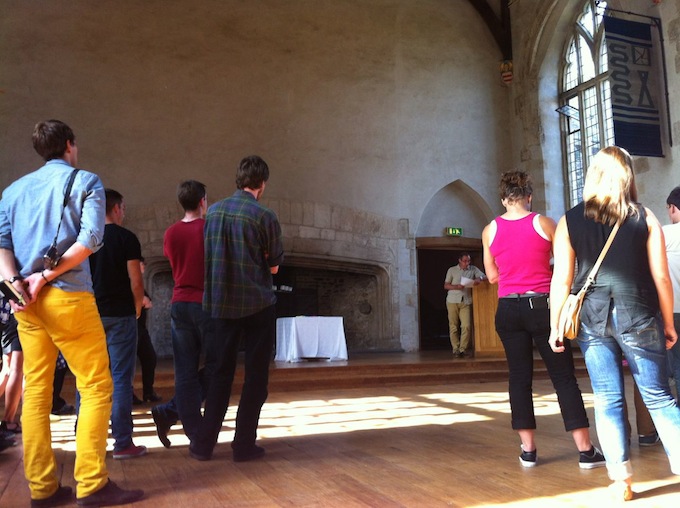
This post is intended as a reminder for the people participants in last week’s conceptual design workshop. It may also pique the interest of anyone else interested in learning or teaching creativity for engineers.
The workshop was the fifth of five workshops for this cohort of engineers. At the start I asked attendees to list any challenges they face in doing conceptual design that they would like to focus on in the final session. I asked attendees to name the challenge and what kind of progress they would realistically like to make today towards overcoming that challenge. I summarised the challenges everyone shared, and asked participants to prioritise the topics for discussion. The following topics and talking points follow from that prioritised list. (more…)
A very interesting couple of days at the 7th International Symposium of Engineering Education down at UCL. Here’s something I found interesting which I am sharing with colleagues and collaborators.
This is the second workshop I have run in the ‘Everyday Creativity for…’ series, this time for blues dancers in the London blues scene. A huge thank you to Ellie and the Sunday Shake Off crew for inviting me down.
The premise is that blues dancing is an inherently creative activity (maybe even more so than lindy hop?), and by interrogating what we are doing when we are dancing blues we can find creative strategies and techniques that we can use in other parts of our lives, from personal projects to professional work.
This workshop was a truncated version of the full workshop that I run for swing dancers. Into an hour we managed to squeeze in:
Thinking of creativity as a system, and understanding the parts of that system
The influences we draw upon in our swing dancing and in our professional work
Generating connection with your collaborators and your audience
Strategies for stimulating divergent thinking
The value of doing really silly things.
Keep an eye out on this site for dates when I’m planning on running the full workshop again.
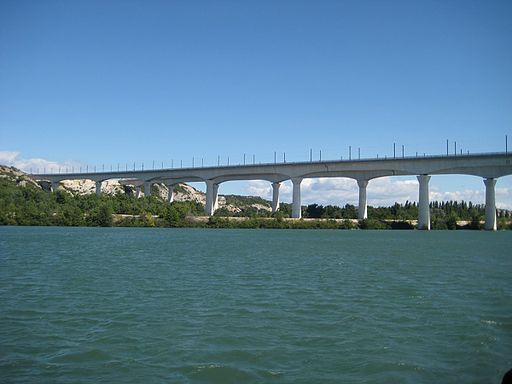
TGV Bridge at Avignon by John is available under CC 3.0
Recently in beginner’s swing dancing classes I’ve described the connection between lead and follow when dancing side-by-side Charleston as being a bit like how pre-stressed concrete works. I promised a longer explanation. Here it is.
Starting with reinforced concrete
To begin we need to understand how reinforced concrete works.
When you build a beam in a building and you stand in the middle of it, the beam sags, albeit ever so slightly. To understand what is happening, you can simulate a simple beam by interlacing your fingers in front of you, palms down. Now imagine what were to happen if someone were to balance a bag of sugar on your knuckles: your hands would sink down, the skin on the underside of your fingers would stretch, and the skin on the top would pucker up. That’s because the skin underneath is going into tension, and the skin that is on top is going into compression. This tension-compression couple is what supports the load resting on the back of your hands.
For a video illiustration of this deomonstration, see this video I helped to script a few years ago at Think Up.
Now let’s imagine what happens if we were to build that beam out of pure concrete instead. Concrete is strong in compression, and so would have no difficulty in resisting the compressive force in the top side of a bending beam. But it has virtually no tensile strength, and so as soon as the underside of that beam starts to stretch it would suddenly crack and catastrophically fail.
So for about 130 years now, engineers have been embedding reinforcing steel in the bottom of concrete beams to carry that tension which arises when a beam bends. Steel is strong in tension (think of the steel cables in a suspension bridge). In a beam reinforced with steel, the steel rods act like stiff elastic bands which resist the tensile loads that are generated when the beam bends.
The importance of depth
Reinforced concrete is a popular building material. To work, the beams need to have a certain depth to them. To illustrate we can think what happens when we bend a 30cm ruler. If you hold the ruler out in front of you flat side facing down, and try to bend it downwards, it bends easily. But if you hold the ruler out in front of you edge-downwards, and try to bend it downwards, it is almost impossible. What’s the difference? It’s the difference in distance between the top and bottom fibre that determines the stiffness.
So, deeper beams are stiffer, and can span further between supports.
Pre-stressed concrete
The problem with deeper beams is that they require a deeper floor void between the ceiling of one level and the floor the level above. Building designers usually want to minimise the floor depth so that they can fit in as many levels as possible within a given height. More levels means more rent.
Pre-stressed concrete is an evolution of reinforced concrete which enables shallower beams and slabs to be used in buildings. In pre-stressed concrete, the steel bars of reinforced concrete are replaced with steel cables which run through the middle of the beam and are attached to a plate at either end. When the concrete is set, this steel cable up is tensioned up squeezing either end of the beam, putting the entire thing into compression.
The effect is similar to when you pick up a row of books simply by squeezing from either end. If you squeeze hard enough, you can pick up say 15 paper backs without any of the middle ones slipping out.
For an illustration of this principle, see another video that I helped to make a few years back at Think Up:
Now imagine you were picking up a row of books in this way, squeezing from either end, and someone were to put a bag of sugar on top in the middle, as long as you were squeezing hard enough, you could probably support the weight of the bag of sugar.
So what is happening here? In fact, the same thing is happening here as when the sugar was placed on our interlaced hands. The top of the books are squashed together, and the bottom split apart a bit. The difference is that because these bending forces are applied to a set of books that is already being compressed together from either end, the bottom edge never goes into tension: it is just a little less compressed. Similarly the top of the books are more compressed because of the sugar they are supporting.
Putting pre-stressing cables into a concrete beam puts the whole thing into constant compression, making the whole thing stiffer.
What’s that got to do with swing dancing?
In teaching beginner swing dancing classes there often seems to come a point where we have to move learners from simply dancing a choreography to leaders leading and followers following. The key to that is the connection between them, which works in different ways depending on the dance.
When dancing side-by-side Charleston, the leader has their arm around their follower’s waist. The follower needs to sit back into this arm slightly, and the lead needs to push against their follower’s back. This creates a slight compressive force between them, which is equal and opposite.
To signal to the follower that the leader wants to move forwards, the leader moves forwards themselves, and in doing so, increase the compression in the connection, which causes the follower to accelerate forwards.
To signal to the follower that the leader wants to move backwards again, the leader moves backwards themselves, and in theory, this reduction in compression should cause the follower to accelerate backwards.
In practice, what we see is leaders moving backwards, and become disconnected from the followers. This disconnection reveals that they never had that matched compressive force in the first place: the pre-stress was missing.
If that compression is there to start with, if one person reduces the compression by pulling away, the other starts moving towards them. If there is no compression, and one person reduces the compression by pulling way, the two simply separate from each other.
So, to get the connection right, get the pre-stress right.
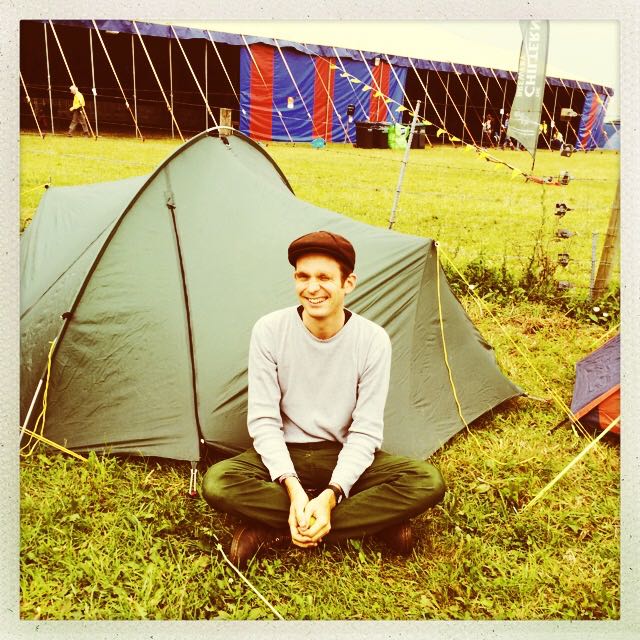
I’m writing this on the train home from Towersey Festival to which I had been invited by my friends Nat and Sophie to help out with some swing teaching and performing for the Shooting Roots line-up. Towersey was my introduction to folk festivals, and it felt like a gateway to a fascinating world of music and dancing to discover. Nat and I were there to teach a 1 hour Lindy hop class and to do some dancing with a band in the evening (see the gig notes below for info).
Towersey felt quite unlike any festival I’d been to before, and I think the main difference is the way in which people are engaged with the music and dance that is being performed. The crowds are attentive; they really listened in our lesson; they were really paying attention in the band performances. People are having a great time but there is none of the rowdiness, (except for being kept awake by a choir singing in four part harmony at 1am in the campsite). I love the way people carry around instruments, and there is space for people to jam. There was also the largest selection of real ales I’ve seen at any festival. And what’s more people walk around with their own tankards, which as far as I’m concerned is the best way yet to reducing festival waste.
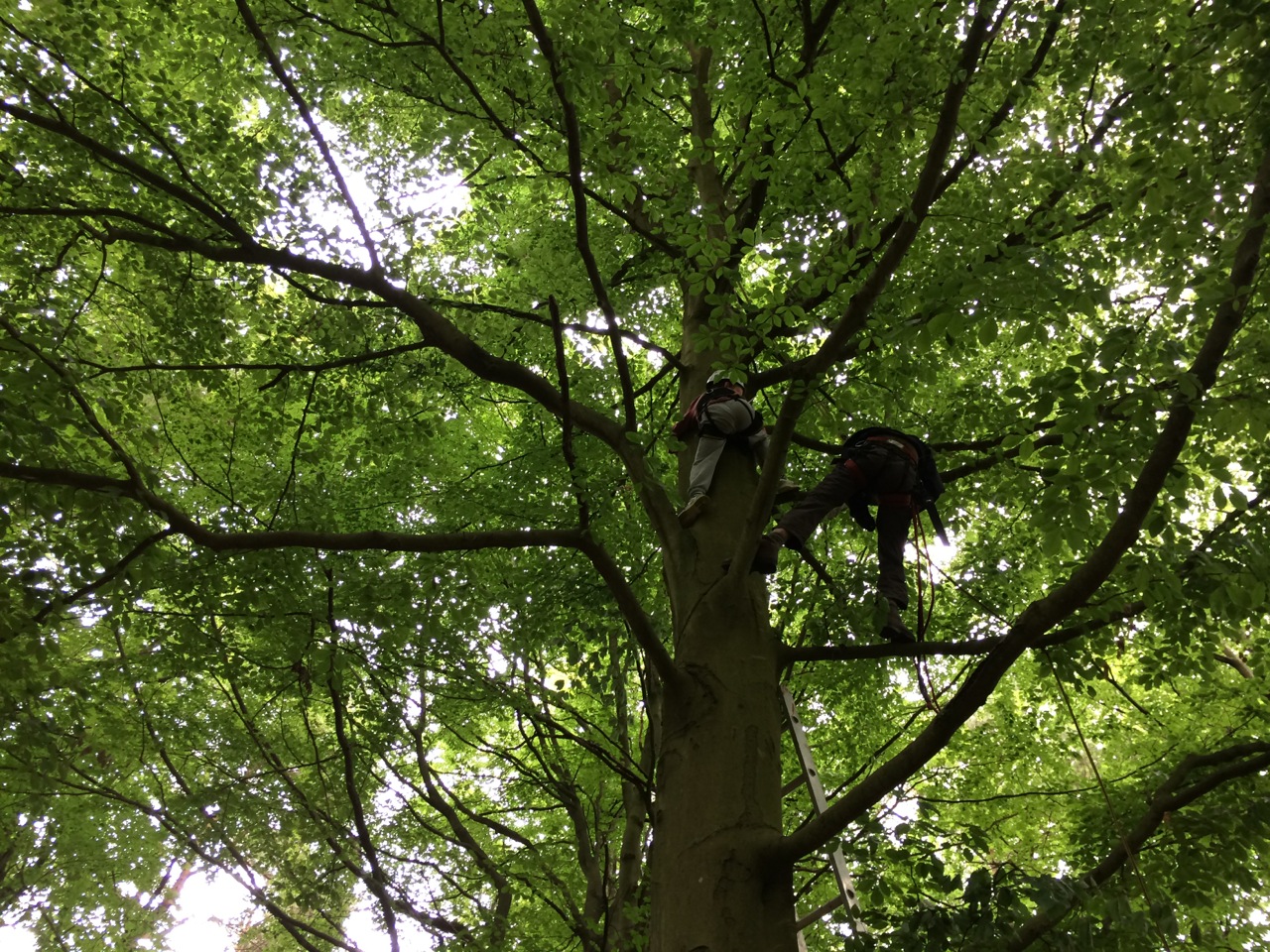
A kid, supported with a harness, climbs ten metres up a tall beech tree at Hazel Hill
I’ve just returned a wonderful weekend in the woods, the first ever Hazel Hill Family Adventure Weekend. The aim of the weekend was to give kids the chance to get out into the woods and to create their own adventures. We ran the weekend in partnership with Monkey Do who create fantastic rope net structures that allow kids (and grown ups) to jump, bounce and swing from level to level between the trees.
When the families arrived on Friday evening, we filled up on enchiladas before going on a walk through the woods to help everyone get their bearings. We finished the evening with introductions around the campfire and a discussion about the weekend ahead. We had thought the kids would want to go to bed, but, as it turned out, not until they had been on a night walk through the pitch-black forest.
After an early breakfast on Saturday morning we went looking for leaves to help us learn about the different types of tree in the wood. Then it was time to get into the nets. For an hour and a half the kids clambered around, daring each other to jump from the highest net to the lowest one, and challenging each other to race from one side to the other. Meanwhile, one by one, kids and adults were strapped into a safety harness and climbed as high as they would dare up one of the tallest beech trees in the wood. When the forecast rain came in the afternoon we retreated to the covered roundhouse for a session on how to light a fire with a flint and steel. My accordion provided background music which eventually turned into everyone singing along.
Earlier in the day we challenged the kids to move from one area of the wood to another without being seen. The idea was to encourage them to go deeper into the woods and explore the secret pathways through the undergrowth created by the dear. This exercise was good practice for our last outdoor activity of the afternoon, a game of capture the flag (tea towel) played right across an area of dense woodland at the westernmost end of Hazel Hill.
The evening began with a dinner of vegetable kebabs that the kids roasted on an open fire. I then ran a solo Charleston class for adults and kids, which was supposed to last half an hour, but went on for an hour and a half as everyone was enjoying it so much. We eventually regrouped at the campfire to reflect on the day and to listen to some poems by Michael Rosen.
Sunday’s start was not quite so early: the kids’ exertions were beginning to catch up with them. We played more stalking games through the wood, this time in the thickest area of forest. We then moved on to the dark wood, an area planted with scots pine, for a game of Owl and Mouse, a blindfold game in which the ‘mice’ must sneak up on the blindfolded ‘owl’ without being heard – an exquisitely silent game to watch! We returned to the nets for more suspended adventures and finished with a final game of capture the flag, this time played among the tall trees of the heart wood where there is much more space to run around.
The weekend was a great success in many ways. All the participants left beaming. The parents told of their joy at managing to persuade their kids to put away their electronic devices for the weekend; and even some of the kids admitted to appreciating this as well. It was also a for the crew, none of us having worked together before, and all of us enjoying ourselves and feeling part of the wood. And I think it was a great success for Hazel Hill, showing how the woodland can be used as a place for adventure.
I look forward to using what we learnt from this event in other weekends at Hazel Hill (especially at our upcoming Autumn Conservation Weekend), to working with all the facilitators again, and hopefully to seeing many of the participants at future Hazel Hill weekends.
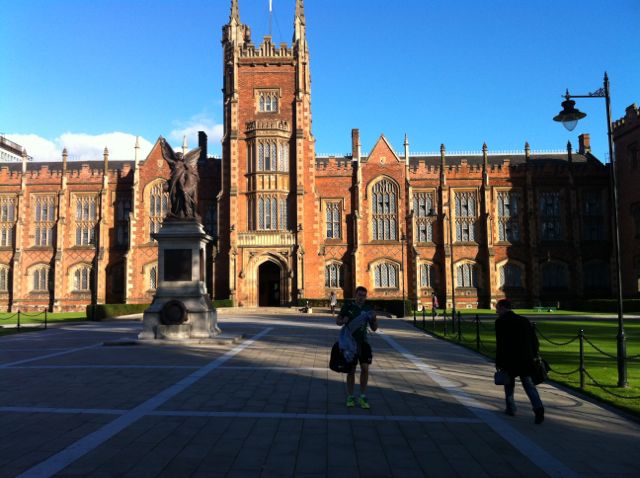
Over the next couple of days I’ll be at Queens University Belfast to do two things: to kick off a new sustainability-themed student project, and to run a curriculum development session with staff on the theme of embedding sustainability.
Queens commissioned Think Up to design a sustainability-themed project for first year students. With this collaboration we plan to test three things: the idea of using a project early in the course to introduce the ‘basic building blocks’ of sustainable design; how this project can be used to introduce a topic that other teaching staff can build upon in later modules; and how a virtual learning environment (in this case Our in-house platform Student Studio) can be used to facilitate a better link between universities and industry.
Basic building blocks
Principle Two of our report Embedding Sustainability in the Undergraduate Civil Engineering Curriculum is to ‘establish the basic building blocks early on in the course’. Using Bloom’s Taxonomy as our theoretical basis, the higher order cognitive processes needed for sustainable design (analysis, assimilation, creation and evaluation) are founded upon the more basic cognitive processes (knowledge of, knowledge that). To enable students to make better judgements in the field of sustainable design, we need to establish the basics that will help them make those decisions.
The basics are widespread, and include: common terms and definitions; principles of simple analysis techniques; materials; exemplars. Communicating this material is not a great use of class time. The project that we are designing will provide a context within which the students can start to establish these basic building blocks.
Project brief
Student are asked to work in groups to answer the rather open-ended question, how sustainable is Titanic Quarter (a large new mixed commercial-residential-cultural development in Belfast)? To help them, we have suggested seven axes for investigation based on the twelve objectives for sustainable development on the Olympic Park. For each axis, we have suggested aspects of the development to investigate, analysis tools and techniques they might use, and technologies they should find out more about.
Over the coming week, students will go on a fact-finding tour, do online research and try to speak to people who know about the site. Once they have gathered their data, they need to agree as a group how they are going to answer this question. The task is deliberately designed to provoke debate, and to ask students to apply their judgement. We emphasise that there is no right answer, and what is important is the thinking process they go through.
To conclude the project, students will present their findings to other groups. In each pair of groups, one will the on the role of the developer, the other will take on the role of sustainability consultants answering this question. The students will choose which team they think have best answered-the question. That group will then present their findings to my colleague in the Useful Simple Trust, Dan Epstein, who was head of sustainability on the London Olympics.
Basis for our teaching modules
Our hope is that this project will enable other teaching staff to develop modules that build upon these foundations. Titanic Quarter is a development close to he Queens campus and it is likely to be under development for some years to come, so it makes sense to link teaching to reality by drawing on case studies from this project.
Using Student Studio
This project will be the second time that I have used Think Up’s virtual learning environment Student Studio to run a remote teaching module in a university. The platform is used to provide briefing information to the students, to provide an online space for a learning blog, and a forum space for discussion posting questions.
The plan is that I will be in Belfast to kick off the project and give the students an introductory lecture. I will brief them on how to use Student Studio. I will then go back to London, but I will be able to track students’ progress through the project remotely. Together with using Skype to deliver the final presentation, if successful, we hope this technique will demonstrate how industry can be connected to the teaching environment without necessarily having to be there all the time.
7am: ten of us met for an early morning swim in the Dart. The water was so cold it began to burn, but the sensation was incredible. Whether they had been swimming or not, by impression from the people I interviewed that morning was that everyone felt refreshed – charged with renewed energy.
The instructions were to continue the journey begun yesterday. Unlike the day before, there seemed to be a greater feeling of coalescence in each of the working groups. Perhaps a trust was forming; people began to be quite secretive. I decided it would be difficult to learn about what was going on by skipping from group to group so I joined one.
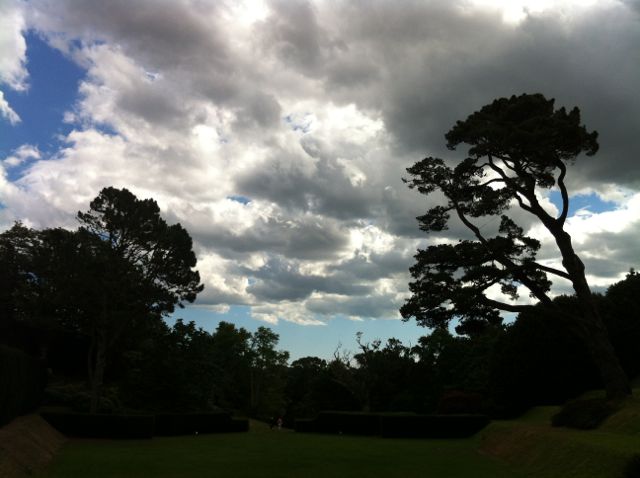
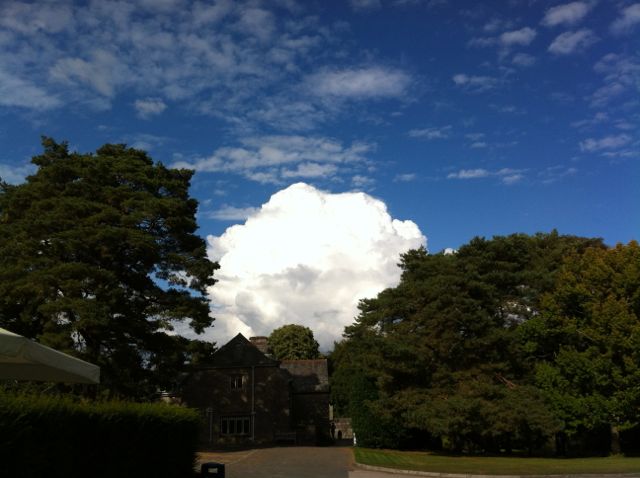
Stratocumulus over the tilting field at Dartington
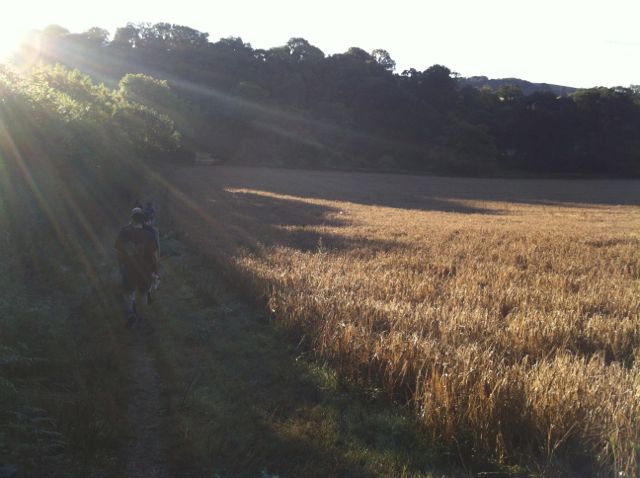
For several hours, we walked and explored the gardens. The brief remained wide open. Ideas emerged and disappeared just as quickly – but without judgement. We found our way to High Cross House, and it was there that, like the fleck of dust that is needed to begin the crystallisation of a solute from solution, something stuck around which ideas started to emerge. We wanted to create something that responded to the landscape – a giant puppet or mobile suspended from one side of the tilting yard to the other. We needed a rope, but all the rope had been taken by other groups.
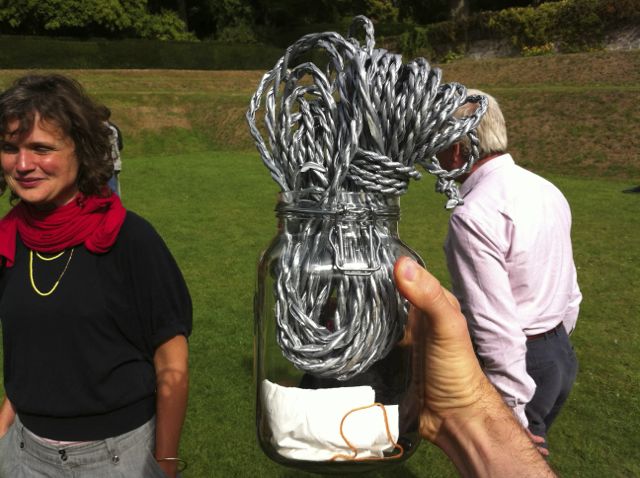
We decided to create our own rope from the only remaining material in the stores, gaffer tape. Then began wonderful process of collaboration and learning as we crafted our own 25m-long rope by spinning the tape around itself. Engaged in this physical task our spirits were soaring. The storm clouds that had been threatening all weekend finally broke, but we stayed out in the rain, spinning our rope.
A rope hand-woven from gaffer tape
When the rain stopped we tested our idea – to explore emotion by creating a giant tug-o-war spanning the great valley of the tilting field. It didn’t work – the rope failed under the stress of two people pulling – but it drove us to something better: to create a giant skipping rope. The next hour was brimful with joy as we leaped in and out of the skipping rope. We showed each other how to do it, we created games – we played. We returned to dinner with spring in our step aware that we had touched upon something profound, perhaps the satisfaction of craft…the beauty in simplicity…the joy in play.
Later we returned to the wish sculpture begun on the day two. Here is what Co-Director Chris Wise had to say about he happened.
My aim for this reportage has been to tell a live story from the Summer School. This is tricky to do because, as I said in my first day post, part of the appeal – and perhaps the impact – of the Summer School is that the participants know so little about what is going to happen. Summer School co-director Chris Wise told me that this mystery intends to put participants on a level playing field without preparation, preconception or prejudice. I understand the importance of what he is saying, but this leaves me, as a storyteller, little story to tell other than descriptions of historic buildings and landscape gardening. I have decided therefore to use the hindsight of what actually happened to help judge what I can include in my reportage of this Summer School without jeopardising the experience for future participants. So, if you are sitting comfortably…
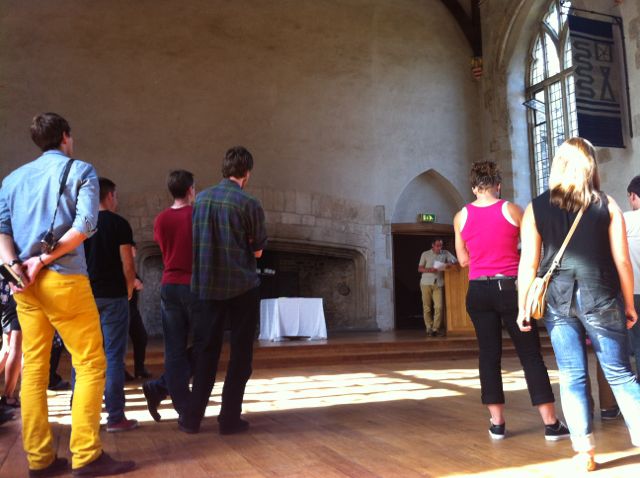
We gathered in one of these rooms for our first activity of the day. Having all been asked to bring a small object that represented a precious wish, we suspended our wishes from tiny threads within a giant cube structure. Our wishes floating before us (check potter Billy Lloyd’s wish here, and more pics here), we were then instructed to ask others about what they had brought, and if we felt some connection to that person’s wish, to connect our two wishes together with more string. Gradually forty-eight individuals and their wishes – many very profound and personal – became interlinked and co-supported in a fine matrix – a beautiful manifestation of the webs that were already starting to spin around and between us.
Assembled around this wish sculpture we listened to a compilation of interviews from Mike Dempsey’sRDInsights podcasts. As the collection included excerpts from interviews with many of the RDIs present, it allowed something quite personal to be revealed about these designers without anyone having to speak a word. For me this process of opening up began here, and became an important part of our stay at Dartington.
At eleven, the Co-Directors of the Summer School briefed the participants on what was to become the main activity of the Summer School. The participants were instructed to carry out a sequence of tasks, the means and mechanics of which I won’t go into, designed to set us off on a journey exploring human emotion. The journey would end on the last day of the Summer School when everyone would report back to say what they had found.
While the Directors’ briefing focused on the mechanics of the exercise, they were ambiguous about their expectations. With hindsight, this ambiguity set up an important tension that would eventually propel each of the groups to go far on their journeys of exploration. I witnessed this growing tension while I moved from group to group, interviewing participants along the way. Initially, everyone participated in good faith, but over a few hours unease grew. Two camps emerged. Some participated in the exercises placing their full faith in the mysterious programme that would somehow guide them to some sort of epiphany. Others found the exercises opaque and a barrier to meaningful discussion.
Then over dinner something snapped. The Directors stood up and effectively told everyone to stop being so polite and to take responsibility for themselves. It felt like a dressing down, but it was enough to suddenly propel everyone forwards. I think that for those who had been following instructions it was a shock: the instructions were no-longer trustworthy; the only people they could trust were themselves. And I think for those that had felt shackled, they were suddenly released. I may be wrong about those last two sentences, but I am certain by the end of day two a threshold had been crossed.
What is remarkable about the RDI Summer School is how so many people applied on the basis on personal recommendation, and yet how little any of the attendees know about what they are going to happen or who they are going to meet. There is a shroud of secrecy around the event that none of the previous attendees want to unveil – as clear an indicator as possible that this event is about the journey and not the destination. The journey began at 7:30am where a mixture of RDIs, young designers and ‘wild cards’ boarded the magical mystery coach. The RDIs are senior designers who have been awarded the title of Royal Designers for Industry in honour of achieving sustained design excellence, aesthetic value, and significant benefit to society. The RDIs are here to inspire, guide and inform the young designers, the largest constituency here – tactfully named to suggest people less advanced in career and age than the RDIs. The wildcards are professionals who are not designers and generally do not work with designers per se but may be touched by design, either as civil servants, commissioners, etc. They too can inspire and guide the young designers, but for this latter group it is also a chance to learn about how to build better collaborations with designers.
As the charabanc advanced westwards, curious conversation began to unfold between clusters on the bus. People began to discover who their co-travellers are. Somewhere outside Bristol the bus disgorged its contents into a service station. All of a sudden some the UK’s leading designers – architects, potters, stage designers, engineers – were all in the queue at the tiny coffee stand. It was like some 21st century recreation of the 19th century coffee shop encounters of Josiah Wedgwood, James Watt, James Bolton and Erasmus Darwin. By mid-afternnon we arrived in the glorious ground of Dartington Hall. We disembarked, ate and went straight into our first activity. Blackberries, iPhones and laptops were thrown aside, space was created, contact was made, and connections began to form.
My job on board this journey is to tell a story that it seems must remain secret. From four hours of moving from seat to seat on the coach, I am getting a clearer idea who the characters are and what their backstory is. This is a gang of people who all do useful stuff, and to do that well, they seek in one form or another, a creative recharge. I look forward to witnessing that.
For the next few days, I will be down at the RDI Summer School. Over four days and three nights, the School inspires, challenges, and provokes designers and those who use design, sharing experiences and searching for insight. For the participants, the Summer School is a journey, and my job is to capture that journey in a series of short videos and blog posts.
Contrary to current trends in event organisation, there will be no official live blogging or tweeting from the site. The organisers feel that clarity of thought at the school (maintained by minimising distraction from the outside world) is more important than any minute-by-minute account of the event, and I completely agree. The odd tweet that does spin out may use the hashtag #RSARDIsummerschool. So, watch this space, but don’t hold your breath.