Blog

  • Seeing the flow

    Seeing the flow

    Everything is in flow. Rivers and streams. The air blowing our heads and tall buildings. Information. Pedestrians and traffic. Materials, from mine, to factory, to building, to disassembly and on. Facades eroding. And even the mountains (the Alps grow by 1mm per year). 

    I saw on the beach yesterday in Devon a stunning reminder of very slow flow: the tightly folded bands of shale and sandstone on the Hartland peninsula. These were formed when two great tectonic plates collided to form Pangea. Massive tectonic forces causing things to move, very slowly.

    However slow the movement, once we realise everything is moving, we can decide are we going to swim with the current, swim against it or try to shift its course. 

    References

  • Facilitation Life – a rock solid template

    Here’s a facilitation structure (straight from our How to Run a Great Workshop Workshop playbook) that I’ve used in a wide range of contexts, from a global Zoom conference, to beer brewers in Bristol, to strategic planning sessions for infrastructure projects (usually hosted in hotel conference rooms near a motorway junction). It’s a robust facilitation method to lead a group through a problem topic to a series of possible solutions or areas of action. 

    Welcome – how is everyone arriving. 

    Presentation – open up the topic with a short presentation from someone with a more in-depth understanding of the context. This presentation sets the scene. 

    Breakout 1 – in groups discuss the topic and identify the key challenges that the topic raises. Ask groups to present two or three key challenges. 

    Guided Q&A – ask for a spokesperson from each table to simply list the challenge areas. If time, invite extra commentary or clarifying questions. 

    Co-create the agenda – collate all the challenges listed and sort them into a priority list. The sorting can be done by the facilitator or by groups voting on topics. ‘Dotmocracy’ works here where participants put sticky dots against the top topics they want to explore

    Break – During the break reset the tables and allocate one of the challenge areas to each table

    Breakout 2 – participants allocate themselves to a challenge topic that interests them. They then discuss possible responses to their self-selected challenge. Ask for a spokesperson to create a summary of the discussion.

    Guided Q&A – Hear from each spokesperson and invite clarifying questions. Look for opportunities to connect answers between the different groups.

    Conclusion – you can end the session there summarising the discussion so far, or go further and identify next actions. 

    This facilitation is particularly effective at enabling participants to steer the conversation in a structured way: the participants identify what the challenges are themselves and then decide which challenge they want to respond to. 

  • A regenerative framing for supporting local workforce development

    One of the participants in the Regenerative Design Lab is exploring working with The Purpose Xchange,  who work directly with individuals to uncover their dreams and aspirations. The organisation then helps to match those aspirations with work opportunities in the local borough. 

    A key question the lab participant is exploring is how providing an operating space for this community activity could help enable and scale this initiative, proven elsewhere, to thrive in their local borough.

    We can  intuitively see the benefits of this approach, but how does this work for more explicitly into a regenerative framing? 

    The Living Systems Blueprint

    In regenerative design, we use the living world itself as a template for understanding how to thrive within ecosystem limits. Instead of extractive, linear systems, we seek to imitate the mechanisms that the living world uses to thrive within its ecosystem limits. 

    The Living Systems Blueprint, which James Norman and I first proposed in the Regenerative Structural Engineer, outlines three key characteristics of thriving, living systems. 

    • Increased interconnection – strengthen the number and quality of connections between elements in the local system
    • Increased symbiosis – creating mutually beneficial exchange that build local system richness
    • Increased capacity to adapt – ensuring the local system can adapt in response to changing environmental conditions. 

    Creating more local symbiosis in the workforce

    Of the three elements of the Living Systems Blueprint, this example relates most closely to creating symbiosis, but it also relates to building interconnection and unlocking capacity to adapt. 

    Living systems create thriving with the resources that are present in the local ecosystem. By resources we mean materials, energy and labour. These resources go round and round, the waste streams from one process being the input to the next. The work of the system creates structures of growing complexity that give the local system increasing richness. 

    This approach is distinct from the alternative: importing materials, energy and labour from other places, and treating processes as linear, creating unlimited consumption and drawdown of resources.

    Building on this principle, the regenerative economy:

    • Works with and seeks to build the latent potential of the local workforce. 
    • Creates local thriving by working with the unique potential and needs of that  place. 
    • Avoids one-size-fits-all solutions that waste resource and a poor fit for the local system’s needs.

    A workforce that is rooted in the local economy and connected to local opportunities:

    • Returns money to the local community – but also builds relationships of trust (symbiosis)
    • Strengthens people’s connection to their local place and each other (interconnection)
    • Builds the local capability to maintain, repair and modify our build environment (capacity to adapt)

    The role of the regenerative designer

    One of the key roles of the regenerative designer is to connect together and enable the growth of positive initiatives that create thriving. Regenerative design isn’t necessarily about imposing solutions – rather it about seeking out and amplifying what is emergent in the system.

    In this case, creating operating space for Purpose Xchange to work from could be a key step in unlocking this change. Sometimes, the barriers to initiatives that build local thriving are not about potential or demand, but lie in being able to join up the pieces. This could be one of the most important roles for the regenerative designer.

  • Want to fix the future? Try fixing something today

    The question came up at a recent roundtable: how do we inspire designers to act regeneratively. And I said, train to be a plumber.

    But instead of plumber I could have inserted, carpenter, tree surgeon, blacksmith, cycle mechanic, gardener, food grower, repairer – in fact any sort of useful role that works with real materials and real systems.

    I don’t pretend these are quick paths to take. But I think too often in conversations around regenerative design we spend lots of time imagining the future we want to create (which is indeed one of the roles of the regenerative designer), but not nearly enough time deeply involving ourselves with the challenges of the existing systems.

    Making things in our existing system embeds us deeper into it. It grounds our thinking in physical and social reality. It helps us recognise the barriers but also the untapped potential in places and communities. We gain trust by offering services of genuine use now, and from those relationships open up new possibilities that are much more closely related to both reality and emergent opportunities.

    Regenerative design isn’t only about imagining the future – it’s about rooting our thinking in the challenges and opportunities of today. 

    (For more on this line of thinking check out ‘The Case for Working with Your Hands’, by Matthew Crawford)

  • Signs of bad design

    Signs of bad design

    Warning signs interest me. In some instances warning signs are necessary and appropriate, but in my experience they are often the mitigation measure of last resort for an issue that probably could have been solved by a different conceptual design.

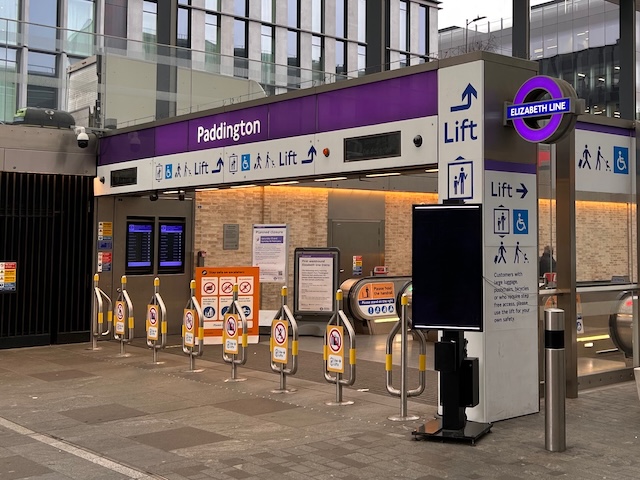
    Take this example, one of the entrances to the Elizabeth Line at Paddington Station, London.

    In this image I count six different classes of sign directing people to the lifts with their luggage. And, what’s more, in addition to all the signs you can see, there is an additional innovation. The black TV screen is connected to a camera that scans for passengers who are towing suitcases towards the escalators. Guilty parties spotted, it displays an image of their suitcase along with an arrow pointing to the lift.

    In addition to the signs there are physical barriers to suitcases, which must not be working otherwise the signs would not be necessary.

    As I recall, when the station opened, there were no barriers and hardly any signs. All of these measures are therefore an attempt to solve a problem that has emerged since the station has opened.

    Clearly the station managers are dealing with a real, operational safety challenge. And with limited options for re-design of the physical infrastructure, they are using the levers available to them: signs, barriers and sophisticated surveillance. This isn’t a criticism of station managers – rather a provocation for conceptual designers in the built environment:

    How often do we use signs and barriers to fix problems that better design could prevent?

  • Forest Ark – a lesson in continuous place-based design

    The Forest Ark is our most distinctive building at Hazel Hill Wood. It was designed in 2008 to showcase high-tech, off-grid living. Within its curving, organic form, rainwater was converted into drinking water, a wood-burning stove cooks, heats water for washing and heating; there is a cob wall that transmits heat from the south-facing wall.

    The problem is, fifteen years later, many of these technologies are no longer working – or indeed never worked. It turns out that operating all these technologies together is complicated. Getting these systems to work in sync takes regular testing and tweaking of routines, which is fine if you live there every day, but is not suited to a building that is for more occasional educational use. 

    So is this a failure? The only failure I would say is if we fail to see this building as an experiment. The failure would be if we gave up and stopped learning. 

    The challenges of keeping the building working have caused the Forest Ark to fall into some disrepair with a potentially hefty bill for restoring it to its full glory. The easiest path would be to abandon the building. This is more typically the approach of modern construction. A blank slate is so much easier to work with, so much easier to profit from, than the complexities of existing structures.

    A regenerative approach is to see our work on the Forest Ark as an act of care, to unlock the potential of what we have, and to see the potential of the work itself to create thriving, not just in the ends of improving the building. 

    For that care to start, we need to get to know each other. Our first date is the rainwater harvesting system. We just don’t think we can justify the expense and complication of running a rainwater harvesting and high-tech purification system on such a small scale. But connecting to the mains is itself an experiment that involves digging around the site to rediscover the buried rainwater harvesting system and the wastewater pipes. 

    And in that digging work, I already notice my connection to and affection for this building growing. I appreciate the craftsmanship that went into the original construction and want to honour that in our maintenance. I also encounter, for the first time, the clay that is so abundant on our site. Could clay become a locally abundant material that we work with?

    Buildings are not static objects but living experiments that can evolve over time. Through the process of continuous, place-based design, we create and then we observe and see what needs to change. That ongoing dialogue connects us to place, connects us to the specific emergent needs of the local built environment and the local community. 

    My hope is that through our work with the Forest Ark, we weave more people into the journey, developing our skills as we go to work with local materials, building our capacity to adapt and evolve with the place around us.

    Hazel Hill Build Weeks

    If you are interested in getting involved with caring for our off-grid eco-buildings at Hazel Hill, then you might be interested joining one of our two Build Weeks in July from 14th to 27th July 2025. I’ll share on this blog details when they go live.

  • Divergent poem

    Two days ago we had the Convergent Poem, full of ways of working that engineers (and other humans) tend to get praise for. Here is its awkward sibling, the Divergent Poem. Full of the things that aren’t necessarily valued by the professional system we are in, but are no less important, and could be more important.

    Shake it up,

    Tear it down,

    Breathe it in,

    Break it out,

    Multiply,

    Ask, what if I,

    Take random paths,

    And photographs,

    Pin up, collate,

    Re-conbobulate,

    Find time to explore,

    And imagine more.

    Choose the right poem for the job. Because, there’s no point in aiming for the summit if we are climbing the wrong hill.

  • A suboptimal walk in the hills

    Here’s a made-up story I usually tell in our How to Have Ideas workshops at Constructivist. It is a story from the distant past when humans lived without phones in their pockets…

    Imagine you and a friend agree to meet for a walk in the hills. You agree to meet at the bench on the top of the hill nearest the carpark. It’s easy to see from the carpark, and it is a nice spot to sit and wait for each other. 

    But when you arrive, you find a thick fog has descended upon the valley. You have no idea which way the hill is. So you start walking and notice that you are going uphill. Feeling encouraged, you carry on finding your way through the fog by following the line of steepest slope. Eventually, this method brings you to the top of the hill, where you see the bench and sit down. 

    The fog begins to clear.

    Gradually you begin to see that on the other side of the carpark there is another hill, with another bench on it, and there is your friend waving back at you.

    Ok, it’s quite a crude story, but it serves as a lesson in constant optimisation. Sometimes, following the line of steepest slope – making what seems like the optimal decision at every step – only gets us to the top of the nearest hill. But to reach the top of the tallest hill we might need to stumble around in different directions in the fog before the best way forwards becomes clear. 

  • Convergent poem

    Zero in

    Figure out

    Tidy up

    Manage down

    Validate

    Mitigate

    Prioritise

    Optimise

    Strip it back

    Keep it clear

    Make the risks 

    All disappear.

    These all sound like good things to do on a project, and are what engineers (and other humans) spend a lot of time being trained to do. And it makes sense – we manage projects that come with big risks and sometimes big budgets. 

    All of these processes are forms of convergent thinking: ways of working that take a situation with many possibilities, inefficiencies and uncertainties and reduce it to something more refined, more singular, more known.

    This approach is fine if what you are starting with contains the elements of the right answer. You can take some approximately right answers and iteratively improve them to make them better and better. 

    But if the starting point isn’t the right approach, optimising it won’t make it better. You just make the wrong answer more efficient.

    So we need to balance convergent thinking with divergent thinking that opens up the problem, that sees what else might be possible. But first, let’s go for a walk…[to be continued tomorrow].

  • Observe | Brief | Ideas | Test | Repeat

    This week I’ve been making the case for a continuous, place-based approach to design. As James Norman and I set out in the Regenerative Structural Engineer, we see this process as a cycle of the following stages.

    1. Observation

    Traditional design often begins with a design brief—a predefined problem to be solved. But Continuous Place-Based Design, with its focus on working with the existing dynamics of a place rather than imposing change from outside, begins with observation.

    Observation means more than a desk study or mapping exercise. It requires time spent in a place—experiencing it from different perspectives, noticing rhythms, interactions, and patterns of change. But observation isn’t just the first step. It is something we return to again and again, each time we make a change.

    2. Brief

    From observation, we begin to sense what is needed. The brief emerges as a way of distilling these needs into a set of design requirements.

    In traditional design, the brief is often seen as something to resolve upfront—reducing uncertainty as quickly as possible. But the Designer’s Paradox reminds us that a brief is never fully known at the start; understanding of the brief unfolds through the act of designing itself.

    Continuous Place-Based Design embraces this reality. The brief evolves over time, but it doesn’t necessarily converge to a single, finalised solution. Each iteration is the best response for now, while recognising that every intervention changes the system—and with it, the design brief itself.

    3. Ideas

    The creative phase of the process is deeply influenced by the place itself. Ideas are not imposed from outside but emerge from the system we are designing within.

    The designer’s role is not just to generate ideas, but to facilitate the emergence of ideas from place—to see what is latent, what is already forming, what might be supported. At the same time, by embedding ourselves in a place, we too become part of its system. Our ideas are shaped by this connection, rather than being external impositions.

    4. Make and Test

    This is where we intervene—where design moves from thought to action. We begin making changes to the system.

    Interventions can range from small-scale tests to large-scale changes—though an important principle stands: start small, learn, then scale out. Through making, we begin to see how the system responds.

    For example, in a housing development, instead of building an entire estate at once, we might start with a few houses, observing how the place changes and adapts before expanding further. The goal is not to eliminate uncertainty, but to work with the unforeseen consequences of our design decisions—using them as feedback to refine and update the brief.

    Back to Observation Again

    Having made our changes to the system, we go back to observation. But we are not back where we started: the system we are designing in has changed and we too are changed by that process. We become a more integrated part of the system we are designing in, better able to facilitate change that will bring forward thriving in that place.

  • What is Continuous Place-Based Design?

    Continuous Place-Based Design is distinct from its opposite — Short-Term Design from Anywhere (see yesterday’s post). The following is an extract from a new entry I wrote today on the Constructivist website describing Continuous Place-Based Design

    Engineers and architects often design buildings, but their true impact is on places—the communities and ecosystems that inhabit them. If we want our work to create genuinely positive outcomes for both humans and the wider living world, we need to move beyond an isolated focus on buildings and shift towards a deeper understanding of place. So how can we evolve our design philosophy to support the creation of thriving places?

    Places are complex living systems, full of people and other species, shaped by relationships and constant change. In such systems, we cannot fully predict the impact of the changes we introduce. Instead, we learn by doing—by making small interventions, observing their effects, and adjusting accordingly. Long-term engagement with place is essential for truly understanding how it works.

    This gives us our first clue: design must be an ongoing process, not a one-off intervention.

    A second clue comes from recognising that every place is unique, and that uniqueness becomes even more pronounced the deeper we look. How can we possibly create designs that embrace such diversity? The living world offers a model: evolution. Nature doesn’t rely on rigid masterplans—it works iteratively, testing variations, adapting over time, and responding to changing conditions. The result is a best-fit design for the specific ecological, cultural, and environmental context.

    If we take these two starting points seriously, then instead of asking “What do we want to do to this place?”, we should begin by asking:

    • What is already here?
    • What is needed?
    • What is missing?
    • What is beginning to change?

    From this foundation, design can emerge gradually—guided by the dynamics of the place itself. Small interventions can be tested, refined, and expanded, always with an eye on how the system is responding. This shifts design from being a one-time act imposed from outside to an ongoing process that works with that place, learns from that place, and evolves alongside it.

    In our book, The Regenerative Structural Engineer, James and I call this design philosophy ‘Continuous Place-Based Design’.

    Tomorrow I’ll share an overview of the stages in this process.

  • Introducing Short-Term Design from Anywhere

    Today I’ve been imagining what a design process might look like if its goal was the opposite of enabling humans and the living world to survive, thrive, and co-evolve.

    I have called it Short-Term Design from Anywhere.

    It might look like parachuting into a place we know nothing about and immediately starting to develop ideas. It might mean designing without ever visiting the site—relying instead on drawings, Google Earth and reports. It could mean defining success in ways that have nothing to do with the community or ecosystem of that place. It might not even consider the ecosystem at all.

    Short-Term Design from Anywhere is about importing ideas from elsewhere—assuming that what worked well in one place will work just as well in another. It loves one-size-fits-all solutions that seem economically efficient but fail to account for the cost of misalignment at a local level.

    This approach to design typically involves no local participation, no engagement, and no involvement—not in the design, not in construction, not in long-term operation. It requires no commitment to place, no exposure to long-term risks. It’s perfect for prioritising return on investment for external stakeholders with no stake in the place itself.

    Most of all, Short-Term Design from Anywhere assumes everything will work perfectly the first time. It does not anticipate learning, adaptation, or unintended consequences. And it rarely includes designers who stick around to find out what actually happens.

    Overall, Short-Term Design from Anywhere doesn’t sound like a great approach.

    Fortunately, there’s another way—one that works with place rather than against it. More on that tomorrow.

  • Full Circle

    Here’s a simple experiment. Take a wine glass and place it on a city map. With a pencil, draw around the base. Follow the circle as closely as you can and see what you discover.

    These instructions are the basis of a psychoderive, an approach to rediscovering the city, proposed by Situationist philosopher Guy Debord.

    Debord wants us to see the city anew. To break the matrix of familiarity, the hierarchies of roads, the boundaries of commerce. And instead to see again the underlying contours of place and community.

    Familiarity dims the senses. The circle forces us onto new paths. This uncertainty sharpens our awareness again. To notice the gaps between buildings. The pockets of life thriving in forgotten spaces. Not knowing if there is a way through.

    This act—forcing us to see the familiar in a new way—is a perfect analogy for how regenerative design begins. That starting point is deep observation of place. In places we think we know, it’s about peeling back the skin that habit forms and seeing what lies beneath. Then we can connect more deeply with community and ecosystem. To see what ingredients we already have to work with. To spot potential we can help unlock. To recognise the successful patterns of place.

    To do all of that, we need to learn to look again. Guy Debord’s wine glass gives us a good starting point. What do you notice when you follow the circle?

    Further reading

    • It turns out I did my first psychoderives in 2018 – Read Derive#2, about a circle I tried to squash into the Square Mile.
    • And continuing on the theme of games that change the way we experience the city, check out the Left-Right game, which my daughter and I invented during lockdown.
  • What you only notice when everything quietens down

    This is my final post for the year.

    Some things we notice because we are looking for them. I have lost my keys; I look around the house, my brain is scanning for the keys; I spot the keys. But in that search what I fail to notice is that the pot plant above my desk hasn’t been watered for weeks and is about to die. 

    Then there’s another kind of noticing, an awareness that isn’t driven by a specific task. It’s a more open awareness, in which we we may be able to see things that we were not necessarily looking for. 

    For me, the starting point in design is observation. And not just the laser-focused, looking-for-a-thing type of observation, but a more open, breathing-in-of-the-situation kind. What does a place feel like? What is the energy of a group of people? What am I drawn towards or away from? 

    Our brains are incredible at spotting patterns, but only when we let them. Hyper-focused attention, while useful, often comes at the cost of perceiving the bigger picture.

    For many in the built-environment sector, work is a hyper-focused, task-orientated space. Deadlines don’t leave mush space for stepping back. But taking a break from work gives us the opportunity to look up and have a more general awareness.

    If you have holidays coming up, then I invite you to simply notice what you notice when you aren’t looking for anything in particular. What you see might reveal be the wider patterns of place, of community, of life that we aim to serve in our work as engineers (and other humans). 

  • Exploring the Brief with IDBE at Cambridge

    Four times a year, I have the pleasure of heading up to Cambridge to teach on the Interdisciplinary Design for the Built Environment (IDBE) course. It’s always a highlight. The people on this course arrive with a great deal of experience from across the built environment sector—and that diversity makes for some fantastic conversations.

    This week’s workshop focused on exploring the brief, a topic I’ve touched on a lot in this blog and that sits at the heart of much of our conceptual design training at Constructivist . For me, it’s about debunking the idea that the brief in a design project is fixed.

    The kernel of the training is, the brief evolves. That realisation fundamentally changes how we approach design. It keeps us open—open to change, open to deeper listening, and open to discovering what the situation is really calling for.

    I’m already looking forward to rejoining this cohort in March. In the meantime, here are a few past posts where I’ve explored this topic further.

  • Human beings or human doings

    It is easy to look back on the year and list what you have done – projects started and milestones met, things ticked off.

    It is much harder to look back and reflect on how you have been.  Asking questions like how you have felt along the way or how you have inhabited the year are much more groined and embodied questions than what you have done.

    But these latter questions remind us that we are human beings rather than human doings.

    This year, I’m going to try weaving this question into more of my end-of-year conversations and self-reflection. Not just what did I do?, but how was I?

  • Through and through

    Any domain of knowledge is a treasure trove of jargon. When that knowledge relates to a traditional craft, it becomes a vocabulary deeply rooted in working with the land—a language passed down orally, generation to generation, long before it was ever written.

    Learning these word and phrases, even in a small way, reconnects us to a language of observation, design, and craft that originates from the bioregions we inhabit.

    I am lapping up this language in Ben Law’s book on Woodland Craft, and discovering phrases that I take for granted. 

    Like ‘through and through’, which I took to loosely mean homogeneity. But in woodland craft it describes the process of sawing timber down the length of the log rather than across it. What it produces is planks of timber with border of bark on either side. The bark can be taken off, or left on to create waney edge boards, like we have used around Hazel Hill Wood.

    And then I read that sawing ‘through and through’ is necessary for creating ‘bastard shakes’. Now I am intrigued.

  • Make hay while the wind blows

    Make hay while the wind blows. Riffing on yesterday’s theme of power, a few weeks ago as storm winds tore across the UK, I was kept awake by the sound of the plastic sheeting slapping against the scaffolding on the front of our house. 

    And I found myself wondering, what is the wind analogy to making hay while the sun shines? It’s an incantation to seize the moment and make the most of an opportunity while it lasts. And of course, we already harness wind power. I presume a lot more energy is generated on a stormy night.

    But like any abundance in nature, the wind doesn’t distribute its power evenly. It comes in surges. It’s a fleeting opportunity. 

    Storm’s blowing, quick—boil a kettle! Pump some water uphill! These were my middle-of-the-night musings.

    Eventually, my thoughts drifted to a memory from 2024: cycling along Loch Awe, near Oban. After a long day cycling in heavy winds, we reached a campsite in Dalavich that was attached to a well-equipped community centre. It had a restaurant and bar with a deck overlooking the lake, games rooms with pool and table tennis and excellent washing and cooking facilities.

    But it wasn’t just for tourists—the local community was in there too, enjoying the space. Curious, I wanted to know more about how this facility had been paid for, and it turns out that it gets funds from the community owned wind turbine at the top of the hill. 

    Brilliant, I thought: community energy, harvesting a local abundant resource—the wind—and reinvesting the money into the community.

    I suppose on gale-force nights, the drinks are on the house?

  • Watt to do?

    At my latitude in Bristol, there are about 12 fewer hours of sunlight at the winter solstice compared to the summer. That’s half a day’s less light.

    What’s more, the noontime midwinter sun sits far lower in the sky than its midsummer counterpart. This means the sunlight we do get has only a fraction of its June-time wattage.

    There could not be a clearer signal from the living world to do less.

  • Better than a New Year’s resolution

    I used to like making New Year’s resolutions. My resolution to stop eating chocolate digestives in my old job at Expedition Engineering lasted 3.5 years. My resolution to stop being sarcastic has been more intermittent—let’s call it a “New Year’s preference” rather than a resolution.

    But lately, I’ve been thinking that resolutions are a rather peculiar way to approach change. They tend to overplay our sense of agency while underestimating the myriad unseen factors that shape how our complex lives unfold.

    As 2025 approaches, I’m struck by the idea that the seeds of what will emerge in the coming year have already been planted throughout 2024. Taking inspiration from the Three Horizons Model, a better approach might be to ask:

    • What new patterns are emerging for me?
    • How might these patterns bear fruit?

    These are questions that take time to answer. In the living world, new shoots don’t appear until late winter or early spring—they emerge in their own time

    So, instead of making a New Year’s resolution, why not try something quieter? Pay attention to the patterns emerging in your life and work. Notice them, nurture them, and think about how you might align yourself with them. In doing so, you’ll work with the momentum that has already, quietly, been building beneath the surface.

  • Juice the System: a strategy for exploring complex systems

    Last week, I wrote about an idea-generation strategy I regularly use in teaching called Juice the Brief.

    This week, I’ve been working on an analogous method called Juice the System. This approach builds on the Systems Bookcase model, which we use to understand why systems behave the way they do and to identify opportunities for intervention.

    The challenge with complex systems is that they often seem overwhelming—like walking into a messy bedroom where everything is scattered across the floor. The goal of Juice the System is to “tidy up” this complexity by sorting the mess into clear categories using the Systems Bookcase as our framework.

    Recap – The Systems Bookcase model

    The Systems Bookcase is a way to organise information about a system into ascending shelves on a bookcase. From bottom to top:

    1. The Design Shelf

    • For anything tangible—what has been built or created.
    • Examples: buildings, infrastructure, physical objects.

    2. The Operations Shelf

    • For rules, incentives, restrictions, and enabling or limiting conditions—the mechanisms that drive the system.
    • Examples: policies, processes, regulations.

    3. The Mindsets Shelf

    • For attitudes, assumptions, and beliefs that underpin how the system operates.
    • Examples: cultural norms, biases, overarching worldviews.

    4. The Goals Shelf

    • For the high-level goals of the system
    • Example: in our current paradigm in construction, to build things profitably and safely; in a more holistic paradigm, for humans and the living world to survive, thrive and co-evolve.

    5. The Paradigm Shelf

    • Right at the top, the paradigm – the guiding philosophy of the whole system
    • Example: in UK and similar economies, the paradigm of continuous economic growth.

    How to juice the system

    To start, you’ll need some “mess”—raw material to sort through. This could be:

    • A report,
    • Notes from a site visit,
    • An audio recording or podcast, Or any other information source related to the system you’re exploring.

    Follow these steps to organise the mess:

    Step 1: Gather Inputs

    • Read or listen to your chosen input material.

    Step 2: Sort Information onto the Shelves

    • As you go through, pick out elements and assign them to the appropriate shelves:
    • Design Shelf: Tangible outputs (e.g., buildings, objects).
    • Operations Shelf: Rules, incentives, restrictions, or enabling factors (e.g., policies, processes).
    • Mindsets Shelf: Attitudes, assumptions, or beliefs (e.g., cultural norms, biases).

    Step 3: Infer Connections

    The Systems Bookcase helps you uncover how layers of the system interact:

    • A mindset permits certain rules (operations shelf), which in turn result in specific designs (bottom shelf).
    • Ask questions like: what belief enabled this rule? and what process allowed this design to exist?

    Why Juice the System?

    The purpose of Juice the System is to make sense of complex, messy situations. By categorising information, you can identify patterns, understand interconnections, and pinpoint leverage points for meaningful intervention.

    It’s like tidying a messy room—suddenly, everything is in its place, and you can see how it all fits together.

    Whether you’re tackling a large-scale project or understanding the behaviours of a system, juicing the system gives you the tools to start untangling complexity.

  • Tagging along

    I’ve been thinking a lot recently about doing more with the tags on this blog. 

    Tags are the keywords that I assign to every post on this blog. Clicking on a tag pulls up all other posts related to that tag.

    For a long time, I’ve imagined this blog as a compendium—a collection of thoughts and ideas gathered over time. Eventually, I knew I’d need a way to find what was in there. Tags seemed like the perfect tool, both for me and for readers who might want to explore particular themes.

    Sure, you can use search functions or AI to uncover related themes, but tags are something I write myself. They require thought, and that process of thinking helps organise ideas.

    That said, I’ve never really done much with my tags. But as I’ve increased my writing output in recent months, I’m finding they’re starting to come into their own—helping me see emerging themes in the work.

    So, I’ve had an idea: create a Feature Tag—a way to spotlight a particular theme each week. This will give both me and readers the chance to discover related posts.

    This week’s Feature Tag is ‘DesignBrief.’

    Under this tag, you’ll find posts about:

    • Design versus shopping,
    • Finding the disputable brief in your project,
    • And a post from 2020 about unreliable briefs—whatever they were!
  • Don’t interrupt

    I need to get that invoice out. What was I thinking about? Should I order another coffee? There’s so much to do before Christmas. Is the role of the regenerative designer to fully imagine a regenerative world or just design the next step? Am I hungry? I must write those slides for Monday.

    Thoughts can be scrambled, non-linear, profound, or anodyne. They might gush out in torrents or emerge as a slow trickle.

    But a conversation provides the chance to focus—a chance to tether those thoughts down, to allow them to build.

    In conversation, we have to speak, and the power of language lies in its ability to provide a framework for expressing and organising our thoughts.

    Random musings must be transformed into nouns, verbs, and adjectives, structured by the rules of grammar.

    The thoughts we choose to express must be organised to keep our listener interested (I’m more likely to stay on topic and not digress into talking about invoicing).

    Giving someone the opportunity to speak is also giving them the opportunity to think—to refine and develop their ideas as they go.

    So, keep them talking – don’t interrupt.

  • What shall we do a with a no-brief client?

    (To the tune of “What Shall We Do with a Drunken Sailor”)

    Chorus:

    What shall we do with a no-brief client?

    What shall we do with a no-brief client?

    What shall we do with a no-brief client?

    Early in the morning? 

    Verse 1:

    Start with a list of their requirements,

    Start with a list of their requirements,

    Start with a list of their requirements,

    To get the process rolling!

    Verse 2:

    Sprinkle on a little bit of what delights them,

    Sprinkle on a little bit of what delights them,

    Sprinkle on a little bit of what delights them,

    And now we’ve got a briefing!

    Verse 3:

    Now it’s time to go and break the brief right open,

    Now it’s time to go and break the brief right open,

    Now it’s time to go and break the brief right open,

    To start creative thinking!

    Verse 4:

    Read the brief out slowly to them,

    Read the brief out slowly to them,

    Read the brief out slowly to them,

    And see what is emerging!

    Verse 5:

    Capture all their questions on a great big mind map,

    Capture information on a great big mind map,

    Capture inspiration on a great big mind map,

    And see what thoughts are forming!

    Verse 6:

    Oh ay, another idea!

    Oh ay, another idea!

    Oh ay, another idea!

    No idea is too stupid!

    Verse 7:

    Now it’s time to test them all against the briefing,

    Now it’s time to test them all against the briefing,

    Now it’s time to test them all against the briefing,

    To see what needs improving!

    Verse 8:

    And so you’ve got a brief and some emerging concepts,

    So you’ve got a brief and some emerging concepts,

    So you’ve got a brief and some emerging concepts,

    That the team can work with!

    Final Chorus:

    That’s what we do with a no-brief client,

    That’s what we do with a no-brief client,

    That’s what we do with a no-brief client,

    Next time, call us sooner!

    —–

    🎼 Do you like songs about engineering? Here’s another one I wrote.

  • Make a little time for design

    Things are just a bit too busy right now. I don’t really have much time to think about my design process. Or so it goes.

    But here’s the thing: even a little time spent thinking about your process is time well spent. Steal a few seconds on your commute or book a 15-minute meeting with yourself in a quiet pod.

    Once you’ve carved out those moments, here are some quick things you can do:

    • Write down the high-level brief. – Often, we forget what the brief actually is! Take a moment to capture the key things that need to be achieved to meet the client’s needs.
    • Gather your inputs. Check you’ve got the basics covered: information from the brief, site details, precedents, and inputs from colleagues.
    • Print off some sketches, images, or drawings. So much of our work lives on tiny screens, but our brains evolved to process a much wider field of vision. Fill that space with physical inputs to stimulate creative thinking.
    • Do a quick sketch. A simple sketch can help you spot new connections or things you hadn’t noticed before.
    • Do nothing! Sit quietly for ten minutes and let your subconscious do the work. Sometimes, clarity comes from stillness.

    Try it once, and you’ll likely notice something you hadn’t seen before. Do it often, and you’ll build a habit of making time for design—a habit that pays dividends over time.

  • 120 Satsumas at the dentist’s

    Nobody relishes the prospect of a dull meeting, which is why, as a facilitator and trainer, I always try to bring an element of play into my workshops.

    But play isn’t just a distraction from the “real business.” Sometimes, it is the real business. Creative, playful exploration often leads to more insightful and daring ideas. It helps us take risks, builds trust, and provides the buoyancy we need to bounce back when things get tough.

    That’s why I love to include games in my sessions to lighten the mood. One of my favourites is lemon jousting—a simple game where you try to knock a lemon off your opponent’s spoon without losing the lemon on your own spoon. At Constructivist, for ease of procurement, we’ve adopted satsumas instead of lemons. The bonus? Participants get a tasty snack afterward.

    Of course, this playful approach means that in the peripatetic life of a trainer, I often find myself travelling with some rather unusual props.

    Which is how I ended up at the dentist’s, en route to a training course, hauling 120 satsumas.

    👉 Find out more about the facilitation training I deliver at Constructivist.

  • Losing at Tetris (and planning)

    If you’ve ever played the computer game Tetris, you’ll know how it goes: things are fine at first. Blocks drop at a manageable pace, and you can take your time placing them neatly. But as the stack grows higher and headroom becomes limited, the blocks fall faster. You’re forced to make snap decisions, and it gets harder to place them well. Mistakes compound, and suddenly, it feels like everything is accelerating towards disaster.

    Today, I’ve been running training for the Get It Right Initiative, and this is one of the analogies I use to explain what happens when we don’t make time to plan.

    In design and construction, as in Tetris, when we skip planning, we’re more likely to make rushed decisions. These decisions can lead to mistakes, which in turn create more problems, more stress, and even less time to address the growing chaos.

    Unfortunately, in real life, the consequences of getting things wrong are far more serious than losing at a game.

    Fortunately, unlike in Tetris, we do have more freedom to step back and make time for planning. Planning is the important-but-not-urgent task that prevents small issues from escalating into crises.

    It might not always feel like we have that freedom. Making space for planning might mean sacrificing something else, but that sacrifice is often far less damaging than the entire plan going wrong and it being game over.

  • Slow-growing ideas

    Some ideas are an instant hit. Some don’t stick at all. And some—ones you thought hadn’t stuck—are simply taking a long time to grow.

    Today, I’m running training for a group of engineers who are passionate about moving beyond warm words around the climate emergency. The material I’m drawing on comes from a course Constructivist ran back in 2020, titled Training on What to Do After Declaring a Climate Emergency.

    Back then, the IPCC’s 2018 report on climate breakdown and ecological collapse had captured the zeitgeist. Across all levels of the profession, engineers (and other humans) were beginning to confront the net impact of their work and the urgent need to act.

    Hundreds of firms signed up to various Built Environment Declares statements. These were terrific initiatives, requiring board-level sign-off and firm commitments from signatories.

    The big question, of course, was: What happens next?

    At Constructivist, we recognised that following those declarations, someone—usually at associate or associate director level—would be tasked with spearheading the initiative within their organisation.

    Our mission has always been to design and deliver training for engineers (and other humans) who are bravely reshaping the construction industry in the face of the climate and ecological emergency—working towards a future where our industry creates thriving in its wake.

    And so we developed and delivered Training on What to Do After Declaring a Climate Emergency. We ran it twice. Then Covid hit, and everything went quiet.

    In many ways, that course planted the seed for what became our next and most successful initiative: the Regenerative Design Lab. For that, I am immensely grateful.

    But I’ll admit, I’ve also felt disheartened. It seemed like the original framing—seizing that moment of change-making energy—hadn’t stuck.

    Then, recently, I started hearing from graduates of that original programme. They told me about the lasting impact it had on their work, how it gave them confidence to take bolder action in their designs, and how it inspired them to push further.

    And today, I’m running a workshop with a client that draws directly on the ideas from that same programme.

    Like the seeds of different tree species, some ideas grow quickly, while others take much longer to take root. The challenge is, unlike with trees, it’s much harder to know from the outset which ideas will spread quickly and which will turn out to be slow-growing.

    What’s important is that don’t judge the ideas that we have planted too quickly.

  • Juice the brief

    Juice the Brief is one of my favourite techniques for uncovering the possibilities hidden in a design brief. It’s a simple yet powerful way to stimulate creativity, generate new ideas, and explore questions that might not otherwise surface.

    How to Juice the Brief: Step-by-Step Guide

    To begin, you need a design brief—or at least a written description of the need or potential you’ve identified in a situation. It’s crucial that this is written down so it can be read aloud.

    Next, prepare your workspace by writing the following three headings on a large sheet of paper, a flip chart, or an online whiteboard: Information, Questions, and Ideas.

    Step 1: Write Down the Brief
    Ensure the brief is clearly documented. This is the foundation for the process and will guide your team’s exploration.

    Step 2: Read the Brief Slowly
    One person reads the brief out slowly—and I mean really slowly. The goal is to give everyone listening enough time to focus on their thoughts and notice:

    • Any information (e.g., design requirements, facts about the project).
    • Any questions that come to mind (e.g., about the end-user, the site, or the requirements).
    • Any ideas, no matter how unformed or rough, that the brief inspires.

    Step 3: Extract Information, Questions, and Ideas
    Listeners write down their thoughts under the corresponding headings:

    • Information: Captures specific details from the brief that are important to the project.
    • Questions: Identifies areas needing clarification, exploration, or further research.
    • Ideas: Encourages creative sparks—small or large—that can fuel the design process.

    In this divergent phase, every thought is valuable. Questions often lead to new information or ideas. Ideas inspire further questions, encouraging exploration and deeper understanding.

    Why Juice the Brief

    Juicing the Brief is like spinning the dense words of a brief apart in a centrifuge. It extracts the rich potential hidden within and reveals creative stimuli that might otherwise be overlooked.

    The name? It wasn’t mine. This technique originally had a more formal title, but one of my trainees—whose name, alas, I don’t recall—said, “Do you juice the brief?” Yes, that’s exactly what we’re doing.

    (Juicing the brief is just one of the many creative thinking tools in our conceptual design training for engineers (and other humans) at Constructivist.)

  • Imagining the wood from the trees

    This week, I’ve been writing about observation as the starting point for regenerative design.

    Today, I’ve been working with colleagues at Hazel Hill Wood to envision a year-long process of investigating what timber is currently—or could be—available for harvesting from the wood to use in our buildings. In a sense, we are learning to tell the wood from the trees.

    Through this process, I foresee the following levels of timber availability:

    • Ready – Timber that has already been felled, sawn, and seasoned—ready to be used immediately.
    • Ready for processing/seasoning – Timber that has been felled but still needs additional preparation, such as seasoning.
    • Ready for felling – Mature trees that are best harvested now to make the most of their timber potential.
    • Needs tending to – Timber that could become valuable in the future but requires care now—such as thinning or pruning lower branches—to ensure a high-quality crop later.
    • Needs time – Young trees that aren’t yet ready for harvesting but can be planned for as part of a long-term strategy.
    • Needs imagining – The trees that don’t yet exist. With thoughtful, long-term planning, we can envision trees growing in the future—trees that may one day be harvested, perhaps not by us, but by future generations.

    It’s this final phase that I find particularly magical: imagining the wood from the trees. It’s about seeing what’s missing and planting the seeds—both literal and metaphorical—that could flourish decades from now.

    All of this thinking reminds me that the role of the regenerative designer is imagine a thriving future and take steps towards creating that future. It begins with observation and imagination.