Tag: CreativeProcess

  • Rapid poem development

    This week’s project is to write a series of six poems for a mystery client. To leave a trace but not give anything away, here are some notes on process.

    Primary creation step – morning pages. Most of my ideas have come from writing morning pages (Julia Cameron’s technique from the Artist’s Way, described here by Oliver Burkeman). From starting with me writing the question over and over again – what shall I write in these poems?

    Next key move. Just start writing some words down. They don’t have to be very good. I found some simple word play. I like working lists and categories. Pick a category, like tree species, and all of a sudden you have a list of words to pick from. And as soon as you pick a word, you can probably find something for it to rhyme with.

    Are poems supposed to rhyme? I’m not going to worry about that for now.

    Yes, in fact, that feels like another step. Don’t worry about it for now. Because soon you will have the first poem written. And then, it’s easier when you’ve started.

    Rewrite the lyrics of a song. That’s good because you have the poem structure set up for you.

    Finding written things that are banal, and try re-imagining them. Instructions, signs, WhatsApp conversations.

    That’ll do for now.
  • Mizuna Seed Song

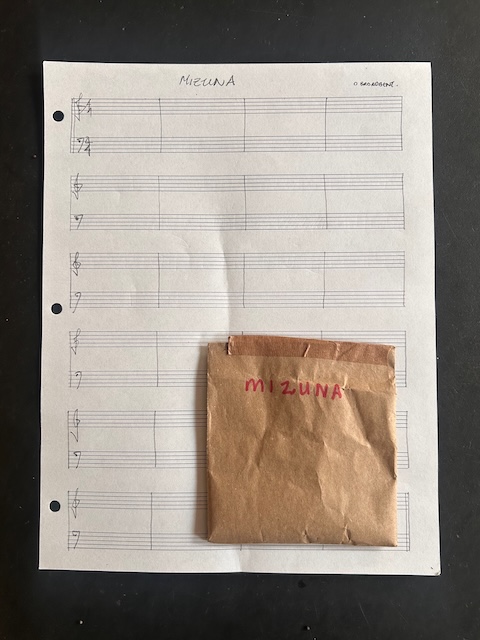
    Yesterday I spilt a bag of mizuna seeds on the floor. A pile of black dots on the floor that were very fiddly to pick up.

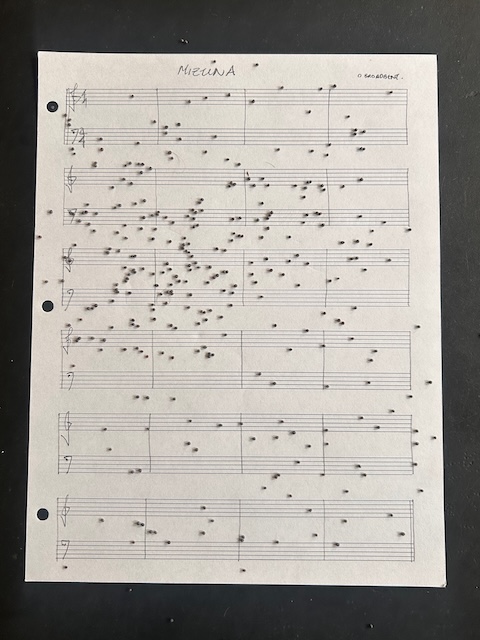
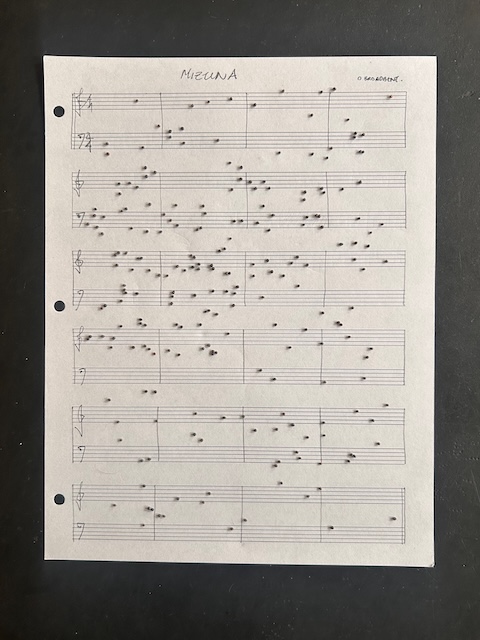
    Last night I dreamt that the spilt seeds were crotchets and quavers. I wondered what would happen if I spilt the seeds on manuscript paper instead.

    1] Blank staves and seeds

    2] Seed drop

    3] Outliers removed

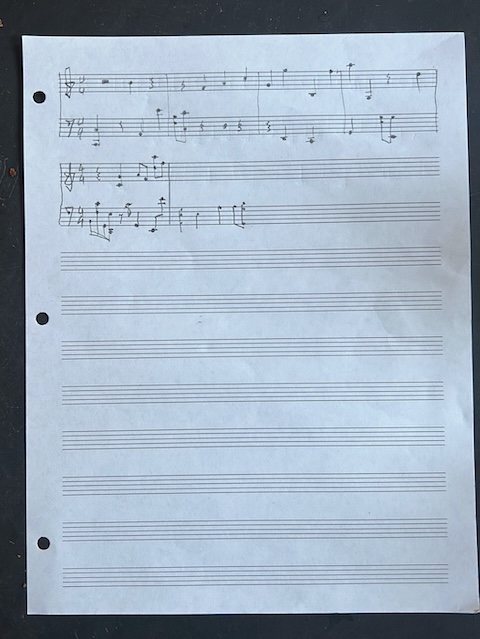
    4] Transcription

    Quantisation rules:

    • Limit to semiquavers
    • Maximum two ledger lines.

    Next stage: turn it into a song.

  • Start with your scales

    I was taught to start my music practice by playing my scales. Starting with your scales:

    • Grounds you in the practice. The basic relationship between you and the instrument and the sound you can make
    • Reinforces and enhances the automatic movements that become how you play.
    • Takes you through the full range of motions of play.
    • Removes the barrier to knowing where to start because where to start is always the same. You pick up your instrument, you play a scale and you have begun.

    Starting with your scales doesn’t just apply to instruments. It applies to any work where you develop a practice, be that a practice of design, facilitation or performance. 

    In the technique I call Professional Palette in my conceptual design training, I encourage participants to warm up to a design exercise by quickly drawing through all the common typologies for the project they are working on.

    It applies whether you are designing a bridge span, an investigation, a workshop or a dance performance. 

    Make it your default to start with your scales: go through the range of motions, get all the pens out and put them on the table, familiarise yourself with the full breadth of your tools, and then begin.