
Yesterday I wrote about the inputs you might gather at the start of a creative project. These are what I call inputs in the moment. But there is a different sort input that is only available to you if you put in the work to gather them. I call these creative inputs over time.
(more…)Tag: Csikszentmihalyi
-

#15 Show-notes – Oliver Broadbent interview by Alexie Sommer – Creativity, climate and clowning
I spend most of my time designing creativity training for engineers. In this episode we flip the format. Alexie Sommer, Independent Design and Communication Director and collaborator on many of my projects interviews me about why I set up Eiffel Over and Constructivist Ltd, and what our plans are for designing creativity training for engineers in 2020. We get into:
- Techniques for teaching creativity
- Our programme of training support people tackling the climate emergency
- And what engineers might learn from clowns.
Listen on Apple Podcasts , Sticher or by download here
(more…) -
Building creative culture in engineering companies
I am starting to shift my attention away from creative tools for engineers. Tools are still important. But I’ve realised that you need a creative culture for individual creativity to thrive.
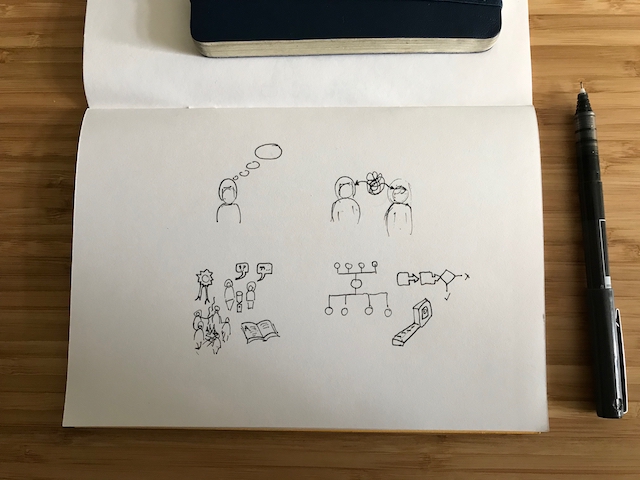
Recently, I rediscovered in Laloux’s ‘Reinventing Organisations‘ the Wilbur four-quadrant model. The model describes how culture, systems and worldviews interact. We can use this model to understand a phenomena in an organisations from four different perspectives:
- How the phenomenon can be measured from the outside
- How the phenomenon feels from the inside – intuiting how it feels
- How the phenomenon appears to the individual
- How the phenomenon appears to a group of people.
Like all engineer-friendly models, Wilbur’s is a two-by-two grid. The columns divide the grid into interior perspecitve and exterior perspective. The rows divide the grid into individual and collective perspective. According to Laloux
Wilbur’s insight, applied to organisations, means we should look at: 1) people’s mindsets and beliefs [individual interior perspective]; 2) people’s behaviour [indvidiual exterior perspective]; 3) organisational culture [collective interior perspective]; and, 4) organisational systems (structures, processes and practices) [collective exterior perspective]”
From Reinventing Organisations, Laloux (2016)Applying the four quadrant model to organisational creativity
I’ve assembled some quick thoughts on how the four quadrant model might apply to understanding creativity in an organisation. I have written the statements for a fictional, ideal case. This difference between this ideal case and reality can give us some suggestions for what we might need to do to build a more creative organisation.
(more…)