Tag: culture

  • Preaching to the unconverted

    Cognitive dissonance is when we know something to be true but we don’t act as if it is true.

    In the built environment sector, the cognitive dissonance is that the living world knows how to operate complex systems much more effectively than engineers (and other humans) do. And yet, the living world is not revered and not held as a reference point.

    Imagine if the opposite were true, if we held deep reverence for the most sophisticated of operating system on the planet, this respect would be reflected in:

    • The stories we tell about new ideas and innovation.
    • The design references we put on the wall or use as inspiration.
    • The metrics we track to measure successful outcomes.
    • The way we relate to and engage with living systems.
    • The way we make design decisions.

    In short, deep respect for the living world would be reflected in our culture, which is another word for ‘how things get done’.

    But we know this isn’t the case. 

    Of course, we know the important, long-term work is to shift the culture in engineering and construction to see humans as part of a larger web of life. This is the work of changing paradigms and goals, which Donella Meadows tells us are the highest points of leverage in a system. Movements like Engineers Declare are doing great work at this level.

    But the reality is that most organisations in our sector do not have an ecocentric culture. We have the opportunity to influence people every day, but only if we can help them with the challenges they face. 

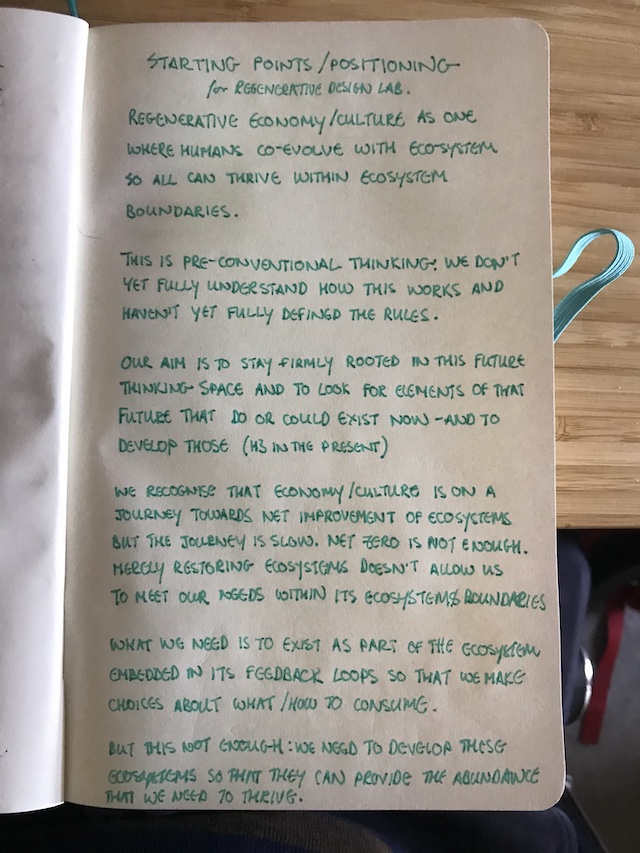
    The goal of regenerative design is for humans and the living world to survive, thrive and coevolve. But this isn’t the goal of most people running projects today. Their goals are usually much more occupied with the present: budgets, deadlines, dwindling resources and growing uncertainty. 

    This isn’t a criticism, but an observation. 

    So we need to find a bridge, a way to meet people where they are, tools that help tackle the challenges of today in ways that are compatible with a thriving future. A language that translates into both today’s conversations and tomorrow’s. 

    If we can use a shared language, we can start to close this cognitive dissonance, not by telling people they are wrong, but by meeting people and projects where they are.

    This work is about earning trust, building empathy, finding common ground and helping people do their jobs today in a way that sets the foundations for systems change tomorrow.
  • Does power support change?

    This post has moved.
    It now lives on the Constructivist blog: read the updated version →

    Eiffel Over is now my stage for engineering-related clowning, singing, dancing and writing — you’ll find my professional writing on design and regenerative thinking over at Constructivist.

    Earlier this week I wrote about designers needing to understand the conditions for change. What enables change and what blocks it.

    If we understand organisational culture as how things get done in an organisation, then culture gives us some strong clues about what – or who might be enabling or blocking change.

    Power is one of the six lenses of culture in the Johnson and Scholes culture web. How people with power wield it in the organisation sets a strong signal for what is valued and what can be ignored. The policy may say one thing, but it is what management or leadership actually do that sets the culture.

    And so back to change. Do the people with power visibly support change? If so, a culture of change will enable you to do your work more easily. If not, you will have more work to do.

  • New developments in ‘i’

    Engineers have announced today some astounding new breakthroughs in their latest version of i.

    • Empathy – the ability to see the world from the perspective of another. To have a genuine, shared sense of pain. This ability is developed through twenty-year long training process called ‘childhood and adolescence’.
    • Embodied cognition – a way to develop understanding that emerges through the unique physical characteristics of each ‘i’ and how it moves through and experiences the world.
    • Music – audio signals organised into patterns and created by individual or groups of ‘i’s to communicate information that can’t be captured in a .txt file.
    • Culture – a collective intelligence that emerges when several i operating systems do things together.
    • Gut-feeling – a parallel processor providing checks and balances against the logic board.
    • Sleep – a remarkable sub-routine that both repairs the operating system and identifies new patterns.
    • Love – a higher order circuit that guides priorisation, builds system resilience and provides additional energy when resources are low.

    This technology is completely free and open-source.

  • How much does your website weigh?

    It’s a funny question. How much does my website weigh? Is it heavy? It is light? I have no way of knowing. 

    But I like the question, because it is a good proxy for the energy impact of my website. What is its footprint? What is the energy used in keeping the servers whirring in the cloud (which is not in fact fluffy and is in fact a warehouse). 

    And the reason we don’t know the answer to the questions is that there is no feedback loop. When I write a post and add some data-heavy images I don’t feel that extra load. 

    (more…)
  • If you want to save the planet… have dancing lessons

    Serendipitously, as I was preparing for my first dance teaching workshop this morning at the Idler Festival, I spotted a quote in one of my other open browser tabs a quote from David Flemming.

    Commons are cooperative enterprises; they therefore depend on trust, on reciprocity, and on social capital. The market economy can get by, for a time, with a gravely-weakened culture and social capital, but the commons cannot. If you really want to save the planet and to give human society a decent chance of living on it, the first thing you should do is to join a choir. Or have dancing lessons, or both. That is not quite the hyperbole it seems: in enduring communities, the thing which defines and distinguishes them is their culture of dance, music, story and tradition—so intertwined with trust that it is hard to tell cause from effect. 

    David Flemming, in ‘Lean Logic – A DICTIONARY for the FUTURE and HOW to SURVIVE IT’

    We always said in the Mudflappers that our mission was to make the world slightly better through the medium of dance. Well here is some compelling philosophical underpinning to back that up. I shared this quote with the dance workshop today and it was well received.

  • Reflections on transformational innovation

    These are my reflective notes as I work through chapter two of Daniel Wahl’s ‘Designing Regenerative Cultures‘. My aim in this reading is to find clues as to what a set of principles for regenerative design for engineers could look like.

    Wahl introduces three types of innovation:

    • Sustaining innovation – that which keeps the current system working
    • Disruptive innovation – that which introduces new operating systems
    • Transformative innovation – that which is the ‘long-term innovation process of fundamental changes in culture and identity.

    He argues that if we want to achieve a transition towards a regenerative culture, it is this third kind of innovation that we need.

    (more…)
  • Rethinking our relationship with our ecosystem

    Yesterday I was writing about what to do after declaring a biodiversity emergency. My conclusions was that the process starts with rethinking our relationship to our ecosystem. Not how can we do something to our ecosystem but how can we work with it. Today I want to get into more ways that we can achieve this shift in the way we think.

    (more…)
  • Building creative culture in engineering companies

    Building creative culture in engineering companies

    I am starting to shift my attention away from creative tools for engineers. Tools are still important. But I’ve realised that you need a creative culture for individual creativity to thrive.

    Recently, I rediscovered in Laloux’s ‘Reinventing Organisations‘ the Wilbur four-quadrant model. The model describes how culture, systems and worldviews interact. We can use this model to understand a phenomena in an organisations from four different perspectives:

    • How the phenomenon can be measured from the outside
    • How the phenomenon feels from the inside – intuiting how it feels
    • How the phenomenon appears to the individual
    • How the phenomenon appears to a group of people.

    Like all engineer-friendly models, Wilbur’s is a two-by-two grid. The columns divide the grid into interior perspecitve and exterior perspective. The rows divide the grid into individual and collective perspective. According to Laloux

    Wilbur’s insight, applied to organisations, means we should look at: 1) people’s mindsets and beliefs [individual interior perspective]; 2) people’s behaviour [indvidiual exterior perspective]; 3) organisational culture [collective interior perspective]; and, 4) organisational systems (structures, processes and practices) [collective exterior perspective]”

    From Reinventing Organisations, Laloux (2016)

    Applying the four quadrant model to organisational creativity

    I’ve assembled some quick thoughts on how the four quadrant model might apply to understanding creativity in an organisation. I have written the statements for a fictional, ideal case. This difference between this ideal case and reality can give us some suggestions for what we might need to do to build a more creative organisation. 

    (more…)