Tag: facilitation

  • Facilitation Life – a rock solid template

    Here’s a facilitation structure (straight from our How to Run a Great Workshop Workshop playbook) that I’ve used in a wide range of contexts, from a global Zoom conference, to beer brewers in Bristol, to strategic planning sessions for infrastructure projects (usually hosted in hotel conference rooms near a motorway junction). It’s a robust facilitation method to lead a group through a problem topic to a series of possible solutions or areas of action. 

    Welcome – how is everyone arriving. 

    Presentation – open up the topic with a short presentation from someone with a more in-depth understanding of the context. This presentation sets the scene. 

    Breakout 1 – in groups discuss the topic and identify the key challenges that the topic raises. Ask groups to present two or three key challenges. 

    Guided Q&A – ask for a spokesperson from each table to simply list the challenge areas. If time, invite extra commentary or clarifying questions. 

    Co-create the agenda – collate all the challenges listed and sort them into a priority list. The sorting can be done by the facilitator or by groups voting on topics. ‘Dotmocracy’ works here where participants put sticky dots against the top topics they want to explore

    Break – During the break reset the tables and allocate one of the challenge areas to each table

    Breakout 2 – participants allocate themselves to a challenge topic that interests them. They then discuss possible responses to their self-selected challenge. Ask for a spokesperson to create a summary of the discussion.

    Guided Q&A – Hear from each spokesperson and invite clarifying questions. Look for opportunities to connect answers between the different groups.

    Conclusion – you can end the session there summarising the discussion so far, or go further and identify next actions. 

    This facilitation is particularly effective at enabling participants to steer the conversation in a structured way: the participants identify what the challenges are themselves and then decide which challenge they want to respond to. 

  • Juice the System: a strategy for exploring complex systems

    Last week, I wrote about an idea-generation strategy I regularly use in teaching called Juice the Brief.

    This week, I’ve been working on an analogous method called Juice the System. This approach builds on the Systems Bookcase model, which we use to understand why systems behave the way they do and to identify opportunities for intervention.

    The challenge with complex systems is that they often seem overwhelming—like walking into a messy bedroom where everything is scattered across the floor. The goal of Juice the System is to “tidy up” this complexity by sorting the mess into clear categories using the Systems Bookcase as our framework.

    Recap – The Systems Bookcase model

    The Systems Bookcase is a way to organise information about a system into ascending shelves on a bookcase. From bottom to top:

    1. The Design Shelf

    • For anything tangible—what has been built or created.
    • Examples: buildings, infrastructure, physical objects.

    2. The Operations Shelf

    • For rules, incentives, restrictions, and enabling or limiting conditions—the mechanisms that drive the system.
    • Examples: policies, processes, regulations.

    3. The Mindsets Shelf

    • For attitudes, assumptions, and beliefs that underpin how the system operates.
    • Examples: cultural norms, biases, overarching worldviews.

    4. The Goals Shelf

    • For the high-level goals of the system
    • Example: in our current paradigm in construction, to build things profitably and safely; in a more holistic paradigm, for humans and the living world to survive, thrive and co-evolve.

    5. The Paradigm Shelf

    • Right at the top, the paradigm – the guiding philosophy of the whole system
    • Example: in UK and similar economies, the paradigm of continuous economic growth.

    How to juice the system

    To start, you’ll need some “mess”—raw material to sort through. This could be:

    • A report,
    • Notes from a site visit,
    • An audio recording or podcast, Or any other information source related to the system you’re exploring.

    Follow these steps to organise the mess:

    Step 1: Gather Inputs

    • Read or listen to your chosen input material.

    Step 2: Sort Information onto the Shelves

    • As you go through, pick out elements and assign them to the appropriate shelves:
    • Design Shelf: Tangible outputs (e.g., buildings, objects).
    • Operations Shelf: Rules, incentives, restrictions, or enabling factors (e.g., policies, processes).
    • Mindsets Shelf: Attitudes, assumptions, or beliefs (e.g., cultural norms, biases).

    Step 3: Infer Connections

    The Systems Bookcase helps you uncover how layers of the system interact:

    • A mindset permits certain rules (operations shelf), which in turn result in specific designs (bottom shelf).
    • Ask questions like: what belief enabled this rule? and what process allowed this design to exist?

    Why Juice the System?

    The purpose of Juice the System is to make sense of complex, messy situations. By categorising information, you can identify patterns, understand interconnections, and pinpoint leverage points for meaningful intervention.

    It’s like tidying a messy room—suddenly, everything is in its place, and you can see how it all fits together.

    Whether you’re tackling a large-scale project or understanding the behaviours of a system, juicing the system gives you the tools to start untangling complexity.

  • What shall we do a with a no-brief client?

    (To the tune of “What Shall We Do with a Drunken Sailor”)

    Chorus:

    What shall we do with a no-brief client?

    What shall we do with a no-brief client?

    What shall we do with a no-brief client?

    Early in the morning? 

    Verse 1:

    Start with a list of their requirements,

    Start with a list of their requirements,

    Start with a list of their requirements,

    To get the process rolling!

    Verse 2:

    Sprinkle on a little bit of what delights them,

    Sprinkle on a little bit of what delights them,

    Sprinkle on a little bit of what delights them,

    And now we’ve got a briefing!

    Verse 3:

    Now it’s time to go and break the brief right open,

    Now it’s time to go and break the brief right open,

    Now it’s time to go and break the brief right open,

    To start creative thinking!

    Verse 4:

    Read the brief out slowly to them,

    Read the brief out slowly to them,

    Read the brief out slowly to them,

    And see what is emerging!

    Verse 5:

    Capture all their questions on a great big mind map,

    Capture information on a great big mind map,

    Capture inspiration on a great big mind map,

    And see what thoughts are forming!

    Verse 6:

    Oh ay, another idea!

    Oh ay, another idea!

    Oh ay, another idea!

    No idea is too stupid!

    Verse 7:

    Now it’s time to test them all against the briefing,

    Now it’s time to test them all against the briefing,

    Now it’s time to test them all against the briefing,

    To see what needs improving!

    Verse 8:

    And so you’ve got a brief and some emerging concepts,

    So you’ve got a brief and some emerging concepts,

    So you’ve got a brief and some emerging concepts,

    That the team can work with!

    Final Chorus:

    That’s what we do with a no-brief client,

    That’s what we do with a no-brief client,

    That’s what we do with a no-brief client,

    Next time, call us sooner!

    —–

    🎼 Do you like songs about engineering? Here’s another one I wrote.

  • 120 Satsumas at the dentist’s

    Nobody relishes the prospect of a dull meeting, which is why, as a facilitator and trainer, I always try to bring an element of play into my workshops.

    But play isn’t just a distraction from the “real business.” Sometimes, it is the real business. Creative, playful exploration often leads to more insightful and daring ideas. It helps us take risks, builds trust, and provides the buoyancy we need to bounce back when things get tough.

    That’s why I love to include games in my sessions to lighten the mood. One of my favourites is lemon jousting—a simple game where you try to knock a lemon off your opponent’s spoon without losing the lemon on your own spoon. At Constructivist, for ease of procurement, we’ve adopted satsumas instead of lemons. The bonus? Participants get a tasty snack afterward.

    Of course, this playful approach means that in the peripatetic life of a trainer, I often find myself travelling with some rather unusual props.

    Which is how I ended up at the dentist’s, en route to a training course, hauling 120 satsumas.

    👉 Find out more about the facilitation training I deliver at Constructivist.

  • Start with your scales

    I was taught to start my music practice by playing my scales. Starting with your scales:

    • Grounds you in the practice. The basic relationship between you and the instrument and the sound you can make
    • Reinforces and enhances the automatic movements that become how you play.
    • Takes you through the full range of motions of play.
    • Removes the barrier to knowing where to start because where to start is always the same. You pick up your instrument, you play a scale and you have begun.

    Starting with your scales doesn’t just apply to instruments. It applies to any work where you develop a practice, be that a practice of design, facilitation or performance. 

    In the technique I call Professional Palette in my conceptual design training, I encourage participants to warm up to a design exercise by quickly drawing through all the common typologies for the project they are working on.

    It applies whether you are designing a bridge span, an investigation, a workshop or a dance performance. 

    Make it your default to start with your scales: go through the range of motions, get all the pens out and put them on the table, familiarise yourself with the full breadth of your tools, and then begin.

  • A radical pause in a meeting

    For two minutes we sat there on Zoom and said nothing. We had just concluded a period of intense conversation. Thrashing out details. And then words escaped me. So we just sat there and let the silence in.

    We are often quick in meetings to move on to the next item on the agenda. We listen to others but do we have the time to listen to ourselves.

    Gut feel takes longer to process. And feelings take longer to notice. But these are sources of information as much as quick-fire words.

    Pausing can feel contercultural. But only if we see it as a waste of time. But what if it could reveal something really valuable? Then that would be worthwhile.

  • Notes from RESTORE report Sustainability, Restorative to Regenerative

    Here are my notes from reading the RESTORE report ‘ (REthinking Sustainability TOwards a Regenerative Economy) Sustainability, Restorative to Regenerative – edited by Martin Brown and Edeltraud Haselsteiner – as my part of my regenerative design research. Thanks Emma Crichton for the link.

    On regenerative design

    This is probably the most useful part for me.

    ‘Regenerative design, relates to holistic approaches that support the co-evolution of human and natural systems in a partnered relationship.’

    (more…)
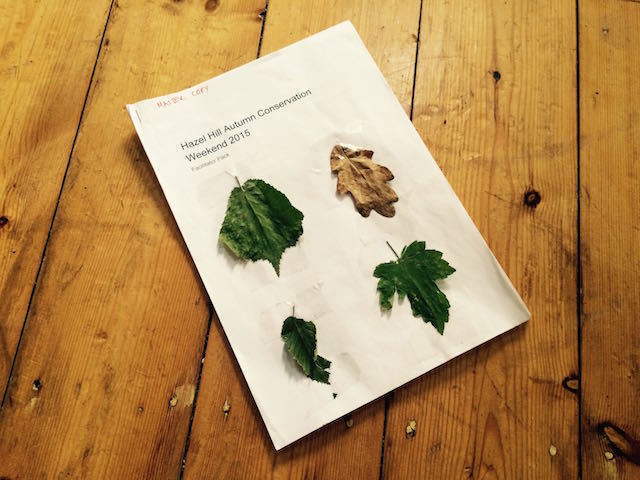
  • Notes from a systems design workshop at Hazel Hill

    On Saturday at the Hazel Hill Autumn Conservation weekend I ran a systems design workshop as a wet-weather activity. Here are my notes and observations from the session.

    Theatre of activity

    The wood, being a place that people travel to and the leave again, is the perfect place to get people thinking about inputs and outputs to systems. You can ask people to think about what they bring with them, what they take home and what they leave behind. You can also ask, is the system richer as a result. And, what happens to that richness?

    (more…)
  • Oliver’s Mantra for Facilitation

    The facilitator comes with nothing and leaves nothing

    The participant comes with something and leaves with much more

    Oliver Broadbent
    (more…)
  • Two facilitation lessons from Strictly

    Facilitation means making something easier. It isn’t about controlling; it’s about following, listening and enabling. In a workshop setting, it’s about having the confidence to let go of control and see what happens, and if things don’t go as expected, being confident to step back in and help everyone get back on track.

    Watching the Christmas Day Strictly Come Dancing highlights show I saw two pieces of facilitation gold, which are a lesson in what to do when things go wrong and how to put them right again.

    (more…)
  • Training with audio in the age of Zoom.

    Training with audio in the age of Zoom.

    In March 2020 we were all sent home and we discovered we could meet using video conferencing instead. Suddenly our wide-angled world was sliced to a quarter of its width. Our body language receptors had to cope with just head and shoulders rendered in a tiny square. And our brains had to work much harder to make sense of this reduced world view.

    Just because we have lost something doesn’t mean we have to replace it anew. Just because we can substitute IRL for Zoom doesn’t mean we always should.

    (more…)
  • #17 Tabitha Pope – Participatory Architecture – Show notes

    #17 Tabitha Pope – Participatory Architecture – Show notes

    Tabitha Pope is an architect and lecturer, with a specialism temporary structures and participatory architecture and a passion for work that sits at the boundary of art and architecture. In this episode, produced in support of International Women’s Day, my colleague Lucy Barber interview Tabitha about:

    • What is participatory design and what benefits does it offer us in the climate emergency.
    • Challenging power in order to make architecture a more inclusive space for all under-represented groups, not just women.
    • How her practice of carpentry allows her to intervene in the design process in a different way.
    • Establishing a nature connection to help designers and citizens alike tackle the biodiversity crisis.
    • Stepping into a space of vulnerability in design in order to do things differently.
    • Creating spaces for joy and encounter to tackle loneliness and build resilience in communities.

    Listen on Apple Podcasts , Sticher or by download here.

    (more…)
  • Choppin’, loppin’, circus and swing – notes from Hazel Hill Autumn Conservation weekend 2015

    Choppin’, loppin’, circus and swing – notes from Hazel Hill Autumn Conservation weekend 2015

    Last weekend 38 people came down to Hazel Hill for our annual Autumn Conservation weekend for two days of woodland conservation and human restoration. We design the weekend to be a mixture of invigorating outdoor conservation work and relaxation in the woods, with a dose of entertainment thrown in too.

    Building on what we learnt from last year, we began the conservation work on the Saturday with a series of activities that would make an immediate and visible difference in the woods. An on-going conservation priority at Hazel Hill is the creation of butterfly rides, which serve two purposes. The first is to create the sort of wide path through the woods that enable the many rare species of butterflies that inhabit the surrounding fields to pass freely through the foerst. The second is to allow light in to the lower levels of the wood in order to increase the biodiversity.

    Widened butterfly ride leading to the Forest Ark

    This year we began our work by significantly widening the ride that runs from the forest ark to the southern cross, which had become significantly encroached upon by regenerating hornbeam. In the process we uncovered and liberated around twenty-five broadleaf trees in tubes that had previously been planted and which were being smothered by the hornbeam. I remember planting some of these trees myself on my first conservation weekend six years ago, and so I am pleased to see them being rescued. Any of this weekend’s participants returning to this spot in the wood in ten years time are now much more likely to find ash, oak and hazel trees maturing, thanks largely to their work this weekend.

    (more…)