Restorative and regenerative are two words I am hearing used interchangeably. Both are relevant to engineering and design. Both are approaches to design that are valuable. But they need differentiating.
(more…)Tag: hierarchy
-
Making the Regenerative Design Lab a Regenerative System
In today’s planning session for the Regenerative Design Lab with my co-facilitator Ellie Osborne, we asked what if we made the lab itself a regenerative system?
Based on my working definition (see my previous post on the four characteristics of regenerative systems), a regenerative regenerative design lab would:
- Be able to renew its sources of material and energy;
- Thrive within wider ecosystem boundaries; and,
- Adapt to a changing operating environment.
-

Four characteristics of regenerative systems
Work on regenerative thinking progresses on all fronts. Book writing with my friend James on Monday (read his excellent blog on this process), developing regenerative practice at Hazel Hill Wood Tuesday and short-listing candidates for the Regenerative Design Lab Wednesday. I love that all of these initiatives inform each other.
To aid all three I have synthesised my understanding of how regenerative systems operate. This framing is informed in large-part by Donnella Meadows’s book ‘Thinking in Systems’, which is helping to understand the conversations are having across all these fronts.
(more…) -
Think resilience to observe and enhance a system’s restorative powers
I underlined these words in Meadows’s Thinking in Systems primer. ‘Thinking about resilience enables us to observe and enhance a system’s restorative powers.’ As with so much in this book it is an efficient sentence that carries so much meaning. This is my thinking-out-loud (not so efficiently written, but I find it helpful).
This quote that I have pulled out is at the end of a section of the book on the characteristics on well functioning systems. The three ingredients are resilience, self-organisation and hierarchy. Natural systems are very good at using these three ingredients to build ever more complex systems that can respond to a range of scenarios in a self-organising way.
(more…) -
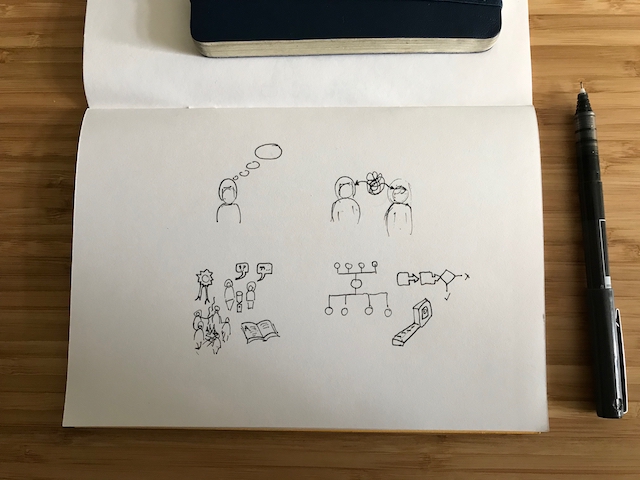
Building creative culture in engineering companies
I am starting to shift my attention away from creative tools for engineers. Tools are still important. But I’ve realised that you need a creative culture for individual creativity to thrive.
Recently, I rediscovered in Laloux’s ‘Reinventing Organisations‘ the Wilbur four-quadrant model. The model describes how culture, systems and worldviews interact. We can use this model to understand a phenomena in an organisations from four different perspectives:
- How the phenomenon can be measured from the outside
- How the phenomenon feels from the inside – intuiting how it feels
- How the phenomenon appears to the individual
- How the phenomenon appears to a group of people.
Like all engineer-friendly models, Wilbur’s is a two-by-two grid. The columns divide the grid into interior perspecitve and exterior perspective. The rows divide the grid into individual and collective perspective. According to Laloux
Wilbur’s insight, applied to organisations, means we should look at: 1) people’s mindsets and beliefs [individual interior perspective]; 2) people’s behaviour [indvidiual exterior perspective]; 3) organisational culture [collective interior perspective]; and, 4) organisational systems (structures, processes and practices) [collective exterior perspective]”
From Reinventing Organisations, Laloux (2016)Applying the four quadrant model to organisational creativity
I’ve assembled some quick thoughts on how the four quadrant model might apply to understanding creativity in an organisation. I have written the statements for a fictional, ideal case. This difference between this ideal case and reality can give us some suggestions for what we might need to do to build a more creative organisation.
(more…)