Tag: listening

  • Reflections on transformational innovation

    These are my reflective notes as I work through chapter two of Daniel Wahl’s ‘Designing Regenerative Cultures‘. My aim in this reading is to find clues as to what a set of principles for regenerative design for engineers could look like.

    Wahl introduces three types of innovation:

    • Sustaining innovation – that which keeps the current system working
    • Disruptive innovation – that which introduces new operating systems
    • Transformative innovation – that which is the ‘long-term innovation process of fundamental changes in culture and identity.

    He argues that if we want to achieve a transition towards a regenerative culture, it is this third kind of innovation that we need.

    (more…)
  • Daddy, how do I have interesting conversations with people?

    Dad heart melt moment. My daughter asked, “how do I have interesting conversations with people?”
    I said, well, a good place to start is finding out what people are interested in.
    Works for me.

  • Proust, constructivism and listening to clients

    This week I underlined this sentence from Proust’s Finding Time Again. 

    “Even at the moments when we are the most disinterested onlookers of nature, of society, of love, or art itself, since every impression comes in two parts, half of it contained within the object, and the other half, which we alone will understand, extending into us, we are quick to disregard this latter half, which ought to be the sole object of our attention, and take notice only of the first, which being external and therefore impossible to study in any depth, will not impose any strain on us: we find it too demanding a task to try to perceive the little furrow that the sight of a hawthorn or a church has made on us.”

    Proust, M. (1927). Le Temps Retrouvé (Finding Time Again) (C. Prendergast (ed.); Ian Patterson tranlation). Penguin Classics.

    This sentence comes in the middle of Proust’s revelation about what his work as a writer should be: to translate his inner world to the outside. He finds much greater richness in understanding the impression that the world makes on individuals than understanding the surface, objective qualities of what is being observed.

    Things I take away:

    (more…)
  • Asking someone instead of Googling

    Asking someone instead of Googling

    What if you couldn’t look stuff up online? This is a question I keep returning to. One answer is that other people might become a more important source of information. You’d need to pay more attention. You’d probably look forward to the opportunity to speak to them more. And you’d remember more about what they said.

    The premise makes me think of books set in a time before tv and radio (let alone internet) when the arrival of a new visitor in the house represented the chance to mine a new seam of experience. 

    (more…)
  • Building creative culture in engineering companies

    Building creative culture in engineering companies

    I am starting to shift my attention away from creative tools for engineers. Tools are still important. But I’ve realised that you need a creative culture for individual creativity to thrive.

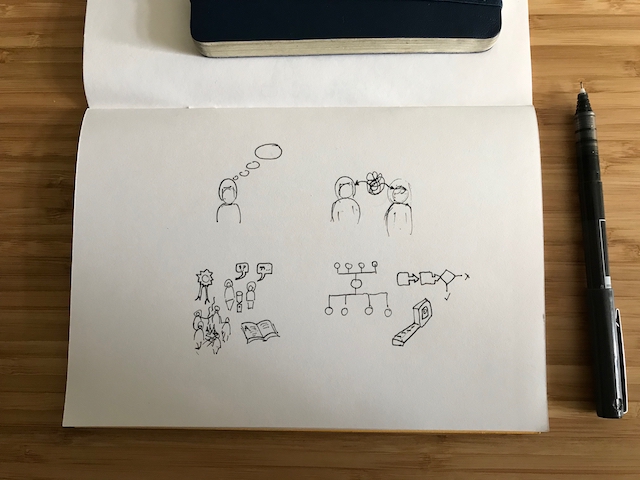
    Recently, I rediscovered in Laloux’s ‘Reinventing Organisations‘ the Wilbur four-quadrant model. The model describes how culture, systems and worldviews interact. We can use this model to understand a phenomena in an organisations from four different perspectives:

    • How the phenomenon can be measured from the outside
    • How the phenomenon feels from the inside – intuiting how it feels
    • How the phenomenon appears to the individual
    • How the phenomenon appears to a group of people.

    Like all engineer-friendly models, Wilbur’s is a two-by-two grid. The columns divide the grid into interior perspecitve and exterior perspective. The rows divide the grid into individual and collective perspective. According to Laloux

    Wilbur’s insight, applied to organisations, means we should look at: 1) people’s mindsets and beliefs [individual interior perspective]; 2) people’s behaviour [indvidiual exterior perspective]; 3) organisational culture [collective interior perspective]; and, 4) organisational systems (structures, processes and practices) [collective exterior perspective]”

    From Reinventing Organisations, Laloux (2016)

    Applying the four quadrant model to organisational creativity

    I’ve assembled some quick thoughts on how the four quadrant model might apply to understanding creativity in an organisation. I have written the statements for a fictional, ideal case. This difference between this ideal case and reality can give us some suggestions for what we might need to do to build a more creative organisation. 

    (more…)