France is well-known for its TGVs. But there is a place in my heart for the ‘trains classiques’, the older, long-distance trains that still trundle round the older lines of France’s rail network.
I like that they don’t go very fast. I don’t want to get there quickly today.
I like how the seats are like sofas; ideal for napping.
I like how they purr. There’s a deep whir that I feel in my stomach. I higher pitched whine that wibbles my nostrils. And when someone opens the end-of-carriage sliding doors, the loud waah that washes through the carriage, like an approaching TIE fighter.
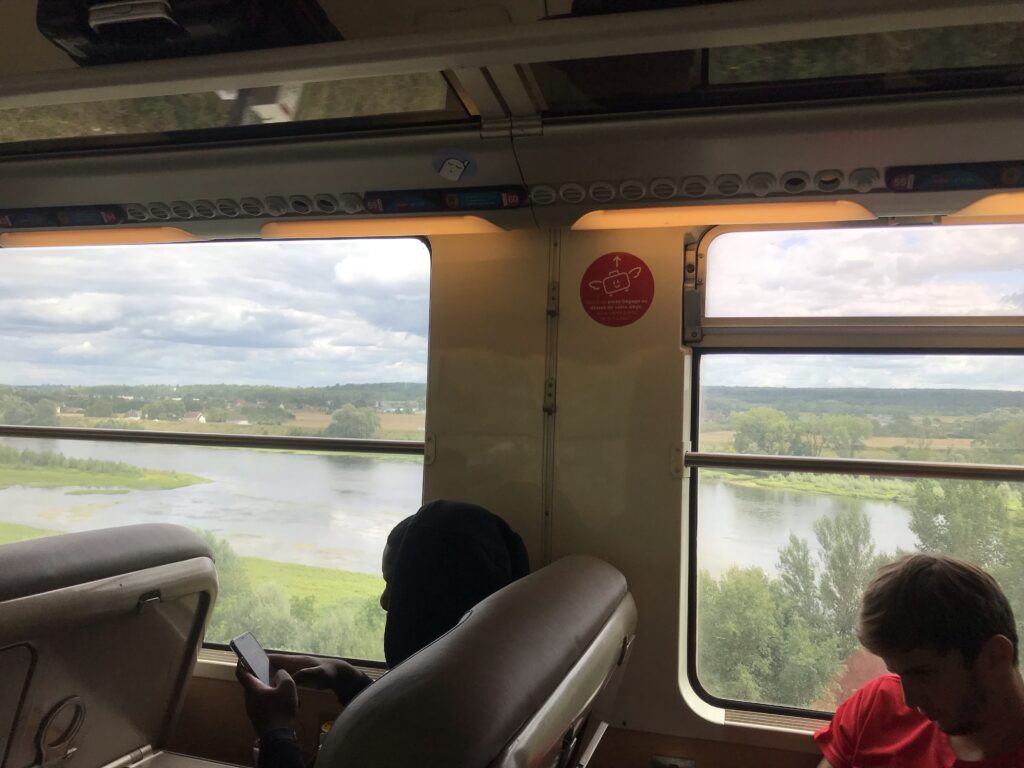
View of the Loire near Blois seen from the train windows
I like the big windows (the opposite of the miserable arrowslits you get on Cross Country train services in the UK).
I like all the unhurried journeys I’ve taken on these trains before, from one regional town to another. Often on holiday.
I like the system of regionally-subsidised train networks (that these trains usually run on), which help keep trains running to remote parts of France.
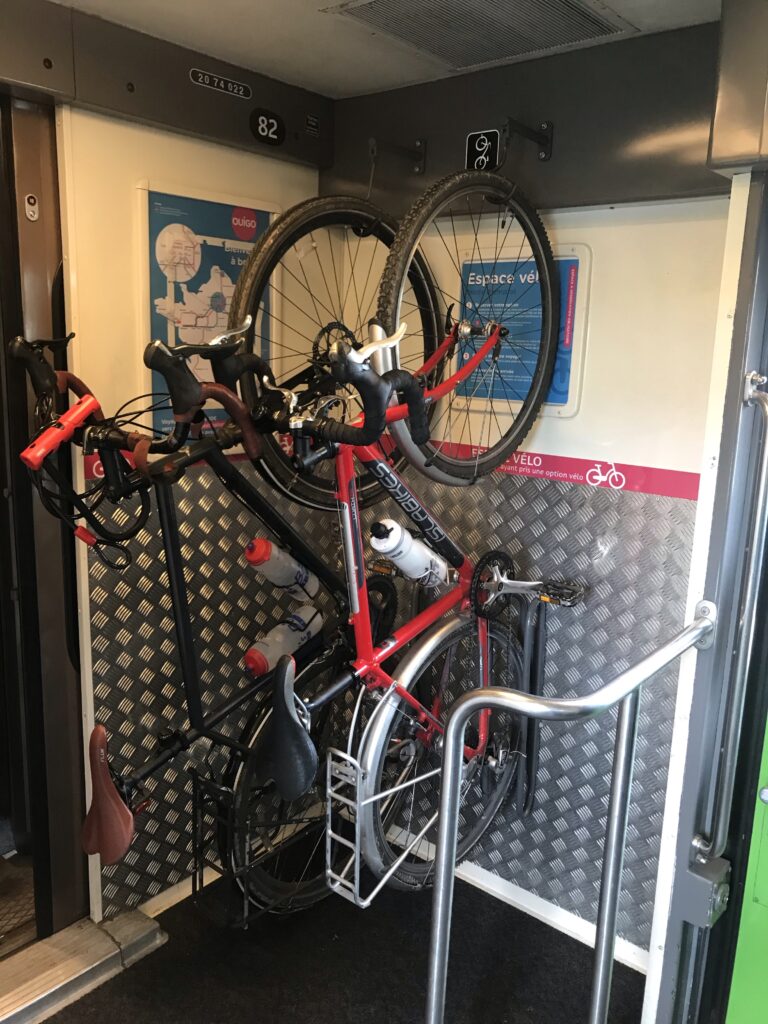
Photo showing cycle storage on Ouigo Trains Classiques – 2 bikes per carriage.
I like the ample bike storage space – two reservable spots per carriage.
I like how these routes are usually cheaper than the TGV.
And I like how these older trains ply a sort of parallel, older network, of places in between or far from the big TGV stations. It somehow feels like more of an adventure.
Want to ride on a train classique? Your best bet is to book a journey between destinations on the SNCF Intercités network – these are the trunk routes where TGVs don’t operate. Or, as we are doing today, travel on the Ouigo Trains Classiques network (these travel between Paris and Lyon and Paris and Nantes – both also served by TGV trains, but the Ouigos classique travel down the old slower routes.
Our summer tour continues. From Batz-sur-Mer we took a TER train to Nantes. No cycle reservation necessary. And then from Nantes, an Intercité train to La Rochelle. This is the only service on our whole tour for which we did need a cycle reservation. At this point in the Tour I am now preferring the idea of having to make a reservation because at least you are guaranteed a place. Of course what we need is much more provision on trains for bikes.
From La Rochelle station we cycled straight through the old town, out of town and over the magnificent Île de Ré viaduct to the island where we would be staying for six nights. The following are selected Eiffel Over highlights.
Île de Ré bridge
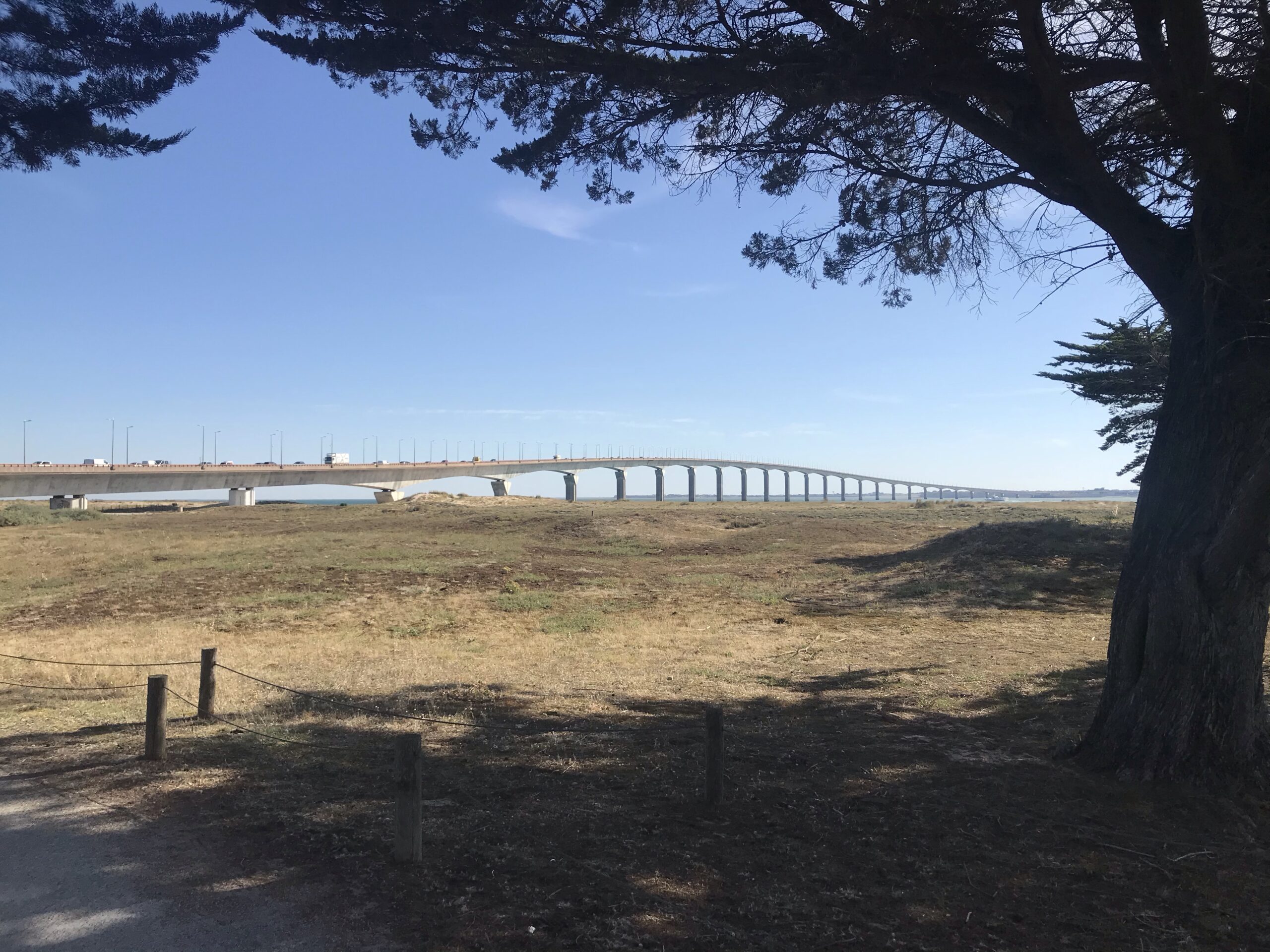
View from the island side of the Île de Ré viaduct
This is the 2.9km bridge linking the mainland to the Ile de Ré. Get all the facty stuff here from Wikipedia.
I find its curve on plan as well as on elevation very graceful.
There is a segregated cycle path which is a much better way to cross than to sit in a 2.9km jam with all the cars.
Very elegant columns too.
Impressive to see this structure marching out across the sea.
A significant portion of the tolls are spent on improving transport infrastructure on the island – see below.
Cycling on Île de Ré
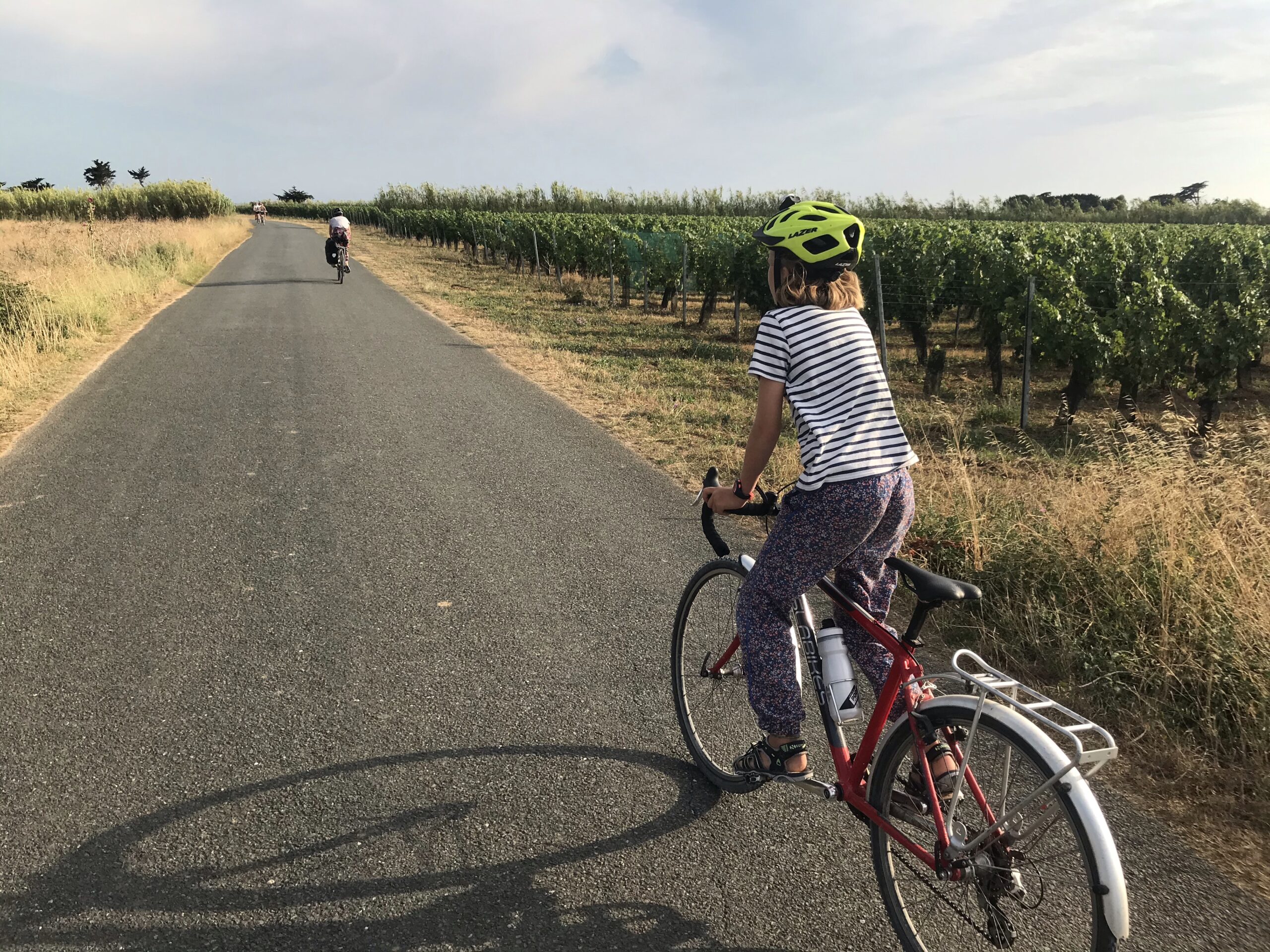
Cycling between vineyards on the Île de Ré
The local authority has invested heavily in promoting cycling on the island to the extent that it is a victim of it’s own success. There is a very comprehensive network of cycle lanes crossing the island. And these are very crowded in places because they are so popular. It is as if the island could do with doubling again the cycle infrastructure.
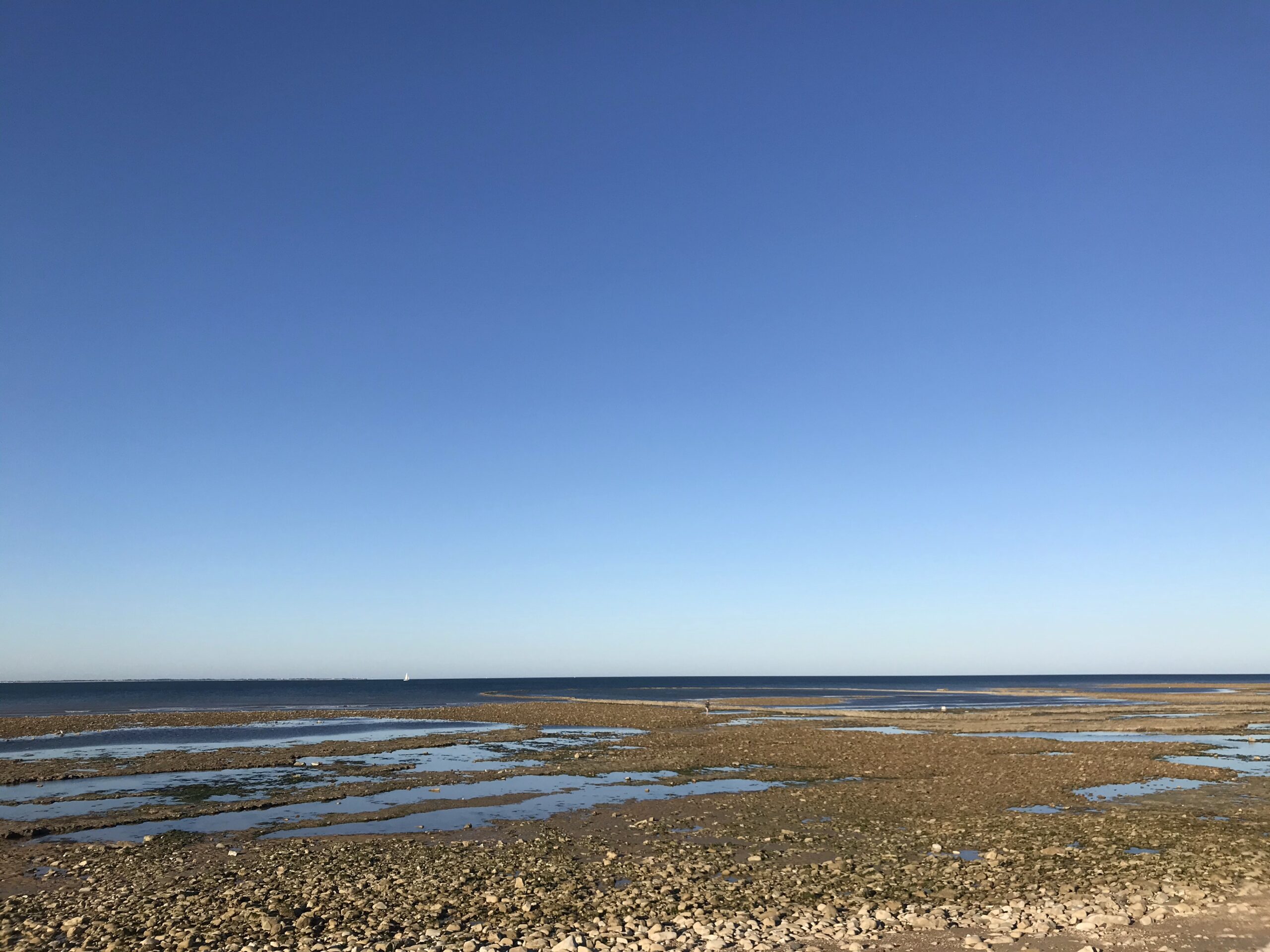
Stone fishing ‘écluses’
The dry stone wall of an écluse can just be seen arcing out to sea in the top left of this picture from the Île de Ré.
For centuries it has been traditional to build tidal lagoons on the beaches that fill with water at high tide and then which slowly drain at low tide, enabling local fishers to scoop up the fish left behind. The lagoons are created by building a large circular dry-stone wall on the tidal flat. Local laws forbid the use of concrete – these walls are carefully built by hand and maintained to create this once important source of food. Their French name is ‘écluses’, the same word for a lock on a canal.
In the eighteenth century local officials destroyed the écluses to stop this source of food and forcing local men to sign up to join the navy.
More unbelievably, in the second half of the twentieth century, the commercial fishing industry lobbied to have them destroyed again so that they wouldn’t eat in to potential markets for commercial fishing.
In recent years there has been an effort to repair some of the écluses. We saw some people fishing in the one shown above at low tide.
Like the salt flats they are an example of infrastructure managed in common to create an honourable harvest – to use Robin Wall Kimmerer’s term – from the local ecosystem.
Final thoughts on the Île de Ré
The Île de Ré is a fascinating place but the early August heat was almost unbearable and the summer crowds relentless – although in the further reaches of the island where M explored there were places where no one was to be seen. There is lots to find out about how people have lived in this island. And not just humans. For instance, two thirds of European bird species have been spotted here, it being a major stopping off point for migration. The sea life is also fascinating to explore at low tide.
The visit makes me want to visit more wild islands. Maybe ones that are not connected by bridge to the mainland.
After six days we were ready to cycle back over the bridge and head on south.
The highlight of our visit to Nantes was standing next to the Great Elephant as it set off for one its walks around the former dock yards. The 45-tonne steel and wood sculpture is part of the Machines de L’Île creations. At the centre is the workshop where engineer-artists create mechanical creatures that replicate real animal movements. The concept is that the creatures escape from the workshop to create the exhibits around the dockyard site.
I find the whole place a wonderful combination of humour, heart, engineering, spectacle and wonder and reverence for creatures big and small. Definitely worth a 3 star engineering detour.
The last leg of our journey along the Loire à Vélo cycle route, à 35km flat run into Nantes. It was misty as we covered the early morning ground, keen to get to Nantes with enough time to wander around the Machines de l’Île. After breakfast in uninspiring Mauves sur Loire, the feel of the cycle path changes: it is more like we are cycling through a city park. We are in the outskirts of Nantes.
We arrive at Nantes train station, which has a new terminal built high across the tracks with tree shaped columns beneath that splay out into oak-tree like branches within the concourse to provide shade for the travellers.
Reflections on Orléans to Nantes via the Loire à Vélo
We were using the cycle route more as a means of getting from Paris to the Atlantic coast rather than planning a dedicated trip to do the Loire à vélo route – and while I thought it would be fun I enjoyed it even more than I expected.
The Loire is much wilder than say the Rhone or the Garonne. It is not used as a major inland shipping route and so feels less industrialised. The water is able to follow a more natural course as reflected in the various channels that weave their way through the landscape, and the sand banks that are a haven for birds.
That said there are levées to cycle along, albeit set back so that the flow is less interrupted, and these are great to cycle along.
My favourite sections were when the levee road is quiet, and we are able to get some speed up while watching the river landscape change in the channel below.
My least favourite where the river approaches a city. Tours in particular seemed to have turned its back on its rivers.
There is a great atmosphere on the path. You meet cyclists going the length of the Loire à vélo path, and some beyond towards Basel and towards the Black Sea.
The riverside guinguettes were great to stumble across and make the most of to eat at en route or chill out at in the evening.
I wouldn’t bother visiting the out-of-town chateaux. They represent an accumulation of wealth extracted from the local landscape and local people that is somehow not reconciled, not addressed. Just a place to drive to. The middle of town chateaux of Blois and Amboise are a bit more connected to the towns, are more interesting and don’t require a detour.
The route is well signposted, there’s lots of campsites en route. The highlights were the Slow Village in Pont de Cé, and wild camping under the stars.
Onward journey
We are now leaving the Loire à vélo cycle path and making a little detour out to Batz sur Mer in Brittany before heading south by train towards the Ile de Ré, cycling to Arcachon, train to Biarritz, then making our way by some means or another to Santander in Northern Spain.