Whenever I enter a period of calm, a quietening, I instinctively want to turn to reflective writing. Writing like this. It feels like I am speaking to an old friend. But the friend is inside. When I look back to my last blog post I realise that we haven’t spoken since March this year – it’s now July. There is so much to catch up on.
(more…)Tag: Proust
-
Design bridges our internal and external worlds
Last night I had the pleasure of attending the Sir Misha Black Awards, which celebrate excellence in design teaching. And even more so, the pleasure of hearing last years award winner Judah Armani give his presentation one year after he won the award.
One phrase that Judah said stuck with me.
“Design communicates between our inner world and our outer world.”
(more…) -
Using ChatGPT to generate ideas
In this post I share some initial thoughts on how using ChatGPT to generate ideas changes creative thinking for engineers, and other humans.
My simple model for idea generation is that an idea is simply a new connection between existing elements in the mind. It’s a practicable model giving us two things to think about in creativity. The first is what information do I have in mind when I am having my idea. The second is how do I form connections between these bits of information to create something new – to create an idea.
As James Webb Young describes in ‘A Technique for Having Ideas‘, the process is akin to using a kaleidoscope. The elements of information are the bits of glass at the end. Multiple shapes, colours and sizes. Turning the kaleidoscope causes the elements to rearrange. The new patterns we make are ideas.
I call a kaleidoscope for having ideas a kalideascope. The process of building, filling and turning the kalideascope is a metaphor for designing an idea generation process.
Using a kalideascope for generating ideas
The first thing I get people in my training to think about when having ideas is what information they are putting into the process. I call this ‘filling the kalideascope’. There are two kinds of information we put into the kalideacope. The first I refer to as ‘information in the moment‘. It includes information from a design brief, from site, from stakeholders, from colleagues and from precedent projects.
The second kind of information we put into the kalideascope we can think of as information gathered over time. In other words from experience. From experience of living in the world, seeing it and thinking about it. Experience includes things we have done professionally. I also emphasise all the experiences we have had outside of work. The things that are unique to us.
The second part of the process is the forming of new connections. This is looking at things in new ways. Acting it out, asking what if and using your professional palette are three of my favourite techniques to teach.
These two processes – filling and turning the kalideacope – provide a simple framework for thinking about our idea generation process.
How does using ChatGPT to generate ideas change things?
None of this creative process I described above needs a computer. But of course we have been using computers to enhance our creative process for decades. The internet gives us access to endless new information. And through our interactions online we can find a similarly endless stream of prompts to help us form new connections.
So how does using ChatGPT to generate ideas change things? Here are my initial thoughts.
Availability versus accessibility of information
When you forget someone’s name and it suddenly pops into your mind, that information suddenly becomes accessible. It was always there. Someone didn’t whisper it in your ear. The name was tucked away somewhere in your brain. In other words, the name was available. But something changed in that moment and all of a sudden it became accessible.
ChatGPT uses the text-based content of the internet as its source of information. Via search, this information has always been accessible to us, but if we don’t know where to look, it is not available. ChatGPT has vastly increased the amount of accessible data. This does not mean that all information is available to us. But information on topics commonly published online is now much more accessible.
This means that whole new data sets can be brought into the creative process. It is as if the number of pieces in our kalideacope suddenly become many orders of magnitude bigger.
The potential for new patterns has vastly increased.
New connections
Gathering information is one part of the idea generation process. The other is forming new connections or associations. Humans are pattern-spotting animals, with a prefrontal cortexes especially evolved for the task. But just because we can spot patterns and have new ideas, doesn’t mean we can do it all the time.
Lots of my creativity training focuses on what to do when you have had one idea and can’t think of another. Various cognitive biases mean that we tend to prefer thinking about the ideas we have already had rather than think of new ones. My ‘ask what if’ technique is explicitly intended to overcome this creative tiredness.
But ChatGPT never gets tired. You can keep asking it generate new possibilities in response to a question.
Introducing the kalAIdeascope
I think we need to rethink the kalideacope for the AI century.
I am calling an AI-powered kaleidoscope for having ideas a kalAIdeascope. The process of building, filling and turning the kalAIdeascope is a metaphor for using artificial intelligence to help us generate ideas. This tool is available to currently available to everyone who has a decent internet connection. We have lots to learn about how to use it.
The process of building, filling and turning the kalAIdeascope is a metaphor for using artificial intelligence to help us generate ideas.
Some final thoughts
Judgement – None of the above says anything about how decide if an idea is any good. And that is how I teach creative thinking. Start with ’no’ turned off, and generate ideas. Then test the ideas for how well they work. How AI can support in the testing is a topic for another post.
Spotify effect – I think my relationship to music degraded when I got Spotify. Suddenly the availability of most of the world’s recorded music on my phone at any time numbed my curiosity. What will be the impact of the accessibility of so much more information and ideas?
What would Proust say? (see my previous writing on Proust) – his view was that the role of the artist is to express their inner world to the outside world. If more of our ideas are ‘externally’ generated, then I find myself even more drawn to what is going on in people’s inner worlds.
Finally, my thanks for Mary Stevens and Nick Francis for the many conversations over recent months on this topic that have prompted this post.
-
Nothing to say but lots to show
I have nothing to say but lots to show you – Walter Benjamin. I heard this quote this morning on In Our Time and it really struck me.
For me it says you don’t have to have the answers in order to bear witness.
There is so much that I see in the world that makes me smile. Things that when I see them make me despair.
I can’t necessarily find the exact narrative to rationalise these sensations. But that shouldn’t stop me from sharing them. Because when I do, I am creating the pieces from which a pattern can form.
(more…) -
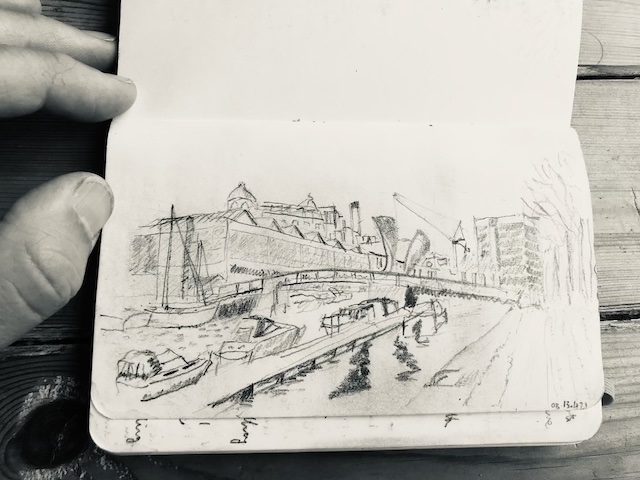
Analogue Skill 009: Sketch what you see
Take out a piece of paper and draw a sketch of what you can see. You will notice more than you ever would by taking a photograph.
Sketching could easily fall into two categories in my collection of analogue skills: Remembering Things and Spending Time Alone.
(more…) -
Why I write (this blog)
When I teach I realise I am drawing on ideas that I have gathered and processed over many years, but little of which exists outside my head. If I compare a mental list of the main concepts and ideas that have preoccupied my thinking for the last few years, I find it bears little correlation with what I have written over that period.
(more…) -
Too many inputs
All this week I have been writing about organising inputs to the creative process, but at the end of the week I’m feeling overwhelmed from too many inputs. I need to switch off and reflect, but before I do here are the themes that are swirling round my head. I capture them so that they might be useful for another time.
(more…) -
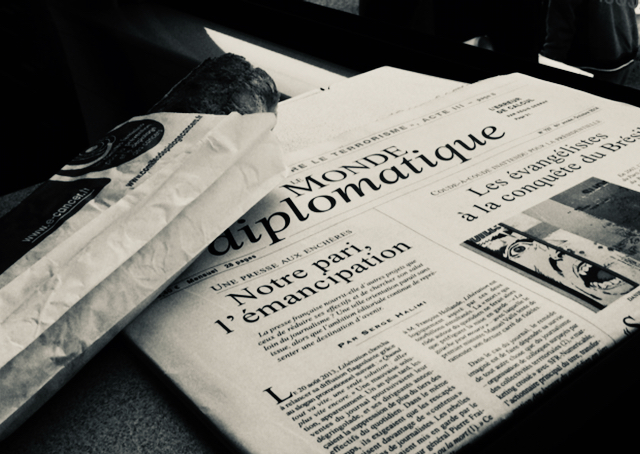
Proust’s antidote to endless scrolling
(more…)The fault I find in our journalism is it forces us to engage with some fresh triviality every day whereas only three or four books give us anything that is of any importance.
Charles Swann, in Swann’s Way, In Search of Lost Time Vol.1 -
Reading Proust – volume 5 update
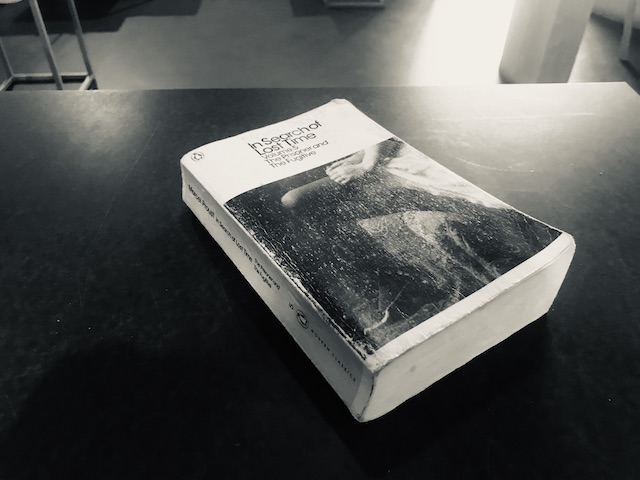
It wasn’t what I was expecting but volume 5 of Proust’s In Search of Lost Time ends on a cliff-hanger. It is incredible how such separate threads from five previous volumes are starting to brought together: a narrative arc that I could never see converging has in fact been much closer to convergence than I expected.
I’ve been reading In Search of Lost Time – Proust’s epic explorationg of memory, art, adolescence and decisre – on and off since 2007. It is one of those books that lots of people have heard of, some know two things about it (the long sentances and the flood of memories provoked by dipping a madeliene cake in his tea) but I’ve hardly found anyone who has actually read it. So in 2007 I decided to give it a go (in English!).
(more…) -
Transformative infrastructure goes both ways
Marseille
In my previous post I was talking about the experience of distance, and how, when understood as an experience, distance is no longer a fixed entity.
That post was triggered by some lines from Proust in which the narrator is talking about how his perception of local distances alters when he switches from rail transport to motorcar. Some further thoughts on this topic.
I recall how the distances between various destinations, and therefore the shape of the city itself, appeared to change when the London Overground, an orbital railway in the inner suburbs, opened. All of a sudden areas of the city that seemed far away felt much closer: South-East London, previously impossibly far, was now a nearby neighbourhood to where I lived in the North-East.
Such a step-change in the experience of city living demonstrates the transformative power of civil engineering infrastructure. Linking, drawing together, connecting – this is what engineers have been doing for centuries.
(more…) -
The experience of distance
Marseille
A morning walk up the steep hill to the Basilica of Notre Dame de la Gard granted me panoramic views of the city of Marseille and the sea. I love the peaceful hum that can be extracted from high up of a limbering up for a day of activity.I underlined these words yesterday in ‘In Search of Lost Time’. The narrator is talking about how his perception of distance was changed when, instead of travelling by rail, he starts to go by car.
(more…)‘We express the difficulty we have in getting to a place in a system of leagues and kilometres, which becomes false the moment that difficulty decreases. The art of distance, too, is modified, since a village that had seemed to be in a different world from some other village, becomes its neighbour in a landscape whose dimensions have altered.’
Proust, M. (1921). In Search of Lost Time, Vol 4. Sodom and Gomorrah. (C. Prendergast, Ed.) (Penguin Cl). Penguin Books. -
The perils of false modesty
I just read this great paragraph on the debilitating impact of false modesty on judgement.
(more…)