Tag: stations

  • Signs of bad design

    Signs of bad design

    Warning signs interest me. In some instances warning signs are necessary and appropriate, but in my experience they are often the mitigation measure of last resort for an issue that probably could have been solved by a different conceptual design.

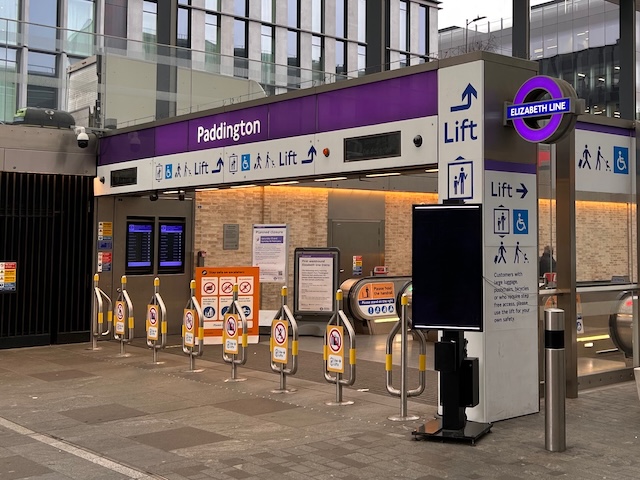
    Take this example, one of the entrances to the Elizabeth Line at Paddington Station, London.

    In this image I count six different classes of sign directing people to the lifts with their luggage. And, what’s more, in addition to all the signs you can see, there is an additional innovation. The black TV screen is connected to a camera that scans for passengers who are towing suitcases towards the escalators. Guilty parties spotted, it displays an image of their suitcase along with an arrow pointing to the lift.

    In addition to the signs there are physical barriers to suitcases, which must not be working otherwise the signs would not be necessary.

    As I recall, when the station opened, there were no barriers and hardly any signs. All of these measures are therefore an attempt to solve a problem that has emerged since the station has opened.

    Clearly the station managers are dealing with a real, operational safety challenge. And with limited options for re-design of the physical infrastructure, they are using the levers available to them: signs, barriers and sophisticated surveillance. This isn’t a criticism of station managers – rather a provocation for conceptual designers in the built environment:

    How often do we use signs and barriers to fix problems that better design could prevent?

  • Champtoceaux to Nantes – reflections on Loire à vélo

    Champtoceaux to Nantes – reflections on Loire à vélo

    The last leg of our journey along the Loire à Vélo cycle route, à 35km flat run into Nantes. It was misty as we covered the early morning ground, keen to get to Nantes with enough time to wander around the Machines de l’Île. After breakfast in uninspiring Mauves sur Loire, the feel of the cycle path changes: it is more like we are cycling through a city park. We are in the outskirts of Nantes.

    We arrive at Nantes train station, which has a new terminal built high across the tracks with tree shaped columns beneath that splay out into oak-tree like branches within the concourse to provide shade for the travellers.

    Reflections on Orléans to Nantes via the Loire à Vélo

    We were using the cycle route more as a means of getting from Paris to the Atlantic coast rather than planning a dedicated trip to do the Loire à vélo route – and while I thought it would be fun I enjoyed it even more than I expected.

    • The Loire is much wilder than say the Rhone or the Garonne. It is not used as a major inland shipping route and so feels less industrialised. The water is able to follow a more natural course as reflected in the various channels that weave their way through the landscape, and the sand banks that are a haven for birds.
    • That said there are levées to cycle along, albeit set back so that the flow is less interrupted, and these are great to cycle along.
    • My favourite sections were when the levee road is quiet, and we are able to get some speed up while watching the river landscape change in the channel below.
    • My least favourite where the river approaches a city. Tours in particular seemed to have turned its back on its rivers.
    • There is a great atmosphere on the path. You meet cyclists going the length of the Loire à vélo path, and some beyond towards Basel and towards the Black Sea.
    • The riverside guinguettes were great to stumble across and make the most of to eat at en route or chill out at in the evening.
    • I wouldn’t bother visiting the out-of-town chateaux. They represent an accumulation of wealth extracted from the local landscape and local people that is somehow not reconciled, not addressed. Just a place to drive to. The middle of town chateaux of Blois and Amboise are a bit more connected to the towns, are more interesting and don’t require a detour.
    • The route is well signposted, there’s lots of campsites en route. The highlights were the Slow Village in Pont de Cé, and wild camping under the stars.

    Onward journey

    We are now leaving the Loire à vélo cycle path and making a little detour out to Batz sur Mer in Brittany before heading south by train towards the Ile de Ré, cycling to Arcachon, train to Biarritz, then making our way by some means or another to Santander in Northern Spain.

  • Analogue Skill 001: Buy tickets at the station

    Analogue Skill 001: Buy tickets at the station

    Go to the station. Stand in the queue. Look at all the people and wonder where they are going. See leaflets in the rack for places you hadn’t thought of going before. Look up at the station architecture, notice how drab it is, notice where someone has made an effort.

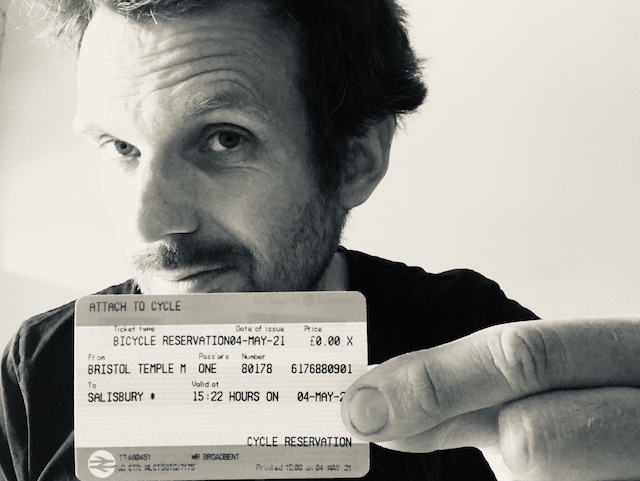
    Talk to the person at the window. Smile at them. You might be the first person to do this today. Engage in life-affirming transaction. You want to buy a ticket and they want to help. Ask an expert. What’s the best route? What’s the best time to travel? Find out if there is a different way. Find out if there really aren’t any spaces available for your bike (or was the computer lying?).

    Leave, ticket in hand, a malleable scrap of evidence that you are going somewhere and you didn’t just imagine it. A ticket that won’t run out of power.

  • Preparing the colours for your Professional Palette

    Preparing the colours for your Professional Palette

    There are some inputs to our creative process that we build up over time so that we are ready to draw on them whenever we work on a new project. In this next post in my series on creative thinking tools for projects, I will share with you another source of inputs for the Kalideacope. I call it the ‘preparing the colours for your Professional Palette. These are the set of colours from which you paint your ideas. The image this phrase conjures up for me is of the Impressionist painter spending time in their workshop in Paris getting their paints ready before they get on a train from the Gare St. Lazare, head out into the Normandy countryside and paint a landscape. You have to do the prep in the workshop before you can go out and paint. But how does this apply to us?

    (more…)
  • Surface travel – Münster to London

    Surface travel – Münster to London

    Overview

    • Six trains and one monorail
    • Leisure
    • 709km
    • £130

    Today I take my journey home from Münster to London via a different route from my way out. Outbound I came by ferry because it was cheaper; travelling back midweek I can just about afford the Eurostar. The route gives me the chance for a quick stop in Köln and the chance for an engineering detour via the Wupertaal suspended monorail.

    Münster to Wuppertal

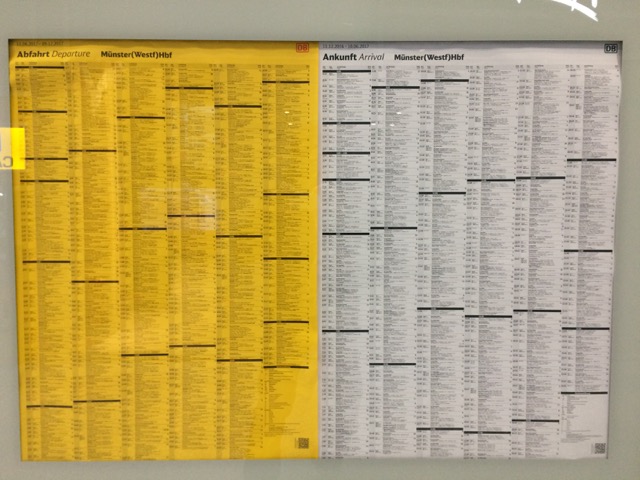
    Münster is a beautiful town. I’ve spent the last few days staying with a friend and working on my book in the city library. The cities walls were removed to create a circumferential boulevard that is now tree-lined and a major thoroughfare for bikes and pedestrians. I walk this path one last time and peel off at the Hauptbahnhof.

    I ride for twenty minutes on a quiet commuter train to Hamm. The flat landscape is filled with a mixture of fields and factories, with the occasional wind turbine. It reminds me of travelling up the Lea Valley north of London.
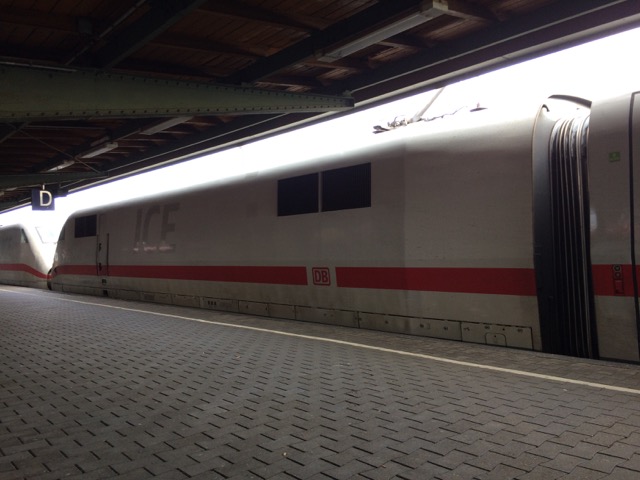
    Hamm station feels in the middle of nowhere but its ten unloved platforms are busy with trains of all sorts coming and going. I get to my platform early and see one of the slightly older German high speed ICE trains arriving. Its bright white carriages are like hermetically sealed capsules. You can imagine this train is capable of zooming along the sea bed as easily as over land.

    The ICE train is in fact two hitched together. I watch as the two are uncoupled and the front half pulls away. Just in time, I realise the back half is my train to Wuppertal, and I jump aboard. The land becomes more rutted and we follow an industrial valley that is well scored into the valley – it resembles  the valley of the Seine as it winds its way north from Paris to Rouen in Normandy.

    My connection time in Wuppertal is three-and-a-half hours; that was deliberate to give me time to make an engineering pilgrimage to a highly unusual railway, the Schweibebahn, Wuppertal’s suspended monorail. More details of that in a separate post.

    Wuppertal to Köln
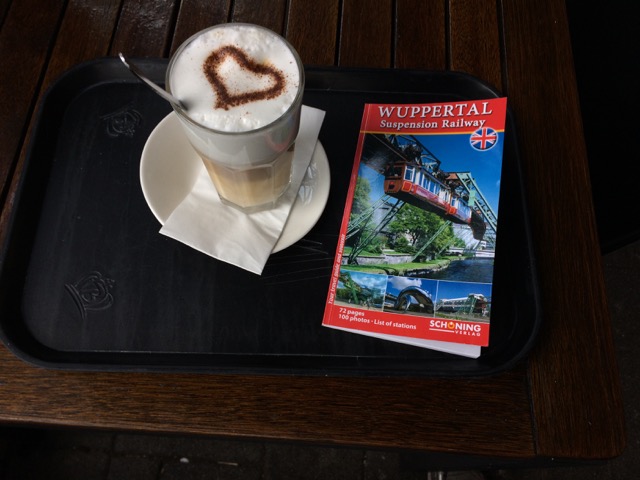
    I’m blown away by the monorail – a great piece of railway engineering integrated into the city. With hindsight, three-and-a-half hours was a bit too long for my engineering excursion and I struggle to find the inspiration to explore the town further. It’s nothing against Wuppertal: I’m just keen to get on. I wait impatiently at the platform for my next train.
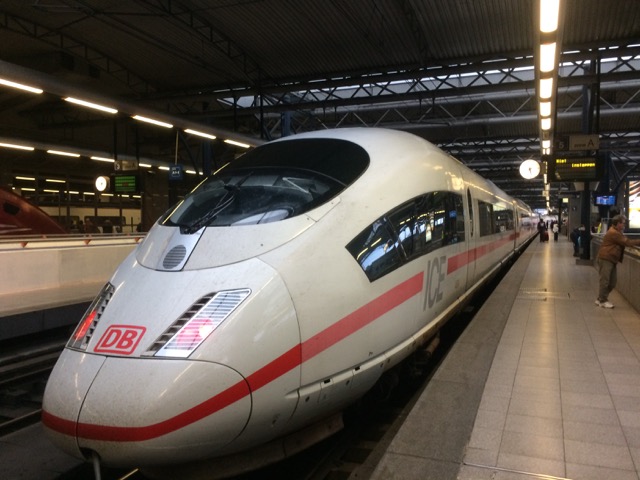
    If the last ICE train I took looked like it could be amphibious, this train, a next generation edition, looks ready for space flight, with it’s pointed nose and sleek black-and-white lines. It’s a short twenty-minute ride to Köln and before I know it we are rumbling across the bridge over the Rhine. Köln Hauptbhahnhoff is covered by a wide arching roof; beneath, trains come and go from across Germany – and I see my first French train, the Thalys service to Paris.

    I have fifty minutes between trains so I visit the magnificent cathedral which is surprisingly right next door to the station – almost on top of it. It’s quiet pews are better than any waiting room I can think of.

    Köln to Bruxelles Midi

    I get on board another of the sleek new DB ICE trains and settle in. I don’t remember much about this 2-hour leg as I slept most of the way. The day before long journeys I rarely sleep well as I worry about missing my train, and last night’s wakefulness just caught up with me. As we slow down on the approach into Brussels I see some fairly grotty looking commuter trains and I realise these are the oldest trains I have seen since I left the UK. All the trains I’ve taken over the last few days in Germany or the Netherlands, whether high speed or slower, were well looked after. I am reminded why I don’t ever get that excited about train travel through Belgium. I may however just be prejudiced against Belgian railways because they were responsible for putting the DB night train to Berlin out of business when they put up the transit fees they charge other countries for their overnight services.

    Bruxelles Midi to London

    Bruxelles Midi is an endless warren of tunnels where the light at the end never seems that appealing. I have an hour and a half before I can check in; I bought tickets for a later train because it would save me £50. The beer in the cafe is half the price of the tea, which is a shame as I’ve just decided to give up alcohol for a few days.

    The journey flies by; before I know it I am back in St Pancras. As I walk down the long platforms I am struck that in all the stations that I have been through on either my outbound or my return journey in the UK, the Netherlands, Germany, Belgium and France nothing quite compares to the experience of arriving under the magnificent Midland Blue-coloured soaring arch of St Pancras station. A fantastic piece of engineering lovingly re-invented for a different century.