Tag: surface travel

  • Caen to Santander

    Caen to Santander

    Today we begin our summer #surfacetravel continental adventure: from Caen in Normandy to Santander in Northern Spain. We are travelling via mixture of bicycle and train.

    The adventure began yesterday with putting our bicycles on the ferry at Portsmouth. As a cycle passenger on a ferry you exist in this weird no persons land between foot passenger and car driver. The cycle route from Portsmouth harbour to the ferry port it’s actually very well signposted. But when you get to the ferry port it is unclear what you are supposed to do. Once we realised though that you’re supposed to line up with the cars, it’s pretty straightforward. And cycling across the open expenses of the ferry terminal and up to the boat feels quite rebellious.

    As a regular readers of this blog will know, I love a ferry ride. Ferries are like floating buildings. A funny mixture of shopping centre, hotel and seagoing vessel. I also love a cafeteria. All of this made for a very enjoyable six hour crossing. I particularly enjoyed trying some handstands in the deck with S.

    Riding with Brittany ferries feels like I’m having a little piece of France pick you up from the UK coast. A two course lunch menu followed by a stiff coffee. The Tour de France on the TV.

    Speaking of which, I was blown away watching the race leader stop to allow his rival to catch up after having fallen on the slopes in the Pyrenees. So often the historical stories of men racing in the tour are about macho rivalries. this feels much more sporting, much more human.

    Looking forward to beginning our own Tour de France.

  • Humbelievable

    Humbelievable

    Last Friday I took the train from York to Hull. Onboard I was speaking on the phone to Will Arnold about our Net Zero Structural Design Course. As we rounded a bend this epic site swung into view and I stunned into silence. Spread out before me, skimming the water like a second horizon, the Humber Bridge.

    This bridge seems improbably long. How can it be that the vertical load at midspan is supported by those towers when they are so far away? There must be some antigravity involved.

    When it opened it was the longest single span bridge in the world, at 1.6km between the towers. Of the other facts I read on the bridge’s Wikipedia page, my favourite is that the towers are 36mm further apart at the top than at the bottom due to the curvature of the earth. I’d like to think I managed to capture that aspect in my rapid-fire photo from the train window.


    Humber Bridge from Railway Line by Oliver Broadbent is licensed under a Creative Commons Attribution 4.0 International License.

  • Where is the bus station?

    Where is the bus station?

    Seen at Turnpike Lane station.

    Both left and right lead to the buses, but why is right prioritised?

    Was there once a member of staff who got so tired of saying where the buses are that they wanted to shout the answer?

    Did someone at the train company say to the sign writer, give me the largest font you have?

    What happens if you try to catch a bus by going left?


    Bus Station at Turnpike Lane by Oliver Broadbent is licensed under a Creative Commons Attribution 4.0 International License.

  • Travelling by high-speed glacier

    Travelling by high-speed glacier

    On a recent trip to the Alps I took Robert MacFarlane‘s breathtaking ‘Mountains of the Mind‘. In it I found this delightful tale about Mark Twain taking his family up on to a glacier in the Alps – a fashionable thing to do in the mid-nineteenth century. In short:

    (more…)
  • Hello Planet Earth (goodbye Planet Money)

    Sunday morning we cycled through Bristol and up to Leigh Woods. We took the ‘high route’, choosing to climb up through the wealthy streets Clifton. Everywhere oozes money and wealth. The cavernous houses, gleaming cars, manicured front gardens and then the tiny shops of Clifton Village. Humans and their worldly possessions are all I can see.

    And then, all of a sudden, release. The ground gives way and we are soaring high over the Avon Gorge. As the Clifton Suspension Bridge leaps from one cliff to the other, I feel like I am looking at a giant fracture in the Earth’s crust, looking back in time through rock layers laid down millions of years ago. The scale changes. Humans are tiny again, a tiny feature of the surface. Nature and all the evidence of all its forces spread out before me.

    I yell ‘hello planet earth, and good bye planet money’, and we are off towards the woods.

  • What the fuel crisis reveals about the government’s approach to climate breakdown

    I’m sharing today my notes on the fuel crisis and what it reveals about how the government is acting in the wider context of climate breakdown.

    Defending fossil fuels

    Fossil fuels are a dying out. One way or another, their use will dwindle. But for now at least the government is prepared to ensure their supply by using the army to distribute supplies. What is so striking is the use of the armed services to prop up the dying system rather than directing these resources towards tackling the far larger crisis: how to massively reduce our dependence on fossil fuels in the first place. It is a sign of how committed the government is to the status quo rather than to find a path away from the bigger problem.

    In a related tactic, the government is willing to bend the rules to fast-track HGV licenses and visas for drivers, but we don’t see it acting to legislate to promote the rapid development of solutions that will reduce our dependence on fossil fuels.

    (more…)
  • Potential energy navigation  – or not pedalling downhill

    Potential energy navigation – or not pedalling downhill

    How driving an e-car has changed the way I think about driving, cycling and our relationship to the landscape through which we travel.

    I have recently started driving an electric vehicle from a car club. I have always understood one of the benefits of electric vehicles being that when you slow down you can convert some of your kinetic energy back into potential energy. In practice you can see this happening when you drive. Motoring along a flat or uphill road, the dashboard display shows a steady flow of current from the battery to the motor. And when you crest a hill and take your foot off the accelerator, the display shows the current flowing the other way. 

    But this engine-braking effect only gives you a slow rate of deceleration. If you need to slow down more quickly then you need to use the old-fashioned breaks, converting that kinetic energy to heat – which is lost. 

    (more…)
  • Analogue Skill 002: Remember some phone numbers

    Analogue Skill 002: Remember some phone numbers

    Your loved ones. Your best friends. Your colleagues. Could you call them if you needed to? 

    This skill is an enabler for leaving the house with your phone. If you need to call home you can use a phone box but only if you know what number to dial. 

    Remembering phone numbers just takes practice. Find the rhythm. Find the pattern. Set them to song, if it helps. Practise recall by dialing the numbers rather than using the saved number.

    (more…)
  • Analogue Skill 001: Buy tickets at the station

    Analogue Skill 001: Buy tickets at the station

    Go to the station. Stand in the queue. Look at all the people and wonder where they are going. See leaflets in the rack for places you hadn’t thought of going before. Look up at the station architecture, notice how drab it is, notice where someone has made an effort.

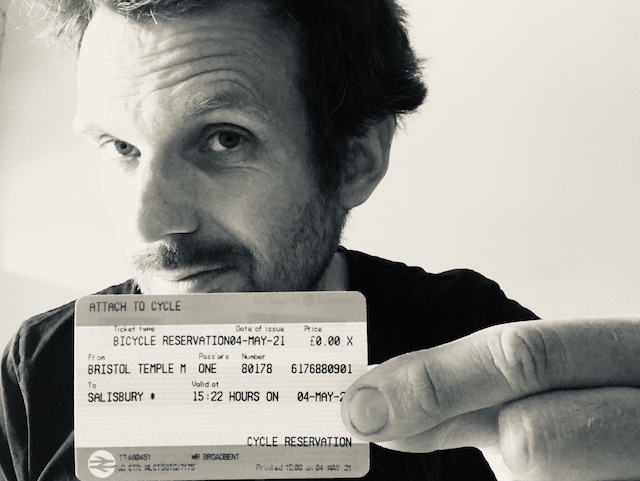
    Talk to the person at the window. Smile at them. You might be the first person to do this today. Engage in life-affirming transaction. You want to buy a ticket and they want to help. Ask an expert. What’s the best route? What’s the best time to travel? Find out if there is a different way. Find out if there really aren’t any spaces available for your bike (or was the computer lying?).

    Leave, ticket in hand, a malleable scrap of evidence that you are going somewhere and you didn’t just imagine it. A ticket that won’t run out of power.

  • Imprisoned with the infinite – the philosophical implications of an imaginary visit to Sweden

    Imprisoned with the infinite – the philosophical implications of an imaginary visit to Sweden

    Yesterday our household returned home from an imaginary holiday. Despite being in lockdown, we realised that we could imagine going on a trip anywhere in the world. Our daughter suggested our Sweden. Too far to easily get to under normal circumstances without flying, with that constraint removed we thought, why not? Now back home, I have been using this visit as an opportunity to explore some philosophical arguments about how we deal with choice and how this affects our creativity.

    (more…)
  • Surface travel – Münster to London

    Surface travel – Münster to London

    Overview

    • Six trains and one monorail
    • Leisure
    • 709km
    • £130

    Today I take my journey home from Münster to London via a different route from my way out. Outbound I came by ferry because it was cheaper; travelling back midweek I can just about afford the Eurostar. The route gives me the chance for a quick stop in Köln and the chance for an engineering detour via the Wupertaal suspended monorail.

    Münster to Wuppertal

    Münster is a beautiful town. I’ve spent the last few days staying with a friend and working on my book in the city library. The cities walls were removed to create a circumferential boulevard that is now tree-lined and a major thoroughfare for bikes and pedestrians. I walk this path one last time and peel off at the Hauptbahnhof.

    I ride for twenty minutes on a quiet commuter train to Hamm. The flat landscape is filled with a mixture of fields and factories, with the occasional wind turbine. It reminds me of travelling up the Lea Valley north of London.
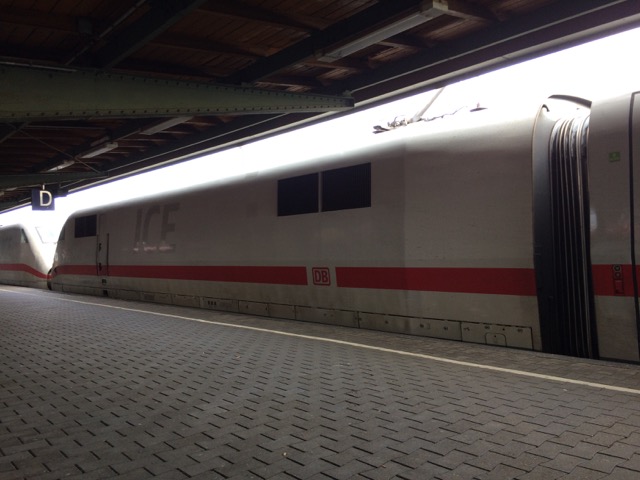
    Hamm station feels in the middle of nowhere but its ten unloved platforms are busy with trains of all sorts coming and going. I get to my platform early and see one of the slightly older German high speed ICE trains arriving. Its bright white carriages are like hermetically sealed capsules. You can imagine this train is capable of zooming along the sea bed as easily as over land.

    The ICE train is in fact two hitched together. I watch as the two are uncoupled and the front half pulls away. Just in time, I realise the back half is my train to Wuppertal, and I jump aboard. The land becomes more rutted and we follow an industrial valley that is well scored into the valley – it resembles  the valley of the Seine as it winds its way north from Paris to Rouen in Normandy.

    My connection time in Wuppertal is three-and-a-half hours; that was deliberate to give me time to make an engineering pilgrimage to a highly unusual railway, the Schweibebahn, Wuppertal’s suspended monorail. More details of that in a separate post.

    Wuppertal to Köln
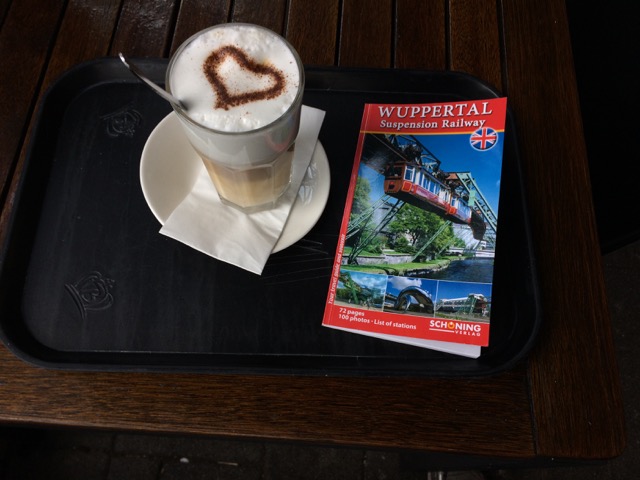
    I’m blown away by the monorail – a great piece of railway engineering integrated into the city. With hindsight, three-and-a-half hours was a bit too long for my engineering excursion and I struggle to find the inspiration to explore the town further. It’s nothing against Wuppertal: I’m just keen to get on. I wait impatiently at the platform for my next train.
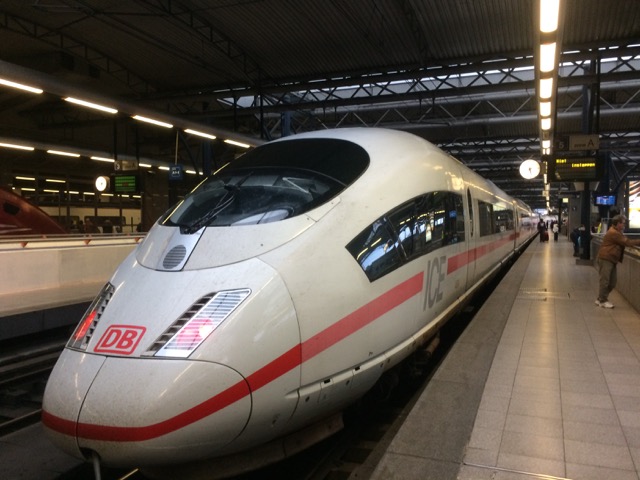
    If the last ICE train I took looked like it could be amphibious, this train, a next generation edition, looks ready for space flight, with it’s pointed nose and sleek black-and-white lines. It’s a short twenty-minute ride to Köln and before I know it we are rumbling across the bridge over the Rhine. Köln Hauptbhahnhoff is covered by a wide arching roof; beneath, trains come and go from across Germany – and I see my first French train, the Thalys service to Paris.

    I have fifty minutes between trains so I visit the magnificent cathedral which is surprisingly right next door to the station – almost on top of it. It’s quiet pews are better than any waiting room I can think of.

    Köln to Bruxelles Midi

    I get on board another of the sleek new DB ICE trains and settle in. I don’t remember much about this 2-hour leg as I slept most of the way. The day before long journeys I rarely sleep well as I worry about missing my train, and last night’s wakefulness just caught up with me. As we slow down on the approach into Brussels I see some fairly grotty looking commuter trains and I realise these are the oldest trains I have seen since I left the UK. All the trains I’ve taken over the last few days in Germany or the Netherlands, whether high speed or slower, were well looked after. I am reminded why I don’t ever get that excited about train travel through Belgium. I may however just be prejudiced against Belgian railways because they were responsible for putting the DB night train to Berlin out of business when they put up the transit fees they charge other countries for their overnight services.

    Bruxelles Midi to London

    Bruxelles Midi is an endless warren of tunnels where the light at the end never seems that appealing. I have an hour and a half before I can check in; I bought tickets for a later train because it would save me £50. The beer in the cafe is half the price of the tea, which is a shame as I’ve just decided to give up alcohol for a few days.

    The journey flies by; before I know it I am back in St Pancras. As I walk down the long platforms I am struck that in all the stations that I have been through on either my outbound or my return journey in the UK, the Netherlands, Germany, Belgium and France nothing quite compares to the experience of arriving under the magnificent Midland Blue-coloured soaring arch of St Pancras station. A fantastic piece of engineering lovingly re-invented for a different century.