Tag: timber

  • Through and through

    Any domain of knowledge is a treasure trove of jargon. When that knowledge relates to a traditional craft, it becomes a vocabulary deeply rooted in working with the land—a language passed down orally, generation to generation, long before it was ever written.

    Learning these word and phrases, even in a small way, reconnects us to a language of observation, design, and craft that originates from the bioregions we inhabit.

    I am lapping up this language in Ben Law’s book on Woodland Craft, and discovering phrases that I take for granted. 

    Like ‘through and through’, which I took to loosely mean homogeneity. But in woodland craft it describes the process of sawing timber down the length of the log rather than across it. What it produces is planks of timber with border of bark on either side. The bark can be taken off, or left on to create waney edge boards, like we have used around Hazel Hill Wood.

    And then I read that sawing ‘through and through’ is necessary for creating ‘bastard shakes’. Now I am intrigued.

  • Imagining the wood from the trees

    This week, I’ve been writing about observation as the starting point for regenerative design.

    Today, I’ve been working with colleagues at Hazel Hill Wood to envision a year-long process of investigating what timber is currently—or could be—available for harvesting from the wood to use in our buildings. In a sense, we are learning to tell the wood from the trees.

    Through this process, I foresee the following levels of timber availability:

    • Ready – Timber that has already been felled, sawn, and seasoned—ready to be used immediately.
    • Ready for processing/seasoning – Timber that has been felled but still needs additional preparation, such as seasoning.
    • Ready for felling – Mature trees that are best harvested now to make the most of their timber potential.
    • Needs tending to – Timber that could become valuable in the future but requires care now—such as thinning or pruning lower branches—to ensure a high-quality crop later.
    • Needs time – Young trees that aren’t yet ready for harvesting but can be planned for as part of a long-term strategy.
    • Needs imagining – The trees that don’t yet exist. With thoughtful, long-term planning, we can envision trees growing in the future—trees that may one day be harvested, perhaps not by us, but by future generations.

    It’s this final phase that I find particularly magical: imagining the wood from the trees. It’s about seeing what’s missing and planting the seeds—both literal and metaphorical—that could flourish decades from now.

    All of this thinking reminds me that the role of the regenerative designer is imagine a thriving future and take steps towards creating that future. It begins with observation and imagination.

  • Remote treehouse design

    Sometimes humour serves best to highlight the ridiculousness of a situation. 

    In my last few posts I’ve been exploring the relationship between designers and the ecosystem they draw their materials from. 

    The working thought experiment has been a game in which differently sized design teams compete to build a wooden shelter from fallen branches in a forest. The size and configuration of the team have a big impact on how the teams source and work with their materials. 

    Now, let’s make it ridiculous. Imagine that instead of the design teams being situated on site in the wood, they are instead situated in a cabin just outside the forest. The construction teams remain on site. How would the game work?

    The direct link between designers, the site, the construction team and the environment that the materials come from is broken.

    The first challenge is communicating to the designers what the site is like. This could be done by means of a drawing, or even a video sent to the designers. But any representation is likely to be a partial version of fully understanding the site. 

    Next we need to find a way to communicate to the designers what materials are available. In the game, the materials are sourced from the surrounding woodland. But found materials don’t necessarily conform to easily describable units. We could envisage then a system in which branches are harvested and sawn to make their dimensions easier to work with and specify. In doing so, we lose some of the material in order to ease communication and specification for the remote design team.

    With a list of standard parts the remote design team can then begin their design. They may invite the build team in to the design office for ‘early contractor involvement’. When the designs are produced, there will need to be further meetings to brief the construction team on how the design works.

    As construction begins, the people on site notice the design could better fit into the local environment with some changes, but that would take additional meetings with the design team over in the cabin. And it’s not their own design anyway. They don’t feel like they own it, so they don’t bother.

    Meanwhile, the design team forget that they are in a game and start selling their remote treehouse design services to other people. They have a design that they believe works, and so start using it in other woodlands, albeit with even less knowledge of the locally available materials, site conditions, and fitness-for-purpose of their design.

    Of course, this is a ridiculous way to organise a construction process.

  • Vision for a regenerative programme of forestry and building maintenance at Hazel Hill Wood

    Vision for a regenerative programme of forestry and building maintenance at Hazel Hill Wood

    This afternoon I met with two trustees of Hazel Hill Wood to develop some ideas for a funding bid to support more regenerative use of timber to maintain our off-grid buildings. I said at the end of the call I’d write up some thoughts on a what a five-year plan could look like. Here is what I wrote down – stimulated by a very thought-provoking conversation with my excellent trustee colleagues. I’m putting it here rather than on the Hazel Hill website as this is by no means policy! Just a set of ideas, captured to enable further discussion.

    Five-year vision for developing Hazel Hill as a centre for regenerative forest management and traditional construction skills.

    At Hazel Hill Wood we have a unique combination of sustainably managed forest, off-grid buildings and a charity with a mission is to use timber from the wood as part of a regenerative cycle of building repair. Our ambition is to work with these gifts to increase local biodiversity and woodland thriving, build community resilience and wellbeing of all who come into contact with the wood.

    While we reach all of these ambitions to some extent through our current charitable activities, we see the opportunity to unlock greater benefits for the ecosystem and local community by establishing the wood as a centre for learning about how timber can be used as part of a regenerative local construction material. We describe this process as regenerative because it has the potential to have zero negative externalities: harvesting timber in the right places can actually increase woodland health and biodiversity; the timber we harvest can be used to re-establish a range of historical, rural practices, including coppicing, hurdle-making, horse-drawn timber extraction and traditional green-wood construction. Training local people in using these skills can help to enhance the rural economy while helping to maintain the heritage of local buildings. And the wellbeing of all is enhanced through extended contact with the living world through nature connection. 

    To shift to this mode of operation we envisage taking three phases over five years. 

    Phase one – from seed to seedling

    In this first phase we assess the state of the current system and create some of the infrastructure to enable this new activity to happen at the wood. 

    • Forest survey – establishing the health of the ecosystem, possible timber for harvest now and possible timber for future extraction and opportunities to enhance biodiversity through timber harvest.
    • Building survey – establishing the long-term maintenance needs and priorities of our heritage timber buildings.
    • Skills survey – understanding the local skills landscape and how training at Hazel Hill wood could enhance the local economy.
    • Re-establishing connection with rural construction tradespeople.
    • Creating working area – wood seasoning shed, tools shed and outdoor classroom
    • Initiation of volunteer programme for simple construction skills using timber in the forest.
    • Initial harvest of coppiced timber
    • Initial harvest of roundwood poles for seasoning.

    Phase two – from seedling to sapling

    In this phase we increase the scale of our regenerative work, starting to work with wood harvested and seasoned in Phase one while increasing our harvest of timber from the wood. In this phase we grow our education programme around how we see the wood and the buildings as part of a continuum, a process of which we are the stewards, adapting to the needs of the ecosystem and the people who we bring here to heal and learn through connection with the living world.

    • On-going habitat creation and monitoring in areas where timber has been harvested.
    • Maintenance forestry – In order to grow trees for timber, some tree pruning needs to be done to create timber of good quality. We need to develop local skills in how to plan and carry out tree maintenance.
    • Running courses in green wood construction skills.
    • Using seasoned, sawed timber to carry out major upgrades to the structure of our heritage buildings, including new decking for the Oak House and Forest Ark.
    • Invitation to other local crafts people to run training courses at our site.
    • Growing programme of volunteer activities engaged in a range of conservation and heritage construction projects.
    • Growing education programme, offering training in the thinking behind the regenerative principles on site.

    Phase three – from sapling to tree

    In this third phase the operations are more self-sustaining. The process of continuous cover forestry is well-established in the wood, with timber harvested at a rate of 1% per year providing a steady rate of firewood and construction materials for the charity as well as surplus for sale into the local economy. The programme of rural forestry and heritage construction skills training is self-sustaining and as well as bringing in revenue for the charity, is part of the active continuous maintenance of our unique heritage buildings. The site will be well known as a demonstrator project for regenerative principles that can be replicated more widely.

  • The Great Elephant – Les Machines de L’Île

    The Great Elephant – Les Machines de L’Île

    The highlight of our visit to Nantes was standing next to the Great Elephant as it set off for one its walks around the former dock yards. The 45-tonne steel and wood sculpture is part of the Machines de L’Île creations. At the centre is the workshop where engineer-artists create mechanical creatures that replicate real animal movements. The concept is that the creatures escape from the workshop to create the exhibits around the dockyard site.

    I find the whole place a wonderful combination of humour, heart, engineering, spectacle and wonder and reverence for creatures big and small. Definitely worth a 3 star engineering detour.

  • Notes on building local

    This month I am writing an article on that explores what if we restricted construction material use to those from a local catchment. Rather than a global supply chain of materials that is disconnected between source and use, what if we could use materials that were a more locally relevant, resilient and regenerative resource?

    Today at the third of James Norman and my sessions exploring regenerative design with Buro Happold in Bath, we heard about the example of the machine shed at Westonburt Arboretum that was built only timber from the site.

    (more…)
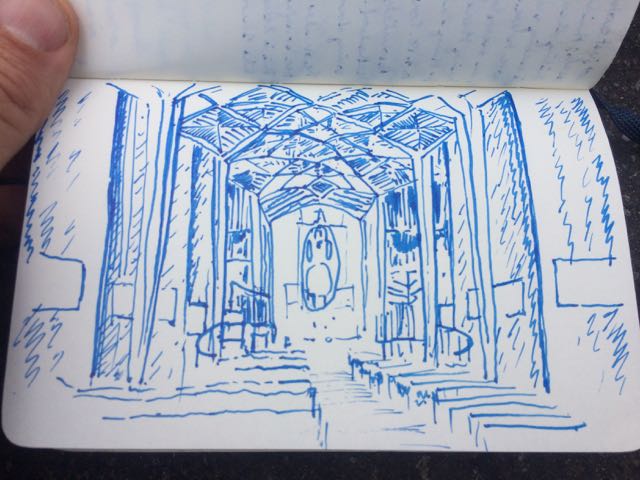
  • Coventry Cathederal

    Coventry Cathederal

    After a recent seminar in Coventry I had an hour to spare and so headed over to the famous cathederal. This sketch doesn’t come close to catching the finesse of the columns on this bold modern design but it serves to remind me of the textiures and feel of the place.

  • The Rise and Fall of Civil Engineering – courtesy Google’s amazing ngram viewer

    I read an astonishing article this afternoon titled ‘Quantitative Analysis of Culture Using Millions of Digitized Books‘, published early last year in the journal Science. Based on Google’s effort to digitise all books in all languages, researchers have carried out computational analysis on a corpus of over 5 million books – approximately 4% of all books ever published – to give access to vast amounts of data on word use.

    The availability of this data allows researchers to observe cultural trends and then subject them to quantitative investigation – the study of ‘culturomics‘. The paper illustrates fascinating changes in language size and use, and shows how the data is used to draw more socio-cultural conclusions.

    Best of all, Google has a nifty tool for presenting the data called the ngram viewer, which has allowed me to do a little culturomics of my own for the field of engineering.

    (more…)