Category: Blog (the archive of everything)

  • Regenerative Design, Net-Zero Design Error-Free Design and Swing Dancing

    Sometimes when I write on this blog I like to distill my thoughts around one topic. But when there’s lots going on I prefer to write in more of a diary mode, capturing observations, events and the things that are on my mind in case they are useful for when I have a bit more time to do some distillation. For anyone who is a regular reader of this blog you will recognise this as just another way to keep a Kalideascope, gathering the elements from which I can make future creative connections. 

    The big news is that James Norman and I now have a signed contract with the Institution of Structural Engineers to publish our book on regenerative design for structural engineers. We are two-thirds of the way through the first draft and our aim is to get this completed before our respective summer travels. So I have a mid-July writing deadline to hit. But in the meantime there is all of the following going on:

    • Monday I am off to Hazel Hill Wood to prep for the next thing on my list:
    • Tuesday and Wednesday this week I co-leading the second of the three woodland-residential retreats for the Regenerative Design Lab. 
    • Thursday I am teaching a session on advocacy in net-zero design as part of the Net-Zero Structural Design course I run with Will Arnold at the Institution of Structural Engineers. 
    • Thursday I am also teaching a workshop for the Cambridge Institute of Sustainable Leadership’s masters programme, Interdisciplinary Design for the Built Environment. This will be a reflective session on preparing the soon-to-graduate students for applying their learning in practice.
    • Thursday also (big day!) we have the summer meeting of Hazel Hill Wood’s Trustees. 
    • Friday to Sunday I am teaching Lindyhop and Charleston at the Idler Festival, Fenton House. 

    And finally, Sunday, at around midnight, I am running an online workshop for a construction firm in Australia about avoiding error in construction, part of the GIRI initiative. 

    Somewhere in the middle of all that, I am going to do some book writing. I’ll keep you posted.

  • Ponts de Cé – Ancenis – Champsaucau

    Ponts de Cé – Ancenis – Champsaucau

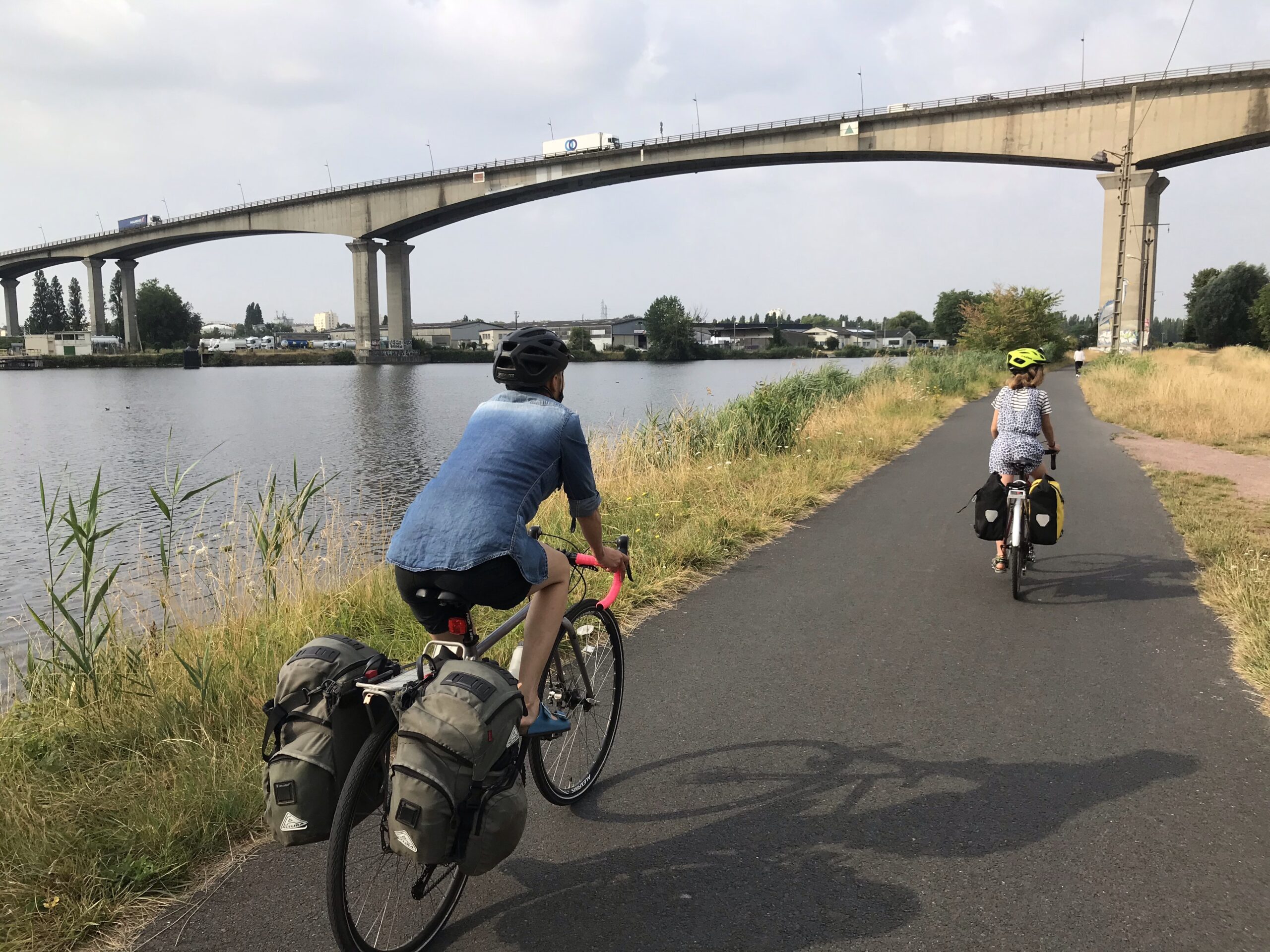
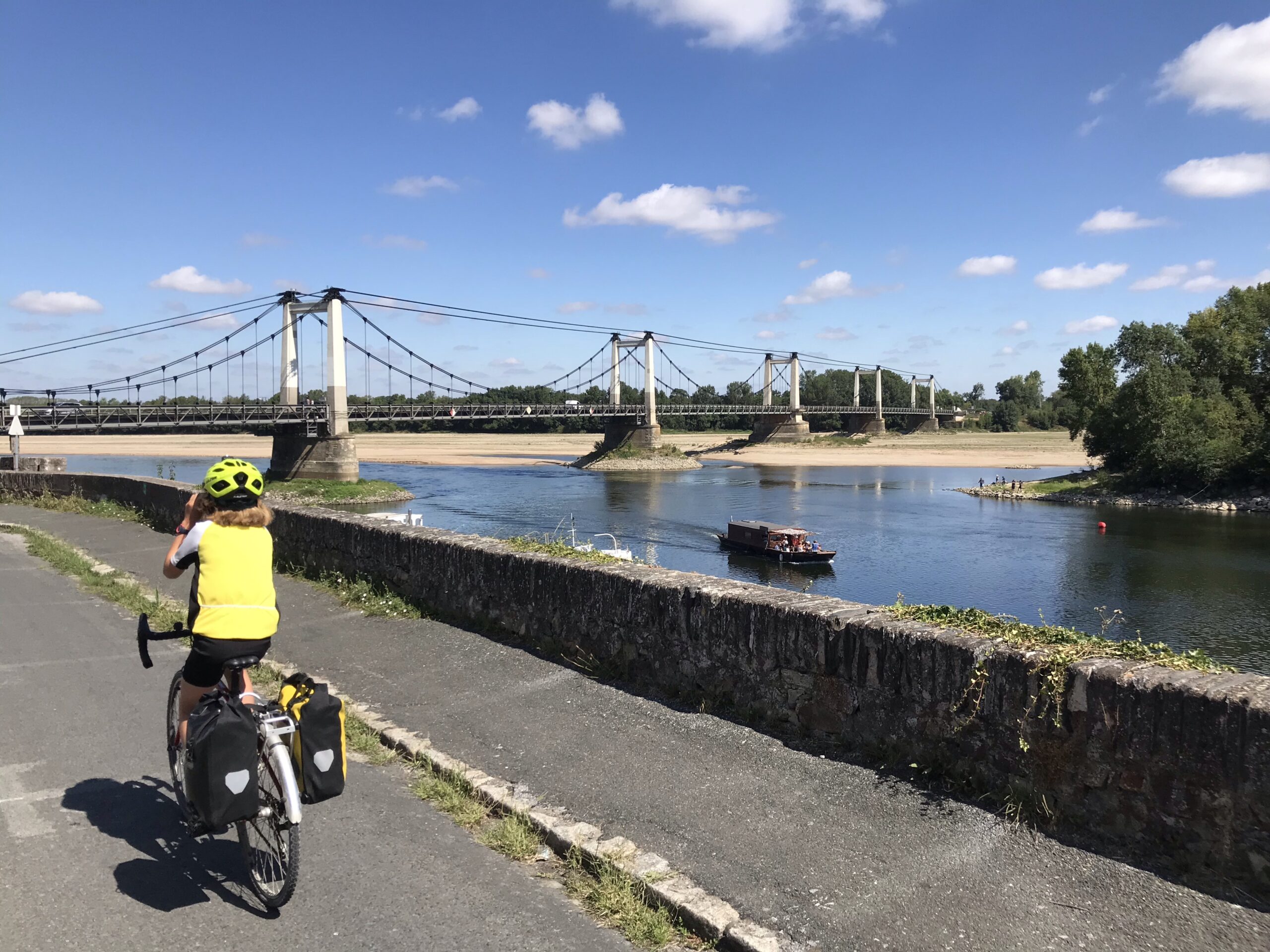
    A multimodal stage on our journey through France, with 70km by bike, 7km by kayak and another 2km uphill to finish the day.

    We crossed the Maine river at Bouchemaine, where we stopped for the market and breakfast by the river. The scene looked like we could be in the Netherlands.

    I remember little about the rest of the ride other than it was hot and we cycled in a tight convoy to keep a steady pace and cover the ground.

    We crossed to the north side of the Loire over a more substantial suspension bridge than we’ve seen so far. Minor aside on suspension bridges. The Loire is the first place I’ve seen multispan suspension bridges with a post tensioned top cable to keep the towers an equal distance apart.

    At Ancenis we boarded two kayaks and our bikes were taken downstream in a van. There was a big difference in river flow rate across the width of the channel and finding the fast flowing sections was quite tricky.

    We were advised we could moor up and swim behind any of the groynes built out into the river. Behind each, the river water swirls in a great rotating eddy that you have to paddle through to reach the beach. This was where we had our only swim in the Loire. It was so warm.

    We arrived at the drop off point, refreshed ourselves as the guinguette and climbed the hill up to our accommodation, a family home we found on warmshowers.com

    Our hosts live in a beautiful, self-build home. We enjoyed hearing the details of the construction, their water conservation measures and meeting their guinea pigs.

    Warm Showers is a great tool for cheap travel, but it does require quite a lot of on-the-go administration.

  • Customer lift

    Customer lift

    I followed this sign expecting some sort of encouragement or affirmation.

    (more…)
  • Notes from RESTORE report Sustainability, Restorative to Regenerative

    Here are my notes from reading the RESTORE report ‘ (REthinking Sustainability TOwards a Regenerative Economy) Sustainability, Restorative to Regenerative – edited by Martin Brown and Edeltraud Haselsteiner – as my part of my regenerative design research. Thanks Emma Crichton for the link.

    On regenerative design

    This is probably the most useful part for me.

    ‘Regenerative design, relates to holistic approaches that support the co-evolution of human and natural systems in a partnered relationship.’

    (more…)
  • Engineering of the commons

    If we want to think really regeneratively about engineering and the creation of buildings, then maybe we should consider building materials as a common resource.

    I realise that I have been approaching the question of regenerative design in engineering from the standpoint of a market-driven economy. Materials are supplied by private suppliers, installed by private companies for a mixture of public and private clients. In most cases the profit (surplus) is reaped far from either the source of the materials or the location of the building.

    But listening to the Frontiers of Commoning podcast I realise that this is only a relatively modern framing of the mechanism by which materials can be sourced, shared and distributed.

    If we want to design buildings regeneratively, then we need to be thinking about how the process of sourcing and manufacturing building materials is regenerative: how the very harvesting of these materials can create more; how these processes can create habitats which enhance other aspects of the ecosystem, building local complexity; how feedback loops are built in so that we know if the system is working within its limits or not.

    If we see our construction materials as a common resource rather than a commodity, we can think much more collectively about how these resources should be manufactured, used, reused, borrowed, repurposed, re-imagined and finally returned to the ecosystem.

    In this framing, no-longer is the engineer is not serving a particular project but the people who share ownership of that common resource. Their role becomes threefold: harvesting of materials from the local bio-mineral region; managing stocks of resources in the most equitable way; and design and re-design of how these materials are used. (Note there is no return of the material to the ground as there is no waste in a regenerative system – just more used for the materials.)

    No-longer would the engineer be working to maximise shareholder value and maximising ecosystem destruction. Instead the engineer would be working to maximise the regenerative harvest of local materials to maximise local flourishing.

  • Exploring regenerative practice for engineers

    As James and I start to delve into the writing for our book on regenerative design for structural engineers, I am gathering my thoughts on what regenerative practice might look for an engineer. This is a working-out-loud post to help develop and share my thoughts.

    The challenge with regenerative design is that we are reaching for something that doesn’t yet exist. But if we wait for the answer to be fully formed, the natural systems that we seek to regenerate – ourselves included – may be destroyed beyond repair.

    And so we have to work with what we’ve got:

    (more…)
  • Notes on building local

    This month I am writing an article on that explores what if we restricted construction material use to those from a local catchment. Rather than a global supply chain of materials that is disconnected between source and use, what if we could use materials that were a more locally relevant, resilient and regenerative resource?

    Today at the third of James Norman and my sessions exploring regenerative design with Buro Happold in Bath, we heard about the example of the machine shed at Westonburt Arboretum that was built only timber from the site.

    (more…)
  • Following abundance versus desire

    Following abundance versus desire

    At our local allotments, permaculture teacher Mike Fiengold re-distributes food waste in the community. Even after he has sent food to various local charities there is lots left over, and so he asks if we can take some away. At first I felt it greedy to take more than what I considered to be my fair share. But then I realised it was helpful if we could take as much as possible off his hands. Because if he can clear his stores, he can get more of whatever waste the system is generating and put it into the hands of the people that need it. So now we take more than we need and try to distribute this excess among our neighbours on our street. 

    There’s a few things going on here that I want to note. 

    (more…)
  • Coming from Bristol, London is a pleasure to cycle through

    After a two-year break I am back on my bike in London. This morning a short hop from Paddington to Kings Cross. Having moved to Bristol almost four years ago the difference I can really appreciate the difference between the two: cycling in London is streets ahead.

    People say to me I wouldn’t want to cycle in London but I think the cycle provision is actually pretty good. I left the station without needing to look at a map*. There were ‘quiet ways’ cycle route signs directing me all the way. Not only did all traffic lights have forward stop boxes for cyclists, cyclists also get their own green light that lets them set off before cars wanting to turn in front of them. And the quiet ways were, well, quiet.

    Of course there are ways that the system could be improved. More cycle and pedestrian-only routes would always be better. But the improvements I have seen are relatively low-cost and easy to implement.
    Bristol has some excellent off-road cycle paths. We chose to live close to one specifically to benefit from the access it provides to the centre of town. But the general permeability of the city to cyclists is poor.

    This is a choice. All it takes is the political way to say we choose not to have a streets choked with cars; we choose to make our streets living, breathing places where people can get around safely and cheaply.

  • Take the meat out of meetings

    Take the meat out of meetings

    Please, take the meat out of meetings. Then you can say, no animal died in the making of this decision.

    Some meetings are pointless. Don’t add to this pointlessness the death of the animal in your sandwich.

    Some meeting reach meaningful outcomes. These are never enhanced by having meat on the table.

    Take the meat out meetings, workshops, seminars and training.

    Image credit: ‘Press Conference on Meat Rationing‘ by Alfred T Palmer of the United States War Office is available in the public domain.

  • Restorative versus regenerative design

    Restorative and regenerative are two words I am hearing used interchangeably. Both are relevant to engineering and design. Both are approaches to design that are valuable. But they need differentiating.

    (more…)
  • Too many emails – the Eiffel Over guide

    Too many emails – the Eiffel Over guide

    I am a connoisseur of email-reduction strategies, so I share this for friends and colleagues of mine who I know are struggling with this at the moment. The best way of dealing with having too many emails is never ‘answer all the emails’. Email overload is a systems problem. It manifests itself as an overflowing inbox but it is rooted in the way the system is set up. Answer all the emails and new ones will appear. We have to fix the system.

    I will start by saying that I still have too many emails. But I don’t feel bad about it because I am trying to work on the system. And some of my system changes have been helpful and I can see are working. This post is not supposed to be a definitive guide but a few things to get you started.

    (more…)
  • Making the Regenerative Design Lab a Regenerative System

    In today’s planning session for the Regenerative Design Lab with my co-facilitator Ellie Osborne, we asked what if we made the lab itself a regenerative system?

    Based on my working definition (see my previous post on the four characteristics of regenerative systems), a regenerative regenerative design lab would:

    • Be able to renew its sources of material and energy;
    • Thrive within wider ecosystem boundaries; and,  
    • Adapt to a changing operating environment. 
  • Why close the train doors 40 seconds before departure?

    This announcement always irks me. “To ensure a timely departure, train doors will shut 40 seconds before departure.” It reminds me of what a senior Network Rail manager once said to me, that railways are great at treating their customers as if they are in the wrong.

    This forty seconds buffer gives time to deal with any problems at the event horizon of the doors closing. But why does this 40 seconds have to come out of the passengers’ time, the free morning they had before they boarded the train rather than from the train company’s time, the schedule.

    (more…)
  • Recognise the desert to return it to life

    When renewable systems are over exploited they fall into a desertlike state. In this state the system population is too low to support regrowth and the system structures break down. But given the right conditions and encouragement, regrowth can return. The seeds are all there. The self-organising ecosystem can return to recreate resilience, complexity and diversity associated with rich life.

    (more…)
  • Bristol: from rainforest to desert

    Where I live, coal was so abundant near the surface that you could have dug a hole in your garden and found it lying there. This coal was laid down during the carboniferous period when Bristol was somewhere over the Equator and the ecosystem was abundant with life. This coal is fossilised life.

    Yet walk a few streets north-west and you find a band of red sandstone. By this time in its geological history, Bristol had drifted north towards the Tropic of Cancer and the area had become desert. No more fossilised life, no more coal – just scorched sand. Carry on further north and carbonate limestones return. The desert receded and life came back.

    (more…)
  • Nothing to say but lots to show

    I have nothing to say but lots to show you – Walter Benjamin. I heard this quote this morning on In Our Time and it really struck me.

    For me it says you don’t have to have the answers in order to bear witness.

    There is so much that I see in the world that makes me smile. Things that when I see them make me despair.

    I can’t necessarily find the exact narrative to rationalise these sensations. But that shouldn’t stop me from sharing them. Because when I do, I am creating the pieces from which a pattern can form.

    (more…)
  • Four characteristics of regenerative systems

    Four characteristics of regenerative systems

    Work on regenerative thinking progresses on all fronts. Book writing with my friend James on Monday (read his excellent blog on this process), developing regenerative practice at Hazel Hill Wood Tuesday and short-listing candidates for the Regenerative Design Lab Wednesday. I love that all of these initiatives inform each other.

    To aid all three I have synthesised my understanding of how regenerative systems operate. This framing is informed in large-part by Donnella Meadows’s book ‘Thinking in Systems’, which is helping to understand the conversations are having across all these fronts.

    (more…)
  • Start by lighting the fire

    Start by lighting the fire

    It’s the first thing we do at Hazel Hill Wood. Light the fire for everyone else. A clutch of tiny twigs, a handful of finger-thick branches, and some small logs. I can do this because other have prepared the materials.

    A year ago someone felled a tree and cut its trunk into lengths that fit the stove. Others took these logs and arranged them into seasoning stacks in the forest, where for a year or so they lose their moisture. More people have transferred the partially seasoned timber to the wood stores, where they get bone dry. Finally, someone has filled the baskets with twigs, branches and logs so that I can light it this morning.

    When the room is warm I meet people, and we talk amongst other things about how to manage the forest that provides us with this renewable source of fuel.

    There’s lots that I like about this human-natural system. Every stage is visible, which makes me much more aware of where the things I use come from. The stock levels in each of the stages are easy to monitor, providing me with feedback about how the system is operating.

    I like the long time frame. We have to make decisions now about how many trees to fell in order to meet demand in two to three years. Over an even longer time frame, we need to think about how to manage the forest to ensure there is sufficient regrowth to provide firewood in thirty years time.

    Rather than destructive, this process of carefully felling trees seems to create life: making openings in the forest canopy that form new habitats for plants, for invertebrates and the animals and birds that live on them.

    Most importantly for me, it is a brilliant example of how we can manage human-natural systems that regenerate to meet our needs with little more than the energy of the sun.

    When I start by lighting the fire, I am engaged with this human-natural system. It primes me to think, what work do I need to put into the system today to ensure it continues to regenerate.

    Photo credit: Joseph Watts

  • Carbon vs everything else: system health vs system outputs

    I’m getting this down while it is fresh in my mind following a planning conversation with Will Arnold this morning for our Net Zero Structural Design course. In the final session of this course we are helping participants think about how to weigh up carbon with other wider sustainability considerations.

    In my post earlier this morning I was reflecting on how focusing on a system’s resilience can enhance its restorative powers. My angle then, from a design perspective, was thinking about how we can shift the design brief from designing objects or outputs to designing resilience. Now I am thinking from a different angle: how we test for resilience, and how this relates to tests for carbon footprint.

    (more…)
  • Think resilience to observe and enhance a system’s restorative powers

    I underlined these words in Meadows’s Thinking in Systems primer. ‘Thinking about resilience enables us to observe and enhance a system’s restorative powers.’ As with so much in this book it is an efficient sentence that carries so much meaning. This is my thinking-out-loud (not so efficiently written, but I find it helpful).

    This quote that I have pulled out is at the end of a section of the book on the characteristics on well functioning systems. The three ingredients are resilience, self-organisation and hierarchy. Natural systems are very good at using these three ingredients to build ever more complex systems that can respond to a range of scenarios in a self-organising way.

    (more…)
  • Humbelievable

    Humbelievable

    Last Friday I took the train from York to Hull. Onboard I was speaking on the phone to Will Arnold about our Net Zero Structural Design Course. As we rounded a bend this epic site swung into view and I stunned into silence. Spread out before me, skimming the water like a second horizon, the Humber Bridge.

    This bridge seems improbably long. How can it be that the vertical load at midspan is supported by those towers when they are so far away? There must be some antigravity involved.

    When it opened it was the longest single span bridge in the world, at 1.6km between the towers. Of the other facts I read on the bridge’s Wikipedia page, my favourite is that the towers are 36mm further apart at the top than at the bottom due to the curvature of the earth. I’d like to think I managed to capture that aspect in my rapid-fire photo from the train window.


    Humber Bridge from Railway Line by Oliver Broadbent is licensed under a Creative Commons Attribution 4.0 International License.

  • Where is the bus station?

    Where is the bus station?

    Seen at Turnpike Lane station.

    Both left and right lead to the buses, but why is right prioritised?

    Was there once a member of staff who got so tired of saying where the buses are that they wanted to shout the answer?

    Did someone at the train company say to the sign writer, give me the largest font you have?

    What happens if you try to catch a bus by going left?


    Bus Station at Turnpike Lane by Oliver Broadbent is licensed under a Creative Commons Attribution 4.0 International License.

  • Storm’s coming: go to the cinema

    Storm’s coming: go to the cinema

    In times gone by, people went to the cinema to stay warm. The movie theatre offers a place of shelter from the elements and also an escape from reality for a couple of hours. Last week, when storms huffed and puffed and infrastructure bent and buckled, Great Western Railway suspended all services from London to Bristol. I was stranded in the capital amid a maelstrom of conflicting information about when services would resume. So rather than stare at the blank departure screen, I headed for the silver screen instead.

    I felt liberated. Give me a ticket for the next film, I said. The next feature was Pedro Almodóvar’s latest film ‘Parallel Mothers’. For the next two hours and three minutes I was transported away from the rain and the wind to sunny Madrid and the tale of two who give birth on the same day.

    By the time I emerged the information storm had settled down. There would be no trains today, and probably none tomorrow morning. Decision made for me: I would need to stay another night in London.

    Incompatible and incomplete information

    In a situation like this, when a system that usually runs in a steady state is knocked off course, then the information about that system is likely to be incompatible or incomplete. For instance, National Rail Enquiries showed some trains leaving Paddington, GWR said none leaving Paddington for now, others had simply crashed.

    (more…)
  • Travelling by high-speed glacier

    Travelling by high-speed glacier

    On a recent trip to the Alps I took Robert MacFarlane‘s breathtaking ‘Mountains of the Mind‘. In it I found this delightful tale about Mark Twain taking his family up on to a glacier in the Alps – a fashionable thing to do in the mid-nineteenth century. In short:

    (more…)
  • Regenerative Design: a process not a thing

    Regenerative Design: a process not a thing

    As I continue my exploration of regenerative design in engineering, correspondents have said it would be helpful to gather examples of regenerative design. Templates that we can look at, imitate and integrate.

    From my reading of Wahl (see my recent post), I’m increasingly understanding regenerative design to be a process rather than a thing.

    Regenerative practice of any sort (in design, in education, in living…) is practice that leaves the ecosystem richer and better able to heal itself. It is practice that sees humans as a keystone species that play a unique role in helping their ecosystems thrive.

    (more…)
  • When government bans protest against our projects, engineers must put down their tools

    When government bans protest against our projects, engineers must put down their tools

    The cornerstone of our democracy is the right to protest. At the moment the government is pushing through amendments to the Police, Crime, Sentencing and Courts Bill that would make it illegal to protest at a range of infrastructure sites.

    The Government is intending to use the latest amendment to

    introduce a new offence of interfering with the operation of key infrastructure, such as the strategic road network, railways, sea ports, airports, oil refineries and printing presses, carrying a maximum penalty of 12 months’ imprisonment, an unlimited fine, or both

    George Monbiot citing in the guardian a private letter to members of the House of Lords

    This is on top of the existing authoritarian measures in the bill. For instance, named individuals can be banned from protesting. If I write a post encouraging readers to attend a protest, I can be individually banned from protesting. If I turn up anyway, under these new measures, I can be sent to prison for 51 weeks.

    Why is the government doing this?

    Well, I suspect it is because they know that protest works, as demonstrated by the success of the protests to stop fracking in the UK. A sustained campaign of protest by a small dedicated group halted one of the most illogical of engineering projects: fracking for more fossil fuels while committing to reducing our carbon footprint.

    (more…)
  • Reflections on transformational innovation

    These are my reflective notes as I work through chapter two of Daniel Wahl’s ‘Designing Regenerative Cultures‘. My aim in this reading is to find clues as to what a set of principles for regenerative design for engineers could look like.

    Wahl introduces three types of innovation:

    • Sustaining innovation – that which keeps the current system working
    • Disruptive innovation – that which introduces new operating systems
    • Transformative innovation – that which is the ‘long-term innovation process of fundamental changes in culture and identity.

    He argues that if we want to achieve a transition towards a regenerative culture, it is this third kind of innovation that we need.

    (more…)
  • Our responsibility: reduce carbon on projects by 7% a year starting now

    Our responsibility: reduce carbon on projects by 7% a year starting now

    Hold this figure in mind: 7%.

    In 2019 the UN Environmental Programme (UNEP) published a report concluding that in order to limit global heating to 1.5 degrees, we need to reduce carbon emissions by 55% below 1990 levels by 2030. That’s equivalent to 7% per year, starting now, every year until the end of the decade. 

    That is faster than they fell in 2020 during the pandemic.

    (more…)