Category: Creativity

  • Bubble surface

    Bubble surface

    This afternoon I headed to We The Curious with my daughter for a summer holiday treat. The highlight was the giant sheet of bubble you can make there by dragging a sort of rollerblind contraption through a soapy solution. The result is a vertical bubble surface that flows and swirls with irridescant eddies. When you blow at the surface is distorts out of plane, like a bullesye from a spun pane of glass, or a portal to another dimension.

    And then without warning, ping, it disappears without a trace.

  • Superpowers for Creative Design – University of Bath

    Superpowers for Creative Design – University of Bath

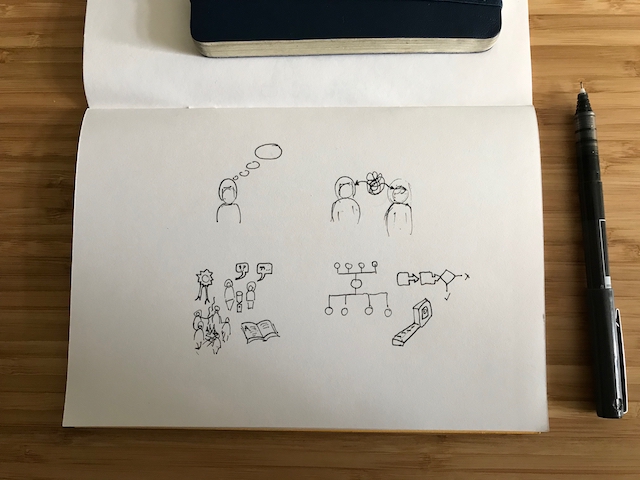
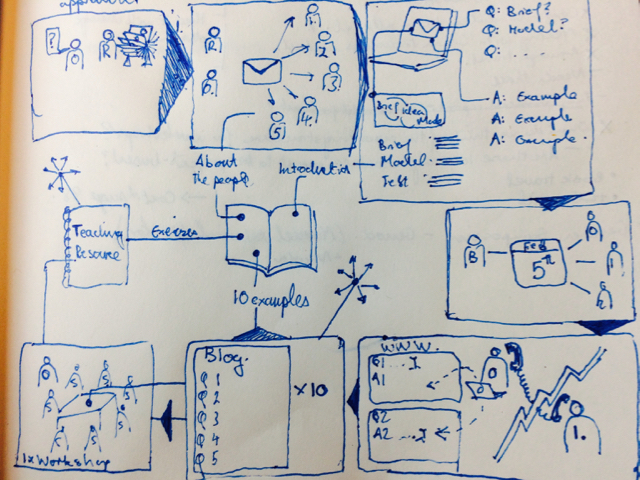
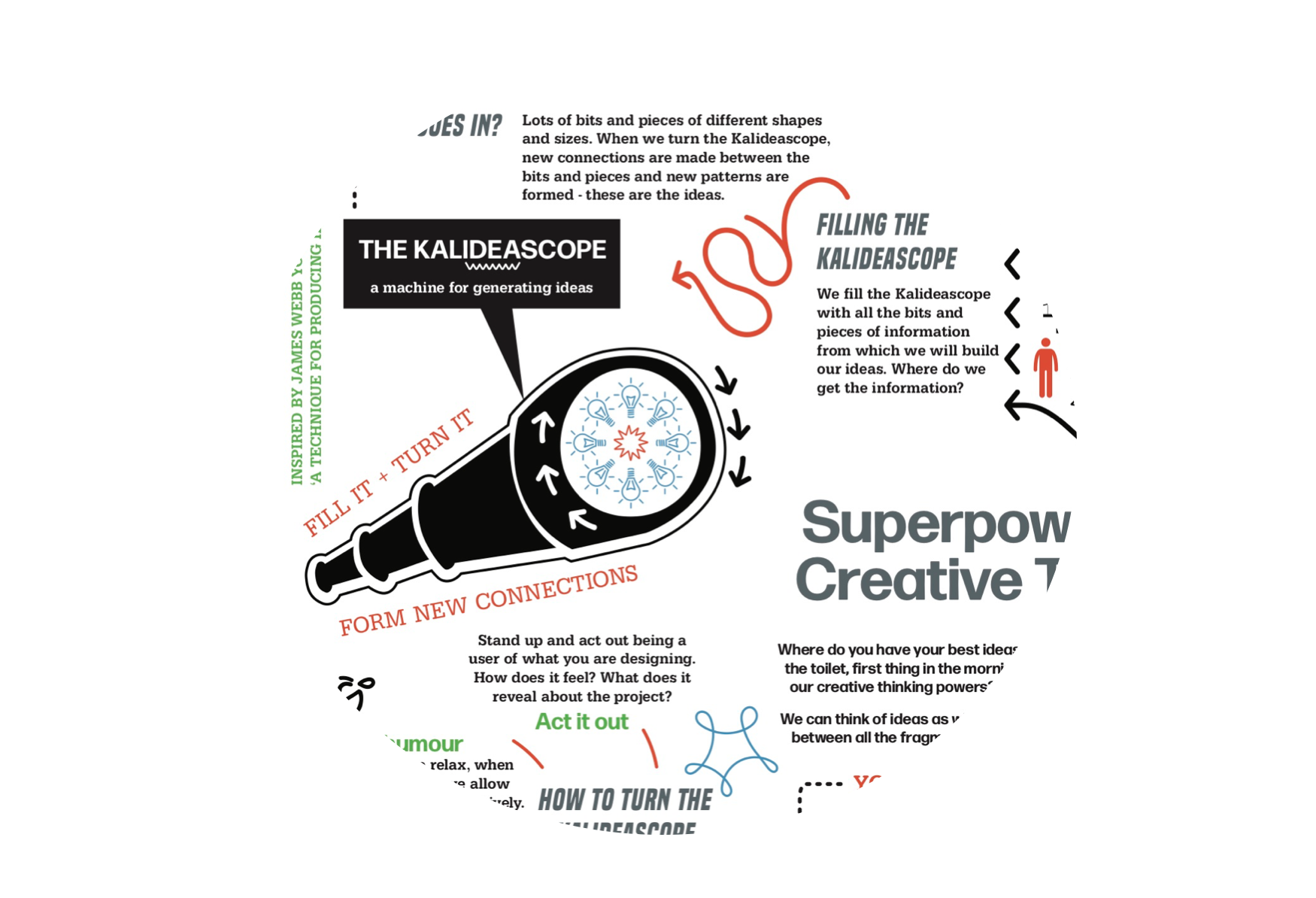
    I’m on the road again, this time to the University of Bath where I have the pleasure of running a workshop with first-year students on creative thinking in support of their structural design projects. I’m using the Superpowers for Creative design resource I shared earlier this month – now updated, thanks to the help of my colleague Alexie Sommer, to be in the form of a fold-out zine. The image above is a teaser for what to expect!

    I’ll posting a downloadable version of this resource soon.

    Lesson notes to follow.

  • Superpowers for Creative Design

    Superpowers for Creative Design

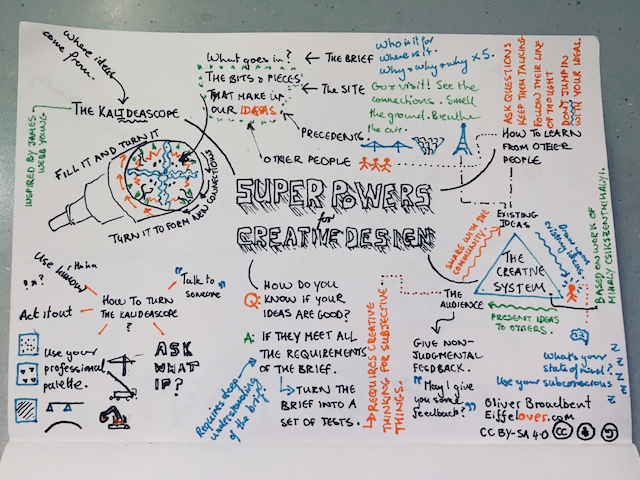
    Superpowers for Creative Design is the name I gave to a one-page summary of my undergraduate creativity teaching at Imperial College. This is my first draft. I like the idea of creativity being a superpower. I am sure that people who can channel their creative thinking will have a great advantage in the future.

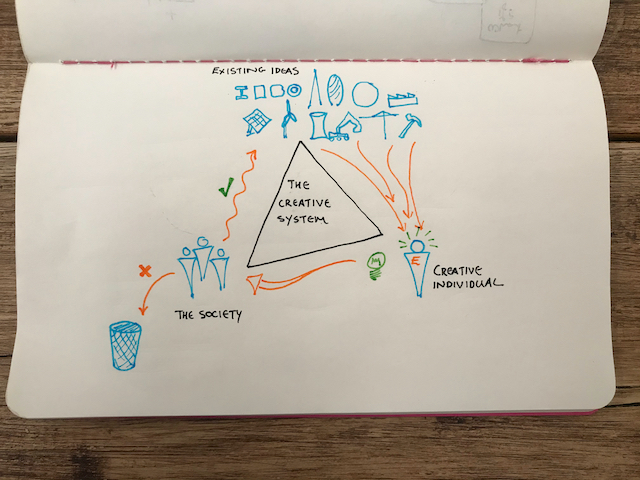
    The diagram brings together material from other posts on this site. I describe the Kalideascope concept in ‘How to have ideas – guidance for engineers and other humans‘. And I wrote about the concept of a creative system in ‘9 Ways to Build Creativity in your Organisation‘.

    Drawing this diagram I found a nice interrelationship between all this material. To have ideas we need to draw upon information. That information comes from the things we see, the books we read, the website we look at. But critically it also comes from talking to others. How we interact with one another has a big impact on the quality of thought exchange. With the right interaction, ideas can sparked off of one-another and can be transmitted to others, and form the basis of their ideas.

    Underlying it all is behaviours, and within that self-discipline. Mastering that self-discpline is a great strength – a superpower!

  • Building creative culture in engineering companies

    Building creative culture in engineering companies

    I am starting to shift my attention away from creative tools for engineers. Tools are still important. But I’ve realised that you need a creative culture for individual creativity to thrive.

    Recently, I rediscovered in Laloux’s ‘Reinventing Organisations‘ the Wilbur four-quadrant model. The model describes how culture, systems and worldviews interact. We can use this model to understand a phenomena in an organisations from four different perspectives:

    • How the phenomenon can be measured from the outside
    • How the phenomenon feels from the inside – intuiting how it feels
    • How the phenomenon appears to the individual
    • How the phenomenon appears to a group of people.

    Like all engineer-friendly models, Wilbur’s is a two-by-two grid. The columns divide the grid into interior perspecitve and exterior perspective. The rows divide the grid into individual and collective perspective. According to Laloux

    Wilbur’s insight, applied to organisations, means we should look at: 1) people’s mindsets and beliefs [individual interior perspective]; 2) people’s behaviour [indvidiual exterior perspective]; 3) organisational culture [collective interior perspective]; and, 4) organisational systems (structures, processes and practices) [collective exterior perspective]”

    From Reinventing Organisations, Laloux (2016)

    Applying the four quadrant model to organisational creativity

    I’ve assembled some quick thoughts on how the four quadrant model might apply to understanding creativity in an organisation. I have written the statements for a fictional, ideal case. This difference between this ideal case and reality can give us some suggestions for what we might need to do to build a more creative organisation. 

    (more…)
  • Notes from IStructE Academics’ Conference 2018

    There was great energy at today’s IStructE Academics’ Conference, the theme of which was Creativity and Conceptual Design.
    If you are visiting this site for the first time, it may have been thanks to Chris Wise’s kind recommendation in his keynote presentation – thanks so much Chris.
    I presented a session on how to have ideas. Usually when I’m billed with this title, I run a workshop on idea generation, but I thought for once, I would stand up and say what I think about the subject. I’m glad I did because it seemed warmly received. It was also a chance to talk through themes that will be included in the chapter I am writing in a book on scheme design – more details to follow.

    (more…)

  • Secretly teaching design – notes from our curriculum planning day at Imperial

    Secretly teaching design – notes from our curriculum planning day at Imperial

    I am just back from taking part in a Design Thread workshop at Imperial College, the aim of which was to co-ordinate activity between the various design-relevant courses on the undergraduate civil engineering course at Imperial. Here are some reflective notes as I whiz home, during the writing of which I came up with the notion of ‘secretly teaching design‘. (more…)

  • Aristotle, Seneca and Emotional Intelligence – conceptual design training notes

    Aristotle, Seneca and Emotional Intelligence – conceptual design training notes

    This post is intended as a reminder for the people participants in last week’s conceptual design workshop. It may also pique the interest of anyone else interested in learning or teaching creativity for engineers.

    The workshop was the fifth of five workshops for this cohort of engineers. At the start I asked attendees to list any challenges they face in doing conceptual design that they would like to focus on in the final session. I asked attendees to name the challenge and what kind of progress they would realistically like to make today towards overcoming that challenge. I summarised the challenges everyone shared, and asked participants to prioritise the topics for discussion. The following topics and talking points follow from that prioritised list. (more…)

  • How to have ideas – guidance for engineers and other humans

    How to have ideas – guidance for engineers and other humans

    When I’m asked, you know, at a cocktail party or some other social setting, ‘what exactly do you do’ I say ‘I train engineers to be more creative’. This is a great statement to use because: it feels good to say; it is reasonably close to the truth; and it is short enough to enable my interlocutors to decide quickly if they want to engage further or keep their distance.

    For the people that stick around the next question is usually, ‘well how do you do that then’, and I explain I run two courses, ‘how to have ideas’ and ‘how to have better ideas’, the first being a pre-requisite to the second.

    This is again only approximatinately true (my course content is usually based on what the learners say they want to cover rather than following a strict syllabus, and the course titles aren’t always as catchy as I’d like) but it keeps the conversation moving.

    After further dialogue, I am asked if I have got this all written down somewhere, and this is when I usually get embarrassed, and have to say, ‘no’, because it is all in my head. But not anymore, because now I can point them to the post you are reading, my first attempt to commit an overview of this material to writing.

    (more…)

  • Working notes: building a questionnaire to characterise design

    Working notes: building a questionnaire to characterise design

    I struggled to find an image to go with this post. When I typed design into my image database, this came up. It is rather fine, isn’t it?

    Today at Think Up I am writing a set of questions that can be used as a diagnostic tool to characterise different stages in the design process. The questions will go into an online questionnaire through which we will be trying to establish a link between different types of design problem, the design process they require and techniques and tools that designers use. The aim is to help students understnad what might be suitable approaches to use in response to different design problems.

    I am fortunate to be working with my colleague Bengt Counsins-Jenvey who knows a huge amount about design thinking in a range of different contexts. He is working on the other part of the questionnaire that is characterising the design problems.

    Here’s some reflections and notes from today’s working:

    • Reducing long-form answer questions on questionnaires. They are easier to write but I’ve learn the hard way on other projects recently that long-form answer questions take so long to analyse it is really worth taking the time to come up with good numeric-scale or mutltiple-choice questions. Having done an initial round of interviews is helping me determine the right language to use.
    • How succint can I get the questions? I am trying to weigh up writing questions that everyone can understand and keeping the questions short. Again, having done some initial interviews helps me know what language people are likely to use.
    • I’ve realised my design world view was initially shaped by ‘blank-piece-of-paper’ designers. My interviews on this project have shown me how few design contexts require blank paper. I hope this process gives me greater understanding of design contexts where the operating context is much more complex.
    • What number scale to use? I’ve gone for 1-4. I don’t want people to think about their answers for too long and I don’t want them to sit on the fence. It will be interesting to see the impact of this choice.
    • I have been daunted by putting this questionnaire together, so last night I just set myself a simple target of writing three questions for each of the main stages in the design process. This much less daunting task was easy to do – the questions almost wrote themselves – and then I was easily able to supplement them. Later Greg Downing explained to me that this process is what he calls skeltoning: you quickly put in place the outline and everything else follows.

    For more info on this piece of research see this post on the Think Up website.

  • #11 Show notes – Jack Bardwell – Spine-tingling creativity

    #11 Show notes – Jack Bardwell – Spine-tingling creativity

    Graphic designer Jack Bardwell and I used to be colleagues at the Useful Simple Trust, he bringing alive the many wacky ideas I have had about how to teach people engineering. Over our three years working together we had many fascinating and long discussions together about creative processes and teaching design.

    I recorded this episode with Jack last summer just before he left to puruse new adventures in interior architecture. I miss him in this office, so it has been a pleasure therefore to listen his voice in the edit, and to hear the many fascinating things he has to say about his creative process, what he has learnt from working with engineers, and, most intriguingly, the spine-tingling effect other people’s creativity can have on him.

    In this episode we get into:

    • Tuning in to other people’s creativity
    • How people express creativity without realising it.
    • The receiver is the context
    • Cooking is design
    • The importance of copying in developing skill as a designer
    • How new skills open up possibilities, too much skill can limit them
    • Using jigs to constrain the creative process
    • How a carefully tuned jig can force a particularly aesthetic on what you create.
    • How you communicate different parts of the design to the client.
    • When is a jig not a jig.
    • Thinking in lists
    • The way information is presented to you is not necessarily the best way for you to look at it.

    I’ve got a feeling this going to be one of those episodes I keep coming back to when I need angles for looking at the world. Enjoy!

    • Listen to it on iTunes
    • Listen on Stitcher
    • Stream by clicking here
    • Download as an MP3 by right-clicking here and choosing “save as.”

    (more…)

  • #10 Show notes- John-Paul Flintoff – Saving the world one creative project at a time

    #10 Show notes- John-Paul Flintoff – Saving the world one creative project at a time

    Journalist and author John-Paul Flintoff is this person who inspired me to start this podcast. He talks passionately about how to get people started on their creative projects and the positive impact their creativity has on the world. This interview gets very meta: a podcast about the creative process of podcasting. We get into all sorts of great techniques for creative projects, including:

    • Improv games
    • Valuing what you are good at
    • Not losing track of what is working well already
    • The importance of getting started
    • Not worrying about whether it is going to be good.
    • Shared space in the creaive process
    • Why we need to keep noticing

    But beyond any particular tactic, it is J-P’s warmth and encouragement that I find so inspiring. I hope it inspires you too.

    • Listen to it on iTunes
    • Listen on Stitcher
    • Stream by clicking here
    • Download as an MP3 by right-clicking here and choosing “save as.”

    (more…)

  • Trust me, I feel your pain, I have a plan – tools for selling design

    Trust me, I feel your pain, I have a plan – tools for selling design

    The final stage in the arc of design thinking workshops that I have been developing at Think Up with my colleague Nick Zienau is developing the ability to convince other people to adopt your design. In these workshops there are three areas we work on with participants: building trust with the client; three elements of content; and giving effective feedback.

    Trust

    Building trust with your client is absolutely essential if you are going to connivence them of anything. There are two things we concentrate on here. The first is being mindful about the first impressions we create. We all create first impressions, whether we like it or not, but we might not be aware of what those are. In our workshops we help people become more aware of the impressions that they create, and help them think about how to create the impressions they want with clients.

    The second thing we concentrate on is developing trust through showing vulnerability. To show vulnerability to someone is to show that you trust them; if you can trust others then they are more likely to reciprocate. In our workshops we help participants explore how they can show their vulnerabilities, such as what they are worried about or where they feel their weaknesses are, and use this as the basis of building trust with others.

    Together, managing first impressions and building reciprocal trust with our clients we call ‘gaining entry’.

    Three-phase content

    For many people, the starting point for any pitch is to work out what they want to say. Aristotle said that for a speaker to convince an audience of anything, then the speaker needs ethos, pathos and logos. Having ethos is to be trustworthy. Having pathos is having a shared sense of their feelings (in particularly their pain). Having logos is to have a logical argument. We can think of these as three phases we need to develop in our pitch.

    In my experience, many engineers are most comfortable starting with the logos phase, the logic of the solution. The trust-building that we start the workshop with is an important element for developing the ethos phase, as is the reputation of the companies that participants work for. For many, the hardest phase is developing pathos. To develop good pathos you need good understanding of the client’s perspective, which is easiest to gain if you have a good relationship with them based on trust.

    Giving and receiving honest non-judgemental feedback

    We now have a plan for getting the content together, but how do we know if the pitch we have put together is any good? Here we rely on feedback from others. But for many, the idea of receiving feedback is dreadful – it isn’t all that fun for the feedback giver either. But when done well, feedback is an invaluable tool for improving our work, and it can be fulfilling for the person offering it too.

    To make feedback work really well, we require the person giving the feedback to be really honest, but also non-judgemental. So they should say how something makes them feel, and why that might be, but not to judge it. A judgement is too final and puts the listener on the defensive, whereas talking about feelings offers the person listening the chance to find out more about why what they have done has elicited these feelings.

    Equally, good feedback has requirements of the receiver too: they need to be open to receiving it, grateful, and not defensive. The last part is critical if the exchange is going to be useful. If the person receiving feedback can hold off on defending, and instead show interest in the other person’s views, then they can really deepen their understanding.

    Taking these tools together, we can build an effective pitch for ideas that says,: ‘trust me, I feel your pain, and I have a plan’.

    [This is an adapted version of a post I originally wrote for the Think Up website, posted on 1st November 2017].

  • #7: Musician and composer Ellie Westgarth-Flynn on creative strategies, instruments as an extension of our bodies and creative feedback

    #7: Musician and composer Ellie Westgarth-Flynn on creative strategies, instruments as an extension of our bodies and creative feedback

    Ever since I was a kid my Dad has been sharing musical composition strategies with me, so I think music has been a lens thorugh which I’ve thought about creativity for a long time. And so I jumped at the opportunity to interview my friend Ellie Westgarth-Flynn, pianist, singer, composer and performer about our shared interest in creative techinques for composition. As in many of these podcast interviews, I think that creative techinques from one domain can easily be transported to another, and so I hope that whatever your domain of work, you find something useful in the creative techinques that Ellie and discuss. In this episode, we get into:

    • The tension between technical mastery and creative freedom.
    • The freedom that rhythmic and harmonic templates or restrictions bring to our compositions.
    • Building up composition from motifs and building blocks.
    • The importance of feedback in the creative process – acting on feedback is where change takes place.
    • There comes a point at which you need to leave yourself out of it and get on the with the job of writing the music.
    • Three creative techniques for anyone trying to get into song writing.


    • Listen to it on iTunes
    • Stream by clicking here
    • Download as an MP3 by right-clicking here and choosing “save as.”

    (more…)

  • Eiffelovercast #5 – Nick Cobbing: photographing the Arctic

    Eiffelovercast #5 – Nick Cobbing: photographing the Arctic

    Photographer and photojournalist Nick Cobbing talks about photographing the Arctic, what happens to photographic equipment at minus 38 degrees, using drones to take photos, the role of the audience in the creative process, being reduced to tears by the beauty of the planet, the best places to swing dance north of the Arctic, life hacks for creative people working on their own and whether penguins tango or waltz.

    (more…)

  • Everyday Creativity for Blues Dancers

    Everyday Creativity for Blues Dancers

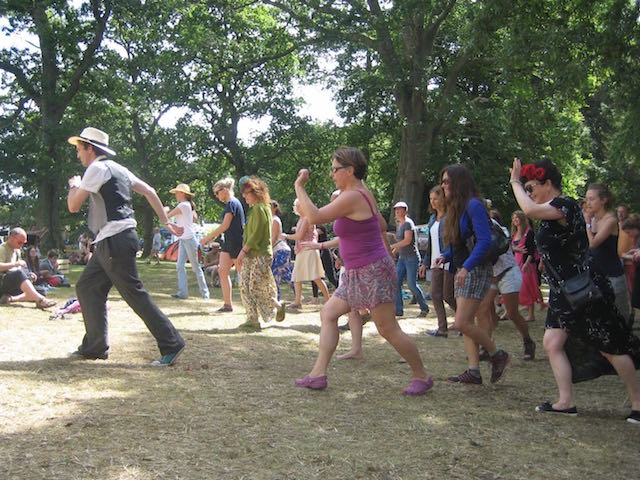
    This is the second workshop I have run in the ‘Everyday Creativity for…’ series, this time for blues dancers in the London blues scene. A huge thank you to Ellie and the Sunday Shake Off crew for inviting me down.

    The premise is that blues dancing is an inherently creative activity (maybe even more so than lindy hop?), and by interrogating what we are doing when we are dancing blues we can find creative strategies and techniques that we can use in other parts of our lives, from personal projects to professional work.

    This workshop was a truncated version of the full workshop that I run for swing dancers. Into an hour we managed to squeeze in:

    • Thinking of creativity as a system, and understanding the parts of that system
    • The influences we draw upon in our swing dancing and in our professional work
    • Generating connection with your collaborators and your audience
    • Strategies for stimulating divergent thinking
    • The value of doing really silly things.

    Keep an eye out on this site for dates when I’m planning on running the full workshop again.

    Related posts

  • Use these 5 apps to create distraction-free time.

    Use these 5 apps to create distraction-free time.

    We need distraction-free time to make progress on our creative projects. At the same time, we rely on online networks and information to nourish our ideas. The trouble is, spending time online is rarely distraction-free. So, is it possible to get the best of both worlds?

    The short answer is yes. In this post I share the strategies that I have adopted to maintain distraction-free time while working online. These include five apps that I regularly use to manage what information I see and when.

    This post follows on from my previous post 9 ways to build creativity in your organisation, focusing on steps that individuals can take to manage their own creativity. Expect more from me on this theme in coming posts.

    Principles

    There are four principles that underpin my approach:

    1 – Know your mode

    In his book ‘Getting Things Done‘, David Allen tells readers not confuse time when you are processing actions with time when you are completing an action. The same is true for working online. Be clear about whether you are meant to be processing emails/tweets etc, completing an action or, importantly,  spending time reading.

    2- Avoid the inbox

    Enter the inbox, get all the information you need out of there, and then leave. If you return when you are in the middle of something else, don’t be surprised if you get distracted.

    3- Reduce the back-and-forth

    Just because we can respond instantly, doesn’t mean we have to. Instant responses lead to communication inflation, and erode time to ourselves.

    4- Remove notifications

    Until the last 100 or so years, toothache must have been the bain of adults lives – always nagging, never leaving us in peace. Today, in the age of modern dentistry, what nags us instead, what disrupts our peace, are social media notifications. If we set regular times to look at our various feeds, we don’t need notifications.

    5 apps

    I am being generous with the definition of ‘apps’, here to mean both ‘app-lications’ and ‘app-roaches’.

    1 – Task management – use Bullet Journal

    The first app isn’t an app at all, it’s an instead-of-an-app. For years I’ve been playing around with lots of different apps for managing tasks. My favourites are OnmiFocus and Trello. The trouble with even the best of these tools is that they allow you to create never-ending lists of tasks that you could never get done.

    Bullet Journal is different. It is no more than a set of rules for using a paper notebook to manage your tasks. It’s simple, and it works. Each day you write down the tasks you need to complete. At the end of the day, you either forward incomplete tasks to the next day, by physically writing them out again, or your forward it to a page for the week or even month ahead, again physically writing down the tasks. It works because every time you re-write something you end up saying to yourself, ‘come on, am I actually going to do this?’

    I’ve been using it for four months now and I’m hooked. Here’s a great intro video for using Bullet Journal.

    2 – Information storage and online workspace – Evernote

    Evernote is a great tool for storing information and for working online. Here’s how I use it to minimise distractions.

    1. As I am processing emails, if I find something that I need to refer to later for a particular project, I forward it to Evernote (which you can do straight from your email), adding meta tags in the subject line so that Evernote can file it for me.
    2. When I am working on a project, I can then look through the notes filed in Evernote that have that project tagged. It’s a great way to get to the information without being distracted by something new in the inbox.
    3. I do all first drafts of longer emails in Evernote – I can even send them from Evernote without having to go back into my inbox.

    One really neat feature of Evernote is that as you use it more and more, it starts to recognise when something you are writing is similar to a previous note – this has the added bonus of making connections that I hadn’t otherwise seen.

    3 – Online reader – Instapaper

    Until I discovered Instapaper, I had basically stopped reading the articles that people were sending me online. This happened as a consequence of being rigourous about not spending more than two minutes processing any email that someone had sent me. If a correspondent had sent me something to read, I would forward it to a folder called ‘browsing’ where it would then languish unread.

    And then I discovered Instapaper, an app that you can forward reading informaiton to. When you open the app, all your articles are there but with the formatting stripped away. What’s left is really clear to read.

    Since then I usually make at least one time a week when I sit down with a cup of coffee and read my articles for the week on Instapaper. It is really refreshing to spend time reading longer articles from end to end.

    If I like what I read, I forward it to Evernote, tagged for appropriate interests. If I want to share it with other people, I forward it to Buffer – see below.

    4 – Schedule social media posts using Buffer

    I know from looking at the analytics that most of the people that follow me are online at times when I’d rather not be. To get round this I use Buffer to schedule some of my social media posts to maximise the chances that the people I want to see the post do. Buffer allows you to set up daily posting schedules for all your social media channels. You can save time by posting to several channels simulataneously. Buffer will tell you what times your audience members are interacting with your contact, and can adjust your posting schedule to suit.

    5 – Clear yesterday’s messages today

    This is a great rule of thumb that I only came across recently in the Guardian (thanks Jenny for the recommendation!). I’ve long abandoned the idea of having an empty inbox – as a strategy it takes too much time and I think can actually lead to more email traffic. In this approach, on any given day, you should only aim to deal with yesterday’s emails. You are still responding within 24 hours, which is a reasonable timeframe, but your response has to be carefully written as you have to empower your correspondent to act without hearing from you againfor 24 hours.

    Conclusion

    My Dad once quoted the following to me (I am hoping he can remember where it came from and can tell us in the comments to this post): getting information from the internet is a bit like trying to take a sip of water from a fire extinguisher.

    Yes, we need access to online information and networks for our creative projects – we just need to manage the flow.

    Related posts

    Image credit: Fire Extinguishers by Claudio González is available under CC-BY-2.0

  • The Happy Grid: prioritise your action list in a more fulfilling way

    The Happy Grid: prioritise your action list in a more fulfilling way

    The Happy Grid is a technique I devised a few months ago to help me use short and long-term happiness as a guide for daily decision making. Since I’ve been using it, it has had a hugely positive impact on me: I am better at prioritising work that makes me more fulfilled, and hopefully the people I collaborate with get more out of working with me.

    In this post I’ll explain how to set up your own Happy Grid. I’ll also go through the four different task types that make up the grid, and what these can tell you about the pressures that influence how you use your time. It’s a long post, but stick with it as I think there’s a lot of useful stuff here.

    Background

    The story begins at the end of a busy week. I had ticked off all the most important actions on all my major projects. I should have been feeling happy, but I felt quite depressed and that depression extended into the weekend. It was confusing because this was supposed to feel good – to have not sucumbed to distraction and to have done the things on which other people were depending on me.  Yet I didn’t feel any payback for getting to the end of the list.

    A few weeks before I had been on holiday. One of the things that I do when I have some time away is write two lists in my journal: the first, a list of goals for the year ahead; the second a list of things I feel happy doing – a list of things that bring happiness in the moment.

    I decided to map my ‘done’ list against my lists of goals and things I enjoy doing. The result was very revealing.

    The Happy Grid Diagnostic Test

    To help you get the most out of reading this post, I suggest you do the following quick diagnostic test right now. Do it quickly on a piece of paper. You can always go back and do it more thoroughly. I am going to ask you to write down four lists.

    Current goals

    First, write down a list of your current goals. Think of goals on a say a 3- to 6-month horizon. Include in your list the sort of state you want to find yourself in. So for instance one of my goals was to spend more time doing face-to-face teaching. Another is to spend time with people who positively influence my thinking. Neither of these goals are to do with attaining some kind of status. Think broadly. Do you want to spend more time inside or out? Are there things you want to learn?

    Anti-goals

    The second list of of things you don’t want to achieve. Think of these as anti goals. For instance I don’t want to spend more time in front of a computer screen. I don’t really want to get involved with teaching projects where I don’t have influence over the content. I don’t really want to get involved in building a new knowledge management system for the business, even though this is something I’ve done before. Knowing what you don’t want to do is as important as what you do, but is sometimes harder to elucidate.

    Enjoy doing

    The third list to write down is a list of things you enjoy doing.. Think of things that make you go into a state of ‘flow’ when you do them, when time just flies by because you are enjoying yourself, but equally which keep you challenged. Think of things that you get a buzz out of because you enjoy doing them. My list includes things like teaching and coaching, writing new teaching material. But it also includes travelling by train, cycling, spending time with family and friends, spending time outside.

    Drag list

    The fourth list to write down is things that you don’t enjoy. These are things that feel like a drag. For me that list includes small-scale management of projects. This is something that I don’t enjoy and recognise that there are other people who do this much better than me. It also includes the opposites to the things I enjoy doing – so I don’t enjoy being inside all the time, I don’t enjoy being alone for too long.
    You are now ready to create your own Happy Grid.

    The four types of tasks

    I reasoned that the tasks on my to-do list fitted into one of four categories, which I labelled and described as follows:

    • Type-1 tasks – Tasks that are goal-aligned and enjoyable. These are things we should prioritise because they feel good to do, and because they are contributing to a goal.
    • Type-2 tasks – Tasks that are not goal aligned, but nevertheless enjoyable. It feels good to do them but it doesn’t help us reach one of our goals.
    • Type-3 tasks – Tasks that are goal-aligned but unenjoyable. We generally need to do them for long-term happiness but doing so doesn’t feel good.
    • Type-4 tasks – Tasks that are neither goal-aligned nor enjoyable. Doing these doesn’t feel good in the short- nor the long-term.

    Creating your Happy Grid

    Create a 2×2 grid and label the four quadrants as follows.
    Type 1     Type 2
    Type 3     Type 4

    Now, go through each entry in your current to-do list, and write it down in the quadrant of the grid to which it corresponds.

    When I categorised and wrote down my list of completed tasks for the previous week, I found that the majority of what I had got done were Type 4 tasks: tasks that are neither enjoyable nor contribute towards longer-term aims, with a smattering of Type 3s and Type 2s. Revealingly I didn’t have anything written down in the Type 1 quadrant, the one that feel good to do and contribute towards some positive goal.

    I felt I had landed upon a key prioritisation tool for the week ahead.

    Understanding the four tasks categories

    Clearly we don’t have the luxury of only doing Type-1 things. But categorising things in this way can at least help us be more aware of the nature of the list of tasks before us, and can help us make more fulfilling choices about what we do. And beyond being simply aware, we can actively make decisions to help us spend more time doing things that we enjoy.

    Let’s explore each of these categories in turn.

    Type-1 tasks – goal-aligned, enjoyable tasks

    In an ideal world, we’d spend the majority of our time doing these sorts of tasks. Half the trouble is simply knowing what these goal-aligned, enjoyable tasks are. The aim of the happy grid is to help us identify the sorts of things we enjoy doing and that are goal-aligned, and to make sure we are spending at least some of everyday doing things that are likely to make us happy.

    By regularly repeating the diagnostic exercise described at the start of this post, you can start to recognise  Type-1 tasks. Identifying and writing down type-1 tasks is the first step to making sure you spend more time doing what makes you happy. The second step is managing and steadily reducing the time you spend doing Type-2, Type-3 and Type-4 tasks.

    Type-2 tasks – non-goal-aligned, enjoyable tasks

    Type-2 tasks are enjoyable in the moment but don’t necessarily contribute to what you want to achieve long-term. The worst Type-2s are tasks that you enjoy doing but that lead you towards anti-goals, the things you really don’t want to be achieving.

    Browsing the web, flicking through social media and sharpening your pot of colouring pencils generally fall into this category. Another word for this type of Type-2 task is procrastination. For procrastination Type-2s, you would be better off doing something from your Type-1 list. If you set up your Type-1 list appropriately, you will always have something more enjoyable to do. But also falling into this category without being procrastination are Type-2 tasks that you might enjoy doing in their own right, but that doing too often will steer you off course from the goals you do want to be aiming towards.

    To give a personal example, I enjoy developing concepts for online learning tools, but it would be a non-goal to build a career in which I end up having to spend more time in front of a computer. On the contrary, my goal is to spend more time doing more face-to-face teaching and to minimise screen time, and so spending time developing proposals for online learning tools, while enjoyable in the moment, is not necessarily getting me any closer to where I want to be.

    This is a very common scenario in the workplace. The organisations that we work for tend to reward us for doing things that help the organisation meet its aims. Less enlightened organisations do it by fiduciary means; more enlightened organisations might try to align individual goals with organisational goals, but in practice this is hard, and in reality tasks get allocated on the basis of best person for the job, rather than best job for the person.

    As Peter Drucker points out in his book, ‘How to manage oneself’, it is up to us as individuals to tell managers what work we do well and how we do it best, and not up to our managers to guess.

    By definition, Type-2 tasks are enjoyable, and so on any particular day, doing lots of Type-2 tasks isn’t a problem. But over time, time spent on Type-2s is at the expense of time on Type-1 tasks. So how should we reduce the Type 2s?

    Minimising the Type-2 tasks

    For the procrastination Type-2s there are lots of options for reducing distraction, which I will cover in another post. As for the more structured work-based Type-2 tasks you can:
    • Avoid taking them on in the first place. Before you take on a new task, look at where it will go on your Happy Grid. If it’s a type 2, consider politely turning it down.
    • Try delegating – after all, just because a task doesn’t align to one of your goals, it might align to someone else’s.
    • Try to find a way to recast the task so that it does align to one of your goals.

    Type-3 tasks – goal-aligned, unenjoyable tasks

    If you don’t get Type-3 tasks done then you won’t meet your goals. But the chances are you are unlikely to do Type-3 tasks because, by definition, you don’t enjoy doing them.

    Here you have two options: either delegate the task, or set up a regular routine that ensures you get them done reliably and in as short a time as possible in order to liberate your time for Type-1 tasks. A personal example of such a routine is that time I set aside each week to deal with expenses. I don’t enjoy it, I need to do it, and I do it the same time on Wednesdays without fail. Then the rest of the week I don’t have to think about it.

    It is important to be disciplined about carrying out the routine so that you be confident the rest of the time that these Type-3 tasks can wait until the next time you carry out your routine.

    Type-4 tasks – non-goal-aligned, unenjoyable tasks

    These are the tasks that we want to minimise. We don’t enjoy doing them and they aren’t getting us any closer to any of our goals. As I discovered, a week full of Type-4 tasks is an unhappy week.

    As well as not making us feel good, Type-4 tasks come with an opportunity cost: they are preventing us doing any of the other 3 types of task, all of which would make us happier, not least of all, Type-1 tasks. We should make it our business to try and reduce as far as possible the Type-4 tasks on our list.

    Minimising the Type-4 tasks

    We can start the Type-4 purge using the techniques we used for Type-3s and Type-2, in decreasing order of preference:

    • Avoid taking them on in the first place – once we know what counts as Type-4, we can spot it before we say yes.
    • Try delegating – as above, there may be someone else for whom the task is more enjoyable or for whom the task is more goal-aligned.
    • Set up a strict routine for getting this type of task done quickly. See the notes above for Type-3 tasks. If you take this approach, experiment with running the routine as infrequently as possible so you don’t let the time spent doing it creep up too much.
    • Just don’t do the task and see what happens. It is very easy to think that a task is important when we are caught up in the moment, but given some distance and time, some tasks can just go away. Either someone else does them, or, because it isn’t done, alternative options open up. You may well end up being thought of as unreliable, but better that than being reliable at doing something you don’t want to.

    If having worked through the above options, and you decide you can’t’ simply not do the task, then it is time to start asking some serious questions about the sort of activities that you do. But saying that is not so gloomy as this process gives you a constructive way to talk about what it is you do want to do.

    Prioritisation using the Happy Grid

    Setting up your first Happy Grid should be revealing in itself. But it is also meant to be a decision-making tool. Having distributed your tasks into the grid, what should you do first?

    For grown-ups, I don’t think the get-your-homework-done-before-you-go-out-to-play approach counts any more because there are so many factors influencing us to get things done to meet other people’s aims. You need to start prioritising your own goals. So I would recommend starting the day with either a Type-1 or Type-3 task. Let the happiness that you derive from getting that thing done first then set the tone for the day ahead.

    Reflective use of the Happy Grid

    I am finding that the more times I use the grid, the better I am getting at understanding my own motivations and goals, and the more adept I am becoming at making sure I am not getting lumbered with things that I don’t enjoy doing.

    I believe being more aware of these things is better for everyone. As Peter Drucker says, we are much more likely to perform well doing work that we enjoy and that we are motivated to do. More philosophically, Seneca said ‘Life is long if you know how to use it’. It is up to us to positively decide how to use our time in a way that will make us happy.

  • Podcast Episode 1 – Engineering, creativity and practical philosophy

    Podcast Episode 1 – Engineering, creativity and practical philosophy

    I’ve been thinking about creating an Eiffelover podcast for over a year. Last week at Port Eliot festival I saw John-Paul Flintoff (@jpflintoff) give a great talk on creativity in which he challenged us to name one creative project that we want to do, and commit to taking the first step…

    And so this is it, the Eiffelover podcast, the first of what I hope will become a regular digest of matters engineering, creative and practically philosophical garnered from the people I meet, the workshops I run and the material I read. I hope you find it useful.

    To kick off, I created my first episode here at Electromagnetic Field camp, a non-profit UK camping festival for those with an inquisitive mind or an interest in making things: hackers, artists, geeks, crafters, scientists, and engineers.

    In this podcast I meet some of the fantastic people here at EMF camp and their imaginitive creations, I dig around to find out what makes these creative people tick, and I get into a fascinating conversation with Richard Sewell about ‘Thingness’, a term he and his colleague coined to talk about the power of making things. Listen now to learn more.

    People mentioned

  • 9 Ways to Build Creativity in your Organisation

    9 Ways to Build Creativity in your Organisation

    Creativity doesn’t happen on its own, it happens in a social context. So if we want to build creativity in organisations, we need to focus not only on the individual but also on the overall system within which creativity takes place. So argues leading creative thinking psychologist Mihally Csiskzentmihalyi in his article ‘The Implications of a Systems Perspective for the Study of Creativity’, which appears in Robert Sternberg’s Handbook of Creativity. I’ve been working on a longer post in which I extend his systems model to explore design as a whole. That post is becoming a bit theoretical, and so I offer up this post as a series of practical suggestions that can be applied by anyone who would like their organisations to benefit from more creative thinking.

    The systems model of creativity contains three elements: the creative individual; the domain, which is the pool of existing ideas; and the field, which is the people who decide whether or not an idea is a good one. Using this model, the individual creates new things by adapting ideas that have gone before (things in the domain). These novel outcomes are then judged to be acceptable or not by a third party (the field), say colleagues, a client, a design jury etc. If the idea is judged to be good then it enters the domain – that is, it becomes recorded somehow and can then become the seed of another idea.

    This model is useful from an organisational development perspective because it offers three areas to focus on for stimulating more creative outputs. I have seen that in practise, certainly in engineering, Csikszentmihalyi’s terms ‘domain’ and ‘field’ can be confusing, so I propose ‘database’ and ‘audience’, respectively.

    The following is a series of practical suggestions for how to develop each of these components of the creative system in organisations.

    Building the creative database

    1) Seek out innovation

    If you want to your organisation to be at the creative forefront of a particular domain, then make sure your people have ready access to the latest thinking in that domain. Contact with the existing thinking on a topic can promote thinking about the next iteration.

    I recently vistied a school where the principal wanted to encourage his staff to start thinking creatively about how to furnish their classrooms. To seed their thinking, he ordered in some innovative new chairs designed to improve the way children study in classrooms. He just put them out in his office. When members of staff asked about them he said try them out. Staff members then started experimenting with these chairs in different configurations. In the end, they ended up using completely different models that they’d researched in configurations that suited their own needs. This creative thought had been stimulated by allowing them to dip their toes into the domain of chair design – which then prompted them to dive in.

    2) Become a hub for different ideas and ways of thinking

    As Csikszentmihalyi points out in his paper, cities that have been trade hubs have commonly been centres of innovation because ideas and ways of thinking from completely different domains can come together.

    Find ways to turn your organisation into a hub for different ways of thinking. Invite people in with completely different backgrounds and areas of expertise to talk about their work, what innovation is in their domain, and how they approach problems. Doing so will widen the available categories in your database from which ideas can be drawn.

    3) Record your existing ideas

    It’s hard to make a change to something which isn’t already described.

    For example, so much of what we do in organisations, particular in knowledge-based organisations, is not written down. Doing so doesn’t feel very creative. But doing so is a necessary starting point for creating new approaches to how we might work.

    Recently I was worried that I wasn’t being very imaginative about the way I spent time with my daughter. So I started by writing down all the things that we already do together that we particularly enjoy, and quickly, starting from this list, I was able to create a load of new suggestions.

    Get the existing thinking down on paper so that it can seed the next creative iteration.

    Building creative individuals

    4) Collate

    This is about the creative individual engaging with the database; about building a palette from which they can paint their ideas. Song-writers collect lyrics and interesting chord progressions. Chefs collect recipes.

    I collect facilitation techniques by always asking people I know after they’ve attended a workshop what techniques they enjoyed. I write them down in Evernote, and refer to this list when I am designing a workshop.

    The thing about the process of collation is that it requires attention, more than just a passive engagement with the content. I believe this attention makes it easier to recall useful information in the moment of creation.

    Identify the area in which you want to be creative, and build your scrapbook.

    5) Create distraction-free time

    There are times when we need to focus our attention on generating ideas. There are other times when we let our mind wander, when the subconscious chews on the problem, and then the idea spits up. Both of these thought processes can be jeopardised by distraction. But in the modern workplace, distraction is everywhere: from notifications on every screen we use, to the interruptions that ensue from open-plan offices.

    In the coaching conversations I have with people about developing design skills, the lack of distraction-free time is one of the commonest barriers to creative thinking.

    For individuals, creating this time has two components. The first is mastering the technological distractions, getting rid of the notifications that keep us flitting from one place to the next. The second component is identifying and persuing activities that let your mind wander.

    Organisations that want to create distraction-free time for their staff should consider developing work processes that don’t rely on staff being permanently plugged in. They should also allow their staff to work at the time and places in which they are most creative.

    6) Generate and communicate

    The creative process works through interaction between the creative individual and the audience. It is a dynamic relationship.

    To start with, the individual needs to be creating ideas. There are a range of techniques for stimulating this divergent thinking, which will be the subject of another blog post.

    But having the ideas alone is not enough, they need to be effectively communicated to the field. Draw ideas, write them down, pin them up where they will be seen, talk to people about what you are thinking, and you will give your ideas the chance to grow.

    Building the creative audience

    7) Produce surplus energy

    This comes straight from Csikszentmihalyi. If a group of people are spending all their energy fighting for survival then they don’t have the energy for creative activity.

    Most organisations could probably prioritise their activities in such a way as to make more energy (time, money) available for creative thinking. Creativity is a social affair: everyone has a role to play, either as the conceiver of ideas, or as the audience. Therefore it is important that everyone feels there is enough fuel in the tank to justify time spent on creative pursuits.

    8) Build a culture of listening

    It is through dialogue with the relevant audiences that the creative individual can assess the merit of their ideas.

    As Nancy Kline describes in her book ‘Time to Think‘, we often do our best thinking in conversation with others, but this requires careful attention on the part of the listener, letting them develop their thoughts without interruption.

    Talking about ideas should be a hallmark of creative organisations.

    9) Build a culture of challenge

    There is a lot of evidence for intrinsic motivation supporting creative thought (a summary of this to come in a future blog post, no doubt).

    One way to build intrinsic motivation is through identifying in conversation challenges that need addressing. If the challenge feels like their challenge then they are more likely to be intrinsically motivated towards tackling it.

    Another technique for building intrinsic motivation is to challenge individuals to reach further in their thinking, and helping them to remove hurdles which may have been holding them back.

    To conclude, creativity doesn’t happen in isolation in people’s heads, it happens in a context. To create more creative organisations, we need to work on the context as well as the individual.

    Related posts

  • Does going for a walk improve design?

    Does going for a walk improve design?

    Taking a walk at Port Eliot Festival

    I have just read an interesting piece on the Stanford university website, ‘Stanford study finds walking improves creativity’ (article found via this news piece on the Hazel Hill Wood website). The article describes research that has for the first time investigated the impact of ‘non-aerobic walking on the simultaneous creative generation of new ideas and then compared it against sitting’. I had an intuitive idea that going for a walk improves the quality of my ideas – an example that springs to mind is a catchy tune I wrote on short walk back from the library at college. This research shows that ‘creativity levels were consistently and significantly higher for those walking compared to those sitting.’ What’s more, they stayed high for a short period after sitting back down again.

    But the striking thing revealed by this research is that the walking environment doesn’t seem to make a difference. I had assumed that going for a walk outdoors in the woods would be good for my creative thinking, but this study shows that the boost to creative thinking is just as powerful when you take a walk on a treadmill in a featureless indoor room!

    This result has obvious implications for how we set ourselves up to do good design, but there is another significant finding reported further down in this news article that also has important implications for design. While walking helps to boost divergent thinking, it is shown in this study to impede ‘more focussed thinking, characteristic of insight’.

    So how can we use these findings when think about how we do design work?

    In the design training that we have been developing at Think Up, we describe design as a process that starts with identifying a need and establishing a brief, that moves through idea generation and testing, and moves on to choosing the best ideas. These stages are linked by iterative loops which take you back through the process many times.

    The obvious place for divergent thinking is in the idea generation phase, but there are others. Right at the start when we are identifying the need, we often need to think around the problem to check if it has been framed properly. We also need to have an open-minded view of the client brief if we are to unpick the unwritten and implied elements of what the client wants. We also need to apply some divergent thinking to enable us to think of all the factors that are going to determine whether our ideas are good ones, rather than simply relying on the usual tests we apply.

    There is also an obvious place for convergent thinking: at the part of the design process where we are refining our ideas, and when we are testing them for adequacy against the brief. But there are other places where we need insight: when we are trying to choose the factors in the brief that are going to dominate the design; and when we are trying to make a decision based on hard-to-compare factors.

    So there is a place for walking and a place for sitting in design.

    Unfortunately, from what I have observed in design offices, we tend to do too little of the latter and not enough of the former. What we could learn from this research is to be more mindful of the type of thinking that is required at any one time and to move or stay still as appropriate.

    We should also beware of metaphorical trip hazards. There’s no use in going for a divergent thinking walk if we are distracted by our smart phone en route. Turn it off! And our creative reverie stands a good chance of being extinguished if when we return to our desks we find a set of monthly sales figures demanding our attention. In other words it is probably a good idea to think about that environment you will be returning to at the end of your walk.

    Related posts


  • Designers: turn off your phone – harness the wandering mind

    Designers: turn off your phone – harness the wandering mind

    Fireside reflection at Hazel Hill wood. Photographer: Peter Clarkson
    Fireside reflection at Hazel Hill wood. Photographer: Peter Clarkson

    I recently read Daniel Goleman’s excellent book Focus, and I have been thinking about how our ability to focus affects our ability to design. This thinking was the basis of a workshop session that I recently wrote about harnessing ‘wandering mind’, that mode in which the brain roams freely and forms new associations which are the basis of creative thought. I piloted this material as part of Think Up workshop on creativity that we ran at Hazel Hill wood in July, which seemed to go down well, so I am sharing it here.

    Below is a modified extract from some of the course materials associated with this activity. I’d be interested to know if anyone reading recognises these phenomena or tries the approach I am recommending.

    In his book Focus, emotional intelligence pioneer Daniel Goleman explains that the brain can really be understood as having two distinct sets of circuitry: the lower brain and upper brain. The lower brain whirs away in the background working on solving problems without us even noticing. Its activity only comes to our attention when it produces an idea as if from nowhere. The upper brain by contrast is the seat of self-control and is the part of the brain that we actively focus on a problem.

    In evolutionary terms, the lower brain is the older part. The lower brain is the source of our impulses and emotional reactions. The upper brain can repress these impulses, but at the cost of diverting our attention from the design challenge on which we want to actively direct our focus. In this instance, the lower brain circuitry is causing a hindrance to creative thinking.

    However, the lower brain does have a crucially important role to play in design. Research shows that in the moments before people achieve creative insight, their lower brain has been in a state of open awareness. In this state, the mind wanders freely, widely and without judgment to create new associations. When these new associations are made, the upper brain then locks in on them and fishes them out into our active attention.

    In order to harness our wandering minds as part of the design process, our upper brain needs to be ready to spot a good idea when it emerges. To do this we need to do two things. The first is to make time in which we stop actively thinking about things and let out thoughts come to us, for example, going for walk or even going on holiday. The second is to minimise distractions, which divert our active attention away from spotting new ideas as they emerge from the lower brain. In other words, making time we when turn off our smart phones and blocking out interruptions.

  • What makes a good conceptual design statement? – working notes

    What makes a good conceptual design statement? – working notes

    Gateshead Millennium Bridge
    Gateshead Millennium Bridge

    Today I am working on course material related to defining what is a good conceptual design. I think, in construction at least, it is quite difficult to identify good conceptual design from the finished project. One can judge a finished project on the basis of the final outcome, but unless you have had an overview of the whole design process, it is hard to know how much the final project resembles the original concept design.
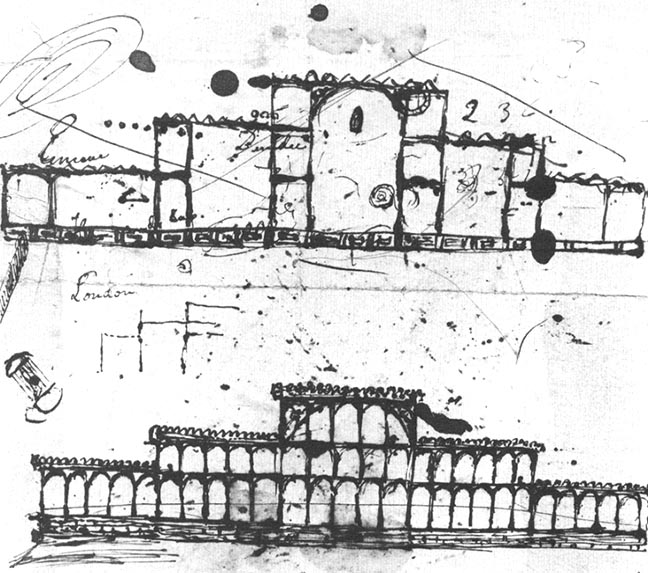
    One clue is in competition sketches, if they are available. It is tempting to suggest that if a simple early-stage sketch exists that closely resembles the final project, then we have a good conceptual design. Good examples might include Paxton’s sketches on a napkin for Crystal Palace or the Utzon’s competition sketches for the Sydney Opera House. But (and I’m not suggesting it was the case for these two examples) it is not beyond designers to create a post-rationalised concept diagram. And while this idea of the simple sketch is also beguiling, it is much more appropriate for projects that resemble a sculpted object, rather than a complex system.
    From a training perspective, if we were to stand in front of a building and seek to judge the quality of the conceptual design without knowledge of the early-stage design process, I think we’d be on shaky ground. The approach we will adopt instead is to spend time defining what a good conceptual design statement looks like so that designers can judge the quality of their conceptual designs at the start of the project.
    There are lots of definitions of what a good conceptual design statement is. My colleague Ed McCann has pointed me towards a helpful description from the world of interior fit out. In his book Shaping Interior Space, Rengel describes the three elements of a good conceptual design statement as:
    1. Talking more about the solution than the problem
    The place for the statement of the problem is in the brief.
    2. Selective
    Here he means it talking about the dominant factor which is going to define the design approach. Is it a question of how a long span is going to be achieved, huge forces are going to be resisted, or what the human experience is.
    3. Economical
    Careful use of words to pack the most into the fewest words.
    These three elements are something I can work on with a group of learners. We might begin by asking them to compare different conceptual design statements, and get them to elucidate these rules; and then get them to create their own statements.
    One key modification I will make to this set of rules to make them equally applicable to sketching as to words.
    If you are reading this and have either your own definition of good conceptual design statements that you use, or particularly good examples of conceptual design that you’d like to share, then please comment below.
  • Workshop inspiration from Jackson Pollock

    Workshop inspiration from Jackson Pollock

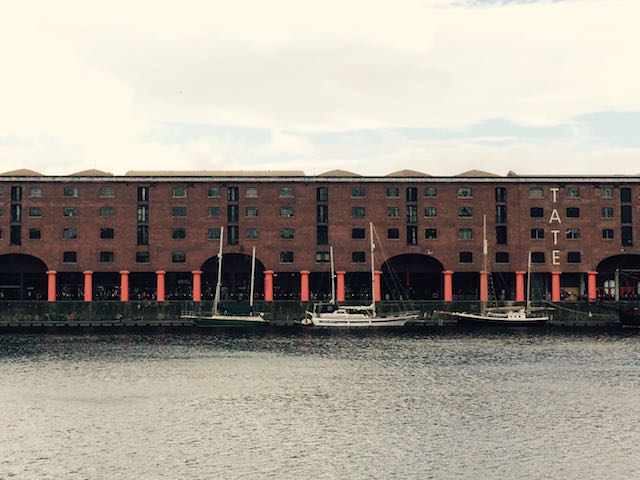
    Tate Liverpool across Albert Dock
    Today I went on a recce to the Tate Liverpool for a course we are designing at Think Up for a client. As I left the event hosting space I was left to wander the Jackson Pollock exhibition. The show will still be running when we hold our event, which great because I can see three ways in which this exhibition can be used to support the learning on our course.

    1. Working with the subconscious

    One of the features of the model of idea generation that I will be introducing is the important role of the subconscious in creativity. In Daniel Goleman‘s book Focus, he describes (more elegantly than I am doing here) how the ‘active’ brain is always on the lookout for useful stuff that the wandering brain generates. On this theme, I picked up some useful quotes from the exhibition notes:
    ‘Pollock’s aim to work directly from the subconscious led to a radical process of dripping and pouring paint over large canvasses placed flat on the studio floor…”the modern artist…is working and expressing an inner world – in other words expressing te energy, the motion, and other inner forces.”
    Then, this from another section:
    ‘Although there was an element of chance Pollock frequently spoke of the importance of decisions over the merely accidental.’
    My intention is to use Pollock’s work to emphasise the link between the conscious and subconscious in creative work.

    2. Relating to your audience

    Engineers often have to communicate ideas to audiences with different value sets. One place where there is commonly a clash of values is around aesthetics. Engineers typically get little training in aesthetics, compared, say, to architects. Therefore it is unsurprising that engineers can find themselves cut out of such conversations with the client when an architect is at the table. In the course that we are creating, we are not trying to run training on aesthetic appreciation, but simply intending to make the point that you need to understand the perspective of the audience you are dealing with.
    To help make this point, I think there is a role-play example that we can create that involves Pollock’s work, given the bumpy relationship he had with his audiences. One idea might be to get engineers to take on the role of Pollock’s agent, and to get them to persuade a critical viewer of the merits of his work.

    3. Thinking Hard

    Pollock reflects that ‘his new works require a lot from the viewer’. I find this exhibiton forces me to think hard, and not merely to engage with the surface, and I think the same can be said of good creative thinking. You need to think hard.
    To conclude, as ever, I’ll have to see if there’s time in the programme to fit in these ideas. I hope that there is.
  • Notes on ‘Teaching Design  in the first years of a traditional mechanical engineering degree: methods, issues and future perspectives’

    Notes on ‘Teaching Design in the first years of a traditional mechanical engineering degree: methods, issues and future perspectives’

    Constructionarium offers students the chance to build real civil engineeirng structures
    Constructionarium offers students the chance to build real civil engineeirng structures

    From the latest edition of the European Journal of Engineering Education (Vol 40 (1)) I have just read the very interesting paper ‘Teaching Design  in the first years of a traditional mechanical engineering degree: methods, issues and future perspectives’ by Silva, Fontul and Henriques. This blog is to capture my thoughts.
    I am conscious that while I and my colleagues at Think Up have been involved for many years now in changing the way design is taught in civil engineering degree courses, we have written relatively little on what we have been up to. This paper is a good introduction to some the issues associated with integrating design teaching into the first year of mechanical engineering degree courses. It offers some parallels to civil engineering teaching (I will look in due course for papers directly related to civil engineering)
    The authors describe how mechanical engineering is traditionally taught through a series of separate courses with little cross-over and little opportunity for interdisciplinary design and open-ended problem solving. They describe a pilot project in which a design project is spread across three early modules in the course. Briefly, during two modules on technical drawing students design a simple innovative product, and create a prototype; and then in a subsequent course on materials they have to choose a material to manufacture it from. Some of the benefits are that learning is massively enhanced because students have to build something. Students learnt that iteration is a necessary and valuable process and not an admission of failure. And interestingly, students become aware of what they don’t know, which motivates them to learn in later courses. One of the challenges that this form of teaching throws up is that it takes much longer to facilitate.
    Reflections on relevance to civil engineering teaching
    • I haven’t yet seen a survey on how design is taught on civil engineering courses, but I have a reasonable idea. For the last ten years or so design has become a feature of most courses; however it seems often to exist as a stand-alone module at the end of the year, or a task within a module, tackled from the perspective of that course only. The innovation here is that one design project is taken as the common thread across three separate courses. During each course that design project is tackled from the perspective of that course but due attention needs to be given to the perspectives adopted by the other disciplines of the other courses. A parallel in civil engineering would be for instances to spread a hydroelectric dam design project across a geomatics, fluid mechanics and geotechnics course.
    • The challenge with teaching design in civil engineering is that it is difficult to build what students design at a meaningful scale. I haven’t yet found the answer to this, but it regularly occupies my thoughts. It is possible at an elemental scale, for instance Ahmer Wadee’s plate girder make and break course at Imperial College; but harder at a greater scale. The Constructionarium is an example of a place where students get to build civil engineering structures at a meaningful scale, but students don’t get the chance to design what they are building.
    • In the report which we wrote on experinece-led learning we strongly advocated taking an approach in which students try to define what knowledge they would need to know in order to become a professional engineer. As my experience with Engineering Knowledge Club has shown , the process needs a lot of facilitated discussion as students initially have very little idea of what information they need. Reading this paper it seems that setting a design project early in the course might be an alternative way of meeting this aim.
    • I have previously written that interdisciplinary working is a skill that supports sustainable design, and this paper reminds me that interdisciplinary working can of course be achieved by running an interdisciplinary design course.
    • The authors note that this type of project takes time. In my seminars with lecturers  in civil engineering departments this factor is a common complaint. My response is that we have to look at course content and evaluate what is more important, the ability to solve open-ended problems and design more effectively, the skill which industry is looking for, or the mastery of specific technical skills to a high level, often higher than what is needed for practice.
    The paper also points to a number of other publications that I want to check out. In particular:
    • Dym et al (2005) Engineering Design Thinking, Teaching and Learning – Journal of Engineering Education – A summary of designing thinking, teaching and learning, including an analysis of first-year cornerstone design courses and curriculum dispersed design courses.
    • Marra, Palmer and Litzinger (2000) – The Effects of a First Year Engineering Design Course on Student Intellectual Development as Measured by the Perry Scheme – 2000 – Journal of Engineering Education.
    • Haungs et al – 2001 – “Improving Engineering Education through Creativity, Collaboration and Context in a First Year Course” – ASEE Annual Conference & Exposition, Pittsburgh PA  – Three major factors influencing negatively affecting creativity and retention rates in first year students:
      • 1) hard for students to see how course material relates to real-world applications
      • 2) students perceive engineering as an individual endeavour rather than an activity with peers
      • 3) engineering assignments are overly constrained
    • Bedard – 1999 – advocates a hands-onapproach to promote creativity in engineering education despite the risk of developing a reflex that trial and error can solve most problems and reduce student respect for the analytical component of engineering.
    • “Enhancing Student Creativity and Respect for the Linkages between analysis and design in a first year engineering course.
    • Hargreaves (2008) – Inherent balance between exposing students to challenge, and thus risk, and current higher education models of quality assurance that are risk-averse and thus potentially limit the scope of creative learning and teaching strategies.
    • Meinel and Leifer 2011 – “Design Thinking: Understand – Improve – Apply. Berlin: Springer.-  report on the HPI-Stanford Design Thinking Research Programme where students are taught the basic rules of design.
    • Hirsch et al (2001) – “Engineering Design and Communication – the case for interdisciplinary collaboration” – International Journal of Engineering Education 2001 – How teaching design and communication at the same can enhance the students’ ability to tackle future engineering courses and career.