Category: Diary

  • Workshop: Planning for learning – IDBE, University of Cambridge

    Workshop: Planning for learning – IDBE, University of Cambridge

    I was in Cambridge today to teach my first of four workshops this academic year on the Interdisciplinary Design for the Built Environment Masters programme.

    Part of my teaching bookends the course, with a workshop in week on planning for learning and a workshop in the final week on planning for practice. For the rest I feed in models for understanding the design process that students can use in their studio projects. 

    In this first workshop I introduce my Continuous Design diagram as a common framework for talking about design interventions. The Continuous Design diagram emphasises the continuous cycle of observing, intervening, observing, intervening that we need to do when we are making changes in complex systems. 

    We use this diagram to help participants design a learning journey for themselves. It is a good way to think about what your learning goals are, how you could achieve them and how you will know you are on track. 

    I conclude the workshop with an introduction to action learning and I lead participants through the Action Learning Proforma which I developed with Søren Willert a few years ago now.

    Continuous Design diagram
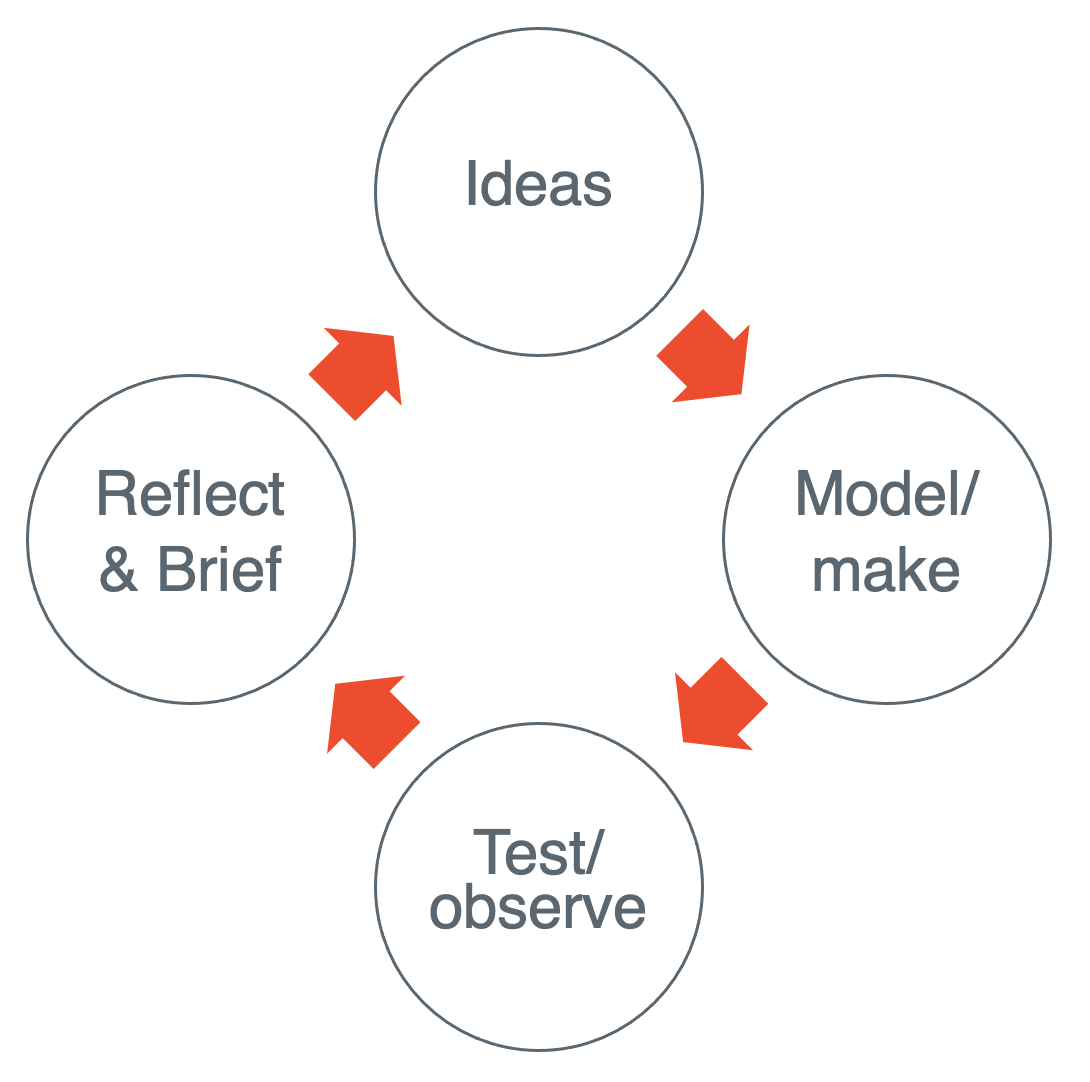
    Continuous Design Diagram by Oliver Broadbent (2021). The diagram shows a loop with four stages: Reflect/brief; Ideas; Make/model; and Test/observe

    This is only the third or fourth time I’ve used the Continuous Design diagram. I see its greatest strength as emphasising the cyclical nature of design, which becomes even more important as we start to think about how to design more regeneratively. 

    This was a particularly lovely day to be teaching in Cambridge. The morning was fresh. I enjoyed having breakfast in the hall at Selwyn College. By lunchtime things had warmed up and I enjoyed sitting for a few minutes by a tributary of the Cam, watching the clear water babble by.

    I am looking forward to returning in December when we will explore what a design brief is in more detail.

  • Notes from the Île de Ré

    Notes from the Île de Ré

    Our summer tour continues. From Batz-sur-Mer we took a TER train to Nantes. No cycle reservation necessary. And then from Nantes, an Intercité train to La Rochelle. This is the only service on our whole tour for which we did need a cycle reservation. At this point in the Tour I am now preferring the idea of having to make a reservation because at least you are guaranteed a place. Of course what we need is much more provision on trains for bikes.

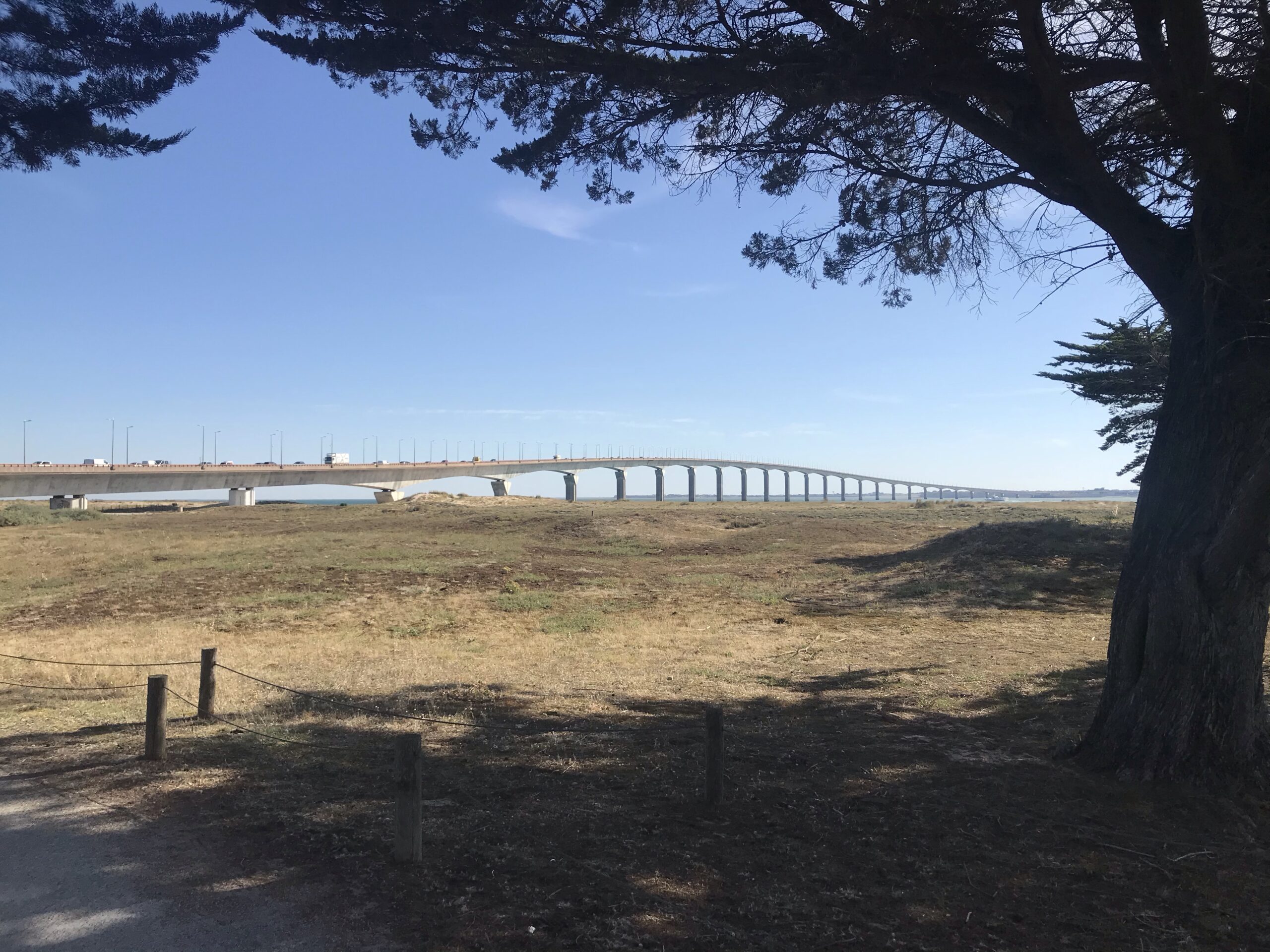
    From La Rochelle station we cycled straight through the old town, out of town and over the magnificent Île de Ré viaduct to the island where we would be staying for six nights. The following are selected Eiffel Over highlights.

    Île de Ré bridge

    View from the island side of the Île de Ré viaduct

    This is the 2.9km bridge linking the mainland to the Ile de Ré. Get all the facty stuff here from Wikipedia.

    • I find its curve on plan as well as on elevation very graceful.
    • There is a segregated cycle path which is a much better way to cross than to sit in a 2.9km jam with all the cars.
    • Very elegant columns too.
    • Impressive to see this structure marching out across the sea.
    • A significant portion of the tolls are spent on improving transport infrastructure on the island – see below.

    Cycling on Île de Ré

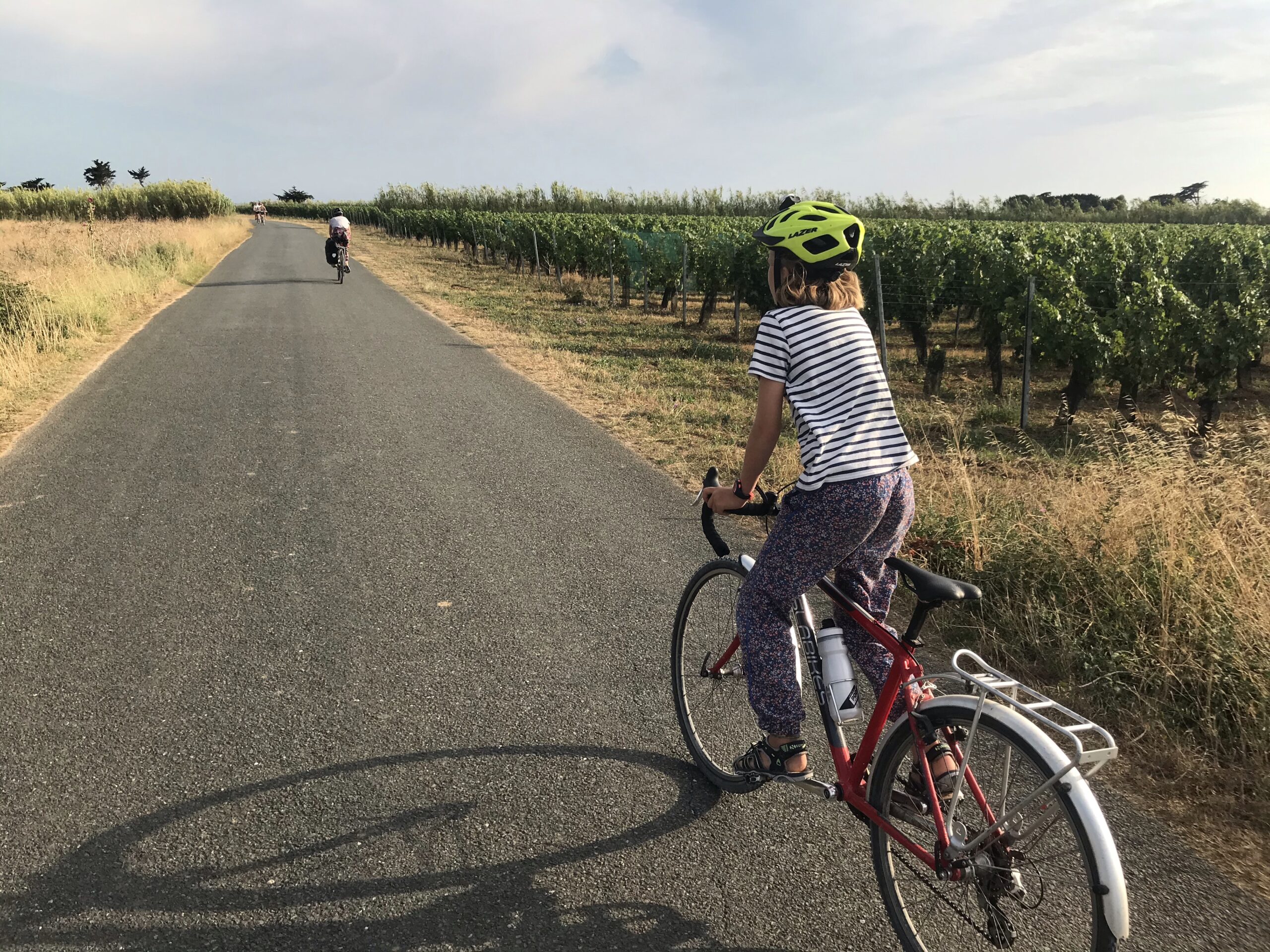
    Cycling between vineyards on the Île de Ré

    The local authority has invested heavily in promoting cycling on the island to the extent that it is a victim of it’s own success. There is a very comprehensive network of cycle lanes crossing the island. And these are very crowded in places because they are so popular. It is as if the island could do with doubling again the cycle infrastructure.

    Stone fishing ‘écluses’

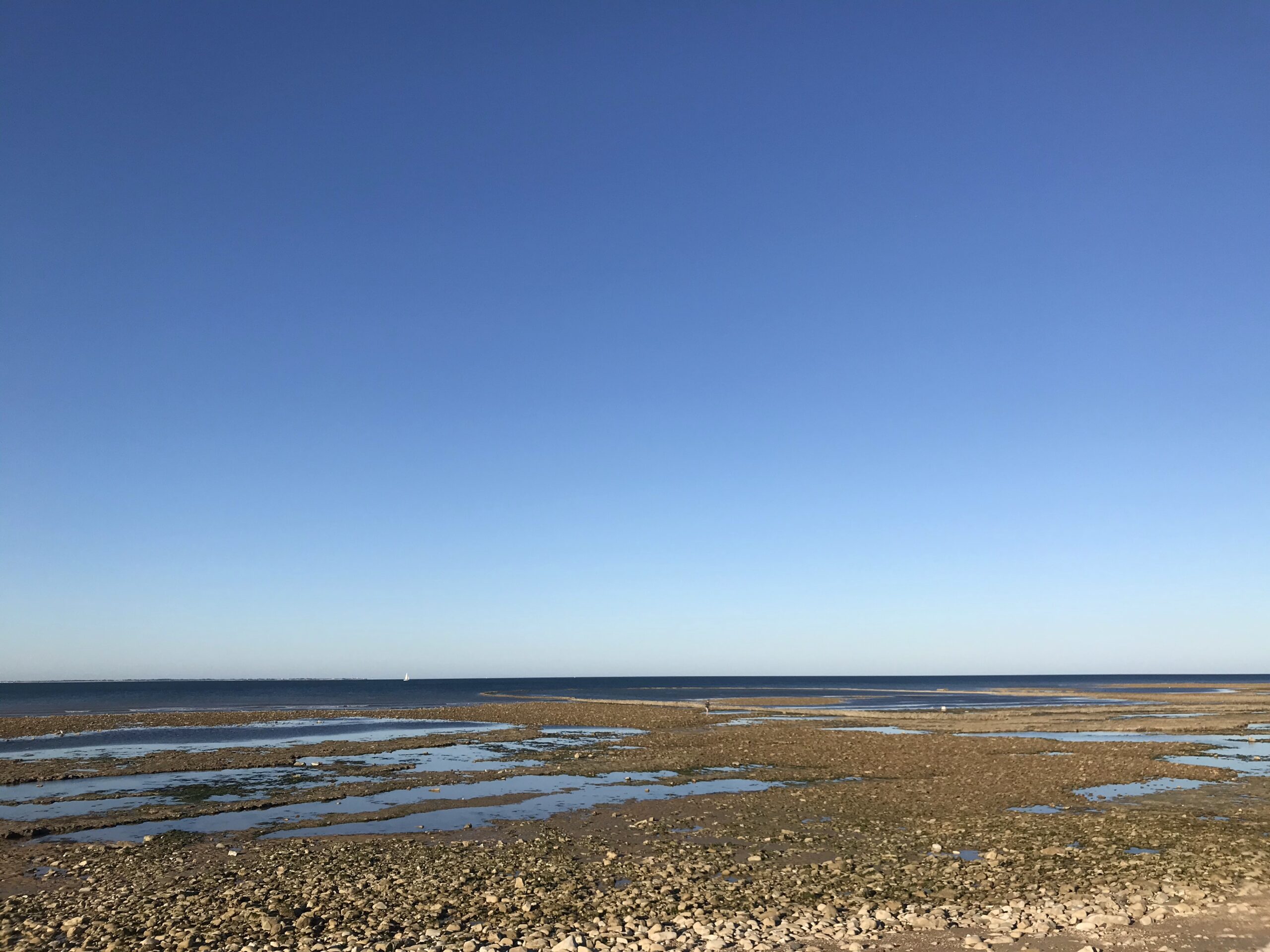
    The dry stone wall of an écluse can just be seen arcing out to sea in the top left of this picture from the Île de Ré.

    For centuries it has been traditional to build tidal lagoons on the beaches that fill with water at high tide and then which slowly drain at low tide, enabling local fishers to scoop up the fish left behind. The lagoons are created by building a large circular dry-stone wall on the tidal flat. Local laws forbid the use of concrete – these walls are carefully built by hand and maintained to create this once important source of food. Their French name is ‘écluses’, the same word for a lock on a canal.

    In the eighteenth century local officials destroyed the écluses to stop this source of food and forcing local men to sign up to join the navy.

    More unbelievably, in the second half of the twentieth century, the commercial fishing industry lobbied to have them destroyed again so that they wouldn’t eat in to potential markets for commercial fishing.

    In recent years there has been an effort to repair some of the écluses. We saw some people fishing in the one shown above at low tide.

    Like the salt flats they are an example of infrastructure managed in common to create an honourable harvest – to use Robin Wall Kimmerer’s term – from the local ecosystem.

    Final thoughts on the Île de Ré

    The Île de Ré is a fascinating place but the early August heat was almost unbearable and the summer crowds relentless – although in the further reaches of the island where M explored there were places where no one was to be seen. There is lots to find out about how people have lived in this island. And not just humans. For instance, two thirds of European bird species have been spotted here, it being a major stopping off point for migration. The sea life is also fascinating to explore at low tide.

    The visit makes me want to visit more wild islands. Maybe ones that are not connected by bridge to the mainland.

    After six days we were ready to cycle back over the bridge and head on south.

  • The Great Elephant – Les Machines de L’Île

    The Great Elephant – Les Machines de L’Île

    The highlight of our visit to Nantes was standing next to the Great Elephant as it set off for one its walks around the former dock yards. The 45-tonne steel and wood sculpture is part of the Machines de L’Île creations. At the centre is the workshop where engineer-artists create mechanical creatures that replicate real animal movements. The concept is that the creatures escape from the workshop to create the exhibits around the dockyard site.

    I find the whole place a wonderful combination of humour, heart, engineering, spectacle and wonder and reverence for creatures big and small. Definitely worth a 3 star engineering detour.

  • Salt harvesting in Brittany – engineering and commoning

    Salt harvesting in Brittany – engineering and commoning

    Salt has been harvested in the bay between Le Croisic and Guérance on the edge of Brittany for centuries. The industry had been in decline but in more recent decades has started to grow again with the local attainment of a ‘red label’ quality status for its salt products.

    We had the privilege of getting a tour of the salt beds with my old friend from Paris days, Ronan when we stayed with his family in the house he grew up in in Batz-sur-Mer. It was a welcome two-day stop on our Summer Tour.

    As Ronan explained:

    • At high tide, sea water flows into reservoirs that stock the water for the day of salt harvesting.
    • This salt water is then directed by an intricate network of channels to blocks of salt beds.
    • Each salt bed is about the size of a typical English allotment. In a salt bed the water from the channels flows in and the flow reduced to almost a stand-still.
    • During the heat of the day, the water evaporates and salt crystals form. There are two salt products: the purer ‘fleur de sel’, which accumulates on the surface; and the darker ‘sel gris’ which accumulates on the bottom.
    • Morning and evening salt harvesters walk out to their salt beds and gently scrape the two types of salt out of the beds and pile them up on the side. Single bed can produce a wheelbarrow-full every day in high summer.
    • The salt harvesters transfer their salt to larger communal salt piles, which are then taken to the town cooperative.
    • Individuals and families have harvesting rights over a specific beds.

    I find the salt beds a fascinating example of engineering and commoning. This is a common resource which requires shared infrastructure to harvest. What we take out is bountiful, but requires a shared responsibility for preserving the purity of the resource. Similar to the water irrigation channels that I saw in Mirenna in Spain many years ago.

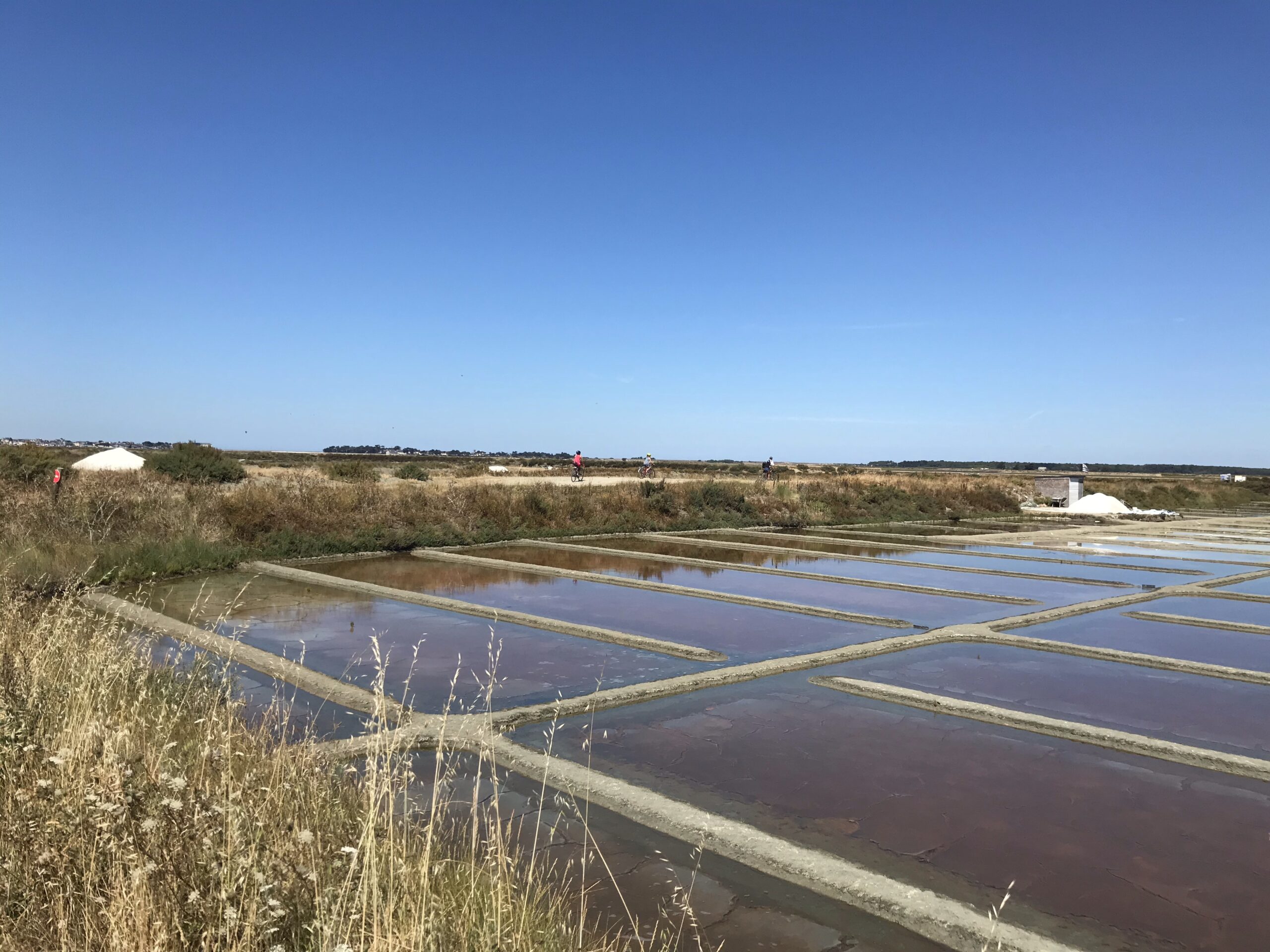
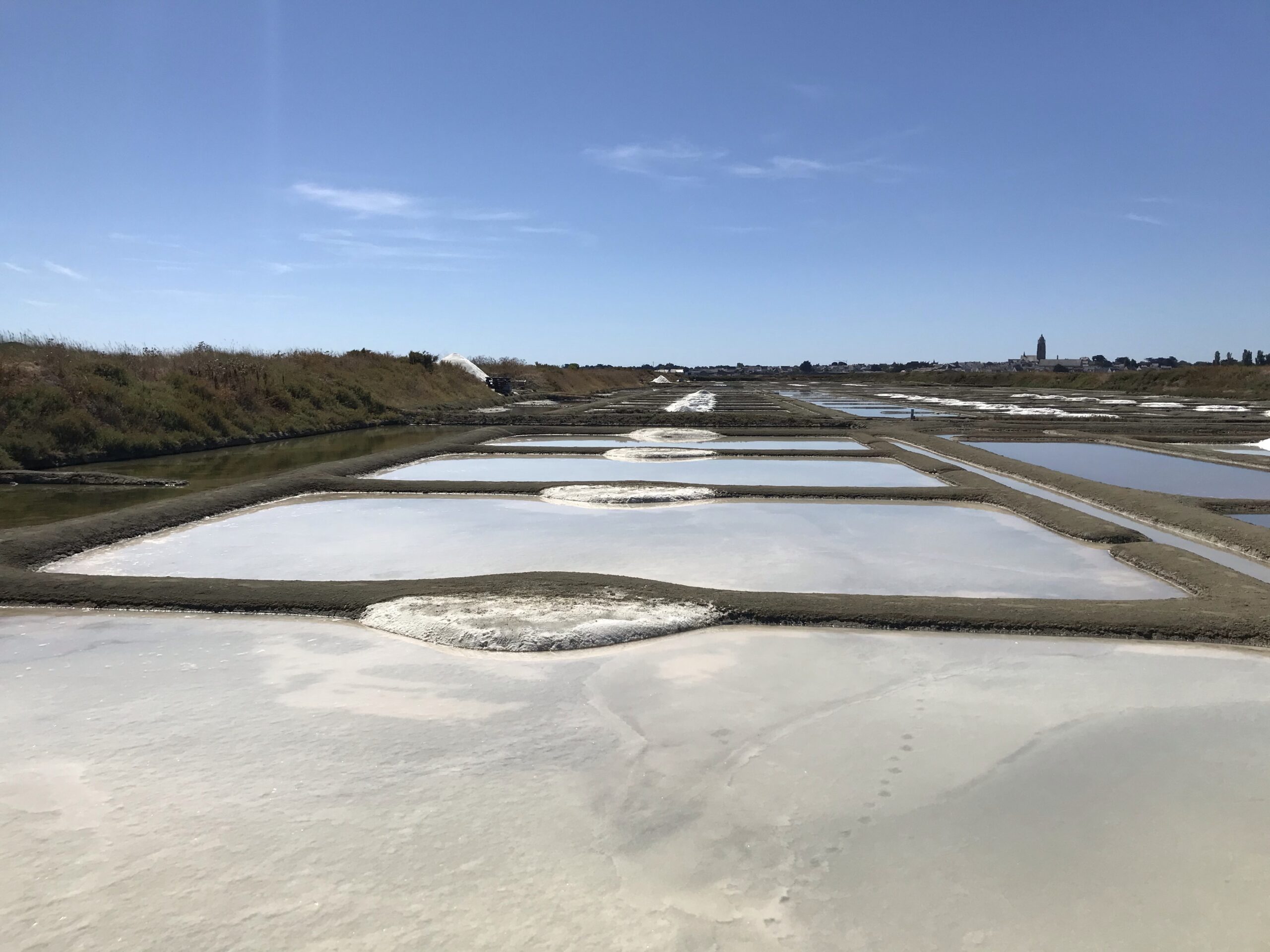
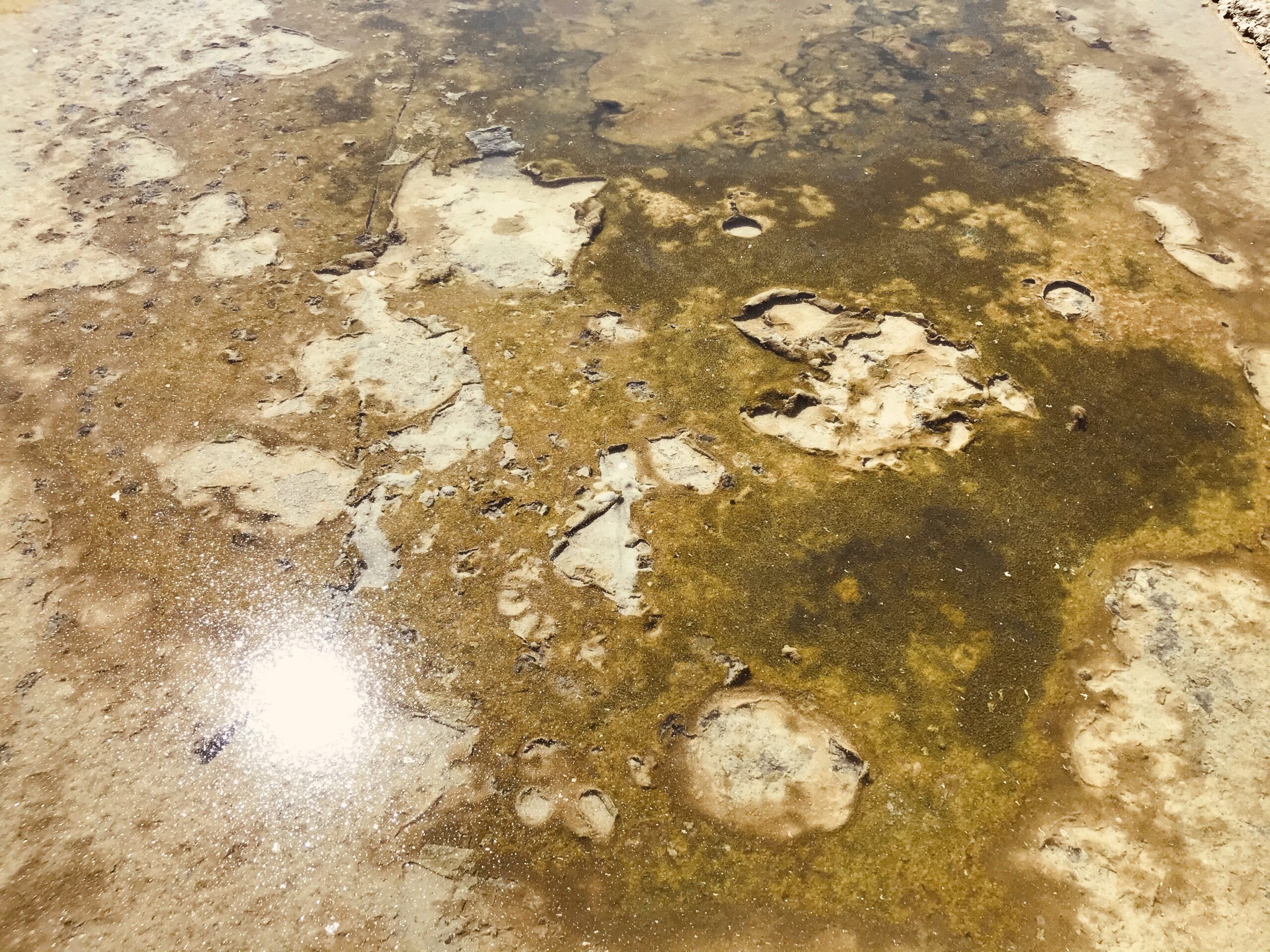
    The salt beds also create wonderful colours. The colour depends on the salt concentration and the angle of the sun.

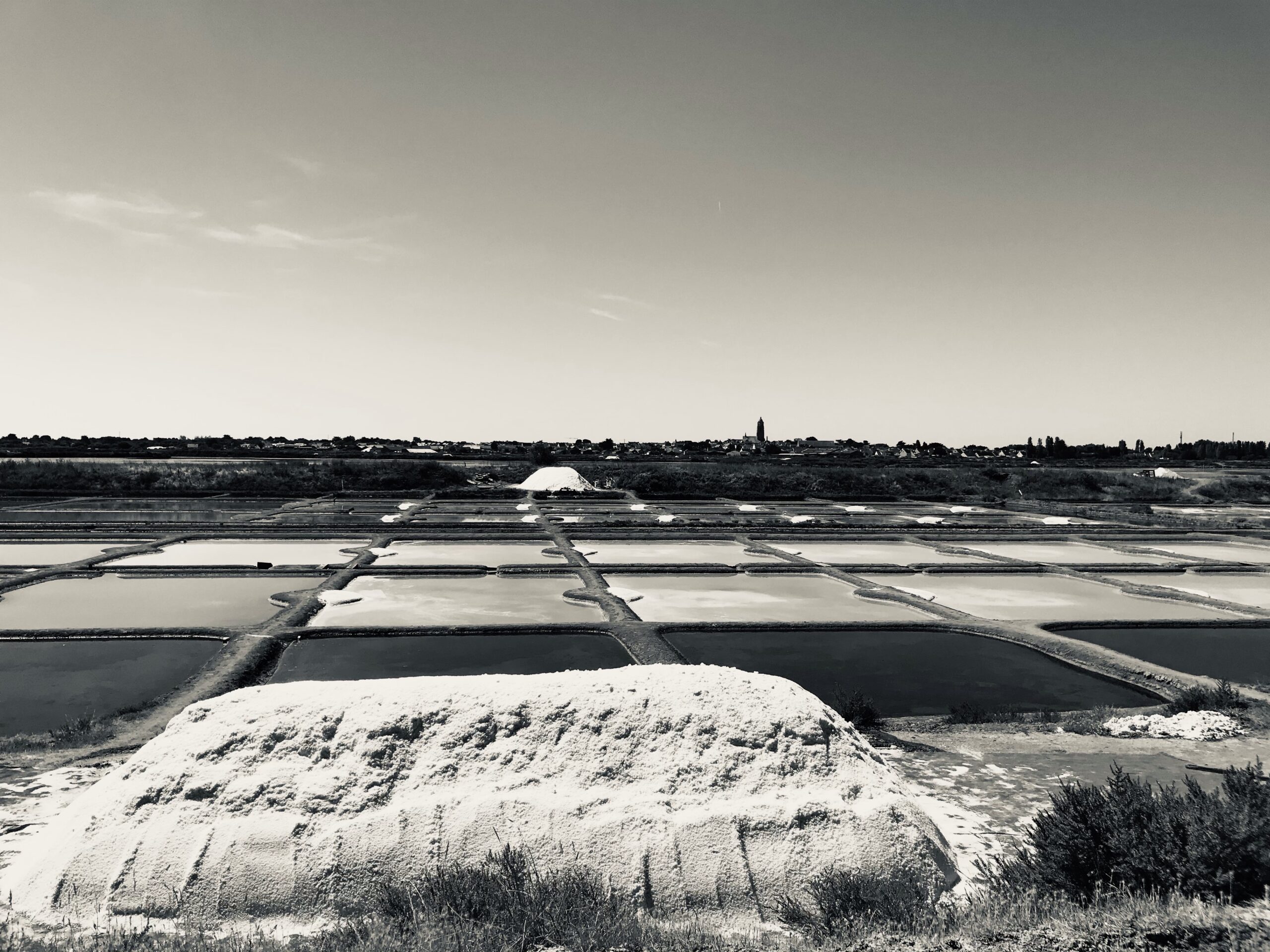
    A group of salt beds at Batz-sur-Mer
    The morning’s harvest of fleur de sel is gathered up against the wall
    The individual harvests are collected together
    The colours of a salt bed
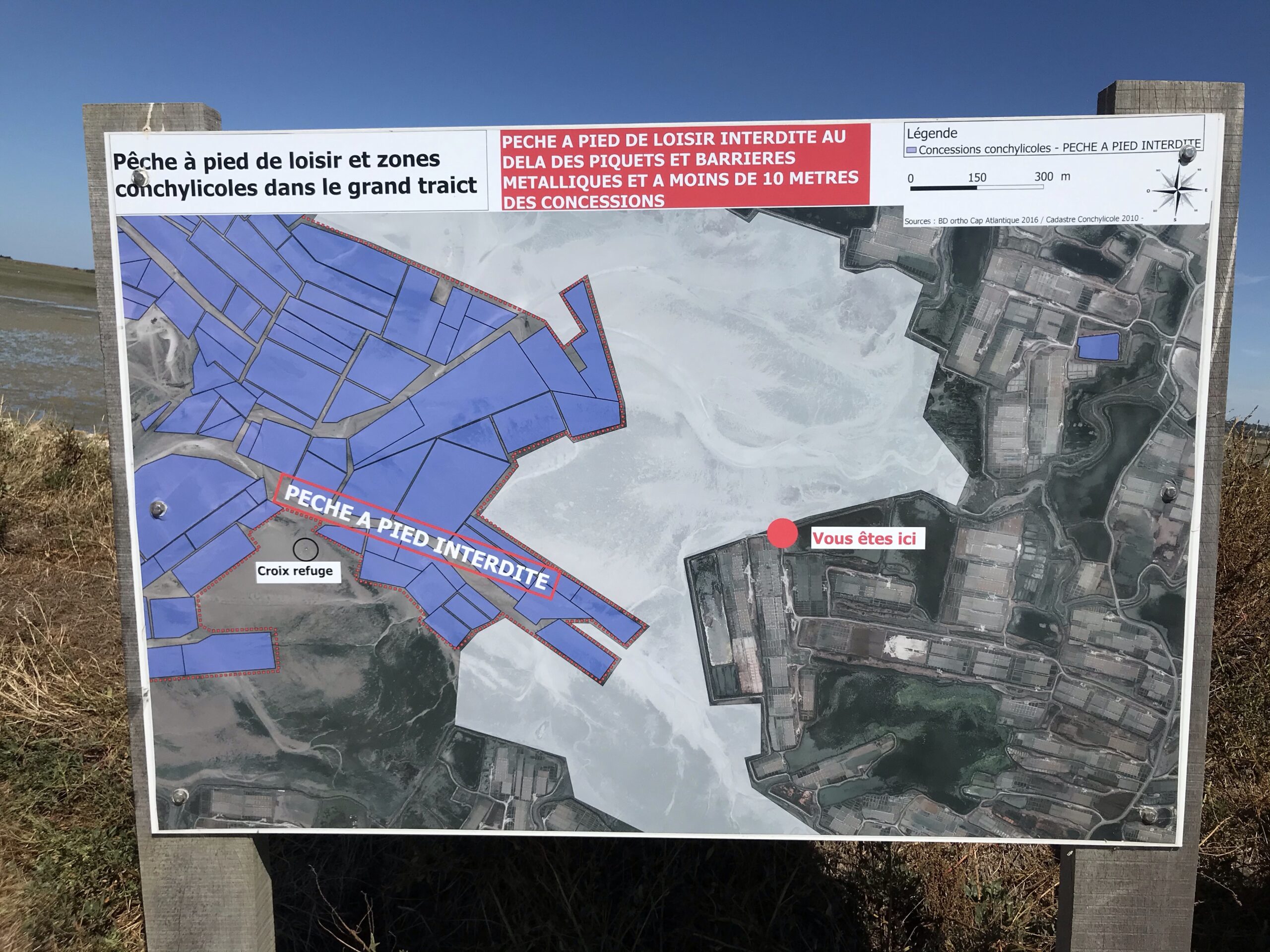
    Map of the salt beds of Batz-sur-Met
    The very slow flow of water through the salt beds – watch carefully.

  • Champtoceaux to Nantes – reflections on Loire à vélo

    Champtoceaux to Nantes – reflections on Loire à vélo

    The last leg of our journey along the Loire à Vélo cycle route, à 35km flat run into Nantes. It was misty as we covered the early morning ground, keen to get to Nantes with enough time to wander around the Machines de l’Île. After breakfast in uninspiring Mauves sur Loire, the feel of the cycle path changes: it is more like we are cycling through a city park. We are in the outskirts of Nantes.

    We arrive at Nantes train station, which has a new terminal built high across the tracks with tree shaped columns beneath that splay out into oak-tree like branches within the concourse to provide shade for the travellers.

    Reflections on Orléans to Nantes via the Loire à Vélo

    We were using the cycle route more as a means of getting from Paris to the Atlantic coast rather than planning a dedicated trip to do the Loire à vélo route – and while I thought it would be fun I enjoyed it even more than I expected.

    • The Loire is much wilder than say the Rhone or the Garonne. It is not used as a major inland shipping route and so feels less industrialised. The water is able to follow a more natural course as reflected in the various channels that weave their way through the landscape, and the sand banks that are a haven for birds.
    • That said there are levées to cycle along, albeit set back so that the flow is less interrupted, and these are great to cycle along.
    • My favourite sections were when the levee road is quiet, and we are able to get some speed up while watching the river landscape change in the channel below.
    • My least favourite where the river approaches a city. Tours in particular seemed to have turned its back on its rivers.
    • There is a great atmosphere on the path. You meet cyclists going the length of the Loire à vélo path, and some beyond towards Basel and towards the Black Sea.
    • The riverside guinguettes were great to stumble across and make the most of to eat at en route or chill out at in the evening.
    • I wouldn’t bother visiting the out-of-town chateaux. They represent an accumulation of wealth extracted from the local landscape and local people that is somehow not reconciled, not addressed. Just a place to drive to. The middle of town chateaux of Blois and Amboise are a bit more connected to the towns, are more interesting and don’t require a detour.
    • The route is well signposted, there’s lots of campsites en route. The highlights were the Slow Village in Pont de Cé, and wild camping under the stars.

    Onward journey

    We are now leaving the Loire à vélo cycle path and making a little detour out to Batz sur Mer in Brittany before heading south by train towards the Ile de Ré, cycling to Arcachon, train to Biarritz, then making our way by some means or another to Santander in Northern Spain.

  • Ponts de Cé to Champtoceaux

    Ponts de Cé to Champtoceaux

    A day for integrated travel! 70km from Ponts de Cé to Ancenis, and then 10km by kayak, our bikes carried to the downstream dock in a van, then cycling up the final 2km out of the valley and into our warm-showers accommodation in Champtoceaux.

    I remember a forward to a Department for Transport report in which John Prescott set out his vision for ‘integrated transport’, journeys made possible by joining together different modes of travel. I’ve always liked this idea, but I try to mix it with a bit of the spirit of adventure of Jules Vernes and Around the World in 80 Days. Mixing cycling and kayaking definitely fits into this category.

    We ate breakfast at a riverside market at Bouchedemaine, where the Maine river joins the Loire. We’ve skirted Angers, but all the surrounding places we’ve visited have been so friendly that I imagine I’d like the city too.

    We really had to get the kilometres in early today to get to the kayak in time. This is the first time we’ve really had to cycle in tight convoy to keep the pace up and stay motivated that we are covering the ground.

    At Saint Florient, I saw this plaque showing distances measured from the bridge. It was created at the start of a period of measuring and controlling the Loire after devastating floods. Measure it, control it, exert power over it. Except compared to other big rivers I’ve seen in France, the Loire still feels quite wild. Not the freight transport artery I was expecting.

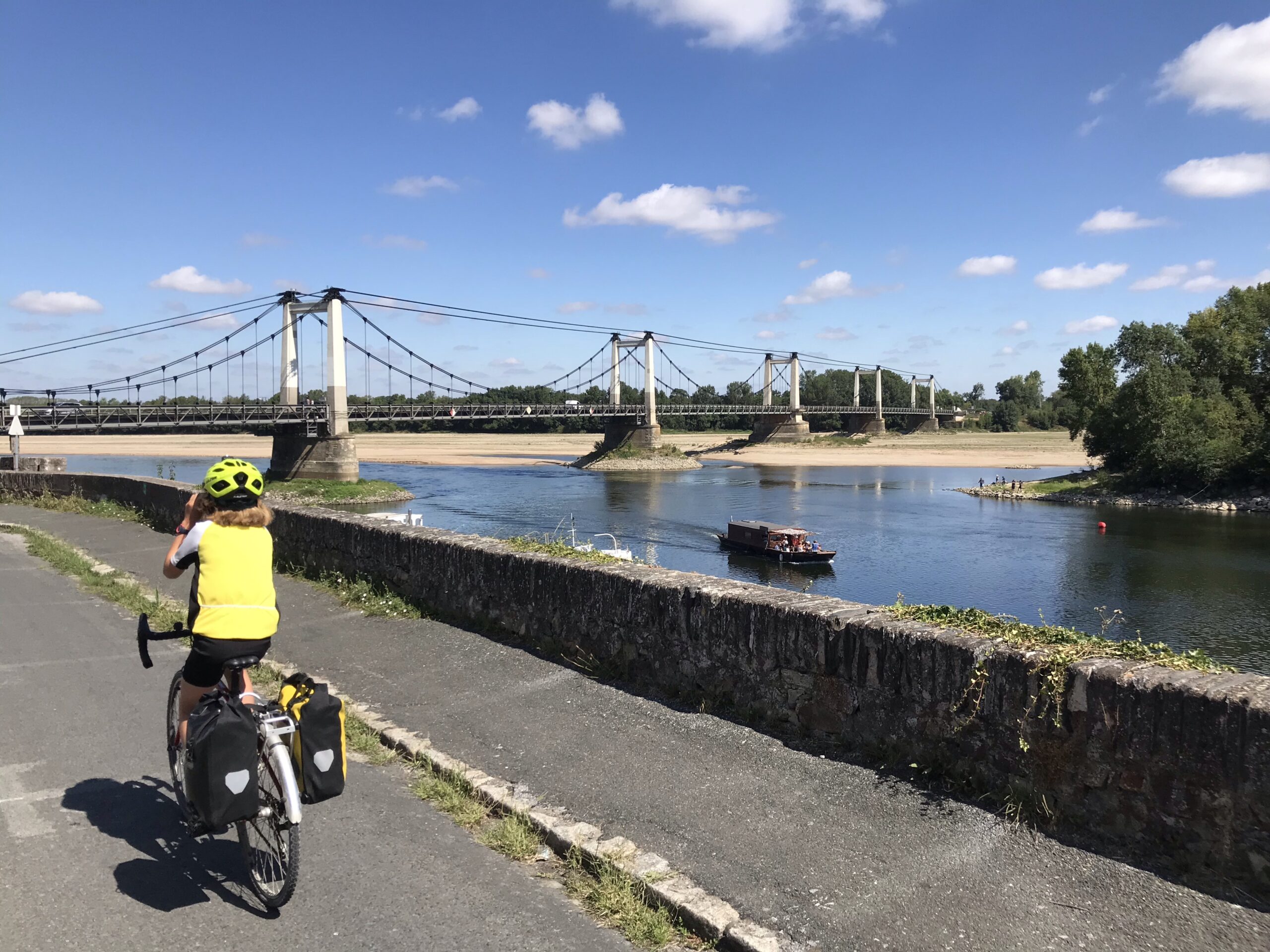
    At Ancenis we see our first major suspension bridge across the river. This is where M & I crossed the Loire on our first cycle trip in France from Saint Malo to Agen in 2008.

    We rendezvous with the kayaks and head downstream. Wonderful to be in and on the water, travelling with the flow. The current is strong but it is safe to moor up behind the groynes that reach out into the river and create little beaches behind. We climb out on a beach and swim for the first time in the warm river water.

    A stop at a guinguette, recover our bikes, then do the final climb to our hosts for the evening, a lovely couple who welcomed us to their self-built home, where we camped next to their guinea pigs. We stayed up talking about their travels with a trailer and a tandem through Sardinia, Scilly, Greece and the Adriatic, and then about how they built their house.

  • Saumur to Ponts de Cé

    Saumur to Ponts de Cé

    The next leg of our cycle trip along the Loire took us from Saumur to Ponts de Cé, a town a little south of Angers.

    Again the river landscape has changed here. Now wider, another notch up in scale. The islands are longer. The curves more sweeping.

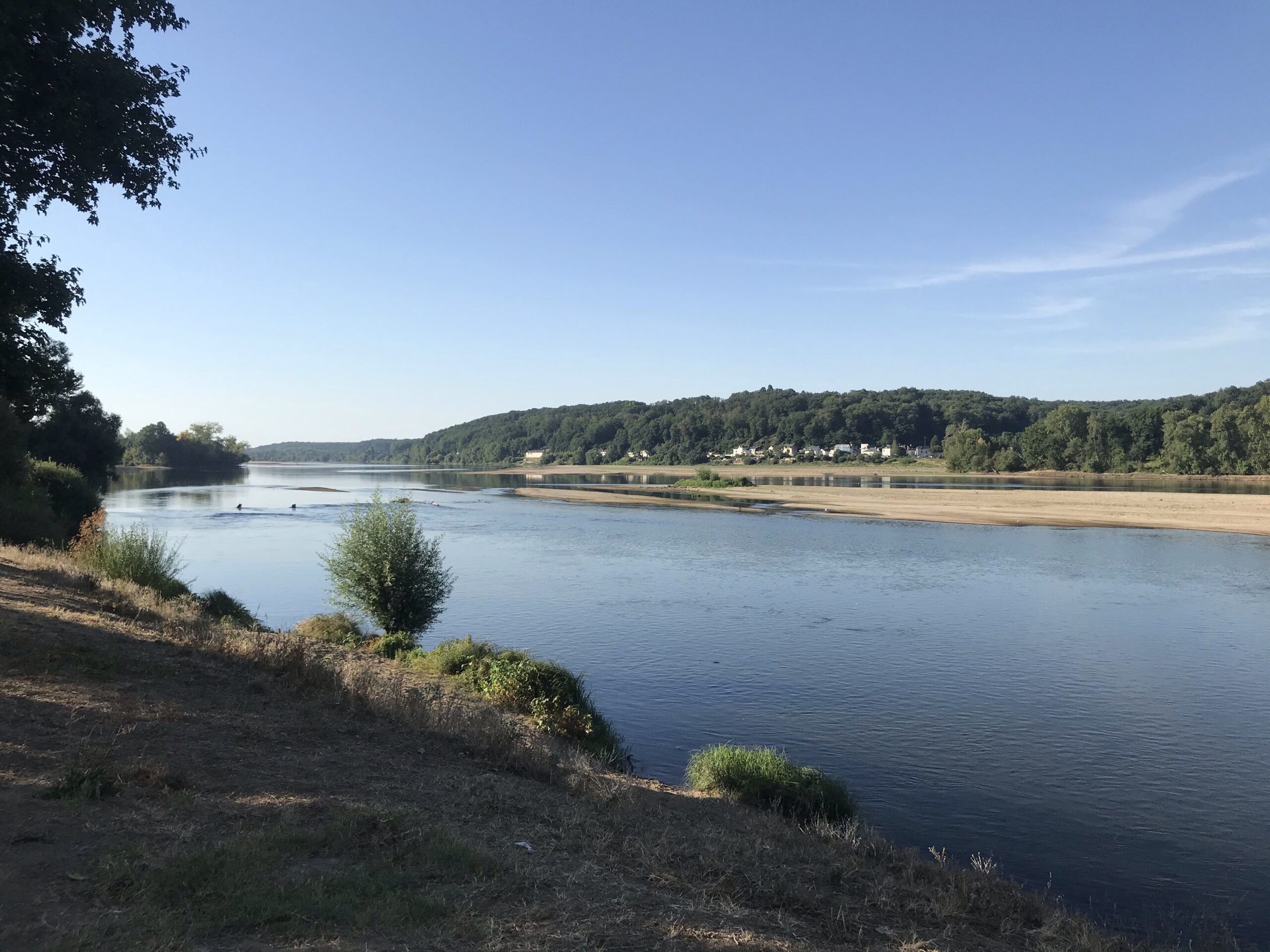
    The Loire downstream of Saumur

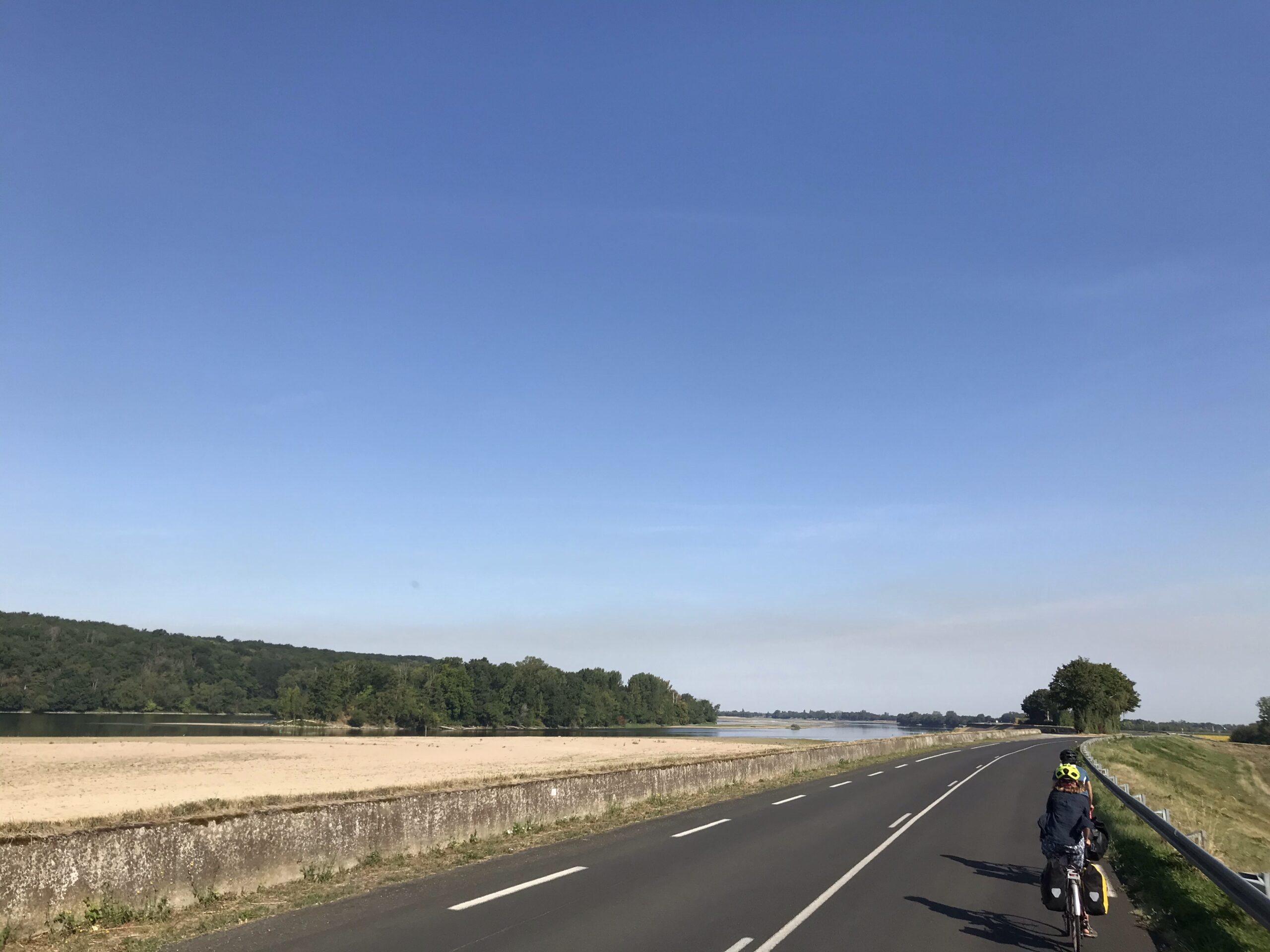
    As the cycle path was getting a little bumpy we decided to cycle in convoy along the fast road that follows the top of the flood dyke. This was to be a strategy we used more and more to cover the kilometres on longer stages of our ride. We had roughly 60km to cover and we wanted to get most of them done by lunchtime.

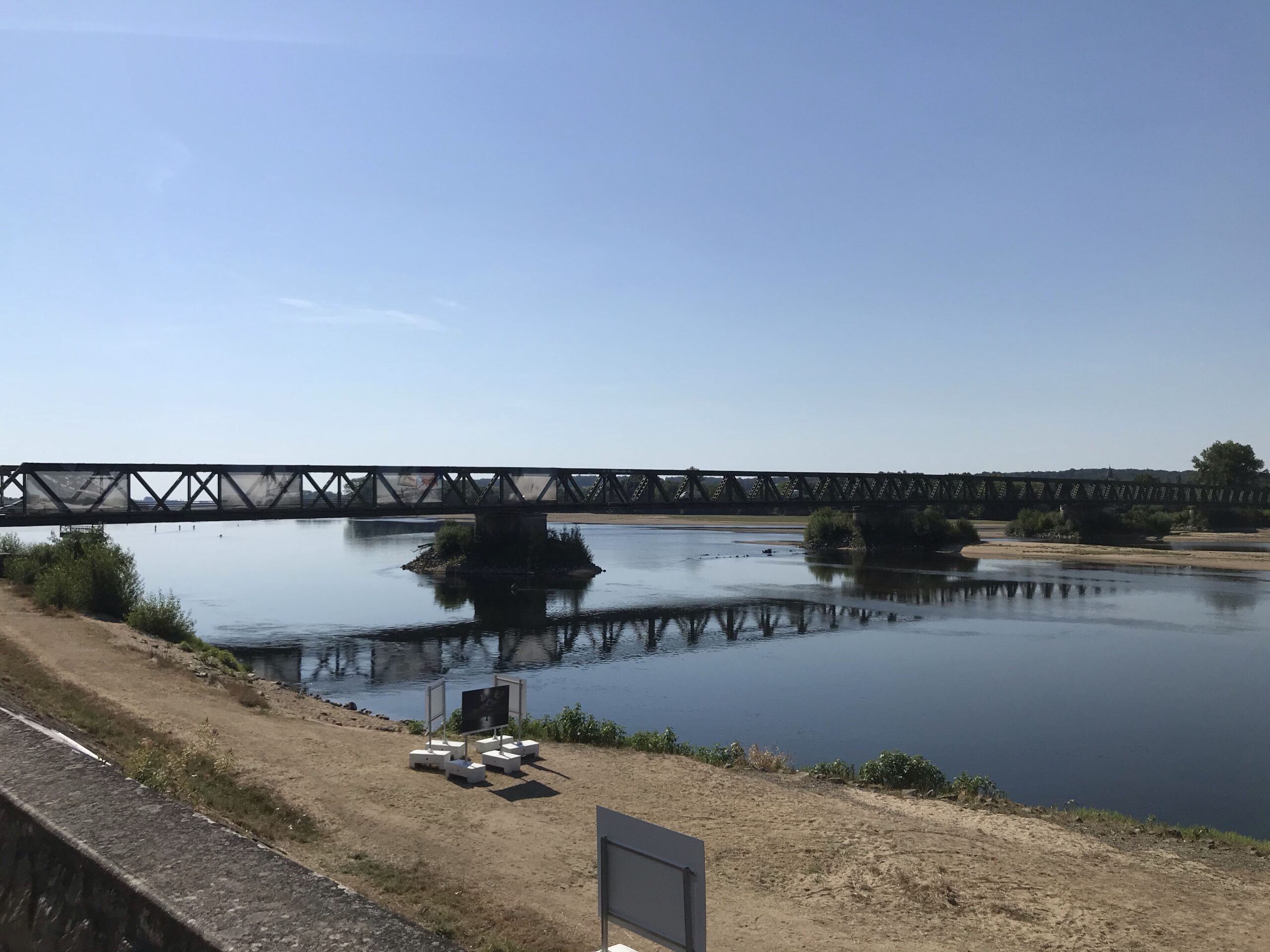
    Much of the riverbed is dry, with the flow restricted to one part of the channel.

    We can start to predict where good watering holes will be by seeing in the distance where the river crossings are. We had a refreshing stop by this typical truss bridge.

    We arrived in Ponts de Cé early afternoon and made our way to the very relaxed and comfortable Slow Village campsite. It was a relief to reach our destination before the heat of the day reached its maximum. A chance to do some washing, repack, chill out.

    A had a typical altercation with a swimming pool attendant who found my swimming shorts not stretchy enough to conform to the swimming rules. Mysteriously my well-used cycle shorts were perfectly acceptable.

    We spent the evening at the best guinguette so far of our trip. Good food and wine at reasonable prices and friendly staff. After dinner we walked out across the dry river bed to channel on the other side and waded in the warm waters.

  • Cher-Loire confluence to Saumur

    Cher-Loire confluence to Saumur

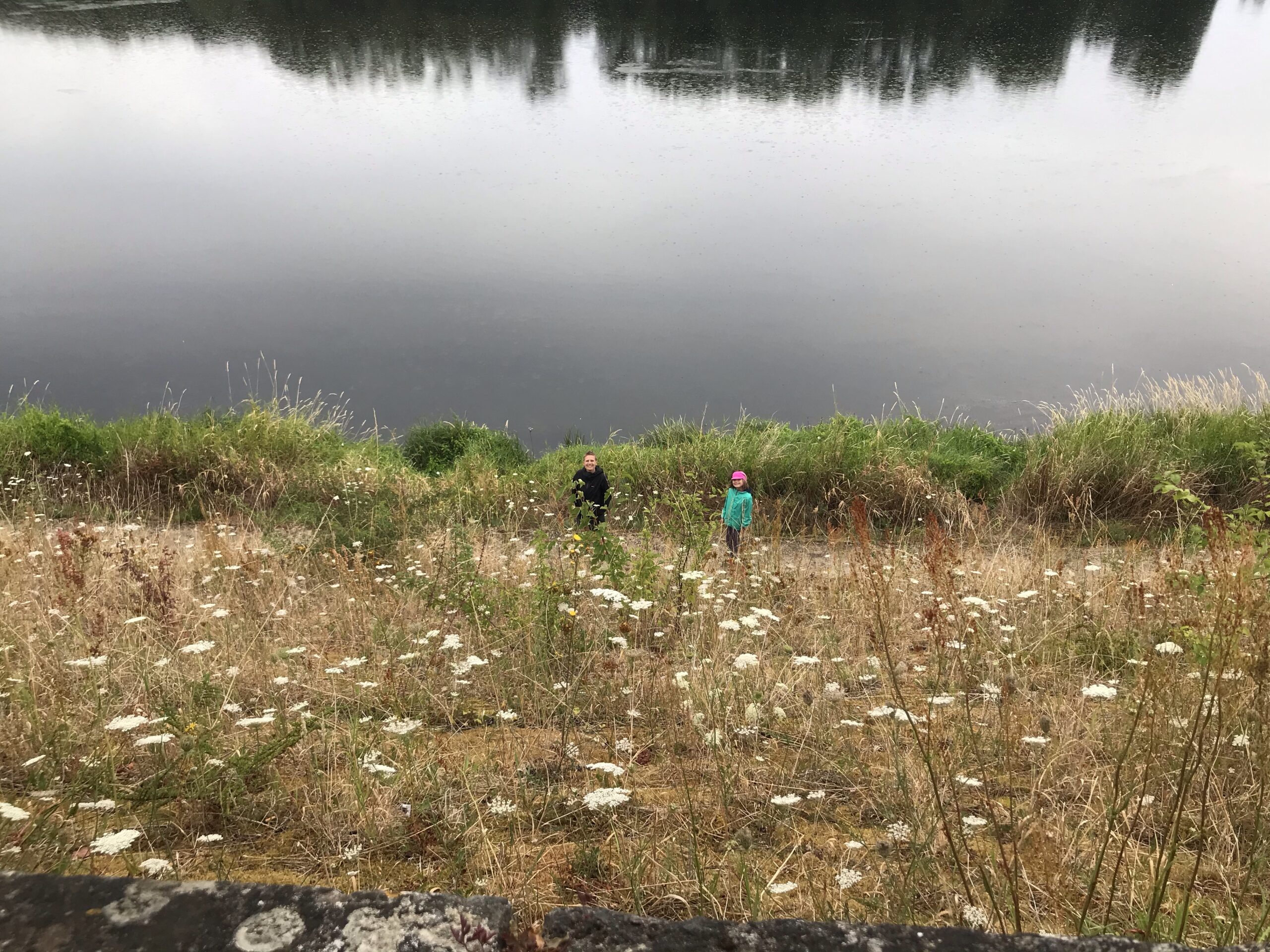
    The one night we decided to sleep with out a tent and it rained. Only a few spots at around 5am, but enough to wake me and wonder if we should abandon camp. It was still dark. I decided to hope for the best and go back to sleep. Half-an-hour later we were woken by torch lights. This time fishers hoping to find a quiet spot for an early stint with the rod. I think were as surprised by them as they were by us. We got up and watched the dawn light up the water for two hours.

    We cycled 10km to find breakfast, the morning still a welcome cool temperature and overcast. We were happy to reach Bréhemont, perched on the dyke above a sweep in the Loire. Since the confluence with the Cher the river has changed character. A bit wider with sand banks that make great habitats for birds. We saw bird watchers along the banks with their telescopes.

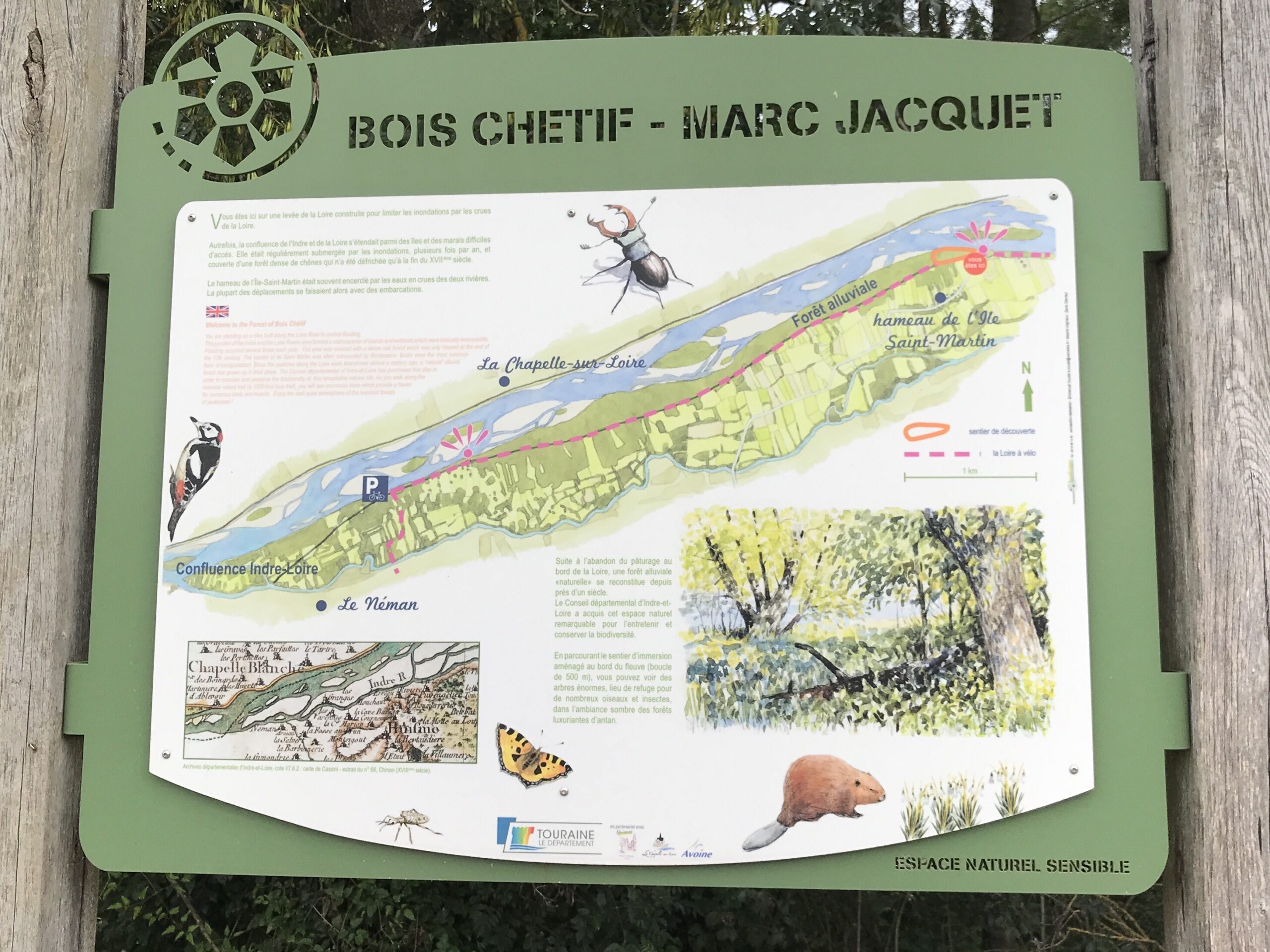
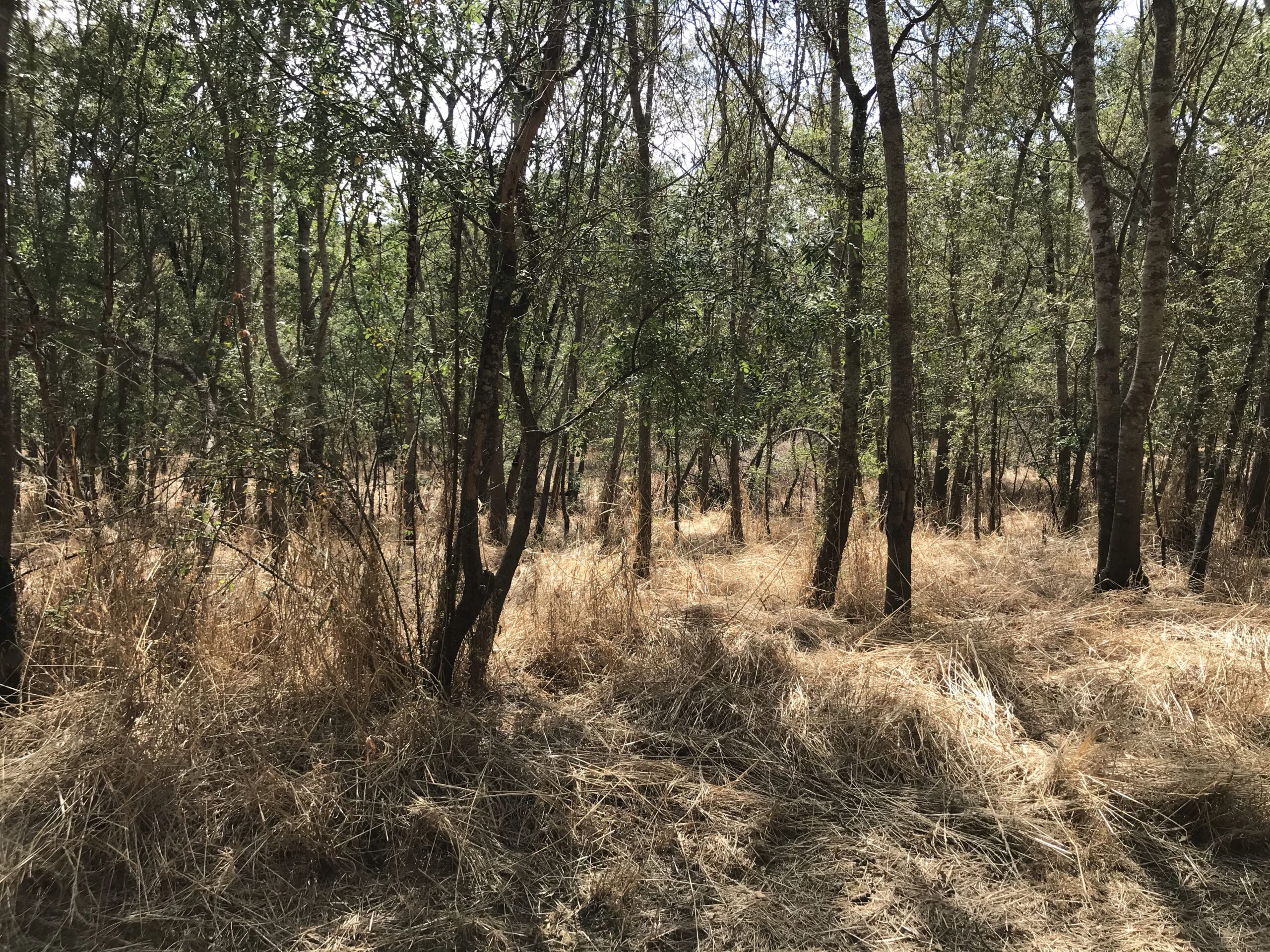
    The next section of path passes through a reforested area of land between the dyke and the river. Long ago the river borders were marshy woodlands that would flood several times a year. The marshes were drained to make agricultural land but now the terrain is being left to return to rich woodland. The space is cool and lush. We followed an enormous bird of prey which glided down the cycle path ahead of us through the trees.

    Boos Chetif- Marc Jacquet

    Lunch in Avoine, a great example of a town that has invested in its public spaces to create an environment that attracts visitors and supports civic life as well. A lovely town square, well appointed with cafe, tabac, supermarket, boulangerie and street market. Spaces for parking bikes and doing maintenance. A water feature.

    We cross the Indre river, a tributary of the Loire, and enter the valley of the next tributary, the Vianne. We find a friendly looking campsite, very laid back with furniture out by the river, and we wade in the Vianne’s waters- colder than the Cher last night.

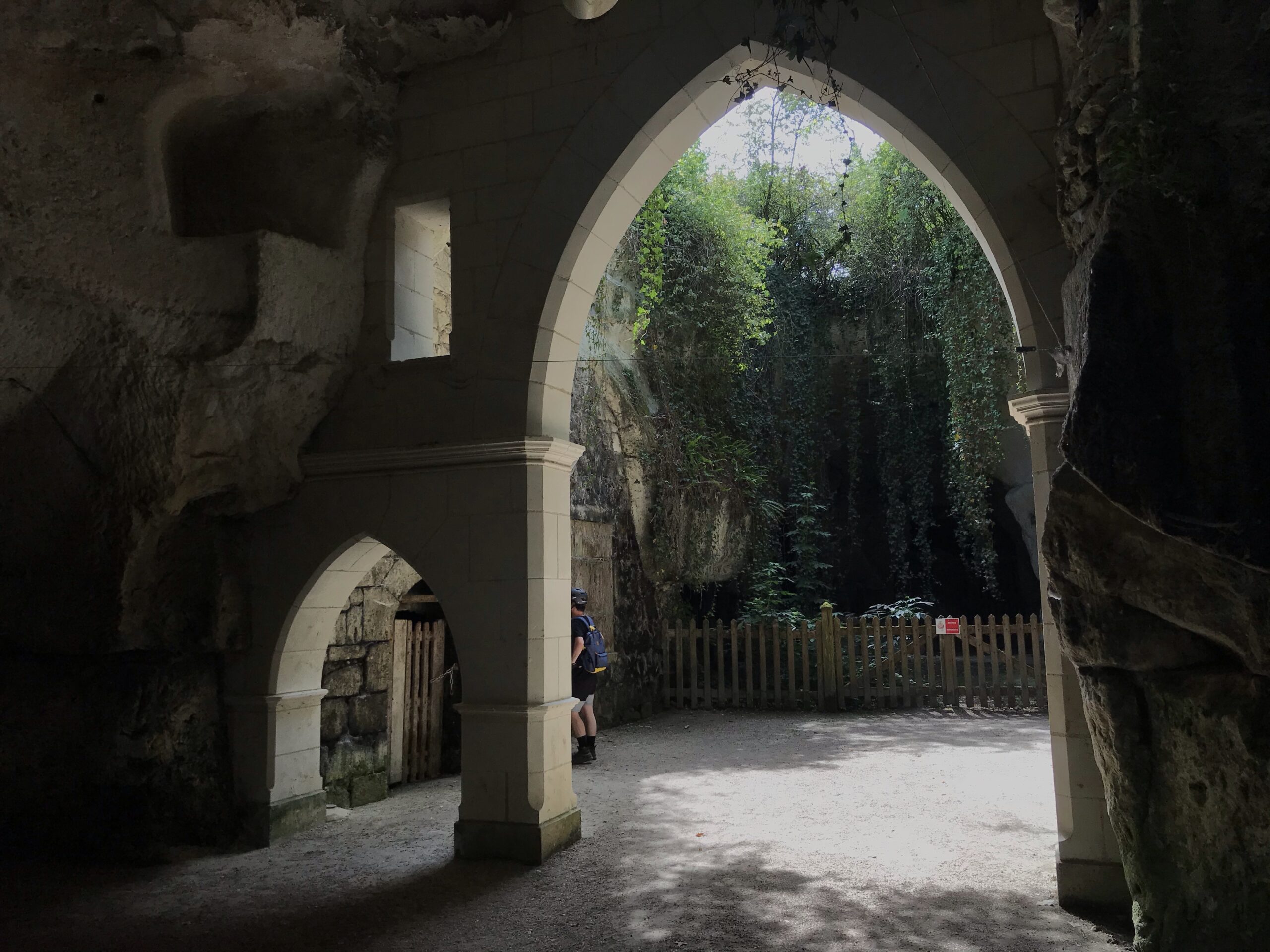
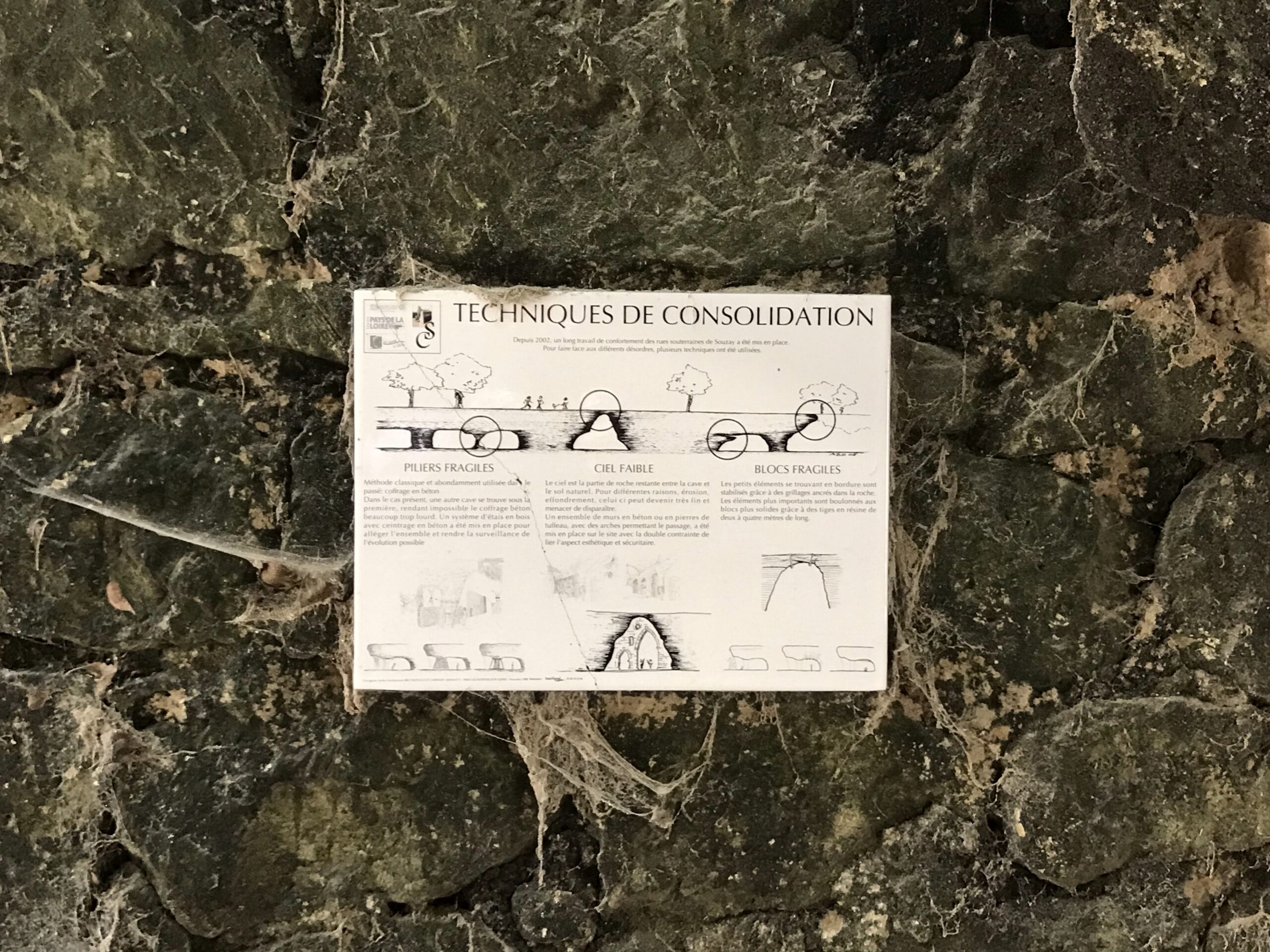
    Approaching Saumur, we climb up the valley sides to the plateau above where the regions famous grapes are grown. The path then winds down again and suddenly takes you underground into a recently-restored subterranean village. Not long ago the village high street was in a deep canyon in the limestone. The shops were in eroded and excavated caves to either side. Plants hung down from above, adding additional shade to prevent the sun overhead from heating the space too much. After the heat of the hills the space was so refreshingly cool.

    These incredible underground spaces are from the past but they could be the future too. All around us the signs of a climate heating up are increasingly obvious. It feels almost unbearable to be out in the midday sun and yet here is a way to live in the cool in the hottest place in the valley that uses just the shade and the coolness of the earth to create habitable conditions.

    As if to emphasise the impact of climate heating locally, we cycled out of the underground village and almost immediately into a bone-try forest. But this isn’t the south of France, it’s the middle bit. This is not normal.

    In Saumur we camped on the island in the middle of town. Camp sites on islands in rivers close to big towns seems to be a common format of civic infrastructure in France. Perhaps it is common more widely to European countries with wide rivers running through them. I enjoy being able to step out from your tent, cross the bridge and absorb the evening atmosphere.

    The strange feeling we had though in Saumur is of a place that is in the middle of a heat crisis but no one seems to mind. As long as the wine is cold.

  • Ponts de Cé – Ancenis – Champsaucau

    Ponts de Cé – Ancenis – Champsaucau

    A multimodal stage on our journey through France, with 70km by bike, 7km by kayak and another 2km uphill to finish the day.

    We crossed the Maine river at Bouchemaine, where we stopped for the market and breakfast by the river. The scene looked like we could be in the Netherlands.

    I remember little about the rest of the ride other than it was hot and we cycled in a tight convoy to keep a steady pace and cover the ground.

    We crossed to the north side of the Loire over a more substantial suspension bridge than we’ve seen so far. Minor aside on suspension bridges. The Loire is the first place I’ve seen multispan suspension bridges with a post tensioned top cable to keep the towers an equal distance apart.

    At Ancenis we boarded two kayaks and our bikes were taken downstream in a van. There was a big difference in river flow rate across the width of the channel and finding the fast flowing sections was quite tricky.

    We were advised we could moor up and swim behind any of the groynes built out into the river. Behind each, the river water swirls in a great rotating eddy that you have to paddle through to reach the beach. This was where we had our only swim in the Loire. It was so warm.

    We arrived at the drop off point, refreshed ourselves as the guinguette and climbed the hill up to our accommodation, a family home we found on warmshowers.com

    Our hosts live in a beautiful, self-build home. We enjoyed hearing the details of the construction, their water conservation measures and meeting their guinea pigs.

    Warm Showers is a great tool for cheap travel, but it does require quite a lot of on-the-go administration.

  • Farewell Beethoven

    Farewell Beethoven

    Off-topic, but I feel we rarely capture and talk about moments of grief. Between facilitation sessions today I listened to the final episode of Radio 3’s year-long Composer of the Week series on Beethoven, the episode in which he dies. And now I am streaming tears: because it is a sad story, yes; because he wrote music that can make you cry, also yes. But more so because I really, really miss the all-encompassing world of live music. To hear that full orchestral sound now would be such a joy. I miss going to see my Dad play in an orchestra. I miss the joy of giving shared attention to creative spectacles, be they small or large. I can stream whatever music I want, but I want to see human beings playing, making the noise. That’s all.

  • Creative inspiration from December

    Creative inspiration from December

    A new month, new good intentions. Just like when I started a new exercise book at school, when I would commit to being extra neat (and then forgetting about it a few days later). It’s good time at least to think about how the advent of December can influence your creative work.

    (more…)
  • Why I write (this blog)

    When I teach I realise I am drawing on ideas that I have gathered and processed over many years, but little of which exists outside my head. If I compare a mental list of the main concepts and ideas that have preoccupied my thinking for the last few years, I find it bears little correlation with what I have written over that period.

    (more…)
  • Reading Proust – volume 5 update

    Reading Proust – volume 5 update

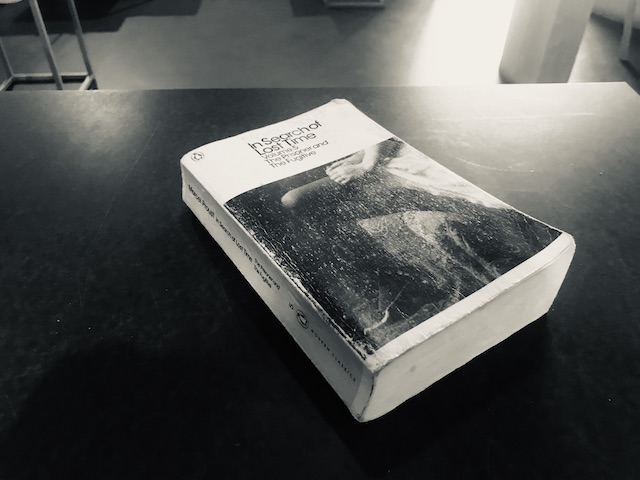
    It wasn’t what I was expecting but volume 5 of Proust’s In Search of Lost Time ends on a cliff-hanger. It is incredible how such separate threads from five previous volumes are starting to brought together: a narrative arc that I could never see converging has in fact been much closer to convergence than I expected.

    I’ve been reading In Search of Lost Time – Proust’s epic explorationg of memory, art, adolescence and decisre – on and off since 2007. It is one of those books that lots of people have heard of, some know two things about it (the long sentances and the flood of memories provoked by dipping a madeliene cake in his tea) but I’ve hardly found anyone who has actually read it. So in 2007 I decided to give it a go (in English!).

    (more…)
  • A better-dressed version of me

    A better-dressed version of me

    I sit in my current preferred cafe bolthole and the jacket of the person opposite me catches my eye. It’s a slightly faded turquoise, not unlike a jacket I recently got in the sale. Hang on a second, it is the same jacket, maybe slightly older. I zoom out and notice their whole clothing combination is familiar: a stripey top, dark blue jeans, converse, set off with a dark grey panier.

    These are the clothes that I wear, or at least I think I wear – only better. I look down at my own sartorial combination and I realise it is a poor approximation to my self image. I start to take notes for self improvement – cream converse, turned up jeans – but then my alter-wardrobe is gone.

    I have long been in pursuit of the one outfit to rule them all. There are a few inspirations.

    (more…)
  • If you go down to the woods today

    If you go down to the woods today

    It will probably be very muddy. At least it was for my first visit of the year to Hazel Hill Woods. Recent rain has made the forest wetter than anyone can remember. Water is reanimating forgotten courses that we hadn’t even noticed existed.

    Today was my first day in post as the Deputy Chair of Hazel Hill Trust, the charity set up by Alan Heeks to run the wood and to provide a place where people can learn about wellbeing, resilience and sustainability.

    (more…)
  • My neighbours don’t like bees

    My neighbours don’t like bees

    https://youtu.be/ofLmUmiK1Nc

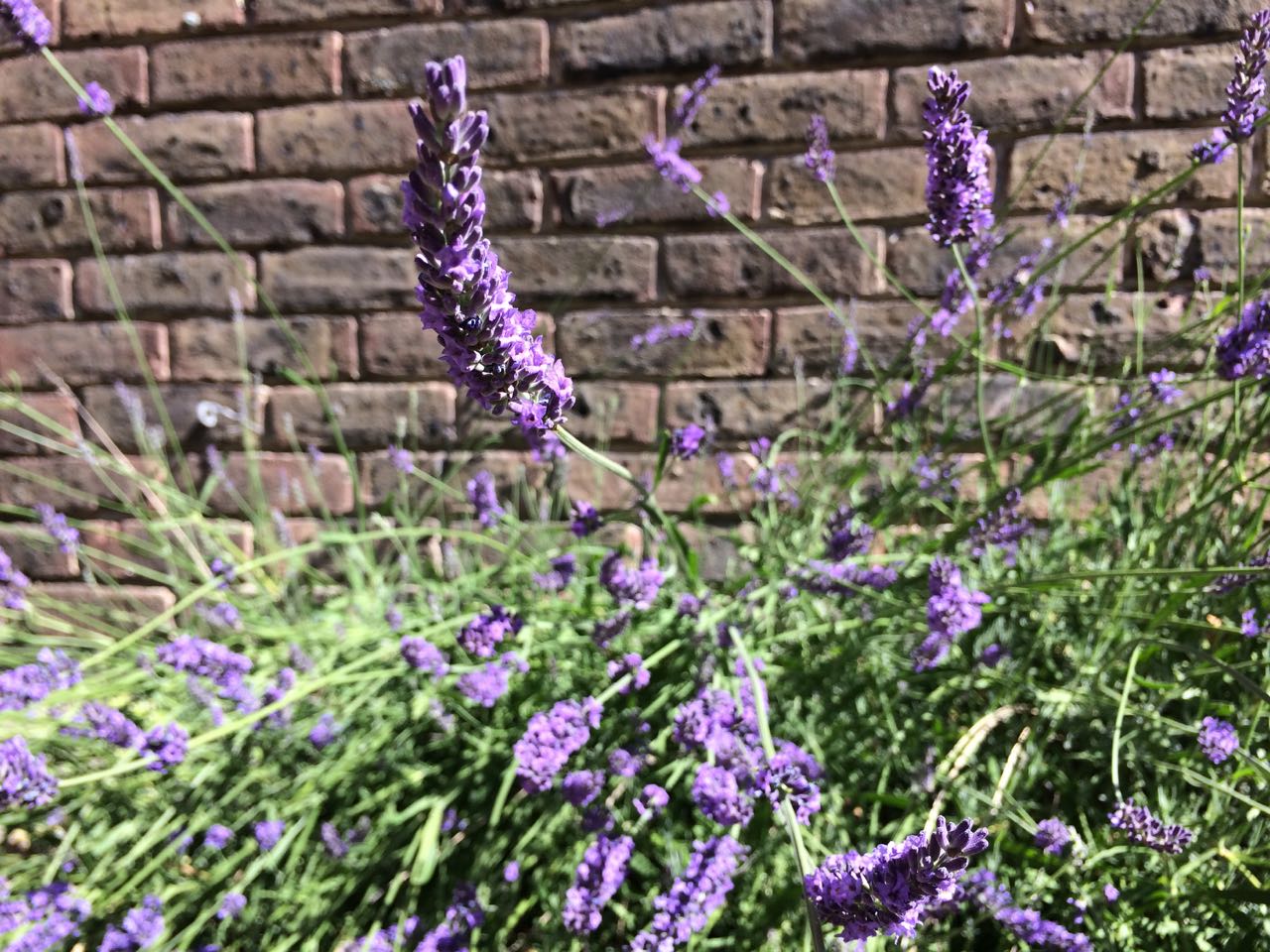
    We planted a hedge of lavender on our estate to revitalise a barren patch of soil near our front door. This sunny morning, the enthusastic lavender stems were bobbing up and down laden with bees. There must have been between 20 and 30. I went to count, as part of the Great British Bee Count. And so it was that I had conversations with several of my neighbours about bees, and I was depressed by what I heard.

    • One complemented me on the lavender, but said the only problem with lavender is that it attracts bees.
    • A second reported hatred for bees, having been repeatedly stung by that very flower bed, before conceding they had been wasps.
    • The third, having been complementary about the flowers, reported a bee had dive bombed from twenty metres above delibrately to sting him and concluded they must be evil.
  • Derive #2 City of London – Log book

    Derive #2 City of London – Log book

    • 19/3/18
    • Derive #2
    • Location: City of London
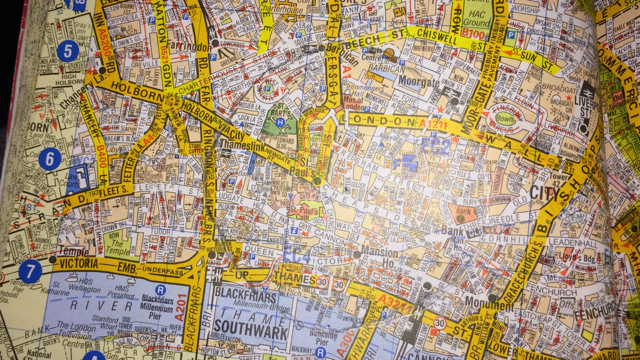
    • Context: preparation for my talk ‘Circling the Square

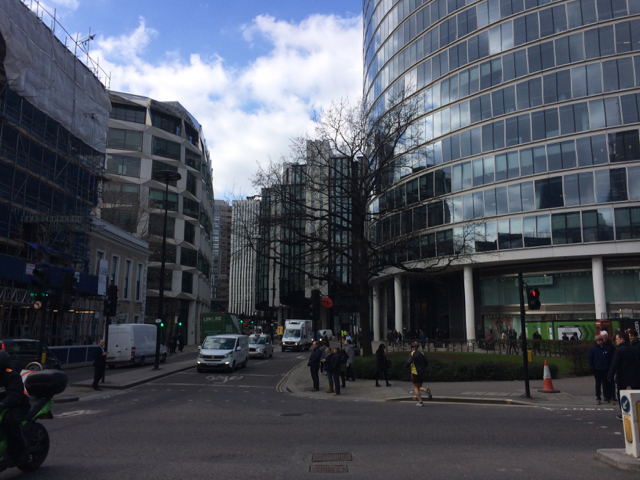
    Moorgate x London Wall

    • 0:00:00 Moorgate and London Wall. Once solid-looking stonewalls are now façades pinned in place by scaffolding while new buildings are constructed behind. In just a few years the streetscape along London Wall has completely changed
    • 0:04:34 London Wall and Copthall Avenue Deep metallic groans sound out from behind these hoardings. I assume the core of the building is being demolished, and the sound is the building complain.

    • 00:09:41 Black Rock The circle leads straight into the offices of Black Rock. I enter the revolving doors and walk through a long dark lobby past whispering clusters of suited men and women. I emerge blinking onto a much quieter street, Tower 42 in the distance.
    • 0:13:31 Copthall Avenue The circle passes straight through the Angel Court building. I attempt to walk through the underground loading bay but I’m turned back by security. There are some places you really aren’t supposed to go.

    (more…)

  • My VR training epiphany

    My VR training epiphany

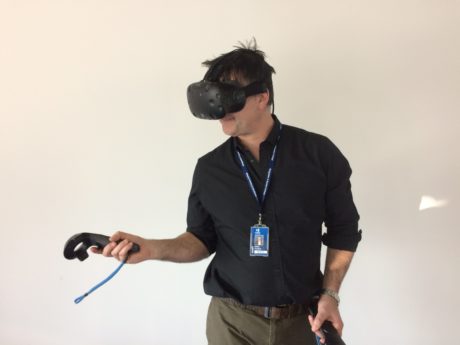
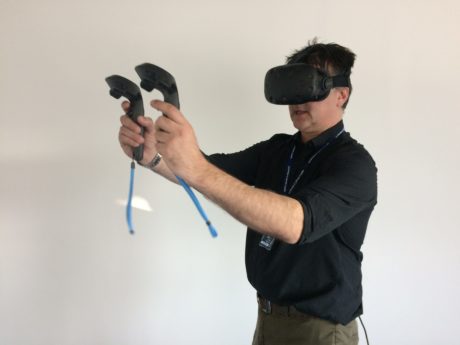
    Last week I was down at Bridgwater and Taunton College to check out the tools Stefan Cecchini and his colleagues are going to be using to deliver a revolutionary new engineering degree curriculum that aims to be entirely inquiry-led. There for the first time I tried out a virtual reality (VR) training environment. I put on the VR headset and gloves, and this is what happened (that’s Stefan, by the way wearing the VR gear).

    (more…)

  • A sketch for the Big Idea

    It was on a train to Bristol yesterday, travelling with my colleague Ben, that I articulated in I think the clearest terms yet the model of learning that through my various projects I would like to explore and develop practically. It goes something like this:

    What do I want to know or be able to do?

    What skills or knowledge do I need to have in order to meet this aim?

    Which of these skills, knowledge or aptitudes do I already have?

    How can I make up the deficit?

    How will I know when I’ve got there?

    The benefits of the approach are:

    it starts with the needs of the individual, and values their own experience of the world. It is potentially empowering and rewarding. It could be self-sustaining if the individuals develop the skills necessary to adopt the approach.

    Disadvantages or challenges I can see are:

    Learners need to have developed a certain level of skill and maturity before they can adopt the approach. Learners need access to a whole different type of coach or teacher who can guide them through the process. The approach is not easily scalable, requiring a much more tailored relationship between coach or teacher and student.

    I see these disadvantages as challenges to be overcome, and hopefully my projects can help contribute.

    My motivations are:

    A love of self-started learning and personal development; the astounding way that our brains can learn and a concern that our current formalised systems of learning are crude; the depressing sight of students motivated purely by grades and the hugely destructive fetch that summative assessment seems to have on the learning process.

    Clearly these thoughts need refining, but I wanted to get these reflections written down while they are fresh. Clearly these are also big ideas to implement – perhaps impossible. In this respect I am inspired by the following from Rousseau’s Emile:

    “People are always telling me to make practicable suggestions. You might as well tell me to suggest what people are doing already, or at least to suggest improvements which may be incorporated with the wrong methods currently in use. There are matters witch regard to which such a suggestion is far more chimerical than my own, for in such a connection the good is corrupted and the bad is none the better for it. I would rather follow the established method than adopt a better method by halves. There would be fewer contradictions in the man; he cannot aim at one and at the same time two objects.”

  • Following Laws of Simplicity, and stumbling upon life hacks

    At the RDI Summer School, I met potter Billy Lloyd. He suggested I take a look at John Maeda’s blog, The Laws of Simplicity‘ which I’ve just started following and reading. I like the approach of having a blog based around the idea of applying a series of rules or commandments. It is something that could work well for putting online Think Up’s report on principles for embedding sustainability teaching in undergraduate engineering courses.

    Reading the Laws of Simplicity blog I stumbled upon a link to a page on 50 life hacks. Well worth looking at!

  • From concrete courtyard to blooming garden – the story of the Big Dig

    From concrete courtyard to blooming garden – the story of the Big Dig

    IMG_5294

    In December last year I wrote about day one of the Big Dig, M and my plan to transform our barren concrete courtyard into a thriving patch of urban greenery. Today we celebrated the completion of that grand plan with a garden party – a harvest festival no less! – for everyone who helped us along the way. Here’s a little movie slide show of what we achieved.

    Seeing all the insects buzzing between the flowers in the beds it is hard to remember that this was an apparently lifeless little corner of London (no doubt kept lifeless with ample weed killer). And in January, when we were standing in knee-deep holes in the ground digging in compost, it was hard to believe that it would turn into the lush environment that it is now.

    IMG_5912

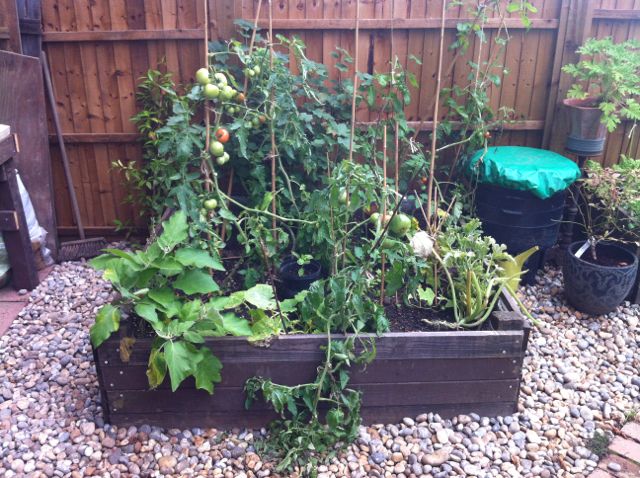
    By the time spring arrived we were putting in the new ground covering: a mixture of turf and gravel, beds and raised beds. The trees and most of the plants went in by early April. I remember thinking that they were quite spread out – just as well given how much they grew. In the summer we turned our hands to plant vegetables – too late in hindsight, but we are still figuring this stuff out.

    One of the aims of the project was to use waste material wherever possible. We had had our collapsing garden fence replaced with a new one, but had asked to keep the old timber. This well weathered material we were able to put to good use, creating three raised beds, a cold frame, a bike shed and compost heap. And because the material all came from the same fence, all the structures we built have a unified look. Continuing on the re-use theme: half of the old back door became the lid for the cold frame; the dozens of bricks we found in the ground became the garden path; an old allotment shed door became the roof of the bike shed.

    IMG_5908

    Two things have made this transformation possible. The first is the plan for the garden put together by our friend Amanda Dennis. From her beautiful pen and watercolour design, to the step-by-step project plan, she guided us through the whole process, and I think she is as pleased as we are with the result. The second is the tremendous help we have had from friends, family and neighbours – I count sixteen volunteers in total over the last nine months. People have lent us tools, sent us plants, driven cars to the dump, built sheds, looked after our baby and dedicated whole days to digging. It has been very heartwarming – and a lot of fun.

    And so to the harvest. Roughly speaking: a punnet of raspberries, red currants, blueberries and a half one of strawberries; a few baby carrots; two plums; two courgettes; fist-fulls of herbs; a dozen ripe tomatoes – and two dozen green tomatoes still full of promise; and a gherkin. We wanted to feed our harvest festival guests the fruits of the labour, but since most of these fell earlier in the year, we had to be a bit creative with the menu: lavender cake; savoury vine leaf cake (delicious!) and herb bread topped with our one gherkin thinly sliced.

    It would be easy to think now that the hard work is done – but now we have the not so small task of keeping it all alive. Watch this space.

  • Diary: Imperial College/Serpentine Pavilion/University of Austin Texas

    Diary: Imperial College/Serpentine Pavilion/University of Austin Texas

    [pe2-image src=”http://lh3.ggpht.com/-IqvJLaCnMnE/Ubn1VYuE31I/AAAAAAAAAZI/RFR8CFqYrV8/s144-c-o/13%252520-%2525201.jpg” href=”https://picasaweb.google.com/101339256689884186918/61313#5889007735525400402″ caption=”Dropping in at the Serpentine Pavilion” type=”image” alt=”13 – 1″ pe2_parse_caption=”false” ]

    Yesterday morning was a first. I gave a presentation to 80 students at Imperial while holding a baby in my hip. The presentation was part of the kick-off day for the Expedition-Imperial 2013 Constructionarium week (Event Facebook page; Think Up news piece – soon). The Expeditionengineer due to give the presentation had to go to a meeting in Athens; since I’m the person at Think Up who knows probably most about the Constructionarium it was easiest for me to replace him, even though I didn’t have any child care cover for our daughter. She didn’t seem to mind. She chirped loudly a few times (Imperial presentation at eight months can be the first line of her CV) and the audience certainly weren’t bothered!

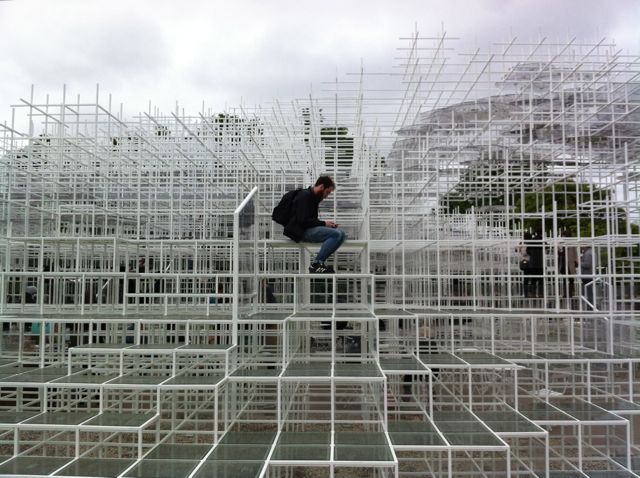
    Pushing the buggy north out of the college I stumbled upon this year’s Serpentine Pavilion, pictured. The structure is wonderfully intriguing to approach. You have a sense that there are spaces and surfaces inside but you can’t see where they begin and end. The people inside therefore appear to be floating inside a sea of addition signs.

    There I received a birthday present, George Monbiot’s ‘Feral‘. Learning from nature is a regular strand in my thinking at the moment (see my post on Hazel Hill to see the sort of thing I mean), and so I expect this book will be of great interest.

    I hurried home to prepare dinner for our evening guest, Gregory Brooks, a senior lecturer at the University of Texas at Austin and who is responsible for third year design studios at in the Architectural Engineering programme. Gregory is faculty director for the Emerging Technologies Programme, a study abroad programme for engineering and architecture students that takes place every two years in London. Here, they visit the architectural engineering sites and to tour the offices of architecture and engineering practices in the capital. I first met Gregory with his cohort of students two years ago when they first visited Expedition. Back then I introduce them to our Workshed site, and ever since I have noticed a significant blip on our Google Analytics over the city of Austin. I was delighted therefore to present once more two weeks ago to this year’s group of visitors.

    Gregory’s work in developing the programme, and in developing a set of online architectural engineering online teaching resources is impressive (for example, see AEWorld, a very comprehensive blog on projects of architectural and engineering interest -to his credit, one of the most popular blogs on WordPress.com) . Our discussion over dinner was  packed with ideas for mutual cooperation and sharing resources, which I look forward to exploring in future.