Category: Engineering communication

  • Reflections on video selfie training

    Reflections on video selfie training

    Think Up Selfie Movie Training

    Yesterday at Think Up I ran a workshop training engineers in how to use selfie movies to tell communicate to people about engineering. The aim of the workshop was to inspire and give the participants the skills to use video as a medium to share interesting engineering stories. The attendees were a group of engineering students from UCL and Imperial and a couple of graduate engineers from Expedition Engineering.

    The content I had to deliver was in two parts: the technical skills – talking to camera, framing the shot, etc; and storytelling – figuring out what to say.

    In my experience people are nervous to talk to camera, so I kicked off the workshop with asking people to film a selfie introducing themselves and sharing two surprising facts about themselves. It turned out to be a great way to kick off the exercise. I think it worked because people had to confront their fears straight away. We used these examples as a context for talking about what makes a good selfie. I then showed them a selfie I had made that morning, and asked them what was good and bad about it (below).

    We then moved on to storytelling. I had thought that the participants would find the storytelling easier than the technical material, but it was the contrary. I asked individuals to think of a subject that they are passionate about, and to find one particular intriguing aspect of that subject that could form the kernel of their story. That bit was mostly easy, the challenge was finding the language that helped weave a compelling yarn. In the end the way round this was for me to suggest linking phrases or expressions and to show them how they could be used, and then for the individuals to weave those phrases into their stories.

    The impact was stark: once they had a compelling story to tell, and they knew how to say it, even the least confident sounded a lot more confident on camera.

    In the end I saw some really quite moving videos being produced. As homework I asked the participants to polish their performances and upload a video to the Think Up Facebook page. I’ll have more to write on this depending on whether they do or don’t post anything!

    There are some important things that I take away from delivering this workshop:-

    • This is another reminder that there is no substitute in learning for getting people to do. Forcing the participants to make a film straightaway was probably scary for most, but once they were ‘doing’ it was easier to talk about how to do it better. I had a similar experience in a communications workshop I ran last week on difficult conversations in engineering projects. We talked about the ideas, but it was only when I forced participants to role-play the scenarios (which they seemed reluctant to do at first) that the learning really seemed to sink in.
    • I haven’t previously appreciated the value of good storytelling, though many of the people I work with do. Perhaps because it is something I think I’m good at, I don’t recognise how other people find it a challenge. This is a theme that I would like to develop in more training for engineers.
    • This event was about confidence building, and I used a lot of the confidence building techniques I know from swing dance teaching – lots of applause for one-another’s efforts; keeping the momentum up and the tone positive – and it seemed to pay off.
  • Stressed by stressed ribbons – teaching notes from Southampton

    Stressed by stressed ribbons – teaching notes from Southampton

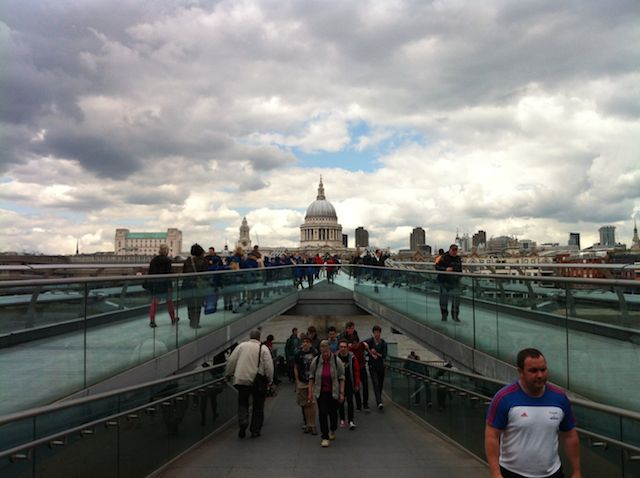
    St Paul's in the distance viewed via the long axis of the Millennium Bridge
    Long axis of the Millennium Bridge by Oliver Broadbent is licensed under CC BY-NC-SA 4.0

    One of the groups of students that Ben Godber and I teach at the University of Southampton is designing a stressed ribbon footbridge as their entry for a design competition we’ve set them. A stressed ribbon is bridge is like a very shallow suspension bridge, the difference is that once the deck units are attached, the tension in the cables is ratcheted up, squashing the deck units together. The benefit of this post-tensioning is that it can greatly reduce the sag in the bridge, creating a much flatter bridge.

    The students’ proposal is an elegant response to the site, but they have come up against the problem that they don’t know how to calculate the forces in the cables and so they can’t design the bridge. I was talking to my colleague Chris Wise about this problem of students not being able to design what they draw (a common student response apparently is that because they have seen a similar design online, they know it can be done: job done). But what Chris tells me he tells his students is that they should be able to justify every line that they draw. To help them, he provides students with an engineer’s toolbox, a handout full of rules of thumb that allow student engineers to draw engineering structures in roughly the right dimensions the first time around.

    Returning to the case of our student’s stressed ribbon bridge, the bit of mechanics they need to understand is the equation that links the sag in a catenary cable with the horizontal force at the supports. For a static load on a single span bridge, this is easy to calculate, and is given by the equation Fh = wL^2/8s (where ‘w’ is the line load; ‘L’ is the length of the span; and ’s’ is the sag in the cable). Plugging the numbers into this equation gives what the horizontal pull of the cables at either end. The picture is however complicated when there are there are three unequal spans with the cables running continuously over the two supports in the river. If the cable is continuous, the tension in the cable must be equal either side of the support. If that is the case, then for a fixed load on the bridge, the sag in the spans needs to be adjusted to ensure the horizontal forces in the cables at the point where they go over the supports is equal on either side.

    Were you to create a physical model of this scenario in which two people hold a chain that is draped across a pair of stools, the chain would adjust it’s own position until it finds its own equilibrium. To find this equilibrium in the design process, engineers do what’s called form-finding, an iterative process in which the parameters of the design are adjusted until all the forces are in equilibrium. For the purposes of a student project, a good-enough result can be obtained by setting up a spreadsheet to do the horizontal force calculations, and to iteratively adjust the sag in the cables until the forces balance.

    There’s one final catch though. The process I’ve just described assumes the load on the bridge is constant; however, loads on a bridge change according to how people are using it. Engineers look for worse-case scenarios: the pattern of loading that would create the most difficult load for the bridge to carry. For instance, one worse-case scenario for a footbridge might be all the users standing against one edge watching a boat race, and then all at once, running to the other edge as the boats pass underneath. In the students’ scenario, the students need to think about how they will accommodate any difference in loading between the spans. If they were to leave the cables to free slide back and forth over the central supports, then as the loading changes the sags in the bridge spans would increase or decrease, which would be quite uncomfortable for the user! The alternative is to clamp the cables down on the tops of the supports. Any difference in the tension between the two spans due to unequal loading will then cause the column to be pulled sideways one way or another. The columns can be designed to resist these overturning forces. The challenge for the students is to work out what worse-case scenarios would exist to cause this unbalance in the cable forces.

    Of course, everything above is greatly simplified. I don’t pretend to know the details of how to design a stressed ribbon bridge and I am grateful to my colleague Andrew Weir who helped me understand the mechanics of the problem in such a way that I can easily explain it to my students. The point is to illustrate what I think is one of the most important things that students can learn from design projects at university, and that is the ability to use their knowledge of mechanics and their experience of the world to develop a plausible response to a project. It is also one the areas of teaching that I enjoy the most because it best illustrates what an engineer can do: combining their own experience with an understanding of how things work to shape the world around them.


  • Being Bazalgette – a new work experience idea

    Being Bazalgette – a new work experience idea

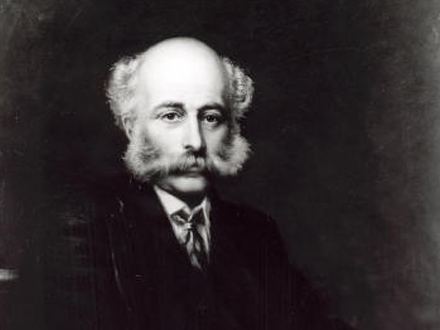
    Joseph Bazalgette by ICE Archive is licensed under a Creative Commons Attribution 4.0 International License.Based on a work at expeditionworkshed.org.
    Creative Commons License
    Joseph Bazalgette by ICE Archive is licensed under a Creative Commons Attribution 4.0 International License.
    Based on a work at expeditionworkshed.org.

    Today at Think Up, Ed McCann and I had lunch with Mike Chrimes from the Institution of Civil Engineers. The main topic on the menu was how to articulate the value to practising engineers of a knowledge of engineering history. Earlier in the day the two of us were talking about how tech could be used to create engaging simulations of work experience for use in schools.

    And then as the main courses arrived the light bulb lit up above my head: why not create a mini module for schools that allows students to take on the role of a famous engineer say for a week. For example, students could spend a week being Bazalgette, chewing over the task of how to transfer vast quantities of poo across London. It would be a fun, playful exercise, but which could be used to develop a range of workplace skills as well as hopefully getting students thinking about what engineers did and do now. There’s more to come on this, but I need to sleep on it…

  • Building the Forth Bridge on Stage

    Building the Forth Bridge on Stage

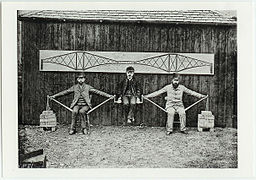
    Cantilever bridge human model

    For my first time on stage at Science Showoff back in November 2011, I decided to recreate the famous public demonstration conducted by engineer Benjamin Baker to reassure the public that his planned Forth Rail Bridge would stand up. For me, this demonstration captures both the engineering daring-do and the showmanship of the period.

    In Baker’s experiment, two stout volunteers sitting several metres apart represent the enormous pylons of the Forth Bridge, their arms out-stretched to represent the top chords of the structure, broom sticks stretching from hand to foot representing the bottom chords of the structure. On a seat suspended between the human pylons a slighter fellow sits representing the weight of a train passing from one structure to the next. What stops the two human pylons from see-sawing in towards the middle under the weight of the central load are the brick counterweights attached to their outer arms. These counterweights represent the massive weight of the approach gateways on either side of the bridge, and show how these gateways play an integral to the stability of the bridge.

    The demonstration is beguilingly simple; recreating it on stage was not. Given the restricted performance space, I had to align the human bridge on the diagonal. Whereas the original experiment was conducted against a wall, mine was done mid-stage, without the benefit of the lateral stability that a wall would have offered. In placed of the broom sticks I created four wooden armatures to represent the bottom booms of the truss so that I could make the necessary connection with the pub chairs – these wooden arms were less sturdy than I had hoped. Finally, as I had arrived at the venue by bicycle, I needed on-site counterweights. The pub were unhappy about me using beer kegs, so one end of the structure was tied down to the underside of the stage, while the other was attached to a hefty base amp.

    The rules of Science Showoff are clear: 9 minutes only on stage. Without the benefit of any rehearsal time, I took to the stage. Three volunteers were selected; all were given fake moustaches for authenticity. Everything was in position, but it all looked very shaky. With a few seconds left, the volunteer in the middle riding the bridge nervously lifted her feet from the floor. Without any wall to lean against, the whole structure began to wobble out of plane, but for a few seconds at least the span was achieved.

    Sadly no photos were taken, but it is a moment I won’t easily forget. I would love to repeat this experiment, but next time I’d build more sturdy armatures designed to actually fit the seats at the venue, I’d do it on a wider stage…and I’d do it against a wall.

    I didn’t know the Science Showoff team at the time, but they have since told me they were scared. Daring do indeed.


  • Babbling about Babel: penning a new routine for Science Showoff

    Babbling about Babel: penning a new routine for Science Showoff

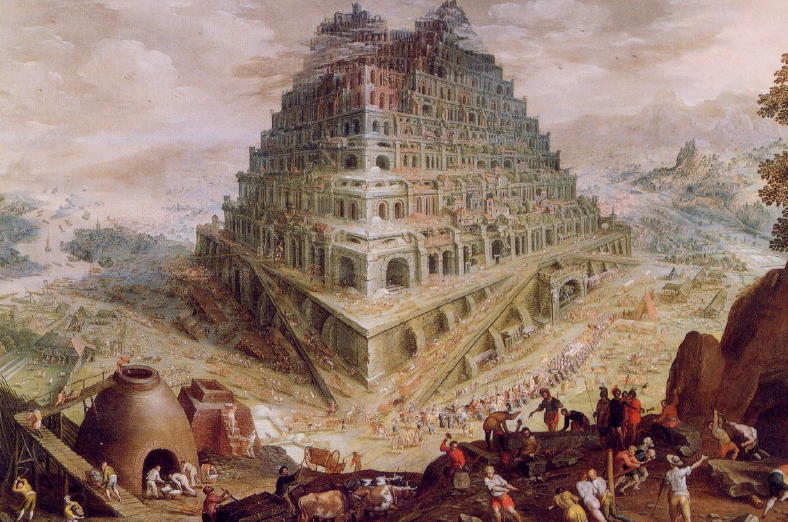
    I’ve just signed up to do a slot at the final Science Showoff to be held at the Wilmington Arms on Tuesday June 4th. I haven’t written any new material since January’s Structural Elements song, but the cogs are now whirling. The theme will be how an engineer would go about designing the Tower of Babel. A tall order, indeed.


    English: Tower of Babel
    English: Tower of Babel (Photo credit: Wikipedia)


  • Using construction site notebooks as a teaching tool

    Today the Expedition-Imperial team met to plan their week at this year’s Constructionarium.

    The learning experience is intense on site at the Constructionarium, with students on their feet all day for five days building their projects. Along the way there is lots of background knowledge they can pick up about construction techniques, but it is easy for these nuggets to get lost in the blur of the overall experience.

    My suggestion was that this year we give all students a site notebook in which they can plan their activities, note useful info along the way and write up their daily activities. Of course, giving students a notebook doesn’t necessarily mean they’ll use it, so perhaps we can guide them by showing extracts from real site engineers’ notebooks. These could be shared as a teaching resource on Workshed.

    Earlier this year we bid for some innovation grant funding to develop methods for students to develop their general engineering knowledge. One of the ideas I was interested in exploring was the use of a site diary to develop this knowledge. This year’s Constructionarium looks like a good opportunity to test this approach.

  • The Return of Low Carb

    The Return of Low Carb

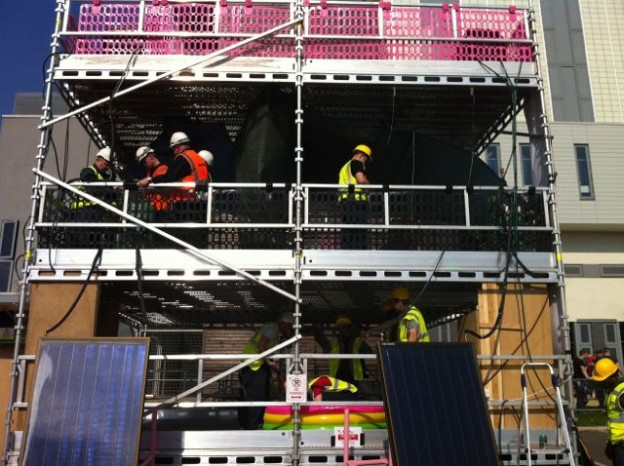
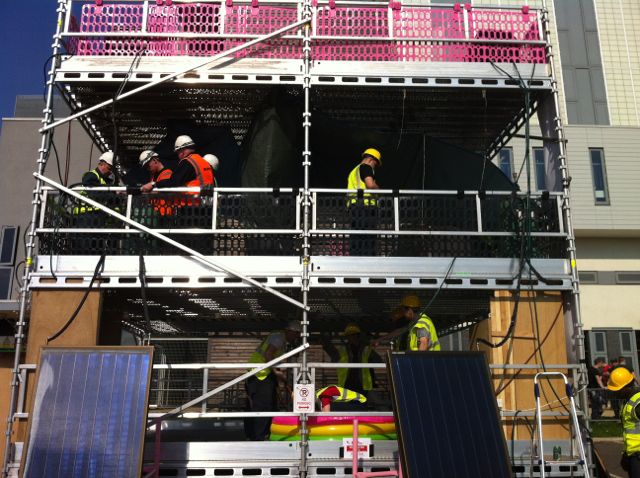
    Installation of solar-thermal water heaters on the Big Rig
    Installation of solar-thermal water heaters on the Big Rig

    Yesterday I was at the Big Rig facilitating the annual low-carbon skills challenge at the Big Rig. This is the fourth year in a row that Think Up has run the ‘Low Carb‘ event. I am very proud that since we came up with the Big Rig concept, 100s of students have taken part in Low Carb. (more…)

  • Facilitating the Global Grand Challenges Student Day

    Facilitating the Global Grand Challenges Student Day

    Royal Academy of Engineering, Microsoft Global Grand Challenges Summit, Think Up
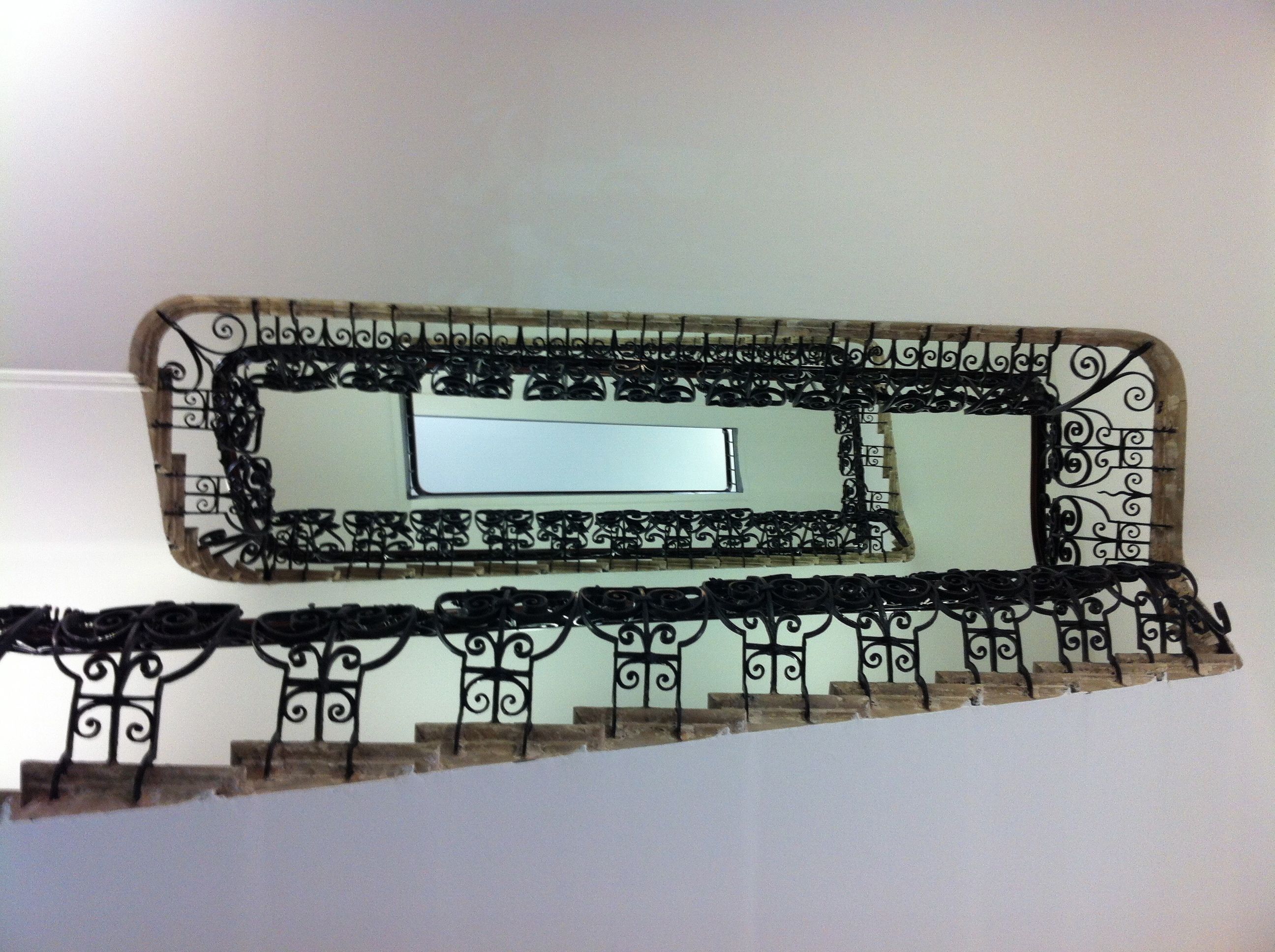
    Spiral staircase at the Royal Academy Engineering, taken on the morning of the Microsoft Global Grand Challenges Summit

    Today Think Up facilitated the Global Grand Challenges Student Day at the Royal Academy of Engineering. The student day is a prelude to the main Global Grand Challenges Summit which starts tomorrow. Our brief for designing the event was to choreograph a day of activities in which students from engineering universities around the world would come together and collaborate to develop a solution to six of the Global Grand Challenges. Our response was a programme that sought to unpick the creative process, and to enable students to examine what skills they need to develop to be better designers, all in the context of solving a major societal challenge. (more…)

  • Chemistry, engineering and Abbey Road studios

    Image

    My courting of the chemical engineering world continued today with a visit to the ChemEng department at Imperial. Today it got even better, because not only do chemical engineers get to use engineering and chemistry, but they get to sit in a huge control room that looks like the sound desk at Abbey Road studios. Or so it seems. (more…)

  • Why did the Toucan cross the road?

    I was cycling from Islington to Old Street this afternoon and saw a sign saying ‘Cyclists, push button for Toucan crossing’. Odd, as there weren’t any Toucans in site.

    Joking aside, I realised I had no idea what this unusually named highway device is. So I look up Toucan crossing online to find out what that it is one of a menagerie of animal themed crossing devices. How many of the following have you heard of?

    Pelican crossing – this is the pedestrian crossing that everyone has heard of. It’s name apparently comes from PELICON, a shortening of pedestrian light controlled. From which a whole ark of possibilities emerges…

    Toucan crossing – this is one that both pedestrians and cyclists can use, so-called because ‘two-can’ cross. Clever.

    Puffin crossing – no, this is not a crossing for children. This is the one that has the pedestrian signal at eye-level above the button. It also includes a pedestrian sensor that checks when pedestrians have finished crossing. Hence the name pedestrian user-friendly intelligent crossing.

    Pegasus crossing – like a Toucan crossing, but this time for horses.

    Who knew?!

  • The Architecture of Pasta Shapes

    I just spotted this while reading someone else’s Christmas present.

    “The more interesting pasta shapes, such as the shell-shaped conchiglie, or the ear-like orecchiette, didn’t just happen…Those clever twists and curls and flowing lines are much more drawing board than chopping board. Although as a sauce hound, I would suggest that Frank Gehry would probably make a better pasta designer than the late Mies van der Ruhe.”

    – Nigel Slater, The Kitchen Diaries Volume 2.

  • Going full circle on the Overground

    IMG_3920

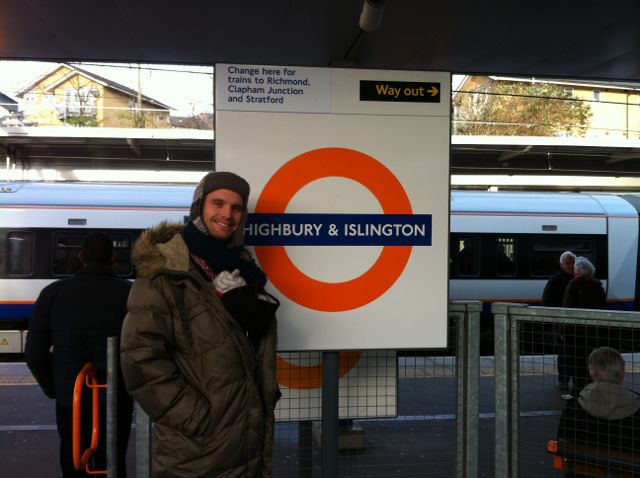
    I feel like a bit of a wally standing here in the rain at Clapham High Street Overground station. There are many shorter ways to get me home, which is diametrically across London from here. I could for example slice straight through the middle on the Northern Line. But I want to take the slow circumferential route simply because for the first time, I can. (more…)

  • A3 Hindhead Tunnel: User notes for the London-to-Portsmouth Motorist

    English: Hindhead Tunnel A3 Open Day 14th May ...
    English: Hindhead Tunnel A3 Open Day 14th May 2011 North Portal (Photo credit: Wikipedia)

    For many years the London to Portsmouth motorist would often have been delayed in tail-backs where the A3 wound its way up the closely packed contours of the Devil’s Punchbowl, a site of special scientific interest. But not so any more thanks to a twin-bore tunnel which sends the A3 beneath this stunning part of the Surrey landscape.

    Here are a few things for the curious motorcar driver to know on as he or she whizzes 65m under the landscape: (more…)

  • Skyfall, starring Daniel Craig…and Bazalgette’s sewerage system

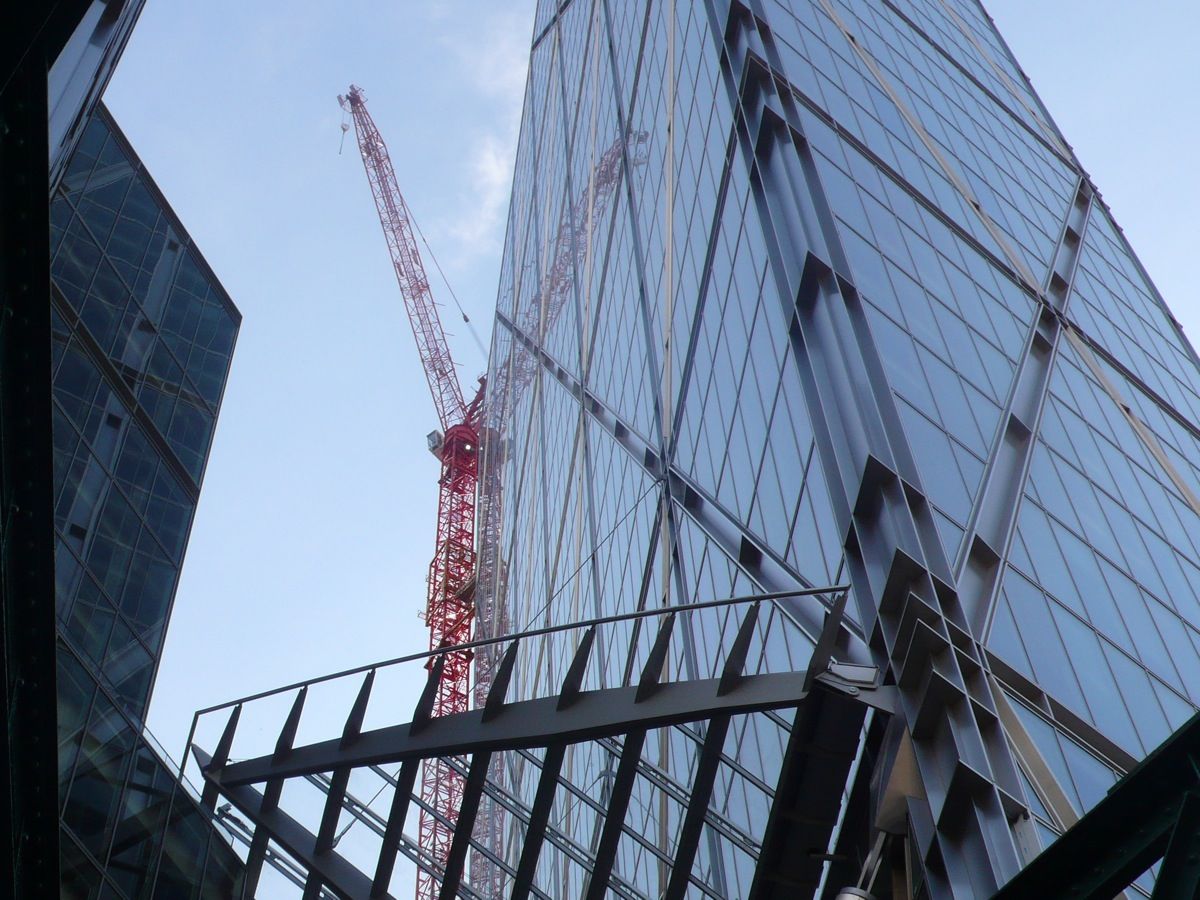
    Being set mostly in London, the latest James Bond film, Skyfall, takes us an action-packed tour of some the city’s great engineering projects: disused Underground tunnels, Bazalgette‘s embankment sewerage system, and even the ancient tunnels under Smithfields, adjacent to the Crossrail site at Farringdon. Even Bond is supposed to be scaling a skyscraper in Shanghai, it is in fact The Bishopsgate Tower (pictured). I was bemused to see that the meticulous plan of the villain seemed to depend on the District line running without delay. Was this meant as a joke?

  • Built in Britain

    Yesterday I watched the first episode of Evan Davis‘s two-part programme Built in Britain. If you like engineering then you’ll love this. It is great to see a big-budget BBC feature on civil engineering that both celebrates modern engineering projects in the UK, but also attempts to answer some of the more difficult questions that new infrastructure projects raise. I feel that engineering programmes usually feature the superlatives – biggest, tallest, longest, deepest – and miss the more important issues, like what societal benefit large-scale engineering projects do, or in some cases don’t, bring. The example of the A3 tunnel under the Devil’s Punch Bowl is a great example of how the case can be made for an expensive infrastructure projects (see links below). And the example of Kielder dam shows how risky predicting the future is.
    (more…)

  • Speaking with Pictures – Peter Ayres at Big Draw Big Make at the V&A

    This afternoon M and I dropped in to the V&A to see what was happening at Big Draw, Big Make. The first talk that caught our eye was Speaking with Pictures, by Peter Ayres from Hetherwick Studio.
    (more…)

  • Happy Birthday Livic – Seven Years Old!

    Back in 2004, I and fellow civil engineering student Andy Kosinski got together to create a new student newspaper for the civil engineering department at Imperial College. It was called Livic (‘civil’ backwards). (more…)

  • Thoughts on developing a social media strategy for an educational resource

    Image

    Over the last few weeks at Think Up we have been getting our Workshed site (an open educational resource) ready for the start of the new university academic year. Part of this process has been putting in place our social media strategy for the year ahead. Over dinner with a friend last week I realise that this is easier said than done, especially as it is based on working with a number of social media tools over the last few years. To come at it cold can potentially be daunting, and potentially frustratingly slow.

    This post therefore is to share with my friend and people in his position our approach to developing a social media strategy for an educational resource. It is by no means definitive or authoritative, and it is a work in progress. Where things do or don’t work I will be happy to report them. I am also aware that people reading this post will be much more experienced in developing social media strategies. If that is you, and you see great big holes in what we are doing, then please tell me. Ultimately, the Workshed site that we are promoting is designed to improve the way people learn about engineering, and is free to use. Anything that can be done to meet its aims can only be a good thing.
    (more…)

  • World tour of structural form at Cafe Scientifique

    A big thank you to the lovely audience at Cafe Scientifique Brighton who welcomed me this evening for my talk, A World Tour of Structural Form. I felt very welcome indeed.

    20120418-000102.jpg

    The aim of the talk was to share a number of basic structural engineering principles and to demonstrate how these can be used to explain how buildings stand up. The talk was illustrated with structures from around the world. I promised no maths and no equations. I stuck to my promise, and judging from the audience responses to my questions, I think this method worked!

    (more…)

  • Notes from Migrations at the Tate Britain

    Notes on a few things that caught my engineer’s eye at the Migrations exhibition at the Tate Britain today.

    ‘Quickly Away Thanks to Pneumatic Doors’ and ‘Soon in the Train by Escalator’, both by László Maholy-Nagy, 1937 are two eye-catching information posters that explain how new technologies will work to improve passenger journeys. The posters are clear, without being patronising. It makes me wonder why we don’t do the same now to explain the engineering that is being employed to build the latest additions to the Tube. Right now in London, we have one of the largest infrastructure projects ever undertaken in the capital underway, Crossrail, and yet the project feels hidden rather than celebrated. More public civil engineering information posters please – I am sure they would be avidly read by young and old.

    (more…)

  • Roll up roll up engineering communicators…time for more Science Showoff

    …it’s Science Showoff time (well it will be next Tuesday). That magnificent monthly occasion when enthusiasts from all walks of science tread the boards in an entertaining manner in a pub, a nice pub in fact. There’s live demos, banjo-playing quantum mechanicians and people with witty things to share with you across the spectrum from biology to astrophysics. There’s a good cause and a general feeling of bonhomie.

    What’s missing? Engineers. There’s loads of stuff that engineers could talk about that this science-hungry audience would lap up. I had a go with cooking with concrete and a Forth Bridge demo, and now it’s my job to try to get more engineers to do the same. So if you think you it’s up your street then come on down on Tuesday to get the measure of the place.

    The next one after that will be on the 5th June, when you could have a go yourself. Go on…

  • The Future of Construction, Surveying…and rock’n’roll?

    The flying robots that Vijay Kumar and his team have built are breathtaking. In this TED talk, he explains how the flying machines work, shows how they can fly in formation to construct simple structures, perform astonishing acrobatics, and explore and map out empty buildings autonomously. Obviously it doesn’t take much to think of more sinister uses of this technology, but another more positive application, shown at the end, shows a considerable amount of imagination…it is worth watching this to the end which is laugh-out-loud funny.

    [ted id=1376]


  • Cooking with Concrete at Science Showoff 5

    Thanks to everyone who came down to Science Showoff 5 to see my first attempt at Cooking with Concrete on stage. I think I was able to convince the audience that, like pastry or dough, concrete is indeed a versatile cooking ingredient. In a little under nine minutes we went through the my grandmother’s C35 concrete recipe, handed down to her by her grandmother. Unfortunately as concrete takes 28 days to reach testing strength we didn’t have time to test the sample there and then, but we did have a look at the samples that we tested rather spectacularly in the lab back in August at Imperial.

    I have uploaded the recipe to the new cooking with concrete section of this blog – available for a short time only.

    I’ll be jointing the Science Showoff gang for the Brighton Science Festival next week doing more ‘hardcore’ cooking. Next time I might even be able to bag some video footage.

  • The Rise and Fall of Civil Engineering – courtesy Google’s amazing ngram viewer

    I read an astonishing article this afternoon titled ‘Quantitative Analysis of Culture Using Millions of Digitized Books‘, published early last year in the journal Science. Based on Google’s effort to digitise all books in all languages, researchers have carried out computational analysis on a corpus of over 5 million books – approximately 4% of all books ever published – to give access to vast amounts of data on word use.

    The availability of this data allows researchers to observe cultural trends and then subject them to quantitative investigation – the study of ‘culturomics‘. The paper illustrates fascinating changes in language size and use, and shows how the data is used to draw more socio-cultural conclusions.

    Best of all, Google has a nifty tool for presenting the data called the ngram viewer, which has allowed me to do a little culturomics of my own for the field of engineering.

    (more…)

  • Good laughs at Science Showoff

    I went down to Science Showoff last night at the Wilmington arms, ‘an open mic night for all communicators of science’. The spectrum of material covered was rather large: from shining infra red light through the skulls of babies, to the biochemistry of baking; from the sad world of lonely neutrinos to the history of the space shuttle programme as told through a mash up of archive footage.

    (more…)

  • Resisting Ikea – preparing for Monday’s sustainability conference

    I spent most of last weekend preparing for a sustainability conference that we ran on Monday (post about that event appearing shortly). I know from experience that the last few days of organising any event like this always involve a mad dash to the shops, and this time was no different.

    [slideshow]
    (more…)

  • Using the Flipped Classroom model with Expedition Workshed

    It’s been one of those days where everything comes together. I have spent the day working on Expedition Workshed site, in particular a new blog aimed helping us have a better dialogue with the teachers who are using the resource in their teaching (I will post a link to the blog when it is ready in a couple of days). At the same time, I have been contributing to discussions related to a new paper that we will be publishing that sets out a model for understanding how structural engineers learn.

    And now this evening I have been reading this interesting blog post (http://usergeneratededucation.wordpress.com/2011/06/13/the-flipped-classroom-model-a-full-picture/#entry)about the Flipped Classroom model for teaching, in which material usually delivered during the lecturers and in class is instead delivered via online resources, freeing up classroom time for problem solving, group work, debating, creating and communicating. The post has some overlap with the paper that we are working on, and has got my cognitives whirling away thinking about how Workshed can be used to deliver the at home content.

    The post sets out a cycle of learning with four stages:
    1. Experimental engagement through hands-on activities, games etc
    2. Concept exploration through content-rich website, pod-casts, online chats etc
    3. Meaning making through reflective blogging, podcasts
    4. Demonstration and application through creative personalised projects and presentations.

    So here’s my idea (and hopefully before too long I will be able to try it out). I would like to create a lesson plan for s series of activities that teach school children about construction materials and the fabric of their school.

    The first stage would be a series of games and discovery activities using the fabric of the school is a stimulus. Learners could for example try to make a model of their school building out of paper, and see what they need to do to make it stronger.

    In stage two they would go away and find out about materials and basic structural forms using the resources on Workshed.

    In stage three would answer quiz questions about materials and simple structural forms using the interactive tools on Workshed.

    In stage four, they would come back to the classroom and work in groups to develop their own design for a new school building, creating a poster or a model, and presenting their proposal to their classmates.

    Whilst I have developed teacher packs before based around the design-and-build methodology, this post on Flipped Classrooms has motivated me to think about how the design-and-build can be more thoroughly split out and developed. I look forward to giving it a go.

  • Showreal – Millennium Bridge Micro Documetary

    Early this year I was filmed presenting a short clip about the Millennium Bridge by a TV production company developing a concept for a new engineering show. We did the shoot on a freezing January lunchtime. Producer/Director Nick Watson has just posted the clip on YouTube. Thanks Nick!

    http://www.youtube.com/watch?v=bJoCc3OyCwA

  • In the can

    In the can: the Useful Simple Trust launch film. I don’t quite remember how I got briefed to make this film. It probably went something along the lines of:
    “the launch should have a cinema off to the side- maybe the Smallest Cinema in the World. And we should get Oli to make a film to go in it about things that are Useful and Simple”

    Over the year I have been involved with making a film about Think Up Mondays. It turns out that making fly-on-the-wall documentaries is difficult- it’s hard to get people to say the right thing! It’s also difficult to get high quality images from the poor camera that we’ve been using. And it’s not cost effective to edit at work. So we got a producer-director in to develop the concept for a number of films with the intention that he will help to a greater or lesser extent produce them. It was about this time that the above conversation was had about making a film for the launch of the trust.

    And so last Monday I met Caius to choose locations: Primrose Hill, the Regent’s Canal by Camden Lock, Chalk Farm Tube and in the print room at Thomas Matthews.

    On Tuesday we filmed the majority of the small clips where people talk about useful or simple things. For the shoot we had both Caius and a cameraman, Mike. It was really interesting to see how the two of them composed shots, as well as how they lit them. Some people just reeled off their lines smoothly- others needed quite a few takes. I really enjoyed writing their lines with them. It’s much better to see how something sounds when someone says it rather than trying to judge the words on paper. With the clocks having gone back the weekend before, we ran out of light surprisingly quickly. We filmed the last few people in the print studio. By the end of the day we’d got nine people in film.

    On Wednesday we filmed Ed’s commentary, which originally didn’t feature in the film. It’s only when I realised that there would be no formal
    announcement at the launch that the need to put some explanation into the film became apparent. Whils at the time this felt like quite a shift in the film’s feel, it also gave the film a raison d’être. In the end the extra day we booked to film Ed was invaluable for assembling enough footage for the film.
    Ed is an old hand at TV filming and he has worked with Caius before and so it was interesting to see the two work together to develop a dialogue and then film it: the greatest contribution in terms of camera time captured in the shortest time. Ed effectively got his lines right first time, but Caius always seem to ask for a second take- just for luck. With hindsight, these second takes were always more relaxed and usually used in the final edit rather than the first take.

    Persuading Alex to film a take holding a worm was not as challenging as I thought it might be. Clement’s take was TV gold- by far the best bit of the film. The low-light of the filming was having to traipse out to Chiswick to hire the turntable used in the filming of the useful simple objects but the results were worth it.

    And so to today when I joined Caius at the editing suite where he has been working with an editor to cut the film. I received a rough cut after one day of editing which I was nervous to watch. I showed it to Chris today and the list of changes was enormous. I didn’t know how we would get them all done. And the most challenging of all was to find a new sound track. Conscience that I only had an hour to trawl the whole of music for a tune I was relieved when Chris came up trumps with a sort of Calypso jazz guitar number. Compared with the twelve bar blues we had before, it gives the whole thing a lift.

    See the finished article on the news part of usefulsimple.co.uk