Serendipitously, as I was preparing for my first dance teaching workshop this morning at the Idler Festival, I spotted a quote in one of my other open browser tabs a quote from David Flemming.
Commons are cooperative enterprises; they therefore depend on trust, on reciprocity, and on social capital. The market economy can get by, for a time, with a gravely-weakened culture and social capital, but the commons cannot. If you really want to save the planet and to give human society a decent chance of living on it, the first thing you should do is to join a choir. Or have dancing lessons, or both. That is not quite the hyperbole it seems: in enduring communities, the thing which defines and distinguishes them is their culture of dance, music, story and tradition—so intertwined with trust that it is hard to tell cause from effect.
David Flemming, in ‘Lean Logic – A DICTIONARY for the FUTURE and HOW to SURVIVE IT’
We always said in the Mudflappers that our mission was to make the world slightly better through the medium of dance. Well here is some compelling philosophical underpinning to back that up. I shared this quote with the dance workshop today and it was well received.
This post is a message to all the lovely people who joined one my dancing lessons at the Idler Festival. You were such a lovely crowd. I had so many great conversations with people who were just happy to be dancing. And it fills me with joy to get people moving their bodies to music.
A big thank you to Tom and Victoria for inviting me back. And a big thank you to Ellie Westgarth-Flynn for teaching with me.
A few of you were asking if I teach anywhere regularly. The short answer is no, but I am looking forward to returning to more festival teaching in the year ahead. If you are based in London, check out Swing Out London for details of classes. If you are based in the West Country, then check out Swing Dance Bristol.
If you have found your way to this blog then hopefully you will find it to be a joyful mix of engineering, creativity, dance and philosophy, all tools I think we need to build the places we want to live in. So stay tuned, or sign up to my mailing list.
I’ll post again soon with the playlists from my teaching sessions.
We move now in my series of posts on tools for creative thinking from gathering inputs to stimulating new connections. This is what I call ‘Turning the Kalideacope‘. The first technique is called ‘Use your Professional Palette’, and it builds on a technique for Filling the Kalideascope we discussed yesterday. It also provides a bridge from gathering inputs to processing them. First, let’s talk about the pre-requisites.
TGV Bridge at Avignon by John is available under CC 3.0
Recently in beginner’s swing dancing classes I’ve described the connection between lead and follow when dancing side-by-side Charleston as being a bit like how pre-stressed concrete works. I promised a longer explanation. Here it is.
Starting with reinforced concrete
To begin we need to understand how reinforced concrete works.
When you build a beam in a building and you stand in the middle of it, the beam sags, albeit ever so slightly. To understand what is happening, you can simulate a simple beam by interlacing your fingers in front of you, palms down. Now imagine what were to happen if someone were to balance a bag of sugar on your knuckles: your hands would sink down, the skin on the underside of your fingers would stretch, and the skin on the top would pucker up. That’s because the skin underneath is going into tension, and the skin that is on top is going into compression. This tension-compression couple is what supports the load resting on the back of your hands.
For a video illiustration of this deomonstration, see this video I helped to script a few years ago at Think Up.
Now let’s imagine what happens if we were to build that beam out of pure concrete instead. Concrete is strong in compression, and so would have no difficulty in resisting the compressive force in the top side of a bending beam. But it has virtually no tensile strength, and so as soon as the underside of that beam starts to stretch it would suddenly crack and catastrophically fail.
So for about 130 years now, engineers have been embedding reinforcing steel in the bottom of concrete beams to carry that tension which arises when a beam bends. Steel is strong in tension (think of the steel cables in a suspension bridge). In a beam reinforced with steel, the steel rods act like stiff elastic bands which resist the tensile loads that are generated when the beam bends.
The importance of depth
Reinforced concrete is a popular building material. To work, the beams need to have a certain depth to them. To illustrate we can think what happens when we bend a 30cm ruler. If you hold the ruler out in front of you flat side facing down, and try to bend it downwards, it bends easily. But if you hold the ruler out in front of you edge-downwards, and try to bend it downwards, it is almost impossible. What’s the difference? It’s the difference in distance between the top and bottom fibre that determines the stiffness.
So, deeper beams are stiffer, and can span further between supports.
Pre-stressed concrete
The problem with deeper beams is that they require a deeper floor void between the ceiling of one level and the floor the level above. Building designers usually want to minimise the floor depth so that they can fit in as many levels as possible within a given height. More levels means more rent.
Pre-stressed concrete is an evolution of reinforced concrete which enables shallower beams and slabs to be used in buildings. In pre-stressed concrete, the steel bars of reinforced concrete are replaced with steel cables which run through the middle of the beam and are attached to a plate at either end. When the concrete is set, this steel cable up is tensioned up squeezing either end of the beam, putting the entire thing into compression.
The effect is similar to when you pick up a row of books simply by squeezing from either end. If you squeeze hard enough, you can pick up say 15 paper backs without any of the middle ones slipping out.
For an illustration of this principle, see another video that I helped to make a few years back at Think Up:
Now imagine you were picking up a row of books in this way, squeezing from either end, and someone were to put a bag of sugar on top in the middle, as long as you were squeezing hard enough, you could probably support the weight of the bag of sugar.
So what is happening here? In fact, the same thing is happening here as when the sugar was placed on our interlaced hands. The top of the books are squashed together, and the bottom split apart a bit. The difference is that because these bending forces are applied to a set of books that is already being compressed together from either end, the bottom edge never goes into tension: it is just a little less compressed. Similarly the top of the books are more compressed because of the sugar they are supporting.
Putting pre-stressing cables into a concrete beam puts the whole thing into constant compression, making the whole thing stiffer.
What’s that got to do with swing dancing?
In teaching beginner swing dancing classes there often seems to come a point where we have to move learners from simply dancing a choreography to leaders leading and followers following. The key to that is the connection between them, which works in different ways depending on the dance.
When dancing side-by-side Charleston, the leader has their arm around their follower’s waist. The follower needs to sit back into this arm slightly, and the lead needs to push against their follower’s back. This creates a slight compressive force between them, which is equal and opposite.
To signal to the follower that the leader wants to move forwards, the leader moves forwards themselves, and in doing so, increase the compression in the connection, which causes the follower to accelerate forwards.
To signal to the follower that the leader wants to move backwards again, the leader moves backwards themselves, and in theory, this reduction in compression should cause the follower to accelerate backwards.
In practice, what we see is leaders moving backwards, and become disconnected from the followers. This disconnection reveals that they never had that matched compressive force in the first place: the pre-stress was missing.
If that compression is there to start with, if one person reduces the compression by pulling away, the other starts moving towards them. If there is no compression, and one person reduces the compression by pulling way, the two simply separate from each other.
So, to get the connection right, get the pre-stress right.
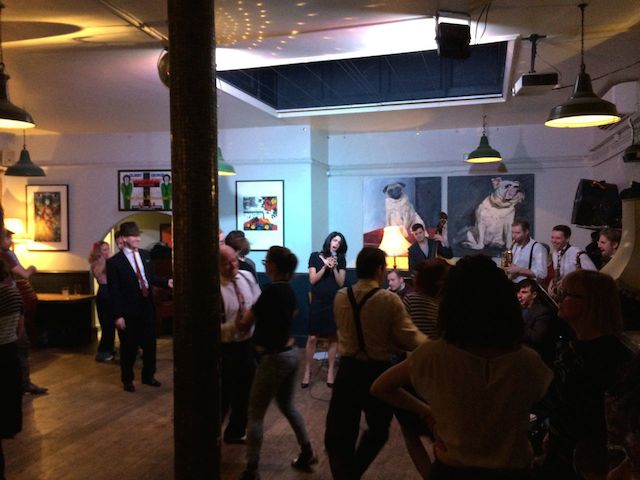
Tuesday nights are when the Mudflappers teach our weekly beginners’ swing dancing class before the London Dance Orchestra takes to the stage at Swing at the Scolt Head. Since I have been doing a lot of the teaching recently I have deployed my usual set of beginners’ class material and so I am having to come up with some new content. Since quite a bit of thought goes into this, I thought I would make some record of it on this blog, not least so I don’t forget in future.
In recent classes we have been spending a lot more time on warm ups. This week we put on Opus One by the Mills Brothers and just got the crowd to shake different bits of their body to the music. It felt really good and everyone seemed instantly to have shaken off their day.
Next up, we taught a bit more of the Shim Sham. This week we tackled the trick bit, the break. (I think we could dedicate a whole class to learning breaks, and maybe call it ‘Breaking Good’). We started by clapping the rhythm, then worked through the footwork, calling the steps. Pretty quickly the crowd picked up, and we had them doing their breaks to the classic T’Ain’t what you do.
Then on to the bulk of the bulk of the lesson, which we spent teaching side-by-side lindy hop moves. I think this set of moves feels really good to learn because you can really move a long way on the dancefloor, you can style it up lots, and the benefit of a strong connection can really be felt. We taught side-by-side charleston, and taught kick ups, and kick the dog. We then showed how from a side-by-side Charleston you can do an inside turn to reverse direction, and from there to move into a hand-to-hand Charleston.
To fit all this in in an hour and half we had to keep the pace up. We did our usual half-time drinks break about two thirds of the way through and then we upped the pace to fit in the hand-to-hand Charleston. By the end, I think everyone in the crowd had nailed the routine and felt pretty good and warmed up for the band.
The last thing to mention is for this week, I paid particular attention to the music. Earlier in the week I had discovered the music of Kid Ory, and so the whole teaching playlist was tracks by him: Ain’t Misbehavin’, Joshua Fit the Battle of Jerricho, Muskrat Ramble and Maple Leaf Rag, all top tunes which I can’t get out of my head. I’m looking forward to next week!
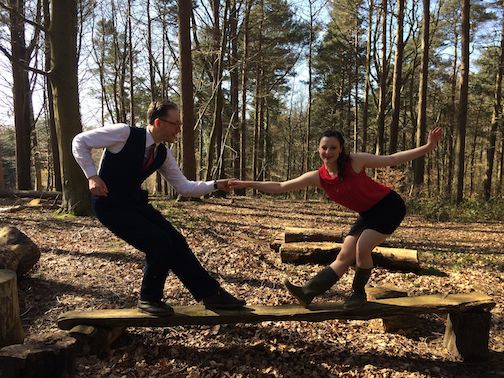
Mudflappers Peter and Nat demonstrate you can lindy hop anywhere.
It’s not long until fellow Mudflapper Jenny Millman and I begin teaching our six-week course ‘Learn to Lindy Hop’ at the Idler Academy. Being a lindy hopper and being an Idler go hand-in-hand, as these classes will show.
You only have to a watch a short vintage clip of lindy hoppers dancing on a film like Hellzapoppin to see that the Lindy Hop oozes with cool, but the great thing about this and other forms of swing dance is that it is a social dance. What this means is that if you learn a few basic moves, and you find yourself in the vicinity of someone else who knows some basic moves, you can get up and start dancing. The threshold for participation is low and the fun you can have is endless. All you need is a song on the radio and someone to dance with and you can get instant pleasure, making it an ideal leisure pursuit for Idlers.
Learning to Lindy Hop is a bit like learning a new language. You begin with learning some words and phrases, and, sure, you have to practice these for a bit using corny holiday-based role-play exercises, but pretty soon, you can start improvising and finding things out about the person you are talking with. In Lindy Hop, the moves are the vocabulary, the rhythms are the grammar, the lead and follow technique the conversational etiquette and the music… is what you talk about. Over the course of six weeks we’ll be teaching some basic vocab and grammar, which we will practice in role-play (où est la salle de danse?) and we’ll be playing lots of music, so that before they know it our students will be conjugating their way around the dance floor.
I find that when I am memorising any sort of sequence – song lyrics, dance moves, lines for a presentation – I usually over rehearse the beginning and spend hardly any time on the end. (more…)