Tag: conceptual design

  • Having a second and third idea

    Having a second and third idea

    Having ideas can be hard, especially when we already have a first idea. How do we trick our brain into thinking that we should go in search of another and another, when as far as our brain is concerned, the first one will do the job?

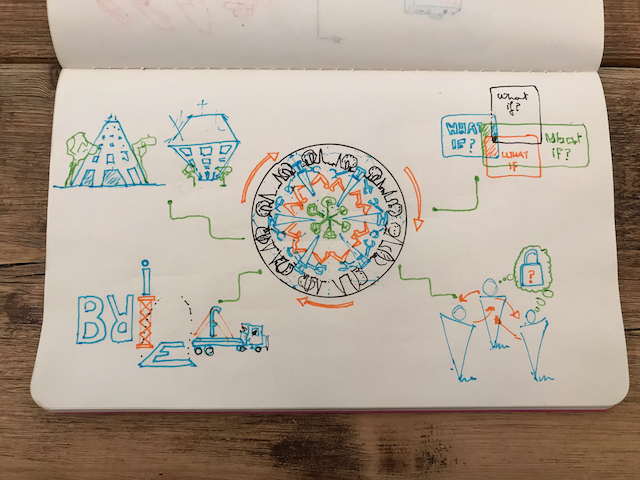
    Here’s a technique I call ‘using your professional palette’. I taught it today in a workshop on conceptual design for engineers, but I think it works for other humans too. The method is to remove the mental block by quickly sketching out five different ways of solving the problem from our palette of standard approaches. The approach forces us to consider options that we might not even have noticed we have discounted.

    (more…)
  • Recognise the desert to return it to life

    When renewable systems are over exploited they fall into a desertlike state. In this state the system population is too low to support regrowth and the system structures break down. But given the right conditions and encouragement, regrowth can return. The seeds are all there. The self-organising ecosystem can return to recreate resilience, complexity and diversity associated with rich life.

    (more…)
  • Carbon vs everything else: system health vs system outputs

    I’m getting this down while it is fresh in my mind following a planning conversation with Will Arnold this morning for our Net Zero Structural Design course. In the final session of this course we are helping participants think about how to weigh up carbon with other wider sustainability considerations.

    In my post earlier this morning I was reflecting on how focusing on a system’s resilience can enhance its restorative powers. My angle then, from a design perspective, was thinking about how we can shift the design brief from designing objects or outputs to designing resilience. Now I am thinking from a different angle: how we test for resilience, and how this relates to tests for carbon footprint.

    (more…)
  • Analogue Skills for Design at the University of Bath

    Analogue Skills for Design at the University of Bath

    Today at the University of Bath I am running a workshop on Analogue Skills for Design. This workshop fuses material from my conceptual design teaching with my observations from the Analogue Skills project, my attempt to collect and curate less digital ways of doing things in case we need to use them again.

    Creativity and design as human skills

    A key thread that runs through my design and creativity teaching is that these are very human processes, which are deeply impacted by individual’s connection to themselves, each other and the environment which supports them. 

    At the individual level, creativity is hugely influenced by our emotional and physiochemical state, the relationship between our conscious and subconscious and our unique combination of lived experience. At a group level, how ideas emerge in a collective consciousness and become the work of many is influenced by relationships, accessibility and the many facets of working culture. And of course we all live in the physical world, the world that we are trying to shape. How we move through and experience that physical world – not in our heads but as moving inhabitants of space – influences how we respond to and act in that space.

    All of these factors are features of how we design, not as purely rational, reason engines, but as emotional, physical human beings.

    Analogue Skills

    Another ability of humans – although not unique to humans – is the ability to create tools. Taking a lever as both an example and a metaphor, our tools enable us to multiply our efforts. The tools we use shape our perception of what is possible, and so influence how we perceive the world. 

    Over the last five years or so I have become increasingly interested in how our tools, and in particular our newer, digital tools influence how we think and live. Because while we have always been influenced by our tools, the rate of introduction of new, digital tools has become so rapid that in less than a generation, our tools have transformed the way we think, feel and behave. 

    I experience this personally because I am a Xennial, someone from a sub-generation that grew up without internet enabled computers but who has spent their whole working life with one. Xennials are halfway between digital natives and digital immigrants. I feel this timing of my up-bringing gives me insight into two different ways of thinking, what I loosely call the more analogue and the more digital. These two ways of thinking can be very different. Take the simple example how to organise information. In the analogue world, information is carefully indexed and prized because it may not be possible to find it again. It is a paradigm of scarcity but also care. In the digital world, the natural assumption is the information is searchable and always available and so information itself is de-valued. This is a paradigm of abundance but also of less care. 

    From this perspective,  individuals become more and more dependent on these new technologies, I see that what once was a tool that served us, these technologies have become a tool to manipulate us. From user to used. With dependency comes fear. How could I ever live without it? But so ubiquitous is our internet-enabled world that we risk forgetting the ways we could live and flourish without computers in our pockets.

    The Analogue Skills Project is my attempt to record less-digital ways of doing things before they get forgotten so that we can use these to evaluate what technology we do and don’t want. It is an attempt to build resilience and reduce dependence on technology that may not always be there to help us. It is my hope to find a more human balance between the analogue and the digital.

    See my collection of analogue skills so far.

    Human operating system

    I see each analogue skill as a way of liberating ourselves from digital dependency and to discover something that it turns out we can do ourselves as humans: each one is a clue to the workings of the human operating system.

    To accompany the growing list of skills I have also created the Analogue Skills Manifesto, which is an invitation to resist the digital pull and rediscover what you can do as a human being:

    • Don’t delegate autonomy to the machines
    • Resist a mediated experience
    • Resist life as content
    • Re-discover old tech
    • Much less is much more
    • Welcome uncertainty
    • Don’t get things done
    • Share, swap and learn from others
    • Relish company
    • Seek nourishment in time alone
    • Embrace friction, embrace inconvenience
    • Forget the unimportant and remember the valuable
    • Ground yourself and find your bearings
    • Use your hands and your senses
    • Concentrate
    • You have everything you need.

    Analogue Skills in Design

    Bringing these two themes of work together, what are the analogue skills that we bring to design that we risk forgetting if we don’t use them, and are worth rediscovering if they have already slipped away?

    Looking through my design teaching deck, there are many concepts which are already analogue, and so I am putting them together here:

    These are skills that we are going to experiment with today. These are things that you can do because you are human. There isn’t going to be a software upgrade. You don’t have to pay a license fee. You can share these tools with whoever you like, and when the internet goes down, you will still be designing. I should also add that these tools don’t stop you from using digital tools – they are here to help you choose.

  • Changing the key system to generate new ideas

    Changing the key system is a technique I teach to help people develop new ideas when their thinking has become stuck. It’s one of my techniques for ‘turning the Kalideascope’. In other words, it’s a way to find new creative connections between all the inputs we have gathered.

    What is the key system?

    Design is creating something new. If it already exists, it isn’t design: it’s shopping (for more on this see my post on the Designer’s Paradox). I usually find that the overall shape of that new thing is defined by the answer to a few key questions.

    For example, the overall shape of a city master plan might be defined by the answer to the question: how do we manage surface water. In a tall building, the key question is how do we manage lateral loads. For a song, it might be the rhyming structure or the chord progression.

    In each of these situations, the key system, then, is the flood water system, the lateral stability system, the rhyming structure or the chord sequence.

    The answer to these big questions has such a dominant effect on the solution space that, once they are set, the rest of the ideas develop within these parameters.

    (more…)
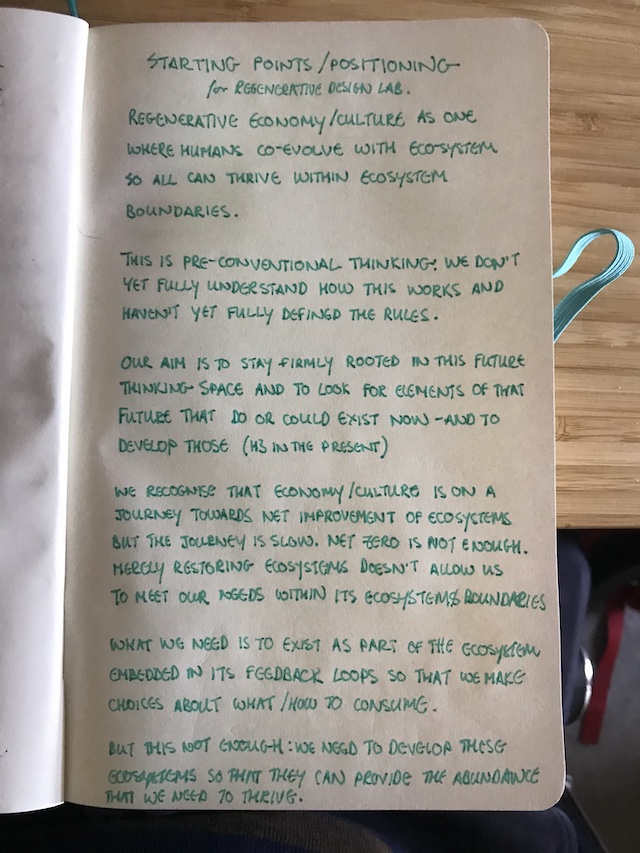
  • Towards Regenerative Conceptual Design

    Towards Regenerative Conceptual Design

    I have had the great fortune of having spent three weeks in France, a good portion of it cycling. Touring is a great way to leave behind your pre-occupations and to think about the future – in my case, the themes for my training and writing in 2021-2022.

    This year, all cycle paths point towards regenerative design – design that is win-win-win for individuals, society and the planet. I hear echos here of the triple bottom line of sustainable design, but sustainability, with it’s promise to protect the environment for the benefit of future generations is no-longer enough. This is a keep-things-the-same model. But as the latest IPCC report confirms, keeping things the same will lead to the breakdown of the carefully balanced ecosystem on which we depend. What we actually need is design that builds back the abundance, diversity, complexity and resilience of the ecosystem that quite literally gives us life.

    (more…)
  • From would you think to what do you think – avoiding hypothetical feedback

    Today I’m sharing a principle of workshop design about how we gather feedback in workshops. But the principle also applies more widely to how we get feedback in design.

    (more…)
  • What is conceptual design?

    What is conceptual design?

    This post has moved and along with my other conceptual design teaching tools is now hosted on the Constructivist website here.

  • How describing design as a process helps teach design

    How describing design as a process helps teach design

    This post has moved and along with my other conceptual design teaching tools is now hosted on the Constructivist website here.

  • The Designer’s Paradox – the key to unlocking the brief

    The Designer’s Paradox – the key to unlocking the brief

    For me the Designer’s Paradox is a key concept in helping people understand what the process of design is. The term was coined by my colleague at Think Up Ed McCann.

    The Designer’s Paradox states that the client doesn’t know what they want until they know what they can have

    Ed McCann – see Think Up (2018). Conceptual Design for Structural Engineers (online) – notes and resources. Available here [Accessed: January 2021].

    In this post I’ll explain why I think this observation is so useful and how we can use it.

    (more…)
  • Creative thinking tools for projects: the Eiffel Over guide

    Creative thinking tools for projects: the Eiffel Over guide

    We need creative thinking tools in our project toolkit to get the most out the opportunities that a new project offers. Projects provide a setting in which people can come together. They provide a focus point for joint attention. They can lead to outcomes that are probably far greater than what we could achieve on our own. In organisations we rightly focus effort on achieving project goals within project constraints – this is project management. But what I think gets neglected is investing in the creative thinking will help define those goals and help reach them in new ways.

    The need for creative thinking in setting goals and figuring out how to achieve them is greater than ever before. The climate and ecological emergencies show us that the usual ways of thinking have failed us. We need new thinking. We need creative thinking.

    I have spent much of the last five years researching, developing and teaching practical creative thinking tools. People use these tools to help develop their personal and team-level creativity in projects. Based on feedback from workshops with hundreds of engineers and other professionals, I have developed a shortlist of tools and techniques that have the most impact: either in terms of how they help people understand creativity; or how they empower people to be creative with more confidence.

    (more…)
  • Training course – Introduction to Conceptual Design for Structural Engineers

    Training course – Introduction to Conceptual Design for Structural Engineers

    This course, which I deliver at Constructivist for the Institution of Structural Engineers is my longest running conceptual design training course. It is an introductory course, which splits conceptual design up into three phases: establishing the brief, creative thinking and convergent thinking and provides simple models for understanding each of these phases.

    (more…)
  • It’s the invisible ingredients in the design dough that makes it rise

    It’s the invisible ingredients in the design dough that makes it rise

    This post has moved and along with my other conceptual design teaching tools is now hosted on the Constructivist website here.

    (more…)
  • Unreliable briefs – finding the deeper design narrative

    Unreliable briefs – finding the deeper design narrative

    It is tempting to think of a design brief as wholly reliable, a document that contains all the information necessary to execute the design. But design briefs are rarely as reliable as that. In fact we should expect them to be unreliable to start with. Our job as designers is to make our briefs more reliable. To help, I have been playing with the literature concept of the unreliable narrator to help characterise types of unreliable briefs.

    (more…)
  • The satisfaction of learning what the buttons can do

    The satisfaction of learning what the buttons can do

    I am reminded this morning of much I like working out what all the buttons do on a machine. Quite often the machines we use, be they an oven, a sports watch or a computer, have many more functions than we realise. Not all of these devices have the levels of user interface design that you might get from say a modern phone. While I’m a fan of good user design, I quite enjoy pouring through manuals to discover these more obscure functions… or better still, trying to discover them for myself.

    (more…)
  • #15 Show-notes – Oliver Broadbent interview by Alexie Sommer – Creativity, climate and clowning

    #15 Show-notes – Oliver Broadbent interview by Alexie Sommer – Creativity, climate and clowning

    I spend most of my time designing creativity training for engineers. In this episode we flip the format. Alexie Sommer, Independent Design and Communication Director and collaborator on many of my projects interviews me about why I set up Eiffel Over and Constructivist Ltd, and what our plans are for designing creativity training for engineers in 2020. We get into:

    • Techniques for teaching creativity
    • Our programme of training support people tackling the climate emergency
    • And what engineers might learn from clowns.

    Listen on Apple Podcasts , Sticher or by download here

    (more…)
  • Creative Surplus

    Creative surplus is the time we have to invest in thinking creatively, just like a financial surplus allows us to make financial investments. I like the term because it implies both that it is a quantity that you have to create and it is something that you can invest for greater benefit later.

    (more…)
  • Notes from IStructE Academics’ Conference 2018

    There was great energy at today’s IStructE Academics’ Conference, the theme of which was Creativity and Conceptual Design.
    If you are visiting this site for the first time, it may have been thanks to Chris Wise’s kind recommendation in his keynote presentation – thanks so much Chris.
    I presented a session on how to have ideas. Usually when I’m billed with this title, I run a workshop on idea generation, but I thought for once, I would stand up and say what I think about the subject. I’m glad I did because it seemed warmly received. It was also a chance to talk through themes that will be included in the chapter I am writing in a book on scheme design – more details to follow.

    (more…)

  • Secretly teaching design – notes from our curriculum planning day at Imperial

    Secretly teaching design – notes from our curriculum planning day at Imperial

    I am just back from taking part in a Design Thread workshop at Imperial College, the aim of which was to co-ordinate activity between the various design-relevant courses on the undergraduate civil engineering course at Imperial. Here are some reflective notes as I whiz home, during the writing of which I came up with the notion of ‘secretly teaching design‘. (more…)

  • The perils of false modesty

    The perils of false modesty

    I just read this great paragraph on the debilitating impact of false modesty on judgement.

    (more…)
  • What makes a good conceptual design statement? – working notes

    What makes a good conceptual design statement? – working notes

    Gateshead Millennium Bridge
    Gateshead Millennium Bridge

    Today I am working on course material related to defining what is a good conceptual design. I think, in construction at least, it is quite difficult to identify good conceptual design from the finished project. One can judge a finished project on the basis of the final outcome, but unless you have had an overview of the whole design process, it is hard to know how much the final project resembles the original concept design.
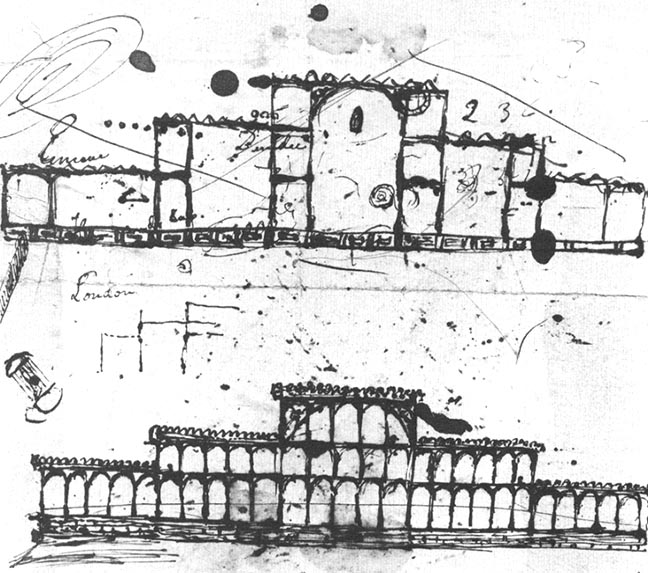
    One clue is in competition sketches, if they are available. It is tempting to suggest that if a simple early-stage sketch exists that closely resembles the final project, then we have a good conceptual design. Good examples might include Paxton’s sketches on a napkin for Crystal Palace or the Utzon’s competition sketches for the Sydney Opera House. But (and I’m not suggesting it was the case for these two examples) it is not beyond designers to create a post-rationalised concept diagram. And while this idea of the simple sketch is also beguiling, it is much more appropriate for projects that resemble a sculpted object, rather than a complex system.
    From a training perspective, if we were to stand in front of a building and seek to judge the quality of the conceptual design without knowledge of the early-stage design process, I think we’d be on shaky ground. The approach we will adopt instead is to spend time defining what a good conceptual design statement looks like so that designers can judge the quality of their conceptual designs at the start of the project.
    There are lots of definitions of what a good conceptual design statement is. My colleague Ed McCann has pointed me towards a helpful description from the world of interior fit out. In his book Shaping Interior Space, Rengel describes the three elements of a good conceptual design statement as:
    1. Talking more about the solution than the problem
    The place for the statement of the problem is in the brief.
    2. Selective
    Here he means it talking about the dominant factor which is going to define the design approach. Is it a question of how a long span is going to be achieved, huge forces are going to be resisted, or what the human experience is.
    3. Economical
    Careful use of words to pack the most into the fewest words.
    These three elements are something I can work on with a group of learners. We might begin by asking them to compare different conceptual design statements, and get them to elucidate these rules; and then get them to create their own statements.
    One key modification I will make to this set of rules to make them equally applicable to sketching as to words.
    If you are reading this and have either your own definition of good conceptual design statements that you use, or particularly good examples of conceptual design that you’d like to share, then please comment below.