Tag: DesignBrief

  • Observe | Brief | Ideas | Test | Repeat

    This week I’ve been making the case for a continuous, place-based approach to design. As James Norman and I set out in the Regenerative Structural Engineer, we see this process as a cycle of the following stages.

    1. Observation

    Traditional design often begins with a design brief—a predefined problem to be solved. But Continuous Place-Based Design, with its focus on working with the existing dynamics of a place rather than imposing change from outside, begins with observation.

    Observation means more than a desk study or mapping exercise. It requires time spent in a place—experiencing it from different perspectives, noticing rhythms, interactions, and patterns of change. But observation isn’t just the first step. It is something we return to again and again, each time we make a change.

    2. Brief

    From observation, we begin to sense what is needed. The brief emerges as a way of distilling these needs into a set of design requirements.

    In traditional design, the brief is often seen as something to resolve upfront—reducing uncertainty as quickly as possible. But the Designer’s Paradox reminds us that a brief is never fully known at the start; understanding of the brief unfolds through the act of designing itself.

    Continuous Place-Based Design embraces this reality. The brief evolves over time, but it doesn’t necessarily converge to a single, finalised solution. Each iteration is the best response for now, while recognising that every intervention changes the system—and with it, the design brief itself.

    3. Ideas

    The creative phase of the process is deeply influenced by the place itself. Ideas are not imposed from outside but emerge from the system we are designing within.

    The designer’s role is not just to generate ideas, but to facilitate the emergence of ideas from place—to see what is latent, what is already forming, what might be supported. At the same time, by embedding ourselves in a place, we too become part of its system. Our ideas are shaped by this connection, rather than being external impositions.

    4. Make and Test

    This is where we intervene—where design moves from thought to action. We begin making changes to the system.

    Interventions can range from small-scale tests to large-scale changes—though an important principle stands: start small, learn, then scale out. Through making, we begin to see how the system responds.

    For example, in a housing development, instead of building an entire estate at once, we might start with a few houses, observing how the place changes and adapts before expanding further. The goal is not to eliminate uncertainty, but to work with the unforeseen consequences of our design decisions—using them as feedback to refine and update the brief.

    Back to Observation Again

    Having made our changes to the system, we go back to observation. But we are not back where we started: the system we are designing in has changed and we too are changed by that process. We become a more integrated part of the system we are designing in, better able to facilitate change that will bring forward thriving in that place.


  • What shall we do a with a no-brief client?

    (To the tune of “What Shall We Do with a Drunken Sailor”)

    Chorus:

    What shall we do with a no-brief client?

    What shall we do with a no-brief client?

    What shall we do with a no-brief client?

    Early in the morning? 

    Verse 1:

    Start with a list of their requirements,

    Start with a list of their requirements,

    Start with a list of their requirements,

    To get the process rolling!

    Verse 2:

    Sprinkle on a little bit of what delights them,

    Sprinkle on a little bit of what delights them,

    Sprinkle on a little bit of what delights them,

    And now we’ve got a briefing!

    Verse 3:

    Now it’s time to go and break the brief right open,

    Now it’s time to go and break the brief right open,

    Now it’s time to go and break the brief right open,

    To start creative thinking!

    Verse 4:

    Read the brief out slowly to them,

    Read the brief out slowly to them,

    Read the brief out slowly to them,

    And see what is emerging!

    Verse 5:

    Capture all their questions on a great big mind map,

    Capture information on a great big mind map,

    Capture inspiration on a great big mind map,

    And see what thoughts are forming!

    Verse 6:

    Oh ay, another idea!

    Oh ay, another idea!

    Oh ay, another idea!

    No idea is too stupid!

    Verse 7:

    Now it’s time to test them all against the briefing,

    Now it’s time to test them all against the briefing,

    Now it’s time to test them all against the briefing,

    To see what needs improving!

    Verse 8:

    And so you’ve got a brief and some emerging concepts,

    So you’ve got a brief and some emerging concepts,

    So you’ve got a brief and some emerging concepts,

    That the team can work with!

    Final Chorus:

    That’s what we do with a no-brief client,

    That’s what we do with a no-brief client,

    That’s what we do with a no-brief client,

    Next time, call us sooner!

    —–

    🎼 Do you like songs about engineering? Here’s another one I wrote.

  • Make a little time for design

    Things are just a bit too busy right now. I don’t really have much time to think about my design process. Or so it goes.

    But here’s the thing: even a little time spent thinking about your process is time well spent. Steal a few seconds on your commute or book a 15-minute meeting with yourself in a quiet pod.

    Once you’ve carved out those moments, here are some quick things you can do:

    • Write down the high-level brief. – Often, we forget what the brief actually is! Take a moment to capture the key things that need to be achieved to meet the client’s needs.
    • Gather your inputs. Check you’ve got the basics covered: information from the brief, site details, precedents, and inputs from colleagues.
    • Print off some sketches, images, or drawings. So much of our work lives on tiny screens, but our brains evolved to process a much wider field of vision. Fill that space with physical inputs to stimulate creative thinking.
    • Do a quick sketch. A simple sketch can help you spot new connections or things you hadn’t noticed before.
    • Do nothing! Sit quietly for ten minutes and let your subconscious do the work. Sometimes, clarity comes from stillness.

    Try it once, and you’ll likely notice something you hadn’t seen before. Do it often, and you’ll build a habit of making time for design—a habit that pays dividends over time.

  • Begin design with observation (part 1)

    We often think of design as starting with a design brief—a set of requirements outlining what we want.

    But when seen through a regenerative lens, design begins differently. The goal of regenerative design is not just to meet human needs but for human and living systems to survive, thrive, and co-evolve.

    This shift in focus changes the design process in significant ways.

    The first difference is that our goal is not simply the creation of a building. Instead, the building itself must contribute to greater thriving within the system it inhabits.

    This leads to a different starting point. Instead of asking, “What building do I need?” we ask, “What is the overall state of the system I’m working within?” Part of that system might include the immediate need for a building. But in this framing, we also consider the broader system needs.

    • What is the health of the ecosystem? Where is it thriving, and where is it depleted?
    • What is the health of the community? In what ways is it flourishing, and where are there unmet needs?

    By starting from these wider perspectives—and including many other factors we might observe—a more holistic design brief emerges. One that has the potential to address far more than our own immediate needs.

    But there’s another important reason to start design with observation. More on that tomorrow.

  • Re-inventing the wheel(ie bin)

    Yesterday, I wrote about improving how we manage poo at Hazel Hill.

    One particular challenge our staff face is dealing with three of our most “productive” toilets. These are indoor composting toilets, designed so that the waste drops directly into wheelie bins in a bay beneath the building. The idea is that the wheelie bins can then be wheeled out and tipped into composting bays.

    The problem? During the design phase, nobody checked whether it was actually possible to tip out a wheelie bin full of poo.

    Originally, the plan included a fleet of wheelie bins, so some could be left full for a while to allow the waste to break down, making for much pleasanter work. However, during procurement, these extra bins were “value engineered” out of the project. We now have just one set of bins in use, which means they must be emptied fresh.

    As part of our Plan for Poo, we want to improve this wheelie bin system. The easy fix is to buy more bins, allowing for a proper ageing process. But even with well-aged “vintage” contents, tipping the bins remains a challenge.

    So we have a live design brief: to create a method or mechanism for safely and effectively emptying wheelie bins of poo.

    Here are the constraints:

    • We’re an off-grid site. While we have some power on-site, we prefer low-energy, low-tech solutions that align with our ethos.
    • The system should be operable by one member of staff.
    • Ideally, we’d like to use materials we already have on-site to stay in line with our preference for self-sufficiency.
    • The bins need to be tipped into a composting bay for continued breakdown. The design of this bay can be part of the solution.
    • The system should be up and running by the summer holidays.

    We’re inviting suggestions from our community. Designs on a postcard, please! Ideas will be displayed on a board near the outdoor composting area for everyone’s consideration.

    Watch this space for updates.

  • Design loop the loop

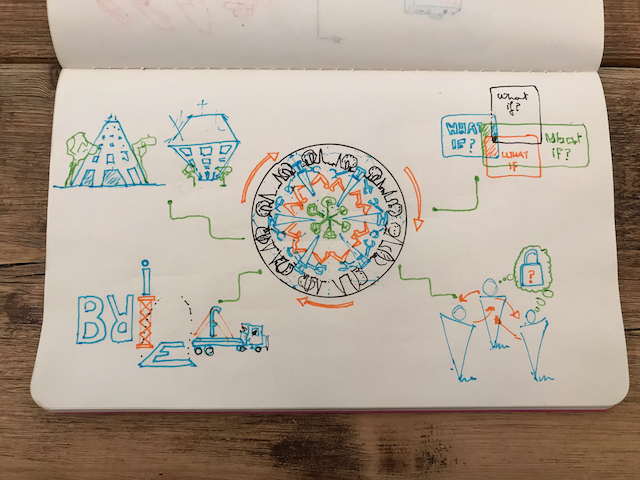
    Design is a continuous, looping process.

    It is a loop that begins with observing a situation, then establishing a brief for your work, developing ideas, and testing those ideas—trying them out in some way and observing what happens.

    Then we are back to observing again. Except we aren’t back in the same place, because the system has changed. It now includes your idea.

    The second time around, we are observing a changed world—a world altered by our developing and testing of ideas in response to a brief.

    Now, we can update the brief to create a better set of requirements—a set informed by what happened the last time we went around the loop.

    Each conversation with a client about needs and possibilities is a journey around the design loop.

    Each time we share sketches with the design team, we go around the loop once more.

    Assembling tender drawings and receiving tender responses—another orbit.

    Early contractor input, detailed design, on-site meetings to resolve design issues—all further revolutions.

    Every time we loop the loop, we learn something more about the system we are working in and how we are changing it.

  • Kinetic versus thermodynamic conversations

    Some conversations go quickly. 

    Some conversations go better.

    I wrote on the 21st October about the difference between a kinetic and a thermodynamic product in a chemical reaction. The kinetic product is the fast result; the thermodynamic is the slower, more stable result. 

    As designers we may feel we need to have fast, productive conversations so that we can show our value. 

    But if we go quickly, we risk producing a fast but unstable, kinetic result. An answer crystallise that we can point to and get paid for, but it might not be the best, most stable, situation appropriate result. 

    Better conversations take time. We need to listen. Then we gain trust. Then we can get to the heart of the issue and start to do work that is more appropriate to the unique specificities of the complex situations are clients are working in.

  • Design versus Shopping

    If the client knows exactly what they want at the start of a design process, then it isn’t design – it’s shopping. Shopping for the answer that you’ve already decided upon. Because design isn’t the business of dealing with knowns. It is precisely because there are unknowns that we need a design process. 

    By all means we should have an initial brief that describes outcomes we are trying to reach. And then begins a journey into realm of unknown possibilities and constraints to find out what might be possible. What we may discover is that that original statement of intent was not quite right. We might find something based on a better understanding of the situation. 

    And then we get a better brief. Better for everyone involved, including the client.

    Consider the opposite. The client sets a tightly defined brief with highly specified outcomes. The designer is forced to the client’s exacting brief, tantamount to a shopping list (and which has probably become formalised as a contract). The designer discovers a better solution but because it is not on the client’s shopping list, it isn’t considered. 

    And so the client comes back from the shops with what they asked for. But there is no guarantee they are going to fit.

  • Carbon vs everything else: system health vs system outputs

    I’m getting this down while it is fresh in my mind following a planning conversation with Will Arnold this morning for our Net Zero Structural Design course. In the final session of this course we are helping participants think about how to weigh up carbon with other wider sustainability considerations.

    In my post earlier this morning I was reflecting on how focusing on a system’s resilience can enhance its restorative powers. My angle then, from a design perspective, was thinking about how we can shift the design brief from designing objects or outputs to designing resilience. Now I am thinking from a different angle: how we test for resilience, and how this relates to tests for carbon footprint.

    (more…)
  • Find the disputable brief in your project

    Find the disputable brief in your project

    The disputable brief is a term I’ve coined to describe the bits of the brief that make your project worthwhile and different. It is easy to write a really long brief for your project. But what is going to make the difference between your project and the next one? It’s the part that isn’t necessarily a given, the part you need to fight for, the part that’s disputable. 

    (more…)
  • How do I know if my ideas are any good?

    How do I know if my ideas are any good?

    It’s a simple question. When I ask people what they want to get out of a training course with me on design or creativity, a common answer is ‘greater confidence that my ideas are good’. But how do I know if my ideas are any good? In this post I provide an answer that is simple, but that has deeper consequences.

    (more…)
  • The Designer’s Paradox – the key to unlocking the brief

    The Designer’s Paradox – the key to unlocking the brief

    For me the Designer’s Paradox is a key concept in helping people understand what the process of design is. The term was coined by my colleague at Think Up Ed McCann.

    The Designer’s Paradox states that the client doesn’t know what they want until they know what they can have

    Ed McCann – see Think Up (2018). Conceptual Design for Structural Engineers (online) – notes and resources. Available here [Accessed: January 2021].

    In this post I’ll explain why I think this observation is so useful and how we can use it.

    (more…)
  • How do you know if your idea is any good?

    I regularly ask this question on my ‘How to Have Better Ideas’ workshops (the sequel to ‘How to Have Ideas’). It’s a short question that triggers a wide range of answers. But the one I am looking for is this:

    ‘A good idea is one that meets the brief’

    My aim is marrying up the brief and the idea. I want to emphasise that the two should match. If the idea doesn’t meet the brief, then we have three consequences:

    (more…)
  • Does your project need a creative boost?

    Here’s four things you can do straight away to give your project a creative boost.

    1. Write down the brief. What are you trying to do? Who are you serving?
    2. Write as many things as you can about the project in a big piece of paper. I recommend using the following three headings as prompts: Information, Questions, Ideas. Stick it on the wall near where you work.
    3. Talk through your ideas with someone. Ask them just to listen and not say anything until you are done.
    4. Try to ignore the project for a day (I bet you can’t), and then the next day, write down five new ideas that will inevitably have emerged.
    (more…)
  • Proust, constructivism and listening to clients

    This week I underlined this sentence from Proust’s Finding Time Again. 

    “Even at the moments when we are the most disinterested onlookers of nature, of society, of love, or art itself, since every impression comes in two parts, half of it contained within the object, and the other half, which we alone will understand, extending into us, we are quick to disregard this latter half, which ought to be the sole object of our attention, and take notice only of the first, which being external and therefore impossible to study in any depth, will not impose any strain on us: we find it too demanding a task to try to perceive the little furrow that the sight of a hawthorn or a church has made on us.”

    Proust, M. (1927). Le Temps Retrouvé (Finding Time Again) (C. Prendergast (ed.); Ian Patterson tranlation). Penguin Classics.

    This sentence comes in the middle of Proust’s revelation about what his work as a writer should be: to translate his inner world to the outside. He finds much greater richness in understanding the impression that the world makes on individuals than understanding the surface, objective qualities of what is being observed.

    Things I take away:

    (more…)
  • Brief explosion –  starting a creative project

    Brief explosion – starting a creative project

    My starting point for gathering inputs to a creative project is the working brief. The technique that I use with participants in my workshops is what I call the ‘brief explosion’, the first stage in the process of ‘Filling the Kalideacope’. It’s an explosion because from just a few brief words you can generate so many inputs.

    (more…)
  • Filling the Kalideascope – creative inputs in the moment

    Filling the Kalideascope – creative inputs in the moment

    In my last post I described the Kalideascope as a tool for having ideas. You fill it with inputs and then turn it to create new the connections between those inputs which constitute new ideas. In this post I will give an overview of the different kinds of inputs to the creative process you might look for.

    (more…)
  • Training course – Introduction to Conceptual Design for Structural Engineers

    Training course – Introduction to Conceptual Design for Structural Engineers

    This course, which I deliver at Constructivist for the Institution of Structural Engineers is my longest running conceptual design training course. It is an introductory course, which splits conceptual design up into three phases: establishing the brief, creative thinking and convergent thinking and provides simple models for understanding each of these phases.

    (more…)
  • Working notes on feedback as a design tool

    This week I ran a workshop with undergraduate students at Imperial College working in design teams at imperial. the aim was to show that it is much easier to give feedback when you a working from a common set of expectations. But this feedback approach can go much further than supporting good team dynamics – itself very important – it can be used as a tool for creative thinking and exploring new ground. Here is a summary of the ten most common points that came up during my conversations with students.

    (more…)
  • It’s the invisible ingredients in the design dough that makes it rise

    It’s the invisible ingredients in the design dough that makes it rise

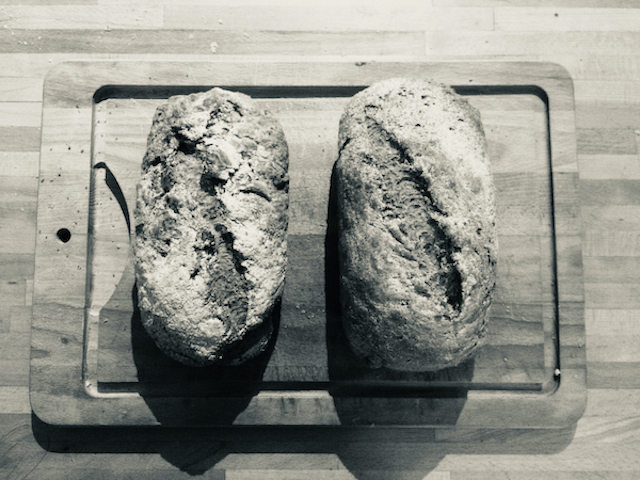
    There used to be a sign outside a bakery in London that said something along the lines of, ‘it’s the invisible ingredients – love, care and attention – that make our bread taste so good. This aphorism often comes to mind when I am running sessions on how to interpret a design brief. Understanding the ingredients can really help the design rise.

    (more…)
  • Unreliable briefs – finding the deeper design narrative

    Unreliable briefs – finding the deeper design narrative

    It is tempting to think of a design brief as wholly reliable, a document that contains all the information necessary to execute the design. But design briefs are rarely as reliable as that. In fact we should expect them to be unreliable to start with. Our job as designers is to make our briefs more reliable. To help, I have been playing with the literature concept of the unreliable narrator to help characterise types of unreliable briefs.

    (more…)
  • Developing a design brief: asking the bigger questions

    Developing a design brief: asking the bigger questions

    When developing a design brief, it is tempting to start by constraining the problem – by clarifying, by simplifying, by cutting out. But if we want to make sure we are answering problems that matter, we need to step back from the brief and ask some bigger questions.

    (more…)