Tag: ecosystems

  • What if every time we built something the world got better?

    What if every time we built something the world got better?

    It is a simple question. What if every time we built something the world got better? Not just in the places we construct but in all the places affected by our construction activities. If we could meet this apparently simple ask, then we would shift the construction industry from a paradigm of extraction and damage to a paradigm of healing and repair.

    In our groundbreaking new book, James Norman and I explore what it would take for the construction industry to make this shift and what role structural engineers have to play in this transition. In short, what it would mean to be a regenerative structural engineer?

    (more…)
  • Design bridges our internal and external worlds

    Last night I had the pleasure of attending the Sir Misha Black Awards, which celebrate excellence in design teaching. And even more so, the pleasure of hearing last years award winner Judah Armani give his presentation one year after he won the award.

    One phrase that Judah said stuck with me.

    “Design communicates between our inner world and our outer world.”

    (more…)
  • Regenerative Design: a process not a thing

    Regenerative Design: a process not a thing

    As I continue my exploration of regenerative design in engineering, correspondents have said it would be helpful to gather examples of regenerative design. Templates that we can look at, imitate and integrate.

    From my reading of Wahl (see my recent post), I’m increasingly understanding regenerative design to be a process rather than a thing.

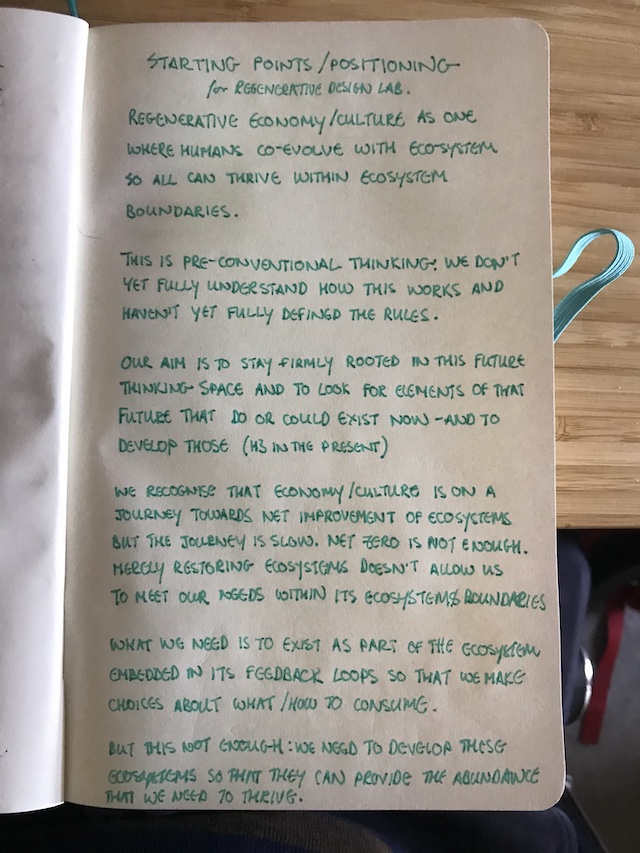
    Regenerative practice of any sort (in design, in education, in living…) is practice that leaves the ecosystem richer and better able to heal itself. It is practice that sees humans as a keystone species that play a unique role in helping their ecosystems thrive.

    (more…)
  • Our responsibility: reduce carbon on projects by 7% a year starting now

    Our responsibility: reduce carbon on projects by 7% a year starting now

    Hold this figure in mind: 7%.

    In 2019 the UN Environmental Programme (UNEP) published a report concluding that in order to limit global heating to 1.5 degrees, we need to reduce carbon emissions by 55% below 1990 levels by 2030. That’s equivalent to 7% per year, starting now, every year until the end of the decade. 

    That is faster than they fell in 2020 during the pandemic.

    (more…)
  • Sustainability is no-longer enough

    Today I am sharing more of the thinking that went into my vision question for Hazel Hill Wood: what if we became a centre for regenerative practice?

    It is my view that sustainability has been captured by mainstream industry and politics as a smokescreen for business-as-normal. We now know that our efforts to sustain our ecosystems for the benefit of future generations has not been enough and that we now beginning a process of climate and ecosystem breakdown. 

    (more…)
  • What does regenerative design mean for engineers?

    What does regenerative design mean for engineers?

    As I wrote in my last post, this summer I have been thinking about regenerative design, and what it means for engineers. 

    In the context of climate breakdown, the dominant paradigm in design is sustainability: design that seeks to sustain the quality of our existing ecosystem for the benefits of future generations. But as the latest IPCC report makes clear, our planetary systems are so depleted that even if we stopped putting carbon dioxide into the environment now, there is sufficient carbon dioxide in the environment to trigger significant temperature rises and ecosystem destruction. What we need now is to go further than maintaining the status quo and start regenerating our planetary ecosystems through our actions – this is regenerative design. 

    (more…)
  • Towards Regenerative Conceptual Design

    Towards Regenerative Conceptual Design

    I have had the great fortune of having spent three weeks in France, a good portion of it cycling. Touring is a great way to leave behind your pre-occupations and to think about the future – in my case, the themes for my training and writing in 2021-2022.

    This year, all cycle paths point towards regenerative design – design that is win-win-win for individuals, society and the planet. I hear echos here of the triple bottom line of sustainable design, but sustainability, with it’s promise to protect the environment for the benefit of future generations is no-longer enough. This is a keep-things-the-same model. But as the latest IPCC report confirms, keeping things the same will lead to the breakdown of the carefully balanced ecosystem on which we depend. What we actually need is design that builds back the abundance, diversity, complexity and resilience of the ecosystem that quite literally gives us life.

    (more…)
  • Revaluing weeds in the biodiversity emergency

    Revaluing weeds in the biodiversity emergency

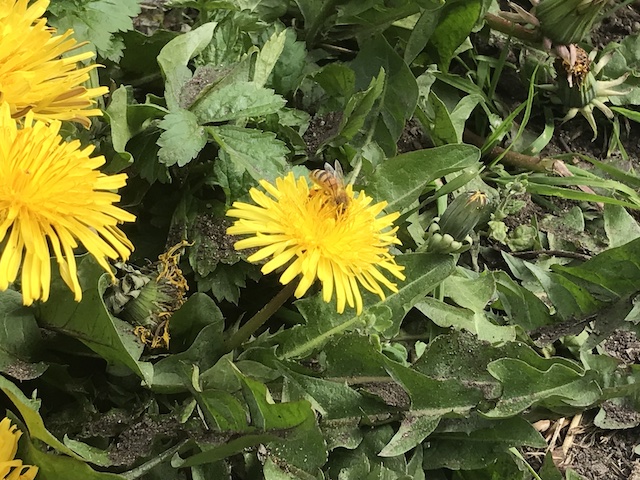
    Yesterday a council contractor rode up and down our street spraying weed killer on the pavements, grass and tree pits. I was dumbstruck. This is the biodiversity crisis manifesting literally on my doorstep. And at the same time double standards. Here you have a council that has led the way in the UK in declaring both climate and ecological emergencies. All the while its contractors are spraying weedkiller on its streets. For me this encapsulates the fundamental challenge of the ecological crisis: we understand at some high level that something must be done but we can’t translate that into what a thriving ecosystem looks like.

    (more…)
  • Questions to ask your colleagues in the biodiversity emergency

    Questions to ask your colleagues in the biodiversity emergency

    The biodiversity emergency requires us to change how we value and relate to the ecosystems that support us.

    Values shift when we change our habits. Habits are the rituals and routines that form part of an organisation’s culture. Work the habits to shift the culture.

    We see it in Toyota’s Improvement Kata, which uses habit to reinforce behaviours around improvement, adaptation and innovation. We see it in the ‘safe-start’ procedure used for meetings in safety-critical industries.

    And so I’m wondering what might be questions that we might routinely ask each other of our projects in organisations that have declared a biodiversity emergency?

    (more…)
  • Rethinking our relationship with our ecosystem

    Yesterday I was writing about what to do after declaring a biodiversity emergency. My conclusions was that the process starts with rethinking our relationship to our ecosystem. Not how can we do something to our ecosystem but how can we work with it. Today I want to get into more ways that we can achieve this shift in the way we think.

    (more…)