Tag: kalideascope

  • The Kalideascope

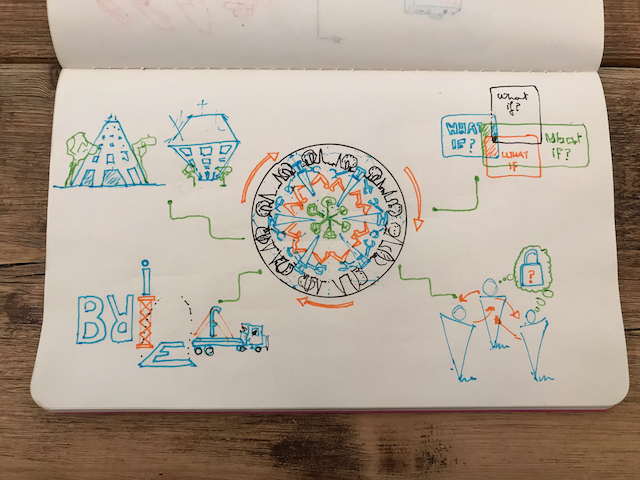
    Some time ago, I took James Webb Young’s kaleidoscope analogy for having ideas and ran with it, building a whole model for helping engineers (and other humans) understand idea generation as a structured process. 

    I call it the Kalideascope

    The model has three distinct stages we can follow: 

    • Building the Kalideascope – creating a shared space for idea generation. 
    • Filling the Kalideascope – gathering input patterns.
    • Turning the Kalideascope – making new connections to generate patterns.

    The Kalideascope can help us work at different levels:

    • For individuals, it provides a structured approach to working creatively on a project.
    • For teams, it creates a pathway for tapping into the group’s creative potential.
    • For leaders, it offers a way to think strategically about the creative processes and habits you establish.
    • For people thinking about system change, the model can help us better see the system more clearly, how ideas emerge in it and the opportunities for change within.

    Over the coming weeks I’ll be sharing posts that explore how the Kalideascope works.

  • The technicolour light of new ideas

    The technicolour light of new ideas

    In December 2016, I visited my favourite building, Barcelona’s Sagrada Familia. That afternoon, the low sun shone straight in through the stained-glass windows in the west wall, filling the space with warm, technicolour light. The effect held me in a trance for what felt like minutes. 

    Unlike traditional stained-glass windows, in which the designs are often more figurative, the image in these windows is created from an apparently random pattern of tiny glass elements. Like a giant, static kaleidoscope. 

    James Webb Young likened the process of having ideas to using a kaleidoscope. The bits of glass are existing pieces of information. Turning the kaleidoscope rearranges the pieces of information to create new patterns— new ideas. 

    For me, this model, like the windows in the Sagrada Familia, captures the essential elements of having ideas: an assembly of existing elements, arranged and rearranged to create something new, something capable of captivating us and driving change.

    Through the creative process, we mix together what we already know with different elements to create new patterns. These new patterns have the capacity to shine a fresh light on existing situations and point a different way forward. 

  • Divergent poem

    Two days ago we had the Convergent Poem, full of ways of working that engineers (and other humans) tend to get praise for. Here is its awkward sibling, the Divergent Poem. Full of the things that aren’t necessarily valued by the professional system we are in, but are no less important, and could be more important.

    Shake it up,

    Tear it down,

    Breathe it in,

    Break it out,

    Multiply,

    Ask, what if I,

    Take random paths,

    And photographs,

    Pin up, collate,

    Re-conbobulate,

    Find time to explore,

    And imagine more.

    Choose the right poem for the job. Because, there’s no point in aiming for the summit if we are climbing the wrong hill.

  • Tagging along

    I’ve been thinking a lot recently about doing more with the tags on this blog. 

    Tags are the keywords that I assign to every post on this blog. Clicking on a tag pulls up all other posts related to that tag.

    For a long time, I’ve imagined this blog as a compendium—a collection of thoughts and ideas gathered over time. Eventually, I knew I’d need a way to find what was in there. Tags seemed like the perfect tool, both for me and for readers who might want to explore particular themes.

    Sure, you can use search functions or AI to uncover related themes, but tags are something I write myself. They require thought, and that process of thinking helps organise ideas.

    That said, I’ve never really done much with my tags. But as I’ve increased my writing output in recent months, I’m finding they’re starting to come into their own—helping me see emerging themes in the work.

    So, I’ve had an idea: create a Feature Tag—a way to spotlight a particular theme each week. This will give both me and readers the chance to discover related posts.

    This week’s Feature Tag is ‘DesignBrief.’

    Under this tag, you’ll find posts about:

    • Design versus shopping,
    • Finding the disputable brief in your project,
    • And a post from 2020 about unreliable briefs—whatever they were!
  • Juice the brief

    Juice the Brief is one of my favourite techniques for uncovering the possibilities hidden in a design brief. It’s a simple yet powerful way to stimulate creativity, generate new ideas, and explore questions that might not otherwise surface.

    How to Juice the Brief: Step-by-Step Guide

    To begin, you need a design brief—or at least a written description of the need or potential you’ve identified in a situation. It’s crucial that this is written down so it can be read aloud.

    Next, prepare your workspace by writing the following three headings on a large sheet of paper, a flip chart, or an online whiteboard: Information, Questions, and Ideas.

    Step 1: Write Down the Brief
    Ensure the brief is clearly documented. This is the foundation for the process and will guide your team’s exploration.

    Step 2: Read the Brief Slowly
    One person reads the brief out slowly—and I mean really slowly. The goal is to give everyone listening enough time to focus on their thoughts and notice:

    • Any information (e.g., design requirements, facts about the project).
    • Any questions that come to mind (e.g., about the end-user, the site, or the requirements).
    • Any ideas, no matter how unformed or rough, that the brief inspires.

    Step 3: Extract Information, Questions, and Ideas
    Listeners write down their thoughts under the corresponding headings:

    • Information: Captures specific details from the brief that are important to the project.
    • Questions: Identifies areas needing clarification, exploration, or further research.
    • Ideas: Encourages creative sparks—small or large—that can fuel the design process.

    In this divergent phase, every thought is valuable. Questions often lead to new information or ideas. Ideas inspire further questions, encouraging exploration and deeper understanding.

    Why Juice the Brief

    Juicing the Brief is like spinning the dense words of a brief apart in a centrifuge. It extracts the rich potential hidden within and reveals creative stimuli that might otherwise be overlooked.

    The name? It wasn’t mine. This technique originally had a more formal title, but one of my trainees—whose name, alas, I don’t recall—said, “Do you juice the brief?” Yes, that’s exactly what we’re doing.

    (Juicing the brief is just one of the many creative thinking tools in our conceptual design training for engineers (and other humans) at Constructivist.)

  • Sleep on it

    Having spent his whole professional career performing and recording symphonic music, my father, Nigel Broadbent, is a font of knowledge about composers’ creative methods. For engineers (and other humans), there’s a lot we can learn from these strategies for ‘music design’.

    This week, I am running a workshop on how we can harness sleep and the subconscious in the design process.

    Sleep is a powerful part of the creative process, and many composers know—or have known—this.

    Nigel says he composes his best music early in the morning, before he has spoken a word to anyone.

    Benjamin Britten had a strict cycle of composing that integrated time at his desk, exercise, play, and sleep.

    Apparently, he would take a walk in the afternoon, and ideas would come to mind. In the evening, he would socialise and improvise tunes at the piano for his friends based on the afternoon’s ideas. He would then sleep and, after waking in the morning, turn the sleep-processed material into output.

    Sleep does wonderful things. Think about how you could make the most of the power of sleep. In fact, don’t—sleep on it instead.

  • Having a second and third idea

    Having a second and third idea

    Having ideas can be hard, especially when we already have a first idea. How do we trick our brain into thinking that we should go in search of another and another, when as far as our brain is concerned, the first one will do the job?

    Here’s a technique I call ‘using your professional palette’. I taught it today in a workshop on conceptual design for engineers, but I think it works for other humans too. The method is to remove the mental block by quickly sketching out five different ways of solving the problem from our palette of standard approaches. The approach forces us to consider options that we might not even have noticed we have discounted.

    (more…)
  • Using ChatGPT to generate ideas

    Using ChatGPT to generate ideas

    In this post I share some initial thoughts on how using ChatGPT to generate ideas changes creative thinking for engineers, and other humans. 

    My simple model for idea generation is that an idea is simply a new connection between existing elements in the mind. It’s a practicable model giving us two things to think about in creativity. The first is what information do I have in mind when I am having my idea. The second is how do I form connections between these bits of information to create something new – to create an idea. 

    As James Webb Young describes in ‘A Technique for Having Ideas‘, the process is akin to using a kaleidoscope. The elements of information are the bits of glass at the end. Multiple shapes, colours and sizes. Turning the kaleidoscope causes the elements to rearrange. The new patterns we make are ideas.

    I call a kaleidoscope for having ideas a kalideascope. The process of building, filling and turning the kalideascope is a metaphor for designing an idea generation process.

    Using a kalideascope for generating ideas

    The first thing I get people in my training to think about when having ideas is what information they are putting into the process. I call this ‘filling the kalideascope’. There are two kinds of information we put into the kalideacope.  The first I refer to as ‘information in the moment‘. It includes information from a design brief, from site, from stakeholders, from colleagues and from precedent projects.

    The second kind of information we put into the kalideascope we can think of as information gathered over time. In other words from experience. From experience of living in the world, seeing it and thinking about it. Experience includes things we have done professionally. I also emphasise all the experiences we have had outside of work. The things that are unique to us. 

    The second part of the process is the forming of new connections. This is looking at things in new ways. Acting it out, asking what if and using your professional palette are three of my favourite techniques to teach. 

    These two processes – filling and turning the kalideacope – provide a simple framework for thinking about our idea generation process. 

    How does using ChatGPT to generate ideas change things?

    None of this creative process I described above needs a computer. But of course we have been using computers to enhance our creative process for decades. The internet gives us access to endless new information. And through our interactions online we can find a similarly endless stream of prompts to help us form new connections. 

    So how does using ChatGPT to generate ideas change things? Here are my initial thoughts.

    Availability versus accessibility of information

    When you forget someone’s name and it suddenly pops into your mind, that information suddenly becomes accessible. It was always there. Someone didn’t whisper it in your ear. The name was tucked away somewhere in your brain. In other words, the name was available. But something changed in that moment and all of a sudden it became accessible.

    ChatGPT uses the text-based content of the internet as its source of information. Via search, this information has always been accessible to us, but if we don’t know where to look, it is not available. ChatGPT has vastly increased the amount of accessible data. This does not mean that all information is available to us. But information on topics commonly published online is now much more accessible. 

    This means that whole new data sets can be brought into the creative process. It is as if the number of pieces in our kalideacope suddenly become many orders of magnitude bigger. 

    The potential for new patterns has vastly increased.

    New connections

    Gathering information is one part of the idea generation process. The other is forming new connections or associations. Humans are pattern-spotting animals, with a prefrontal cortexes especially evolved for the task. But just because we can spot patterns and have new ideas, doesn’t mean we can do it all the time. 

    Lots of my creativity training focuses on what to do when you have had one idea and can’t think of another. Various cognitive biases mean that we tend to prefer thinking about the ideas we have already had rather than think of new ones. My ‘ask what if’ technique is explicitly intended to overcome this creative tiredness. 

    But ChatGPT never gets tired. You can keep asking it generate new possibilities in response to a question.  

    Introducing the kalAIdeascope

    I think we need to rethink the kalideacope for the AI century.

    I am calling an AI-powered kaleidoscope for having ideas a kalAIdeascope. The process of building, filling and turning the kalAIdeascope is a metaphor for using artificial intelligence to help us generate ideas. This tool is available to currently available to everyone who has a decent internet connection. We have lots to learn about how to use it. 

    The process of building, filling and turning the kalAIdeascope is a metaphor for using artificial intelligence to help us generate ideas.

    Some final thoughts

    Judgement – None of the above says anything about how decide if an idea is any good. And that is how I teach creative thinking. Start with ’no’ turned off, and generate ideas. Then test the ideas for how well they work. How AI can support in the testing is a topic for another post.

    Spotify effect – I think my relationship to music degraded when I got Spotify. Suddenly the availability of most of the world’s recorded music on my phone at any time numbed my curiosity. What will be the impact of the accessibility of so much more information and ideas?

    What would Proust say? (see my previous writing on Proust) – his view was that the role of the artist is to express their inner world to the outside world. If more of our ideas are ‘externally’ generated, then I find myself even more drawn to what is going on in people’s inner worlds. 

    Finally, my thanks for Mary Stevens and Nick Francis for the many conversations over recent months on this topic that have prompted this post.

  • Regenerative Design Tetris Blocks

    There’s lots of regenerative design thoughts bubbling around between my ears. I often get to a point in my creative process where I feel I can’t write something down because I haven’t written down the previous thing. But I can’t wait to write down the foundation stuff because the new ideas keep coming in. Like blocks in Tetris, they are soon gonna bump again the ceiling of my head. Time to clear some of the shapes in my head and store them here in case they are useful. In my out-tray are:

    Stand by for posts on these.

  • Nothing to say but lots to show

    I have nothing to say but lots to show you – Walter Benjamin. I heard this quote this morning on In Our Time and it really struck me.

    For me it says you don’t have to have the answers in order to bear witness.

    There is so much that I see in the world that makes me smile. Things that when I see them make me despair.

    I can’t necessarily find the exact narrative to rationalise these sensations. But that shouldn’t stop me from sharing them. Because when I do, I am creating the pieces from which a pattern can form.

    (more…)
  • Act it out – embody your ideas

    ‘Act it Out’ is my favourite technique for shifting creative thinking from the mind to the body. This post is another in my series on Turning the Kalideascope, ways to form new connections in the creative process.

    Engineering has important roots in Enlightenment thinking. The Enlightenment put us firmly in our heads, as abstract, rational thinkers. We take inputs from the outside world, process them and develop a reasoned response. Through this approach, humans have made great progress on some fronts. But this separation from our bodies and our environment comes at a cost. We forget that we are not apart from but in and part of a physiology that itself is situated in an ecosystem.

    (more…)
  • Changing the key system to generate new ideas

    Changing the key system is a technique I teach to help people develop new ideas when their thinking has become stuck. It’s one of my techniques for ‘turning the Kalideascope’. In other words, it’s a way to find new creative connections between all the inputs we have gathered.

    What is the key system?

    Design is creating something new. If it already exists, it isn’t design: it’s shopping (for more on this see my post on the Designer’s Paradox). I usually find that the overall shape of that new thing is defined by the answer to a few key questions.

    For example, the overall shape of a city master plan might be defined by the answer to the question: how do we manage surface water. In a tall building, the key question is how do we manage lateral loads. For a song, it might be the rhyming structure or the chord progression.

    In each of these situations, the key system, then, is the flood water system, the lateral stability system, the rhyming structure or the chord sequence.

    The answer to these big questions has such a dominant effect on the solution space that, once they are set, the rest of the ideas develop within these parameters.

    (more…)
  • Towards Regenerative Conceptual Design

    Towards Regenerative Conceptual Design

    I have had the great fortune of having spent three weeks in France, a good portion of it cycling. Touring is a great way to leave behind your pre-occupations and to think about the future – in my case, the themes for my training and writing in 2021-2022.

    This year, all cycle paths point towards regenerative design – design that is win-win-win for individuals, society and the planet. I hear echos here of the triple bottom line of sustainable design, but sustainability, with it’s promise to protect the environment for the benefit of future generations is no-longer enough. This is a keep-things-the-same model. But as the latest IPCC report confirms, keeping things the same will lead to the breakdown of the carefully balanced ecosystem on which we depend. What we actually need is design that builds back the abundance, diversity, complexity and resilience of the ecosystem that quite literally gives us life.

    (more…)
  • Does your project need a creative boost?

    Here’s four things you can do straight away to give your project a creative boost.

    1. Write down the brief. What are you trying to do? Who are you serving?
    2. Write as many things as you can about the project in a big piece of paper. I recommend using the following three headings as prompts: Information, Questions, Ideas. Stick it on the wall near where you work.
    3. Talk through your ideas with someone. Ask them just to listen and not say anything until you are done.
    4. Try to ignore the project for a day (I bet you can’t), and then the next day, write down five new ideas that will inevitably have emerged.
    (more…)
  • Asking what if – change the frame for new ideas

    Asking what if – change the frame for new ideas

    Asking what if. It’s my go-to technique for stimulating rapid idea generation in groups. In this post, the latest in my series on creative thinking tools for projects, I am sharing another tool for Turning the Kalideascope. In other words, mixing up what we know about a project to help find new ideas. In this post I explain the thinking and then I share a method for facilitating this approach in groups.

    (more…)
  • Use your Professional Palette

    Use your Professional Palette

    We move now in my series of posts on tools for creative thinking from gathering inputs to stimulating new connections. This is what I call ‘Turning the Kalideacope‘. The first technique is called ‘Use your Professional Palette’, and it builds on a technique for Filling the Kalideascope we discussed yesterday. It also provides a bridge from gathering inputs to processing them. First, let’s talk about the pre-requisites.

    (more…)
  • Preparing the colours for your Professional Palette

    Preparing the colours for your Professional Palette

    There are some inputs to our creative process that we build up over time so that we are ready to draw on them whenever we work on a new project. In this next post in my series on creative thinking tools for projects, I will share with you another source of inputs for the Kalideacope. I call it the ‘preparing the colours for your Professional Palette. These are the set of colours from which you paint your ideas. The image this phrase conjures up for me is of the Impressionist painter spending time in their workshop in Paris getting their paints ready before they get on a train from the Gare St. Lazare, head out into the Normandy countryside and paint a landscape. You have to do the prep in the workshop before you can go out and paint. But how does this apply to us?

    (more…)
  • Creative thinking tools for projects: the Eiffel Over guide

    Creative thinking tools for projects: the Eiffel Over guide

    We need creative thinking tools in our project toolkit to get the most out the opportunities that a new project offers. Projects provide a setting in which people can come together. They provide a focus point for joint attention. They can lead to outcomes that are probably far greater than what we could achieve on our own. In organisations we rightly focus effort on achieving project goals within project constraints – this is project management. But what I think gets neglected is investing in the creative thinking will help define those goals and help reach them in new ways.

    The need for creative thinking in setting goals and figuring out how to achieve them is greater than ever before. The climate and ecological emergencies show us that the usual ways of thinking have failed us. We need new thinking. We need creative thinking.

    I have spent much of the last five years researching, developing and teaching practical creative thinking tools. People use these tools to help develop their personal and team-level creativity in projects. Based on feedback from workshops with hundreds of engineers and other professionals, I have developed a shortlist of tools and techniques that have the most impact: either in terms of how they help people understand creativity; or how they empower people to be creative with more confidence.

    (more…)
  • Filling the Kalideascope – inputs from colleagues

    Together, the people around you know so much more than you do. In my last post for now on Filling the Kalideacope – gathering inputs for the creative process – I am suggesting that you tap into the vast resource of information and insight that is the people around you. Ask them about the context, the setting of the brief. Ask them if they have done anything similar themselves. Ask them what ideas the brief inspires in them. How does the project make them feel?

    And then they speak, listen. Don’t interrupt. Don’t pitch in with your idea. See where the train of thought takes them and go along with them on the ride.

  • Filling the Kalideascope – go to site

    This post has moved and along with my other conceptual design teaching tools is now hosted on the Constructivist website here.

  • Brief explosion –  starting a creative project

    Brief explosion – starting a creative project

    This post has moved and along with my other conceptual design teaching tools is now hosted on the Constructivist website here.

  • Filling the Kalideascope – creative inputs over time

    Filling the Kalideascope – creative inputs over time

    Yesterday I wrote about the inputs you might gather at the start of a creative project. These are what I call inputs in the moment. But there is a different sort input that is only available to you if you put in the work to gather them. I call these creative inputs over time.

    (more…)
  • Filling the Kalideascope – creative inputs in the moment

    Filling the Kalideascope – creative inputs in the moment

    In my last post I described the Kalideascope as a tool for having ideas. You fill it with inputs and then turn it to create new the connections between those inputs which constitute new ideas. In this post I will give an overview of the different kinds of inputs to the creative process you might look for.

    (more…)
  • Build a Kalideascope for creative thinking

    Build a Kalideascope for creative thinking

    In my last post I cited James Webb Young’s definition of an idea as being a new arrangement of existing elements. He goes on to suggest having an idea is like using a kaleidoscope. As I explain in this second video on creative thinking, in my teaching I encourage participants to create their own kaleidoscope dedicate to generating ideas – a Kalideacope.

    (more…)
  • Training course – Introduction to Conceptual Design for Structural Engineers

    Training course – Introduction to Conceptual Design for Structural Engineers

    This course, which I deliver at Constructivist for the Institution of Structural Engineers is my longest running conceptual design training course. It is an introductory course, which splits conceptual design up into three phases: establishing the brief, creative thinking and convergent thinking and provides simple models for understanding each of these phases.

    (more…)
  • #15 Show-notes – Oliver Broadbent interview by Alexie Sommer – Creativity, climate and clowning

    #15 Show-notes – Oliver Broadbent interview by Alexie Sommer – Creativity, climate and clowning

    I spend most of my time designing creativity training for engineers. In this episode we flip the format. Alexie Sommer, Independent Design and Communication Director and collaborator on many of my projects interviews me about why I set up Eiffel Over and Constructivist Ltd, and what our plans are for designing creativity training for engineers in 2020. We get into:

    • Techniques for teaching creativity
    • Our programme of training support people tackling the climate emergency
    • And what engineers might learn from clowns.

    Listen on Apple Podcasts , Sticher or by download here

    (more…)
  • From Dminor to F#minor – new adventues in chord transitions

    My Dad and I talk about chords. How would you get from one key in a piece of music to another? To onlookers, it might seem as though we are playing a game of Mornington Crescent. But it makes sense to us.

    This evening I put on the second movement of Ravel’s String Quartet in F, which I love. It’s a plucky effervesecent number, with a soaring, bowed second phrase in a completely different key. I sat down at the piano to work it out. The first section is in D minor, and the second part is in F# minor. The common note that allows the connection is A. But in all my years hammering things out on the piano I have never noticed this as a possible transition, in any key.

    (more…)
  • Olafur Eliasson at the Tate + reflections on my own work

    Olafur Eliasson at the Tate + reflections on my own work

    This week I have had the feeling that I have been struggling recently to find focus on my creative work. I have lots of projects on at the moment, and I am not satisfied that I am being able to draw a cohesive thread between them. I think this is important because I subscribe to the idea that to have impact on your work, you need to be regularly adding to it in a disciplined way – always adding momentum to the fly-wheel, as Jim Collins puts it.

    (more…)