Author: Oliver Broadbent

  • The Schedule

    I am sharing today a schedule I use in my work every time the noise from distractions gets too much and/or I don’t actually think I am making any progress in what I do. It was inspired by reading ‘The Secrets of Productive People’ by Mark Forster, a book which, while labelled productivity, has a lot to do with creativity.

    I call my process simply ‘the schedule’ and it has served me well for the last six years. Feeling stretched? Time to return to the Schedule. The aim is to keep work focused on a single task but also to allow structured time where the brain can wander and new ideas can come into the flow. 

    • 09:10 – 09:50
    • 10mins break
    • 10:00 – 10:40
    • 30mins break
    • 11:10 – 11:50
    • 10mins break
    • 12:00 – 12:40
    • 1h10 break
    • 13:50 – 14h30
    • 10mins break
    • 14:40 – 15:20
    • 30mins break
    • 15:50 – 16:30
    • 10mins break
    • 16:40 – 17:20

    The breaks are as important as the focus time. Both count as work. Both count towards time on a job. Often we only value the active brain time, but sometimes our best thinking happens in between. 

    One rule of the Schedule is to stop the task at break time, even if the task is almost complete. The temptation is to carry on, but as it usually turns out, an almost finished task is never quite as finished as you think. What ensues is a period of dwindling concentration and diminishing returns. Better to take the break, come back with fresh eyes and finish the task quickly, and move on.

    Of course, few days fully work out like this. There’s fitting in with other people’s schedules. And there’s caring responsibilities. But when things start to feel a bit chaotic (see my post on the Chaos Field), re-establishing some order can help me think clearly again. 

    My recommendation is not that you follow my schedule (by all means do if you wish) but to establish a pattern of work that works for your cycle of energy and attention, gives you time to think, provides structure and is something that you just do automatically without devoting mental energy to. 

  • Start with your scales

    I was taught to start my music practice by playing my scales. Starting with your scales:

    • Grounds you in the practice. The basic relationship between you and the instrument and the sound you can make
    • Reinforces and enhances the automatic movements that become how you play.
    • Takes you through the full range of motions of play.
    • Removes the barrier to knowing where to start because where to start is always the same. You pick up your instrument, you play a scale and you have begun.

    Starting with your scales doesn’t just apply to instruments. It applies to any work where you develop a practice, be that a practice of design, facilitation or performance. 

    In the technique I call Professional Palette in my conceptual design training, I encourage participants to warm up to a design exercise by quickly drawing through all the common typologies for the project they are working on.

    It applies whether you are designing a bridge span, an investigation, a workshop or a dance performance. 

    Make it your default to start with your scales: go through the range of motions, get all the pens out and put them on the table, familiarise yourself with the full breadth of your tools, and then begin.

  • Field notes from chaos

    The wind was getting up. The waves were starting to blow in from different directions. The sea scape seemed to be changing at random. The day before, the waves had been rolling in with a nice rhythm.

    This is another blog post that comes from the sea. And this one is about chaos. One characteristic of chaotic systems is the rules of the system keep changing. And this seemed to be what was happening around me. The wind was gusting from different directions, the tide was turning, the sun was coming in and out from behind clouds. And all of this was making a chaotic mess of the surface of the water.

    Standing there trying to figure out what was going on I started to think about ways of coping with chaos. Think of these as working notes rather than a developed theory. 

    Get into the field – the sea looked messy from the shore but only in the water could I really feel how changeable it was. 

    The signal in the noise – there can be a lot of randomness but are there underlying patterns. There did seem to be a beat of waves heading in to the shore, confused by another set rolling in from the side. When you find a pattern in the system it is easier to work with. 

    Notice when the pattern ends – the rules of chaotic systems change. A pattern in the system is only useful as long as it persists. Look out for the pattern changing. 

    Think on your feet – you can’t rely on the normal patterns of working (see yesterday’s post on creating cycles in work). Instead you have to make the most of the situation you are in. 

    Learning is difficult – if learning relies on loops of action and reflection, then learning is much harder when the conditions keep changing.

    Chaos is tiring – if you are constantly on alert trying to figure out what is going on then you are not getting time to rest and recuperate. 

    Writing these notes up I am left wondering:

    • How can we support ourselves, other people and organisations when they enter into periods of chaos?
    • How might our own actions, behaviours and design decisions cause chaos for others?
    • How might we design for increasing chaos as climate breakdown rolls on?
  • Harnessing waves in our work

    Harnessing waves in our work

    Today’s post picks up on yesterday’s theme of riding the waves of human energy in our work. The idea is to create a cycle of working that tunes in to our own and others’ level of available energy to create better thriving for all involved. 

    For the regenerative designer, the living world often gives us a good template for how to create thriving systems. And so, whether the wavelength we are designing for is a day, a month, a year or even a lifetime, here are some modes of working inspired by the changes that living systems cycle through. I have organised these into five touch points.

    1 – Start of a new cycle 

    • Associated with potential and possibilities.
    • Might be a dream-like state.
    • Might be quite slow or dormant – possibly no activity visible on the surface.
    • Gradually shifting into planning.
    • Darkness, low levels of light or energy.

    2 – Ascent 

    • Gathering momentum.
    • Plans transition into action.
    • Gaining confidence.
    • Work becomes visible.

    3 – Peak

    • Maximum output or yield. Possibly a launch phase.
    • Everything is visible, a point of recognition.
    • The brightest part of the cycle, associated with clarity.
    • Celebration of achievement and milestones.

    4 – Descent 

    • Harvest, where outputs are gathered, enjoyed and shared.
    • Reflection on work done, evaluation. 
    • Taking apart or shedding in readiness for the next cycle.
    • Gather resources for dormant phase.

    5 – Rest and renewal 

    • Recovery and restoring. 
    • Lower visibility.
    • Less action, slower movement.

    Of course, how we spend our time is a negotiation with others. The invitation here is to look for opportunities to acknowledge the cyclical ways in which we work. And to acknowledge more widely the cyclical pattern to the living systems that enable us to thrive.

  • The Great Flattening

    Jim Crace’s book Harvest provides fascinating portrait of rural life in England just before the start of the Industrial Revolution. What is so striking is the way the pattern of life is dictated by the availability of light and labour to do work. They make hay while the sun shines and rest in the winter.

    The arrival of energy-dense coal was a game-changer. Now we had energy on tap, factories could be set up and run continuously. The natural rhythms and pace that we had evolved with became smoothed out.

    Enter Taylorism in the twentieth century and every hour is a productive unit to be optimised.

    I call it the Great Flattening. The removal of all the contours of energy, light and even culture in the name of constant productivity, enabled by cheap energy.

    Now, I am not trying to be romantic about living 250 years ago. There are plenty of things not to like (not least the dentistry). But I find it interesting to consider what is the impact of this great flattening of our experience of life and the world that we design.

  • Smoothing things out

    One of earliest childhood memories of travel is riding in the back of the car driving along a motorway in mountains in the north of Italy. To traverse a terrain of deep valleys and high ridges the engineers had taken a midline. The road leaps across the ravines on high viaducts, plunging straight into a tunnel only to fly out again across the next bridge. With the sea glistening deep below it was an exhilarating journey. (Did this sow the seed of going into civil engineering?)

    Faced with a series of peaks and troughs the engineers flattened the journey. They saved journey time and energy on every single car journey on that route, every day for over half a century.

    Smoothing things out is something that engineers seem to be generally good at. For example we’ve been straightening rivers to make them more navigable for centuries. 

    But building faster, straighter roads also increases traffic. Straightening rivers increases flood risk. 

    When we start to consider the unintended consequences smoothing things out we might find that working with the ups and downs and twists and turns is better. The friction slows down the flow. People or water, in these examples, spend longer in each place. There is greater interaction and opportunity exchange and creation of wealth in its many forms.

    Next time I cross the Italian Alps hopefully I can do it on a bicycle, following the contours of the river valleys.

  • Go (notes on complexity)

    My favourite board game is Go. A 19 by 19 board. White stones versus black. You win by surrounding your opponent’s stones before they surround yours. The game has just three rules, but from this simple concept a game of incredible complexity emerges. 

    My early years of playing Go were frustrating: it didn’t matter what I did, I couldn’t find a way to win. And now that I am more experienced, I find it hard to teach others. I take solace therefore that while the first computer to beat a reigning chess world champion (Deep Blue versus Gary Kasparov) did it in 1997 it took another 20 years for a computer, Deep Mind to beat reining world Go champion Ke Jie.

    The reason Go is so much harder for a computer to play than Chess is the number of branching possibilities that emerge from each move. It is just not possible to play solely on the basis of the player assessing the opposite player’s best move. And therefore a much more complex dynamic emerges in the game that involves the players ability to spot patterns as much as the patterns themselves. 

    I find this fascinating. In this complex situation, the players are part of the solution. Or put it another way, the solution is function of both the physical reality (the stones on the board), the players’ perception of the stones, and the players’ perception of each other’s perception of the stones. In maths terms, the solution y = f(physical world, internal world).

    It highlights for me that with complex situations in which engineers (and other humans) are agents, how we show up and how everyone else is showing up has a big impact on the outcome. We are a long way from optimum answers that can be deduced from calculation.

  • Machine work

    Inputs

    Outputs

    KPIs

    Tools

    Models

    Performance

    Quantitative analysis

    Scaling up

    Accelerator

    Dashboard

    Timesheet

    Human resources 

    Bottom line 

    When we think of our work as the work of a machine, then is it any surprise that the incredible machines that we have built will one day starting doing it for us.

    But we do ourselves a disservice if we only think of ourselves in machine terms. If we leave out empathy, care, collective knowledge, grounded understanding of place, knowing that is not describable in words, trust, passion, play… then we are not bringing our whole selves to the work we need to do. 

    There are so many more ways of knowing than the knowledge we can enter into a computer. Let the computers do the computational part – they will be very good at it – and let us step into our wider intelligence as engineers (and other humans).

    This blog post was inspired by Reinventing Organizations, by Frederic Laloux. 

  • A radical pause in a meeting

    For two minutes we sat there on Zoom and said nothing. We had just concluded a period of intense conversation. Thrashing out details. And then words escaped me. So we just sat there and let the silence in.

    We are often quick in meetings to move on to the next item on the agenda. We listen to others but do we have the time to listen to ourselves.

    Gut feel takes longer to process. And feelings take longer to notice. But these are sources of information as much as quick-fire words.

    Pausing can feel contercultural. But only if we see it as a waste of time. But what if it could reveal something really valuable? Then that would be worthwhile.

  • Who hired the knowledge worker?

    Do you work with metal? Wood? No, I work with knowledge. I mine it, I process it, I chop it up into tiny pieces, I study it, I mix it with other ingredients, I put it back together, I mould it into new forms, I package it up, I send it and I get paid for what I make. 

    We have Peter Drucker to thank the metaphor of the knowledge worker. Coined (another manufacturing metaphor) in the 1960s, it was a term he used to capture the essence of the work being done in corporate America. It was a time of shifting away from manual work to desk-based work with knowledge. 

    Ever wondered why we talk about running a ‘workshop’ with other people? Or creating a toolkit of different approaches. It’s the knowledge worker metaphor.

  • Where do you have your best ideas?

    At the start of my how to have ideas workshops, I ask where do people have their best ideas. People often say things like running, taking the dog for a walk, talking with friends, first thing in the morning.

    Depending on how brave the group is someone will say while on the toilet. 

    I must have asked this question to 500 people. And the answer I almost never get is ‘I have best ideas while sitting at my computer’. 

  • New developments in ‘i’

    Engineers have announced today some astounding new breakthroughs in their latest version of i.

    • Empathy – the ability to see the world from the perspective of another. To have a genuine, shared sense of pain. This ability is developed through twenty-year long training process called ‘childhood and adolescence’.
    • Embodied cognition – a way to develop understanding that emerges through the unique physical characteristics of each ‘i’ and how it moves through and experiences the world.
    • Music – audio signals organised into patterns and created by individual or groups of ‘i’s to communicate information that can’t be captured in a .txt file.
    • Culture – a collective intelligence that emerges when several i operating systems do things together.
    • Gut-feeling – a parallel processor providing checks and balances against the logic board.
    • Sleep – a remarkable sub-routine that both repairs the operating system and identifies new patterns.
    • Love – a higher order circuit that guides priorisation, builds system resilience and provides additional energy when resources are low.

    This technology is completely free and open-source.

  • 100 posts in 100 days for engineers (and other humans)

    Dear reader, 

    Thank you for following my writing. It means a lot to me. To mark my 18th year of blogging, I am writing 100 posts in 100 days on regenerative design, creativity and practical philosophy for engineers (and other humans). 

    I will be publishing a weekly digest of the posts via my mailing list (which you can join here).

    My mission in this work is to help the people who are bravely trying to design a more thriving world.

    Through my work as 1851 Fellow in Regenerative Design and my broader teaching I am encountering so many valuable concepts, fascinating projects and amazing people that I want to make sure I am sharing this wealth with my followers.

    I call these posts ‘for engineers and other humans’ because:

    • My centre of gravity is engineering but these ideas apply more widely
    • It’s not just engineers but a much array of wonderful humans doing this work
    • And, because I think we need to emphasise the humanity in engineering.

    So, here we go. Thanks so much for reading.

    Oliver.

  • Returning to the centre

    Whenever I enter a period of calm, a quietening, I instinctively want to turn to reflective writing. Writing like this. It feels like I am speaking to an old friend. But the friend is inside. When I look back to my last blog post I realise that we haven’t spoken since March this year – it’s now July. There is so much to catch up on.

    (more…)
  • Where we make but also where we take

    When it comes to regenerative design, it’s not just where we make but also where we take that matters.

    For the last two decades, engineers (and other humans) have become more conscious of reducing their impact. Of how energy efficient our buildings are. Of reducing pollution from our sites into the surrounding environment.

    These are ways of reducing our impact where we build buildings and infrastructure. In the places where we make.

    (more…)
  • The Systems Bookcase at the Houses of Parliament

    The Systems Bookcase at the Houses of Parliament

    Yesterday I had the privilege of attending the launch at Parliament of Building Blocks to Transform the Built Environment – a manifesto to turn the climate emergency into a climate opportunity. If you don’t know about it, then you should definitely check it out here.

    On the journey back I was thinking about what conversations it is and isn’t possible to have in a place like the Houses of Parliament. For example, we were there to talk about making our building standards fit for purpose, incentivising retrofit and circularity and ensuing a just and green transition. These may not seem like particularly radical ideas, but standing in those halls of power, I couldn’t help think that these run against the grain of business-as-usual here.

    (more…)
  • Inventory of sleeper train journeys

    2024

    2023

    2017

    • London to Penzance

    2013

    • London to Edinburgh

    2011 

    • Paris to Madrid
    • Madrid to Paris

    2010

    • Inverness to London

    2009

    • Paris to Venice
    • Paris to Milan
    • Brussels to Copenhagen

    2008

    • Brussels to Berlin

    2007 

    • Paris to Perpignan
    • Zurich to Belgrade
    • Belgrade to Thessaloniki 
    • Thessaloniki to Istanbul
    • Istanbul to Tehran
    • Tehran to Malatya
    • Istanbul to Budapest

    2006

    2004 

    • Vilnius to Warsaw
    • Krakov to Budapest
    • Budapest to Mostar

    2001

    • Jasper to Winnipeg
    • Winnipeg to Toronto

    2000

    • Marrakesh to Tangiers

    1999

    • Trieste to Zagreb
    • Prague to Venice

    1990

    • Agen to Paris
  • Bristol to Glasgow via the Caledonian Sleeper

    While it is possible to go direct from Bristol to Edinburgh, and from Bristol to Glasgow with one change, it is a long route and involves spending a long time on Cross Country trains (which I prefer to avoid). So when the need arose this week for me to work in Glasgow for the day, I experimented with a different route: via London and the Caledonian Sleeper

    Going from Bristol to London and then up to Scotland is taking two sides of the triangle. But if I can sleep for a decent chunk of the journey then it is very appealing. 

    (more…)
  • How much does your website weigh?

    It’s a funny question. How much does my website weigh? Is it heavy? It is light? I have no way of knowing. 

    But I like the question, because it is a good proxy for the energy impact of my website. What is its footprint? What is the energy used in keeping the servers whirring in the cloud (which is not in fact fluffy and is in fact a warehouse). 

    And the reason we don’t know the answer to the questions is that there is no feedback loop. When I write a post and add some data-heavy images I don’t feel that extra load. 

    (more…)
  • Having a second and third idea

    Having a second and third idea

    Having ideas can be hard, especially when we already have a first idea. How do we trick our brain into thinking that we should go in search of another and another, when as far as our brain is concerned, the first one will do the job?

    Here’s a technique I call ‘using your professional palette’. I taught it today in a workshop on conceptual design for engineers, but I think it works for other humans too. The method is to remove the mental block by quickly sketching out five different ways of solving the problem from our palette of standard approaches. The approach forces us to consider options that we might not even have noticed we have discounted.

    (more…)
  • Construction as an act of healing

    Construction as an act of healing

    What if, every time we designed a building, the world got better? This post explores the transformative potential of regenerative design, a paradigm shift from construction that contributes to carbon emissions and ecosystem destruction, to one that leave people and planet in better health.

    Whereas sustainability seeks to limit damage, regenerative design aims to return human and living systems to a state of thriving within the limits of the planet’s boundaries. It’s a process akin to healing, requiring attentive listening, a holistic approach, and mindful consideration of all affected places, including the often-overlooked ‘Second Site’ of material sourcing and manufacturing. The post argues for a need to reevaluate scale and focus, suggesting that like patient care, construction should focus on individual attention and localized interventions, forming a mosaic of healing actions. This vision calls for a systemic transformation, reimagining the construction industry as a nationwide, network of specific, place-based healing processes, tailored to meet the unique needs of each environment.

    (more…)
  • Design bridges our internal and external worlds

    Last night I had the pleasure of attending the Sir Misha Black Awards, which celebrate excellence in design teaching. And even more so, the pleasure of hearing last years award winner Judah Armani give his presentation one year after he won the award.

    One phrase that Judah said stuck with me.

    “Design communicates between our inner world and our outer world.”

    (more…)
  • Seeking abundance in the Cambridge Fens

    Seeking abundance in the Cambridge Fens

    An abundance mindset is a key tool for the regenerative engineer. It gives three things.

    The first is the ability to see the richness of the situations we are in. The wealth that we have which may go unnoticed. The unused materials that could be worked with. The richness of the harvest.

    The second is the possibility of seeing the potential of a place. What could this place be. What could happen here if we unlock the latent capacity of community and ecosystem to make something better.

    And the third is the ability to see the missing richness of a place. Where a system may be in a desertified state, what it could like where it returned to its previous flourishing state.

    It is this third kind of abundance that I see in the project to return 9000 acres of the Fens in East Anglia to nature. Where this was once a habitat deep in peat and rich in diverse species, draining of the land and intensive farming have left the fens in a decertified state in which 2cm of peat is eroded ever year. Near my cousin’s house the land is four metres lower than it was before draining started in the Victorian period. Soon there will be none left.

    But purchase of large swathes of land by the Wildlife Trusts is enabling the return of wetter forms of farming in this land. This alternative approach aims to restore the peatland habitat, increase biodiversity and create a shift to alternative crops that can thrive in these wetter environments.

    This abundant vision creates the potential for humans and the rest of the living world to thrive together.

  • Glasgow Central Cinema – notes from the Caledonian Sleeper

    Glasgow Central Cinema – notes from the Caledonian Sleeper

    There’s a magic about boarding a night train in a big city terminus. At that hour, some people are ending their nights out. For others their night out is just beginning. But skulking around the station with a mixture of luggage types is a band of travellers who are getting ready for bed, right here in the middle of the city. These are the residents of the night train, who must wait for some late hour until they can board.

    (more…)
  • The Song of the System

    The Song of the System

    Every system has a song.

    Whether that system is the collection of components in an engine. Or the hum of a collaborative team. The tap-dance of ants in an anthill. Or the sound of life in a wood.

    Every system’s song is unique. Like no two performances of an orchestra are the same. The music depends on the complex interaction of who is playing, the acoustics of the hall, who is listening. And many other things.

    The song of the system is its heartbeat. A readout of its vital signs. The signature of its thriving. A trace that it exists.

    Some system songs you can hear very clearly. For others, you have to be listening very carefully.

    Someone recently told me that fish sing to each other. Why is this news? Maybe because this wasn’t expected: we weren’t listening. But now that we know it’s there, we are changing the input range of our sensors and discovering the sea is full of living sounds. Of song.

    Songs are patterns. When we know how they go, we get to know when they change.

    Every system has a song. The question is, are we listening?

    Further reading

    • Time for new patterns
    • Read two more articles about the sounds of fish – here and here.
  • Time for new patterns

    Time for new patterns

    We see patterns. We think in patterns. We create patterns.

    A pattern is something that repeats. A drum beat. An oscillation.

    Patterns make things regular and therefore intelligible. Patterns help us predict what will happen next. Out of a sea of random events a pattern can feel like a life raft. Or pieces from which we can assemble together to create a boat.

    The OED says the word comes from the Middle English ‘patron’ meaning something to be followed.

    This is interesting. What if the patterns we are following are no-longer serving us? What if the drumbeat is no-longer leading us in the right direction. What if the oscillations are going out of control?

    Then we need to learn to see new patterns. We need to learn to think in new patterns. And we need to create new patterns.

    That is why at Constructivist I am starting to build the Pattern Book for Regenerative Design. It is a guide for engineers (and other humans) for thinking in new, regenerative patterns. At the moment it is lots of pieces, but my hope is that these pieces can be assembled to create a useful boat for designers to clamber aboard.

  • The joy of the ‘train classique’

    The joy of the ‘train classique’

    France is well-known for its TGVs. But there is a place in my heart for the ‘trains classiques’, the older, long-distance trains that still trundle round the older lines of France’s rail network.

    I like that they don’t go very fast. I don’t want to get there quickly today.

    I like how the seats are like sofas; ideal for napping.

    I like how they purr. There’s a deep whir that I feel in my stomach. I higher pitched whine that wibbles my nostrils. And when someone opens the end-of-carriage sliding doors, the loud waah that washes through the carriage, like an approaching TIE fighter.

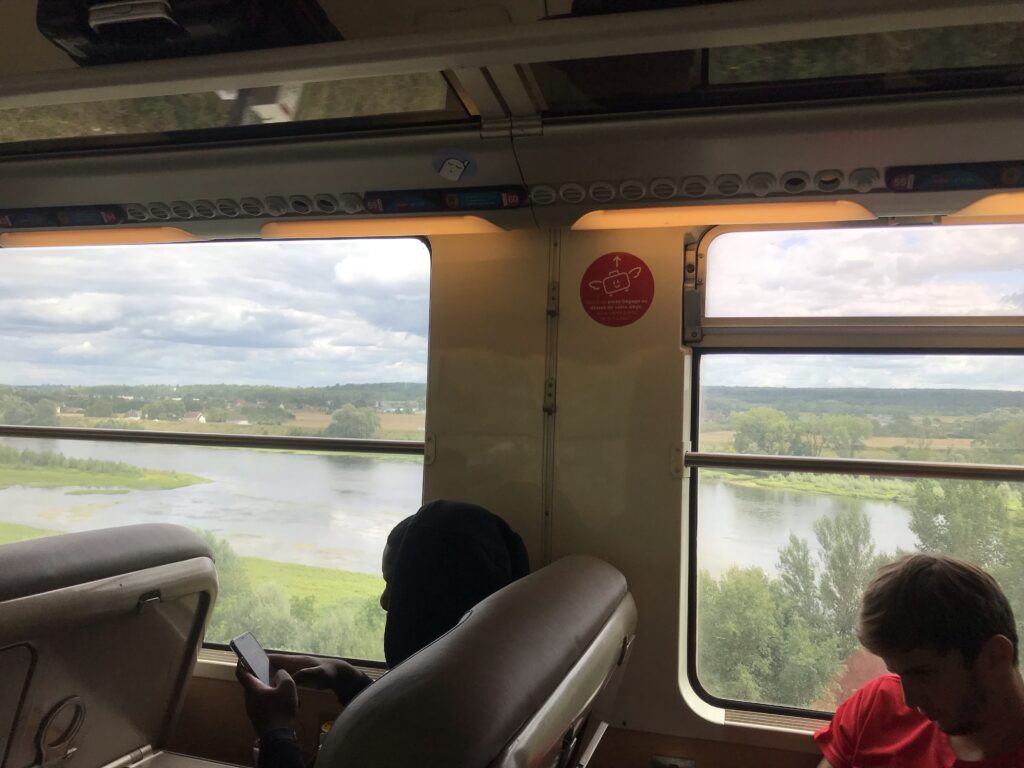
    View of the Loire near Blois seen from the train windows

    I like the big windows (the opposite of the miserable arrowslits you get on Cross Country train services in the UK).

    I like all the unhurried journeys I’ve taken on these trains before, from one regional town to another. Often on holiday.

    I like the system of regionally-subsidised train networks (that these trains usually run on), which help keep trains running to remote parts of France.

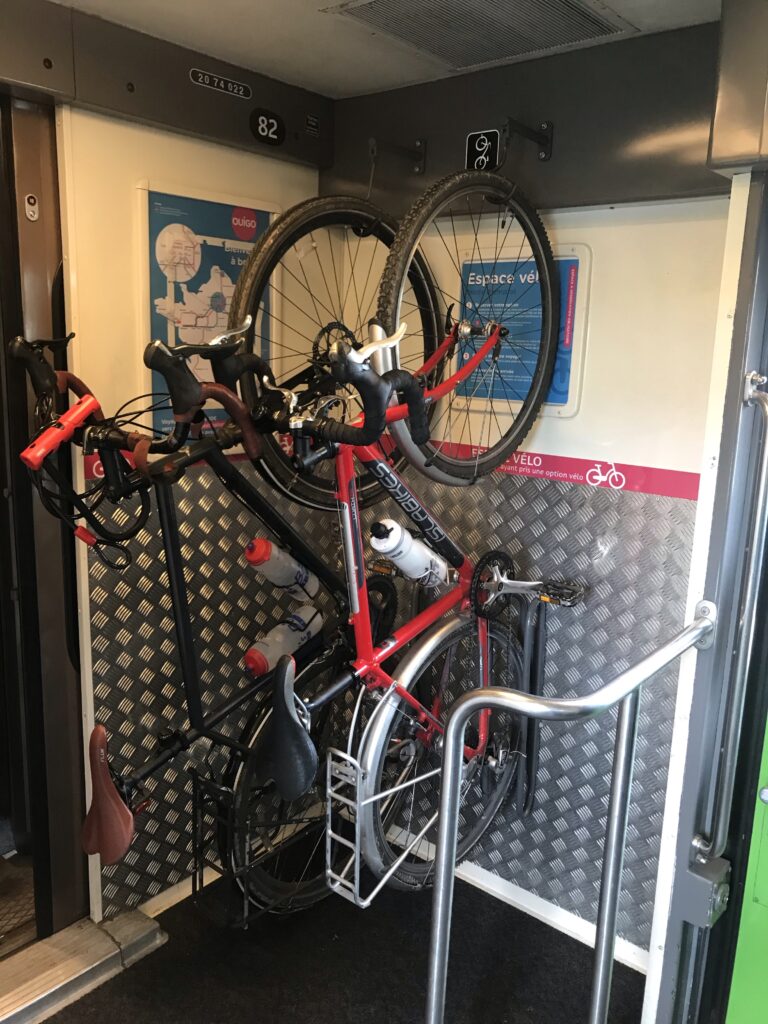
    Photo showing cycle storage on Ouigo Trains Classiques – 2 bikes per carriage.

    I like the ample bike storage space – two reservable spots per carriage.

    I like how these routes are usually cheaper than the TGV.

    And I like how these older trains ply a sort of parallel, older network, of places in between or far from the big TGV stations. It somehow feels like more of an adventure.

    Want to ride on a train classique? Your best bet is to book a journey between destinations on the SNCF Intercités network – these are the trunk routes where TGVs don’t operate. Or, as we are doing today, travel on the Ouigo Trains Classiques network (these travel between Paris and Lyon and Paris and Nantes – both also served by TGV trains, but the Ouigos classique travel down the old slower routes.

    Read more about the train classique rolling stock.

  • Using ChatGPT to generate ideas

    Using ChatGPT to generate ideas

    In this post I share some initial thoughts on how using ChatGPT to generate ideas changes creative thinking for engineers, and other humans. 

    My simple model for idea generation is that an idea is simply a new connection between existing elements in the mind. It’s a practicable model giving us two things to think about in creativity. The first is what information do I have in mind when I am having my idea. The second is how do I form connections between these bits of information to create something new – to create an idea. 

    As James Webb Young describes in ‘A Technique for Having Ideas‘, the process is akin to using a kaleidoscope. The elements of information are the bits of glass at the end. Multiple shapes, colours and sizes. Turning the kaleidoscope causes the elements to rearrange. The new patterns we make are ideas.

    I call a kaleidoscope for having ideas a kalideascope. The process of building, filling and turning the kalideascope is a metaphor for designing an idea generation process.

    Using a kalideascope for generating ideas

    The first thing I get people in my training to think about when having ideas is what information they are putting into the process. I call this ‘filling the kalideascope’. There are two kinds of information we put into the kalideacope.  The first I refer to as ‘information in the moment‘. It includes information from a design brief, from site, from stakeholders, from colleagues and from precedent projects.

    The second kind of information we put into the kalideascope we can think of as information gathered over time. In other words from experience. From experience of living in the world, seeing it and thinking about it. Experience includes things we have done professionally. I also emphasise all the experiences we have had outside of work. The things that are unique to us. 

    The second part of the process is the forming of new connections. This is looking at things in new ways. Acting it out, asking what if and using your professional palette are three of my favourite techniques to teach. 

    These two processes – filling and turning the kalideacope – provide a simple framework for thinking about our idea generation process. 

    How does using ChatGPT to generate ideas change things?

    None of this creative process I described above needs a computer. But of course we have been using computers to enhance our creative process for decades. The internet gives us access to endless new information. And through our interactions online we can find a similarly endless stream of prompts to help us form new connections. 

    So how does using ChatGPT to generate ideas change things? Here are my initial thoughts.

    Availability versus accessibility of information

    When you forget someone’s name and it suddenly pops into your mind, that information suddenly becomes accessible. It was always there. Someone didn’t whisper it in your ear. The name was tucked away somewhere in your brain. In other words, the name was available. But something changed in that moment and all of a sudden it became accessible.

    ChatGPT uses the text-based content of the internet as its source of information. Via search, this information has always been accessible to us, but if we don’t know where to look, it is not available. ChatGPT has vastly increased the amount of accessible data. This does not mean that all information is available to us. But information on topics commonly published online is now much more accessible. 

    This means that whole new data sets can be brought into the creative process. It is as if the number of pieces in our kalideacope suddenly become many orders of magnitude bigger. 

    The potential for new patterns has vastly increased.

    New connections

    Gathering information is one part of the idea generation process. The other is forming new connections or associations. Humans are pattern-spotting animals, with a prefrontal cortexes especially evolved for the task. But just because we can spot patterns and have new ideas, doesn’t mean we can do it all the time. 

    Lots of my creativity training focuses on what to do when you have had one idea and can’t think of another. Various cognitive biases mean that we tend to prefer thinking about the ideas we have already had rather than think of new ones. My ‘ask what if’ technique is explicitly intended to overcome this creative tiredness. 

    But ChatGPT never gets tired. You can keep asking it generate new possibilities in response to a question.  

    Introducing the kalAIdeascope

    I think we need to rethink the kalideacope for the AI century.

    I am calling an AI-powered kaleidoscope for having ideas a kalAIdeascope. The process of building, filling and turning the kalAIdeascope is a metaphor for using artificial intelligence to help us generate ideas. This tool is available to currently available to everyone who has a decent internet connection. We have lots to learn about how to use it. 

    The process of building, filling and turning the kalAIdeascope is a metaphor for using artificial intelligence to help us generate ideas.

    Some final thoughts

    Judgement – None of the above says anything about how decide if an idea is any good. And that is how I teach creative thinking. Start with ’no’ turned off, and generate ideas. Then test the ideas for how well they work. How AI can support in the testing is a topic for another post.

    Spotify effect – I think my relationship to music degraded when I got Spotify. Suddenly the availability of most of the world’s recorded music on my phone at any time numbed my curiosity. What will be the impact of the accessibility of so much more information and ideas?

    What would Proust say? (see my previous writing on Proust) – his view was that the role of the artist is to express their inner world to the outside world. If more of our ideas are ‘externally’ generated, then I find myself even more drawn to what is going on in people’s inner worlds. 

    Finally, my thanks for Mary Stevens and Nick Francis for the many conversations over recent months on this topic that have prompted this post.

  • Vision for a regenerative programme of forestry and building maintenance at Hazel Hill Wood

    Vision for a regenerative programme of forestry and building maintenance at Hazel Hill Wood

    This afternoon I met with two trustees of Hazel Hill Wood to develop some ideas for a funding bid to support more regenerative use of timber to maintain our off-grid buildings. I said at the end of the call I’d write up some thoughts on a what a five-year plan could look like. Here is what I wrote down – stimulated by a very thought-provoking conversation with my excellent trustee colleagues. I’m putting it here rather than on the Hazel Hill website as this is by no means policy! Just a set of ideas, captured to enable further discussion.

    Five-year vision for developing Hazel Hill as a centre for regenerative forest management and traditional construction skills.

    At Hazel Hill Wood we have a unique combination of sustainably managed forest, off-grid buildings and a charity with a mission is to use timber from the wood as part of a regenerative cycle of building repair. Our ambition is to work with these gifts to increase local biodiversity and woodland thriving, build community resilience and wellbeing of all who come into contact with the wood.

    While we reach all of these ambitions to some extent through our current charitable activities, we see the opportunity to unlock greater benefits for the ecosystem and local community by establishing the wood as a centre for learning about how timber can be used as part of a regenerative local construction material. We describe this process as regenerative because it has the potential to have zero negative externalities: harvesting timber in the right places can actually increase woodland health and biodiversity; the timber we harvest can be used to re-establish a range of historical, rural practices, including coppicing, hurdle-making, horse-drawn timber extraction and traditional green-wood construction. Training local people in using these skills can help to enhance the rural economy while helping to maintain the heritage of local buildings. And the wellbeing of all is enhanced through extended contact with the living world through nature connection. 

    To shift to this mode of operation we envisage taking three phases over five years. 

    Phase one – from seed to seedling

    In this first phase we assess the state of the current system and create some of the infrastructure to enable this new activity to happen at the wood. 

    • Forest survey – establishing the health of the ecosystem, possible timber for harvest now and possible timber for future extraction and opportunities to enhance biodiversity through timber harvest.
    • Building survey – establishing the long-term maintenance needs and priorities of our heritage timber buildings.
    • Skills survey – understanding the local skills landscape and how training at Hazel Hill wood could enhance the local economy.
    • Re-establishing connection with rural construction tradespeople.
    • Creating working area – wood seasoning shed, tools shed and outdoor classroom
    • Initiation of volunteer programme for simple construction skills using timber in the forest.
    • Initial harvest of coppiced timber
    • Initial harvest of roundwood poles for seasoning.

    Phase two – from seedling to sapling

    In this phase we increase the scale of our regenerative work, starting to work with wood harvested and seasoned in Phase one while increasing our harvest of timber from the wood. In this phase we grow our education programme around how we see the wood and the buildings as part of a continuum, a process of which we are the stewards, adapting to the needs of the ecosystem and the people who we bring here to heal and learn through connection with the living world.

    • On-going habitat creation and monitoring in areas where timber has been harvested.
    • Maintenance forestry – In order to grow trees for timber, some tree pruning needs to be done to create timber of good quality. We need to develop local skills in how to plan and carry out tree maintenance.
    • Running courses in green wood construction skills.
    • Using seasoned, sawed timber to carry out major upgrades to the structure of our heritage buildings, including new decking for the Oak House and Forest Ark.
    • Invitation to other local crafts people to run training courses at our site.
    • Growing programme of volunteer activities engaged in a range of conservation and heritage construction projects.
    • Growing education programme, offering training in the thinking behind the regenerative principles on site.

    Phase three – from sapling to tree

    In this third phase the operations are more self-sustaining. The process of continuous cover forestry is well-established in the wood, with timber harvested at a rate of 1% per year providing a steady rate of firewood and construction materials for the charity as well as surplus for sale into the local economy. The programme of rural forestry and heritage construction skills training is self-sustaining and as well as bringing in revenue for the charity, is part of the active continuous maintenance of our unique heritage buildings. The site will be well known as a demonstrator project for regenerative principles that can be replicated more widely.

  • Experiments in limiting modal shift

    I’m enjoying listening to ‘World without Email‘ by Cal Newport. I’ve been an aficionado of inbox-management techniques for many years, but this book adds in new layers of systems and computer science understanding that I have found fascinating.

    The book is a critique of the ‘hyper-active hive mind’, the term he uses to describe the way many knowledge workers now interact with each other. I don’t plan to summarise his key points here; rather to chart an experiment I am running.

    I am interested in the idea of minimising modal shift, in other words, how often my brain flips from one activity to another. It is amazing how hard it is to stay focused on just one task, even if it is enjoyable. There are so many factors driving me towards the pull of distraction: the dopamine hit of a new message; the fear of social ostracisation if I don’t respond to a message; the design of the software itself leads me to distraction.

    As Newport describes, we slip into just firing off messages because it is so easy, but by doing so we use up the attention capital of everyone else. It is a case of the tragedy of the commons. Instead, he says, we need to do the hard work of inventing systems for how we should communicate more effectively for different tasks.

    Today I have enjoyed spending some time with Regenerative Design Lab co-convenor Ellie Osborne designing a process for short-listing, interviewing and finalising candidates for the next cohort of lab participants that requires the bare minimum use of our email inboxes. Features of the design are:

    • Agreeing where shared information can be stored – not in an email mailbox.
    • Finding tools to that enable candidates to book interview slots without the need for email back-and-forth.
    • Identifying in advance what things we might need to communicate about and booking in that conversation ahead of time, so that we can save queries for that exchange.

    Setting this system up hopefully means both of us can get on with arranging the interviews with minimal recourse to our email inboxes. And that should mean we can spend more time focusing on the design of the lab itself.

    I’ll report back on how the experiment went.