In this third video in my series on creative thinking, I go into the concept of curating inputs to the creative process. The combination of our brain and body makes for an awesomely powerful creative machine. We can use our bodies to explore and gather a wide range of inputs and then we can use our arms and fingers to manipulate and rearrange elements within our wide field of vision, and yet much of our creative work is blinkered by computer screens, or worse reduced to the width of a phone. In this video I ask viewers to think about how they can arrange their creative inputs to make full use of their creative faculties.
(more…)Author: mazda
-
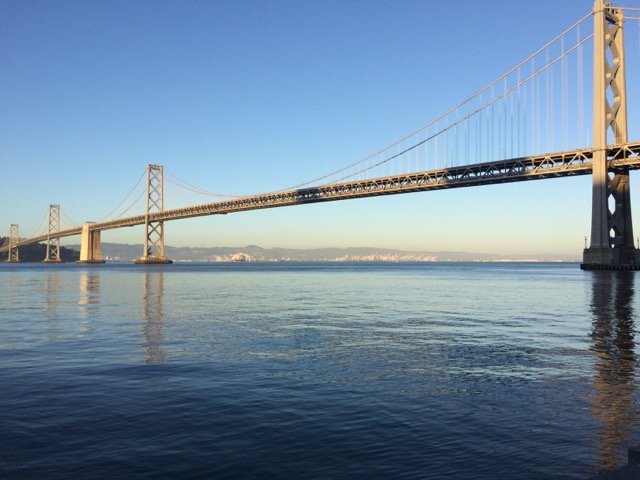
#9: Engineering transport in San Francisco with Andrew Kosinski
I can’t think of metropolitan landscape that offers more varied and exciting opportunities for designing transport infrastructure than San Francisco, with its steep hills, its bay, its rapidly changing economy and its tantalisingly separated land masses.
In this second episode of the Eiffelovercast from my recent trip to the US (catch the first one here) I catch up San Francisco-based transport engineer and old friend Andrew Kosinski and we geek out on transport-related matters including:
- Bridgoff: Bay vs. Golden Gate
- Tearing down freeways
- Bringing cycling into San Francisco
- Is driving a right and it is a freedom?
- The phenomenon of ‘parklets’
- Tunnelling through ships
- Building towers on weak and shifting sands
- The creative bubble of silicon valley and the unintended consequences
- Autonomous vehicles
- Using firms like Uber to replace under-productive bus routes
- Becoming passive consumers of cities


-
Trust me, I feel your pain, I have a plan – tools for selling design
The final stage in the arc of design thinking workshops that I have been developing at Think Up with my colleague Nick Zienau is developing the ability to convince other people to adopt your design. In these workshops there are three areas we work on with participants: building trust with the client; three elements of content; and giving effective feedback.
Trust
Building trust with your client is absolutely essential if you are going to connivence them of anything. There are two things we concentrate on here. The first is being mindful about the first impressions we create. We all create first impressions, whether we like it or not, but we might not be aware of what those are. In our workshops we help people become more aware of the impressions that they create, and help them think about how to create the impressions they want with clients.
The second thing we concentrate on is developing trust through showing vulnerability. To show vulnerability to someone is to show that you trust them; if you can trust others then they are more likely to reciprocate. In our workshops we help participants explore how they can show their vulnerabilities, such as what they are worried about or where they feel their weaknesses are, and use this as the basis of building trust with others.
Together, managing first impressions and building reciprocal trust with our clients we call ‘gaining entry’.
Three-phase content
For many people, the starting point for any pitch is to work out what they want to say. Aristotle said that for a speaker to convince an audience of anything, then the speaker needs ethos, pathos and logos. Having ethos is to be trustworthy. Having pathos is having a shared sense of their feelings (in particularly their pain). Having logos is to have a logical argument. We can think of these as three phases we need to develop in our pitch.
In my experience, many engineers are most comfortable starting with the logos phase, the logic of the solution. The trust-building that we start the workshop with is an important element for developing the ethos phase, as is the reputation of the companies that participants work for. For many, the hardest phase is developing pathos. To develop good pathos you need good understanding of the client’s perspective, which is easiest to gain if you have a good relationship with them based on trust.
Giving and receiving honest non-judgemental feedback
We now have a plan for getting the content together, but how do we know if the pitch we have put together is any good? Here we rely on feedback from others. But for many, the idea of receiving feedback is dreadful – it isn’t all that fun for the feedback giver either. But when done well, feedback is an invaluable tool for improving our work, and it can be fulfilling for the person offering it too.
To make feedback work really well, we require the person giving the feedback to be really honest, but also non-judgemental. So they should say how something makes them feel, and why that might be, but not to judge it. A judgement is too final and puts the listener on the defensive, whereas talking about feelings offers the person listening the chance to find out more about why what they have done has elicited these feelings.
Equally, good feedback has requirements of the receiver too: they need to be open to receiving it, grateful, and not defensive. The last part is critical if the exchange is going to be useful. If the person receiving feedback can hold off on defending, and instead show interest in the other person’s views, then they can really deepen their understanding.
Taking these tools together, we can build an effective pitch for ideas that says,: ‘trust me, I feel your pain, and I have a plan’.
[This is an adapted version of a post I originally wrote for the Think Up website, posted on 1st November 2017].
-
Defending New York with Oyters
 I really enjoyed listening to this 99 Percent Invisible podcast called ‘Oyster-tecture‘, which explains how, in the aftermath of Hurricane Sandy, the city is developing artificial reefs on which oysters will be seeded. The oyster beds will defend the city from storm swell and large waves. As the podcast explains, 200 years ago, the southern end of Manhatten Island was one of the greatest sources of oysters in the world, and these oyster beds woudl have defended the coastline from storms. The oyster beds disappeared due to overexploitation, but now designers are working on bringing them back to defend the city against the impact of severe weather events.
I liked this article because it reminded me of the importance of looking to nature to find more collaborative ways of tackling some of our infrastructure challenges. It is also a reminded of the positive impact that imaginative design thinking can have a positive impact on people’s lives.
-
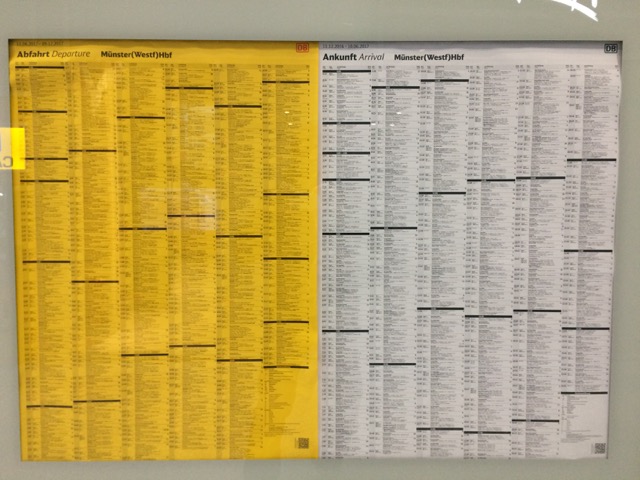
Surface travel – Münster to London
Overview
- Six trains and one monorail
- Leisure
- 709km
- £130
Today I take my journey home from Münster to London via a different route from my way out. Outbound I came by ferry because it was cheaper; travelling back midweek I can just about afford the Eurostar. The route gives me the chance for a quick stop in Köln and the chance for an engineering detour via the Wupertaal suspended monorail.
Münster to Wuppertal
Münster is a beautiful town. I’ve spent the last few days staying with a friend and working on my book in the city library. The cities walls were removed to create a circumferential boulevard that is now tree-lined and a major thoroughfare for bikes and pedestrians. I walk this path one last time and peel off at the Hauptbahnhof.
I ride for twenty minutes on a quiet commuter train to Hamm. The flat landscape is filled with a mixture of fields and factories, with the occasional wind turbine. It reminds me of travelling up the Lea Valley north of London.
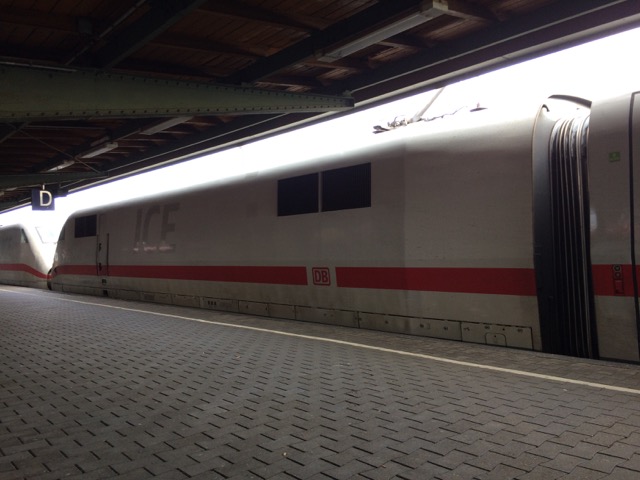
Hamm station feels in the middle of nowhere but its ten unloved platforms are busy with trains of all sorts coming and going. I get to my platform early and see one of the slightly older German high speed ICE trains arriving. Its bright white carriages are like hermetically sealed capsules. You can imagine this train is capable of zooming along the sea bed as easily as over land.
The ICE train is in fact two hitched together. I watch as the two are uncoupled and the front half pulls away. Just in time, I realise the back half is my train to Wuppertal, and I jump aboard. The land becomes more rutted and we follow an industrial valley that is well scored into the valley – it resembles the valley of the Seine as it winds its way north from Paris to Rouen in Normandy.
My connection time in Wuppertal is three-and-a-half hours; that was deliberate to give me time to make an engineering pilgrimage to a highly unusual railway, the Schweibebahn, Wuppertal’s suspended monorail. More details of that in a separate post.
Wuppertal to Köln
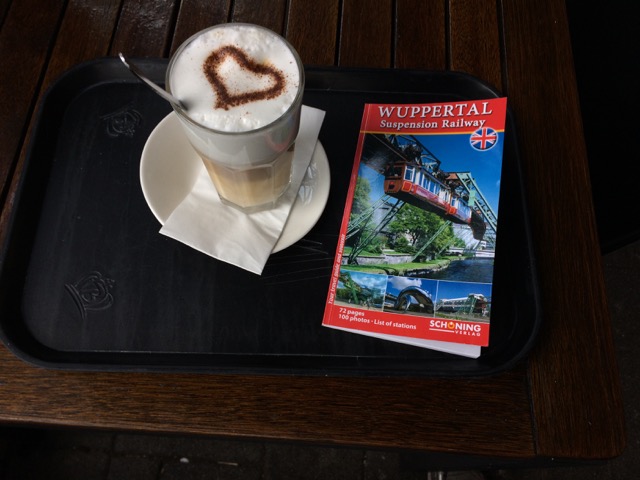
I’m blown away by the monorail – a great piece of railway engineering integrated into the city. With hindsight, three-and-a-half hours was a bit too long for my engineering excursion and I struggle to find the inspiration to explore the town further. It’s nothing against Wuppertal: I’m just keen to get on. I wait impatiently at the platform for my next train.
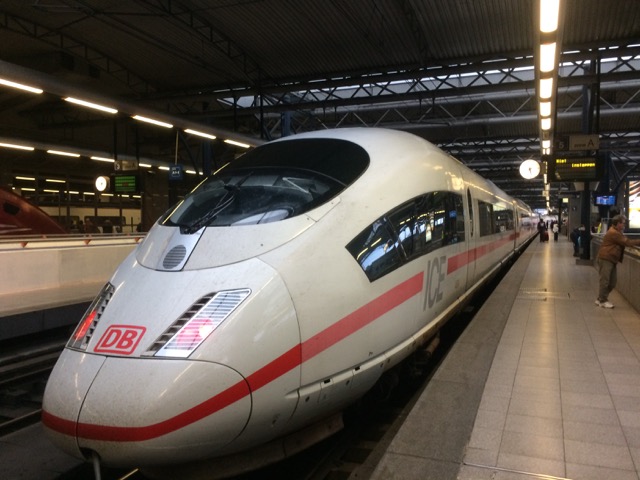
If the last ICE train I took looked like it could be amphibious, this train, a next generation edition, looks ready for space flight, with it’s pointed nose and sleek black-and-white lines. It’s a short twenty-minute ride to Köln and before I know it we are rumbling across the bridge over the Rhine. Köln Hauptbhahnhoff is covered by a wide arching roof; beneath, trains come and go from across Germany – and I see my first French train, the Thalys service to Paris.
I have fifty minutes between trains so I visit the magnificent cathedral which is surprisingly right next door to the station – almost on top of it. It’s quiet pews are better than any waiting room I can think of.
Köln to Bruxelles Midi
I get on board another of the sleek new DB ICE trains and settle in. I don’t remember much about this 2-hour leg as I slept most of the way. The day before long journeys I rarely sleep well as I worry about missing my train, and last night’s wakefulness just caught up with me. As we slow down on the approach into Brussels I see some fairly grotty looking commuter trains and I realise these are the oldest trains I have seen since I left the UK. All the trains I’ve taken over the last few days in Germany or the Netherlands, whether high speed or slower, were well looked after. I am reminded why I don’t ever get that excited about train travel through Belgium. I may however just be prejudiced against Belgian railways because they were responsible for putting the DB night train to Berlin out of business when they put up the transit fees they charge other countries for their overnight services.
Bruxelles Midi to London
Bruxelles Midi is an endless warren of tunnels where the light at the end never seems that appealing. I have an hour and a half before I can check in; I bought tickets for a later train because it would save me £50. The beer in the cafe is half the price of the tea, which is a shame as I’ve just decided to give up alcohol for a few days.
The journey flies by; before I know it I am back in St Pancras. As I walk down the long platforms I am struck that in all the stations that I have been through on either my outbound or my return journey in the UK, the Netherlands, Germany, Belgium and France nothing quite compares to the experience of arriving under the magnificent Midland Blue-coloured soaring arch of St Pancras station. A fantastic piece of engineering lovingly re-invented for a different century.
-
Augmented reality stargazing: unintended consequences
For generations it has been a tradition on the French side of my family to spend summer evenings out in the garden looking at the stars. I happen to know that this is something my great-grand parents were doing from at least their retirement in the 60s, and it is what other families in the village were doing too. When televisions arrived, neighbours didn’t give up their stargazing; they simply opened the windows wide, put the TV on inside and watched it from outside, while still inclined heavenwards.
By the time of my childhood in the 80s, I have no memory of seeing other families outside gazing upwards in the evenings. I wonder if the people watching televisions from their gardens had switched to sitting inside and watching TV with the window open so they could see the stars, to eventually shutting out the stars altogether. But my grandparents, to their credit, shunned the phosphorus screens for the slower moving celestial entertainment.
It is for this reason that I have spent hundreds of nights staring at the same patch of sky from the same particular orientation. I know where the first star usually shines from; where the great bear appears over the horizon; where to expect to see different clusters and motifs of stars. But despite hours of dedicated study, I, nor any of my ancestors seems to have had any definitive knowledge of what any of the stars or constellations actually are. There has been much speculation and debate. That flickering red dot just above the horizon early in the evening must be mars/ no it can’t possibly be mars because it is always in the same place/ it’s actually called Beetlejuice. Our collective space ignorance is further demonstrated when we try and point out to one another where a satellite may be seen crossing the sky: you see that bright star, straight above? Go left a bit to the next bright star, then to that square of really dim stars, then go west about twelve inches, and you’ll see the satellite heading towards to the house.
I share all this to give a sense of the utter familiarity to me of this particular sky-scape, like someone who knows the view from their childhood bedroom window so well that it is impossible that anyone could show them anything new; a scene that is understood through layers of explanation, agreed between generations but never verified, so that you will appreciate the impact on me of downloading for the first time a star identification app and pointing it at the sky. It was as if I had been given a new set of glasses without ever having known that eyes were blurry.
All of a sudden, constellations stretched out in front of me. Scorpio reclining on the horizon, the diving fish of Pisces leaping over the trees in the east. I am looking at the same sky but I am seeing new things – this is augmented reality. That red star of which we had spent so many evenings arguing turns out to be the centre of the galaxy – incredible. I really felt ecstatic. We call out to each other, pointing out new things that we can see with more excitement and intensity than we have mustered for years from these seats.
The next evening, we return to the garden excited to return to our star-gazing. But I sense a subtle shift has come over us. The focus is on the screen and not on the sky; on the augmented reality rather than boring old reality. When the app loses its calibration, I start to believe what the screen tell me rather than what I can see with my eyes, even when the two clearly don’t line up. When I’ve got bored of looking at the app, I start to look at other apps: since I’ve got my screen out why not check my messages quickly. And at this moment the spell of stargazing is broken.
Very quickly the situation seems to be changing from one in which we sat under the cloak of the stars, sometimes in conversation, sometimes in silence, but always together, to one in which we are close-by but in separate worlds. I wonder if in a few years’ time a natural evolution of this scenario will be for us to sit inside where the light is better and check our messages there – with the windows open so we can still see the stars, like our predecessors did two generations ago with their televisions.
This future scenario that I present is of course by no means a foregone conclusion, but it has the characteristics of a pattern that I see myself falling into: using digital technology to solve or augment a particular situation, but in doing so, introducing a set of unintended behaviours, that overall serve to diminish the situation.
Of course none of this information is new. The Greeks new about these constellations. We just needed the technology to help us remember. Now that I know what I am looking at, I need to remember to turn my phone off again.
-

Surface travel – London to Münster, Westfalia
Overview
- London – Harwich – Hook of Holland – Den Haag – Enschede – Münster
- Six trains, two buses and a ferry.
- Leisure
- 365 miles.
- £90.
When I first imagined doing this journey I thought it would be a straight-forward case of taking the Eurostar to Brussels, a fast train to Köln and then a slower train to Münster. That is indeed is a feasible route but becomes expensive when you leave booking to the last minute, especially for a trip on the first day of the half term holidays, so I had to find an alternative plan.
Then I remembered the Dutch Flyer, a rail and boat service that goes from London Liverpool Street to Harwich, then on a ferry to Hook of Holland, and then, included in the ticket, to any station in the Netherlands. It’s a great overland (and sea) route if you are heading anywhere in Northern Europe.
Londond Liverpool street to Harwich
I take two empty local trains to get me to Liverpool Street for the 6:30am train to Harwich, only to realise that I could have had an extra half-hour in bed had I picked up the Harwich train from Stratford on it’s way out of town. Travelling this way is always an experiment though and you work out travel hacks like this as you go for use next time.
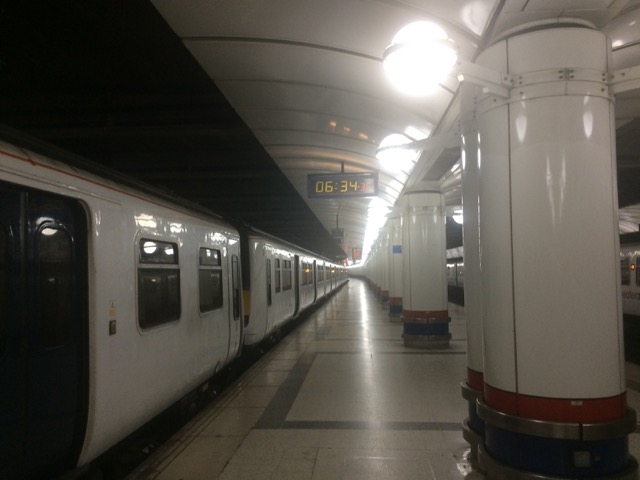
The Harwich train leaves from a dimly lit platform in the upper teens at Liverpool Street. It looks like any other shabby commuter train; nobody onboard seemed to realise they were on the first leg of the Dutch Flyer – or if they did they were concealing their excitement as clattered through the Essex countryside.
Darknesses gave way to an overcast morning. The train made a strange ticking noise when it stopped at stations.We reached beautiful Dedham Vale and as we rolled along the estuary the horizon on the other side was punctured by occasional steeples.
Harwich International is not as glamorous as it sounds, and it doesn’t even sound that glamorous. But the station couldn’t be more convenient for the ferry port: you climb the stairs from the platform and walk straight into the terminal building – integrated transport!
The building seems oversized – presumably designed for some long passed heyday of the ‘Dutch Flyer’. It has six check-in desks but only one booth was open for the three customers I was among. We went on through passport control, with a similar booth count redundancy of five, and onto a bus that drove me 50m from the shore, up a ramp and onto the ferry.
Harwich to Hook of Holland
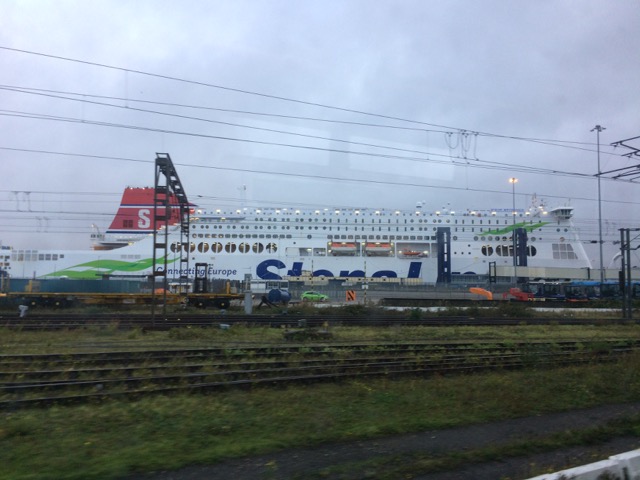
The boat trip is a good seven or so hours at sea. I installed myself in the lounge and settled in for a day of writing. Around me people were settling in for a day of drinking. It was 8:45am and the bar was open before breakfast was even being served. The onboard drinking was a bit alarming as the majority of passengers seemed to be drivers. It now struck me that they were getting their pints in early so that their bodies could process them before we got to the other side.
The sea between Harwich and Hook of Holland is a busy place. There are container ships everywhere. We are following another ship eastwards, and there is another on our tail in the shipping lane. And all the while we are avoiding the impressive arrays of wind farms in the sea. Storm Brian is whipping up in the UK and strong tail winds are sending big rolling waves past us.
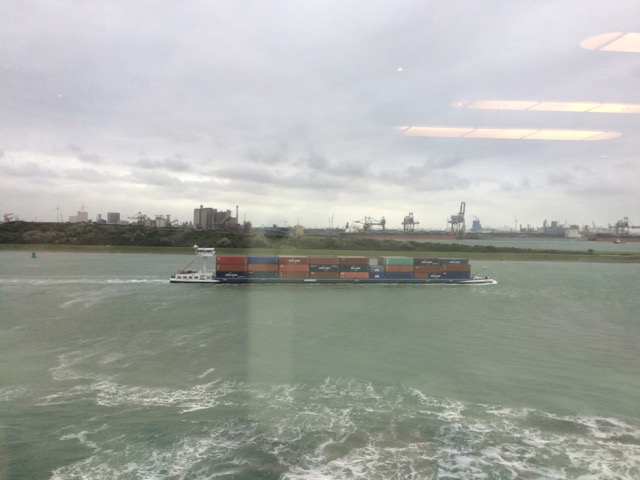
Eventually we arrive at the port at Hook of Holland, an industrial spot complete with flaring oil refineries in the distance. The ferry passenger terminal is slick and modern. It has an exhibition of models of old Stena Ferries in the waiting area that make me think of the Science Museum.
Crossing the Netherlands
Included in the Dutch flyer ticket – which is only £55 – is a rail pass to anywhere in the Netherlands. But before you can get anywhere you have to find the trains. A new rail link is being built between Hook of Holland and the nearby rail hub of Schiedam Centraal, and so I waited twenty minutes on the windy dockside for the bus.
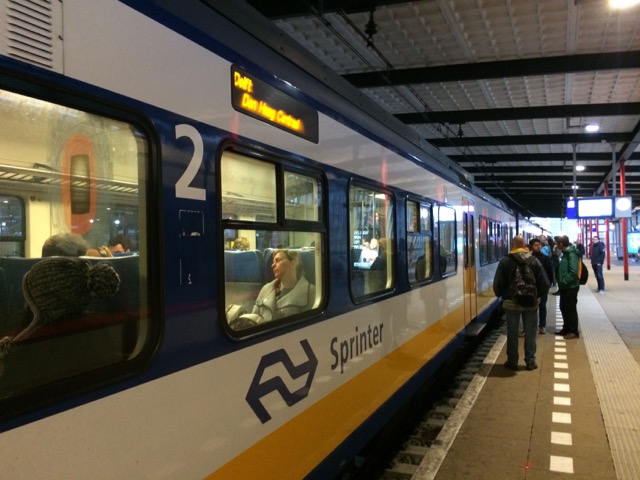
This leg of the journey is a cross-section through industrial flower production. There are acres upon acres of glass houses, some lit up, many apparently heated, filled with flowering plants, there are huge processing and packing factories, and then eventually we reach snazzy looking management buildings and distribution centres. I’ll never look at a cut flower for sale again the same.
For me Dutch railways are about good modern design rather than high-speed, although they are fairly rapid too. The large stations I travel through are modern with a restrained elegance. Take Schiedam Centraal, from where I picked up a train to Den Haag. It has six platforms covered by an elegant roof that cantilevers out on both sides from a central spine. That central spine runs the length of the middle platforms, and while it necessarily an imposing structure because of all the load it carries, has large opening in it to let in lots light.
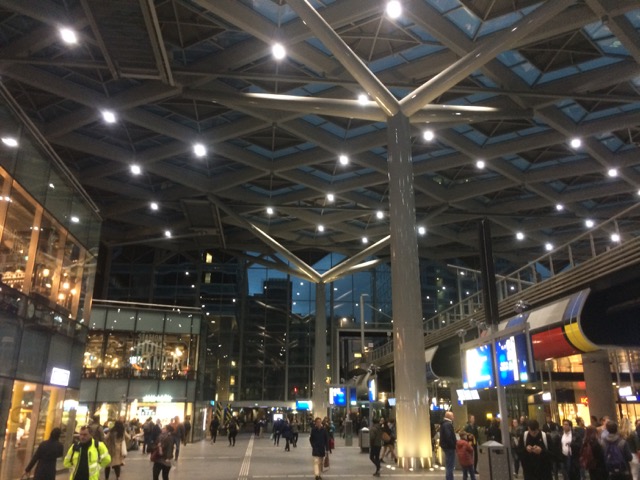
Spectacular roof at Den Haag Centraal I change trains at Den Haag Centraal, a magnificent rail terminus, with towering steel columns that splay out at the top to support a distant roof. By now it is dark again, and as I take my next express train, I can no-longer pick out any features of the countryside I am travelling through.
From the border to Münster
At Enschede I change trains one last time. I am now on a Deutche Bahn service. Somewhere along this leg we cross into Germany, although there is of course no evidence of the border. The only difference is I can understand a small amount of the announcements, which I couldn’t in the Netherlands.
Finally, at 22:45, some seventeen hours after I left the house, I arrive in Münster to be greeted by my host at the station. This has felt like a long journey it has also been very satisfying; I was able to get a day’s work done on the ferry, and read the newspaper cover to cover on the train; and for the first time I feel I have a mental map forming of how the Netherlands and North West Germany relate to each other, and where major cities in this area sit with respect to one another. I look forward to discovering further this corner of Europe.
-
Beware of Shwaa! – (re)learning to read and write
Today I went to a phonics briefing meeting at my daughter’s school. I joked beforehand that we were going to a phonetics briefing session, liking the idea of working out what all those symbols you see in a dictionary mean, the ones that look like thermodynamics equations. But when you stop to think about it, spelling in English must be equally incomprehensible to the unititiated. I’ve realised that beyond spelling out simple three-letter words and stringing them together to create dull scenarios involving recumbant felines on carpeting, I simply don’t understand how to help my daughter spell out most words.
-
Podcast Episode 1 – Engineering, creativity and practical philosophy
I’ve been thinking about creating an Eiffelover podcast for over a year. Last week at Port Eliot festival I saw John-Paul Flintoff (@jpflintoff) give a great talk on creativity in which he challenged us to name one creative project that we want to do, and commit to taking the first step…
And so this is it, the Eiffelover podcast, the first of what I hope will become a regular digest of matters engineering, creative and practically philosophical garnered from the people I meet, the workshops I run and the material I read. I hope you find it useful.
To kick off, I created my first episode here at Electromagnetic Field camp, a non-profit UK camping festival for those with an inquisitive mind or an interest in making things: hackers, artists, geeks, crafters, scientists, and engineers.
In this podcast I meet some of the fantastic people here at EMF camp and their imaginitive creations, I dig around to find out what makes these creative people tick, and I get into a fascinating conversation with Richard Sewell about ‘Thingness’, a term he and his colleague coined to talk about the power of making things. Listen now to learn more.
People mentioned
- Anna Ploszajski – @AnnaPloszajski – and her Reubens Tube
- Steve Cross – @scienceshowoff
- Helen Leigh – @helenleigh
- Richard Sewell – @jarkman
-
Workshop inspiration from Jackson Pollock
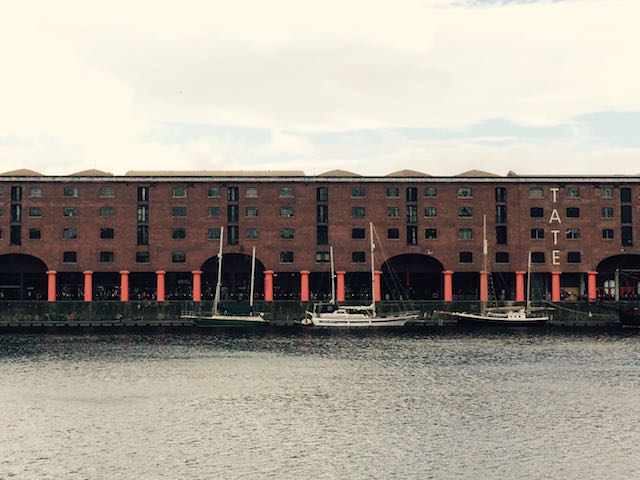
 Today I went on a recce to the Tate Liverpool for a course we are designing at Think Up for a client. As I left the event hosting space I was left to wander the Jackson Pollock exhibition. The show will still be running when we hold our event, which great because I can see three ways in which this exhibition can be used to support the learning on our course.
1. Working with the subconscious
One of the features of the model of idea generation that I will be introducing is the important role of the subconscious in creativity. In Daniel Goleman‘s book Focus, he describes (more elegantly than I am doing here) how the ‘active’ brain is always on the lookout for useful stuff that the wandering brain generates. On this theme, I picked up some useful quotes from the exhibition notes:‘Pollock’s aim to work directly from the subconscious led to a radical process of dripping and pouring paint over large canvasses placed flat on the studio floor…”the modern artist…is working and expressing an inner world – in other words expressing te energy, the motion, and other inner forces.”Then, this from another section:‘Although there was an element of chance Pollock frequently spoke of the importance of decisions over the merely accidental.’My intention is to use Pollock’s work to emphasise the link between the conscious and subconscious in creative work.2. Relating to your audience
Engineers often have to communicate ideas to audiences with different value sets. One place where there is commonly a clash of values is around aesthetics. Engineers typically get little training in aesthetics, compared, say, to architects. Therefore it is unsurprising that engineers can find themselves cut out of such conversations with the client when an architect is at the table. In the course that we are creating, we are not trying to run training on aesthetic appreciation, but simply intending to make the point that you need to understand the perspective of the audience you are dealing with.To help make this point, I think there is a role-play example that we can create that involves Pollock’s work, given the bumpy relationship he had with his audiences. One idea might be to get engineers to take on the role of Pollock’s agent, and to get them to persuade a critical viewer of the merits of his work.3. Thinking Hard
Pollock reflects that ‘his new works require a lot from the viewer’. I find this exhibiton forces me to think hard, and not merely to engage with the surface, and I think the same can be said of good creative thinking. You need to think hard.To conclude, as ever, I’ll have to see if there’s time in the programme to fit in these ideas. I hope that there is. -
Teaching le Charleston Stroll – the Port Sainte Marie Method
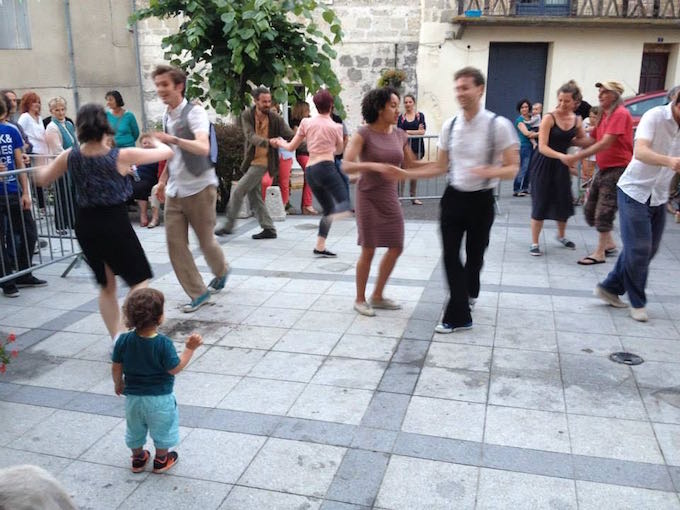
Teaching the Charleston Stroll has become the mainstay of the Mudflappers’ festival swing dance teaching. I think there’s three reasons why it is so popular with crowds: the footwork is easy to pick up, which means that people can quickly overcome their fear of not being able to dance; the fantastic feeling you get from being in a large group of people all moving in sync with each other and the music; and finally there’s the snowball effect whereby a group of people dancing together keeps drawing more and more people in.
This year, the Mudflappers performed in the village of Port Sainte Marie in the south-west of France as part of the country’s national Fete de la Musique. We had already performed four routines and the crowd wanted a lesson. Le Charleston Stroll was the obvious choice. But rather than teach the usual set of variations (fearing being incomprehensible after one-too-many peach juice-infused presssions) we came up with a cunning teaching method. We prominently stationed one Mudflapper on each of the four corners of the crowd, standing on, say, a bench. The crowd did the basic routine facing me and then turned to face the bank, where that Mudflapper would do a variation and everyone would copy. They would then turn to face the town hall where another dancer demoed another variation, and so on, until we faced the front again. Holding the microphone, all I had to do was shout, ‘vers la banque’, ‘vers la mairie’, ‘vers la route’ and ‘vers la Garonne’ – using my best beginner French.
And it worked. At 11:30pm in the heart of a sleepy French village in which in all my life I have never seen more than four people congregate, we had 50-odd people doing the Charleston Stroll. The Port Sainte Marie technique as it will henceforth be called is now standard issue in the Mudflappers manual – coming soon to a festival/soirée musicale near you.
-

Reflections on video selfie training
Yesterday at Think Up I ran a workshop training engineers in how to use selfie movies to tell communicate to people about engineering. The aim of the workshop was to inspire and give the participants the skills to use video as a medium to share interesting engineering stories. The attendees were a group of engineering students from UCL and Imperial and a couple of graduate engineers from Expedition Engineering.
The content I had to deliver was in two parts: the technical skills – talking to camera, framing the shot, etc; and storytelling – figuring out what to say.
In my experience people are nervous to talk to camera, so I kicked off the workshop with asking people to film a selfie introducing themselves and sharing two surprising facts about themselves. It turned out to be a great way to kick off the exercise. I think it worked because people had to confront their fears straight away. We used these examples as a context for talking about what makes a good selfie. I then showed them a selfie I had made that morning, and asked them what was good and bad about it (below).
We then moved on to storytelling. I had thought that the participants would find the storytelling easier than the technical material, but it was the contrary. I asked individuals to think of a subject that they are passionate about, and to find one particular intriguing aspect of that subject that could form the kernel of their story. That bit was mostly easy, the challenge was finding the language that helped weave a compelling yarn. In the end the way round this was for me to suggest linking phrases or expressions and to show them how they could be used, and then for the individuals to weave those phrases into their stories.
The impact was stark: once they had a compelling story to tell, and they knew how to say it, even the least confident sounded a lot more confident on camera.
In the end I saw some really quite moving videos being produced. As homework I asked the participants to polish their performances and upload a video to the Think Up Facebook page. I’ll have more to write on this depending on whether they do or don’t post anything!
There are some important things that I take away from delivering this workshop:-
- This is another reminder that there is no substitute in learning for getting people to do. Forcing the participants to make a film straightaway was probably scary for most, but once they were ‘doing’ it was easier to talk about how to do it better. I had a similar experience in a communications workshop I ran last week on difficult conversations in engineering projects. We talked about the ideas, but it was only when I forced participants to role-play the scenarios (which they seemed reluctant to do at first) that the learning really seemed to sink in.
- I haven’t previously appreciated the value of good storytelling, though many of the people I work with do. Perhaps because it is something I think I’m good at, I don’t recognise how other people find it a challenge. This is a theme that I would like to develop in more training for engineers.
- This event was about confidence building, and I used a lot of the confidence building techniques I know from swing dance teaching – lots of applause for one-another’s efforts; keeping the momentum up and the tone positive – and it seemed to pay off.
-
Notes on ‘Teaching Design in the first years of a traditional mechanical engineering degree: methods, issues and future perspectives’
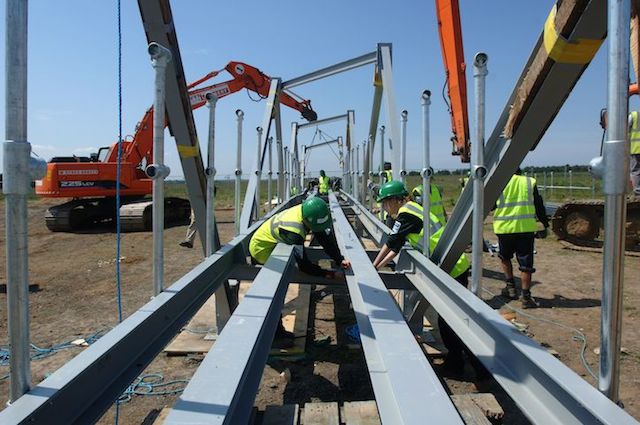
Constructionarium offers students the chance to build real civil engineeirng structures From the latest edition of the European Journal of Engineering Education (Vol 40 (1)) I have just read the very interesting paper ‘Teaching Design in the first years of a traditional mechanical engineering degree: methods, issues and future perspectives’ by Silva, Fontul and Henriques. This blog is to capture my thoughts.I am conscious that while I and my colleagues at Think Up have been involved for many years now in changing the way design is taught in civil engineering degree courses, we have written relatively little on what we have been up to. This paper is a good introduction to some the issues associated with integrating design teaching into the first year of mechanical engineering degree courses. It offers some parallels to civil engineering teaching (I will look in due course for papers directly related to civil engineering)The authors describe how mechanical engineering is traditionally taught through a series of separate courses with little cross-over and little opportunity for interdisciplinary design and open-ended problem solving. They describe a pilot project in which a design project is spread across three early modules in the course. Briefly, during two modules on technical drawing students design a simple innovative product, and create a prototype; and then in a subsequent course on materials they have to choose a material to manufacture it from. Some of the benefits are that learning is massively enhanced because students have to build something. Students learnt that iteration is a necessary and valuable process and not an admission of failure. And interestingly, students become aware of what they don’t know, which motivates them to learn in later courses. One of the challenges that this form of teaching throws up is that it takes much longer to facilitate.Reflections on relevance to civil engineering teaching- I haven’t yet seen a survey on how design is taught on civil engineering courses, but I have a reasonable idea. For the last ten years or so design has become a feature of most courses; however it seems often to exist as a stand-alone module at the end of the year, or a task within a module, tackled from the perspective of that course only. The innovation here is that one design project is taken as the common thread across three separate courses. During each course that design project is tackled from the perspective of that course but due attention needs to be given to the perspectives adopted by the other disciplines of the other courses. A parallel in civil engineering would be for instances to spread a hydroelectric dam design project across a geomatics, fluid mechanics and geotechnics course.
- The challenge with teaching design in civil engineering is that it is difficult to build what students design at a meaningful scale. I haven’t yet found the answer to this, but it regularly occupies my thoughts. It is possible at an elemental scale, for instance Ahmer Wadee’s plate girder make and break course at Imperial College; but harder at a greater scale. The Constructionarium is an example of a place where students get to build civil engineering structures at a meaningful scale, but students don’t get the chance to design what they are building.
- In the report which we wrote on experinece-led learning we strongly advocated taking an approach in which students try to define what knowledge they would need to know in order to become a professional engineer. As my experience with Engineering Knowledge Club has shown , the process needs a lot of facilitated discussion as students initially have very little idea of what information they need. Reading this paper it seems that setting a design project early in the course might be an alternative way of meeting this aim.
- I have previously written that interdisciplinary working is a skill that supports sustainable design, and this paper reminds me that interdisciplinary working can of course be achieved by running an interdisciplinary design course.
- The authors note that this type of project takes time. In my seminars with lecturers in civil engineering departments this factor is a common complaint. My response is that we have to look at course content and evaluate what is more important, the ability to solve open-ended problems and design more effectively, the skill which industry is looking for, or the mastery of specific technical skills to a high level, often higher than what is needed for practice.
The paper also points to a number of other publications that I want to check out. In particular:- Dym et al (2005) Engineering Design Thinking, Teaching and Learning – Journal of Engineering Education – A summary of designing thinking, teaching and learning, including an analysis of first-year cornerstone design courses and curriculum dispersed design courses.
- Marra, Palmer and Litzinger (2000) – The Effects of a First Year Engineering Design Course on Student Intellectual Development as Measured by the Perry Scheme – 2000 – Journal of Engineering Education.
- Haungs et al – 2001 – “Improving Engineering Education through Creativity, Collaboration and Context in a First Year Course” – ASEE Annual Conference & Exposition, Pittsburgh PA – Three major factors influencing negatively affecting creativity and retention rates in first year students:
- 1) hard for students to see how course material relates to real-world applications
- 2) students perceive engineering as an individual endeavour rather than an activity with peers
- 3) engineering assignments are overly constrained
- Bedard – 1999 – advocates a hands-onapproach to promote creativity in engineering education despite the risk of developing a reflex that trial and error can solve most problems and reduce student respect for the analytical component of engineering.
- “Enhancing Student Creativity and Respect for the Linkages between analysis and design in a first year engineering course.
- Hargreaves (2008) – Inherent balance between exposing students to challenge, and thus risk, and current higher education models of quality assurance that are risk-averse and thus potentially limit the scope of creative learning and teaching strategies.
- Meinel and Leifer 2011 – “Design Thinking: Understand – Improve – Apply. Berlin: Springer.- report on the HPI-Stanford Design Thinking Research Programme where students are taught the basic rules of design.
- Hirsch et al (2001) – “Engineering Design and Communication – the case for interdisciplinary collaboration” – International Journal of Engineering Education 2001 – How teaching design and communication at the same can enhance the students’ ability to tackle future engineering courses and career.
-
A systems engineering approach to parenting
In 2012, as I was preparing to begin my parental leave, one of my colleagues told me about an engineer he knew in New Zealand who quit their job in order to become a full-time parent. As the story goes, within a few months that engineer had all the household systems optimised freeing up lots of time to play golf. Now, knowing very little about the circumstances of the parent in question, their parenting style or their support network, so I took the story with a pinch of salt, but it did plant the seed of the idea in mind that all those processes and routines that make a household tick can be thought of as a series of systems which can be optimised.
One of the big changes I’ve noticed in becoming a parent is a shift in mindset from one in which it is possible to complete a task and move on to the next, to one in which you are constantly in the middle of getting lots of things done. The GANTT chart for being a parent would show a series of overlapping tasks that repeat for years at time within a programme time-frame that lasts around twenty. You are always planning the next thing, or two things ahead, at the same time as clearing up the last.
It is a paradigm shift. You are constantly in operational mode, with very little downtime – tiny variances can cause the system to wobble; winter vomiting bugs can send the plant into meltdown – but you do have some freedom in how you operate that system. And that is what the engineer in me muses on, usually when doing the washing up or hanging out wet nappies. Of course any optimisation process requires a target variable to minimise or maximise. It is tempting to assume, as the anecdote above implies, that target variable should be free time; however I think that fulfilment is a better thing to aim for, because there is plenty in parenting that is enjoyable. The system optimisation should take things that are unenjoyable and either reduce time spent on them, or make them more enjoyable. The system optimisation should also increase time spent on more fulfilling tasks.
In short becoming a parent replaces unstructured time with routine. The aim is to make that routine as enjoyable as possible for you, and to make it resilient enough so that you can every so often throw it to the wall and go to the seaside for the day. Now before I go any further, I don’t mean to say that our system is fully optimised, although I think we are doing ok! But I do want to chalk up a minor victory today, which has prompted me to write this post.
Monday is washday
I noticed a few months back that we were always doing washing. There was always some to wash; some to hang out on the line; some to bring in; some to put away. So, wearing my systems hard hat a few months ago, I decided I would try and crack this nut. Here are the parameters:
- The volume flow-rate is about five washing machine loads per week, sometimes six depending on the number of nappies we use.
- The fixed time factor is the wash time, roughly 2 hours per load.
- Drying time is a variable factor, especially if we put it on the washing line. In the summer washing can be dried in an afternoon, in the winter it can take a few days, or may never dry at all. Then there is the hanging out time, which is enjoyable in the summer, but less so in the winter, in the dark.
I’m a firm believer in batching things to do them more efficiently, so I decided that my Mondays at home with my daughter would become wash day. The idea was to line up all the loads of washing back-to-back in the washing machine, with no downtime between loads, and then to take the whole lot to the launderette for drying in the winter. In the summer there will be a washing line version of this plan.
While the washing bit works fine, the plan throws up a considerable transport challenge: how to get five loads of washing to and from the launderette with a toddler in tow at about 5pm when the clock is ticking before bedtime. I’ve been struggling to overcome this challenge for weeks now, and not for want of trying different approaches:
- I’ve tried waddling down the road with two laden Ikea bags and a pushchair but the bags are so heavy that this is actually quite painful. A few weeks ago one of the bags split spilling clean washing onto the wet pavement. Sub-optimal.
- I’ve strapped my daughter into the bike trailer and piled washing up around her, but the capacity is quite limited, so it defeats the object (but she loves being surrounded by warm washing on the way home)
- Rather than using a push chair, I’ve tried tried to let the little one go by scooter, with me following behind with my laden bags, but the little bean is so slow on her three-wheeled mobile that it took us an age to get there and I had to completely abandon dinner at home and get a pizza next to the launderette.
- My most extravagant approach: to load all the washing up in the trailer, to attach a separate bike seat to my bike to carry S, and then for us to set off like a mighty laundry tractor trailer down the streets of Highbury. It was fun but it took ages to set up, lock up, unlock, reload and come home.
Then, the solution emerged in two parts. One of the stressful bits is doing all of this to-ing and fro-ing close to the little one’s bedtime. So now I do all the washing on Sunday night and early Monday morning so that we can take it up around 10am. While it is whirling round and round we go off to a music session in Finsbury Park. When the music’s done, the washing is dry.
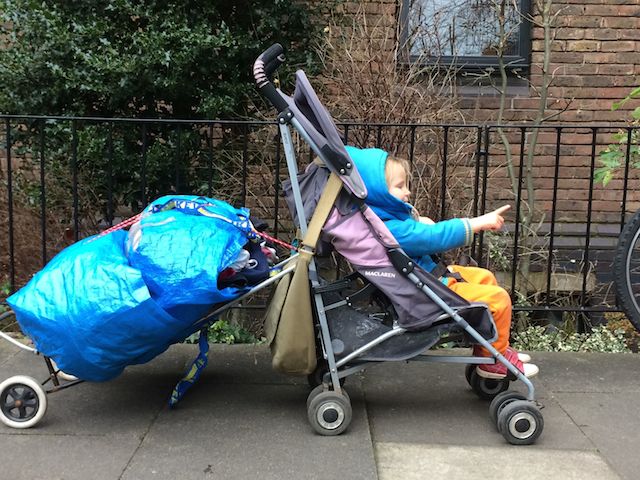
But the real winner came today when I brought an old shopping caddy into my service. I can just about bag up all the washing and fix it to the caddy with bungees. It is then a doddle to push the pushchair with one hand, and tow the trailer with the other.
So, system improved, which means I’ve got a little more time to spend doing things like writing blog posts.
Related posts
-
Setting my landfill targets for the year ahead
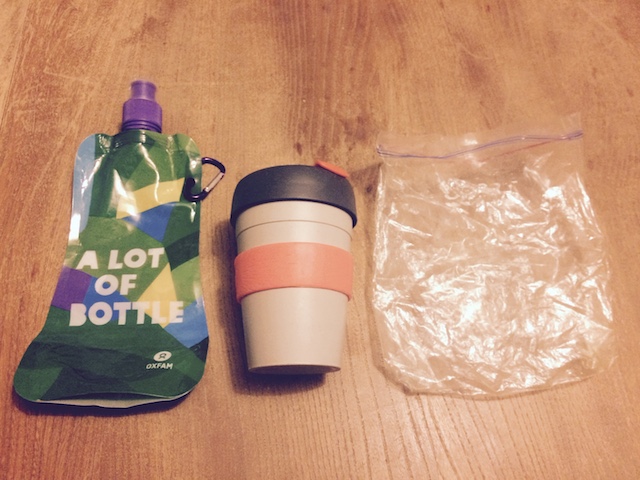
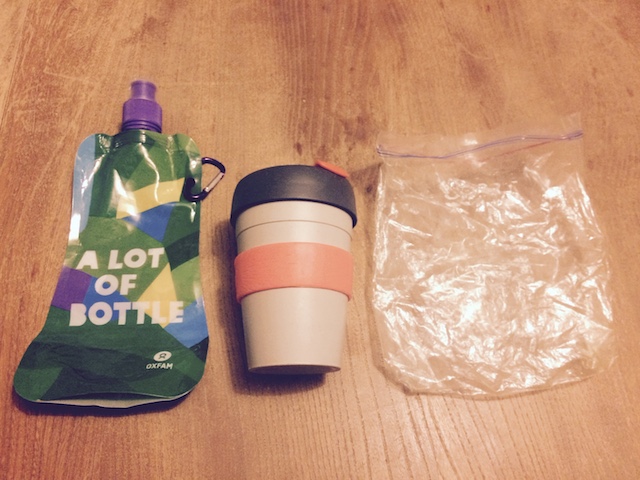
By carrying these three items with me a save loads of waste. The water bottle and coffee cup should be obvious. The plastic bag is for food waste which is hard to get rid of on the go. This way I can bring it home and feed it to the worms. My New Year’s resolution for 2015 is to reduce my waste to landfill. I realised as soon as I came up with this resolution that I didn’t really know what I meant by reduce because I had no idea how much waste I produce in the first place. So I have been spending January measuring and observing, and now I can set myself some targets. But before I do, here are some my ‘rubbish observations’.
– You can’t observe something without changing it. And so the mere act of being mindful of the waste that I generate is making me alter my behaviour, so my benchmark is already likely to be at a lower level than say my typical waste production was last year.
– I realised very quickly that I produce far more waste than what goes in my kitchen bin. The waste that I produce at home is relatively small compared to what I generate consuming food and drink at work, particularly on work trips. Even if those bits of food packaging are recyclable, that only happens if you actually recycle them, which is not always easy to do. At home, it is much easier to make sure that the materials are reused, or correctly recycled. From an ecological perspective, this makes sense: the more removed we are from our local ecosystems (as we are when on a work trip) the more waste we generate.
– somebody once asked my hairdresser if she could keep the hair that was cut from her head (the hair is usually thrown in the bin). Apparently hair cuttings are good for spreading around roses in the garden.
– What’s in and what’s out? I realise I need to determine the edges of this problem. Obviously, waste is produced at every stage in the production of most things we consume. What I want to focus on is the waste that I directly generate, be that at home, or at work. Nevertheless I am sure that in the process embodied waste will be something I at least think about.
– If you are prepared, you can easily reduce the amount of waste you generate on the road. Three things I now carry with me have almost entirely irradiated the waste I generate while on work trips: a reusable coffee cup (I have a KeepCup. A cool design and has the right balance of keeping your hands warm and your coffee warm); a collapsable reusable water bottle; and a plastic bag for putting food waste and other things that I can deal with when I get home.
– Funny numbers. Those numbers that tell you what a plastic is are actually called ‘Resin Identification Numbers’ – and I almost have them committed to heart.
– Does any of my waste go to landfill in any case? Looking into this a little (and I need to delve much deeper), my waste collected from home is taken to an incinerator where, once valuable elements are removed the waste stream, it is burnt and energy is recovered from the heat. That said this shouldn’t deter me, as this approach surely must be the last option once all other reduction and reuse options have been considered. Nevertheless I want to find out more – and I am hoping that finding out more will involve a visit to an incinerator.
– This exercise is already informing my shopping choices. I have ordered different food for a large meeting at work in order to reduce the packaging waste generated, and I brought home the waste from the meeting where I would have more time to sort the waste properly!
– That portion of chips and pitta I had on New Year’s Eve is probably the last of those I will be having this year unless I can think of something else to transport it in -though surely the pitta is a good enough vessel without the need for a polystyrene box.
– And finally, as the following numbers reveal, may landfill isn’t my biggest challenge, because, if you forget about the nappies, the weight of recycling I produce is X times more than the amount of waste for landfill I produce. Don’t get me wrong, I am all for recycling, but I could try to do a bit more reducing and reusing before resorting to the recycling bucket. Maybe that is something I should address later in the year.
The numbers
I weighed the waste that went into our three bins: kitchen, bathroom and garden. Since each waste stream is distinct, I kept them separate as I want to set a separate target for each. The kitchen waste is mainly packaging and wet waste that can’t be fed to our wormery or put in the compost. The main contents of the bathroom bin is the night-time disposable nappies that we use for our daughter (she is in washables during the day at home). The garden waste bin is mainly for packaging of stuff we buy for outside.
- Kitchen – 1kg/month
- Bathroom – 13.9kg/month
- Garden – 0.25kg/month
Based on these numbers, clearly the single biggest difference I can make to our waste stream is to potty train our daughter, which is something we are doing. I should add in defence of this number that for most of her life she has been in washable nappies, and this weight is a fraction of what it would be were we using disposables all the time. Having looked at the kitchen waste stream, I feel this is something that could be reduced mainly by being more careful about what we buy. The garden waste stream is hard to say much about because it is winter, and we are not doing much out there.
And so, on the basis of what I have observed this month, I am setting myself the target of generating less than 1/2kg of waste/month. This includes all the waste we generate as a household, except the nappies, which fingers crossed, we are going to be able to phase out in the next few months altogether. It also includes all the waste that I generate through my day-to-day activities at work and when on holiday.
I’ll let you know in a month’s time how I am getting on!
-
Greenwich Peninsula
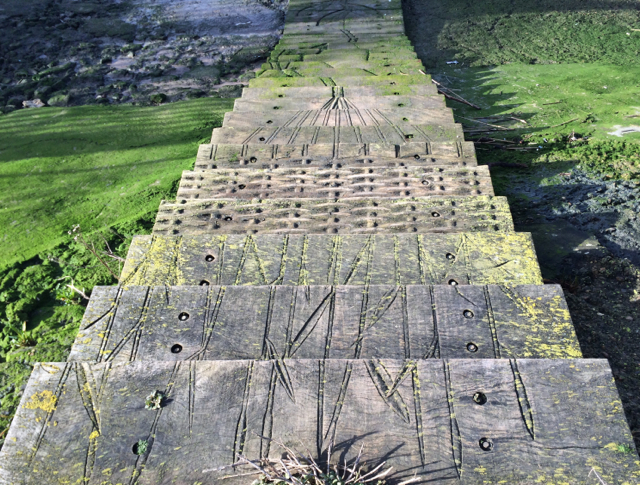
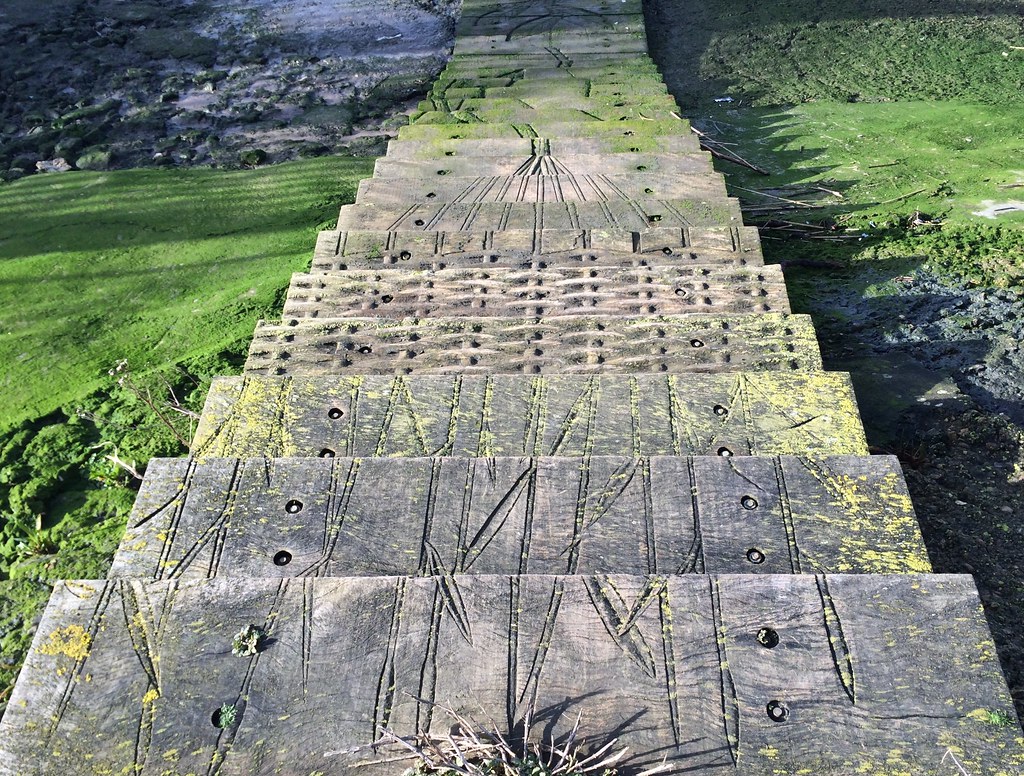
I snapped these wandering along Greenwich Peninsula last Saturday.
Enderby Steps 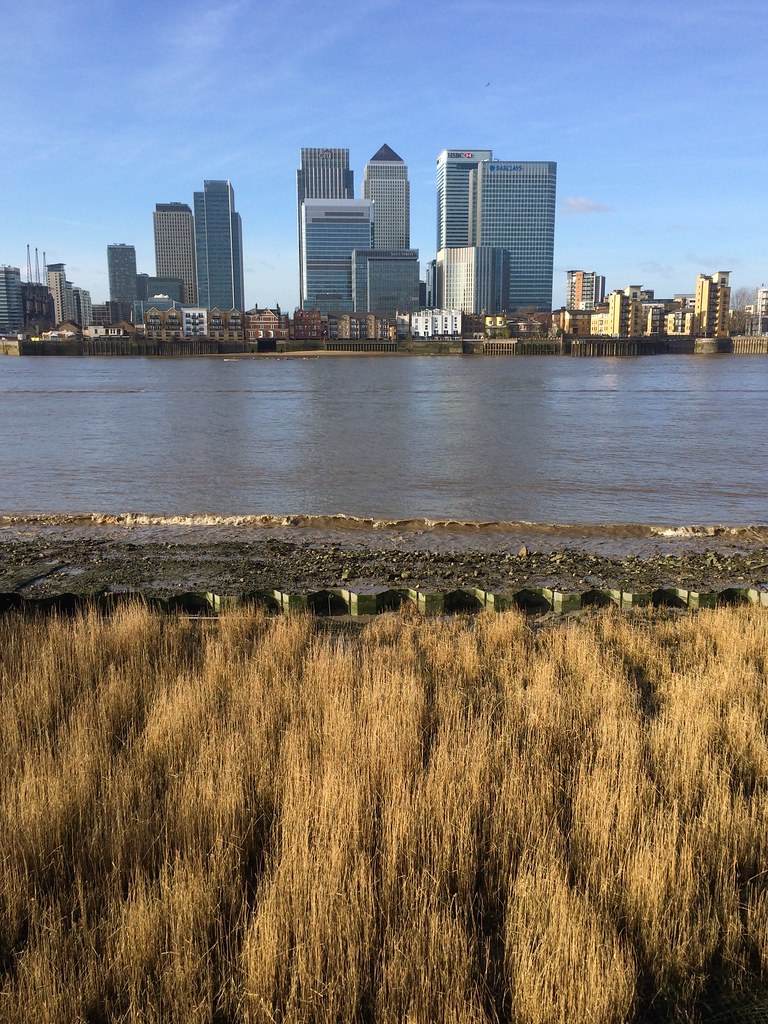
Canary Wharf from Greenwich Peninsula 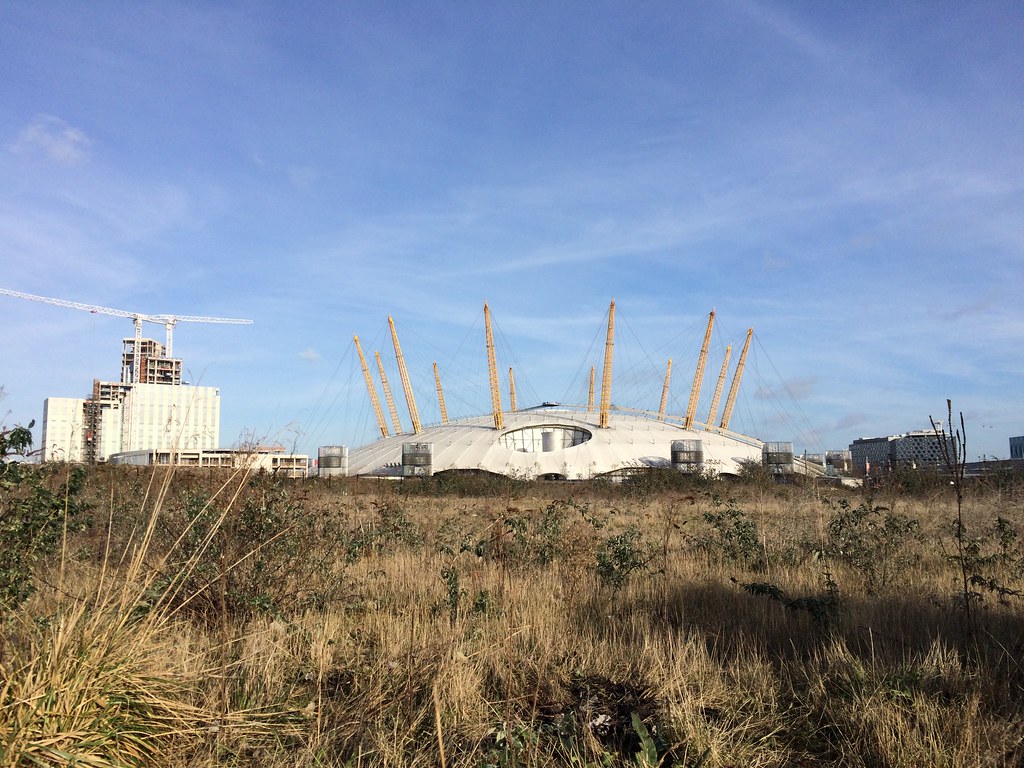
Millennium Dome 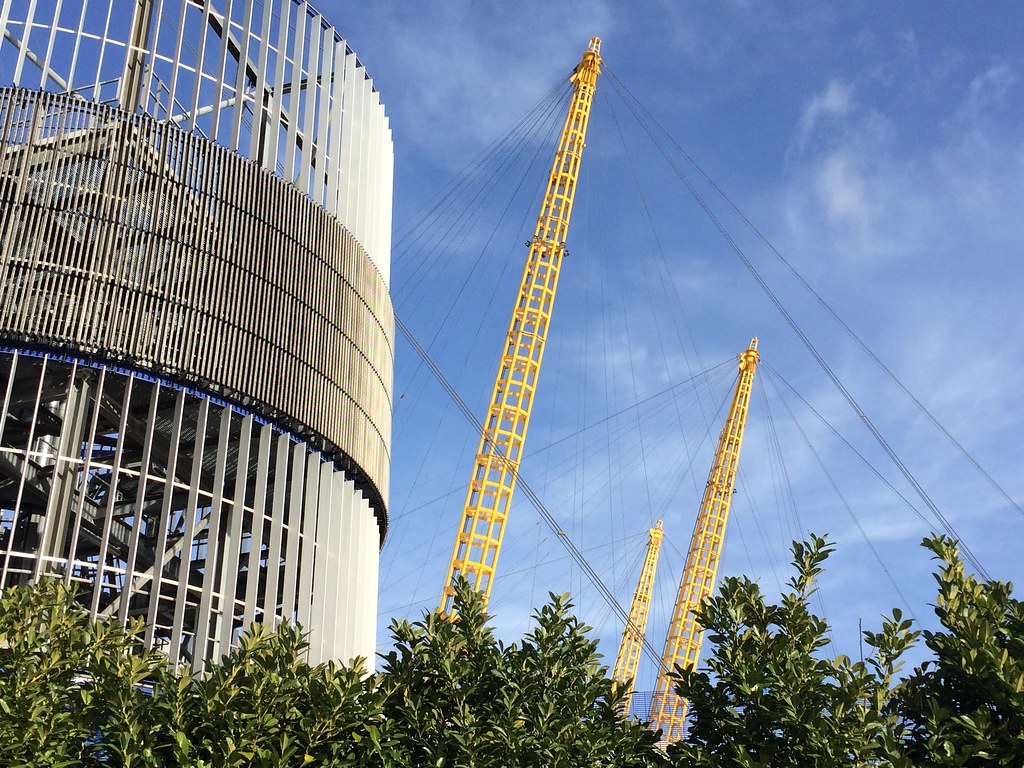
Millennium Dome – over the tree tops -
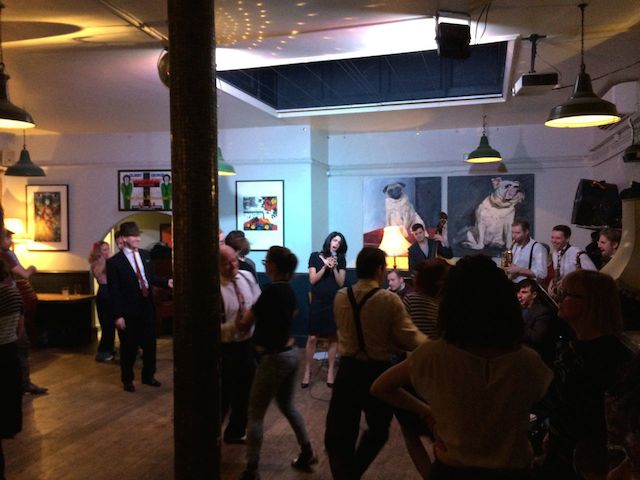
8-count basic lindy hop lesson
Tuesday nights are when the Mudflappers teach our weekly beginners’ swing dancing class before the London Dance Orchestra takes to the stage at Swing at the Scolt Head. Since I have been doing a lot of the teaching recently I have deployed my usual set of beginners’ class material and so I am having to come up with some new content. Since quite a bit of thought goes into this, I thought I would make some record of it on this blog, not least so I don’t forget in future.
In recent classes we have been spending a lot more time on warm ups. This week we put on Opus One by the Mills Brothers and just got the crowd to shake different bits of their body to the music. It felt really good and everyone seemed instantly to have shaken off their day.
Next up, we taught a bit more of the Shim Sham. This week we tackled the trick bit, the break. (I think we could dedicate a whole class to learning breaks, and maybe call it ‘Breaking Good’). We started by clapping the rhythm, then worked through the footwork, calling the steps. Pretty quickly the crowd picked up, and we had them doing their breaks to the classic T’Ain’t what you do.
Then on to the bulk of the bulk of the lesson, which we spent teaching side-by-side lindy hop moves. I think this set of moves feels really good to learn because you can really move a long way on the dancefloor, you can style it up lots, and the benefit of a strong connection can really be felt. We taught side-by-side charleston, and taught kick ups, and kick the dog. We then showed how from a side-by-side Charleston you can do an inside turn to reverse direction, and from there to move into a hand-to-hand Charleston.
To fit all this in in an hour and half we had to keep the pace up. We did our usual half-time drinks break about two thirds of the way through and then we upped the pace to fit in the hand-to-hand Charleston. By the end, I think everyone in the crowd had nailed the routine and felt pretty good and warmed up for the band.
The last thing to mention is for this week, I paid particular attention to the music. Earlier in the week I had discovered the music of Kid Ory, and so the whole teaching playlist was tracks by him: Ain’t Misbehavin’, Joshua Fit the Battle of Jerricho, Muskrat Ramble and Maple Leaf Rag, all top tunes which I can’t get out of my head. I’m looking forward to next week!
-
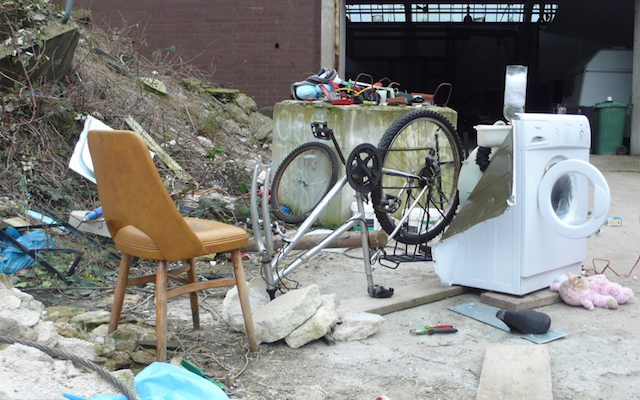
2015 New Year’s Resolution – Zero waste, or as close to
Pedal-powered washing machine – created as part of a TV demo I took part in which we tried imagine making machines from waste in post-apocalyptic Britain My New Year’s resolution for 2015 is it to try and send as little waste to landfill as possible. (Read my end of January update). The idea popped into my mind a few weeks ago, and since then I have been thinking of more and more reasons why I should give this a go.
- Waste is such a waste – I look at piles of waste, big or small – in bins, on building sites, in front gardens – I think, wow, what a waste! It seems crazy to me that given everything we can do with modern technology we still live in such a throw-away way.
- I like a challenge
- I have actually given versions of this challenge a go, but usually only for a week, and not since starting a family, so it is time to revisit.
- Recycling is great, and there’s more of it around, but what about the stuff that can’t be recycled? Is it ok to to buy something knowing it’s going to landfill? I want to experiment with having to adopt ‘no’ as the answer to that question. What does it mean I can’t buy or do?
- I think this is something lots of people will have a view on, and I am interested to hear what they have to say.
- It’s a great chance to find out what’s in stuff, how things are made.
- Finding ingenious uses for things I don’t want to throw away.
- Experimenting with keystone habits – I read about ‘keystone habits’ in the book ‘the Power Habit’ and I don’t know it is a common term, but basically the idea that if people develop certain habits, then other habits follow suit. I’d be interested to see what other habits the habit of reducing waste develops.
- Hopefully out of all of this I can develop practical ways to reduce my waste which might be useful to other people (this reason is inspired by ‘Walden’, one of my best reads of 2014, in which one of the key themes is finding ways to develop a ‘practical philosophy for life’, which I really like).
- To challenge the status quo.
- Personal supply chain management – I put this in because I have recently been running training for corporations on sustainable supply chain management, and one of the key ideas in the training is to encourage buyers to talk to sellers about ways to reduce waste in production. Perhaps by engaging with the people I buy stuff from I can find ways to reduce waste in my ‘supply chain’.
- It is a chance to assess how compatible low-impact living is with working four-days-a-week and looking after a child. Is zero waste a full time job?
So there are the reasons. Achieving the aim is going to take some time. For starters, ‘as little waste as possible’ to landfill is not really an aim, so January is going to be a benchmarking month on the basis of which I hope to be able to set myself a reasonable target. I also need to think a bit more time to think about the parameters. Measuring kitchen waste is one thing, but what about all the waste I produce out and about, or doing my job. Hopefully come then end of January, I will have some answers.
I am looking for co-travellers on this journey, either to join me on the challenge, or just to ask me how’s it going every so often. If either appeal, I look forward to hearing from you.
-
Stressed by stressed ribbons – teaching notes from Southampton
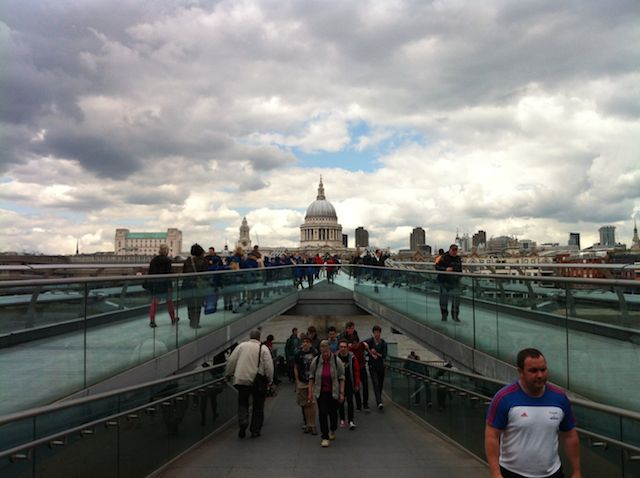
Long axis of the Millennium Bridge by Oliver Broadbent is licensed under CC BY-NC-SA 4.0 One of the groups of students that Ben Godber and I teach at the University of Southampton is designing a stressed ribbon footbridge as their entry for a design competition we’ve set them. A stressed ribbon is bridge is like a very shallow suspension bridge, the difference is that once the deck units are attached, the tension in the cables is ratcheted up, squashing the deck units together. The benefit of this post-tensioning is that it can greatly reduce the sag in the bridge, creating a much flatter bridge.
The students’ proposal is an elegant response to the site, but they have come up against the problem that they don’t know how to calculate the forces in the cables and so they can’t design the bridge. I was talking to my colleague Chris Wise about this problem of students not being able to design what they draw (a common student response apparently is that because they have seen a similar design online, they know it can be done: job done). But what Chris tells me he tells his students is that they should be able to justify every line that they draw. To help them, he provides students with an engineer’s toolbox, a handout full of rules of thumb that allow student engineers to draw engineering structures in roughly the right dimensions the first time around.
Returning to the case of our student’s stressed ribbon bridge, the bit of mechanics they need to understand is the equation that links the sag in a catenary cable with the horizontal force at the supports. For a static load on a single span bridge, this is easy to calculate, and is given by the equation Fh = wL^2/8s (where ‘w’ is the line load; ‘L’ is the length of the span; and ’s’ is the sag in the cable). Plugging the numbers into this equation gives what the horizontal pull of the cables at either end. The picture is however complicated when there are there are three unequal spans with the cables running continuously over the two supports in the river. If the cable is continuous, the tension in the cable must be equal either side of the support. If that is the case, then for a fixed load on the bridge, the sag in the spans needs to be adjusted to ensure the horizontal forces in the cables at the point where they go over the supports is equal on either side.
Were you to create a physical model of this scenario in which two people hold a chain that is draped across a pair of stools, the chain would adjust it’s own position until it finds its own equilibrium. To find this equilibrium in the design process, engineers do what’s called form-finding, an iterative process in which the parameters of the design are adjusted until all the forces are in equilibrium. For the purposes of a student project, a good-enough result can be obtained by setting up a spreadsheet to do the horizontal force calculations, and to iteratively adjust the sag in the cables until the forces balance.
There’s one final catch though. The process I’ve just described assumes the load on the bridge is constant; however, loads on a bridge change according to how people are using it. Engineers look for worse-case scenarios: the pattern of loading that would create the most difficult load for the bridge to carry. For instance, one worse-case scenario for a footbridge might be all the users standing against one edge watching a boat race, and then all at once, running to the other edge as the boats pass underneath. In the students’ scenario, the students need to think about how they will accommodate any difference in loading between the spans. If they were to leave the cables to free slide back and forth over the central supports, then as the loading changes the sags in the bridge spans would increase or decrease, which would be quite uncomfortable for the user! The alternative is to clamp the cables down on the tops of the supports. Any difference in the tension between the two spans due to unequal loading will then cause the column to be pulled sideways one way or another. The columns can be designed to resist these overturning forces. The challenge for the students is to work out what worse-case scenarios would exist to cause this unbalance in the cable forces.
Of course, everything above is greatly simplified. I don’t pretend to know the details of how to design a stressed ribbon bridge and I am grateful to my colleague Andrew Weir who helped me understand the mechanics of the problem in such a way that I can easily explain it to my students. The point is to illustrate what I think is one of the most important things that students can learn from design projects at university, and that is the ability to use their knowledge of mechanics and their experience of the world to develop a plausible response to a project. It is also one the areas of teaching that I enjoy the most because it best illustrates what an engineer can do: combining their own experience with an understanding of how things work to shape the world around them.
-
Qui l’eût cru – when Paris flooded in 1910
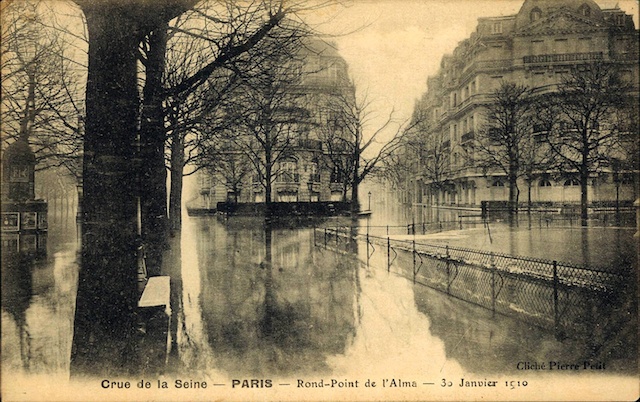
Crue de la Seine – Rond Point de L’Alma – 
This work is licensed under a Creative Commons Attribution 4.0 International License.Seven years ago I was rummaging in the loft of my great grandfather’s old house in the south of France when I discovered a box of postcards, ninety of them in total, like the one above, all depicting images of the 1910 Great Flood of Paris.
While not in great condition, and certainly not unique, I thought I should do something with them. It’s taken seven years to act on that impulse, and here is the result. I’ve had the postcards scanned and then I’ve posted them to an online map of Paris. Click on any of the pins and you can see a photo of the flood from that location. Click on the URL below each picture and it will take you to the Flickr gallery I’ve created of these images.

Note this is just a screenshot of the map. Click here to access the interactive version of this map Origins
The reason, I think, that the postcards were in the house in the first place is that I think my great grandfather saw himself as a historian and a bit of an archivist. It is unlikely that he collected the postcards himself: he would have been seven at the time and it would be at least another five years until he left his farming community – although he did end up running a bookshop in one of the areas flooded. It is more likely that he picked up a job lot of them at a flea market and recognising the significance of the event, thought they were worth keeping. In these days of the internet I don’t have the feeling that people do that sort of thing so much. But I’m glad that he did, because today I am able to publish online a load of photos that I haven’t seen elsewhere on the web, and hopefully others will find them useful.
Below are a few of my favourites. Be sure not to miss the polar bears.
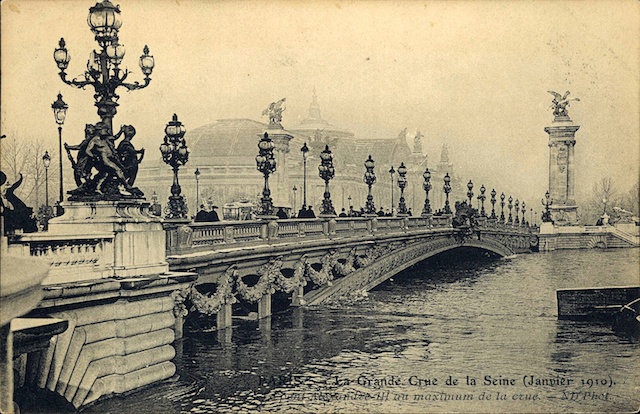
La Grande Crue de la Seine – le pont Alexandre III –
This work is licensed under a Creative Commons Attribution 4.0 International License.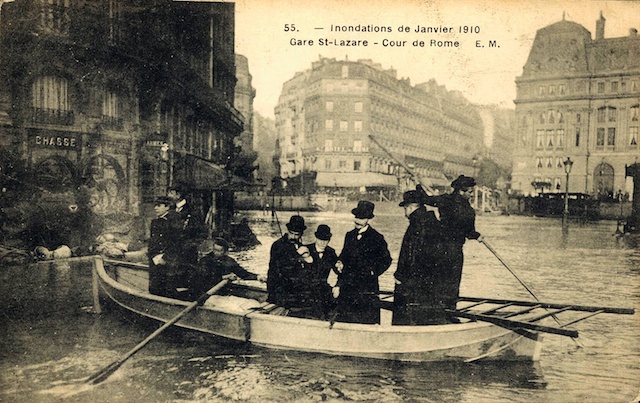
La Grande Crue de la Seine – Gare St Lazare –
This work is licensed under a Creative Commons Attribution 4.0 International License.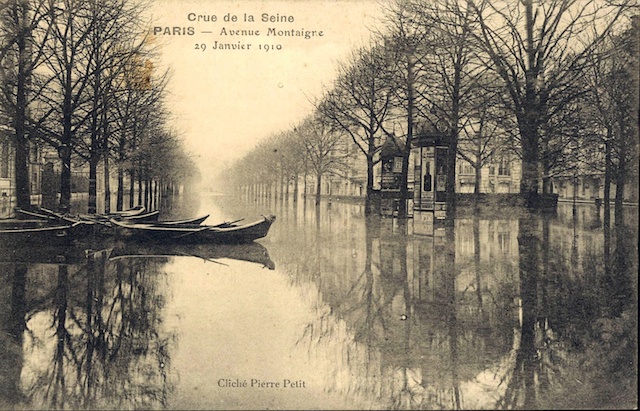
La Grande Crue de la Seine – Avenue Montaigne –
This work is licensed under a Creative Commons Attribution 4.0 International License.
La Grande Crue de la Seine – les Ours Blancs du Jardin des Plantes surpris dans leur fosse par l’inondation –
This work is licensed under a Creative Commons Attribution 4.0 International License.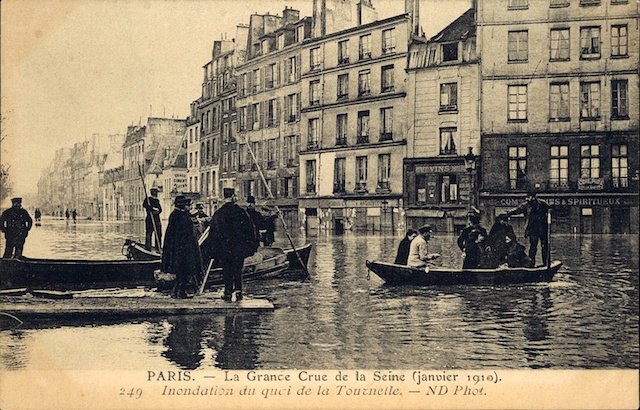
La Grande Crue de la Seine – Quai de la Tournelle –
This work is licensed under a Creative Commons Attribution 4.0 International License.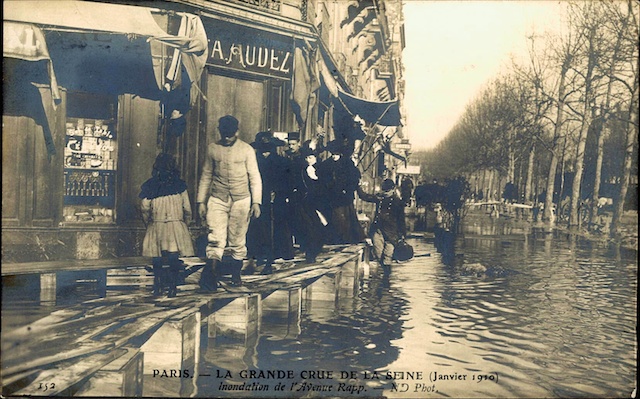
La Grande Crue de la Seine – Innondation de l’Avenue Rapp
This work is licensed under a Creative Commons Attribution 4.0 International License.
Image showing the flooded railway tracks of the Invalides train line in Paris during the 1910 Great Flood of Paris -
Experiments in content flipping
This year I have been experimenting with content flipping in my teaching. The idea of content flipping is that students first encounter the course material in their own time, so that teaching time can be spent discussing, applying or interpreting the material. The aim is to make more effective use of both time together and time apart.
I have had two opportunities this year to take a flipped approach. The first was as part of a Think Up commission at the University of Cambridge to assist in the coordination of a residential Masters module in innovation in construction engineering. It was my job to provide a theoretical framework that would weave together the themes of the week’s speakers. I decided it would be a better use of class time if the students could arrive at the residential week having already got to grips with conceptual ideas around notions of ‘future’ and ‘innovation’. These frameworks having been established before students arrive, we’d then be able to use our contact time to interpret what the course speakers had said against these frameworks.
The flipped exercises I sent out as two documents we called ‘Think Up Think Pieces’, one on ‘Future’ and one on ‘Innovation’. [link coming soon] These were sent to the students along with pre-reading papers from the more ‘traditional’ lecturers. In my first session with the students, I asked if anyone had covered the flipped content – only two out of twenty had. Not a great success – I’ll come on to my reflections on this in a moment.
Where I have had more success with flipping is with the graduate training programme I designed as part of a Think Up commission for a large construction management company. Here the aim was to introduce their first-year graduate intake to the key stages in the construction life-cycle of a building. The programme was to involve five intensive role-play-based workshops in which the graduates, working in teams, would take on the role of a team engineers as it managed the key stages in the construction process of a building. In order to have the maximum time available for role-play we decided to flip the theory. Two weeks before each workshop, we sent the participants a pre-briefing worksheet of activities and reading they needed to carry out to prepare them for the contact time.
In this instance, the majority of the students actually did the ‘flipped’ exercises. So what was the difference?
- In the Cambridge scenario, there was just one set of flipped exercise, followed by a back-to-back set of lectures and contact time. In the corporate training scenario, there were several sessions with long gaps in between when the participants could do their flipped work. In the latter case, the participants could see the benefits of doing the flipped work, and if they didn’t do so for the first workshop, they probably made sure they did for the second one.
- In the Cambridge scenario, my hopefully-interesting flipped exercises were bundled with more traditional reading lists sent out by the other lecturers. They weren’t to know there was something maybe a little different inside the material I’d sent over, and so probably didn’t look (I didn’t get the chance to ask students why they hadn’t read my material, or whether they had read anyone else’s)
- In the corporate training scenario, I got to brief the participants several weeks before the start of the course on the pedagogical model we were adopting, and in particular the importance of the flipped learning exercises. In other words, they knew what was expected of them, and so may have been more motivated to follow that learning scheme.
- Unfortunately I was not able to bring a reflective learning element into the work at Cambridge, but in the corporate training example, the teams were required to complete a reflective learning diary post after each workshop during which they were asked to reflect on the value of what they had learnt in the pre-briefing phase, which I am sure helped participants to see the value of this approach.
- Finally, in some of the flipped exercises in the corporate training example, I required participants to write a short summary of what they had learnt in the run-up to the session.
The flipped learning exercises were clearly of benefit to the graduate participants. They arrived at the role-play scenarios with a clearer idea of how they might be able to succeed at the tasks they were being set, and had more contact time with the facilitators to discuss the issues that they didn’t understand.
So what do I conclude about flipping? In the case where it worked I was very happy with the impact of the approach, and I will continue to adopt the approach where I can. To anyone else trying it, I would recommend:
- Being clear with the learners in advance that this is the approach you are going to take and why.
- Keep the reading or exercises concise and achievable rather than sending out a lengthy reading list that no one is capable of reading.
- Consider setting a short exercise to check participants have completed the flipped activities.
- If you are using a reflective learning approach, ask students to think about what they learnt from the flipped compoment of the teaching.
So, what do you think? Have you tried this approach? What are you experiences?
-
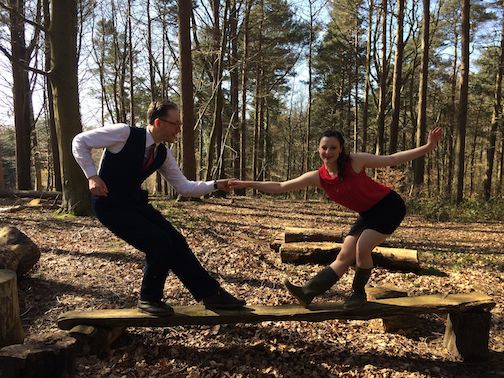
Où est la salle de danse? – Why learning to lindy hop is like learning a language
Mudflappers Peter and Nat demonstrate you can lindy hop anywhere. It’s not long until fellow Mudflapper Jenny Millman and I begin teaching our six-week course ‘Learn to Lindy Hop’ at the Idler Academy. Being a lindy hopper and being an Idler go hand-in-hand, as these classes will show.
You only have to a watch a short vintage clip of lindy hoppers dancing on a film like Hellzapoppin to see that the Lindy Hop oozes with cool, but the great thing about this and other forms of swing dance is that it is a social dance. What this means is that if you learn a few basic moves, and you find yourself in the vicinity of someone else who knows some basic moves, you can get up and start dancing. The threshold for participation is low and the fun you can have is endless. All you need is a song on the radio and someone to dance with and you can get instant pleasure, making it an ideal leisure pursuit for Idlers.
Learning to Lindy Hop is a bit like learning a new language. You begin with learning some words and phrases, and, sure, you have to practice these for a bit using corny holiday-based role-play exercises, but pretty soon, you can start improvising and finding things out about the person you are talking with. In Lindy Hop, the moves are the vocabulary, the rhythms are the grammar, the lead and follow technique the conversational etiquette and the music… is what you talk about. Over the course of six weeks we’ll be teaching some basic vocab and grammar, which we will practice in role-play (où est la salle de danse?) and we’ll be playing lots of music, so that before they know it our students will be conjugating their way around the dance floor.
Learn to Lindy Hop kicks off on Wednesday 22nd October. For more info and to book a place visit the Idler Academy website.
-
Hazel Hill Family Adventure Weekend
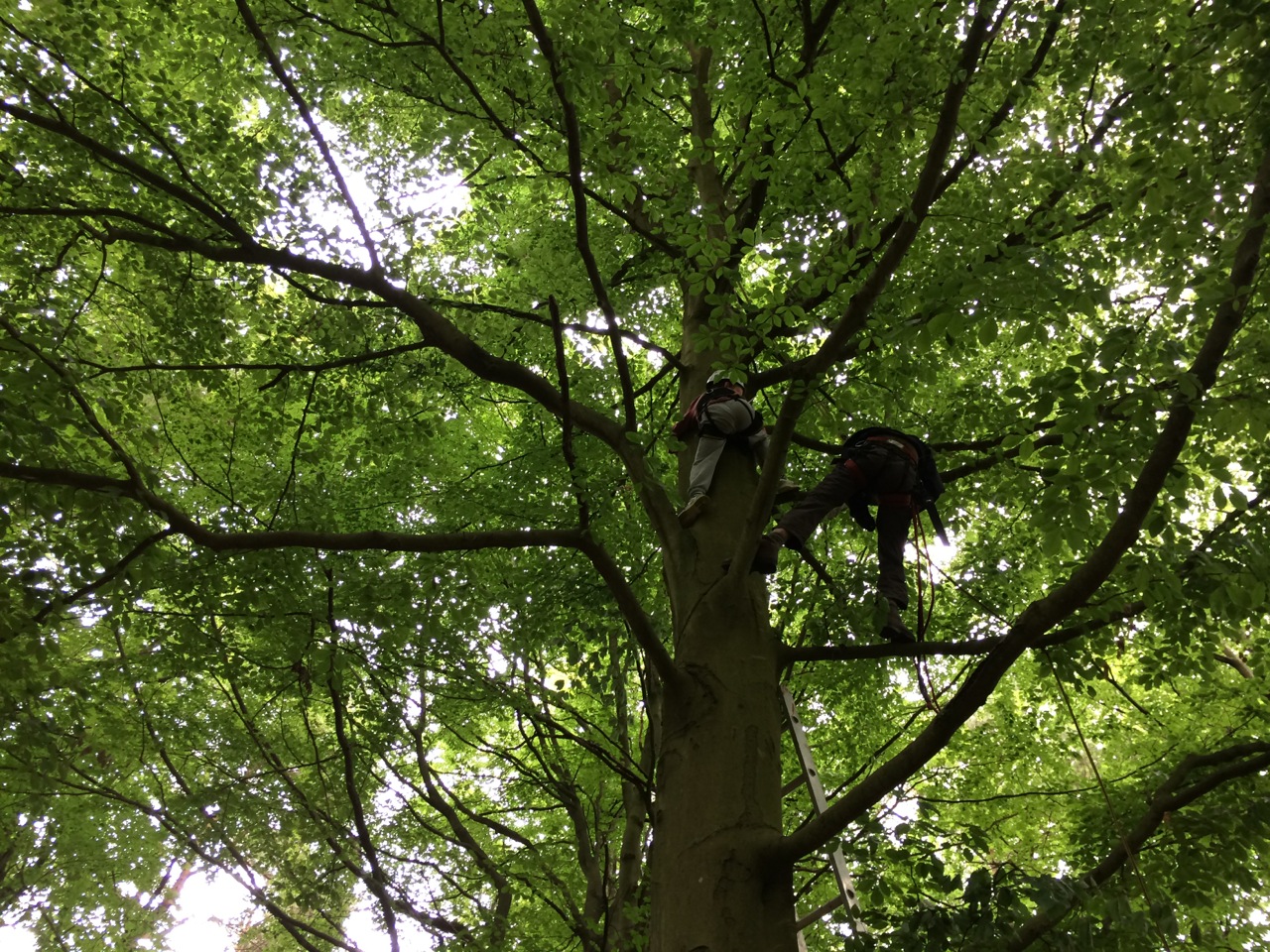
A kid, supported with a harness, climbs ten metres up a tall beech tree at Hazel Hill I’ve just returned a wonderful weekend in the woods, the first ever Hazel Hill Family Adventure Weekend. The aim of the weekend was to give kids the chance to get out into the woods and to create their own adventures. We ran the weekend in partnership with Monkey Do who create fantastic rope net structures that allow kids (and grown ups) to jump, bounce and swing from level to level between the trees.
When the families arrived on Friday evening, we filled up on enchiladas before going on a walk through the woods to help everyone get their bearings. We finished the evening with introductions around the campfire and a discussion about the weekend ahead. We had thought the kids would want to go to bed, but, as it turned out, not until they had been on a night walk through the pitch-black forest.
After an early breakfast on Saturday morning we went looking for leaves to help us learn about the different types of tree in the wood. Then it was time to get into the nets. For an hour and a half the kids clambered around, daring each other to jump from the highest net to the lowest one, and challenging each other to race from one side to the other. Meanwhile, one by one, kids and adults were strapped into a safety harness and climbed as high as they would dare up one of the tallest beech trees in the wood. When the forecast rain came in the afternoon we retreated to the covered roundhouse for a session on how to light a fire with a flint and steel. My accordion provided background music which eventually turned into everyone singing along.
Earlier in the day we challenged the kids to move from one area of the wood to another without being seen. The idea was to encourage them to go deeper into the woods and explore the secret pathways through the undergrowth created by the dear. This exercise was good practice for our last outdoor activity of the afternoon, a game of capture the flag (tea towel) played right across an area of dense woodland at the westernmost end of Hazel Hill.
The evening began with a dinner of vegetable kebabs that the kids roasted on an open fire. I then ran a solo Charleston class for adults and kids, which was supposed to last half an hour, but went on for an hour and a half as everyone was enjoying it so much. We eventually regrouped at the campfire to reflect on the day and to listen to some poems by Michael Rosen.
Sunday’s start was not quite so early: the kids’ exertions were beginning to catch up with them. We played more stalking games through the wood, this time in the thickest area of forest. We then moved on to the dark wood, an area planted with scots pine, for a game of Owl and Mouse, a blindfold game in which the ‘mice’ must sneak up on the blindfolded ‘owl’ without being heard – an exquisitely silent game to watch! We returned to the nets for more suspended adventures and finished with a final game of capture the flag, this time played among the tall trees of the heart wood where there is much more space to run around.
The weekend was a great success in many ways. All the participants left beaming. The parents told of their joy at managing to persuade their kids to put away their electronic devices for the weekend; and even some of the kids admitted to appreciating this as well. It was also a for the crew, none of us having worked together before, and all of us enjoying ourselves and feeling part of the wood. And I think it was a great success for Hazel Hill, showing how the woodland can be used as a place for adventure.
I look forward to using what we learnt from this event in other weekends at Hazel Hill (especially at our upcoming Autumn Conservation Weekend), to working with all the facilitators again, and hopefully to seeing many of the participants at future Hazel Hill weekends.
-
A sketch for the Big Idea
It was on a train to Bristol yesterday, travelling with my colleague Ben, that I articulated in I think the clearest terms yet the model of learning that through my various projects I would like to explore and develop practically. It goes something like this:
What do I want to know or be able to do?
What skills or knowledge do I need to have in order to meet this aim?
Which of these skills, knowledge or aptitudes do I already have?
How can I make up the deficit?
How will I know when I’ve got there?
The benefits of the approach are:
it starts with the needs of the individual, and values their own experience of the world. It is potentially empowering and rewarding. It could be self-sustaining if the individuals develop the skills necessary to adopt the approach.
Disadvantages or challenges I can see are:
Learners need to have developed a certain level of skill and maturity before they can adopt the approach. Learners need access to a whole different type of coach or teacher who can guide them through the process. The approach is not easily scalable, requiring a much more tailored relationship between coach or teacher and student.
I see these disadvantages as challenges to be overcome, and hopefully my projects can help contribute.
My motivations are:
A love of self-started learning and personal development; the astounding way that our brains can learn and a concern that our current formalised systems of learning are crude; the depressing sight of students motivated purely by grades and the hugely destructive fetch that summative assessment seems to have on the learning process.
Clearly these thoughts need refining, but I wanted to get these reflections written down while they are fresh. Clearly these are also big ideas to implement – perhaps impossible. In this respect I am inspired by the following from Rousseau’s Emile:
“People are always telling me to make practicable suggestions. You might as well tell me to suggest what people are doing already, or at least to suggest improvements which may be incorporated with the wrong methods currently in use. There are matters witch regard to which such a suggestion is far more chimerical than my own, for in such a connection the good is corrupted and the bad is none the better for it. I would rather follow the established method than adopt a better method by halves. There would be fewer contradictions in the man; he cannot aim at one and at the same time two objects.”
-
Learning emergency first aid
Resuci-Annie catastrophe Yesterday I went on the excellent St John’s Ambulance 1-day emergency first aid at work course. It was a real eye-opener: it made me realise just how many of the voluntary and fun activities that I go to are made possible by having first-aiders on site.
I was of course also interested in the way it was taught. This is not meant to be the land ambiguity; little room here for interpretation. This training gives clear procedures to help save people’s lives. Any crudeness or bluntness to the rules is offset by the huge potential benefit of saving someone’s life.
The thing I found particularly difficult was doing the treatment with the hands at the same time as doing the patter. One for the science communicators!
The course relies heavily on acronyms to help you remember procedures, and I admit that despite very clear instruction I was on acronym overload by lunchtime. The course has summative assessments built in throughout so that by the end you have an assessment-based qualification. I am however curious about the drop-off rate in retention of that knowledge. For example, I am certain that many people will remember the DR ABC stuff, but other points will drop away.
Obviously some retention is better than nothing, and these courses are clearly doing a great deal to save people’s lives, but I wonder if some delayed assessment, say a week later, using a mobile phone app would be a better basis for the qualification?
That said, St John Ambulance have released an app that gives you back up information, and you do get a pocket reference card – but do you really want to be referring to those in an accident?
I for one know that I will forget much of the content unless I practise, so those of you that know me don’t be surprised if I ask you to lay down and pretend to be unconscious!
-
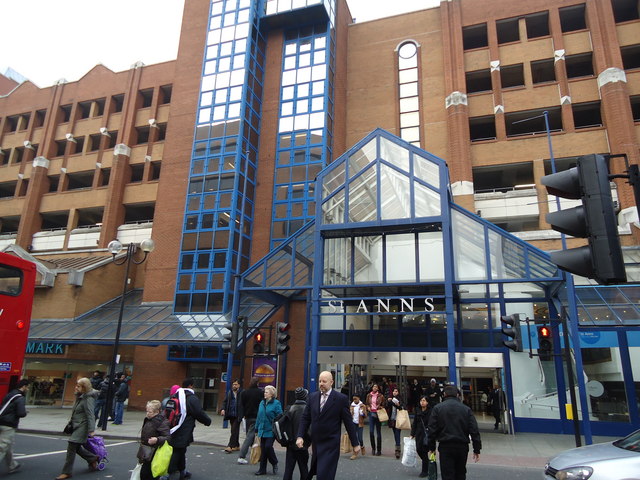
Harrow: my original civil engineering inspiration?
St Ann’s shopping centre, Harrow – my original inspiration? ‘geograph-2284249‘ by Stacey Harris is licenced under CC BY SA 2.0 This morning I was down at our local primary school arranging to do a talk about civil engineering for the Year 5 and 6s. The head teacher remarked that most of the teachers at the school probably wouldn’t know what civil engineers do, let alone the students. It was the same for me as a kid. But although I didn’t know the words civil engineer, I was fascinated by all things civil engineering: big construction, railways, bridges, waterways.
I grew up in Harrow, and though I regularly visit family in the area, in over fifteen years I haven’t been back to the town centre that was the backdrop to my childhood. This week, beating the Tube strikes meant an eighteen mile cycle ride through that part of the world. After an hour and a half in the saddle in the pouring rain I decided to take a pit stop in downtown Harrow. And WHAMM: all these childhood memories came streaming back, as vivid as if they were yesterday:
- There’s the ‘whole in the wall’ where my Dad would queue for cash
- There’s the Debenhams that I followed my Mum round on what seemed like endless trips
- There’s where I first went to McDonald’s on my own
- That’s where I got mugged for the money I’d saved up to buy a new motor for my radio control car
- There’s the bar that underaged me used to go into at 4pm on a Saturday and wait patiently to avoid the evening bouncers.
But the strongest memory I have of all is the excitement of seeing much of the town centre under construction. For the suburban child that I was, Harrow was the big lights. The 6-8 storey office blocks in the town centre I considered big, glamorous, sophisticated – like the buildings in the montage at the start of Dallas. So when construction started of an enormous middle-of-town shopping centre began including a 9-storey post-modern multi-storey car park, it really captured my imagination.
I remember watching the St Ann’s centre being built right from the basement excavation works and the piling through to the fit-out – watching from the bus stop across the road. I remember the steel superstructure being erected and asking my Dad why they were building a giant Meccano model of the building before they built the real thing. The new centre required major rerouting of the roads – this too I found fascinating.
The influence of all this construction is clear in the drawings that I made at this age – some of which I still have. I was trying to design my own shopping centres, car parks, one-way systems, tram systems, all modelled on Harrow. There were other influences too: the construction of the M25 up the road was an event horizon for me. When my best friend moved away, I asked if he would be coming back before they finished the M25, something which I knew would take ages. When I was told no he wouldn’t, I knew I was in for a long wait.
I even remember aged about ten going to a traveling exhibition about how Harrow would be served by something called ‘Crossrail’ – that sounded incredible.
After St Ann’s with its anchor stores and enticing food court, they built St George’s the even more ambitious St George’s shopping centre, and then the Harrow property bubble must have burst because there is the concrete shell of abandoned incomplete office block just around the corner. These days the anchor stores have dwindled, and the food court sells more chicken than I remember.
Had I grown up here fifteen years later I wonder if I would have been similarly inspired?
-
In the can: the Bare Essentials of Soil Mechanics
Today at Think Up I posted the first five videos of a series we are creating called the Bare Essentials of Soil Mechanics. The idea of the Bare Essentials series is for senior figures in the engineering profession to identify the key pieces of knowledge that they think engineers really need to understand. For this first set of videos we worked with Professor John Burland of Imperial College. John is known for being a great teacher, and though I didn’t have the benefit of his lecturers, I can see why. Working with him on this project has been really enjoyable.
Take a look for yourself here, and if you like what you see, please help spread the word as the more hits we get, the sooner we are likely to raise funding for some more…and we have some great ideas for the next set.
- What is soil mechanics?
- The Particulate Nature of Soils
- The Effect of Gravity on Soil Strength
- The Effect of Particle Size and Shape on Soil Strength
- The Effect of Water on Soil Strength

Bare Essentials of Soil Mechanics title slide by Think Up is licensed under a Creative Commons Attribution-NonCommercial-ShareAlike 4.0 International License.
Based on a work at https://www.youtube.com/watch?v=ZuofAC9rq58.
Permissions beyond the scope of this license may be available at www.thinkup.org. -
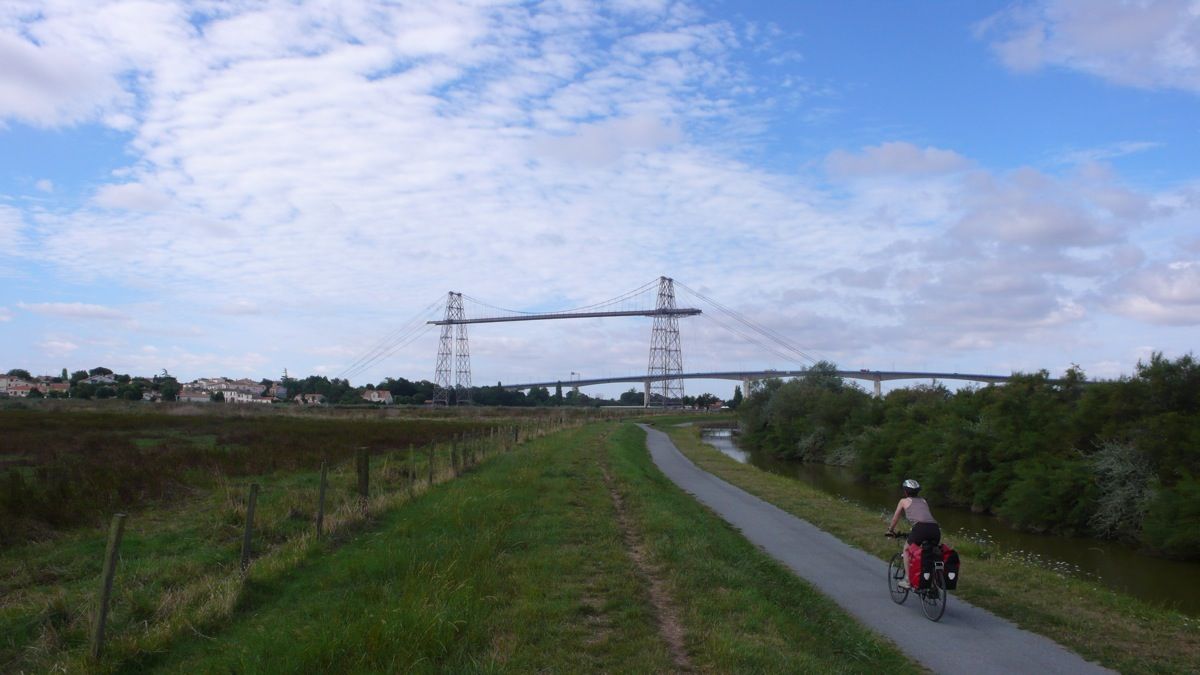
The bridge between mechanical and civil engineers
Rochefort Transporter Bridge Last night I was reminded of the fascinating world of moveable bridges. From the glorious transporter bridges of ports and river estuaries to hulking swing bridges of the New Jersey railroad, these projects would make interesting interdisciplinary case studies for civil and mechanical engineers.
The lightbulb went on when I found this fantastic set of animations on Wikipedia showing the movements of different types of moveable bridges. For me part of the wonder of civil engineering is the scale of the projects. When those massive structures start to move, well, I just have to sit down. But as well as wonder, I think they offer really valuable learning.
A conclusion of research interviews I carried out last year about developing engineering skills for industry was that engineering employers want graduates who can work with people from other backgrounds to solve engineering problems. In my experience as a civil engineering student we felt miles apart from our mechanical cousins down the corridor. Crudely, we were concerned with things that stayed still, and they were concerned with things that moved. Civils courses that had the word ‘dynamic’ in the title were considered hard and we knew our engineering relatives were studying a more difficult degree!
One of the challenges in giving students opportunities for interdisciplinary working is the siloed nature of university departments. This is a problem not just across engineering but also in the built environment. I know of major institutions whose civil engineering and architecture students never meet – at least in any formal capacity. So I am increasingly on the look-out for projects or topics that can bring different disciplines together. And a moveable bridge could be just the ticket.
At the Constructionarium, where engineering students build scaled versions of engineering structures using real materials, plant and processes, two of the bridge projects on site require already significant movement of the superstructure to complete the structure. At Millau the students construct bridge piers in the gorge and slide the deck units across from the gorge sides. At Kingsgate the two halves are the bridge a constructed on either bank of the river and then rotated into position to meet in the middle – I am still struck by the elegance of this construction method.
Moving a bridge deck once as part of the construction sequence is a starting point, but the real crossover with mechanical engineering begins when the bridge requires a permanent mechanism to make the movement repeatable. At their simplest, moveable bridges require bearings to move the deck units, but a more challenging project would be to have to include hydraulic rams to make get the deck to to lift or swing.
The aim of the crossover is to give students from either bank of this engineering divide the chance to understand the perspective of the people from the other side so that they might work together better in the future. For the civil engineer that might mean understanding how mechanisms are modelled, the dynamic forces on moving elements and the tolerances required to get the structure to work. For mechanical engineers that might mean understanding how a piece of mechanical plant fits into a civil engineering structure and understanding the practicalities of construction on site.
But as well as the educational reasons for wanting to develop a moveable bridge-themed student project, I have a more personal reason. When I lived in New Jersey I’d often take the train to New York, and I would stare out of the window in wonder at the host of moveable bridges of every type that the railroad uses between Jersey City and Elizabeth. We just don’t have the same proliferation of moveable bridges in the UK (maybe we paid more to put our railways on viaducts?).
A couple of years later I had a Saturday job in an office adjacent to Thomas Hetherwick’s roll-up bridge. We’d get people visiting the bridge every day and one time I got chatting to a retired engineer from the states, who it turns out had been a very senior member of staff at the US’s largest moveable bridge specialists. He had worked on and knew a great deal about many of those bridges that I had seen out of the train window in Jersey. Hearing that I was studying engineering, he told me all sorts of fascinating stories.
Six months later after leaving that job, I dropped by to see my old colleagues, and the receptionist gave me an envelope stuffed full of pictures and reports that that engineer had posted me from the states, without a return address – I had no way to say thank you. To make things worse, I then managed to lose this treasure trove. If I am able to contrive to get a moveable bridge project set up at the Constructionarium, it willl be my way of saying thank you to that generous-minded engineer.
-
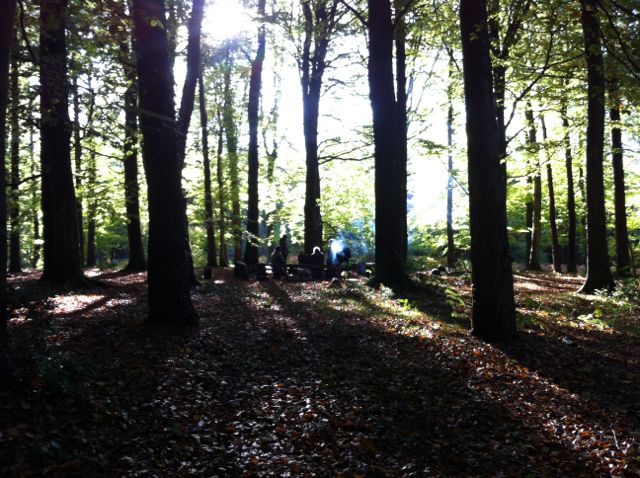
Adventures in the trees – planning under way
Camp fire at Hazel Hill Wood Planning is now in full swing for a Adventures in the Trees, a new project that I am excited to be involved with at Hazel Hill Wood. For this project the team at Hazel Hill Wood has teamed up with the team from Monkey Do to create two family weekends that give young people a taste for wild play in the woods.
Monkey-Do is a small non-profit social enterprise founded to promote tree climbing that runs free wild play activities for children in parks and woodlands, bringing people together with nature through play. At Hazel Hill, Alan Heeks interested in exploring how the wood can be used to prototype new ways of getting young people interested in woodland. The Adventures in the Trees weekends will bring Monkey Do’s experience of rigging aerial playgrounds to the magical woodland of Hazel Hill.
My job is to help design the event programme and to co-lead one of the weekends aimed at 7 to 13-year-olds.
More information and booking details will shortly be available through the Hazel Hill website.
Greater involvement with Hazel Hill
In 2014 I will be getting more involved with developing the programme of educational activities at Hazel Hill wood, in many ways inspired by reading George Monbiot’s ‘Feral’ last year. My role in the Adventures with Trees weekends is part of that programme. Another activity will be co-leading a conservation weekend at the wood in the Autumn. More details to follow…
Related posts