Blog

  • Excited about resource scarcity

    I just found myself getting quite excited about resource scarcity. Not the fact of depleting the earth’s resources, but that the subject is relevant to three things that I can claim to know something about: engineering, chemistry and explaining science.

    Yesterday I was doing some background research for a new teaching resource that we are exploring developing at Think Up related to resource scarcity and material choice. The resource could become part of Workshed.  The starting point for my work Michael Ashby’s book “Material and the Environment, Eco-informed Material Choice”

    All the time I was reading I was thinking how interesting it would be to create ways of explaining some of these complex and multidisciplinary issues in an engaging way – from the maths required to understand the economics of resource scarcity, through to understanding how to optimise the design for the whole life of the product.

    Here are some choice facts that struck me from the first chapter:

    – in 1930 it was estimated that the world would exhaust its stock of copper in thirty years; in 2008, the remaining reserves of copper will still estimated  to be exhausted in thirty years.

    – the global annual consumption of steel is greater than that of all other metals combined

    – the weight of wood used annually in construction is greater than the weight of steel

    – the weight of concrete consumed in construction annually exceeds the weight of all other construction materials combined.

    The book then goes into detail about the economics of resource depletion and processes for assessing the environmental impact of one material over another during the design process.

    Watch is space for teaching resources of this flavour.

  • Compressing my ‘cello

    Yesterday I compressed my ‘cello

    – that is, I turned the tuning pegs, winding up the slack in the strings and gradually started to increase their tension. At first the strings wouldn’t make any noise; and then gradually, as the tension increased, they became audible. At the same time, the wood in the main body of the ‘cello started to creak and groan, and I have to confess I became a little scared.

    I started playing the ‘cello when I was five and gave up at sixteen, finding the guitar a much more exciting prospect. During those eleven years of playing, I had given little thought to the forces that the instrument must withstand. Since then I have completed an engineering degree, and so now when I look at the fragile wooden structure I find it surprising that it should be able to resist the forces that the strings place on it.

    I remember being told that as instruments in the violin family age they improve because the effect of the tensioned strings is to compress the structure. The strings are stretched from the tuning pegs, over the bridge and loop over the bottom edge and around the sound peg, effectively squeezing the whole box together. This is in contract to a classical guitar, in which the strings stretch from the tuning pegs but stop at the bridge. When guitar strings are tightened, rather than squeezing the box together, the effect is to pull up on the bridge, effectively pulling the front off the sound box. Guitars are therefore said to decrease in quality with age.

    I learned the hard way about the physics of guitars at age fifteen when I decided to replace the nylon strings on my mother’s acoustic guitar with steel strings to create a brighter, more jangley sound. Unfortunately the only sound I got was a cracking noise just before I ripped the bridge off of the front of the instrument.

    So with that experience in mind, and some engineering under my belt, I was getting increasingly nervous as I upped the tension on my dusted-off ‘cello. The other reason why I was nervous was that until recently this ‘cello had been a collapsed bag of bits in the corner of a basement. The instrument has belonged to my Aunt. Many years ago it got consigned to the cellar, forgotten about, squashed and ultimately broken. About five years ago, it was dug out and my Dad kindly had it restored for me. My end of the bargain was that I would do a little practice now and then. The instrument was reassembled by the late Geoff Crease, the instrument mender that had supplied my first 1/8th-size ‘cello from when I was five. His parting words to me were that though fixed it remained very fragile. That was five years ago. Almost immediately the fingerboard fell off and I lost it, only it to find it again six months ago hiding in the back of the ‘cello case. It has since been stuck back on, and so it was yesterday following a trip with my Dad that I decided to give it ago.

    With all that in mind that I found it excruciating to tune the strings up those final few semitones: the strings driving the back of the finger board down on to the instruments shoulders, which in turn put the thin front and back into compression. With every turn of the screw I expected to hear that cracking noise, followed by the implosion of my fragile instrument. And so it was with great relief that the A string reached 440Hz, and I could begin playing – well, scraping.

    Since then I have managed two half-our practice sessions. My aim is  to get good enough this summer to audition in September for the Angel Orchestra, which M plays in. Whilst tuning up for me was excruciating, I am sure it will be even more so for my neighbours who will have to hear me preparing for that audition. Does anyone have a practice mute?

  • New Year’s Day – Gauguin: Maker of Myth

    M and I have been meaning to go and see the ‘Gauguin: maker of Myth‘ exhibition at the Tate Modern for some time. The reviews have been great, the main criticism the huge crowds. With the exhibition due to finish soon these crowds were only likely to get worse. On New Year’s Eve I remembered I previous NYE when we were on a skiing holiday. Fresh snow had fallen during the night and so we had set our alarm clocks painfully early on New Year’s Day to make the most of the virgin snow. We were the first people on the slopes and it was magical – well worth the effort. Inspired by this halcyon vision, I booked us in for a 10am slot at the Gauguin on New Year’s Day. It was only slightly painful and well worth it.

    The exhibition is arranged around a number of themes, such as treatment of women, or religion; and not in chronological order. For me the effect was to focus my attention not on the painting and sculpture but on the man himself – something which I imagine Gauguin would have been pleased with.

    I was moved and fascinated by a great number of the paintings- particularly in the way that the colours seem to sizzle; and in the way that some of these paintings seem to open the door to artists such as Matisse.

    But what really surprised me was the remorseless pursuit of his own agenda. Nothing (including a wife and five kids) would stop him pursuing the romantic primitive ideal that he seems to have got a flavour for at the colonial exhibitions that he visited in Paris, which eventually took him to Tahiti. And when he got there and found it not as primitive as he had hoped, he just painted what he had wanted it to look like, and spread syphilis in the process- classy.

    A very interesting exhibition and morning out. By lunchtime a Bloody Mary and a delicious veggie breakfast at Bill‘s offset the creeping return of the New Year’s hangover. Toast and curry for dinner: not a bad start to the year.

  • Hamlet at the National Theatre – what an epic!

    Today I saw Hamlet for the first time. The production that M and I went to was at the National Theatre. Perhaps I shouldn’t be so surprised, but what an epic play it is! There’s murder, deceit, revenge, love, pirates, Denmark and swash-buckling sword fights. I particularly enjoyed the way that this modern production turned the King of Denmark’s speeches into press conferences complete with press advisors and secret service guards. I also liked the mic hidden in the Bible – nice touch.

  • Belly dancing, Charleston and keepy-uppies – civic participation in action

    [youtube=http://www.youtube.com/watch?v=3gooD14xRh4&hl=en_US&fs=1&border=1]

    This morning I was delving further into Bowling Alone (more notes to follow); by this evening I found myself performing at the Charity Gala, Oak View School – part of the Loughton Festival, and the sort of charity event that this book both celebrates and of which it reports the decline.

    I had long had this evening’s dancing gig in my diary but I hadn’t really found out anything about it until I arrived. We cobbled together our routine in the car park – which provoked a few stares) and then went in for the show. I was quite astounded by how eclectic the mix was. We were preceeded by a belly dancing troupe, a folk group who sang about dismembered limbs, and a mandolin player (that we didn’t see because we were busy rehearsing our moves). Ours was the Charleston routine that we have used to tread the boards of a fair few Essex venues now; nevertheless I am glad we got that car park rehearsal in – it paid off. But the show stopper was the guy after us who did endless keepy-uppies to music. It’s amazing what hidden talents people have. The world is a better place for them!

    I won’t know what Joseph Putman says about how to reverse the decline in social and charitable events until I get to the final section of his book; I would like to think that belly dancing, Charleston and keepy-uppies have a role to play.

  • Social capital – Reading Bowling Alone No.1

    The concept of Social Capital came up during my research for Expedition Think Up Mondays. It was in the midst of a conversation about values. The individuals in that group quickly identified that they each bring the value of their personal networks to the group. On a rainy Monday a week later in Islington Central Library I explored this theme, and quickly came upon the notion of Social Capital, and Robert Putman’s highly regarded book ‘Bowling Alone – the Collapse and Revival of American Community’. The book explores the theories relating to social capital, its rise, decline and possible resurrection in America.

    The Expedition Think Up Monday programme is long finished, but understanding and growing social capital seems to be at the core of what I am doing with Think Up, the Useful Simple Trust and through my volunteer role at the Institution of Civil Engineers. I have decided therefore to read Putman’s book and log my notes here, with the hope that rearranged, with some retained and some discarded, they can help with the formulation of a vision for how these organisations could work.

    Bowling Alone – Chapter 1 Thinking about Social Change in America – notes

    Putman notes a general trend that up until the mid-sixties there was an ever increasing involvement of citizens in civic life, be it in sports and social clubs, benevolent societies or in public office; since then however, there has been a considerable decline.

    “In recent years social scientists have framed concerns about the changing character of American society in terms of the concept of “social capital”. By analogy with notions of physical capital and human capital – tools and training that enhance individual productivity – the core idea of social capital theory is that social networks have value. Just as a screwdriver (physical capital) or a college education (human capital) can increase productivity (both individual and collective), so too social contacts affect the productivity of individuals and groups.”

    Some social capital results in personal benefit, as in when any reciprocity is specific – I’ll scratch your back if you scratch mine”; more valuable to society however is generalized reciprocity: “I’ll do this for you without expecting anything specific back from you in the confident expectation that someone else will do something for me down the road.

    On reciprocity, “‘If you don’t go to somebody’s funeral, they won’t go to yours.’ – Yogi Berra”

    Frequent interaction among a society of individuals tends to cause more generalised reciprocity. [pg 21]

    Your social capital comes in many different shapes and sizes – eg sunay schools, family, internet chat groups.

    The external effects of social capital are not always good. Terrorist groups depend on social capital.

    ‘Therefore it is important to ask how the positive consequences of social capital  – mutual support, cooperation, trust, institutional effectiveness – can be maximised and the negative manifestations – sectarianism, ethnocentrism, corruption – minimized. Towards this end many different form of social capital have been distinguished.’ Pg 22

    There is a distinction between bridging capital and bonding capital.

    Bridging (Inclusive) capital

    Outward looking and encompassing people across diverse social cleavages. Eg. civil rights movement, youth service groups.

    Good for establishing specific reciprocity and mobilizing solidarity.

    A socialogical superglue

    Good for getting ahead

    Bonding (exclusive) capital

    By choice of necessity, inward looking and tend to reinforce exlcusive identities and homogeneous groups. Eg Ethnic fraternal organisations, country clubs.

    Better for linking external assets for information diffusion.

    A socialogical WD40

    Good for getting by

    Many people bond in some dimensions (class, race) and bridge in others.

    Putman’s maxim for evidence in his book is similar to the jounralist’s two source rule: never report anything unless two independent sources confirm it.

    The last page of the chapter reveals the inspiration for the books name: two people from quite different socio-economic backgrounds come into contact with one-another through a bowling team. The aquaintance leads to the younger of the two offering to give his kidney to the older of the two who has been on a waiting list for three years.

    Comments

    The Useful Simple Trust exists to blaze a trail in the integrated, intelligent and humane provision of the human environment. Freed from the traditional contraints of serving the aquisition of financial capital, the beneficiaries should be look at (and already are, although not necessarily framed in these terms) look at what social capital they have between them, and look to unlock and stimulate the social capital.  One idea for Think Up in this instance is to run an event that helps everyone realise our collective social capital, and explore what good we can do with it, and examine how we can grow it.

    At first sight, the Institution of Civil Engineers is an organisation that consolidates bonding capital but that wants to create bridging capital. This very concise observation I feel help me shape my input into the ICE London Region’s strategic direction.

  • Touring the Capital with ICE President Paul Jowitt

    Article written for the ICE London’s newsletter in my capacity as Chair of the London Graduates and Students.

    Touring the Capital with ICE President Paul Jowitt

    ICE President Paul Jowitt’s visit to the London Region.

    At the beginning of March I was invited to tour the Capital with ICE President Paul Jowitt. The day long tour was his formal visit to the London Region. I always find the President’s visit to the London Region a funny thing because the President inevitably spends a large portion of his time in the area anyway; nevertheless the President’s visit is intended to be the time at which he or she is formally given a tour of the London Region to hear about the work that this region of the ICE has been up to, as well as to find out about the engineering projects taking shape at the moment. The story of the day was two-fold: great engineering works, and great work being carried out by the ICE London Region volunteers and staff.

    The day started with a tour of the Olympic Site. We met at the View Tube, the Olympic Park’s luminous visitor centre from where all the main stadia can be seen whilst munching on the most up-market breakfast butty (read ciabatta) in town. Touring the site in a bus, our tour guides went to great lengths to tell the story of the engineering that we couldn’t see: the park’s extensive infrastructure and enabling works, which were up for an award at the evening’s ICE Merit Awards.

    A sprint across town took us to the BBC for lunchtime where we met a group teenagers taking part in an ICE/BBC/Collaboration. The group had been filming interviews with members of the public about Crossrail. We joined them while they were making edits to their films in the BBC’s edit suite designed specifically for school groups. All were amazed by just how the students came alive on camera. One participant didn’t realise that he had managed to coller former Controller of BBC One Alan Yentob into doing an interview. That same student said to me later that it had been the best day of his life. Full credit then to Susan Clements at the ICE who had put this event together.

    After lunch in the notorious BBC canteen (do people still make jokes about it? If they do, I don’t see why: it was at least as upmarket as the view tube), another sprint took us back to ICE Headquarters for the President’s meeting with representatives from the ICE London’s Graduate and Students Committee. The session, organised by G&S Vice Chair Kiran Gowda, focused international development, one of the President’s special interest topics for the year, and the role that graduates and students can take in development. The session was a discussion between experts from the field including representatives from Engineers Without Borders and Practical Action, and graduates and students who had secured their place by writing in beforehand with questions that they would like to ask.

    The finale to the day was the ICE London Merit Awards, held at the London Transport Museum. The museum made for an exciting venue. This high-profile event celebrated the best of the capital’s recent engineering. Of course the Shards and the Olympic Parks of the line-up did very well – impressive engineering that deserves celebrating – but I was especially glad to see the work of council engineers being celebrated. The judges gave a special award to a small group of local authority engineers who had improved the pedestrian spaces in Woolwich town centre – as important, if not more so, than than structural gymnastics of sky scrapers.

    All in all a fascinating, enjoyable and thoroughly exhausting day. A big thank you to Miranda and her team for putting together such a great programme of events.

  • An ode to my bookmark

    It slipped away from between the pages as I pushed my way down Oxford Street. It was a present, given to me by my house mate Rose. At that time in 2002 we were house mates while teaching in the States. Rose had been on a trip to Atlanta and brought me back the long oval almost fish-like metal bookmark. Along its body was inscribed, “nothing was ever achieved without enthusiasm”, which I took as a compliment rather than a criticism.
    In those early days of multicoloured security alerts I was held for half an hour at Newark airport while the security staff debated whether or not it could be a terrorising implement.

    It has parted the pages of many books, and has been lost and found many a time. But this time I fear it is gone forever. Goodbye old friend. I hope you are picked up and used by someone else and are not swept up to an early grave.

  • Frank Auerbach: London Building Sites 1952-1962

    Frank Auerbach: London Building Sites 1952-1962

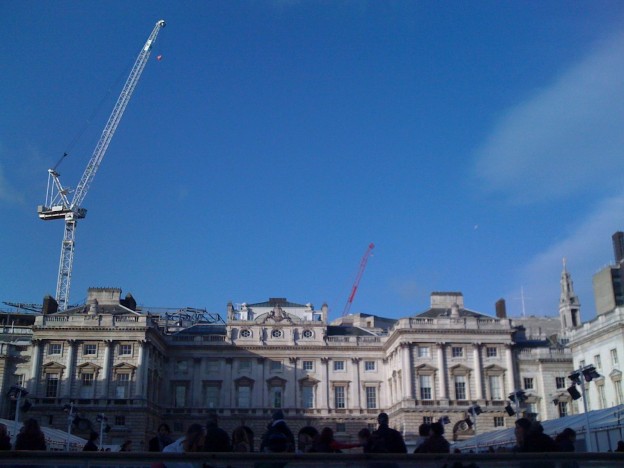
    This afternoon M took me as part of my Christmas present to the Courtauld Gallery to see the exhibition  ‘Frank Auerbach: London Building Sites 1952-1962. Quite how I have managed to live in London and work in the built-environment sector all these years without ever having taken a look at the Courtauld I just don’t know.

    This collection of Auerbach’s work explores the striking and immense construction sites to be found in post-war London. But unlike the clean-cut lines of the modern architecture that rose from the sites, Auerbach’s work is all about the excavations. This is an artist that is painting the world of the civil engineer: the deep excavations for the Shell Building on the Southbank, the basement for the John Lewis headquarters on Oxford Street, the girders of One New Change adjacent to St Paul’s.

    Auerbach layers the paint on in spades – up to an inch thick in some works. This is the result of repeatedly reapplying the paint and reworking each piece. The result is a rich texture that evokes the physicality of the building site. The walls ooze and seem almost to weep water; you can almost smell the unearthed depths. The images have been rendered and rerendered so many times on the same canvas that the original image is almost completely obscured and is only identifiable by reference to the preparatory sketches that accompany some of the works. But as a friend put it, you can get so much more out of the paintings but reflecting on the sensations they evoke rather than trying to pick out any particular detail. The reworking of the paint makes a striking resemblance to the movement of materials on site.

    “Through his labours with paint, Auerback vividly translated the chasms of mud, shored-up earth and equipment into works which express the creation and distruction inherent in London’s post-war building sites” – exhibition introduction

    ‘Building site near St. Paul’s: winter’ situates the observer inside the construction site of One New Change, a building which has since been redemolished and is currently being rebuilt again. Unlike many images of the cathedral painted during the war in which the dome is seen to rise above the flames of the Blitz, in this painting St Paul’s cowers away in the corner submitting to this new architecture.

    ‘Shell Building Site: from the Festival Hall’ is one of set of works peering into the excavations for London’s first skyscraper. What’s struck me about these paintings is that while these are images of the construction of London’s modern era buildings, the viewer could be looking at a  site centuries earlier – medieval even.

    Probably most inspirational however was the collection of quick hand sketch studies of the sites that feature in some of the works. The lines are very simple but very powerful. Over the last two years I have been on a couple of building drawing classes, and have sketched many buildings: sketches that are about a finished product. But these works are much more about the process than the result. 50 years later another gaping hole has opened up on Oxford Street, a building demolished by developers rather than bombs. I find myself reaching for my sketchbook…

  • In the can

    In the can: the Useful Simple Trust launch film. I don’t quite remember how I got briefed to make this film. It probably went something along the lines of:
    “the launch should have a cinema off to the side- maybe the Smallest Cinema in the World. And we should get Oli to make a film to go in it about things that are Useful and Simple”

    Over the year I have been involved with making a film about Think Up Mondays. It turns out that making fly-on-the-wall documentaries is difficult- it’s hard to get people to say the right thing! It’s also difficult to get high quality images from the poor camera that we’ve been using. And it’s not cost effective to edit at work. So we got a producer-director in to develop the concept for a number of films with the intention that he will help to a greater or lesser extent produce them. It was about this time that the above conversation was had about making a film for the launch of the trust.

    And so last Monday I met Caius to choose locations: Primrose Hill, the Regent’s Canal by Camden Lock, Chalk Farm Tube and in the print room at Thomas Matthews.

    On Tuesday we filmed the majority of the small clips where people talk about useful or simple things. For the shoot we had both Caius and a cameraman, Mike. It was really interesting to see how the two of them composed shots, as well as how they lit them. Some people just reeled off their lines smoothly- others needed quite a few takes. I really enjoyed writing their lines with them. It’s much better to see how something sounds when someone says it rather than trying to judge the words on paper. With the clocks having gone back the weekend before, we ran out of light surprisingly quickly. We filmed the last few people in the print studio. By the end of the day we’d got nine people in film.

    On Wednesday we filmed Ed’s commentary, which originally didn’t feature in the film. It’s only when I realised that there would be no formal
    announcement at the launch that the need to put some explanation into the film became apparent. Whils at the time this felt like quite a shift in the film’s feel, it also gave the film a raison d’être. In the end the extra day we booked to film Ed was invaluable for assembling enough footage for the film.
    Ed is an old hand at TV filming and he has worked with Caius before and so it was interesting to see the two work together to develop a dialogue and then film it: the greatest contribution in terms of camera time captured in the shortest time. Ed effectively got his lines right first time, but Caius always seem to ask for a second take- just for luck. With hindsight, these second takes were always more relaxed and usually used in the final edit rather than the first take.

    Persuading Alex to film a take holding a worm was not as challenging as I thought it might be. Clement’s take was TV gold- by far the best bit of the film. The low-light of the filming was having to traipse out to Chiswick to hire the turntable used in the filming of the useful simple objects but the results were worth it.

    And so to today when I joined Caius at the editing suite where he has been working with an editor to cut the film. I received a rough cut after one day of editing which I was nervous to watch. I showed it to Chris today and the list of changes was enormous. I didn’t know how we would get them all done. And the most challenging of all was to find a new sound track. Conscience that I only had an hour to trawl the whole of music for a tune I was relieved when Chris came up trumps with a sort of Calypso jazz guitar number. Compared with the twelve bar blues we had before, it gives the whole thing a lift.

    See the finished article on the news part of usefulsimple.co.uk

  • Joint Best Loser

    NCE Grad of the year cover

    Apparently it was too close to call. The judges deliberated for three hours as to which of the six shortlisted finalists should be given the prestigious title of NCE Graduate of the Year 2008. In the end, the very deserving winner was Emma Kent and Eiffelover was relegated to joint runner up: i.e. Joint Best Loser – which has all the advantages of being a finalist without the obligations of being the winner. So congratulations to the winner, thanks to the NCE, and thank you to the judges, who, through their choice, allowed me to retain my anonymity when shopping in the supermarket.

  • The Smallest Cinema in the World

    Opening of the Smallest Cinema in the World

    The Smallest Cinema in the World is now open. The Cinema, conceived by artist Annika Eriksson as a venue for films that she is making about Regent’s Park, was designed by a team from Hopkins Architects and Expedition Engineering. The Cinema is mobile so that visitors will have to penetrate deep into the park to find it.

    Expedition’s Blog about the Cinema

    Expedition Engineering

    Hopkins Architects

  • Do Schools Kill Creativity?

    This videocast by Sir Ken Robinson is from the TED series.

  • Other mobile structures in London this summer

    The Smallest Cinema in the World will be a mobile structure. It will be towed to different locations in Regent’s Park throughout the summer. This is possible because the base of the cinema, hidden behind those beautiful shells, is a trailer.

    I want to compile a list of other mobile  or demountable structures that will be in London this summer. I will start the ball rolling with:

     Tonkin Liu’s signature pavilion for this year’s London Festival of Architecture.

  • Richard Rogers Exhibition – Pompidou centre

    The Richard Rogers exhibition at the Pompidou centre is now over. I went once and meant to go back as there was so much to take in (and I seem to get exhibition fatigue after about an hour and a half) but alas I didn’t get the chance.

    Highlights were the 1:2 scale bright pink models of one of the Heathrow T5 connections, the exquisite 3d-printed model of the Barcelona Bullring and the original competition drawings for the Pompidou – how apt to see them in the finished building.

    A few belated few pickies then:-

    Antwerp Law Courts
    Antwerp Law Courts

    3D Print of Barcelona Bullring
    3D Print of Barcelona Bullring

    Credits
    Credits

  • A few quotes about cities

    I am currently preparing a presentation about the density of cities and in particular, how housing should be organised. Here are a some snippets gathered here for my research…

    From Rogers’ ‘Cities for a Small Planet

    (Rogers and Gumuchdjian, 1997, Faber)

    “To being our position-fixing aboard our Spacesip Earth wemust first acknowledge that the abundance of immediately consumable, obviously disarable or utterly essential resources have been sufficient until now to allow us to carry on despite our ignorance. Being eventually exhaustible and spoilable, they have been adequate only up to this critical moment. This cushion-for-error of humanity’s survival and growth up to now was apparently provided just as a bird inside of the egg is provided with liquid nutriment to develop it to a certain point” Buckminster Fuller, Operation Manual for Planet Earth (Pg1/1)

     ”We will leave this city not less but greater, etter and more beautiful than it was left to us” – Athenian oath pledged by new citizens (Pg 1/16)

  • Hello St.Pancras

    platform-shot.jpg

    For all the publicity in London about the opening of the new Eurostar terminal at St Pancras, passengers leaving Paris on its inaugural day wouldn’t have been any the wiser. The lack of Parisian interest in the new London terminal was underlined by the ticket prices: while it would have cost me over £100 to book a place on a train leaving St.Pancras that day, the cost of a ticket in the other direction was just £29! I can forgive the lack of excitement from that end of the line however. When it comes to high speed train networks, France’s is in its late twenties whilst Britain’s is still teething.

    concourse-shot.jpg

    Until yesterday, once the tunnel had been crossed and England reached, passengers were treated to a short stretch of tantalizing high-speed rail (the first part of the new link has been in use for some time now) before the trains slowed to a dismal trundle on the old line. Well, no more. Unfortunately it was dark so I did not get to see all that pristine Kent countryside that had seen routes for the line changed so many times. Before I knew it, a tunnel under the Thames, then we appeared to be over-ground and then back under again. We popped up for air again at what I guess was the building site for Stratford International before tunneling our way under North London. I remember five years ago a friend of mine living in Highbury had complained of rumbling under his basement flat for a period of about a week or so. He found out, from the council I believe, that those noises had been the tunnel digging machines digging those very tunnels that I was zooming through significantly faster.

    kissing-shot.jpg

    The train popped of the ground one last time and we were cruising into the magnificently lit train station. Words do not do justice to what an amazing site the new station is. Passengers off the train for the first time on these platforms walked in eerie gob-smacked silence. The train shed, with its arches of ‘heritage Barlow blue’ which soar over the tracks to support 18 000 panes of self cleaning glass, makes for quite a destination. Indeed there were plenty of people there who had just come for the opening. At the end of the platforms they posed for photos beneath the 9m tall sculpture of a couple kissing. Europe’s longest champagne bar was not long enough to accommodate the masses who came to toast the new station.

    longest-champagne-bar.jpg

    I was grabbed for an interview by BBC Radio London who were broadcasting live from the concourse. I think I ticked a few of their boxes: not only had I just stepped off a train from Paris, but I was an enthusing engineer (and, as a bonus, someone whose father had arranged the medley of French songs played that afternoon by the LSO Brass section as part of the opening celebrations). On air, I was asked about how long it must have taken to paint the roof, a question to which I had no answer but assured them that it must take less time than that for the Forth Rail Bridge.

    ensemble.jpg

    For me, St Pancras represents the first completed major engineering project university colleagues of mine have been involved with during their summer placements. St Pancras celebrates the engineering of a bygone era, is a fine example of how old can become new, and puts international rail travel back into the national consciousness. Not a bad start!

    family-shot.jpg

  • Au revoir Waterloo

    waterloo-sunset.jpg
    Last Tuesday evening I bid farewell to Waterloo International, the last day that Eurostar will serve this station before it transfers to St Pancras ‘in the (other) heart of London’. Before I even arrived I had fears that the Eurostar staff had packed up and gone as all the signs directing travelers from the Underground up to the terminal had already been whited out. How wrong I was. I arrived on the main station concourse to the sound of live music and the sight of dazzling lights. In the sunken entrance level to the Eurostar terminal, a stage had been set up and a band were playing, none too aptly, “Waterloo Sunset”.

    I am happy to admit that I am a station spotter and have long been. It is cooler than being a train spotter as you get to talk about architecture, your subject doesn’t move so you don’t have to stand their waiting for it, there are plenty of food shops so no packed lunches required, and you can wear any clothes you like. This last advantage makes the station spotter hard to spot. I have blended in all these years and have simply thought that I was alone in my pursuit, unaware that other station spotters were all around me. That is until that evening when they showed their true colours and, in droves, they headed down to Waterloo International to wish it farewell.

    projection.jpg

    The police had crowd control measures in place to stop people pushing into the sunken entrance area. If your name wasn’t on the list (read, if you didn’t have a ticket) you weren’t getting in. By the time I got in, the show was wrapping up, leaving only video footage of the new station projected onto the wall. It felt like mass train station hysteria; one woman had a tear in her eye. Staff stood around beaming, journalists were interviewing. With all the publicity for the new St. Pancras terminal, international train travel has recaptured the public’s imagination. But from this train station 81,891,738 travelers over the last thirteen years have already trained it, internationally. And so one can understand people being sad to see it go.

    But go where exactly? It is all very well to wish a station farewell but it is not going anywhere. What are they going to do with it? Scuttle it? The plan as I understand it is to make the platforms available for comunter trains to use. But what of the long arrival and departure concourses? When I was twelve or so, I saw an architectural model of the terminal with it’s snake-like blue roof. It is hard to believe that this structure will now lie largely obsolete.

    The party was over on the other side of security (the real bouncers). The place has felt tatty for a while now. I can’t imagine the maintenance budget has been kept up in recent months. Shops lay half empty of stock which was annoying as I badly wanted an adaptor. There were girls handing out free cake. Just like at the end of a party.

    hauptbahnhoff.jpg

    The squashed arch roof of the Hauptbahnhof in Berlin

    I rode the escalator up to the platforms beneath their wonderful blue roof. This Grimshaw structure arches over the three platforms. Like that of the Hauptbahnhof (photo above) in Berlin the curving roof is made from a squashed arch which means that the roof in both Waterloo and at the Hauptbahnhof can cover the tracks without having to rise to high. By contrast the un-squashed arch of St Pancras’ roof soars high above the cityscape. Squashing the arch induces bending in the structure. In both cases the structure follows the exact form of the bending moment diagram giving a very pure structural aesthetic. At the Hauptbahnhof the arch is four-pinned and symmetric. At Waterloo, the designers chopped a third off this symmetric arch, giving it its asymmetric shape.

    final-departure.jpg

    With the fanfare far behind, I boarded the train and as we pulled out was reminded that it was not the station that was the problem but the line. As the train bumps through Vauxhall, the carriages bottom-out their suspension. We creaked round a sharp left turn and then screeched through Brixton, presumably deafening those on the platform. By Herne Hill, the train slowed further to skateboard speed. However, after forty minutes of this bumping and grinding, a reminder of what the new route will bring, as the the Eurostar joins the already-open section of high speed track and accelerates towards France.

    And so Waterloo must close. I am sure that station spotters such as myself will get over it soon enough. The start of services to St Pancras, for example, might offer a suitable distraction. With this opening I am certain that a whole new generation of station spotters will be inspired into being

  • Iran diaries* – the omelette hall of fame

    Istanbul

    Every omelette* has a story to tell. The first omelette was in Istanbul. It was on a Wednesday morning, having just arrived by train by a round about route from Paris. I was due to be meeting Dan outside the Agia Sofia mosque at some point in the afternoon, but didn’t feel like sightseeing in between, so I installed myself in front of a tiny street-corner cafe and killed three hours explaining to the owner that I was vegetarian using freshly garnered phrases in Turkish.

    nadiri.jpg

    Omelette number two was rustled up in Coffee Nadiri. After spending our first night in Tehran in a soulless 4 star hotel, we relocated to a much more friendly place down the road, hotel Nadiri. During afternoons and evenings, the tea room underneath is humming with young people. It is a pleasant respite from Tehran’s bustling streets. But if you are looking for a dose of coffee before noon then is to the sister establishment Coffee Nadiri in an alley around the corner that you must go. It is in this small tiled room that we first saw an omelette cooking technique that we would see all over Iran. Omelette was apparently the only foodstuff on Coffee Nadiri’s menu, and the smart khaki-trousered proprietor had all the components and tools laid out before him. Arriving at opening time, as we did, we got to see the chef/manager’s entire routine. After sweeping out the tiled floors and feeding the budgie, the delicious corrugated bread is delivered. The tea samovars are prepared (Dan will surely write his own post about the tea routine), tomatoes are diced and onions are chopped and the cooking starts. Into an aluminum pan goes butter, the eggs and the tomatoes. The pan is tossed about using a spanner and then when the concoction is just ready, the hot pan is put on a tray with a hunk of delicious bread. Simple but very tasty.

    gorgon.jpg

    Omelette number three was out East. We had arrived in Gorgon and felt a long way off the tourist track. We had found the town’s bazaar and over the road a tiny cafe with a spiral staircase up to a balcony overlooking the market. By now we had our Persian ordering phrases down to a T, so to speak, and a tomato ‘kuku’ was sent up to us. Here, the same delicious corrugated bread, but this time accompanied by some raw onion. Eating the onion was a mistake – I didn’t speak to a girl for almost a week!

    katys.jpg

    Omelette number four was part of a wonderful spread cooked up for us by Katy’s mother. We had met Katy and her family on the train down from Istanbul and they had invited us to spend several days with them in their home city Shahrud. We took them up on the offer, and Katy’s mum had plenty of time to cook up an unending supply of vegetarian food to expand our stomachs. The omelette in this spead is vegetable flavoured and situated over to the left. In the middle is a leeky rice dish. It is cooked in a butter-lined pan in the oven so that the outside forms a tasty crust. The whole lot is turned over when served up. Bottom left is a soft flat bread. It appears that when we crossed the mountains between Gorgon and Shahrud, the corrugated bread got left behind. Just off to the right is my favourite iranian dish, kashka bademjum. Bademjum is aubergine, and kashka appears to be untranslatable but available in Iranian shops in London I am told. Also of note is the bowl of green leaves at the top, made up entirely of fresh herbs. And in the jug at the top right, doukh, a sour yoghurt drink. We stayed with Katy for three days, and each mealtime, a spread of these proportions was unveiled. Quite incredible!

    dads-hotel.jpg

    Omelette number four in this hall of fame was found in a posh hotel in Yazd. I say found because it took us a long time to track one down. We had been up early touring this extraordinary desert town’s streets before the tourist hoards hit and were suddenly hit by a burning hunger. But none of the restaurants we found would sell us anything vegetarian. We were directed down the street to a breakfast place that looked like it would never arrive. In the end we gave up and walked into the brand new and completely empty Hotel Dad. We asked the receptionist if an omelette could be prepared for us even though we weren’t guests. They were only to happy to pamper us and direct us to this enormous and empty dining room. There we sat for half an hour ( I am sure that they were waiting for the eggs to be laid ) while at least five different waiters brought out drinks and bits of cutlery one by one. Eventually, our food arrived, but rather than the queen of omelets that we had been expecting, a fired egg in tomato sauce arrived. I would say I was a little disappointed not to score an omelette but it was the tastiest fried egg in tomato sauce that I have ever had.

    budapest.jpg

    Omelette number five signalled our return to Europe. I had tried to return to the cafe in Istanbul where I had spent three hours ordering my meal last time. This time I tried to speed things up by showing the man a picture on my camera of the omelette that he had cooked me four weeks before, but he just didn’t get it and kept trying to take a photo of me instead. So it was that we had arrived in Budapest after two days of train through Bulgaria and Romania and were pretty desperate for an egg fix. Budapest being the train hub that it is, I had past through the city several times on my travels and without a map, I have always been able to find my way through the back streets to this luxurious breakfast place. That morning was no exception, and in travel-grimey clothes we sat amongst the well groomed and ate an omelette that must have cost more than all the omelettes we had in Iran combined.

    zurich.jpg

    Omelette number six was a rather sad affair. Not only was it on the last day of our trip, in Zurich, it was also rubbish. Just look at the bread! Give me Coffee Nadiri any day of the week!

    *Being a vegetarian traveller in Iran is not impossible but it is not either. Omelette was about the best source of protein we could lay our hands on. Hence the obsession.

    *posts about will also appear on the blog Tehran Taxi which we will soon have underway

  • It’s not just architects who make great buildings

    article3.jpgOver the last couple of weeks the Guardian has been publishing their Great Modern Buildings pullout. In each issue, there are photos, blue prints and articles about the structure of the day. The articles go into some depth about the architects, but the engineers seem to have been forgotten. In the case of the Pompidou centre, who’s design has as much to do with the structural engineer Peter Rice as it does to do with the architects Renzo Piano and Richard Rogers, the omission of the engineer was the subject of a column today in the Guardian co-authored Rice’s son Kieran who is President of RFR, the company that the late Rice senior cofounded.

    I think it is great that the Guardian is championning some great pieces of design in these daily supliments. I only wish that they would also champion the designers.

  • Moet et Chandon vs Mercier

    p1010738.jpg
    This weekend I took a visit to Eperney in Champagne where I found many of the caves that produce that region’s local tipple. I went on a tour of two champagne houses, Moët et Chandon and Mercier. During a visit to the first, we were assured of Moët’s credentials with stories of the fonder’s patronage by Napoleon I along with other impressive customers. We were led down into the wine caves, 25m underground and some 31km of them dug by hand into the chalk beneath the beautiful buildings above. Tipsy after a dégustation hosted by black clad experts, we were lead upstairs to the boutique where, surrounded by posters of the uber-glamourous drinking Moet, we were subliminally persuaded to buy champagne in bottles with unpronounceable names.

    p1010723.jpg

    Then it was up the road to Mercier’s altogether less stuffy-looking building. If Mr Moët was the Wright brothers of champagne (in an incredible 2 for 1 offer) – making champagne in the early days, then Mr Mercier was the Richard Branson, joining the scene much later in the second half of the 19th century, but making waves for himself much later using clever marketing. He commissioned the Lumière brothers to make was to be the world’s first commercial. In another act of embracing new technology, he invited the willing and the curious at the Great Exhibition of 1889 to taste his brew while floating high over Paris in a tethered hot air balloon. But it was to be his 200,000 bottle barrel that stole the show. This enormous construction which took over ten years to build (and presumably to fill!). It was dragged to Paris by 28 oxen, requiring five bridges along the route to be strengthened and the purchase and demolition of several houses in order to make way. At the show, Mercier’s enormous barrel was a huge success, and he would have one the first place medal had it not been for a certain Mr Eiffel and his tower.

    p1010730.jpg

    Mercier has long been pushing up grape vines but his cellars still have that technological flare: whereas the Moët tout guide was keen to point out the painstakingly laborious process of turning the bottles of fermenting champagne by hand, on display at Mercier’s was the cunning robot that did all this turning automatically; and rather than walking the galleries we were driven round in a lazer guided train. Now to my monochrome palette, the champagne at both houses tastes pretty similar (I’m no expert and I certainly couldn’t afford the bottles where the difference in taste starts to become noticeable) but Mercier’s trail blazing approach and embrace of modern technology caught my attention far more than Moët’s ‘natural ascendancy’ approach. And besides, who can beat a laser-guided train?

  • Finishing my course – travelling to Iran by train

    Since my last post, I have been rather busy!  The lack of posts on this blog since then can be attributed in part to the large amount of work my final year project has required in order to get it finished.  The project has changed direction many times along the way and even the end point of the project had not been set until my final week at the company where I had my placement.  But as of Friday it has all been wrapped up. 

    But it hasn’t all been work.  In between we have managed visits to Brittany’s gale-force wind-lashed coast, Bratislava and Alsace as well as to marriages in the UK and Madrid.

    And now the summer beckons.  My plan is to travel with a friend from Paris to Iran and back by train.  The route takes me from Paris via Strasbourg to Zurich and then overnight to Zagreb and then Belgrade.  The next leg from Belgrade through Macedonia brings me to northern Greece on the second day.  After a couple of days rest, the overnight train takes me to Istanbul where I will be meeting Dan for our onward journey across the Bosporous and into Asia.  The direct train from Istanbul to Tehran takes three days.  After two days crossing Turkey, the train reaches lake Van in the east of the country where we must board a boat across to the other shore where we pick up the train again down to the Iranian capital. 

    Once in Iran, we will spend three weeks visiting the major cities of Tehran, Isphahan, Shiraz, Yazd and Mashad before heading back along the Caspian Sea coast back into Turkey and back along the Black Sea coast to Istanbul and back through Europe.  

    So many people have asked me why Iran? The trip itself is the end product of an itinerary that looked very different at the beginning of the year.  But my interest in Iran is manyfold.   All I have read about the country tells me that it is a beautiful place with some unmissable places to visit. Iranian friends I have told about the visit are at pains to emphasise just how well we will be welcomed.  And yet, this impression of the country is a far cry from that held by those who rely on western media for any ideas about the country.  This difference in points of view is one of the reasons that I want to go to Iran and experience the country and its hospitality myself.

    And why go by train?  Well, apart from the enormous carbon footprint associated with flying, I find it hard to imagine going by any other means.  The journey from Europe to Iran by land is one that dates back to the silk route.  Travelling by land is a way of feeling physically connected to a land that in the press feels far away.  Ok, so six days of travel is not exactly close, but these trains do go slowly!  And I am looking forward to seeing how the landscape, climate, architecture, people and language change along the way.  Flying can’t give you that. 

    I am also lucky that I have the time to make such a journey.   The website seat61 and Thomas Cook international rail timetable are in part responsible for my choosing this route.  It also turns out that I am taking the same route as that described in Paul Theroux’s Great Railway Bazaar in which he describes his journey to and from Singapore by train.  He made his journey in the 1970s.  Since then, a lot has changed along his route, and I look forward to comparing notes.

    I will be writing up my journey on this website upon my return, and will be publishing it on this blog.

  • Metro entrance – TGV promotion on stilts

    Going home from work is always such a pleasure when it’s such a beautiful day…

    guimard.jpg

    On my way home through Gare de Lyon I saw three stilt walkers dancing avant-garde style to music played by a live saxophonist. They were all wearing green and white clothes, the colours of the new TGV est eurpoéen. I really wish I could have been at the marketing meeting when they came up with this idea.

    stilts.jpg

  • Things to do in Paris ⋕1: Go to Lyon

    This Monday I did “le pont”, which is when French employers give their staff an extra day off between the weekend and a bank holiday, in this case, on a Tuesday. But rather than have a lie in I put myself on the 06h50 train to Lyon for a day in a city that I have wanted to visit for many years. France‘s first TGV line was built between Paris and Lyon linking France‘s two largest centres of population in just under two hours.

    lyon-st-exupery0003.jpg

    I had two sites of design interest on my wish list. The first is the awe-inspiring Calatrava -designed TGV station at St.Exupery, Lyon‘s airport. Trains running directly to the centre of Lyon do not in fact stop here as St Exupery is on the branch that bypasses the city and heads down to the Med; in order to get there I had to catch a train to Marseille and remember not to fall asleep. The station was conceived to fulfil three roles: as a show piece to mark the opening of the newly built TGV line to the Med, as an entrance to the airport and thirdly as a symbolic gateway to the Rhone-Alps region.

    lyon-st-exupery0002.jpg

    When I stepped off the train at 8h30, I was virtually the only person there and it felt I had the entire station in all its magnificence to myself. I took photos of the magnificent train concourse and of the arching atrium over the ticket hall, but it was only by sketching different views of the building that I was able to decompose the anthropomorphic structure and understand its underlying logic. In the end I spent the rest of the morning there and I hope you will see why from the photos that I will post over the next week.

    lyon-st-exupery0001.jpg

    I arrived in the centre of town about 13h00 with no map and no plan. I found a FNAC and bought a guide, and then made it my first task to walk up the very steep hill just next to the town centre and get an overview of the city. Lyon is built on the confluence of Soane and the Rhone rivers. The city centre is on the long spit of land known as the presque-ile which reaches out to where the two rivers eventually join. From the top I was able to see all this and beyond.

    Then it back downhill and up again in the district called Croix Rousse. In this area was based Lyon‘s formerly booming silk weaving industry. The district is full of secret passages that link streets and buildings up and down the hillside. Unfortunately there was too little time to discover any and if ever I go back, a return to this fascinating area will at the top of my list.

    lyon-opera.jpg

    Back in the centre, I positioned myself in a café in front of the Opéra de Lyon which had its extension designed by Jean Nouvelle. Unfortunately the building was closed for the bank holiday which was a shame as I would have liked to have taken a tour of the new rehearsal spaces at the top from which, the view is apparently amazing.

    Late afternoon was spent drinking coffee with a friend in the town by the town hall, followed by a tour of the campus of the Ecole Normal Supérieure. The tranquil wilderness of the glade in the middle of architect Henri Gaudin’s plan for the school makes for such a pleasant respite from the hustle and bustle of the city beyond its walls.

    As evening drew in, there was just enough time for a beer on a floating bar before the thunderstorms rolled in, forcing me to take shelter in a pizzeria opposite the central station.

    I really enjoyed my visit to Lyon. It is a city that seems charged with youthful energy and it is in the middle of a region of France that I would really like to get to know better. My visit was rathe quick, but it will serve as a good taster for when I go back, for I am sure that I will do.


  • Reducing electricity consumption in homes to become as addictive as checking your blogstats?

    blogstats1.jpg

    The UK government has recently passed new legislation requiring electricity suppliers to fit free real time electricity price monitors in homes in a plan to massively reduce electricity consommation in homes. With Britain committed to reducing its carbon emissions to 60% of 1990 levels by 2050, I am certain that this measure will go at least some way to seeing how much electricity they are wasting. Who knows, checking your consumption metre might become just as addictive as checking your blog stats (addicts, you know who you are!). Read more on the ICE website.

  • Pre-‘fab’ wooden house in Hackney

    Over the last few days the way we live, architechnophilia, and inhabit have all been covering a new pre-fab wooden house in Hackney designed by David Adjaye. Pre-fab does exactly what is says on the tin. It is PREfabricated and it allows the construction of some FABulous buildings in less time than it takes concrete to set. I remember seeing a documentary about a pair of artists who dreamt of building their own house for their retirement. In the end chose to have a house designed by a German team who specialise in pre-fab metal structures. The house arrived in pieces on a flat bed lorry and within a matter of days, a team of five or so had ratchetted the whole thing together in a latter of days (if any readers remember seeing this programme and know who they were I would be much obliged if they could share the knowledge!).

    There are quite a number of streets in Hackney with grand old Victorian semi-detached houses set back from the road, especially around London Fields and Victoria Park. Every so often however there is a house missing, presumably victims of stray second world war bombs in this area of East London. And quite often these gaps are filled with new and exciting architecture. I haven’t seen Adjaye’s house for myself, but I can well imagine it filling such a void.

    ps If anyone reading happens to be going to Hackney this weekend (I’m sure one of you will be) and happens to be passing, could they get me a picture so that I don’t have to steal somebody else’s… thanks

  • Fischli and Weiss at the Musée d’art moderne de la ville de Paris


    11_le-droit-chemin-350.jpg


    Last night I went to the brilliant and rather amusing Fischli and Weiss exhibition “Flowers and Questions” at the Musée d’art moderne de la ville de Paris. To say rather amusing is somewhat of an understatement: I spent so much time smiling, if not laughing out loud, that if ever I left one of the exhibition rooms without the corners of my mouth turned up, I was inclined to feel it was a bit boring. In fact I think this happened only once.

    This pair of artists play on our perceptions of materials and our sense of scale. One room was filled with jet black objects all apparently made from different materials: a tree trunk, a stone facia for a fireplace, a cutlery rack, a leather pouf. They were all in fact cast in rubber. More unbelievably, in another room which appeared to be an artists work shop filled with tools, rotting food, furniture, cargo pallets, razor blades, cigarette packets etc etc, I was stupefied to find out that every single object had been cast in plastic and then painstakingly painted. We were permitted to pick up a plank of “wood”. It was in fact a plank of plastic that seemed to float up with no effort. This illusionary game played with materials made apparently everyday objects unusually tactile.

    In front of two video projections is where I spent most of my time. One was the ultimate childhood dream. It showed footage of one of those chain reaction sequences that kids dream of but apparently only grown ups get to build. Something falls over, it tips something else, a bowling ball rolls down a spiral etc. Only in this system, it wasn’t a ball that was kept moving, but a flame. Paraffin flows, and catches fire, balloons burst fireworks rocket up tubes and set off detonators, fire extinguisher foam dissolves blocks of sugar cube that support a vat of chemicals on the point of tipping over and so on and so on.

    From the sublime to the ridiculous in the second video. A nature video but with our two heroes in a panda and mouse suit living out their animal existence.

    In fact, I loved it so much that I am going to go back.

    Showing in Paris until 13th May.

  • Can’t get enough of Calatrava, Hertzog and De Meuron

    Two articles on the way we live caught my attention…

    Since my final year project is well and truly rooted in the domain of tall buildings, I was interested by Calatrava’s Chicago spire

    and because, quite simply, they build beautiful buildings, cast an eye over Hertzog and de Meuron’s work in Beijing