Tag: Hazel Hill

  • Vision for a regenerative programme of forestry and building maintenance at Hazel Hill Wood

    Vision for a regenerative programme of forestry and building maintenance at Hazel Hill Wood

    This afternoon I met with two trustees of Hazel Hill Wood to develop some ideas for a funding bid to support more regenerative use of timber to maintain our off-grid buildings. I said at the end of the call I’d write up some thoughts on a what a five-year plan could look like. Here is what I wrote down – stimulated by a very thought-provoking conversation with my excellent trustee colleagues. I’m putting it here rather than on the Hazel Hill website as this is by no means policy! Just a set of ideas, captured to enable further discussion.

    Five-year vision for developing Hazel Hill as a centre for regenerative forest management and traditional construction skills.

    At Hazel Hill Wood we have a unique combination of sustainably managed forest, off-grid buildings and a charity with a mission is to use timber from the wood as part of a regenerative cycle of building repair. Our ambition is to work with these gifts to increase local biodiversity and woodland thriving, build community resilience and wellbeing of all who come into contact with the wood.

    While we reach all of these ambitions to some extent through our current charitable activities, we see the opportunity to unlock greater benefits for the ecosystem and local community by establishing the wood as a centre for learning about how timber can be used as part of a regenerative local construction material. We describe this process as regenerative because it has the potential to have zero negative externalities: harvesting timber in the right places can actually increase woodland health and biodiversity; the timber we harvest can be used to re-establish a range of historical, rural practices, including coppicing, hurdle-making, horse-drawn timber extraction and traditional green-wood construction. Training local people in using these skills can help to enhance the rural economy while helping to maintain the heritage of local buildings. And the wellbeing of all is enhanced through extended contact with the living world through nature connection. 

    To shift to this mode of operation we envisage taking three phases over five years. 

    Phase one – from seed to seedling

    In this first phase we assess the state of the current system and create some of the infrastructure to enable this new activity to happen at the wood. 

    • Forest survey – establishing the health of the ecosystem, possible timber for harvest now and possible timber for future extraction and opportunities to enhance biodiversity through timber harvest.
    • Building survey – establishing the long-term maintenance needs and priorities of our heritage timber buildings.
    • Skills survey – understanding the local skills landscape and how training at Hazel Hill wood could enhance the local economy.
    • Re-establishing connection with rural construction tradespeople.
    • Creating working area – wood seasoning shed, tools shed and outdoor classroom
    • Initiation of volunteer programme for simple construction skills using timber in the forest.
    • Initial harvest of coppiced timber
    • Initial harvest of roundwood poles for seasoning.

    Phase two – from seedling to sapling

    In this phase we increase the scale of our regenerative work, starting to work with wood harvested and seasoned in Phase one while increasing our harvest of timber from the wood. In this phase we grow our education programme around how we see the wood and the buildings as part of a continuum, a process of which we are the stewards, adapting to the needs of the ecosystem and the people who we bring here to heal and learn through connection with the living world.

    • On-going habitat creation and monitoring in areas where timber has been harvested.
    • Maintenance forestry – In order to grow trees for timber, some tree pruning needs to be done to create timber of good quality. We need to develop local skills in how to plan and carry out tree maintenance.
    • Running courses in green wood construction skills.
    • Using seasoned, sawed timber to carry out major upgrades to the structure of our heritage buildings, including new decking for the Oak House and Forest Ark.
    • Invitation to other local crafts people to run training courses at our site.
    • Growing programme of volunteer activities engaged in a range of conservation and heritage construction projects.
    • Growing education programme, offering training in the thinking behind the regenerative principles on site.

    Phase three – from sapling to tree

    In this third phase the operations are more self-sustaining. The process of continuous cover forestry is well-established in the wood, with timber harvested at a rate of 1% per year providing a steady rate of firewood and construction materials for the charity as well as surplus for sale into the local economy. The programme of rural forestry and heritage construction skills training is self-sustaining and as well as bringing in revenue for the charity, is part of the active continuous maintenance of our unique heritage buildings. The site will be well known as a demonstrator project for regenerative principles that can be replicated more widely.

  • An experiment in foundational capital

    Last year I read about foundational capital in Lean Logic. It’s the idea of the capital that systems depend upon to live. For us Earthlings it’s clean air and water, a thriving biosphere, sufficient minerals. But it can also be intangible things: trust, knowledge, peace. In an extractive economy, we seek to mine these resources and use them to create a financial surplus. This financial surplus we can then invest to invest in growth. But not growth of the foundational capital, but growth of the business. In this model the foundational capital is repeatedly depleted. This extraction works for a while so long as there remains sufficient foundational capital, but at some point the foundational capital is so reduced that it can no longer support life.

    The idea of investing financial surplus is so ingrained that it is hard to imagine alternative models. As a business owner, I feel it myself: the instinctive thing to do with any profit the business makes is to invest in growth of the business.

    But we can see an alternative approach in more traditional approaches that seek to re-noursish the growing environment with each harvest. For example, I have heard permaculture teachers talk about sharing the harvest three ways: one part for me; one part for the community; one part for the soil. That final third is left to rot on the the plant to return nutrients to the ground. Contrast this to a more extractive approach, which would harvest all the fruit, leaving the ground more depleted. More profit but less foundational capital.

    Last year I thought how could I experiment with this idea at Constructivist Ltd. A traditional business approach would be to charge clients as much as possible to run training. But that sets our aims against the aims of our clients. The more we can extract, the more profit we can make and the more our clients are depleted.

    Another way to look at things is to say that if we’ve made a profit this year it’s by charing our clients more than we needed to. What is the equivalent of returning this harvest to the ground? Well we could return the extra fees. Another approach is to use the funds to support the flourishing in some way of those organisations that are our clients, which we depend on. The latter option is easy to administer, but the bigger reason I prefer it that it isnon-financial exchange. It is specific, rather than interchangeable (non-fungible), building interconnections and therefore the capacity for feedback. It is also greater than zero-sum (a topic for another post).

    Since most of our work with clients involves direct collaboration with individuals, we decided to return the surplus to the system by running a regenerative thinking retreat at Hazel Hill Wood for this group of individuals. Much like the work done in winter by soil-plant systems – quietly, underground – this gathering deepened connections, allowed knowledge to be exchanged, repaired damage from the last season of growth. In other words, fed the foundational capital of the system we are in and set the scene for a new season of growth on a more resilient grounding.

    In regenerative design we are seeking to create thriving socio-ecological systems. By noticing foundational capital we can start to tune in to how the projects and processes we are involved with deplete or nourish foundational capital. And we can start to think about how to design systems that aim to grow this capital.

  • Restorative versus regenerative design

    Restorative and regenerative are two words I am hearing used interchangeably. Both are relevant to engineering and design. Both are approaches to design that are valuable. But they need differentiating.

    (more…)
  • Four characteristics of regenerative systems

    Four characteristics of regenerative systems

    Work on regenerative thinking progresses on all fronts. Book writing with my friend James on Monday (read his excellent blog on this process), developing regenerative practice at Hazel Hill Wood Tuesday and short-listing candidates for the Regenerative Design Lab Wednesday. I love that all of these initiatives inform each other.

    To aid all three I have synthesised my understanding of how regenerative systems operate. This framing is informed in large-part by Donnella Meadows’s book ‘Thinking in Systems’, which is helping to understand the conversations are having across all these fronts.

    (more…)
  • Start by lighting the fire

    Start by lighting the fire

    It’s the first thing we do at Hazel Hill Wood. Light the fire for everyone else. A clutch of tiny twigs, a handful of finger-thick branches, and some small logs. I can do this because other have prepared the materials.

    A year ago someone felled a tree and cut its trunk into lengths that fit the stove. Others took these logs and arranged them into seasoning stacks in the forest, where for a year or so they lose their moisture. More people have transferred the partially seasoned timber to the wood stores, where they get bone dry. Finally, someone has filled the baskets with twigs, branches and logs so that I can light it this morning.

    When the room is warm I meet people, and we talk amongst other things about how to manage the forest that provides us with this renewable source of fuel.

    There’s lots that I like about this human-natural system. Every stage is visible, which makes me much more aware of where the things I use come from. The stock levels in each of the stages are easy to monitor, providing me with feedback about how the system is operating.

    I like the long time frame. We have to make decisions now about how many trees to fell in order to meet demand in two to three years. Over an even longer time frame, we need to think about how to manage the forest to ensure there is sufficient regrowth to provide firewood in thirty years time.

    Rather than destructive, this process of carefully felling trees seems to create life: making openings in the forest canopy that form new habitats for plants, for invertebrates and the animals and birds that live on them.

    Most importantly for me, it is a brilliant example of how we can manage human-natural systems that regenerate to meet our needs with little more than the energy of the sun.

    When I start by lighting the fire, I am engaged with this human-natural system. It primes me to think, what work do I need to put into the system today to ensure it continues to regenerate.

    Photo credit: Joseph Watts

  • Sustainability is no-longer enough

    Today I am sharing more of the thinking that went into my vision question for Hazel Hill Wood: what if we became a centre for regenerative practice?

    It is my view that sustainability has been captured by mainstream industry and politics as a smokescreen for business-as-normal. We now know that our efforts to sustain our ecosystems for the benefit of future generations has not been enough and that we now beginning a process of climate and ecosystem breakdown. 

    (more…)
  • Setting a vision question rather than a vision statement

    It is my role as Chair of Hazel Hill Trust to be the ‘vision holder’ for the project. There are lots of ways you can interpret what this means. It could be to write the vision. Or it could be to facilitate the process from which the vision emerges. I have chosen a middle path, which is to ask a question.

    My question is, what if Hazel Hill Wood could become a centre for regenerative practice? The challenge I am faced with is being consultative and facilitative about longer-term decision-making at the same time as providing direction while we bring on board new Trustees and make some important operating decisions.

    Asking a question rather than providing an answer sits more comfortably with my constructivist, problem-based learning practice. Yes, I am setting a question, and that question tells us in which direction to head. But the answer gets decided by the people on the journey.

    Read my post setting out this vision question on the Hazel Hill Trust website.

  • Notes from a systems design workshop at Hazel Hill

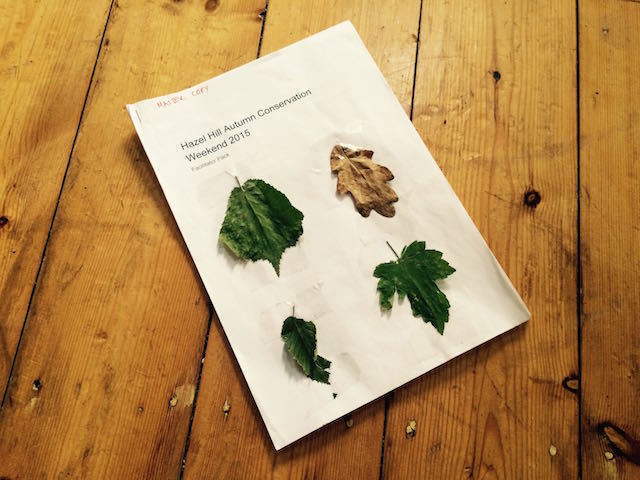
    On Saturday at the Hazel Hill Autumn Conservation weekend I ran a systems design workshop as a wet-weather activity. Here are my notes and observations from the session.

    Theatre of activity

    The wood, being a place that people travel to and the leave again, is the perfect place to get people thinking about inputs and outputs to systems. You can ask people to think about what they bring with them, what they take home and what they leave behind. You can also ask, is the system richer as a result. And, what happens to that richness?

    (more…)
  • Towards Regenerative Conceptual Design

    Towards Regenerative Conceptual Design

    I have had the great fortune of having spent three weeks in France, a good portion of it cycling. Touring is a great way to leave behind your pre-occupations and to think about the future – in my case, the themes for my training and writing in 2021-2022.

    This year, all cycle paths point towards regenerative design – design that is win-win-win for individuals, society and the planet. I hear echos here of the triple bottom line of sustainable design, but sustainability, with it’s promise to protect the environment for the benefit of future generations is no-longer enough. This is a keep-things-the-same model. But as the latest IPCC report confirms, keeping things the same will lead to the breakdown of the carefully balanced ecosystem on which we depend. What we actually need is design that builds back the abundance, diversity, complexity and resilience of the ecosystem that quite literally gives us life.

    (more…)
  • If you are stuck in the weeds, look at the ecosystem

    This morning I’m writing about how action in the context ecological crisis will sometimes feel a long way from anything to do with nature.

    I wrote this week about my reflections following reading ‘What if we stopped pretending?‘. One was that the ecological crisis will require action on many fronts to build resilience and support regeneration. On a day-to-day level, many of these actions will feel a long way from that greater cause, but it is important, I think to maintain a connection between the means and the ends.

    This week and last I have had my head in helping my colleagues at Hazel Hill Wood with providing back-up power supply to our off-grid buildings. The sorts of things that need doing are negotiating contracts with suppliers, managing resources, working with the team to set objectives, thinking about fundraising.

    All of this feels a long way from ecosystem regeneration and supporting people’s connection to nature, which are our aims for the wood, and my motivations in the project. But there is a thread that connects the two:

    (more…)
  • Human-scale chalk stream restoration.

    Human-scale chalk stream restoration.

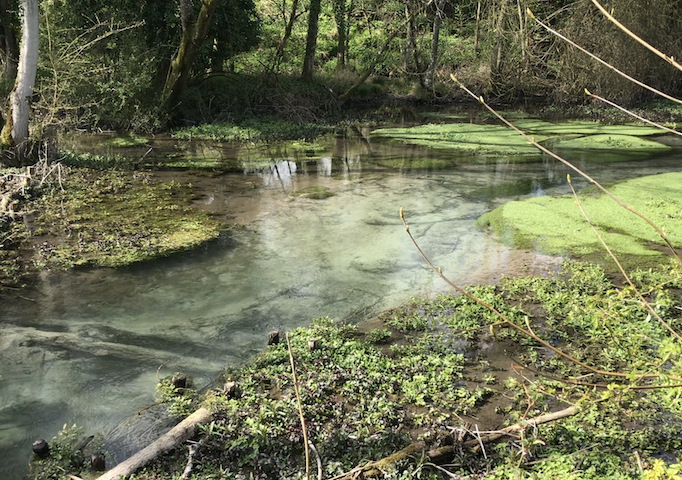
    On this afternoon’s walk we had the joy of arriving at a chalk stream. We had started high on the Ridgeway and descended quickly down through the Devil’s Punchbowl, a dry valley. And it was at the lowest point on our walk that we came upon Letcombe Brook. At this site, conservationist are working to recreate the natural conditions of a chalk stream to enable wildlife to thrive.

    (more…)
  • Connection with nature through drawing

    Connection with nature through drawing

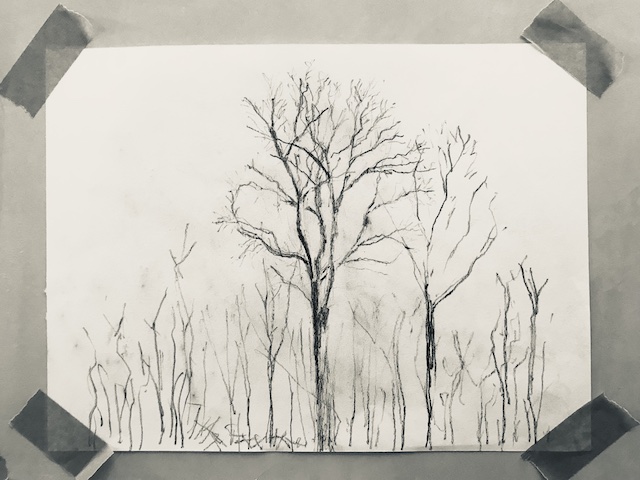
    I drew this ash tree at Hazel Hill Wood last weekend. Though it rises opposite a bench where I like to have a morning coffee, I have never paid it much attention. But doing a twenty-minute sketch I am discovering the tree. Climbing the trunk that rises without foothold for a third of its height. Noticing for the first time its rhythm – the trees spatial ordering. How one trunk becomes a thousand twigs, like a trachea transitioning to countless alveoli.

    As I draw I see a space in the canopy to the left, one that I would not have noticed otherwise. I presume it is a space left by another tree that is now fallen, on the ground but leaving its imprint in the sky.

    (more…)
  • Chamber music in the woods

    Chamber music in the woods

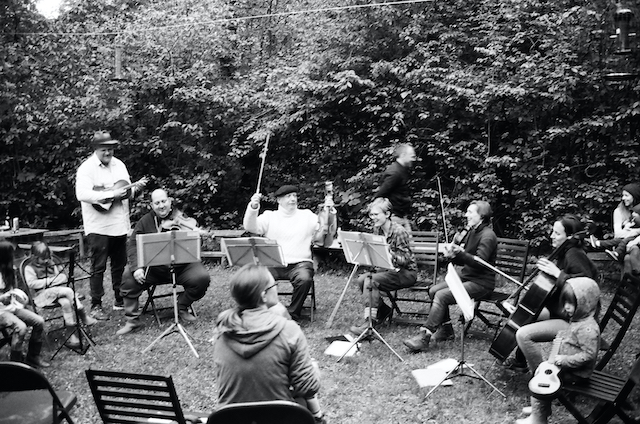
    Yesterday I was feeling particularly sad about the loss of live music during lockdown and the stories of musicians who just don’t have any work at the moment. And then, because this how my brain works, I thought, how can we put on some live chamber music at Hazel Hill Woods?

    (more…)
  • Book notes – The Hidden Life of Trees

    Book notes – The Hidden Life of Trees

    It feels right as I take on my new role at Hazel Hill Wood to read the Hidden Life of Trees. This is an evolving post based on notes I take as I read through the book.

    From the foreward: ‘The author’s deep understanding of the lives of trees, reached through decasdes of careful observation and study, reveals a world so astonishing that if you read his book, I believe that forests will become magical places for you too.’

    (more…)

  • #18 Hazel Hill Wood – Dawn chorus sonic lockdown therapy- show-notes

    #18 Hazel Hill Wood – Dawn chorus sonic lockdown therapy- show-notes

    30 minutes of uninterrupted dawn chorus Hazel Hill Wood, recorded at the end of March. Hazel Hill is woodland nature reserve and education centre helping frontline staff develop resilience and wellbeing through connection with nature. While people are prevented from visiting the woods during lockdown, the team are working on ways to bring the wood to them during lockdown. Listening suggestions:

    • Early in the morning
    • Over breakfast
    • In the background while you work
    • To clear your mind at the end of work
    • Late at night as you drift off to sleep
    (more…)
  • Olafur Eliasson at the Tate + reflections on my own work

    Olafur Eliasson at the Tate + reflections on my own work

    This week I have had the feeling that I have been struggling recently to find focus on my creative work. I have lots of projects on at the moment, and I am not satisfied that I am being able to draw a cohesive thread between them. I think this is important because I subscribe to the idea that to have impact on your work, you need to be regularly adding to it in a disciplined way – always adding momentum to the fly-wheel, as Jim Collins puts it.

    (more…)
  • Hazel vs. Hornbeam (the fate of best-laid plans)

    Hazel vs. Hornbeam (the fate of best-laid plans)


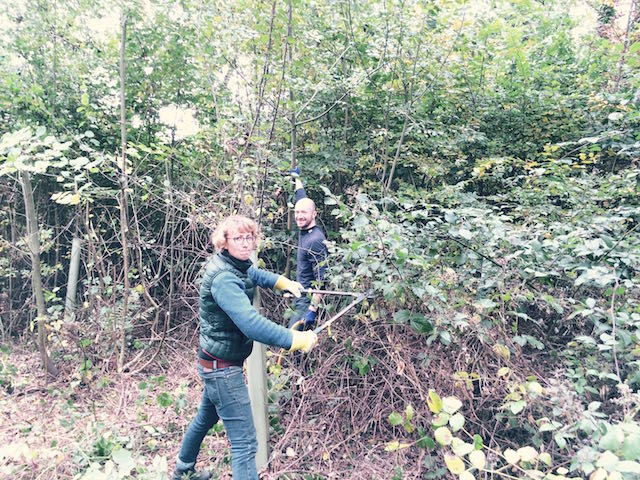
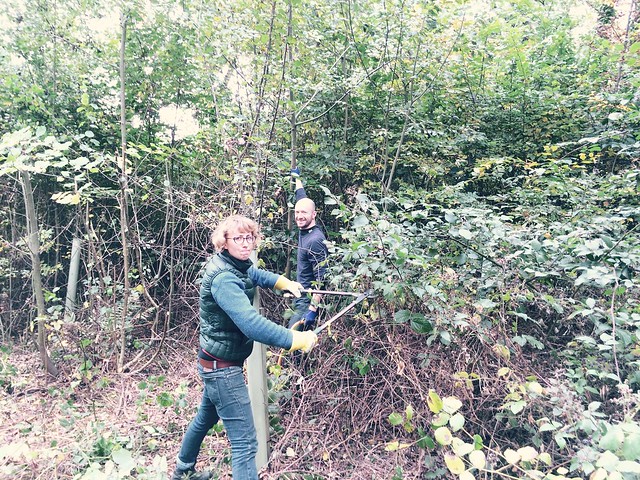
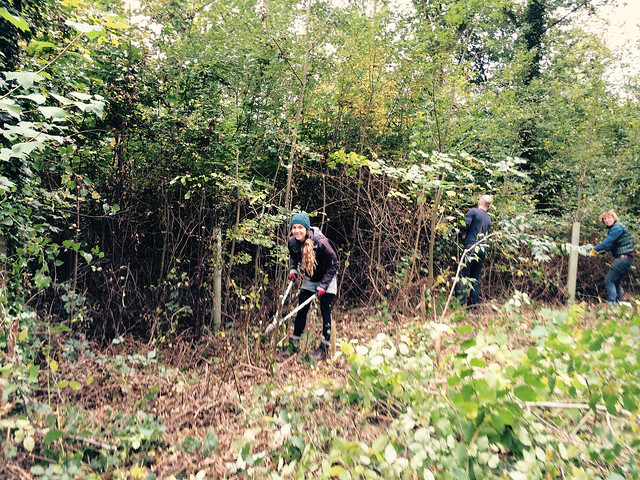
    Cutting back the Brambles at Hazel Hill Woods

    A recent weekend of conservation work Hazel Hill Woods has revealed to me another woodland analogy for the struggles of daily life, and how we might overcome them. I am calling the analogy, Hazel vs. Hornbeam (the Fate of Best-laid plans).

    It emerged when a team of us at the woods were cutting back an area of regenerating hornbeam trees in a clearing. In this patch the hornbeam had shot up to a dense crowd of 6ft-tall finger-thick stems, knitted together with a head-height mat of bramble. Our conservation aim had been to cut these back to chest height to stop them from encroaching on an important butterfly corridor through the woods.

    As we slowly cut our way into the dense thicket we started to discover small trees in protective tubes that were being crowded out by the hornbeam and strangled by the bramble. As we uncovered more hidden trees in tubes, we realised that there was a whole array of them that had once been planted. We found hazel, oak, ash, holy and blackthorn struggling to grow in their protective tubes. They had been planted on another conservation weekend years ago but had been forgotten about, and were now being smothered by the naturally regenerating growth.

    The woodland context

    There is a hundred-year plan at Hazel Hill to transform the forest ecosystem from that of a commercial wood, in which just a few species grow, into a much more biodiverse environment, which is much more likely to be resilient to changes in climate. The area in which we were working had previously been occupied by sycamore trees. This undesirable species had been cleared with a grant from the forestry commission, and in the clearing created, a range of broadleaf species had been planted (the hazel, oak and ash), along with shrubs (the holly and the blackthorn) to create ground-level growth, which had been absent in the commercial forest.

    Left to its own devices however, naturally regenerating hornbeam and bramble had quickly grown up and overtaken the planted trees. The former were on the way to winning, the battle for light, already killing some of the latter , and leaving the others struggling. In the short-run there is nothing wrong with hornbeam and bramble, but their short-term success was putting at risk the long-term resilience of the wood by preventing the development of a diverse tree species.

    Best laid plans

    For me, those broadleaf trees in their little tubes represent best laid plans that were being left unattended because of short-term factors. There are competing conservation priorities in the woods, and these planted trees had been left unattended. Our attention is the light that enables our best-laid plans to flourish. But too often we are forced to direct our attention towards short-term priorities: the deadlines that need to be met, the clothes that need to be folded, the colleagues that need to be briefed, the clients that need to be satisfied.

    In the short-term these more immediate matters flourish as they benefit from our attention, but they don’t necessarily lead us to where we want to be. As you wade into the thicket of regrowth, all is lush and green at the top, benefiting as it does from the light of the forest clearing, but underneath, all is brown – there is no diversity. Down there is where our best-laid plans languish.

    The feeling of being surrounded

    At one point, four of us were working simultaneously and in close proximity in the same thicket. Though we were probably only a few metres apart we couldn’t see each other for all the hornbeam branches and briars that surrounded us. At times, our repeated cuts didn’t seem to be making a difference. I’d turn around and the path that I had driven would have closed in behind me.

    This is what it can be like when we feel overwhelmed with matters competing for our attention. After some struggling, my strategy became to just to keep going in one direction. After a sustained, focused effort the lattice of branches and brambles would suddenly give way. A sense of being surrounded turned into a sense of direction; of liberation: I felt freer, able to pause and choose where to go next.

    Cutting back our brambles

    As I type, I still have some small scratches on my arms from cutting back the brambles. Clearing away some of the things which grab our attention can hurt. There is the pain of letting someone down, or the fear of getting into trouble. But what I noticed as I cut through barbed branches was that they fell away to nothing; untangled and trampled they lost all of their strength, freeing a way through to the trees in tubes.

    Personal conservation strategies

    Conservation work gives you time to think, and so I set my mind to thinking up strategies for protecting our best-laid plans.

    Log what you planted

    It sounds simple, but creating a map of what trees we planted where might help us to remember to tend to them every so often. During conservation weekends in which we are planting trees, getting the trees in the ground is a big achievement. It seems unnecessary to create a map of where we planted them. Surely we won’t forget? Inevitably we do. Simply noting down our plans gives us a fighting chance of remembering what we intended.

    Regular tending

    Once we know what we planted, one strategy is to make time to regularly tend our saplings. It would only take a small amount of systematic attention to keep the hornbeam and brambles in these area in check.

    Occasional clearouts

    Sometimes though, we don’t have the luxury of being able to provide these things with regular attention. The alternative is to do what we did this weekend – every so often, go in there and cut back all the distractions and bathe our best laid plans with the totality of our attention. In daily life this might amount to a digital detox. Or, for a more substantial clear out, we might consider taking what Daniel Pink calls ‘Sagmeisters’ – regular sabbaticals interspersed in our working lives.

    Get real

    Our aim wasn’t to clear out all the hornbeam and bramble. Hornbeam regeneration is a natural part of the woodland ecosystem, as are the brambles that weave their way amongst them. We just need to create a bit of space for those slower-growing but ultimately very beneficial species to establish themselves. Similarly, short-term matters are part of the humdrum of daily life – we just need to carve out enough time to give our long-term plans the attention they deserve.

    Get things established

    Ocourse, the aim of all this cutting back is to enable the hazel, ash, oak, holly and blackthorn to establish themselves. As they start to mature they can look after themselves, and the hornbeam and brambles will subside. This is the point that Steven Covey makes in his book ‘The Seven Habits of Highly Successful People’ when he talks about what happens when we prioritise the important over the urgent. If we make time for the important things, we should see the number of urgent things we need to deal with reduce.


    One day, decades after the scratches on my arms have healed, we’ll be able to sit under the shade of these broadleaf trees and know that our efforts to tend to them were worth it.

  • Choppin’, loppin’, circus and swing – notes from Hazel Hill Autumn Conservation weekend 2015

    Choppin’, loppin’, circus and swing – notes from Hazel Hill Autumn Conservation weekend 2015

    Last weekend 38 people came down to Hazel Hill for our annual Autumn Conservation weekend for two days of woodland conservation and human restoration. We design the weekend to be a mixture of invigorating outdoor conservation work and relaxation in the woods, with a dose of entertainment thrown in too.

    Building on what we learnt from last year, we began the conservation work on the Saturday with a series of activities that would make an immediate and visible difference in the woods. An on-going conservation priority at Hazel Hill is the creation of butterfly rides, which serve two purposes. The first is to create the sort of wide path through the woods that enable the many rare species of butterflies that inhabit the surrounding fields to pass freely through the foerst. The second is to allow light in to the lower levels of the wood in order to increase the biodiversity.

    Widened butterfly ride leading to the Forest Ark

    This year we began our work by significantly widening the ride that runs from the forest ark to the southern cross, which had become significantly encroached upon by regenerating hornbeam. In the process we uncovered and liberated around twenty-five broadleaf trees in tubes that had previously been planted and which were being smothered by the hornbeam. I remember planting some of these trees myself on my first conservation weekend six years ago, and so I am pleased to see them being rescued. Any of this weekend’s participants returning to this spot in the wood in ten years time are now much more likely to find ash, oak and hazel trees maturing, thanks largely to their work this weekend.

    (more…)

  • Designers: turn off your phone – harness the wandering mind

    Designers: turn off your phone – harness the wandering mind

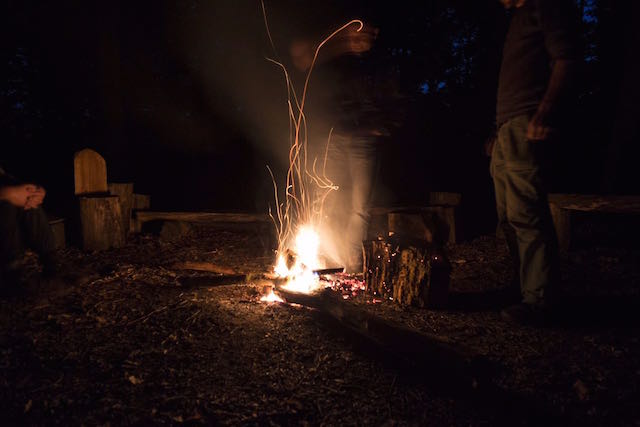
    Fireside reflection at Hazel Hill wood. Photographer: Peter Clarkson
    Fireside reflection at Hazel Hill wood. Photographer: Peter Clarkson

    I recently read Daniel Goleman’s excellent book Focus, and I have been thinking about how our ability to focus affects our ability to design. This thinking was the basis of a workshop session that I recently wrote about harnessing ‘wandering mind’, that mode in which the brain roams freely and forms new associations which are the basis of creative thought. I piloted this material as part of Think Up workshop on creativity that we ran at Hazel Hill wood in July, which seemed to go down well, so I am sharing it here.

    Below is a modified extract from some of the course materials associated with this activity. I’d be interested to know if anyone reading recognises these phenomena or tries the approach I am recommending.

    In his book Focus, emotional intelligence pioneer Daniel Goleman explains that the brain can really be understood as having two distinct sets of circuitry: the lower brain and upper brain. The lower brain whirs away in the background working on solving problems without us even noticing. Its activity only comes to our attention when it produces an idea as if from nowhere. The upper brain by contrast is the seat of self-control and is the part of the brain that we actively focus on a problem.

    In evolutionary terms, the lower brain is the older part. The lower brain is the source of our impulses and emotional reactions. The upper brain can repress these impulses, but at the cost of diverting our attention from the design challenge on which we want to actively direct our focus. In this instance, the lower brain circuitry is causing a hindrance to creative thinking.

    However, the lower brain does have a crucially important role to play in design. Research shows that in the moments before people achieve creative insight, their lower brain has been in a state of open awareness. In this state, the mind wanders freely, widely and without judgment to create new associations. When these new associations are made, the upper brain then locks in on them and fishes them out into our active attention.

    In order to harness our wandering minds as part of the design process, our upper brain needs to be ready to spot a good idea when it emerges. To do this we need to do two things. The first is to make time in which we stop actively thinking about things and let out thoughts come to us, for example, going for walk or even going on holiday. The second is to minimise distractions, which divert our active attention away from spotting new ideas as they emerge from the lower brain. In other words, making time we when turn off our smart phones and blocking out interruptions.