
I just read this great paragraph on the debilitating impact of false modesty on judgement.
(more…)Author: Oliver Broadbent
-

My neighbours don’t like bees
We planted a hedge of lavender on our estate to revitalise a barren patch of soil near our front door. This sunny morning, the enthusastic lavender stems were bobbing up and down laden with bees. There must have been between 20 and 30. I went to count, as part of the Great British Bee Count. And so it was that I had conversations with several of my neighbours about bees, and I was depressed by what I heard.
- One complemented me on the lavender, but said the only problem with lavender is that it attracts bees.
- A second reported hatred for bees, having been repeatedly stung by that very flower bed, before conceding they had been wasps.
- The third, having been complementary about the flowers, reported a bee had dive bombed from twenty metres above delibrately to sting him and concluded they must be evil.
-
12 Principles for Problem-based Learning for Engineers
Over the last 9 months at Think Up I’ve been invovled with an engineering education project that has had a really deep philsophical impact on me. The project is called Enginite, an EruasmusPlus-funded programme of graduate training and placements that aims to give graduating engineers extra skills and experience that will make them more employable.
My role has been to collaborate with Prof Søren Willert, of the University of Aalborg, to train project partners in how to design courses using a problem-based learning methodology. PBL flips traditional learning on itself, and holds as its fundamental principle that learning is more effective – in terms of retention, recall and motivation – if students drive the learning process themselves. It is one of those statements that we know to be true from experience, but goes directly against how most education is delivered in engineering education. PBL addresses that dissonance by creating a framework for giving students ownership of the problem. (more…)
-
The joys of ferry travel – a postcard from Crete
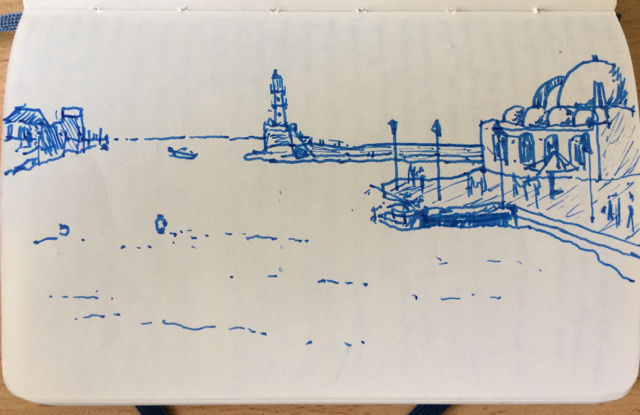 You can get from London to Crete by land and sea but it takes about four days each way.
I was due there for a four-day meeting and training course, part of the EU Erasmus Plus-funded Enginite project, with partners from Cyprus and Greece. I didn’t have time for the surface journey. In this case I felt the cross-border collaboration benefits outweighed the environmental cost of flying, so I jumped on a plane. But having flown that far, I was determined to have an overland adventure when I got there. I got my chance on the last day.
-
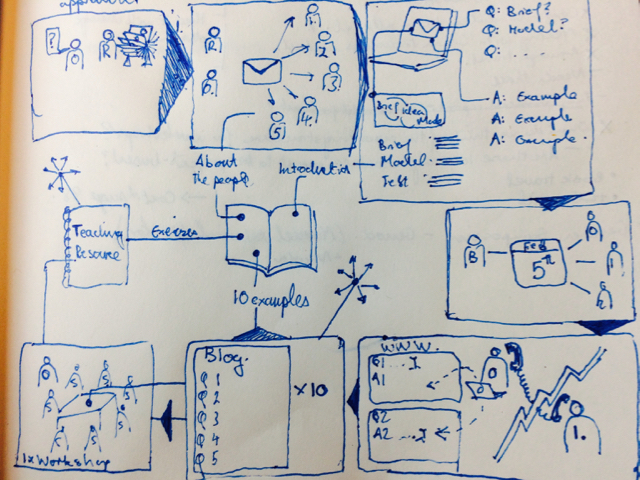
How to have ideas – guidance for engineers and other humans
When I’m asked, you know, at a cocktail party or some other social setting, ‘what exactly do you do’ I say ‘I train engineers to be more creative’. This is a great statement to use because: it feels good to say; it is reasonably close to the truth; and it is short enough to enable my interlocutors to decide quickly if they want to engage further or keep their distance.
For the people that stick around the next question is usually, ‘well how do you do that then’, and I explain I run two courses, ‘how to have ideas’ and ‘how to have better ideas’, the first being a pre-requisite to the second.
This is again only approximatinately true (my course content is usually based on what the learners say they want to cover rather than following a strict syllabus, and the course titles aren’t always as catchy as I’d like) but it keeps the conversation moving.
After further dialogue, I am asked if I have got this all written down somewhere, and this is when I usually get embarrassed, and have to say, ‘no’, because it is all in my head. But not anymore, because now I can point them to the post you are reading, my first attempt to commit an overview of this material to writing.
-
Derive #2 City of London – Log book
- 19/3/18
- Derive #2
- Location: City of London
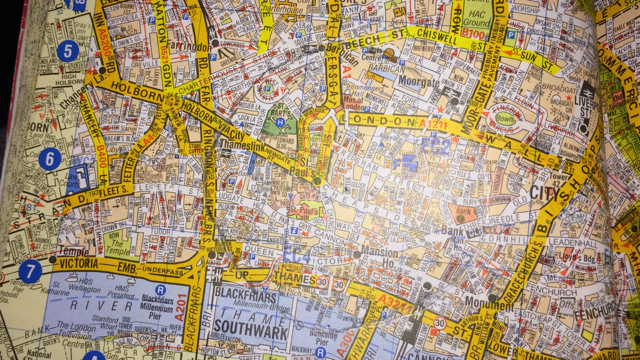
- Context: preparation for my talk ‘Circling the Square‘
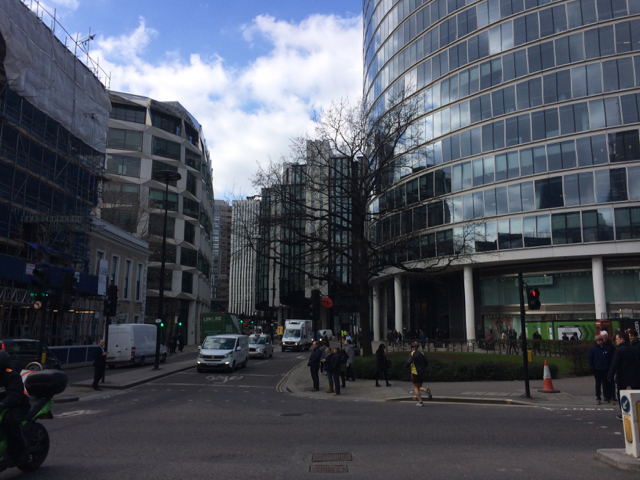
Moorgate x London Wall - 0:00:00 Moorgate and London Wall. Once solid-looking stonewalls are now façades pinned in place by scaffolding while new buildings are constructed behind. In just a few years the streetscape along London Wall has completely changed
- 0:04:34 London Wall and Copthall Avenue Deep metallic groans sound out from behind these hoardings. I assume the core of the building is being demolished, and the sound is the building complain.

- 00:09:41 Black Rock The circle leads straight into the offices of Black Rock. I enter the revolving doors and walk through a long dark lobby past whispering clusters of suited men and women. I emerge blinking onto a much quieter street, Tower 42 in the distance.
- 0:13:31 Copthall Avenue The circle passes straight through the Angel Court building. I attempt to walk through the underground loading bay but I’m turned back by security. There are some places you really aren’t supposed to go.
-
Circling the square – psychogeography in the City
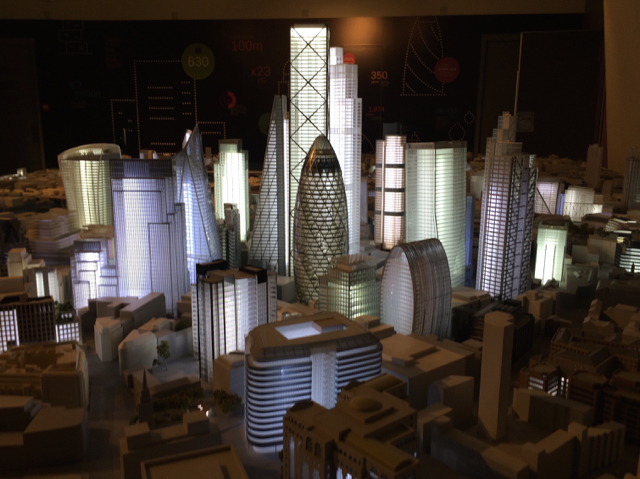
Last night I have a talk at the first ever City of London Showoff called Circling the Square. The event was put on by the City Centre, a fantastic organsiation right at the heart of the City that hosts a fascinatingly detailed 3D model of the City of London. I had been asked to say something entertaining and interesting about engineering in the City. I thought this was a great opportunity to try out and talk about my new hobby, psychogeography. The folllowing is a transcript of my talk (my full data log see my post Dérive #2 – City of London – Logbook)
As an engineer I love going on unconventional journeys: using odd means of transport, exploring forgotten paths, seeing the new from different perspectives. In his book, a Road of One’s Own, Robert Macfarlane instructs us to:
…unfold a street map. Place a glass rim down anywhere on the map and daw round its edge. Pick up the map, go out into the city and walk the circle, keeping as close you can to the curve. Record the experience as you go, in whatever medium you favour: film, photograph, manuscript, tape. Catch the graffiti, the branded litter, the snatches of conversation…Log the data stream…Be alert to the happenstance of metaphors, watch for visual rhymes, conincidenes, analogies, family resemblances, the changing moods of the street. Complete the circle and the record ends. Walking makes for content; footage for footage.
Robert Macfarlne – a Road of One’s Own, cited by Merlin Covereley in ‘Psychogeogrpahy’
-

Alt peer-to-peer feedback
Pear-to-pear (it was better than the images I got for peer-to-peer). As part of my Visiting Professorship at Imperial College I have been asked to think about how peer-to-peer assessment works in group works. Here are my thoughts.
One of the common features of the group-work-based learning experiences that I have been involved with is the need for the participants to be able to give each other feedback. Often in an undergraduate setting there is an emphasis on giving anonymous feedback. I have seen many colleagues cook up clever ways of gathering this anonymous feedback – I’ve conceived a few such systems myself – and processing this feedback in order to find out what is going on in student groups and to enable the teacher to be the arbiter of fairness. Managing such systems of peer-to-peer feedback can quickly become burdensome, and I am never really sure whether you really know what is going in the group or if the students are rigging the system.
As I become more and more involved in problem-based learning, I realise that this approach – anonymity and delegation of confrontation to the teacher – misses the point. If students feel that their peers aren’t pulling their weight in a teaching scenario, then they should be trained in how to confront these issues in themselves. And taking a more positive spin, students should also learn how to give positive feedback too.
I think it should be possible to give students the tools to handle these sorts of interactions themselves, and then for the teaching staff to coach students through the process where difficult situations arise. These are tools that my collaborator Nick Zienau uses in his ‘Leading and Influencing‘ course. The following is how I envisage this could work:
How it would work
The context is an extended student group design session in which a group of six to ten students spend a number of weeks collaborating to deliver a shared group output.
Skills development day: trust, confrontation and non-judgemental feedback.
I envisage a day-long training day for student groups. This would involve a series of group work exercises punctuated with whole-class briefing and feedback sessions.
Contracting – this is the process by which students agree with each other what they can each contribute to the team, what they want from the others, and how through their own actions they might jeopardise the group’s success. Students develop contracts for themselves, present them to one-another, and then agree a contract for the group.
The creation of contracts is a trust-building activity, and it creates a visible set of expectations by which the students can hold each-other to account.
Confrontation – in this session we provide a quick formula for confronting challenges. It involves naming a behaviour that they have seen and saying how it contravenes their individual or group contract. The reference to the contracts makes the terms of engagement very clear. Practising a formula for engagement makes the process something that people are familiar with.
Non-judgemental feedback – we walk students through process where they give each non-judgemental feedback, much of which comes down to language. We show students how to stick to facts, like ‘I have seen you do this’ or ‘when you do that it makes me feel like this’, rather than ‘what you have done is bad, or wrong’.
At the end of the training day, students have contracts for themselves and the group, a language for direct, open and kind confrontation and a mechanism for giving non-judgemental feedback.
Self-regulation during group work
After the initial training day students get on with their group work as normal. They are asked to have a quick daily group feedback session, where they appreciate each other’s efforts and identify any emerging issues. They are also expected to have a weekly structured feedback session, where they tell each other where they are contributing most to the group, and how they could contribute more.
Through the group work, it is expected that the contracts remain in view. They are intended to be a visual reminder to individuals of what they should be doing themselves, and also a way for people to understand other people’s behaviour.
Instructor Intervention
The course instructor makes themselves available say once a week to deal with any issues that students feel they can’t deal with in their own groups. The consultation happens with the whole group and the instructor will ask to see evidence that the teams have been meeting to review their contracts regularly and have been giving each other constructive feedback along the way.
Overall, I believe this approach would empower the students, give them useful life skills and improve the quality of their learning.
My thanks to Nick Zienau and Søren Willert who have significantly advanced my thinking on this topic.
‘Pear‘ by Augustus Binu, licensed under the Creative Commons Attribution-Share Alike 4.0 International license.
-

Working notes: building a questionnaire to characterise design
I struggled to find an image to go with this post. When I typed design into my image database, this came up. It is rather fine, isn’t it? Today at Think Up I am writing a set of questions that can be used as a diagnostic tool to characterise different stages in the design process. The questions will go into an online questionnaire through which we will be trying to establish a link between different types of design problem, the design process they require and techniques and tools that designers use. The aim is to help students understnad what might be suitable approaches to use in response to different design problems.
I am fortunate to be working with my colleague Bengt Counsins-Jenvey who knows a huge amount about design thinking in a range of different contexts. He is working on the other part of the questionnaire that is characterising the design problems.
Here’s some reflections and notes from today’s working:
- Reducing long-form answer questions on questionnaires. They are easier to write but I’ve learn the hard way on other projects recently that long-form answer questions take so long to analyse it is really worth taking the time to come up with good numeric-scale or mutltiple-choice questions. Having done an initial round of interviews is helping me determine the right language to use.
- How succint can I get the questions? I am trying to weigh up writing questions that everyone can understand and keeping the questions short. Again, having done some initial interviews helps me know what language people are likely to use.
- I’ve realised my design world view was initially shaped by ‘blank-piece-of-paper’ designers. My interviews on this project have shown me how few design contexts require blank paper. I hope this process gives me greater understanding of design contexts where the operating context is much more complex.
- What number scale to use? I’ve gone for 1-4. I don’t want people to think about their answers for too long and I don’t want them to sit on the fence. It will be interesting to see the impact of this choice.
- I have been daunted by putting this questionnaire together, so last night I just set myself a simple target of writing three questions for each of the main stages in the design process. This much less daunting task was easy to do – the questions almost wrote themselves – and then I was easily able to supplement them. Later Greg Downing explained to me that this process is what he calls skeltoning: you quickly put in place the outline and everything else follows.
For more info on this piece of research see this post on the Think Up website.
-
No dairy diary (I had un oeuf of eggs too)
In Janaury 2018 I decided I would try veganism. I have been vegetarian all my life but in recent years I have found it harder to reconcile concern about the meat industry with eating dairy produce and eggs. In recent years we have eaten very little dairy at home, so this year I decided to try going the full hog and committing myself to a no-dairy no-eggs diet.
Understandably people ask ‘what do you eat?’ Here’s the answer:
7/3/18
- Toast with marmite
- Lunch: humous and veg sandwiches from platter
- Cake time – Vegan banana and coconut bread (Southbank)
- Dinner – Turkish mezze at Taz
6/3/18
- Leon porridge with blueberries
- Elevenses: toast
- Lunch: Pure vegan wraps (from platter)
- Tea: more toast with humous
- 1st dinner: Kale and pumpkin one-pot pasta (Anna Jones)
- 2nd dinner: Roast spiced brassicas with split pea purée (Hugh Fearnley-Whittingstall)
5/3/18
- Breakfast: porridge
- Lunch: Pret a Manger Spiced chickpea and spinach sandwich
- Dinner: Kale and pumpkin one-pot pasta (Anna Jones)
- General grazing in the kitchen
4/3/18
- Blueberry pancakes
- Lunch?
- Crisps
- Sweetcorn fritters with roasted potatoes
3/3/18
- Breakfast: porridge
- Lunch: baked beans on toast
- Dinner: Pumpkin stew with kidney beans (receipe: A six-ingredient squash stew – and five ways to eat it, Anna Jones in the Guardian)
2/3/18
- Breakfast: Indian breakfast kheer (a sort of rice pudding with cashews and safron) (Anna Jones – The Modern Cook’s year)
- Elevenses: toast
- Lunch: Borscht with hidden tofu
- Apple cake
- Pasta with putinseca sauce (olives, capers etc)
1/3/18
- Breakfast: porridge made with soya milk, topped with pear, honey and a nutmeg spice mix
- Elevenses: avacado on toast
- Lunch: beetroot soup with toast
- Dinner: Beetroot and mustard seed fritters with cardamom yoghurt (Anna Jones – The Modern Cook’s year); roasted cauliflower stalks; dark chocolate
28/2/18
- Breakfast: Museli with soy milk
- Lunch: leek and potatos soup with toast
- Motivational snack: toast
- Dinner: Toasted quinoa, roasted brassicas and spiced green herb smash (Anna Jones – The Modern Cook’s year)
27/2/18
- Breakfast: Peanut butter on toast
- Lunch: Pumpkin stew with kidney beans (receipe: A six-ingredient squash stew – and five ways to eat it, Anna Jones in the Guardian)
- Dinner: More stew.
-
Problem-based learning – action learning from around Europe
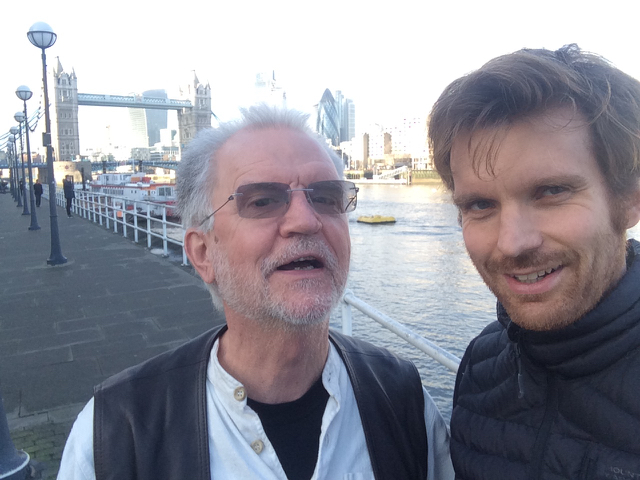
Today I have been reviewing the action learning diaries that half a dozen people have sent me from Greece and Cyprus. They are getting ready for training in problem-based learning that I will be co-leading here in London at Think Up with Prof Søren Willert from the University of Aalborg (see picture) as part of the EU ErasmusPlus-funded Enginite programme, and we have set them some problem-based learning of their own to do before they arrive.
The idea behind problem-based learning is that the student should own the problem and own the process of finding the solution. This approach is diamertrically opposed to the traditional direction of travel for learning. The aim of our approach is to get the participants to experience this problem-based approach for themselves before they start designing such experiences for their students.
The first set of reflective diaries that I have read reveal very different ways of working in our cohort. Some are applying problem-based learning with their students; others, who don’t teach, are adopting this approach with colleagues in their companies, and it is this latter group which is perhaps the most fascinating – because is in fact the sort of environment for which we are eventually preparing students.
At the moment problem-based learning feels like very rich territory to be farming in. The approach itself is a powerful philisophy that has many daily applications, and coaching other people in its use is gives me the chance to witness the daily strategies for sucess that other people use.
One of things that I really enjoy about this project is that is it is open – you can join in yourself if you follow the instructions below – and everyone is learning as they go. For my part I am learning what other people understand problem-based learning to be and become ever more aware of its applications. It is also terrific to be working with Søren, I feel like I learn so much from each of our interactions. Today it has been really interesting to see how he characterises the different types of PBL as described in the reflective diaries. To his words, it is enabling me to notice ‘exemplarities’ that I can look for in other people’s work.
To find out more about this project and get involved visit ‘Getting Started with Problem-based learning‘ on the Think Up website.
-
My VR training epiphany
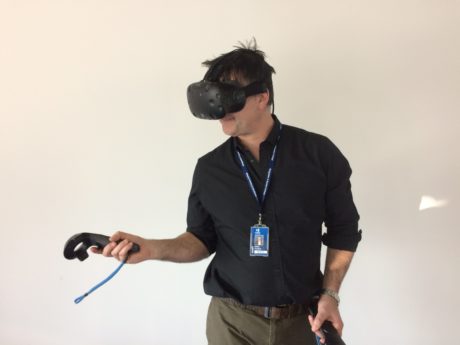
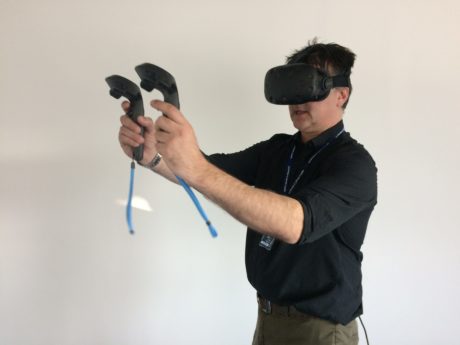
Last week I was down at Bridgwater and Taunton College to check out the tools Stefan Cecchini and his colleagues are going to be using to deliver a revolutionary new engineering degree curriculum that aims to be entirely inquiry-led. There for the first time I tried out a virtual reality (VR) training environment. I put on the VR headset and gloves, and this is what happened (that’s Stefan, by the way wearing the VR gear).
-

#12 Show-notes – Roma Agrawal: how to build a skyscraper
In this episode I bring you a step-by-step guide on how to build a skyscraper with structural engineer Roma Agrawal (@RomaTheEngineer), author of ‘Built, the Hidden Stories Behind our Structures’. We get into the engineering, creativity and philosophy of sky scrapers and their designers. Don’t try to build a skyscraper yourself without listening to this first.And since engineering education is something I do for my day job, I thought I’d accompany this episode with some additional resources related to the topics of this podcast. I’ll be adding to these over the next few days so stay tuned. -

#11 Show notes – Jack Bardwell – Spine-tingling creativity
Graphic designer Jack Bardwell and I used to be colleagues at the Useful Simple Trust, he bringing alive the many wacky ideas I have had about how to teach people engineering. Over our three years working together we had many fascinating and long discussions together about creative processes and teaching design.
I recorded this episode with Jack last summer just before he left to puruse new adventures in interior architecture. I miss him in this office, so it has been a pleasure therefore to listen his voice in the edit, and to hear the many fascinating things he has to say about his creative process, what he has learnt from working with engineers, and, most intriguingly, the spine-tingling effect other people’s creativity can have on him.
In this episode we get into:
- Tuning in to other people’s creativity
- How people express creativity without realising it.
- The receiver is the context
- Cooking is design
- The importance of copying in developing skill as a designer
- How new skills open up possibilities, too much skill can limit them
- Using jigs to constrain the creative process
- How a carefully tuned jig can force a particularly aesthetic on what you create.
- How you communicate different parts of the design to the client.
- When is a jig not a jig.
- Thinking in lists
- The way information is presented to you is not necessarily the best way for you to look at it.
I’ve got a feeling this going to be one of those episodes I keep coming back to when I need angles for looking at the world. Enjoy!
-
#10 Show notes- John-Paul Flintoff – Saving the world one creative project at a time
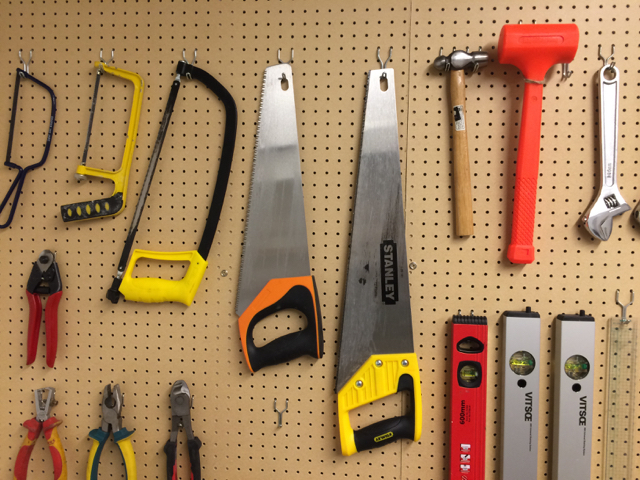
Journalist and author John-Paul Flintoff is this person who inspired me to start this podcast. He talks passionately about how to get people started on their creative projects and the positive impact their creativity has on the world. This interview gets very meta: a podcast about the creative process of podcasting. We get into all sorts of great techniques for creative projects, including:
- Improv games
- Valuing what you are good at
- Not losing track of what is working well already
- The importance of getting started
- Not worrying about whether it is going to be good.
- Shared space in the creaive process
- Why we need to keep noticing
But beyond any particular tactic, it is J-P’s warmth and encouragement that I find so inspiring. I hope it inspires you too.
-

#8 – Eiffelover on tour in San Francisco
This is the first of two episodes of the Eiffelovercast recorded in San Francisco earlier this month. I was in the city to run some Think Up workshops, and so talk the opportunity to recorded some thoughts, interviews and sound bites related to my regular themes of engineering, creativity and practical philosophy.
“News from San Francisco: We are all part of the cloud”
In this episode I visit the Golden Gate Bridge (my favourite bridge in the world?), find out about experiments down in Stanford about what makes us collaborate better, try out as many modes of transport I can, learn about extended cognition and our relationship with the cloud, and experiment with ditching Google maps in an attempt to understand the city better.
The second episode from San Francisco will be on line later this week. In the meantime, I hope you enjoy listening.
To listen you can:
- Click play on the player above
- Subscribe by RSS
- Listen on iTunes
- Download the episode here
- Access all episodes online here
Did none of those links work for you? Or do you access podcasts from another source that I am missing? Then please let me know in the comments below.
-
Embodied perception and the Bristol Swing Festival
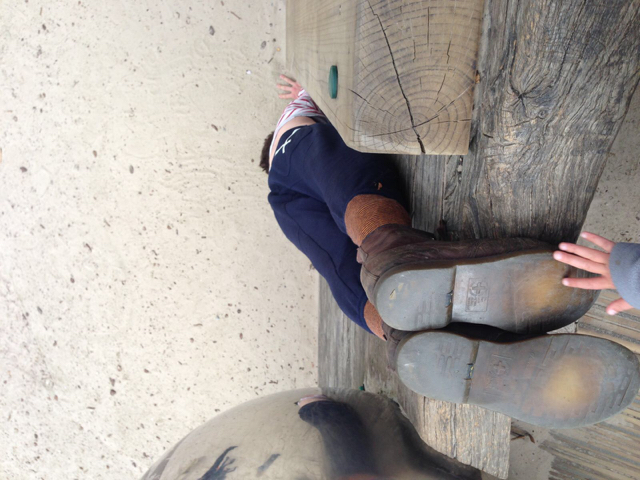
 Bristol Swing Festival is unique among swing dancing festivals because it offers the chance to learn circus skills alongside learning to dance. One of the things that I love about coming to Bristol for the swing festival every year is the way it makes me feel grounded in myself and the connection it gives me to other people and the world around me. In the past, I haven’t had a philosophical framework to help me interpret these experiences. But this year I think I found it in Matthew Crawford’s book The World Beyond Your Head. Reading the second chapter, ‘Embodied Perception’, I recognise many of the phenomena that he describes in my experiences here at the festival.The key idea Crawford introduces is that we think through our bodies: our bodies are an integral part of our thinking process and thinking doesn’t occur just within the confines of our skulls. Before I think about the consequences of this idea I want to first relate the pieces of evidence that he puts forward for this notion of embodied perception to the experiences I have here at the festival. Before we go on I should just say a little more about what goes on at this festival. As the name suggests people coming to this festival to learn to swing dance but what what makes it unusual is that you also learn circus skills alongside those dance skills. On a typical day you’ll spend the morning and early afternoon learning dance steps and then the rest of the afternoon trying out different circus techniques such as tumbling, handstands, tight rope walking, juggling and clowning. It is therefore a very physical environment and one in which you make a lots of physical and mental contact with other people.The first piece of evidence that Crawford sites in support of embodied perception is what happens when we use a stick held in the hand to explore a space we can’t see. When we use the stick to rummage around in the unseen space, we are aware of the stick jostling around in our hand as the other end moves over the contours of the hidden space; however, after a while we stop noticing the stick’s pressure against our hands changing and focus instead on what is happening at the tip of the stick. As he describes, it is as if we see through the stick right to the tip. Our awareness has shifted from our hands and is focused instead on what is happening at the tip of the stick. To use his words the probe itself has become transparent – it disappears. He goes on that the crucial fact that makes this integration of the prosthetic possible is it there is a closed loop between action and perception: “what you perceive is determined by what do you, just as when we make use of our own hands.You can see this happening as people start to develop dancing and circus skills. The stiltwalkers are initially very aware of the contraptions they have strapped to their legs but as they gain confidence and familiarity with the sensations they receive through these prosthetics about their relationship to the physical world on the ground it is as if the stilts disappear from view. They have become incorporated into the body from an attentional perspective and what the stiltwalker senses is the ground at the at the bottom of the stilts and not the stilts themselves. I think the same can be said of the sensations that two people feel when they learn to dance with one another. When they begin they are very aware of all the places where their two bodies touch: the connection between their arms, between the sides of their bodies. To beginners this connection with the other dancer is something that they think about a lot. But as the familiarity with this dance hold increases it is if the notion that there are two separate bodies holding onto each other disappears and they experience the dance as one conjoined unit. To re-emphasise Crawford’s words this integration of the stilt or the other dancer into our own bodies is only possible because there is a feedback loop between action and perception. The sensory information we receive when we are dancing with someone is that associated with a four-legged organism with a centre of gravity that exists at some imaginary point between the two dancers’ ribcages and so based on this sensory information we no longer perceive ourselves to be two separate beings but rather one entity.So that was the first piece of evidence in support of extended perception:tThe way we integrate tools and prosthetics and even other people into our bodies. The second set of evidence relates to how we interpret the world around us based on sensory information. He explains that the traditional model of perception has it that our eyes supply our brains with a two dimensional representations of the world. When I look at the beer can in front of me what I see is a 2-D representation. But from memory I have images of the can from other perspectives. What my brain does is a sort of three-dimensional rendering in order to create a 3-D model of the can in front of me. This model seems to imply a great deal of processing happens in the head whenever we wish to perceive a 3-D object. That model however, as Crawford explains is being challenged by and alternative approach. That approach takes as its starting point the fact that our eyes are located in eye sockets in which they can swivel. Those eye sockets are located in a head seated up on a neck that can look from left to right up and down. Those eyes, head and neck are attached to a body that is connected to legs that can propel the body forwards, backwards, left and right and up-and-down. To repeat the quote that Crawford uses, vision is not the purely mental processing of sensory inputs but rather the way in which we use our body to extract invariants from the stimulus flux. In other words, we explore and understand the world around us by moving through it and seeing things from different perspectives and critically this allows us to identify things that remain the same from different perspectives. Movement through the world is therefore critical to understanding it.Here at the festival we learn lots about movement and moving in different ways, so it is possible that this altered locomotion offers us new perspectives on the world. In the handstand classes we spent time moving around on all fours and connecting our hands to the ground. In solo jazz we learn to slide, hop and skip through a space, filling it in new ways. In tumbling classes we run, we jump and we fall (gracefully). All of these activities reveal the world to us from new perspectives, and remind us how narrowly we perceive the environments that we commonly inhabit.When I look out of the window from the cafe at which I am writing this post at the streams of people walking to work, walking the same direction as each other, walking the same way as each other, to go and sit in office environments that are probably very similar to one another. If we move through (or rather remain sedentary) in very similar ways, what does that say about diversity of thought?Crawford concludes this part of the chapter with a reflection on how toddlers learn to walk. When they are learning they are experimenting to see what movements of their bodies produce what effects. Initially this takes lots of concentration, but eventually the commands can be carried out with thinking about them. The child’s attention shifts away from the body toward the world that can now be explored through movement. Through mastering a new skill, their world has grown, and their attention and perception reaches out beyond the body. Invoking Nietzsche, Crawford says that joy is the sense of one’s power increasing. As we master a new physical skill, frustration gives way – their attention shifts from their body to the world beyond – and they feel a sense of joy.So what do I take from all of this? Why does going to the Swing Festival feel so good. I think that there are four things at play here:The first is that for many, myself included, our primary stimuli during the day are visual and audio – all from the head and little from the body. At the festival, the stimuli are much more physical. This gives our brains a break, and perhaps puts us back into a sensory environment to which are perhaps better evolutionarily suited.The second is that many of the skills we learn at the festival allow us to move through the world in new ways, giving us new ways of perceiving it and understanding it. Turning upside down may seem a trivial thing to do, but when we do so much of our thinking the right way round, flipping things provides a refreshing change.A third thing I’ve noticed is that spending a few hours a day doing bodily-focused classes seems to make people more physically playful outside those classes. It’s as if we are given permission to rediscover our world through physical play, to rediscover that intrinsic joy that children find when they run around, swing from branches, balance on walls, wrestle with one another or just give each other hugs.And finally, the festival gives us a tiny taste of the power we could feel if we could master a circus skill: when we might one day stop looking at our hands and watch the juggling balls dancing in front of us; when we might one day feel the lightness that comes with the perfect handstand.To conclude with one of Crawford’s phrases, ‘we think through our bodies’. Bristol Swing Festival gives me new ways to think through my body, and that’s why I enjoy being there so much.
Related posts
-

#7: Musician and composer Ellie Westgarth-Flynn on creative strategies, instruments as an extension of our bodies and creative feedback
Ever since I was a kid my Dad has been sharing musical composition strategies with me, so I think music has been a lens thorugh which I’ve thought about creativity for a long time. And so I jumped at the opportunity to interview my friend Ellie Westgarth-Flynn, pianist, singer, composer and performer about our shared interest in creative techinques for composition. As in many of these podcast interviews, I think that creative techinques from one domain can easily be transported to another, and so I hope that whatever your domain of work, you find something useful in the creative techinques that Ellie and discuss. In this episode, we get into:
- The tension between technical mastery and creative freedom.
- The freedom that rhythmic and harmonic templates or restrictions bring to our compositions.
- Building up composition from motifs and building blocks.
- The importance of feedback in the creative process – acting on feedback is where change takes place.
- There comes a point at which you need to leave yourself out of it and get on the with the job of writing the music.
- Three creative techniques for anyone trying to get into song writing.

-

Eiffelovercast #6 – Riding the Northern Line Ghost Train
In this episode of the podcast I attempt a sonic recreation of a part of the London Underground that never got built, a stretch of the Northern Line that would have run from Moorgate to Alexandra Palace. En route I reflect on the transport infrastructure shapes our experience of the city and the difference between what engineers plan and what actually gets built. I really loved making this podcast – it features my mother, Anne Soutry, as Northern Line announcer, making the most of her skills as a continuity announcer for BBC Radio Manchester many years ago. Also, as part of my research, I got a ride in the cab of a Northern Line train with my friend Stuart McGee – thanks Stu. So, have a listen, and I hope you enjoy the ride.
- Listen to it on iTunes
- Stream by clicking here
- Download as an MP3 by right-clicking here and choosing “save as.”
If you liked this podcast then you’d definitely enjoy:
-
Analogue skills: fogotten powers
We live in a time of rapid and accelerating technological change. It is the age of digital, big data and smart technology. The digital zeitgeist is presented with a benign face: faster, more connected, more megapixels, do more, see more. But over the last couple of years I’ve had a feeling that in the race to embrace these new digital tools we are forgetting pre-digital ways of doing things which might turn out to have been more useful, more sustainable and better for us. Things like how to communicate face-to-face, how to communicate in written long-form (even the long email is a thing of the past), how to read a map, how to spell, how to sketch, how to make an appointment and keep to it, how to concentrate, how to make things, and even how to take notice of our physical environment.The name I am giving to this pre-digital ways of doing things is ‘analogue skills’. As an on-going project, I plan to explore what analogue skills it would be worthwhile keeping hold of, and to interrogate the digital tools at our disposal to see how to make good use of those without detriment impact to our well-being or to the planet. I hope the outcomes of this project will be to produce some suggestions for how we can use the tools at our disposal, both analogue and digital to improve our experience and quality of life.Of course, there are many ways in which digital tools empower us: wide-spread and long-distance communication; access to information and knowledge sharing; access to an almost unlimited range of media; online commerce and sharing economies; increased connectivity through social media – and I benefit from all of these.But there are also costs. More screen time means less time experiencing the physical environment.The flip side to the benefits of social media is the social anxiety in can cause, fear of missing out – so called FOMO. The huge choice of media that the Internet offers can lead to a sense of being overwhelmed and lower levels of engagement with the content. Digital consumption is dependent on technologies over which consumers have decreasing amounts of control – no longer are we necessarily the masters of our tools – and with built-in obsolescence, these technologies have a large environmental impact.Around me, I increasingly see the signs of digitial discontent. Friends talk about digital detoxes and commit ‘Facebook suicide’. At Hazel Hill Wood, where I co-lead conservation weekends, there is no mobile phone reception. Most participants are relieved for this enforced time offline. But there are usually one or two users per group who anxiously spend time at the one spot in the wood where they can get a feint signal and wave their handsets around in the air, like some ritual dance to the digital deity, in a desperate attempt to connect.At this point I need to make a full disclosure: I write this post on an laptop, using notes that I made while walking along the street on the memo app on my iPhone, cross-referencing that with notes that I made in Evernote almost a year ago, which I will post to a website, which I will then share on social media. So yes, I am fully-signed up user of digital technologies. But there are plenty of digital things that I don’t use. For example, for the last year I have been trying to minimise the distractions of social media by removing notifications from my phone, and by limiting my screen time. For certain, I’ve been sceptical for some time about the digital panacea. This project is an attempt to martial these thoughts, to change my skills and habits and hopefully to help other people along the way.I am fascinated by really cutting edge technology, the innovation that goes into it and the possibility it offers. But I do think that older technologies allow us to interrogate the new; indeed one of the most fascinating things about older technologies is finding out how the engineers of the day were using great ingenuity to extend what was possible within the limits of the technology of the time. Of course, digital technologies are here to stay, and in many ways for the better. What I think is important is making sure that is us who are smart and not just the technology.Related posts
-
Eiffelovercast #5 – Nick Cobbing: photographing the Arctic
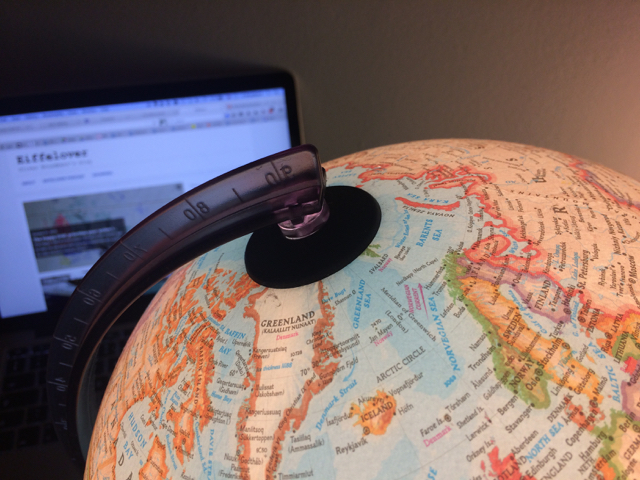
Photographer and photojournalist Nick Cobbing talks about photographing the Arctic, what happens to photographic equipment at minus 38 degrees, using drones to take photos, the role of the audience in the creative process, being reduced to tears by the beauty of the planet, the best places to swing dance north of the Arctic, life hacks for creative people working on their own and whether penguins tango or waltz. - Listen to it on iTunes
- Stream by clicking here
- Download as an MP3 by right-clicking here and choosing “save as.”
-
Everyday Creativity for Blues Dancers
This is the second workshop I have run in the ‘Everyday Creativity for…’ series, this time for blues dancers in the London blues scene. A huge thank you to Ellie and the Sunday Shake Off crew for inviting me down.
The premise is that blues dancing is an inherently creative activity (maybe even more so than lindy hop?), and by interrogating what we are doing when we are dancing blues we can find creative strategies and techniques that we can use in other parts of our lives, from personal projects to professional work.
This workshop was a truncated version of the full workshop that I run for swing dancers. Into an hour we managed to squeeze in:
- Thinking of creativity as a system, and understanding the parts of that system
- The influences we draw upon in our swing dancing and in our professional work
- Generating connection with your collaborators and your audience
- Strategies for stimulating divergent thinking
- The value of doing really silly things.
Keep an eye out on this site for dates when I’m planning on running the full workshop again.
Related posts
-

Eiffelovercast #4 – Crossing France very very fast: a paean to TGVs
Ever since I saw my first one zoom past as a boy I’ve loved TGVs. In January I travelled from one side of France to the other and back by high-speed train to get to a conference, and used the chance to try to capture some of what I love about fast trains in France. It’s a mash up of travel diary, interviews and engineering history, all stitched together with familiar SNCF noises. I hope you enjoy.
- Listen to it on iTunes
- Stream by clicking here
- Download as an MP3 by right-clicking here and choosing “save as.”
If you enjoy the interview then please let me know in the comments thread below.
-
Eiffelovercast #3 – Andrew Scoones – is there is such a thing as engineering culture?
We are trying to define the heritage of the future – the creativity and ideas in engineering that people will look back on – Andrew Scoones
Andrew Scoones is a filmmaker specialising in the built environment. Andrew seems to have interviewed or met almost all of my engineering design heroes, and so I was equally delighted and nervous when he agreed to let me interview him! In this podcast we explore one of Andrew’s passions, the identification and celebration of engineering culture. Along the way way we get in to some great stories about designers, what they design and how they do it.
Andrew is director of the Engineering Club, set up over twenty years ago to host events about the broad culture of engineering in an informal setting. In this podcast he shares some of his favourite stories from Engineering Club guests, which illustrate different aspects of engineering culture.
En route we get into bicycle design, designing trainers, whether there engineering culture includes creativity, and whether there is room for creativity in industrialissed systems. We talk about some great engineers and their projects. And we talk about building your own dishwasher.
Please enjoy this interview with Andrew Scoones and let me know what you think in the comments below.
-

Pre-stressed concrete: lessons for swing dancers
TGV Bridge at Avignon by John is available under CC 3.0 Recently in beginner’s swing dancing classes I’ve described the connection between lead and follow when dancing side-by-side Charleston as being a bit like how pre-stressed concrete works. I promised a longer explanation. Here it is.
Starting with reinforced concrete
To begin we need to understand how reinforced concrete works.
When you build a beam in a building and you stand in the middle of it, the beam sags, albeit ever so slightly. To understand what is happening, you can simulate a simple beam by interlacing your fingers in front of you, palms down. Now imagine what were to happen if someone were to balance a bag of sugar on your knuckles: your hands would sink down, the skin on the underside of your fingers would stretch, and the skin on the top would pucker up. That’s because the skin underneath is going into tension, and the skin that is on top is going into compression. This tension-compression couple is what supports the load resting on the back of your hands.
For a video illiustration of this deomonstration, see this video I helped to script a few years ago at Think Up.
Now let’s imagine what happens if we were to build that beam out of pure concrete instead. Concrete is strong in compression, and so would have no difficulty in resisting the compressive force in the top side of a bending beam. But it has virtually no tensile strength, and so as soon as the underside of that beam starts to stretch it would suddenly crack and catastrophically fail.
So for about 130 years now, engineers have been embedding reinforcing steel in the bottom of concrete beams to carry that tension which arises when a beam bends. Steel is strong in tension (think of the steel cables in a suspension bridge). In a beam reinforced with steel, the steel rods act like stiff elastic bands which resist the tensile loads that are generated when the beam bends.
The importance of depth
Reinforced concrete is a popular building material. To work, the beams need to have a certain depth to them. To illustrate we can think what happens when we bend a 30cm ruler. If you hold the ruler out in front of you flat side facing down, and try to bend it downwards, it bends easily. But if you hold the ruler out in front of you edge-downwards, and try to bend it downwards, it is almost impossible. What’s the difference? It’s the difference in distance between the top and bottom fibre that determines the stiffness.
So, deeper beams are stiffer, and can span further between supports.
Pre-stressed concrete
The problem with deeper beams is that they require a deeper floor void between the ceiling of one level and the floor the level above. Building designers usually want to minimise the floor depth so that they can fit in as many levels as possible within a given height. More levels means more rent.
Pre-stressed concrete is an evolution of reinforced concrete which enables shallower beams and slabs to be used in buildings. In pre-stressed concrete, the steel bars of reinforced concrete are replaced with steel cables which run through the middle of the beam and are attached to a plate at either end. When the concrete is set, this steel cable up is tensioned up squeezing either end of the beam, putting the entire thing into compression.
The effect is similar to when you pick up a row of books simply by squeezing from either end. If you squeeze hard enough, you can pick up say 15 paper backs without any of the middle ones slipping out.
For an illustration of this principle, see another video that I helped to make a few years back at Think Up:
Now imagine you were picking up a row of books in this way, squeezing from either end, and someone were to put a bag of sugar on top in the middle, as long as you were squeezing hard enough, you could probably support the weight of the bag of sugar.
So what is happening here? In fact, the same thing is happening here as when the sugar was placed on our interlaced hands. The top of the books are squashed together, and the bottom split apart a bit. The difference is that because these bending forces are applied to a set of books that is already being compressed together from either end, the bottom edge never goes into tension: it is just a little less compressed. Similarly the top of the books are more compressed because of the sugar they are supporting.
Putting pre-stressing cables into a concrete beam puts the whole thing into constant compression, making the whole thing stiffer.
What’s that got to do with swing dancing?
In teaching beginner swing dancing classes there often seems to come a point where we have to move learners from simply dancing a choreography to leaders leading and followers following. The key to that is the connection between them, which works in different ways depending on the dance.
When dancing side-by-side Charleston, the leader has their arm around their follower’s waist. The follower needs to sit back into this arm slightly, and the lead needs to push against their follower’s back. This creates a slight compressive force between them, which is equal and opposite.
To signal to the follower that the leader wants to move forwards, the leader moves forwards themselves, and in doing so, increase the compression in the connection, which causes the follower to accelerate forwards.
To signal to the follower that the leader wants to move backwards again, the leader moves backwards themselves, and in theory, this reduction in compression should cause the follower to accelerate backwards.
In practice, what we see is leaders moving backwards, and become disconnected from the followers. This disconnection reveals that they never had that matched compressive force in the first place: the pre-stress was missing.
If that compression is there to start with, if one person reduces the compression by pulling away, the other starts moving towards them. If there is no compression, and one person reduces the compression by pulling way, the two simply separate from each other.
So, to get the connection right, get the pre-stress right.
Related posts
-

The Margherita Principle for decision-making
Pizza (altough not quite a Margarita) I’ve been promising friends this post for some time, especially those that have eaten in a restaurant with me recently. In the season of good will and consumption, this rule of thumb helps us make better menu choices. But as a decision-making tool, it goes much deeper, helping us (re)discover the real value in things.
The principle is simple: the best value pizza in a restaurant is the one at the top of the list, usually the Margherita.
This realisation first came to me last year at a pizza restaurant by the Canal St Martin in Paris. The 6€ Margherita offered: a delicious and filling meal – the prototypical pizza; a nice warm place to sit; the atmosphere of the restaurant; banter with the waiter; a view over the canal; a small basket of bread and a bottle of tap water; and chilli oil.
The next pizza on the menu was the Fungi. At 7.50€ I was getting everything the Margherita offered plus a chopped mushroom. At 1.50€ that’s a bad value-for-money mushroom. And from there on down – Fiorentina, Vegetarian, Quatro Staggione – the value just keeps on going down.
The cheapest thing on the menu usually gives you the most, the rest are opportunities to spend more money with diminishing returns. (Incidentally, as Tim Harford explains in his book ‘the Undercover Economist’, menus are usually structured in ways to give customers the opportunity to spend as much money as they want to.)
The benefits of the principle
- By applying the Margarita principle not just to pizza but also drinks and coffee, I was able to have a pizza, a glass of house red and a shot of espresso for 10€ all in.
- It’s a training in simplicity, which as Thoreau argues in Walden, is the route of happiness.
- It’s a training in looking for the real value in things.
What about non-linear effects?
My colleague David pointed out to me that the principle may not be applicable if the combination of extra ingredients amounted to a taste that was greater than the sum of it’s parts – a sort of non-linear taste progression.
I concede that this sort of topping alchemy may be possible, but in reality it would have to deliver significant extra value to be anywhere near as valuable as the initial Margherita. Besides, another colleague of mine, who is also Italian, claims the Margarita is the best tasting pizza anyway – so why add anything more?
Broader application
The Margaherita Principle is a sort of mix of the Pareto Principle and the Law of Diminishing returns, and has applications beyond pizza choice. It helps get greater clarity of thought when making decisions.
For example, I was recently agonising over the order in which to publish various blog posts. But then a realised that the greatest value outcome was just to get the post published. There may be some marginal benefit to publicising them in a certain order; however that was much less than the value of just getting the material online and circulated. Worse, the time I was spending worrying about the order to publication was time that I wasn’t spending writing – and I might have ended up publicising nothing at all.
Another example related to the branding of a training course that I am involved with developing. At this stage, we are not sure how the course is going to evolve, and so it was difficult to decide what direction to take the branding. But, applying the Margarita Principe, I realised that the most important thing is to at least get something published, which we could then revisit as started to run and iteratively develop the course.
The fallacy of menu choices
As I write, I realise that we often have less control over our experiences than we think. A restaurant is probably quite a high control scenario: we choose what we want to eat and drink; choose our company; and with care, the topic of conversation; and things usually go to plan. In reality, we often have less control over the projects that we manage than we think. The branding example above illustrates this. It is very hard to know what the best way to describe a training course is until you run it and see how the content evolves in practice. With this sort of thing, the best approach is make quick decisions, see how they work in practice, and then re-evaluate along the way.
In a restaurant situation, this is akin to not ordering your main course until you have finished your starter, and then waiting until later to order dessert. This is decision making on the basis of feedback – literally!
The horror of advanced menu choices
Given all of the above, the worst possible decision-making scenario with regards to menus is when you are sent dinner options for a conference or a corporate meal a month in advance and you have to choose then. How on earth are you going to know what you want to order that far in advance?
In these situations, Margheritas are rarely available, so here I apply the Tiramisu principle: always choose the first option as long as it is vegetarian, and along is it isn’t Tiramisu, which is the food of the devil and should be avoided at all costs.
-

Sorting out your lego – the Eiffelover guide
If you own a big pile of Lego, then sorting it into separate boxes for different sorts of parts makes it much quicker for you to build anything you want to. I have found that the creative potential my haul of lego is multiplied manyfold by the simple act of separating it out. All of a sudden, when I can see what types of pieces I have, the ideas flow much more quickly, and the time lag between having the idea, and it manifesting itself in physical form is much reduced.
The question is knowing where to start. There are so many types of pieces, it doesn’t work to have a pot for every single type. I’ve probably completely sorted my Lego three times in my life (so far), and I think the categories that I have now are pretty effective. So to save you thre trouble, here they are.
Helpfully, since the first time I sorted my Lego, the Internet has been invented, and so it is now much easier to find commonly agreed names for pieces. In the lists below I’ve included some links to to photos of the pieces that I am talking about. I’ve organised the following list according to the size of tub I needed for each part. It’s the relative size that’s important here.
8L tubs
Base plates
- Lunar landscapes
- Road pieces
Miscellaneous- Train buffers
- Rigging
- Pirate ship hull
- Pirate ship sails
- Pirate ship masts
- Monorail track and pylons
- Train track
4L tubs
BricksThese are your standard building bricks. You would think that the protypical lego brick would be the most common, but compared to other bits I have relatively few of these. 2 by X bricks (X>1)Wheels and tyresThis is for wheels of all shapes and sizes, their tyres and the plates with axle stubs attached onto which little wheels and wagon wheels can be fixed. This is the biggest tub of all.Large platesFor those large base plates that are at least 4×4Narrow long bricksThese are like beams. These are 1 bx X bricks where X>3, but with no side holesNarrow long bricks with holesAs above but with holes in so you can push through axles.Small bricksThis is probably the modal category of my lego bricks. You are much more likely to find one of these than a standard 2×2 brick. Includes:- 1×1 bricks
- 1×2 bricks
- 1×3 bricks
- 1x1x5 bricks
Wide platesI think of these as planks 2 x X where X>1Narrow platesThese are thin plates – 1x X where X>32L tubs
Automotive paraphernalia- Specialist pieces for making cars, such as
- Steering wheel
- Seat
- 1×2 grille
- Wheel guard
- 1×2 textured brick
- 2x4x2 windscreen
- 2x4x2 sloped windscreen
- Chassis
Space paraphernaliaPieces for making space rockets and space stations, such as- Joystick
- Propeller with 4 blades
- Propeller with 2 blades
- 1×2 plate with side bars
- 3×8 angled plate
- 2×2 printed slope
- Loud hailer
- 3×4 double angled plate
- 1×2 plate with jet engine
- Spiral tubes
- 1×6 curved bar with studs
1L tubs
Little platesThese are among the smallest pieces- 1×1 plates
- 1×2 plates
- 1×3 plates
- 1×2 jumper plate
Slopes and archesThere are lots of variations of arches and slops, and the nomenclature can become a bit confusing.- 1×2 slope
- 1×2 inverted slope
- 2×2 slope
- 2×2 inverted slope
- 1×3 slope inverted slope
- 2×3 slope
- 2×3 inverted slope
- 4×3 slope
- 1x2x3 inverted slope
- 1x5x4 half arch
- 1×6 arch
- 1×3 arch
Round bitsThere is some ambiguity as to whether some of these pieces should really go under space paraphernalia.- 1×1 cones
- 1×1 round brick
- 2×2 cone
- 1×1 round plates
- 2×2 round plates
- 2×2 round brick
- antenna
- 2×2 curved brick
- 4x4x2 cone
HingesWhen I was a kid, hinges were my favourite part. Now I have a whole box full of them. They include:People and their accessoriesA box full of Lego people is always fun just to play with on its own. I throw in all the accessories too such as:- Shield
- Spear
- Sword
- Cutlas
- Lance
- Torch
- Knight’s helmet flame
- Musket
- Pistol
- Oar
- Spanner
- Hammer
- Broom brush
Pirate/medieval- Horse harness
- Flag with 2 clips
- Streamer (type of flag)
- Barrels
- Treasure chest
- Treasure
- Canon
- Castle panel sides
- 3×3 angled corner brick
Windows and doors- Includes hinges for windows and shutters too.
TownParts for building suburbia- Mailbox with door
- 2×4 winch
- Street furniture
- Car wash pieces
- Long fencing
- Petrol station parts
- Emergency services parts
- Roadworks parts
Flora and forna- Small tree
- Conifer
- Flowers and stem
- Palm tree leaf
- Sharks
- Monkeys
0.5L tubs
HoldersPieces for clipping things too, like personal accessories- 2×3 curved plate with hole
- 1×1 plates with vertical clip
- 1×1 plate with horizontal clip
- 1×2 plate with vertical bar
- 1×2 tile with top bar
- 1×2 plate with handled bar
- 2×2 brick with ball joint
Wall elements- These are the pieces that make up the walls of castles and the sides of vans and trucks
Lattice fences- 1x4x1 lattice fence
- 1x4x2 lattice fence
Lights- Transluscent pieces usually used for making headlights and tail lights
Light holders- 1×1 brick with 1 side stud
- 1×1 plate with side ring
Small tiles- 1×1 tiles
- 1×2 tiles
- 2×2 tiles
Long tiles- 1xX tiles where X>2
Angle plates- 1×2/1×4 Angle plate
Turntables- 2×2 turntable
- 4×4 turntable
Axles- Cross Axles
- Threaded cross axles
Things that go on cross axles- Gears
- Right angle axle connector
- Collars
Pins- Half pin
- Grey pin
- Black pin
-

Use these 5 apps to create distraction-free time.
We need distraction-free time to make progress on our creative projects. At the same time, we rely on online networks and information to nourish our ideas. The trouble is, spending time online is rarely distraction-free. So, is it possible to get the best of both worlds?
The short answer is yes. In this post I share the strategies that I have adopted to maintain distraction-free time while working online. These include five apps that I regularly use to manage what information I see and when.
This post follows on from my previous post 9 ways to build creativity in your organisation, focusing on steps that individuals can take to manage their own creativity. Expect more from me on this theme in coming posts.
Principles
There are four principles that underpin my approach:
1 – Know your mode
In his book ‘Getting Things Done‘, David Allen tells readers not confuse time when you are processing actions with time when you are completing an action. The same is true for working online. Be clear about whether you are meant to be processing emails/tweets etc, completing an action or, importantly, spending time reading.
2- Avoid the inbox
Enter the inbox, get all the information you need out of there, and then leave. If you return when you are in the middle of something else, don’t be surprised if you get distracted.
3- Reduce the back-and-forth
Just because we can respond instantly, doesn’t mean we have to. Instant responses lead to communication inflation, and erode time to ourselves.
4- Remove notifications
Until the last 100 or so years, toothache must have been the bain of adults lives – always nagging, never leaving us in peace. Today, in the age of modern dentistry, what nags us instead, what disrupts our peace, are social media notifications. If we set regular times to look at our various feeds, we don’t need notifications.
5 apps
I am being generous with the definition of ‘apps’, here to mean both ‘app-lications’ and ‘app-roaches’.
1 – Task management – use Bullet Journal
The first app isn’t an app at all, it’s an instead-of-an-app. For years I’ve been playing around with lots of different apps for managing tasks. My favourites are OnmiFocus and Trello. The trouble with even the best of these tools is that they allow you to create never-ending lists of tasks that you could never get done.
Bullet Journal is different. It is no more than a set of rules for using a paper notebook to manage your tasks. It’s simple, and it works. Each day you write down the tasks you need to complete. At the end of the day, you either forward incomplete tasks to the next day, by physically writing them out again, or your forward it to a page for the week or even month ahead, again physically writing down the tasks. It works because every time you re-write something you end up saying to yourself, ‘come on, am I actually going to do this?’
I’ve been using it for four months now and I’m hooked. Here’s a great intro video for using Bullet Journal.
2 – Information storage and online workspace – Evernote
Evernote is a great tool for storing information and for working online. Here’s how I use it to minimise distractions.
- As I am processing emails, if I find something that I need to refer to later for a particular project, I forward it to Evernote (which you can do straight from your email), adding meta tags in the subject line so that Evernote can file it for me.
- When I am working on a project, I can then look through the notes filed in Evernote that have that project tagged. It’s a great way to get to the information without being distracted by something new in the inbox.
- I do all first drafts of longer emails in Evernote – I can even send them from Evernote without having to go back into my inbox.
One really neat feature of Evernote is that as you use it more and more, it starts to recognise when something you are writing is similar to a previous note – this has the added bonus of making connections that I hadn’t otherwise seen.
3 – Online reader – Instapaper
Until I discovered Instapaper, I had basically stopped reading the articles that people were sending me online. This happened as a consequence of being rigourous about not spending more than two minutes processing any email that someone had sent me. If a correspondent had sent me something to read, I would forward it to a folder called ‘browsing’ where it would then languish unread.
And then I discovered Instapaper, an app that you can forward reading informaiton to. When you open the app, all your articles are there but with the formatting stripped away. What’s left is really clear to read.
Since then I usually make at least one time a week when I sit down with a cup of coffee and read my articles for the week on Instapaper. It is really refreshing to spend time reading longer articles from end to end.
If I like what I read, I forward it to Evernote, tagged for appropriate interests. If I want to share it with other people, I forward it to Buffer – see below.
4 – Schedule social media posts using Buffer
I know from looking at the analytics that most of the people that follow me are online at times when I’d rather not be. To get round this I use Buffer to schedule some of my social media posts to maximise the chances that the people I want to see the post do. Buffer allows you to set up daily posting schedules for all your social media channels. You can save time by posting to several channels simulataneously. Buffer will tell you what times your audience members are interacting with your contact, and can adjust your posting schedule to suit.
5 – Clear yesterday’s messages today
This is a great rule of thumb that I only came across recently in the Guardian (thanks Jenny for the recommendation!). I’ve long abandoned the idea of having an empty inbox – as a strategy it takes too much time and I think can actually lead to more email traffic. In this approach, on any given day, you should only aim to deal with yesterday’s emails. You are still responding within 24 hours, which is a reasonable timeframe, but your response has to be carefully written as you have to empower your correspondent to act without hearing from you againfor 24 hours.
Conclusion
My Dad once quoted the following to me (I am hoping he can remember where it came from and can tell us in the comments to this post): getting information from the internet is a bit like trying to take a sip of water from a fire extinguisher.
Yes, we need access to online information and networks for our creative projects – we just need to manage the flow.
Related posts
- 9 ways to build creativity in your organisation
- The Happy Grid: prioritise your action list in a more fulfilling way
- Does going for a walk improve design?
Image credit: Fire Extinguishers by Claudio González is available under CC-BY-2.0
-
The Happy Grid: prioritise your action list in a more fulfilling way
The Happy Grid is a technique I devised a few months ago to help me use short and long-term happiness as a guide for daily decision making. Since I’ve been using it, it has had a hugely positive impact on me: I am better at prioritising work that makes me more fulfilled, and hopefully the people I collaborate with get more out of working with me.
In this post I’ll explain how to set up your own Happy Grid. I’ll also go through the four different task types that make up the grid, and what these can tell you about the pressures that influence how you use your time. It’s a long post, but stick with it as I think there’s a lot of useful stuff here.
Background
The story begins at the end of a busy week. I had ticked off all the most important actions on all my major projects. I should have been feeling happy, but I felt quite depressed and that depression extended into the weekend. It was confusing because this was supposed to feel good – to have not sucumbed to distraction and to have done the things on which other people were depending on me. Yet I didn’t feel any payback for getting to the end of the list.
A few weeks before I had been on holiday. One of the things that I do when I have some time away is write two lists in my journal: the first, a list of goals for the year ahead; the second a list of things I feel happy doing – a list of things that bring happiness in the moment.
I decided to map my ‘done’ list against my lists of goals and things I enjoy doing. The result was very revealing.
The Happy Grid Diagnostic Test
To help you get the most out of reading this post, I suggest you do the following quick diagnostic test right now. Do it quickly on a piece of paper. You can always go back and do it more thoroughly. I am going to ask you to write down four lists.
Current goals
First, write down a list of your current goals. Think of goals on a say a 3- to 6-month horizon. Include in your list the sort of state you want to find yourself in. So for instance one of my goals was to spend more time doing face-to-face teaching. Another is to spend time with people who positively influence my thinking. Neither of these goals are to do with attaining some kind of status. Think broadly. Do you want to spend more time inside or out? Are there things you want to learn?
Anti-goals
The second list of of things you don’t want to achieve. Think of these as anti goals. For instance I don’t want to spend more time in front of a computer screen. I don’t really want to get involved with teaching projects where I don’t have influence over the content. I don’t really want to get involved in building a new knowledge management system for the business, even though this is something I’ve done before. Knowing what you don’t want to do is as important as what you do, but is sometimes harder to elucidate.
Enjoy doing
The third list to write down is a list of things you enjoy doing.. Think of things that make you go into a state of ‘flow’ when you do them, when time just flies by because you are enjoying yourself, but equally which keep you challenged. Think of things that you get a buzz out of because you enjoy doing them. My list includes things like teaching and coaching, writing new teaching material. But it also includes travelling by train, cycling, spending time with family and friends, spending time outside.
Drag list
The fourth list to write down is things that you don’t enjoy. These are things that feel like a drag. For me that list includes small-scale management of projects. This is something that I don’t enjoy and recognise that there are other people who do this much better than me. It also includes the opposites to the things I enjoy doing – so I don’t enjoy being inside all the time, I don’t enjoy being alone for too long.
You are now ready to create your own Happy Grid.The four types of tasks
I reasoned that the tasks on my to-do list fitted into one of four categories, which I labelled and described as follows:
- Type-1 tasks – Tasks that are goal-aligned and enjoyable. These are things we should prioritise because they feel good to do, and because they are contributing to a goal.
- Type-2 tasks – Tasks that are not goal aligned, but nevertheless enjoyable. It feels good to do them but it doesn’t help us reach one of our goals.
- Type-3 tasks – Tasks that are goal-aligned but unenjoyable. We generally need to do them for long-term happiness but doing so doesn’t feel good.
- Type-4 tasks – Tasks that are neither goal-aligned nor enjoyable. Doing these doesn’t feel good in the short- nor the long-term.
Creating your Happy Grid
Create a 2×2 grid and label the four quadrants as follows.
Type 1 Type 2
Type 3 Type 4Now, go through each entry in your current to-do list, and write it down in the quadrant of the grid to which it corresponds.
When I categorised and wrote down my list of completed tasks for the previous week, I found that the majority of what I had got done were Type 4 tasks: tasks that are neither enjoyable nor contribute towards longer-term aims, with a smattering of Type 3s and Type 2s. Revealingly I didn’t have anything written down in the Type 1 quadrant, the one that feel good to do and contribute towards some positive goal.
I felt I had landed upon a key prioritisation tool for the week ahead.
Understanding the four tasks categories
Clearly we don’t have the luxury of only doing Type-1 things. But categorising things in this way can at least help us be more aware of the nature of the list of tasks before us, and can help us make more fulfilling choices about what we do. And beyond being simply aware, we can actively make decisions to help us spend more time doing things that we enjoy.
Let’s explore each of these categories in turn.
Type-1 tasks – goal-aligned, enjoyable tasks
In an ideal world, we’d spend the majority of our time doing these sorts of tasks. Half the trouble is simply knowing what these goal-aligned, enjoyable tasks are. The aim of the happy grid is to help us identify the sorts of things we enjoy doing and that are goal-aligned, and to make sure we are spending at least some of everyday doing things that are likely to make us happy.
By regularly repeating the diagnostic exercise described at the start of this post, you can start to recognise Type-1 tasks. Identifying and writing down type-1 tasks is the first step to making sure you spend more time doing what makes you happy. The second step is managing and steadily reducing the time you spend doing Type-2, Type-3 and Type-4 tasks.
Type-2 tasks – non-goal-aligned, enjoyable tasks
Type-2 tasks are enjoyable in the moment but don’t necessarily contribute to what you want to achieve long-term. The worst Type-2s are tasks that you enjoy doing but that lead you towards anti-goals, the things you really don’t want to be achieving.
Browsing the web, flicking through social media and sharpening your pot of colouring pencils generally fall into this category. Another word for this type of Type-2 task is procrastination. For procrastination Type-2s, you would be better off doing something from your Type-1 list. If you set up your Type-1 list appropriately, you will always have something more enjoyable to do. But also falling into this category without being procrastination are Type-2 tasks that you might enjoy doing in their own right, but that doing too often will steer you off course from the goals you do want to be aiming towards.
To give a personal example, I enjoy developing concepts for online learning tools, but it would be a non-goal to build a career in which I end up having to spend more time in front of a computer. On the contrary, my goal is to spend more time doing more face-to-face teaching and to minimise screen time, and so spending time developing proposals for online learning tools, while enjoyable in the moment, is not necessarily getting me any closer to where I want to be.
This is a very common scenario in the workplace. The organisations that we work for tend to reward us for doing things that help the organisation meet its aims. Less enlightened organisations do it by fiduciary means; more enlightened organisations might try to align individual goals with organisational goals, but in practice this is hard, and in reality tasks get allocated on the basis of best person for the job, rather than best job for the person.
As Peter Drucker points out in his book, ‘How to manage oneself’, it is up to us as individuals to tell managers what work we do well and how we do it best, and not up to our managers to guess.
By definition, Type-2 tasks are enjoyable, and so on any particular day, doing lots of Type-2 tasks isn’t a problem. But over time, time spent on Type-2s is at the expense of time on Type-1 tasks. So how should we reduce the Type 2s?
Minimising the Type-2 tasks
For the procrastination Type-2s there are lots of options for reducing distraction, which I will cover in another post. As for the more structured work-based Type-2 tasks you can:
• Avoid taking them on in the first place. Before you take on a new task, look at where it will go on your Happy Grid. If it’s a type 2, consider politely turning it down.
• Try delegating – after all, just because a task doesn’t align to one of your goals, it might align to someone else’s.
• Try to find a way to recast the task so that it does align to one of your goals.Type-3 tasks – goal-aligned, unenjoyable tasks
If you don’t get Type-3 tasks done then you won’t meet your goals. But the chances are you are unlikely to do Type-3 tasks because, by definition, you don’t enjoy doing them.
Here you have two options: either delegate the task, or set up a regular routine that ensures you get them done reliably and in as short a time as possible in order to liberate your time for Type-1 tasks. A personal example of such a routine is that time I set aside each week to deal with expenses. I don’t enjoy it, I need to do it, and I do it the same time on Wednesdays without fail. Then the rest of the week I don’t have to think about it.
It is important to be disciplined about carrying out the routine so that you be confident the rest of the time that these Type-3 tasks can wait until the next time you carry out your routine.
Type-4 tasks – non-goal-aligned, unenjoyable tasks
These are the tasks that we want to minimise. We don’t enjoy doing them and they aren’t getting us any closer to any of our goals. As I discovered, a week full of Type-4 tasks is an unhappy week.
As well as not making us feel good, Type-4 tasks come with an opportunity cost: they are preventing us doing any of the other 3 types of task, all of which would make us happier, not least of all, Type-1 tasks. We should make it our business to try and reduce as far as possible the Type-4 tasks on our list.
Minimising the Type-4 tasks
We can start the Type-4 purge using the techniques we used for Type-3s and Type-2, in decreasing order of preference:
- Avoid taking them on in the first place – once we know what counts as Type-4, we can spot it before we say yes.
- Try delegating – as above, there may be someone else for whom the task is more enjoyable or for whom the task is more goal-aligned.
- Set up a strict routine for getting this type of task done quickly. See the notes above for Type-3 tasks. If you take this approach, experiment with running the routine as infrequently as possible so you don’t let the time spent doing it creep up too much.
- Just don’t do the task and see what happens. It is very easy to think that a task is important when we are caught up in the moment, but given some distance and time, some tasks can just go away. Either someone else does them, or, because it isn’t done, alternative options open up. You may well end up being thought of as unreliable, but better that than being reliable at doing something you don’t want to.
If having worked through the above options, and you decide you can’t’ simply not do the task, then it is time to start asking some serious questions about the sort of activities that you do. But saying that is not so gloomy as this process gives you a constructive way to talk about what it is you do want to do.
Prioritisation using the Happy Grid
Setting up your first Happy Grid should be revealing in itself. But it is also meant to be a decision-making tool. Having distributed your tasks into the grid, what should you do first?
For grown-ups, I don’t think the get-your-homework-done-before-you-go-out-to-play approach counts any more because there are so many factors influencing us to get things done to meet other people’s aims. You need to start prioritising your own goals. So I would recommend starting the day with either a Type-1 or Type-3 task. Let the happiness that you derive from getting that thing done first then set the tone for the day ahead.
Reflective use of the Happy Grid
I am finding that the more times I use the grid, the better I am getting at understanding my own motivations and goals, and the more adept I am becoming at making sure I am not getting lumbered with things that I don’t enjoy doing.
I believe being more aware of these things is better for everyone. As Peter Drucker says, we are much more likely to perform well doing work that we enjoy and that we are motivated to do. More philosophically, Seneca said ‘Life is long if you know how to use it’. It is up to us to positively decide how to use our time in a way that will make us happy.
-

Packing lists are sexy
I love packing. But until four years ago, I hated it. I would put off packing my bags, leave it to the last minute, forget things, bring the wrong things, and make the same mistake again next time. Packing became a lot more complicated when I started to pack for a child too.
Then one day I realised I needed to create a master list, a go-to reference that could be honed over time. From that day, I started writing, collecting and comparing my packing lists. Fifteen festivals, a dozen trips abroad and countless weekends away later, I have arrived at something pretty solid, which I share now for people who hate packing as much as I did, or who agree with the lifestyle design principle of improving situations which regularly annoy us.
It is probably worth mentioned a couple of drivers in the choices I have made:
- I usually travel car-less – in fact I actively seek out ways of not going by car to take me off the beaten track – so I like to travel light.
- Wherever I go, I often end up teaching swing dancing, which means that even in my regular kit I have some dance paraphernalia.
- These previous two points mean there is usually a mixture between high-tech lightweight stuff, and heavy vintage stuff. Lightweight vintage stuff is the holy grail.
- I hate luggage that you tow. Just saying.
As Seneca said, ‘May your faults die before you do’. I’ve got many left to fix, but being bad at packing is now safely interred. I even enjoy it.
The master packing list
This list is made up of a core which rarely changes, then a series of bolt-ons, which are groupings of things I commonly find I have to add for certain types of trip. There is some duplication between different bolt-ons so beware.
The core
Clothes
(Starting from the top)
- A flat cap – I used prefer a wide-brimmed number like a Panama but it just gets in the way and falls off when dancing.
- Sunglasses – usually really cheap ones so I don’t get annoyed when I lose them.
- Coat (eiher a ski jacket or waterproof + fleece)
- Tweed suit jacket – works for work, and for swing teaching. Really handy for docs when travelling.
- Long-sleeved lightweight smart shirt.
- Tie
- Cravat (good accessory for swing gigs)
- 2x t-shirts.
- Thin jumper.
- Belt
- Underwear
- Swimming/running shorts
- Jeans – lightweight Rohan jeans – dry super quickly. Work for smart/casual.
- Lightweight trousers – only sometimes – something light to perform in, or hang around a festival.
- Thermal underear – takes no room, can use for PJs or to keep warm in sleeping bag.
- Waterproof trousers – sometimes.
- Socks
- DMs/converse
- Flip flops.
Equipment
- Diary + pen&ink, pencil.
- Book
- Phone + charger
- Wallet
- Computer/iPad + charger
- Headphones
- Speaker for teaching
- Water bottle
- Coffee cup.
- Washbag
- Wipes
- Credit card swiss army tool
- Travel towel.
- Mudflappers business card
Swing teaching bolt-on
- Garland
- Hawaiian shirtWhite short-sleeved shirt (Mudflappers standard issue)
- Brown smart waist coat
- Dancing waist coat
- Big grey trousers + braces
- Big black trousers – possibly
- Dancing shoes – possibly
- Cable for connecting ipod to soundsystem.
Cycling bolt-on
- Helmet
- Gloves
- Pump
- Repair kit + multitool
- Lights
- Locks
- iPhone holster
- Bungee
Camping bolt-on
- Tent
- Sleeping mat
- Sleeping bag
- Liner – sometimes
- Hot water bottle – sometimes
Torch
Camping cooking bolt-on
- Large collapsable water carrier
- Plastic bowl
- Plastic spork
- Mini chopping board
- Sharp knife
- Bag for left-overs
- Trave wash and scrubber
- Jet boil, cafetiere plunger, gas and stand.
- Coffee
Three-year-old daughter
- Hats – sun hat for the day and warm hat for the evening
- Festival headphones
- Jumper
- Hoody
- Fleece
- T-shirts
- Long-sleeved t-shirt
- Leggings
- Trousers
- Underwear
- Dress
- Shorts
- Tights
- Wellies
- Crocs
- Onezee for sleeping in/evenings.
- Sun glasses
- Swimming costume
- Nappies
- Wipes
- Face paints
- Lego
- Books
- Sticker book, pens
- Colouring book
- Fancy dress stuff
- PensBubbles
Happy travels everyone!

