Author: Oliver Broadbent

  • Pre-stressed concrete: lessons for swing dancers

    Pre-stressed concrete: lessons for swing dancers

    TGV Bridge at Avignon by John is available under CC 3.0
    TGV Bridge at Avignon by John is available under CC 3.0

    Recently in beginner’s swing dancing classes I’ve described the connection between lead and follow when dancing side-by-side Charleston as being a bit like how pre-stressed concrete works. I promised a longer explanation. Here it is.

    Starting with reinforced concrete

    To begin we need to understand how reinforced concrete works.

    When you build a beam in a building and you stand in the middle of it, the beam sags, albeit ever so slightly. To understand what is happening, you can simulate a simple beam by interlacing your fingers in front of you, palms down. Now imagine what were to happen if someone were to balance a bag of sugar on your knuckles: your hands would sink down, the skin on the underside of your fingers would stretch, and the skin on the top would pucker up. That’s because the skin underneath is going into tension, and the skin that is on top is going into compression. This tension-compression couple is what supports the load resting on the back of your hands.

    For a video illiustration of this deomonstration, see this video I helped to script a few years ago at Think Up.

    Now let’s imagine what happens if we were to build that beam out of pure concrete instead. Concrete is strong in compression, and so would have no difficulty in resisting the compressive force in the top side of a bending beam. But it has virtually no tensile strength, and so as soon as the underside of that beam starts to stretch it would suddenly crack and catastrophically fail.

    So for about 130 years now, engineers have been embedding reinforcing steel in the bottom of concrete beams to carry that tension which arises when a beam bends. Steel is strong in tension (think of the steel cables in a suspension bridge). In a beam reinforced with steel, the steel rods act like stiff elastic bands which resist the tensile loads that are generated when the beam bends.

    The importance of depth

    Reinforced concrete is a popular building material. To work, the beams need to have a certain depth to them. To illustrate we can think what happens when we bend a 30cm ruler. If you hold the ruler out in front of you flat side facing down, and try to bend it downwards, it bends easily. But if you hold the ruler out in front of you edge-downwards, and try to bend it downwards, it is almost impossible. What’s the difference? It’s the difference in distance between the top and bottom fibre that determines the stiffness.

    So, deeper beams are stiffer, and can span further between supports.

    Pre-stressed concrete

    The problem with deeper beams is that they require a deeper floor void between the ceiling of one level and the floor the level above. Building designers usually want to minimise the floor depth so that they can fit in as many levels as possible within a given height. More levels means more rent.

    Pre-stressed concrete is an evolution of reinforced concrete which enables shallower beams and slabs to be used in buildings. In pre-stressed concrete, the steel bars of reinforced concrete are replaced with steel cables which run through the middle of the beam and are attached to a plate at either end. When the concrete is set, this steel cable up is tensioned up squeezing either end of the beam, putting the entire thing into compression.

    The effect is similar to when you pick up a row of books simply by squeezing from either end. If you squeeze hard enough, you can pick up say 15 paper backs without any of the middle ones slipping out.

    For an illustration of this principle, see another video that I helped to make a few years back at Think Up:

    Now imagine you were picking up a row of books in this way, squeezing from either end, and someone were to put a bag of sugar on top in the middle, as long as you were squeezing hard enough, you could probably support the weight of the bag of sugar.

    So what is happening here? In fact, the same thing is happening here as when the sugar was placed on our interlaced hands. The top of the books are squashed together, and the bottom split apart a bit. The difference is that because these bending forces are applied to a set of books that is already being compressed together from either end, the bottom edge never goes into tension: it is just a little less compressed. Similarly the top of the books are more compressed because of the sugar they are supporting.

    Putting pre-stressing cables into a concrete beam puts the whole thing into constant compression, making the whole thing stiffer.

    What’s that got to do with swing dancing?

    In teaching beginner swing dancing classes there often seems to come a point where we have to move learners from simply dancing a choreography to leaders leading and followers following. The key to that is the connection between them, which works in different ways depending on the dance.

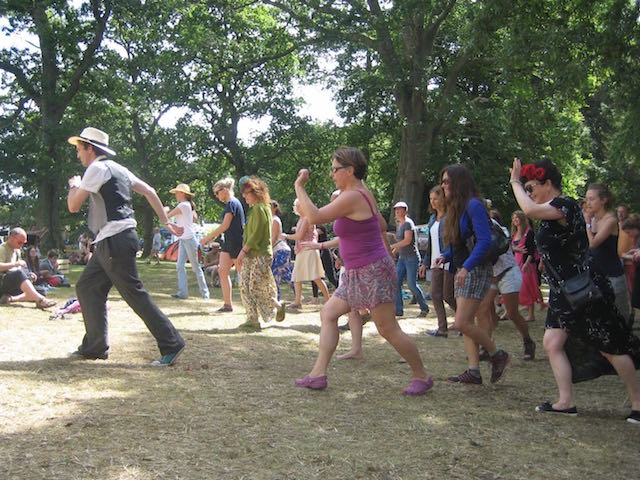
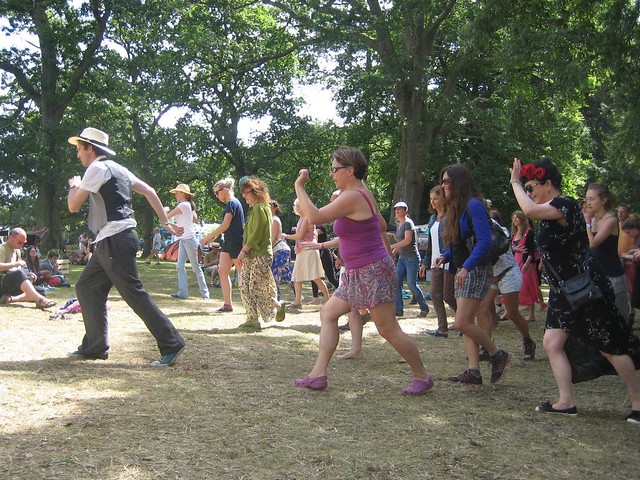
    When dancing side-by-side Charleston, the leader has their arm around their follower’s waist. The follower needs to sit back into this arm slightly, and the lead needs to push against their follower’s back. This creates a slight compressive force between them, which is equal and opposite.

    To signal to the follower that the leader wants to move forwards, the leader moves forwards themselves, and in doing so, increase the compression in the connection, which causes the follower to accelerate forwards.

    To signal to the follower that the leader wants to move backwards again, the leader moves backwards themselves, and in theory, this reduction in compression should cause the follower to accelerate backwards.

    In practice, what we see is leaders moving backwards, and become disconnected from the followers. This disconnection reveals that they never had that matched compressive force in the first place: the pre-stress was missing.

    If that compression is there to start with, if one person reduces the compression by pulling away, the other starts moving towards them. If there is no compression, and one person reduces the compression by pulling way, the two simply separate from each other.

    So, to get the connection right, get the pre-stress right.

    Related posts

  • The Margherita Principle for decision-making

    The Margherita Principle for decision-making

    Pizza
    Pizza (altough not quite a Margarita)

    I’ve been promising friends this post for some time, especially those that have eaten in a restaurant with me recently. In the season of good will and consumption, this rule of thumb helps us make better menu choices. But as a decision-making tool, it goes much deeper, helping us (re)discover the real value in things.

    The principle is simple: the best value pizza in a restaurant is the one at the top of the list, usually the Margherita.

    This realisation first came to me last year at a pizza restaurant by the Canal St Martin in Paris. The 6€ Margherita offered: a delicious and filling meal – the prototypical pizza; a nice warm place to sit; the atmosphere of the restaurant; banter with the waiter; a view over the canal; a small basket of bread and a bottle of tap water; and chilli oil.

    The next pizza on the menu was the Fungi. At 7.50€ I was getting everything the Margherita offered plus a chopped mushroom. At 1.50€ that’s a bad value-for-money mushroom. And from there on down – Fiorentina, Vegetarian, Quatro Staggione – the value just keeps on going down.

    The cheapest thing on the menu usually gives you the most, the rest are opportunities to spend more money with diminishing returns. (Incidentally, as Tim Harford explains in his book ‘the Undercover Economist’, menus are usually structured in ways to give customers the opportunity to spend as much money as they want to.)

    The benefits of the principle

    • By applying the Margarita principle not just to pizza but also drinks and coffee, I was able to have a pizza, a glass of house red and a shot of espresso for 10€ all in.
    • It’s a training in simplicity, which as Thoreau argues in Walden, is the route of happiness.
    • It’s a training in looking for the real value in things.

    What about non-linear effects?

    My colleague David pointed out to me that the principle may not be applicable if the combination of extra ingredients amounted to a taste that was greater than the sum of it’s parts – a sort of non-linear taste progression.

    I concede that this sort of topping alchemy may be possible, but in reality it would have to deliver significant extra value to be anywhere near as valuable as the initial Margherita. Besides, another colleague of mine, who is also Italian, claims the Margarita is the best tasting pizza anyway – so why add anything more?

    Broader application

    The Margaherita Principle is a sort of mix of the Pareto Principle and the Law of Diminishing returns, and has applications beyond pizza choice. It helps get greater clarity of thought when making decisions.

    For example, I was recently agonising over the order in which to publish various blog posts. But then a realised that the greatest value outcome was just to get the post published. There may be some marginal benefit to publicising them in a certain order; however that was much less than the value of just getting the material online and circulated. Worse, the time I was spending worrying about the order to publication was time that I wasn’t spending writing – and I might have ended up publicising nothing at all.

    Another example related to the branding of a training course that I am involved with developing. At this stage, we are not sure how the course is going to evolve, and so it was difficult to decide what direction to take the branding. But, applying the Margarita Principe, I realised that the most important thing is to at least get something published, which we could then revisit as started to run and iteratively develop the course.

    The fallacy of menu choices

    As I write, I realise that we often have less control over our experiences than we think. A restaurant is probably quite a high control scenario: we choose what we want to eat and drink; choose our company; and with care, the topic of conversation; and things usually go to plan. In reality, we often have less control over the projects that we manage than we think. The branding example above illustrates this. It is very hard to know what the best way to describe a training course is until you run it and see how the content evolves in practice. With this sort of thing, the best approach is make quick decisions, see how they work in practice, and then re-evaluate along the way.

    In a restaurant situation, this is akin to not ordering your main course until you have finished your starter, and then waiting until later to order dessert. This is decision making on the basis of feedback – literally!

    The horror of advanced menu choices

    Given all of the above, the worst possible decision-making scenario with regards to menus is when you are sent dinner options for a conference or a corporate meal a month in advance and you have to choose then. How on earth are you going to know what you want to order that far in advance?

    In these situations, Margheritas are rarely available, so here I apply the Tiramisu principle: always choose the first option as long as it is vegetarian, and along is it isn’t Tiramisu, which is the food of the devil and should be avoided at all costs.

  • Sorting out your lego – the Eiffelover guide

    Sorting out your lego – the Eiffelover guide

    image

    If you own a big pile of Lego, then sorting it into separate boxes for different sorts of parts makes it much quicker for you to build anything you want to. I have found that the creative potential my haul of lego is multiplied manyfold by the simple act of separating it out. All of a sudden, when I can see what types of pieces I have, the ideas flow much more quickly, and the time lag between having the idea, and it manifesting itself in physical form is much reduced.

    The question is knowing where to start. There are so many types of pieces, it doesn’t work to have a pot for every single type. I’ve probably completely sorted my Lego three times in my life (so far), and I think the categories that I have now are pretty effective. So to save you thre trouble, here they are.

    Helpfully, since the first time I sorted  my Lego, the Internet has been invented, and so it is now much easier to find commonly agreed names for pieces. In the lists below I’ve included some links to to photos of the pieces that I am talking about. I’ve organised the following list according to the size of tub I needed for each part. It’s the relative size that’s important here.

    8L tubs

    Base plates

    • Lunar landscapes
    • Road pieces
    Miscellaneous
    • Train buffers
    • Rigging
    • Pirate ship hull
    • Pirate ship sails
    • Pirate ship masts
    • Monorail track and pylons
    • Train track

    4L tubs

    Bricks
    These are your standard building bricks. You would think that the protypical lego brick would be the most common, but compared to other bits I have relatively few of these. 2 by X bricks (X>1)
    Wheels and tyres
    This is for wheels of all shapes and sizes, their tyres and the plates with axle stubs attached onto which little wheels and wagon wheels can be fixed. This is the biggest tub of all.
    Large plates
    For those large base plates that are at least 4×4
    Narrow long bricks
    These are like beams. These are 1 bx X bricks where X>3, but with no side holes
    Narrow long bricks with holes
    As above but with holes in so you can push through axles.
    Small bricks
    This is probably the modal category of my lego bricks. You are much more likely to find one of these than a standard 2×2 brick. Includes:
    Wide plates
    I think of these as planks 2 x X where X>1
    Narrow plates
    These are thin plates – 1x X where  X>3

    2L tubs

    Automotive paraphernalia
    Space paraphernalia
    Pieces for making space rockets and space stations, such as

    1L tubs

    Little plates
    These are among the smallest pieces
    Slopes and arches
    There are lots of variations of arches and slops, and the nomenclature can become a bit confusing.
    Round bits
    There is some ambiguity as to whether some of these pieces should really go under space paraphernalia.
    • 1×1 cones
    • 1×1 round brick
    • 2×2 cone
    • 1×1 round plates
    • 2×2 round plates
    • 2×2 round brick
    • antenna
    • 2×2 curved brick
    • 4x4x2 cone
    Hinges
    When I was a kid, hinges were my favourite part. Now I have a whole box full of them. They include:
    People and their accessories
    A box full of Lego people is always fun just to play with on its own. I throw in all the accessories too such as:
    • Shield
    • Spear
    • Sword
    • Cutlas
    • Lance
    • Torch
    • Knight’s helmet flame
    • Musket
    • Pistol
    • Oar
    • Spanner
    • Hammer
    • Broom brush
    Pirate/medieval 
    • Horse harness
    • Flag with 2 clips
    • Streamer (type of flag)
    • Barrels
    • Treasure chest
    • Treasure
    • Canon
    • Castle panel sides
    • 3×3 angled corner brick
    Windows and doors
    • Includes hinges for windows and shutters too.
    Town
    Parts for building suburbia
    • Mailbox with door
    • 2×4 winch
    • Street furniture
    • Car wash pieces
    • Long fencing
    • Petrol station parts
    • Emergency services parts
    • Roadworks parts
    Flora and forna
    • Small tree
    • Conifer
    • Flowers and stem
    • Palm tree leaf
    • Sharks
    • Monkeys

    0.5L tubs

    Holders
    Pieces for clipping things too, like personal accessories
    • 2×3 curved plate with hole
    • 1×1 plates with vertical clip
    • 1×1 plate with horizontal clip
    • 1×2 plate with vertical bar
    • 1×2 tile with top bar
    • 1×2 plate with handled bar
    • 2×2 brick with ball joint
    Wall elements
    • These are the pieces that make up the walls of castles and the sides of vans and trucks
    Lattice fences
    • 1x4x1 lattice fence
    • 1x4x2 lattice fence
    Lights
    • Transluscent pieces usually used for making headlights and tail lights
    Light holders
    • 1×1 brick with 1 side stud
    • 1×1 plate with side ring
    Small tiles
    • 1×1 tiles
    • 1×2 tiles
    • 2×2 tiles
    Long tiles
    • 1xX tiles where X>2
    Angle plates
    • 1×2/1×4 Angle plate
    Turntables
    • 2×2 turntable
    • 4×4 turntable
    Axles
    • Cross Axles
    • Threaded cross axles
    Things that go on cross axles
    • Gears
    • Right angle axle connector
    • Collars
    Pins
    • Half pin
    • Grey pin
    • Black pin
  • Use these 5 apps to create distraction-free time.

    Use these 5 apps to create distraction-free time.

    We need distraction-free time to make progress on our creative projects. At the same time, we rely on online networks and information to nourish our ideas. The trouble is, spending time online is rarely distraction-free. So, is it possible to get the best of both worlds?

    The short answer is yes. In this post I share the strategies that I have adopted to maintain distraction-free time while working online. These include five apps that I regularly use to manage what information I see and when.

    This post follows on from my previous post 9 ways to build creativity in your organisation, focusing on steps that individuals can take to manage their own creativity. Expect more from me on this theme in coming posts.

    Principles

    There are four principles that underpin my approach:

    1 – Know your mode

    In his book ‘Getting Things Done‘, David Allen tells readers not confuse time when you are processing actions with time when you are completing an action. The same is true for working online. Be clear about whether you are meant to be processing emails/tweets etc, completing an action or, importantly,  spending time reading.

    2- Avoid the inbox

    Enter the inbox, get all the information you need out of there, and then leave. If you return when you are in the middle of something else, don’t be surprised if you get distracted.

    3- Reduce the back-and-forth

    Just because we can respond instantly, doesn’t mean we have to. Instant responses lead to communication inflation, and erode time to ourselves.

    4- Remove notifications

    Until the last 100 or so years, toothache must have been the bain of adults lives – always nagging, never leaving us in peace. Today, in the age of modern dentistry, what nags us instead, what disrupts our peace, are social media notifications. If we set regular times to look at our various feeds, we don’t need notifications.

    5 apps

    I am being generous with the definition of ‘apps’, here to mean both ‘app-lications’ and ‘app-roaches’.

    1 – Task management – use Bullet Journal

    The first app isn’t an app at all, it’s an instead-of-an-app. For years I’ve been playing around with lots of different apps for managing tasks. My favourites are OnmiFocus and Trello. The trouble with even the best of these tools is that they allow you to create never-ending lists of tasks that you could never get done.

    Bullet Journal is different. It is no more than a set of rules for using a paper notebook to manage your tasks. It’s simple, and it works. Each day you write down the tasks you need to complete. At the end of the day, you either forward incomplete tasks to the next day, by physically writing them out again, or your forward it to a page for the week or even month ahead, again physically writing down the tasks. It works because every time you re-write something you end up saying to yourself, ‘come on, am I actually going to do this?’

    I’ve been using it for four months now and I’m hooked. Here’s a great intro video for using Bullet Journal.

    2 – Information storage and online workspace – Evernote

    Evernote is a great tool for storing information and for working online. Here’s how I use it to minimise distractions.

    1. As I am processing emails, if I find something that I need to refer to later for a particular project, I forward it to Evernote (which you can do straight from your email), adding meta tags in the subject line so that Evernote can file it for me.
    2. When I am working on a project, I can then look through the notes filed in Evernote that have that project tagged. It’s a great way to get to the information without being distracted by something new in the inbox.
    3. I do all first drafts of longer emails in Evernote – I can even send them from Evernote without having to go back into my inbox.

    One really neat feature of Evernote is that as you use it more and more, it starts to recognise when something you are writing is similar to a previous note – this has the added bonus of making connections that I hadn’t otherwise seen.

    3 – Online reader – Instapaper

    Until I discovered Instapaper, I had basically stopped reading the articles that people were sending me online. This happened as a consequence of being rigourous about not spending more than two minutes processing any email that someone had sent me. If a correspondent had sent me something to read, I would forward it to a folder called ‘browsing’ where it would then languish unread.

    And then I discovered Instapaper, an app that you can forward reading informaiton to. When you open the app, all your articles are there but with the formatting stripped away. What’s left is really clear to read.

    Since then I usually make at least one time a week when I sit down with a cup of coffee and read my articles for the week on Instapaper. It is really refreshing to spend time reading longer articles from end to end.

    If I like what I read, I forward it to Evernote, tagged for appropriate interests. If I want to share it with other people, I forward it to Buffer – see below.

    4 – Schedule social media posts using Buffer

    I know from looking at the analytics that most of the people that follow me are online at times when I’d rather not be. To get round this I use Buffer to schedule some of my social media posts to maximise the chances that the people I want to see the post do. Buffer allows you to set up daily posting schedules for all your social media channels. You can save time by posting to several channels simulataneously. Buffer will tell you what times your audience members are interacting with your contact, and can adjust your posting schedule to suit.

    5 – Clear yesterday’s messages today

    This is a great rule of thumb that I only came across recently in the Guardian (thanks Jenny for the recommendation!). I’ve long abandoned the idea of having an empty inbox – as a strategy it takes too much time and I think can actually lead to more email traffic. In this approach, on any given day, you should only aim to deal with yesterday’s emails. You are still responding within 24 hours, which is a reasonable timeframe, but your response has to be carefully written as you have to empower your correspondent to act without hearing from you againfor 24 hours.

    Conclusion

    My Dad once quoted the following to me (I am hoping he can remember where it came from and can tell us in the comments to this post): getting information from the internet is a bit like trying to take a sip of water from a fire extinguisher.

    Yes, we need access to online information and networks for our creative projects – we just need to manage the flow.

    Related posts

    Image credit: Fire Extinguishers by Claudio González is available under CC-BY-2.0

  • The Happy Grid: prioritise your action list in a more fulfilling way

    The Happy Grid: prioritise your action list in a more fulfilling way

    The Happy Grid is a technique I devised a few months ago to help me use short and long-term happiness as a guide for daily decision making. Since I’ve been using it, it has had a hugely positive impact on me: I am better at prioritising work that makes me more fulfilled, and hopefully the people I collaborate with get more out of working with me.

    In this post I’ll explain how to set up your own Happy Grid. I’ll also go through the four different task types that make up the grid, and what these can tell you about the pressures that influence how you use your time. It’s a long post, but stick with it as I think there’s a lot of useful stuff here.

    Background

    The story begins at the end of a busy week. I had ticked off all the most important actions on all my major projects. I should have been feeling happy, but I felt quite depressed and that depression extended into the weekend. It was confusing because this was supposed to feel good – to have not sucumbed to distraction and to have done the things on which other people were depending on me.  Yet I didn’t feel any payback for getting to the end of the list.

    A few weeks before I had been on holiday. One of the things that I do when I have some time away is write two lists in my journal: the first, a list of goals for the year ahead; the second a list of things I feel happy doing – a list of things that bring happiness in the moment.

    I decided to map my ‘done’ list against my lists of goals and things I enjoy doing. The result was very revealing.

    The Happy Grid Diagnostic Test

    To help you get the most out of reading this post, I suggest you do the following quick diagnostic test right now. Do it quickly on a piece of paper. You can always go back and do it more thoroughly. I am going to ask you to write down four lists.

    Current goals

    First, write down a list of your current goals. Think of goals on a say a 3- to 6-month horizon. Include in your list the sort of state you want to find yourself in. So for instance one of my goals was to spend more time doing face-to-face teaching. Another is to spend time with people who positively influence my thinking. Neither of these goals are to do with attaining some kind of status. Think broadly. Do you want to spend more time inside or out? Are there things you want to learn?

    Anti-goals

    The second list of of things you don’t want to achieve. Think of these as anti goals. For instance I don’t want to spend more time in front of a computer screen. I don’t really want to get involved with teaching projects where I don’t have influence over the content. I don’t really want to get involved in building a new knowledge management system for the business, even though this is something I’ve done before. Knowing what you don’t want to do is as important as what you do, but is sometimes harder to elucidate.

    Enjoy doing

    The third list to write down is a list of things you enjoy doing.. Think of things that make you go into a state of ‘flow’ when you do them, when time just flies by because you are enjoying yourself, but equally which keep you challenged. Think of things that you get a buzz out of because you enjoy doing them. My list includes things like teaching and coaching, writing new teaching material. But it also includes travelling by train, cycling, spending time with family and friends, spending time outside.

    Drag list

    The fourth list to write down is things that you don’t enjoy. These are things that feel like a drag. For me that list includes small-scale management of projects. This is something that I don’t enjoy and recognise that there are other people who do this much better than me. It also includes the opposites to the things I enjoy doing – so I don’t enjoy being inside all the time, I don’t enjoy being alone for too long.
    You are now ready to create your own Happy Grid.

    The four types of tasks

    I reasoned that the tasks on my to-do list fitted into one of four categories, which I labelled and described as follows:

    • Type-1 tasks – Tasks that are goal-aligned and enjoyable. These are things we should prioritise because they feel good to do, and because they are contributing to a goal.
    • Type-2 tasks – Tasks that are not goal aligned, but nevertheless enjoyable. It feels good to do them but it doesn’t help us reach one of our goals.
    • Type-3 tasks – Tasks that are goal-aligned but unenjoyable. We generally need to do them for long-term happiness but doing so doesn’t feel good.
    • Type-4 tasks – Tasks that are neither goal-aligned nor enjoyable. Doing these doesn’t feel good in the short- nor the long-term.

    Creating your Happy Grid

    Create a 2×2 grid and label the four quadrants as follows.
    Type 1     Type 2
    Type 3     Type 4

    Now, go through each entry in your current to-do list, and write it down in the quadrant of the grid to which it corresponds.

    When I categorised and wrote down my list of completed tasks for the previous week, I found that the majority of what I had got done were Type 4 tasks: tasks that are neither enjoyable nor contribute towards longer-term aims, with a smattering of Type 3s and Type 2s. Revealingly I didn’t have anything written down in the Type 1 quadrant, the one that feel good to do and contribute towards some positive goal.

    I felt I had landed upon a key prioritisation tool for the week ahead.

    Understanding the four tasks categories

    Clearly we don’t have the luxury of only doing Type-1 things. But categorising things in this way can at least help us be more aware of the nature of the list of tasks before us, and can help us make more fulfilling choices about what we do. And beyond being simply aware, we can actively make decisions to help us spend more time doing things that we enjoy.

    Let’s explore each of these categories in turn.

    Type-1 tasks – goal-aligned, enjoyable tasks

    In an ideal world, we’d spend the majority of our time doing these sorts of tasks. Half the trouble is simply knowing what these goal-aligned, enjoyable tasks are. The aim of the happy grid is to help us identify the sorts of things we enjoy doing and that are goal-aligned, and to make sure we are spending at least some of everyday doing things that are likely to make us happy.

    By regularly repeating the diagnostic exercise described at the start of this post, you can start to recognise  Type-1 tasks. Identifying and writing down type-1 tasks is the first step to making sure you spend more time doing what makes you happy. The second step is managing and steadily reducing the time you spend doing Type-2, Type-3 and Type-4 tasks.

    Type-2 tasks – non-goal-aligned, enjoyable tasks

    Type-2 tasks are enjoyable in the moment but don’t necessarily contribute to what you want to achieve long-term. The worst Type-2s are tasks that you enjoy doing but that lead you towards anti-goals, the things you really don’t want to be achieving.

    Browsing the web, flicking through social media and sharpening your pot of colouring pencils generally fall into this category. Another word for this type of Type-2 task is procrastination. For procrastination Type-2s, you would be better off doing something from your Type-1 list. If you set up your Type-1 list appropriately, you will always have something more enjoyable to do. But also falling into this category without being procrastination are Type-2 tasks that you might enjoy doing in their own right, but that doing too often will steer you off course from the goals you do want to be aiming towards.

    To give a personal example, I enjoy developing concepts for online learning tools, but it would be a non-goal to build a career in which I end up having to spend more time in front of a computer. On the contrary, my goal is to spend more time doing more face-to-face teaching and to minimise screen time, and so spending time developing proposals for online learning tools, while enjoyable in the moment, is not necessarily getting me any closer to where I want to be.

    This is a very common scenario in the workplace. The organisations that we work for tend to reward us for doing things that help the organisation meet its aims. Less enlightened organisations do it by fiduciary means; more enlightened organisations might try to align individual goals with organisational goals, but in practice this is hard, and in reality tasks get allocated on the basis of best person for the job, rather than best job for the person.

    As Peter Drucker points out in his book, ‘How to manage oneself’, it is up to us as individuals to tell managers what work we do well and how we do it best, and not up to our managers to guess.

    By definition, Type-2 tasks are enjoyable, and so on any particular day, doing lots of Type-2 tasks isn’t a problem. But over time, time spent on Type-2s is at the expense of time on Type-1 tasks. So how should we reduce the Type 2s?

    Minimising the Type-2 tasks

    For the procrastination Type-2s there are lots of options for reducing distraction, which I will cover in another post. As for the more structured work-based Type-2 tasks you can:
    • Avoid taking them on in the first place. Before you take on a new task, look at where it will go on your Happy Grid. If it’s a type 2, consider politely turning it down.
    • Try delegating – after all, just because a task doesn’t align to one of your goals, it might align to someone else’s.
    • Try to find a way to recast the task so that it does align to one of your goals.

    Type-3 tasks – goal-aligned, unenjoyable tasks

    If you don’t get Type-3 tasks done then you won’t meet your goals. But the chances are you are unlikely to do Type-3 tasks because, by definition, you don’t enjoy doing them.

    Here you have two options: either delegate the task, or set up a regular routine that ensures you get them done reliably and in as short a time as possible in order to liberate your time for Type-1 tasks. A personal example of such a routine is that time I set aside each week to deal with expenses. I don’t enjoy it, I need to do it, and I do it the same time on Wednesdays without fail. Then the rest of the week I don’t have to think about it.

    It is important to be disciplined about carrying out the routine so that you be confident the rest of the time that these Type-3 tasks can wait until the next time you carry out your routine.

    Type-4 tasks – non-goal-aligned, unenjoyable tasks

    These are the tasks that we want to minimise. We don’t enjoy doing them and they aren’t getting us any closer to any of our goals. As I discovered, a week full of Type-4 tasks is an unhappy week.

    As well as not making us feel good, Type-4 tasks come with an opportunity cost: they are preventing us doing any of the other 3 types of task, all of which would make us happier, not least of all, Type-1 tasks. We should make it our business to try and reduce as far as possible the Type-4 tasks on our list.

    Minimising the Type-4 tasks

    We can start the Type-4 purge using the techniques we used for Type-3s and Type-2, in decreasing order of preference:

    • Avoid taking them on in the first place – once we know what counts as Type-4, we can spot it before we say yes.
    • Try delegating – as above, there may be someone else for whom the task is more enjoyable or for whom the task is more goal-aligned.
    • Set up a strict routine for getting this type of task done quickly. See the notes above for Type-3 tasks. If you take this approach, experiment with running the routine as infrequently as possible so you don’t let the time spent doing it creep up too much.
    • Just don’t do the task and see what happens. It is very easy to think that a task is important when we are caught up in the moment, but given some distance and time, some tasks can just go away. Either someone else does them, or, because it isn’t done, alternative options open up. You may well end up being thought of as unreliable, but better that than being reliable at doing something you don’t want to.

    If having worked through the above options, and you decide you can’t’ simply not do the task, then it is time to start asking some serious questions about the sort of activities that you do. But saying that is not so gloomy as this process gives you a constructive way to talk about what it is you do want to do.

    Prioritisation using the Happy Grid

    Setting up your first Happy Grid should be revealing in itself. But it is also meant to be a decision-making tool. Having distributed your tasks into the grid, what should you do first?

    For grown-ups, I don’t think the get-your-homework-done-before-you-go-out-to-play approach counts any more because there are so many factors influencing us to get things done to meet other people’s aims. You need to start prioritising your own goals. So I would recommend starting the day with either a Type-1 or Type-3 task. Let the happiness that you derive from getting that thing done first then set the tone for the day ahead.

    Reflective use of the Happy Grid

    I am finding that the more times I use the grid, the better I am getting at understanding my own motivations and goals, and the more adept I am becoming at making sure I am not getting lumbered with things that I don’t enjoy doing.

    I believe being more aware of these things is better for everyone. As Peter Drucker says, we are much more likely to perform well doing work that we enjoy and that we are motivated to do. More philosophically, Seneca said ‘Life is long if you know how to use it’. It is up to us to positively decide how to use our time in a way that will make us happy.
  • Packing lists are sexy

    Packing lists are sexy

    I love packing. But until four years ago, I hated it. I would put off packing my bags, leave it to the last minute, forget things, bring the wrong things, and make the same mistake again next time. Packing became a lot more complicated when I started to pack for a child too.

    Then one day I realised I needed to create a master list, a go-to reference that could be honed over time. From that day, I started writing, collecting and comparing my packing lists. Fifteen festivals, a dozen trips abroad and countless weekends away later, I have arrived at something pretty solid, which I share now for people who hate packing as much as I did, or who agree with the lifestyle design principle of improving situations which regularly annoy us.

    It is probably worth mentioned a couple of drivers in the choices I have made:

    • I usually travel car-less – in fact I actively seek out ways of not going by car to take me off the beaten track – so I like to travel light.
    • Wherever I go, I often end up teaching swing dancing, which means that even in my regular kit I have some dance paraphernalia.
    • These previous two points mean there is usually a mixture between high-tech lightweight stuff, and heavy vintage stuff. Lightweight vintage stuff is the holy grail.
    • I hate luggage that you tow. Just saying.

    As Seneca said, ‘May your faults die before you do’. I’ve got many left to fix, but being bad at packing is now safely interred. I even enjoy it.

    The master packing list

    This list is made up of a core which rarely changes, then a series of bolt-ons, which are groupings of things I commonly find I have to add for certain types of trip. There is some duplication between different bolt-ons so beware.

    The core

    Clothes

    (Starting from the top)

    • A flat cap – I used prefer a wide-brimmed number like a Panama but it just gets in the way and falls off when dancing.
    • Sunglasses – usually really cheap ones so I don’t get annoyed when I lose them.
    • Coat (eiher a ski jacket or waterproof + fleece)
    • Tweed suit jacket – works for work, and for swing teaching. Really handy for docs when travelling.
    • Long-sleeved lightweight smart shirt.
    • Tie
    • Cravat (good accessory for swing gigs)
    • 2x t-shirts.
    • Thin jumper.
    • Belt
    • Underwear
    • Swimming/running shorts
    • Jeans – lightweight Rohan jeans – dry super quickly. Work for smart/casual.
    • Lightweight trousers – only sometimes – something light to perform in, or hang around a festival.
    • Thermal underear – takes no room, can use for PJs or to keep warm in sleeping bag.
    • Waterproof trousers – sometimes.
    • Socks
    • DMs/converse
    • Flip flops.

    Equipment

    • Diary + pen&ink, pencil.
    • Book
    • Phone + charger
    • Wallet
    • Computer/iPad + charger
    • Headphones
    • Speaker for teaching
    • Water bottle
    • Coffee cup.
    • Washbag
    • Wipes
    • Credit card swiss army tool
    • Travel towel.
    • Mudflappers business card

    Swing teaching bolt-on

    • Garland
    • Hawaiian shirtWhite short-sleeved shirt (Mudflappers standard issue)
    • Brown smart waist coat
    • Dancing waist coat
    • Big grey trousers + braces
    • Big black trousers – possibly
    • Dancing shoes – possibly
    • Cable for connecting ipod to soundsystem.

    Cycling bolt-on

    • Helmet
    • Gloves
    • Pump
    • Repair kit + multitool
    • Lights
    • Locks
    • iPhone holster
    • Bungee

    Camping bolt-on

    • Tent
    • Sleeping mat
    • Sleeping bag
    • Liner – sometimes
    • Hot water bottle – sometimes
      Torch

    Camping cooking bolt-on

    • Large collapsable water carrier
    • Plastic bowl
    • Plastic spork
    • Mini chopping board
    • Sharp knife
    • Bag for left-overs
    • Trave wash and scrubber
    • Jet boil, cafetiere plunger, gas and stand.
    • Coffee

    Three-year-old daughter

    • Hats – sun hat for the day and warm hat for the evening
    • Festival headphones
    • Jumper
    • Hoody
    • Fleece
    • T-shirts
    • Long-sleeved t-shirt
    • Leggings
    • Trousers
    • Underwear
    • Dress
    • Shorts
    • Tights
    • Wellies
    • Crocs
    • Onezee for sleeping in/evenings.
    • Sun glasses
    • Swimming costume
    • Nappies
    • Wipes
    • Face paints
    • Lego
    • Books
    • Sticker book, pens
    • Colouring book
    • Fancy dress stuff
    • PensBubbles

    Happy travels everyone!

  • HS2, Seneca and the art of persuasion

    HS2, Seneca and the art of persuasion


    Persuasion is an important skill for designers: to convince the audience of an idea is it to allow it take root and evolve. Unfortunately, I never have been convinced of my persuasive powers, which is why I am always on the look out for useful tools of persuasion. The following two approaches from very different sources caught my attention this week. Add them to your thinking toolkits if you think they are of use.

    The case High Speed 2 and the Overton Window

    I first read about the concept of the Overton Window in Owen Jones’s excellent book, ‘The Establishment’. The Overton Window is the range of ideas that the public will accept. This range is not necessarily fixed and can be stretched or shifted one way or the other. Jones argues that the UK ‘establishment’ has successfully shifted the Overton Window in the UK by supporting pressure groups that consistently present in the media opinions to the right of popular acceptability. Over time and exposure these once-extreme views become more acceptable, shifting the Overton Window to the right. In this article from the US National Review the author claims the Overton Window in the US is moving the other way, although I can’t say I agree.

    From an engineering design point of view, it is interesting to see how the high-speed rail Overton Window has shifted, as described by Simon Jenkins in his article ‘HS2: the zombie train that refuses to die’. When the first enthusiasts started proposing high-speed rail in the 80s, the railways were in decline – it was an extreme view. Then, little by little, things nudged the terms of the debate towards acceptability: the construction of the channel tunnel; the lack of high-speed line to the tunnel; the eventual opening of the first high-speed line to the tunnel; how high-speed rail could see off the need for a third runway at Heathrow. Eventually, the terms of the debate shifted from whether or not to have a high-speed line, to which route it would take.

    And so, there we have persuasive tool number one. It is possible to shift an audience to your way of thinking by consistently and repeatedly advocating ideas that are just beyond acceptability and looking for small wins that slowly shift the Overton Window in your favour. Think of it more as a stopping train than a high-speed approach.

    Seneca says don’t be scruffy

    My second persuasive tool is not so much a technique but a starting point and comes from Seneca’s ‘Letters from a Stoic’. In his fifth letter he advises his correspondent to

    “avoid shabby attire, long hair, an unkempt beard, an outspoken dislike of silverware, sleeping on the ground and all other misguided means to self-advertisement”

    The aim of his advice is to make his friend, a fellow philosopher, more acceptable in appearance to his audience so that he may may have more influence over them. He goes on,


    “Let our way of life be not diametrically opposed to, but better than that of the mob. Otherwise we shall repel and alienate the very people whose reform we desire”.

    And so there we have our second tool of persuasion: don’t be so extreme as to put people off. Be of them, be recognisable to them so that they might accept you.

    Acceptable unacceptability?

    I encountered these two approaches in the same week, and initially thought them opposed: one is to champion views from the extremes and draw people towards them; the other is to champion views from a position of acceptability. So which is better?

    Seneca anticipates and resolves this paradox for us by recommending that,

    “one’s life should be a compromise between the ideal and the popular morality. People should admire our way of life but they should at this time find it understandable.”

    So perhaps where these approaches meet, and where designers should aim for is acceptable unacceptability.

    Related posts

  • 3 safety valves for high-pressure decisions

    3 safety valves for high-pressure decisions

    IMG_0374

    One of the things that I’m learning through the design and creativity coaching sessions that I am running with engineers is that it is not a lack of design skills but rather other factors which impede their ability to do good design. One such factor is making decisions under pressure. So I’ve put together this three-part process to help relieve the pressure. It is written with engineers in mind but as you can see this approach is much more widely applicable.

    Decision-making, of course, is an important part of design: a designer has to continually choose between multiple options; to decide whether an idea is an appropriate response to a brief; to decide whether or not to proceed. But beyond the design process itself, our decisions also affect how much time we have to do design, or do to do anything else we want to spend our time on.

    In the workplace, we are often forced to make decisions under pressure: “Can you make a quick decision for me so that we can move ahead?” “I know it’s not what we originally agreed, but could you just a spend a bit of time working out how to do this for me?” “This situation has arisen, I need you to quickly decide which of these two options to go for. If we get this wrong, we will be pouring money down the plughole, blocking sewers and causing effluent to back up and flood streets with a tide of… ” Sound familiar?

    So here are three pressure valves to try. They won’t work all the time, but hopefully something in here will serve as a reminder to help you buy more time.

    1. Change the rules of the game in your favour

    This is the pre-emptive bit. Is there anything you can do to avoid being put into a situation where you have to make high-pressure decisions in the first place? Here are some things to think about.

    • Create the rules – in many organisational contexts there are usually rules in place to dictate how much time you have to respond to a query. These are there in part to ensure quality of service, but also, to make sure you have the time to think carefully about your response. Is it always necessary to respond straight away?
    • Be clear about response times – you can often look ahead in a project and see when people are going to be asking you make decisions. Pre-empt the process by being clear about how much time you will need to respond to queries, and perhaps even set a time after which you won’t be able to accept any more.
    • Limit access – are you being asked to make the decision because you are the most available person? If you were less available, would the people asking you to make a decision actually figure out the problem for themselves? When I spent a year working in a research laboratory for my Masters degree, as hand-in time loomed, the leader of the research group made it very clear when he would be answering queries and when we wouldn’t, and we made very sure we carefully prepared our questions for him before his door would shut.
    • Avoid making decisions altogether – decisions are hard work. Maybe if we made fewer of them, we might have more energy to make the important ones correctly? For more on this theme I highly recommend Tim Ferris’s post ‘The Choice-Minimal Lifestyle: 6 Formulas for More Output and Less Overwhelm’

    2. Unload the emotional baggage

    We are not fully rational beings. Our brain functions evolved in a very different environment. (Sometimes I wonder how we might have evolved had natural selection taken place in the modern open-plan workplace – maybe a blog post for the future?). Naturally, emotions influence our decision-making.

    As Daniel Goleman explains in his book Emotional Intelligence, the part of our brain which engages with higher level thinking is also the part that has the job of suppressing our more deep-seated emotional reactions. If that pre-frontal cortex is busy surpressing that little voice in our head that is telling us we are in trouble, then it is not available to work on problem solving. He suggests that this is the original of the phenomenon of not being able to think straight. Here’s some things to try out to help unload the emotional baggage that is stopping us from thinking straight.

    • Is this really your problem? – before you start exercising your decision-making faculties, ask if this is even your decision to make in the first place. Sometimes all the person asking needs is someone to talk to about the situation, afterwhich they can make the decision themselves.
    • Be upfront about the emotional angle – sometimes it is best to be upfront about the emotional consequences of being asked to make a decision. For example, when a client asks you to make a difficult decision on a job, you could just say, look, this decision is going to be difficult for me because I feel this or that. Your interlocutor may have had no idea about the way you were feeling about the situation and may easily be able to offer much more clarity or even change what they are asking.
    • Is the decision reversible? – If it is, then don’t get stressed over it, especially if it frees up your mind to think about the things that really are important to you (see again the Tim Ferris post mentioned above).
    • Talk through your concerns with someone – talking through the situation with someone can help you more objectively assess the issues at hand and perhaps diffuse some of the emotional content of the decision. I often find that when I have a mental block about a decision, it is often because I am scared of consequences that I have conjured up which, on talking it through, I realise are imaginary.
    • Is it just bad luck that the decision has landed on your desk? – sometimes, despite the best planning, fortune is not smiling on you and you have to make a difficult decision. This realisation can at least remove the guilt factor so that you can get on with thinking about the right solution.
    • Perhaps there is no right answer, and that’s not your fault – I have just started reading Senneca’s Letters from a Stoic, and it immediately reminds me that we are sometimes faced with situations which are just outside our control. It takes emotional discipline, but if we can recognise when we are faced with such a situation, we can get over the emotional reaction and try to think about what the best, or least worst, solution is.

    3. Open the decision-making toolbox

    Unnecessary decisions avoided, emotional baggage checked in, here are some of my favourite tools to help with making decisions.

    • Ask someone else what they would do – this sounds obvious, but something that I have observed recently is that this technique helps even if you disagree with what they propose. I recently had a difficult work decision to make regarding a customer. I had a roughly formed view, and wanted a second opinion. My colleauge argued a different course of action, but when I heard their reasoning, I was more convinced that my own approach was the right one.
    • Go back to the brief – the brief or the project objectives are there to provide guidelines on how to make decisions in the project – use them.
    • How would you feel about this in the future – this comes straight from Chip and Dan Heath’s book Decisive, which has a range of great decision-making tools in it. They suggest trying to take the long view on a decision. Thinking how you might regard your decision in ten years’ time helps to remove you from your daily milieu and encourages you to think about broader factors which might influence the decisions.
    • Invert the problem – Ask yourself what decision would lead to the worst possible outcome for everyone. Sometimes thinking about problems from the opposite way round can give you insights which you never saw from the other side.

    If you have any suggestions of your own about how to take the pressure out of high-pressure decisions, then please share them with other readers by commenting below.

    Related posts

  • 9 Ways to Build Creativity in your Organisation

    9 Ways to Build Creativity in your Organisation

    Creativity doesn’t happen on its own, it happens in a social context. So if we want to build creativity in organisations, we need to focus not only on the individual but also on the overall system within which creativity takes place. So argues leading creative thinking psychologist Mihally Csiskzentmihalyi in his article ‘The Implications of a Systems Perspective for the Study of Creativity’, which appears in Robert Sternberg’s Handbook of Creativity. I’ve been working on a longer post in which I extend his systems model to explore design as a whole. That post is becoming a bit theoretical, and so I offer up this post as a series of practical suggestions that can be applied by anyone who would like their organisations to benefit from more creative thinking.

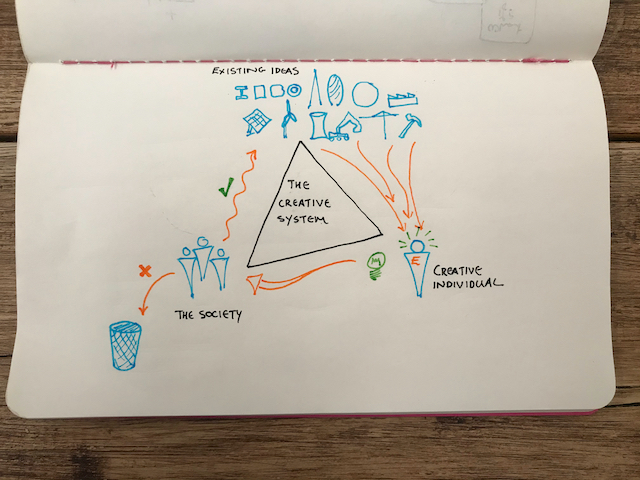
    The systems model of creativity contains three elements: the creative individual; the domain, which is the pool of existing ideas; and the field, which is the people who decide whether or not an idea is a good one. Using this model, the individual creates new things by adapting ideas that have gone before (things in the domain). These novel outcomes are then judged to be acceptable or not by a third party (the field), say colleagues, a client, a design jury etc. If the idea is judged to be good then it enters the domain – that is, it becomes recorded somehow and can then become the seed of another idea.

    This model is useful from an organisational development perspective because it offers three areas to focus on for stimulating more creative outputs. I have seen that in practise, certainly in engineering, Csikszentmihalyi’s terms ‘domain’ and ‘field’ can be confusing, so I propose ‘database’ and ‘audience’, respectively.

    The following is a series of practical suggestions for how to develop each of these components of the creative system in organisations.

    Building the creative database

    1) Seek out innovation

    If you want to your organisation to be at the creative forefront of a particular domain, then make sure your people have ready access to the latest thinking in that domain. Contact with the existing thinking on a topic can promote thinking about the next iteration.

    I recently vistied a school where the principal wanted to encourage his staff to start thinking creatively about how to furnish their classrooms. To seed their thinking, he ordered in some innovative new chairs designed to improve the way children study in classrooms. He just put them out in his office. When members of staff asked about them he said try them out. Staff members then started experimenting with these chairs in different configurations. In the end, they ended up using completely different models that they’d researched in configurations that suited their own needs. This creative thought had been stimulated by allowing them to dip their toes into the domain of chair design – which then prompted them to dive in.

    2) Become a hub for different ideas and ways of thinking

    As Csikszentmihalyi points out in his paper, cities that have been trade hubs have commonly been centres of innovation because ideas and ways of thinking from completely different domains can come together.

    Find ways to turn your organisation into a hub for different ways of thinking. Invite people in with completely different backgrounds and areas of expertise to talk about their work, what innovation is in their domain, and how they approach problems. Doing so will widen the available categories in your database from which ideas can be drawn.

    3) Record your existing ideas

    It’s hard to make a change to something which isn’t already described.

    For example, so much of what we do in organisations, particular in knowledge-based organisations, is not written down. Doing so doesn’t feel very creative. But doing so is a necessary starting point for creating new approaches to how we might work.

    Recently I was worried that I wasn’t being very imaginative about the way I spent time with my daughter. So I started by writing down all the things that we already do together that we particularly enjoy, and quickly, starting from this list, I was able to create a load of new suggestions.

    Get the existing thinking down on paper so that it can seed the next creative iteration.

    Building creative individuals

    4) Collate

    This is about the creative individual engaging with the database; about building a palette from which they can paint their ideas. Song-writers collect lyrics and interesting chord progressions. Chefs collect recipes.

    I collect facilitation techniques by always asking people I know after they’ve attended a workshop what techniques they enjoyed. I write them down in Evernote, and refer to this list when I am designing a workshop.

    The thing about the process of collation is that it requires attention, more than just a passive engagement with the content. I believe this attention makes it easier to recall useful information in the moment of creation.

    Identify the area in which you want to be creative, and build your scrapbook.

    5) Create distraction-free time

    There are times when we need to focus our attention on generating ideas. There are other times when we let our mind wander, when the subconscious chews on the problem, and then the idea spits up. Both of these thought processes can be jeopardised by distraction. But in the modern workplace, distraction is everywhere: from notifications on every screen we use, to the interruptions that ensue from open-plan offices.

    In the coaching conversations I have with people about developing design skills, the lack of distraction-free time is one of the commonest barriers to creative thinking.

    For individuals, creating this time has two components. The first is mastering the technological distractions, getting rid of the notifications that keep us flitting from one place to the next. The second component is identifying and persuing activities that let your mind wander.

    Organisations that want to create distraction-free time for their staff should consider developing work processes that don’t rely on staff being permanently plugged in. They should also allow their staff to work at the time and places in which they are most creative.

    6) Generate and communicate

    The creative process works through interaction between the creative individual and the audience. It is a dynamic relationship.

    To start with, the individual needs to be creating ideas. There are a range of techniques for stimulating this divergent thinking, which will be the subject of another blog post.

    But having the ideas alone is not enough, they need to be effectively communicated to the field. Draw ideas, write them down, pin them up where they will be seen, talk to people about what you are thinking, and you will give your ideas the chance to grow.

    Building the creative audience

    7) Produce surplus energy

    This comes straight from Csikszentmihalyi. If a group of people are spending all their energy fighting for survival then they don’t have the energy for creative activity.

    Most organisations could probably prioritise their activities in such a way as to make more energy (time, money) available for creative thinking. Creativity is a social affair: everyone has a role to play, either as the conceiver of ideas, or as the audience. Therefore it is important that everyone feels there is enough fuel in the tank to justify time spent on creative pursuits.

    8) Build a culture of listening

    It is through dialogue with the relevant audiences that the creative individual can assess the merit of their ideas.

    As Nancy Kline describes in her book ‘Time to Think‘, we often do our best thinking in conversation with others, but this requires careful attention on the part of the listener, letting them develop their thoughts without interruption.

    Talking about ideas should be a hallmark of creative organisations.

    9) Build a culture of challenge

    There is a lot of evidence for intrinsic motivation supporting creative thought (a summary of this to come in a future blog post, no doubt).

    One way to build intrinsic motivation is through identifying in conversation challenges that need addressing. If the challenge feels like their challenge then they are more likely to be intrinsically motivated towards tackling it.

    Another technique for building intrinsic motivation is to challenge individuals to reach further in their thinking, and helping them to remove hurdles which may have been holding them back.

    To conclude, creativity doesn’t happen in isolation in people’s heads, it happens in a context. To create more creative organisations, we need to work on the context as well as the individual.

    Related posts

  • Hazel vs. Hornbeam (the fate of best-laid plans)

    Hazel vs. Hornbeam (the fate of best-laid plans)


    Cutting back the Brambles at Hazel Hill Woods

    A recent weekend of conservation work Hazel Hill Woods has revealed to me another woodland analogy for the struggles of daily life, and how we might overcome them. I am calling the analogy, Hazel vs. Hornbeam (the Fate of Best-laid plans).

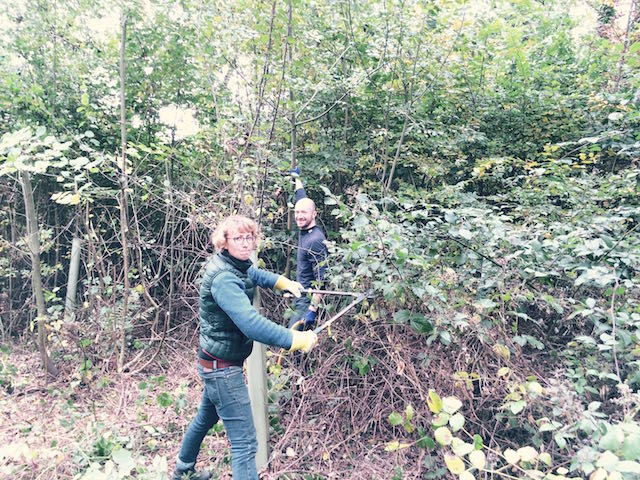
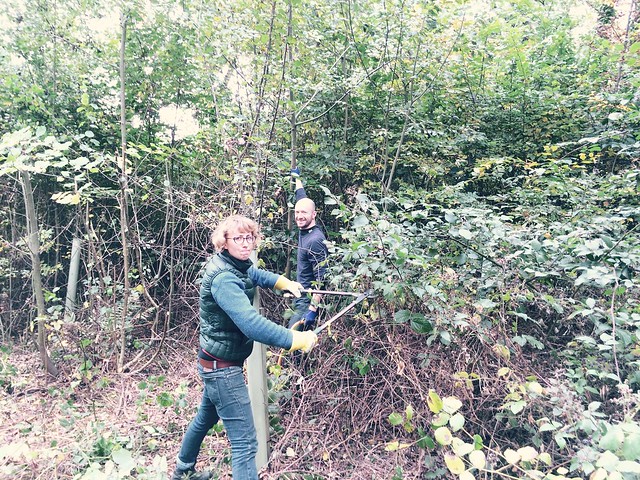
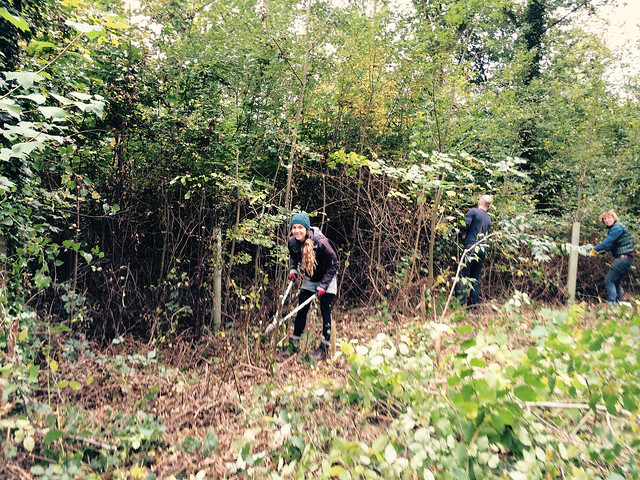
    It emerged when a team of us at the woods were cutting back an area of regenerating hornbeam trees in a clearing. In this patch the hornbeam had shot up to a dense crowd of 6ft-tall finger-thick stems, knitted together with a head-height mat of bramble. Our conservation aim had been to cut these back to chest height to stop them from encroaching on an important butterfly corridor through the woods.

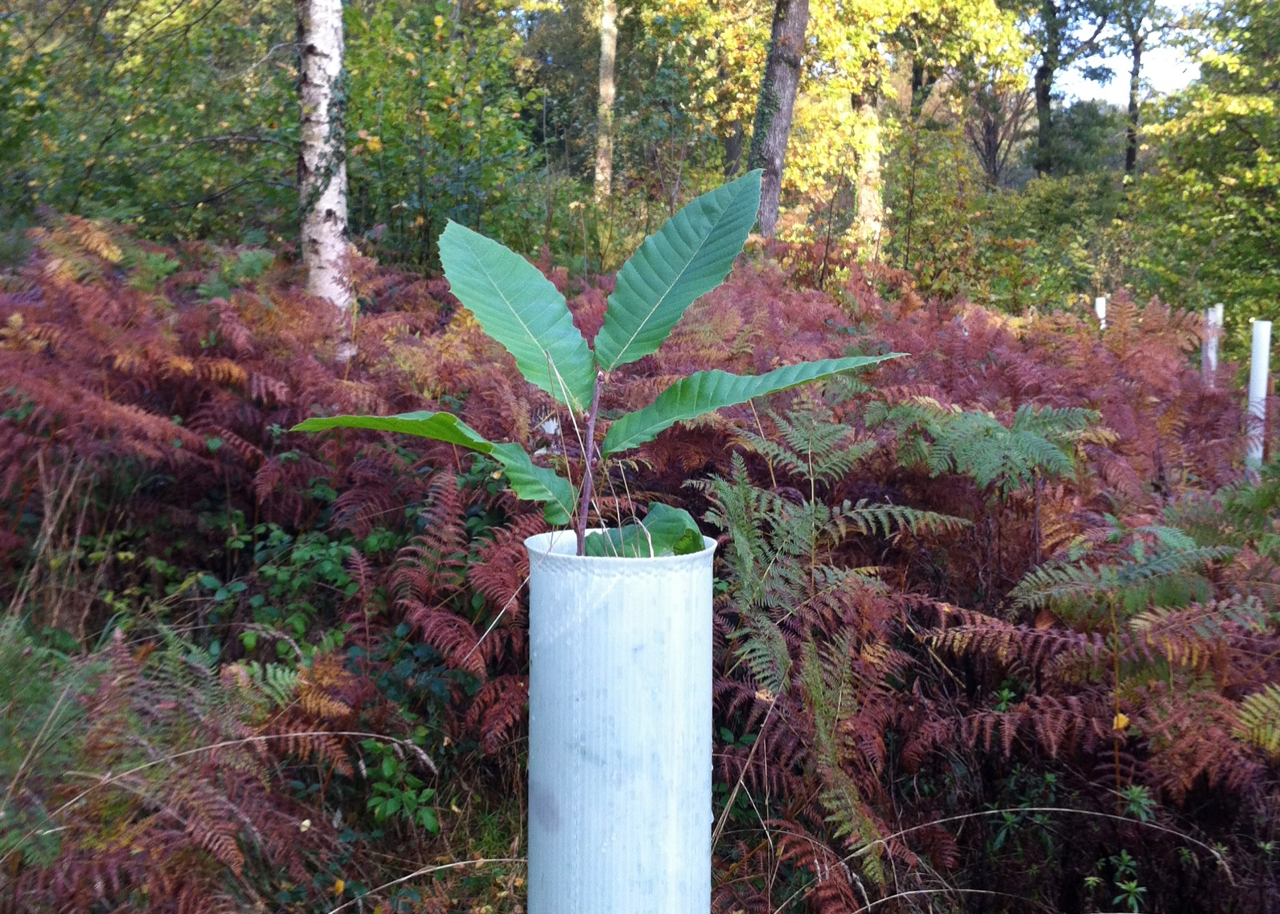
    As we slowly cut our way into the dense thicket we started to discover small trees in protective tubes that were being crowded out by the hornbeam and strangled by the bramble. As we uncovered more hidden trees in tubes, we realised that there was a whole array of them that had once been planted. We found hazel, oak, ash, holy and blackthorn struggling to grow in their protective tubes. They had been planted on another conservation weekend years ago but had been forgotten about, and were now being smothered by the naturally regenerating growth.

    The woodland context

    There is a hundred-year plan at Hazel Hill to transform the forest ecosystem from that of a commercial wood, in which just a few species grow, into a much more biodiverse environment, which is much more likely to be resilient to changes in climate. The area in which we were working had previously been occupied by sycamore trees. This undesirable species had been cleared with a grant from the forestry commission, and in the clearing created, a range of broadleaf species had been planted (the hazel, oak and ash), along with shrubs (the holly and the blackthorn) to create ground-level growth, which had been absent in the commercial forest.

    Left to its own devices however, naturally regenerating hornbeam and bramble had quickly grown up and overtaken the planted trees. The former were on the way to winning, the battle for light, already killing some of the latter , and leaving the others struggling. In the short-run there is nothing wrong with hornbeam and bramble, but their short-term success was putting at risk the long-term resilience of the wood by preventing the development of a diverse tree species.

    Best laid plans

    For me, those broadleaf trees in their little tubes represent best laid plans that were being left unattended because of short-term factors. There are competing conservation priorities in the woods, and these planted trees had been left unattended. Our attention is the light that enables our best-laid plans to flourish. But too often we are forced to direct our attention towards short-term priorities: the deadlines that need to be met, the clothes that need to be folded, the colleagues that need to be briefed, the clients that need to be satisfied.

    In the short-term these more immediate matters flourish as they benefit from our attention, but they don’t necessarily lead us to where we want to be. As you wade into the thicket of regrowth, all is lush and green at the top, benefiting as it does from the light of the forest clearing, but underneath, all is brown – there is no diversity. Down there is where our best-laid plans languish.

    The feeling of being surrounded

    At one point, four of us were working simultaneously and in close proximity in the same thicket. Though we were probably only a few metres apart we couldn’t see each other for all the hornbeam branches and briars that surrounded us. At times, our repeated cuts didn’t seem to be making a difference. I’d turn around and the path that I had driven would have closed in behind me.

    This is what it can be like when we feel overwhelmed with matters competing for our attention. After some struggling, my strategy became to just to keep going in one direction. After a sustained, focused effort the lattice of branches and brambles would suddenly give way. A sense of being surrounded turned into a sense of direction; of liberation: I felt freer, able to pause and choose where to go next.

    Cutting back our brambles

    As I type, I still have some small scratches on my arms from cutting back the brambles. Clearing away some of the things which grab our attention can hurt. There is the pain of letting someone down, or the fear of getting into trouble. But what I noticed as I cut through barbed branches was that they fell away to nothing; untangled and trampled they lost all of their strength, freeing a way through to the trees in tubes.

    Personal conservation strategies

    Conservation work gives you time to think, and so I set my mind to thinking up strategies for protecting our best-laid plans.

    Log what you planted

    It sounds simple, but creating a map of what trees we planted where might help us to remember to tend to them every so often. During conservation weekends in which we are planting trees, getting the trees in the ground is a big achievement. It seems unnecessary to create a map of where we planted them. Surely we won’t forget? Inevitably we do. Simply noting down our plans gives us a fighting chance of remembering what we intended.

    Regular tending

    Once we know what we planted, one strategy is to make time to regularly tend our saplings. It would only take a small amount of systematic attention to keep the hornbeam and brambles in these area in check.

    Occasional clearouts

    Sometimes though, we don’t have the luxury of being able to provide these things with regular attention. The alternative is to do what we did this weekend – every so often, go in there and cut back all the distractions and bathe our best laid plans with the totality of our attention. In daily life this might amount to a digital detox. Or, for a more substantial clear out, we might consider taking what Daniel Pink calls ‘Sagmeisters’ – regular sabbaticals interspersed in our working lives.

    Get real

    Our aim wasn’t to clear out all the hornbeam and bramble. Hornbeam regeneration is a natural part of the woodland ecosystem, as are the brambles that weave their way amongst them. We just need to create a bit of space for those slower-growing but ultimately very beneficial species to establish themselves. Similarly, short-term matters are part of the humdrum of daily life – we just need to carve out enough time to give our long-term plans the attention they deserve.

    Get things established

    Ocourse, the aim of all this cutting back is to enable the hazel, ash, oak, holly and blackthorn to establish themselves. As they start to mature they can look after themselves, and the hornbeam and brambles will subside. This is the point that Steven Covey makes in his book ‘The Seven Habits of Highly Successful People’ when he talks about what happens when we prioritise the important over the urgent. If we make time for the important things, we should see the number of urgent things we need to deal with reduce.


    One day, decades after the scratches on my arms have healed, we’ll be able to sit under the shade of these broadleaf trees and know that our efforts to tend to them were worth it.

  • Does going for a walk improve design?

    Does going for a walk improve design?

    Taking a walk at Port Eliot Festival

    I have just read an interesting piece on the Stanford university website, ‘Stanford study finds walking improves creativity’ (article found via this news piece on the Hazel Hill Wood website). The article describes research that has for the first time investigated the impact of ‘non-aerobic walking on the simultaneous creative generation of new ideas and then compared it against sitting’. I had an intuitive idea that going for a walk improves the quality of my ideas – an example that springs to mind is a catchy tune I wrote on short walk back from the library at college. This research shows that ‘creativity levels were consistently and significantly higher for those walking compared to those sitting.’ What’s more, they stayed high for a short period after sitting back down again.

    But the striking thing revealed by this research is that the walking environment doesn’t seem to make a difference. I had assumed that going for a walk outdoors in the woods would be good for my creative thinking, but this study shows that the boost to creative thinking is just as powerful when you take a walk on a treadmill in a featureless indoor room!

    This result has obvious implications for how we set ourselves up to do good design, but there is another significant finding reported further down in this news article that also has important implications for design. While walking helps to boost divergent thinking, it is shown in this study to impede ‘more focussed thinking, characteristic of insight’.

    So how can we use these findings when think about how we do design work?

    In the design training that we have been developing at Think Up, we describe design as a process that starts with identifying a need and establishing a brief, that moves through idea generation and testing, and moves on to choosing the best ideas. These stages are linked by iterative loops which take you back through the process many times.

    The obvious place for divergent thinking is in the idea generation phase, but there are others. Right at the start when we are identifying the need, we often need to think around the problem to check if it has been framed properly. We also need to have an open-minded view of the client brief if we are to unpick the unwritten and implied elements of what the client wants. We also need to apply some divergent thinking to enable us to think of all the factors that are going to determine whether our ideas are good ones, rather than simply relying on the usual tests we apply.

    There is also an obvious place for convergent thinking: at the part of the design process where we are refining our ideas, and when we are testing them for adequacy against the brief. But there are other places where we need insight: when we are trying to choose the factors in the brief that are going to dominate the design; and when we are trying to make a decision based on hard-to-compare factors.

    So there is a place for walking and a place for sitting in design.

    Unfortunately, from what I have observed in design offices, we tend to do too little of the latter and not enough of the former. What we could learn from this research is to be more mindful of the type of thinking that is required at any one time and to move or stay still as appropriate.

    We should also beware of metaphorical trip hazards. There’s no use in going for a divergent thinking walk if we are distracted by our smart phone en route. Turn it off! And our creative reverie stands a good chance of being extinguished if when we return to our desks we find a set of monthly sales figures demanding our attention. In other words it is probably a good idea to think about that environment you will be returning to at the end of your walk.

    Related posts


  • Choppin’, loppin’, circus and swing – notes from Hazel Hill Autumn Conservation weekend 2015

    Choppin’, loppin’, circus and swing – notes from Hazel Hill Autumn Conservation weekend 2015

    Last weekend 38 people came down to Hazel Hill for our annual Autumn Conservation weekend for two days of woodland conservation and human restoration. We design the weekend to be a mixture of invigorating outdoor conservation work and relaxation in the woods, with a dose of entertainment thrown in too.

    Building on what we learnt from last year, we began the conservation work on the Saturday with a series of activities that would make an immediate and visible difference in the woods. An on-going conservation priority at Hazel Hill is the creation of butterfly rides, which serve two purposes. The first is to create the sort of wide path through the woods that enable the many rare species of butterflies that inhabit the surrounding fields to pass freely through the foerst. The second is to allow light in to the lower levels of the wood in order to increase the biodiversity.

    Widened butterfly ride leading to the Forest Ark

    This year we began our work by significantly widening the ride that runs from the forest ark to the southern cross, which had become significantly encroached upon by regenerating hornbeam. In the process we uncovered and liberated around twenty-five broadleaf trees in tubes that had previously been planted and which were being smothered by the hornbeam. I remember planting some of these trees myself on my first conservation weekend six years ago, and so I am pleased to see them being rescued. Any of this weekend’s participants returning to this spot in the wood in ten years time are now much more likely to find ash, oak and hazel trees maturing, thanks largely to their work this weekend.

    (more…)

  • Designers: turn off your phone – harness the wandering mind

    Designers: turn off your phone – harness the wandering mind

    Fireside reflection at Hazel Hill wood. Photographer: Peter Clarkson
    Fireside reflection at Hazel Hill wood. Photographer: Peter Clarkson

    I recently read Daniel Goleman’s excellent book Focus, and I have been thinking about how our ability to focus affects our ability to design. This thinking was the basis of a workshop session that I recently wrote about harnessing ‘wandering mind’, that mode in which the brain roams freely and forms new associations which are the basis of creative thought. I piloted this material as part of Think Up workshop on creativity that we ran at Hazel Hill wood in July, which seemed to go down well, so I am sharing it here.

    Below is a modified extract from some of the course materials associated with this activity. I’d be interested to know if anyone reading recognises these phenomena or tries the approach I am recommending.

    In his book Focus, emotional intelligence pioneer Daniel Goleman explains that the brain can really be understood as having two distinct sets of circuitry: the lower brain and upper brain. The lower brain whirs away in the background working on solving problems without us even noticing. Its activity only comes to our attention when it produces an idea as if from nowhere. The upper brain by contrast is the seat of self-control and is the part of the brain that we actively focus on a problem.

    In evolutionary terms, the lower brain is the older part. The lower brain is the source of our impulses and emotional reactions. The upper brain can repress these impulses, but at the cost of diverting our attention from the design challenge on which we want to actively direct our focus. In this instance, the lower brain circuitry is causing a hindrance to creative thinking.

    However, the lower brain does have a crucially important role to play in design. Research shows that in the moments before people achieve creative insight, their lower brain has been in a state of open awareness. In this state, the mind wanders freely, widely and without judgment to create new associations. When these new associations are made, the upper brain then locks in on them and fishes them out into our active attention.

    In order to harness our wandering minds as part of the design process, our upper brain needs to be ready to spot a good idea when it emerges. To do this we need to do two things. The first is to make time in which we stop actively thinking about things and let out thoughts come to us, for example, going for walk or even going on holiday. The second is to minimise distractions, which divert our active attention away from spotting new ideas as they emerge from the lower brain. In other words, making time we when turn off our smart phones and blocking out interruptions.

  • Are you doing a French Mazurka?

    Are you doing a French Mazurka?

    I’m writing this on the train home from Towersey Festival to which I had been invited by my friends Nat and Sophie to help out with some swing teaching and performing for the Shooting Roots line-up. Towersey was my introduction to folk festivals, and it felt like a gateway to a fascinating world of music and dancing to discover. Nat and I were there to teach a 1 hour Lindy hop class and to do some dancing with a band in the evening (see the gig notes below for info).

    Towersey felt quite unlike any festival I’d been to before, and I think the main difference is the way in which people are engaged with the music and dance that is being performed. The crowds are attentive; they really listened in our lesson; they were really paying attention in the band performances. People are having a great time but there is none of the rowdiness, (except for being kept awake by a choir singing in four part harmony at 1am in the campsite). I love the way people carry around instruments, and there is space for people to jam. There was also the largest selection of real ales I’ve seen at any festival. And what’s more people walk around with their own tankards, which as far as I’m concerned is the best way yet to reducing festival waste.

    (more…)

  • What makes a good conceptual design statement? – working notes

    What makes a good conceptual design statement? – working notes

    Gateshead Millennium Bridge
    Gateshead Millennium Bridge

    Today I am working on course material related to defining what is a good conceptual design. I think, in construction at least, it is quite difficult to identify good conceptual design from the finished project. One can judge a finished project on the basis of the final outcome, but unless you have had an overview of the whole design process, it is hard to know how much the final project resembles the original concept design.
    One clue is in competition sketches, if they are available. It is tempting to suggest that if a simple early-stage sketch exists that closely resembles the final project, then we have a good conceptual design. Good examples might include Paxton’s sketches on a napkin for Crystal Palace or the Utzon’s competition sketches for the Sydney Opera House. But (and I’m not suggesting it was the case for these two examples) it is not beyond designers to create a post-rationalised concept diagram. And while this idea of the simple sketch is also beguiling, it is much more appropriate for projects that resemble a sculpted object, rather than a complex system.
    From a training perspective, if we were to stand in front of a building and seek to judge the quality of the conceptual design without knowledge of the early-stage design process, I think we’d be on shaky ground. The approach we will adopt instead is to spend time defining what a good conceptual design statement looks like so that designers can judge the quality of their conceptual designs at the start of the project.
    There are lots of definitions of what a good conceptual design statement is. My colleague Ed McCann has pointed me towards a helpful description from the world of interior fit out. In his book Shaping Interior Space, Rengel describes the three elements of a good conceptual design statement as:
    1. Talking more about the solution than the problem
    The place for the statement of the problem is in the brief.
    2. Selective
    Here he means it talking about the dominant factor which is going to define the design approach. Is it a question of how a long span is going to be achieved, huge forces are going to be resisted, or what the human experience is.
    3. Economical
    Careful use of words to pack the most into the fewest words.
    These three elements are something I can work on with a group of learners. We might begin by asking them to compare different conceptual design statements, and get them to elucidate these rules; and then get them to create their own statements.
    One key modification I will make to this set of rules to make them equally applicable to sketching as to words.
    If you are reading this and have either your own definition of good conceptual design statements that you use, or particularly good examples of conceptual design that you’d like to share, then please comment below.
  • Follow the deer tracks, who knows where they’ll lead

    Follow the deer tracks, who knows where they’ll lead

    Searching for deer tracks at Hazel Hill Wood

    Every time I go to the woods I find new insight or inspiration that I can use in my teaching. Today’s comes from deer tracks.

    I know the main tracks that criss cross Hazel Hill Wood well. I could probably draw a reasonably accurate map of the place from memory. In a sense, I’m a bit sad that as I have got to know the wood better, I don’t get lost there any more.

    But there’s a whole different level on which the wood can be explored, and on which I can lose myself. If you pay attention as you wander down any of the main tracks, you’ll see thin paths going off into the undergrowth. They are easy to miss at first because no sooner than they are off the main path they dive off under low branches. These are in fact deer tracks, and they criss-cross the wood on a different plane – about two feet high. When you start to look for them you’ll spot them everywhere.

    For me these deer tracks are an invitation to go off track, to go into the unknown and see to where you end up.

    I followed such a track this morning and it led me through dark pine trees and then suddenly I was into a patch of widely-spaced silver birch pushing up through a carpet of lush muss. The place had a sort of magical green light. I had been to this place once before but would not have known how to find it.

    To follow deer tracks you have to go off course, you have to pay attention – it’s not the easiest path. The tracks take you via unknown, sometimes-secret places, and bring by new routes to places you already know. And because the journey is different, the destination is not the same.

  • Seedling analogy for organisational change

    Seedling analogy for organisational change

    A couple of time in the last year or so I have used what I call the ‘seedling analogy’ to explain what I believe to be is a sustainable approach to organisational change. My inspiration came during a conservation weekend that I was involved with at Hazel Hill Wood several years ago (see my post about that weekend here).

    One of the main aims of the conservation activities at the wood is to reintroduce  hardwood trees. Hardwoods were common here before the site was cleared for commercial forestry. For many years, conversation groups had been spending weekends planting new trees. But only a small number took root and flourished. However, on the weekend in quesiton, the conservation team were trying a new approach. Rather than planting new trees, they were looking for places where the seedlings of the desired species had already sprung up from the floor. Having found the seedlings, they protected them from browsing deer by putting a tube around them.

    (more…)

  • Being Bazalgette – a new work experience idea

    Being Bazalgette – a new work experience idea

    Joseph Bazalgette by ICE Archive is licensed under a Creative Commons Attribution 4.0 International License.Based on a work at expeditionworkshed.org.
    Creative Commons License
    Joseph Bazalgette by ICE Archive is licensed under a Creative Commons Attribution 4.0 International License.
    Based on a work at expeditionworkshed.org.

    Today at Think Up, Ed McCann and I had lunch with Mike Chrimes from the Institution of Civil Engineers. The main topic on the menu was how to articulate the value to practising engineers of a knowledge of engineering history. Earlier in the day the two of us were talking about how tech could be used to create engaging simulations of work experience for use in schools.

    And then as the main courses arrived the light bulb lit up above my head: why not create a mini module for schools that allows students to take on the role of a famous engineer say for a week. For example, students could spend a week being Bazalgette, chewing over the task of how to transfer vast quantities of poo across London. It would be a fun, playful exercise, but which could be used to develop a range of workplace skills as well as hopefully getting students thinking about what engineers did and do now. There’s more to come on this, but I need to sleep on it…

  • 5 months of paternity leave – the highlights

    5 months of paternity leave – the highlights

    Since April, through a mixture of parental leave and part-time working, I’ve been the primary carer for our daughter. Tomorrow I resume (almost) full time office work so I thought I’d take a moment to write down some of the highlights of being a full-time stay-at-home Dad.

    1. Getting to spend extended periods of time in the company of my daughter, getting to know her, her getting to know me, and creating the kind of bond that could never have formed had I stayed behind my desk.
    2. Confidence – before I went on parental leave, I would need a list of instructions just to look after the little one for the afternoon. Five months of responding to a baby’s needs is a great confidence builder – and teaches you to improvise.
    3. Cooking – I’ve been doing lots of cooking – sometimes four meals a day. – and its been really enjoyable. I have tried my hand at loads of new dishes, but perhaps more importantly I have a few tricks up my sleeve for when there’s a tired hungry baby at the table and the cupboards are all but bare.
    4. Time outside – weather-wise I couldn’t have chosen a better five months to be on parental leave. Our baby seems to thrive on being outside, so I’ve been making the most of the opportunity to get outdoors. In the early days she’d only nap in a buggy on the move – never in her cot – so I’d walk some times ten kilometres in a day interspersing naps with playgrounds we’d find along the way. More recently things flipped, and she’d only sleep at home, but that just means we spend more time in local parks. The thought of spending winter indoors is daunting.
    5. Getting to know local people and the neighbourhood. Like it or not (for some people this is a surprise): having a baby immediately connects you to your neighbourhood and the people in it. I like it – I can’t walk out the door anymore without recognising a parent out and about. The funny thing about taking over as primary carer is that lots of people already knew our baby but had no idea who I was – luckily the little bean does introductions (see below).
    6. Seeing the world through a different set of eyes – this is quite a parenting cliché so I’ll just illustrate one small example of it. Our baby waves at complete strangers. She smiles at them and elicits a response. Before I know it, strangers are waving back, and I end up talking to people I never would have otherwise. For her there are no social barriers. People are just people, and they are all fair game for a wave and a smile – even if they are combat-ready paratroopers holding enormous machine guns doing security patrols of French train stations.
    7. Witnessing step-by-step developmental changes – it is amazing to have watched our little one become less little. The change over five months – from a sitting grunting baby to an all-waving furniture-surfing toddler with an ever-growing repertoire of gestures to communicate what she wants – has happened through so many increments. A highlight of these last few months has been being able to watch so many of these little changes happen.
    8. Time to think – all that walking around parks, hanging out washing and long lunchtimes have given me plenty of time to think – valuable time that I wouldn’t have had behind my desk.
    9. Time out from my office job – having had lots of time to think, I return to my office job with new ideas and ambitions.

    Of course there have been low points. There have been some afternoons when I have looked at the clock at 2pm and wondered how I’m ever going to get to bedtime. Norro virus was the nadir. But you get through. Overall though, these last five months of parental leave have been fantastically rewarding.

    I am delighted to see more parents sharing the parental leave. I now ask prospective Dads not if they are taking parental leave but rather how much. The question still comes as a surprise to some, but I hope that one day, shared parenting is the norm.

  • Diary – Feral/Flora and Forna/Hook, Line and Singer

    [pe2-image src=”http://lh5.ggpht.com/-MY6w8huA6Ic/UchQA4uxxhI/AAAAAAAAAbU/Fi8B9PgfMl8/s144-c-o/13%252520-%2525201.jpg” href=”https://picasaweb.google.com/101339256689884186918/62413?authkey=Gv1sRgCN3nl-Dng7iRGw#5893048088573101586″ caption=”Gillespie Park” type=”image” alt=”13 – 1″ ]

    I’m now several chapters into George Monbiot’s book Feral, and I’m enjoining it immensely. It is already making me think differently about the ways in which I choose to engage with my surrounding environment. It also makes me realise my vocabulary of flora and fauna is really very limited – it hardly seems to extend further than the words in the picture books I read our daughter (and many of those animals aren’t native to South East England!) This ignorance worries me: if I don’t have the words, then how can I have the ideas?

    Inspired, I took a walk down to wonderful Gillespie Park, and wandered round the meadow. The info panel told me I’d find wild lupins, which I did – not a new word, br a moment’s appreciation of a plant I’d never stopped to see growing in that space.

    I’ve written previously about participating in conservation weekends at Hazel Hill wood. This week the opportunity has arisen to be involved with helping to shape the educational programme at the wood. It is a place I greatly enjoy visiting, and so I look forward to the chance of getting more involved.

    This afternoon we sang two engineering themed songs from Cerys Matthews’s book, Hook, Line and Singer: London Bridge is Falling Down; and The Runaway Train. This week I’ve been listening to Britten arrangements of folk songs, and an idea for a new engineering song, based on one of these tunes, is buzzing round my head – a cross between Boris Vian’s ‘La Java des Bombes Atomiques‘ and the ‘Emperor’s New Clothes’. Watch this space.

  • Building the Forth Bridge on Stage

    Building the Forth Bridge on Stage

    Cantilever bridge human model

    For my first time on stage at Science Showoff back in November 2011, I decided to recreate the famous public demonstration conducted by engineer Benjamin Baker to reassure the public that his planned Forth Rail Bridge would stand up. For me, this demonstration captures both the engineering daring-do and the showmanship of the period.

    In Baker’s experiment, two stout volunteers sitting several metres apart represent the enormous pylons of the Forth Bridge, their arms out-stretched to represent the top chords of the structure, broom sticks stretching from hand to foot representing the bottom chords of the structure. On a seat suspended between the human pylons a slighter fellow sits representing the weight of a train passing from one structure to the next. What stops the two human pylons from see-sawing in towards the middle under the weight of the central load are the brick counterweights attached to their outer arms. These counterweights represent the massive weight of the approach gateways on either side of the bridge, and show how these gateways play an integral to the stability of the bridge.

    The demonstration is beguilingly simple; recreating it on stage was not. Given the restricted performance space, I had to align the human bridge on the diagonal. Whereas the original experiment was conducted against a wall, mine was done mid-stage, without the benefit of the lateral stability that a wall would have offered. In placed of the broom sticks I created four wooden armatures to represent the bottom booms of the truss so that I could make the necessary connection with the pub chairs – these wooden arms were less sturdy than I had hoped. Finally, as I had arrived at the venue by bicycle, I needed on-site counterweights. The pub were unhappy about me using beer kegs, so one end of the structure was tied down to the underside of the stage, while the other was attached to a hefty base amp.

    The rules of Science Showoff are clear: 9 minutes only on stage. Without the benefit of any rehearsal time, I took to the stage. Three volunteers were selected; all were given fake moustaches for authenticity. Everything was in position, but it all looked very shaky. With a few seconds left, the volunteer in the middle riding the bridge nervously lifted her feet from the floor. Without any wall to lean against, the whole structure began to wobble out of plane, but for a few seconds at least the span was achieved.

    Sadly no photos were taken, but it is a moment I won’t easily forget. I would love to repeat this experiment, but next time I’d build more sturdy armatures designed to actually fit the seats at the venue, I’d do it on a wider stage…and I’d do it against a wall.

    I didn’t know the Science Showoff team at the time, but they have since told me they were scared. Daring do indeed.


  • Negotiating the lifts at Kings Cross

    Negotiating the lifts at Kings Cross

    20130515-131350.jpg
    Pushing a pram, as is my new daily habit, has made me much more aware of the relative accessibility or inaccessibility of London. Today I decided the best option for step-free interchange was to be at Kings Cross, where upon arriving I was presented with the lift schematic shown in this photo. Step-free, no doubt – and that is an achievement in itself – but by no means simple. I had to help two other sets of travellers interpret the map as we processed around the station.

    While I may criticise, the Underground is significantly more accessible to buggies than the Paris Metro, where there are simply no prams to be seen.

    I am of course fortunate that my access requirements are such that, should it be necessary, I can carry the buggy down the stairs. But pursuing step-free access around London does cause me to try out new routes, and to discover bits of stations that I’d never noticed before (at London Bridge, in particular). Perhaps not very profound, but another example of how parental leave is giving me a new perspective on things!

  • Travelling on Eurostar with a baby

    Travelling on Eurostar with a baby

    Travelling on Eurostar with a baby
    Riding in the buffet car

    This week we took our 5-month old by Eurostar to Paris. The experience of travelling with a baby is adding a new perspective to my journeys. Long-distance train travel with a baby is by no means impossible. The couple travelling opposite us on the Eurostar last Friday were on their way to Florence by night train, having recently travelled to Venice and to Madrid by sleeper with their well-travelled toddler. Most things still feel possible – I just feel I want to know a little more in advance. So this post is for the benefit of other people seeking reassurance about travelling on Eurostar with a baby. (more…)

  • Going full circle on the Overground

    IMG_3920

    I feel like a bit of a wally standing here in the rain at Clapham High Street Overground station. There are many shorter ways to get me home, which is diametrically across London from here. I could for example slice straight through the middle on the Northern Line. But I want to take the slow circumferential route simply because for the first time, I can. (more…)

  • Skyfall, starring Daniel Craig…and Bazalgette’s sewerage system

    Being set mostly in London, the latest James Bond film, Skyfall, takes us an action-packed tour of some the city’s great engineering projects: disused Underground tunnels, Bazalgette‘s embankment sewerage system, and even the ancient tunnels under Smithfields, adjacent to the Crossrail site at Farringdon. Even Bond is supposed to be scaling a skyscraper in Shanghai, it is in fact The Bishopsgate Tower (pictured). I was bemused to see that the meticulous plan of the villain seemed to depend on the District line running without delay. Was this meant as a joke?

  • Train + bike: the easy way to get to a festival

    Last year for Cloud Cuckoo Land and this year for Shambala, I’ve taken the train most of the way, and covered the final leg by bike. Often the most difficult bit of festival transport is the bit near the site itself, as country lanes groan under the weight of traffic they were never designed for. Even public transport, where available, struggles as it competes with cars.
  • Hello St.Pancras

    platform-shot.jpg

    For all the publicity in London about the opening of the new Eurostar terminal at St Pancras, passengers leaving Paris on its inaugural day wouldn’t have been any the wiser. The lack of Parisian interest in the new London terminal was underlined by the ticket prices: while it would have cost me over £100 to book a place on a train leaving St.Pancras that day, the cost of a ticket in the other direction was just £29! I can forgive the lack of excitement from that end of the line however. When it comes to high speed train networks, France’s is in its late twenties whilst Britain’s is still teething.

    concourse-shot.jpg

    Until yesterday, once the tunnel had been crossed and England reached, passengers were treated to a short stretch of tantalizing high-speed rail (the first part of the new link has been in use for some time now) before the trains slowed to a dismal trundle on the old line. Well, no more. Unfortunately it was dark so I did not get to see all that pristine Kent countryside that had seen routes for the line changed so many times. Before I knew it, a tunnel under the Thames, then we appeared to be over-ground and then back under again. We popped up for air again at what I guess was the building site for Stratford International before tunneling our way under North London. I remember five years ago a friend of mine living in Highbury had complained of rumbling under his basement flat for a period of about a week or so. He found out, from the council I believe, that those noises had been the tunnel digging machines digging those very tunnels that I was zooming through significantly faster.

    kissing-shot.jpg

    The train popped of the ground one last time and we were cruising into the magnificently lit train station. Words do not do justice to what an amazing site the new station is. Passengers off the train for the first time on these platforms walked in eerie gob-smacked silence. The train shed, with its arches of ‘heritage Barlow blue’ which soar over the tracks to support 18 000 panes of self cleaning glass, makes for quite a destination. Indeed there were plenty of people there who had just come for the opening. At the end of the platforms they posed for photos beneath the 9m tall sculpture of a couple kissing. Europe’s longest champagne bar was not long enough to accommodate the masses who came to toast the new station.

    longest-champagne-bar.jpg

    I was grabbed for an interview by BBC Radio London who were broadcasting live from the concourse. I think I ticked a few of their boxes: not only had I just stepped off a train from Paris, but I was an enthusing engineer (and, as a bonus, someone whose father had arranged the medley of French songs played that afternoon by the LSO Brass section as part of the opening celebrations). On air, I was asked about how long it must have taken to paint the roof, a question to which I had no answer but assured them that it must take less time than that for the Forth Rail Bridge.

    ensemble.jpg

    For me, St Pancras represents the first completed major engineering project university colleagues of mine have been involved with during their summer placements. St Pancras celebrates the engineering of a bygone era, is a fine example of how old can become new, and puts international rail travel back into the national consciousness. Not a bad start!

    family-shot.jpg

  • Au revoir Waterloo

    waterloo-sunset.jpg
    Last Tuesday evening I bid farewell to Waterloo International, the last day that Eurostar will serve this station before it transfers to St Pancras ‘in the (other) heart of London’. Before I even arrived I had fears that the Eurostar staff had packed up and gone as all the signs directing travelers from the Underground up to the terminal had already been whited out. How wrong I was. I arrived on the main station concourse to the sound of live music and the sight of dazzling lights. In the sunken entrance level to the Eurostar terminal, a stage had been set up and a band were playing, none too aptly, “Waterloo Sunset”.

    I am happy to admit that I am a station spotter and have long been. It is cooler than being a train spotter as you get to talk about architecture, your subject doesn’t move so you don’t have to stand their waiting for it, there are plenty of food shops so no packed lunches required, and you can wear any clothes you like. This last advantage makes the station spotter hard to spot. I have blended in all these years and have simply thought that I was alone in my pursuit, unaware that other station spotters were all around me. That is until that evening when they showed their true colours and, in droves, they headed down to Waterloo International to wish it farewell.

    projection.jpg

    The police had crowd control measures in place to stop people pushing into the sunken entrance area. If your name wasn’t on the list (read, if you didn’t have a ticket) you weren’t getting in. By the time I got in, the show was wrapping up, leaving only video footage of the new station projected onto the wall. It felt like mass train station hysteria; one woman had a tear in her eye. Staff stood around beaming, journalists were interviewing. With all the publicity for the new St. Pancras terminal, international train travel has recaptured the public’s imagination. But from this train station 81,891,738 travelers over the last thirteen years have already trained it, internationally. And so one can understand people being sad to see it go.

    But go where exactly? It is all very well to wish a station farewell but it is not going anywhere. What are they going to do with it? Scuttle it? The plan as I understand it is to make the platforms available for comunter trains to use. But what of the long arrival and departure concourses? When I was twelve or so, I saw an architectural model of the terminal with it’s snake-like blue roof. It is hard to believe that this structure will now lie largely obsolete.

    The party was over on the other side of security (the real bouncers). The place has felt tatty for a while now. I can’t imagine the maintenance budget has been kept up in recent months. Shops lay half empty of stock which was annoying as I badly wanted an adaptor. There were girls handing out free cake. Just like at the end of a party.

    hauptbahnhoff.jpg

    The squashed arch roof of the Hauptbahnhof in Berlin

    I rode the escalator up to the platforms beneath their wonderful blue roof. This Grimshaw structure arches over the three platforms. Like that of the Hauptbahnhof (photo above) in Berlin the curving roof is made from a squashed arch which means that the roof in both Waterloo and at the Hauptbahnhof can cover the tracks without having to rise to high. By contrast the un-squashed arch of St Pancras’ roof soars high above the cityscape. Squashing the arch induces bending in the structure. In both cases the structure follows the exact form of the bending moment diagram giving a very pure structural aesthetic. At the Hauptbahnhof the arch is four-pinned and symmetric. At Waterloo, the designers chopped a third off this symmetric arch, giving it its asymmetric shape.

    final-departure.jpg

    With the fanfare far behind, I boarded the train and as we pulled out was reminded that it was not the station that was the problem but the line. As the train bumps through Vauxhall, the carriages bottom-out their suspension. We creaked round a sharp left turn and then screeched through Brixton, presumably deafening those on the platform. By Herne Hill, the train slowed further to skateboard speed. However, after forty minutes of this bumping and grinding, a reminder of what the new route will bring, as the the Eurostar joins the already-open section of high speed track and accelerates towards France.

    And so Waterloo must close. I am sure that station spotters such as myself will get over it soon enough. The start of services to St Pancras, for example, might offer a suitable distraction. With this opening I am certain that a whole new generation of station spotters will be inspired into being

  • Iran diaries* – the omelette hall of fame

    Istanbul

    Every omelette* has a story to tell. The first omelette was in Istanbul. It was on a Wednesday morning, having just arrived by train by a round about route from Paris. I was due to be meeting Dan outside the Agia Sofia mosque at some point in the afternoon, but didn’t feel like sightseeing in between, so I installed myself in front of a tiny street-corner cafe and killed three hours explaining to the owner that I was vegetarian using freshly garnered phrases in Turkish.

    nadiri.jpg

    Omelette number two was rustled up in Coffee Nadiri. After spending our first night in Tehran in a soulless 4 star hotel, we relocated to a much more friendly place down the road, hotel Nadiri. During afternoons and evenings, the tea room underneath is humming with young people. It is a pleasant respite from Tehran’s bustling streets. But if you are looking for a dose of coffee before noon then is to the sister establishment Coffee Nadiri in an alley around the corner that you must go. It is in this small tiled room that we first saw an omelette cooking technique that we would see all over Iran. Omelette was apparently the only foodstuff on Coffee Nadiri’s menu, and the smart khaki-trousered proprietor had all the components and tools laid out before him. Arriving at opening time, as we did, we got to see the chef/manager’s entire routine. After sweeping out the tiled floors and feeding the budgie, the delicious corrugated bread is delivered. The tea samovars are prepared (Dan will surely write his own post about the tea routine), tomatoes are diced and onions are chopped and the cooking starts. Into an aluminum pan goes butter, the eggs and the tomatoes. The pan is tossed about using a spanner and then when the concoction is just ready, the hot pan is put on a tray with a hunk of delicious bread. Simple but very tasty.

    gorgon.jpg

    Omelette number three was out East. We had arrived in Gorgon and felt a long way off the tourist track. We had found the town’s bazaar and over the road a tiny cafe with a spiral staircase up to a balcony overlooking the market. By now we had our Persian ordering phrases down to a T, so to speak, and a tomato ‘kuku’ was sent up to us. Here, the same delicious corrugated bread, but this time accompanied by some raw onion. Eating the onion was a mistake – I didn’t speak to a girl for almost a week!

    katys.jpg

    Omelette number four was part of a wonderful spread cooked up for us by Katy’s mother. We had met Katy and her family on the train down from Istanbul and they had invited us to spend several days with them in their home city Shahrud. We took them up on the offer, and Katy’s mum had plenty of time to cook up an unending supply of vegetarian food to expand our stomachs. The omelette in this spead is vegetable flavoured and situated over to the left. In the middle is a leeky rice dish. It is cooked in a butter-lined pan in the oven so that the outside forms a tasty crust. The whole lot is turned over when served up. Bottom left is a soft flat bread. It appears that when we crossed the mountains between Gorgon and Shahrud, the corrugated bread got left behind. Just off to the right is my favourite iranian dish, kashka bademjum. Bademjum is aubergine, and kashka appears to be untranslatable but available in Iranian shops in London I am told. Also of note is the bowl of green leaves at the top, made up entirely of fresh herbs. And in the jug at the top right, doukh, a sour yoghurt drink. We stayed with Katy for three days, and each mealtime, a spread of these proportions was unveiled. Quite incredible!

    dads-hotel.jpg

    Omelette number four in this hall of fame was found in a posh hotel in Yazd. I say found because it took us a long time to track one down. We had been up early touring this extraordinary desert town’s streets before the tourist hoards hit and were suddenly hit by a burning hunger. But none of the restaurants we found would sell us anything vegetarian. We were directed down the street to a breakfast place that looked like it would never arrive. In the end we gave up and walked into the brand new and completely empty Hotel Dad. We asked the receptionist if an omelette could be prepared for us even though we weren’t guests. They were only to happy to pamper us and direct us to this enormous and empty dining room. There we sat for half an hour ( I am sure that they were waiting for the eggs to be laid ) while at least five different waiters brought out drinks and bits of cutlery one by one. Eventually, our food arrived, but rather than the queen of omelets that we had been expecting, a fired egg in tomato sauce arrived. I would say I was a little disappointed not to score an omelette but it was the tastiest fried egg in tomato sauce that I have ever had.

    budapest.jpg

    Omelette number five signalled our return to Europe. I had tried to return to the cafe in Istanbul where I had spent three hours ordering my meal last time. This time I tried to speed things up by showing the man a picture on my camera of the omelette that he had cooked me four weeks before, but he just didn’t get it and kept trying to take a photo of me instead. So it was that we had arrived in Budapest after two days of train through Bulgaria and Romania and were pretty desperate for an egg fix. Budapest being the train hub that it is, I had past through the city several times on my travels and without a map, I have always been able to find my way through the back streets to this luxurious breakfast place. That morning was no exception, and in travel-grimey clothes we sat amongst the well groomed and ate an omelette that must have cost more than all the omelettes we had in Iran combined.

    zurich.jpg

    Omelette number six was a rather sad affair. Not only was it on the last day of our trip, in Zurich, it was also rubbish. Just look at the bread! Give me Coffee Nadiri any day of the week!

    *Being a vegetarian traveller in Iran is not impossible but it is not either. Omelette was about the best source of protein we could lay our hands on. Hence the obsession.

    *posts about will also appear on the blog Tehran Taxi which we will soon have underway

  • Finishing my course – travelling to Iran by train

    Since my last post, I have been rather busy!  The lack of posts on this blog since then can be attributed in part to the large amount of work my final year project has required in order to get it finished.  The project has changed direction many times along the way and even the end point of the project had not been set until my final week at the company where I had my placement.  But as of Friday it has all been wrapped up. 

    But it hasn’t all been work.  In between we have managed visits to Brittany’s gale-force wind-lashed coast, Bratislava and Alsace as well as to marriages in the UK and Madrid.

    And now the summer beckons.  My plan is to travel with a friend from Paris to Iran and back by train.  The route takes me from Paris via Strasbourg to Zurich and then overnight to Zagreb and then Belgrade.  The next leg from Belgrade through Macedonia brings me to northern Greece on the second day.  After a couple of days rest, the overnight train takes me to Istanbul where I will be meeting Dan for our onward journey across the Bosporous and into Asia.  The direct train from Istanbul to Tehran takes three days.  After two days crossing Turkey, the train reaches lake Van in the east of the country where we must board a boat across to the other shore where we pick up the train again down to the Iranian capital. 

    Once in Iran, we will spend three weeks visiting the major cities of Tehran, Isphahan, Shiraz, Yazd and Mashad before heading back along the Caspian Sea coast back into Turkey and back along the Black Sea coast to Istanbul and back through Europe.  

    So many people have asked me why Iran? The trip itself is the end product of an itinerary that looked very different at the beginning of the year.  But my interest in Iran is manyfold.   All I have read about the country tells me that it is a beautiful place with some unmissable places to visit. Iranian friends I have told about the visit are at pains to emphasise just how well we will be welcomed.  And yet, this impression of the country is a far cry from that held by those who rely on western media for any ideas about the country.  This difference in points of view is one of the reasons that I want to go to Iran and experience the country and its hospitality myself.

    And why go by train?  Well, apart from the enormous carbon footprint associated with flying, I find it hard to imagine going by any other means.  The journey from Europe to Iran by land is one that dates back to the silk route.  Travelling by land is a way of feeling physically connected to a land that in the press feels far away.  Ok, so six days of travel is not exactly close, but these trains do go slowly!  And I am looking forward to seeing how the landscape, climate, architecture, people and language change along the way.  Flying can’t give you that. 

    I am also lucky that I have the time to make such a journey.   The website seat61 and Thomas Cook international rail timetable are in part responsible for my choosing this route.  It also turns out that I am taking the same route as that described in Paul Theroux’s Great Railway Bazaar in which he describes his journey to and from Singapore by train.  He made his journey in the 1970s.  Since then, a lot has changed along his route, and I look forward to comparing notes.

    I will be writing up my journey on this website upon my return, and will be publishing it on this blog.