This week I am delving into the data we gathered from cohort one of the regenerative design lab. As I struggle to process reams of text my first job was to convert the text into post it notes of key points on Mural. Next I will start to pull out the key themes, but before I do I thought I would share the pleasing pattern this data makes.
Author: Oliver Broadbent
-
An experiment in foundational capital
Last year I read about foundational capital in Lean Logic. It’s the idea of the capital that systems depend upon to live. For us Earthlings it’s clean air and water, a thriving biosphere, sufficient minerals. But it can also be intangible things: trust, knowledge, peace. In an extractive economy, we seek to mine these resources and use them to create a financial surplus. This financial surplus we can then invest to invest in growth. But not growth of the foundational capital, but growth of the business. In this model the foundational capital is repeatedly depleted. This extraction works for a while so long as there remains sufficient foundational capital, but at some point the foundational capital is so reduced that it can no longer support life.
The idea of investing financial surplus is so ingrained that it is hard to imagine alternative models. As a business owner, I feel it myself: the instinctive thing to do with any profit the business makes is to invest in growth of the business.
But we can see an alternative approach in more traditional approaches that seek to re-noursish the growing environment with each harvest. For example, I have heard permaculture teachers talk about sharing the harvest three ways: one part for me; one part for the community; one part for the soil. That final third is left to rot on the the plant to return nutrients to the ground. Contrast this to a more extractive approach, which would harvest all the fruit, leaving the ground more depleted. More profit but less foundational capital.
Last year I thought how could I experiment with this idea at Constructivist Ltd. A traditional business approach would be to charge clients as much as possible to run training. But that sets our aims against the aims of our clients. The more we can extract, the more profit we can make and the more our clients are depleted.
Another way to look at things is to say that if we’ve made a profit this year it’s by charing our clients more than we needed to. What is the equivalent of returning this harvest to the ground? Well we could return the extra fees. Another approach is to use the funds to support the flourishing in some way of those organisations that are our clients, which we depend on. The latter option is easy to administer, but the bigger reason I prefer it that it isnon-financial exchange. It is specific, rather than interchangeable (non-fungible), building interconnections and therefore the capacity for feedback. It is also greater than zero-sum (a topic for another post).
Since most of our work with clients involves direct collaboration with individuals, we decided to return the surplus to the system by running a regenerative thinking retreat at Hazel Hill Wood for this group of individuals. Much like the work done in winter by soil-plant systems – quietly, underground – this gathering deepened connections, allowed knowledge to be exchanged, repaired damage from the last season of growth. In other words, fed the foundational capital of the system we are in and set the scene for a new season of growth on a more resilient grounding.
In regenerative design we are seeking to create thriving socio-ecological systems. By noticing foundational capital we can start to tune in to how the projects and processes we are involved with deplete or nourish foundational capital. And we can start to think about how to design systems that aim to grow this capital.
-
Regenerative Design Tetris Blocks
There’s lots of regenerative design thoughts bubbling around between my ears. I often get to a point in my creative process where I feel I can’t write something down because I haven’t written down the previous thing. But I can’t wait to write down the foundation stuff because the new ideas keep coming in. Like blocks in Tetris, they are soon gonna bump again the ceiling of my head. Time to clear some of the shapes in my head and store them here in case they are useful. In my out-tray are:
- An experiment in foundational capital
- Zero externalities
- False god of productivity
- Regenerative Design at Hazel Hill.
Stand by for posts on these.
-

Patterns versus words
In my exploration of regenerative design I’m often struck by how language is a barrier to exploring regenerative thinking. I can see two things at play here. The first that we may not have the words to fully describe what we imply by regenerative design. The second is that defining being regenerative using the terms of the growth-extraction paradigm (ie our current economic pattern) risks keeping the whole philosophy bound by that original pattern.
In my application to become an 1851 Regenerative Design Fellow I said I wanted to create a ‘pattern book’ for understanding regenerative design. It was an idea that drew on pattern books in manufacture and it was also a nod to the new pattern for construction that Joseph Paxton ushered in with his sketch for Crystal Palace. But it was also an acknowledgment that words alone may not be enough.
This week I’m reading ‘The Patterning Instinct’ by Jeremy Lent. As he puts it
The idea that language- and its corresponding cultural framework – affects the way we think is a key premise of this book.
Jeremy LentIn it he described how humans create new words to describe a particular set of ideas. My example might be the word ‘optioneering’ (which I I dislike but hear often). In one word we combine the ideas of there being a set of options, that they are assessed, and that this be done in a systematic way. Once this new word is developed it is far easier to use it than to create a different term to link together these ideas.
These words are a way to make thinking easier. All the wisdom of these ideas combined into a single word. Our language is built up of multiple layers of words that contain ideas of deep cultural meaning. This can make it hard to change the way we think. Our existing words are already doing lots of conceptual work and new words have to work hard for adoption if they go against the grain.
Lent situates his work in the domain of neo-Whorfian linguistics, which takes as it’s starting premise that the way we speak affects how we think.
The weak-Whorfian approach says that some thinking patterns can be changed by changing the language that we use.
These insights lead me to think that there may be more to the idea of a pattern book than I had realised. I foresee patterns as a way to transcend words that may be locking us into a certain way of thinking. If so could we use a set of patterns to communicate regenerative design? That’s what I’m thinking about.
As Lent writes later (pg213)
If our cultural inheritance compels us to think in certain ways – strong Whorfianism – then there’s nothing we can do about it. If, however, our cultural framing merely encourages us to think in certain patterns – weak Whorfianism – then, by becoming conscious of those patterns, we may have the power to change them.
Jeremy Lent -
A myriad of questions about regenerative design
In my post earlier last week I made the case for regenerative design as a response to the range of systemic ecological, social and climatic challenges that we are facing. As soon as we start talking about regenerative design, a myriad of questions pop up.
After six months of co-facilitating the first Constructivist Regenerative Design Lab, I can see these questions settling into three categories. Sorting these questions into groups hopefully gives us a way through them. They are as follows:
- What do we mean by regenerative design?
- How do we do it?
- How do we create the conditions for it to happen?
I find this separation brings clarity. The first question sets the terms for the answer to the next two. Regenerative design requires a conceptual leap – a paradigm shift in how we see our role as designers. It requires us to think very differently about how design works. It is likely to feel very inconvenient, not to mention counter-cultural, which is why it is important we separate the question of what we are trying to achieve from the ‘how’. I have seen that when we start the conversation with ‘how’, then the concept gets watered down.
When we can be clear about our aims – and I think the literature is clear, although the concepts are not widely enough understood for them to be mainstream yet – we can start to think about how we do it.
The answers to questions two and three are likely to be iterative and related. Gaining the opportunity to do regenerative design will inform practice; practice will enable more chances to make the case for regenerative design.
More blog posts about regenerative design
My work on regenerative design is generously supported by the Royal Commission for the Exhibition of 1851. Read more about my Fellowship in Regenerative Design.
-
The incredible system that will save us
Good news. There is an incredible system that can save humanity and will enable us to thrive on planet Earth.
Here’s how it works.
- It is entirely powered by the effect of the sun and the moon.
- Using simple elements it can establish itself in new locations and in a few iterations it can rapidly scale up, complexifying and adapting to meet its operating conditions.
- The system produces no waste at all – all outputs from one process are inputs to others.
- It creates incomprehensibly complex structures from a small palette of abundant, local materials.
- The system purifies and circulates water.
- It keeps the air in the atmosphere breathable, and maintains levels of greenhouse gases at a level appropriate for system survival.
- It even screens out harmful rays from the sun.
- It creates food and nutrients.
- It even creates abundant construction materials.
- The system has built-in resilience to enable it to respond to shocks.
- It has the capacity to learn and to develop new designs. These designs are optimised to ensure the health of the whole system, not just the individual element within it.
It is the system of life in the biosphere of planet Earth. If we step back and think about it, there is no system that humans have created that can compete in terms of its resilience, life-giving potential and ability to adapt.
This life giving system is out there, it surrounds us, and it is still just about intact. This is good news.
There is more good news.
We, human beings, have been evolved as part of that system, and it is interwoven with us. As I heard fellow Regenerative Design Fellow Michael Pawlyn describe, there are more microbial cells than human cells in our bodies. So there is no meaningful separation between us and this system.
And if all parts of the system have evolved to increase the health of the system, then we too have been created by that system to fulfil a role.
So, there is this incredible life giving system that we are in extricable part of. So far so good.
Now some not so good news. Since the Enlightenment, in the Global North we have started to see ourselves as separate from that system. That same school of thought which used reason to take power away from the divine, placed rational ‘man’ at the top of the hierarchy of life.
We became separate the system and then we started exploiting it. Initially the system had enough elastic capacity to respond to the damage being rendered by its human population.
But having become separated from that wider living system ourselves, we no-longer paid attention to the feedback loops that might otherwise have limited our behaviour.
Enraptured by our our own reason, we lost sight of the incredible power of the capacity of the wider living world to heal us, for it to be important for us, and so we devalue it even more. Dazzled by the spectacle of our own creations, we lose sight of the incredible, overwhelming, delicate, powerful and fragile system that we are part of.
Now to the really bad news.
We are like engineers working for a foolish developer who asks us to take bricks out of the foundations to build extra storeys at the top. We have extracted, depleted and destroyed so much of this system that it is about to collapse. Without this life-giving support system, we stand little chance of surviving on this rock in the solar system.
And so, what do we do now? Clearly we need to revive the health of our life-support system.
We can think of our ailing living system on planet Earth as a sick patient displaying multiple symptoms. Without being doctors, we can probably see that if we treat one symptom at a time we may never treat the underlying cause of the disease. Holistic medicine in contrast seeks to consider factors that enable the health of the whole person. Things like diet, sleep, exercise, living environment. Adjusting these factors to increase overall patient health can increase the patient’s ability to respond to illness. Long-term observation of the patient can help work out what factors are having the best effect.
This approach recognises the body as a complex system that is not fully knowable and so needs cycles of careful intervention and observation. This approach also recognises that when this system is thriving it is much more resilient and therefore able to respond to shocks and recover.
Applying this same logic to the living system on planet earth, if we can enable the conditions within which it can flourish again, then the system can do what it needs to heal. The questions we should be asking are what are the equivalents to diet, sleep, exercise and living environment for our living system on Earth, and what can we do adjust these conditions to bring the system back into a healthy state?
Creating the conditions for flourishing is an example of intervening higher in the system. Rather than treating the individual elements in the system we are seeking to change the relationships that dictate how the system behaves.
But there is one fundamental relationship that we need to change. And that is the one between humans and the rest of the living world. Its decline has led to our almost total separation from the ecosystem that supports us – physically, culturally, psychologicically and in relation to our concept of power.
In the analogy above we treated the Earth’s living systems as a patient that we are treating. To change that fundamental relationship between humans and this wider living system, we have to see ourselves as the patient. We are part of that living system. We are inextricably linked to it. When it is healthy, we are healthy. When it is sick, we are sick.
So, how can we conclude this news bulletin?
- We are part of an incredible system.
- If we want to heal it we need to treat it holistically.
- We need to rediscover our role – not as controllers, not all-seers, but as a unique part of the system that can help the system bounce back and change course where it needs to.
- We are new on the planetary scene. We have evolved incredible brain powers, very recently we have seen that, used unwisely, our powers can be hugely destructive, but re-tuned to the system we have evolved in, humans could add terrific resilience to our living world.
- If we can create the conditions for the system to thrive, then the system will take care of the rest.
- And if we help it thrive we will, by dint of being part of that system, be thriving too.
More blog posts about regenerative design
My work on regenerative design is generously supported by the Royal Commission for the Exhibition of 1851. Read more about my Fellowship in Regenerative Design.
-
Targets for regenerative design
Rather than look at a design process and ask ‘is that regenerative’, I find it more insightful to look for where a design process is enabling a living system to thrive and adapt.
The advantage of this approach is that it enables us to find regenerative qualities to the design work that we are already doing. (This is an example of looking for the future in the present, one of the techniques in the Three Horizons approach).
So for instance, we can look at where an abundant local, natural material is being used as a part of a new structure and we can see that it is enabling of many of the qualities of a thriving living system:
- Use of abundant renewable materials
- Feedback – connection between people and the resources they depend upon, building local resilience.
- Self-organisation – design that uses local materials better lends itself to local adaptation.
- Appropriate structure – in this case a smaller scale supply chain that can adapt according to material availability.
Design that enables these qualities of a thriving living system to emerge is regenerative.
But what if those renewable elements are only a decorative feature on the front of a brand new building made of virgin, non-renewable materials, then is that design process regenerative?
Instinctively the regenerative design elements feel massively outweighed by the degenerative design of the superstructure. And there is an emergent risk here that regenerative ‘elements’ will be introduced to a project as a cover up for business-as-norma.
But getting into assessing how regenerative something is feels like an intellectual trap that misses the point.
The goals remain to massively increase the health of the biosphere at the same time as reversing the anthropogenic release of carbon dioxide into the atmosphere.
The point about regenerative design is that it gives us a means to achieve these aims in a holistic way.
The real question is not how regenerative the design process is, but how has the overall process contributed to meeting these global goals.
That isn’t to say we should celebrate regenerative processes where we see them – we can learn a great deal from what people are already doing, and by sharing these stories we can start to build a regenerative culture that enables more regenerative design in the future.
More blog posts about regenerative design
My work on regenerative design is generously supported by the Royal Commission for the Exhibition of 1851. Read more about my Fellowship in Regenerative Design.
My work on regenerative design is generously supported by the Royal Commission for the Exhibition of 1851. Read more about my Fellowship in Regenerative Design.
-
Workshop: Planning for learning – IDBE, University of Cambridge
I was in Cambridge today to teach my first of four workshops this academic year on the Interdisciplinary Design for the Built Environment Masters programme.
Part of my teaching bookends the course, with a workshop in week on planning for learning and a workshop in the final week on planning for practice. For the rest I feed in models for understanding the design process that students can use in their studio projects.
In this first workshop I introduce my Continuous Design diagram as a common framework for talking about design interventions. The Continuous Design diagram emphasises the continuous cycle of observing, intervening, observing, intervening that we need to do when we are making changes in complex systems.
We use this diagram to help participants design a learning journey for themselves. It is a good way to think about what your learning goals are, how you could achieve them and how you will know you are on track.
I conclude the workshop with an introduction to action learning and I lead participants through the Action Learning Proforma which I developed with Søren Willert a few years ago now.
Continuous Design diagram
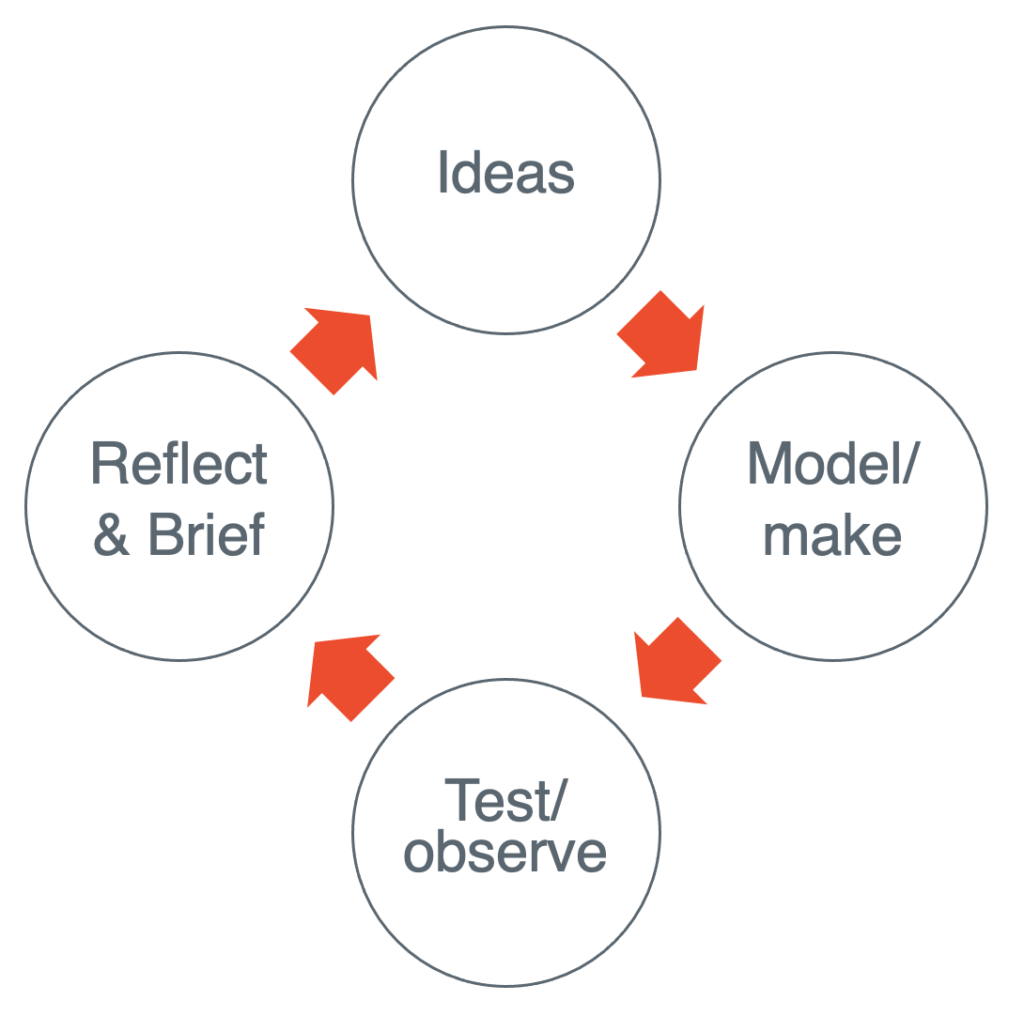
This is only the third or fourth time I’ve used the Continuous Design diagram. I see its greatest strength as emphasising the cyclical nature of design, which becomes even more important as we start to think about how to design more regeneratively.
This was a particularly lovely day to be teaching in Cambridge. The morning was fresh. I enjoyed having breakfast in the hall at Selwyn College. By lunchtime things had warmed up and I enjoyed sitting for a few minutes by a tributary of the Cam, watching the clear water babble by.
I am looking forward to returning in December when we will explore what a design brief is in more detail.
-

Caen to Santander
Today we begin our summer #surfacetravel continental adventure: from Caen in Normandy to Santander in Northern Spain. We are travelling via mixture of bicycle and train.
The adventure began yesterday with putting our bicycles on the ferry at Portsmouth. As a cycle passenger on a ferry you exist in this weird no persons land between foot passenger and car driver. The cycle route from Portsmouth harbour to the ferry port it’s actually very well signposted. But when you get to the ferry port it is unclear what you are supposed to do. Once we realised though that you’re supposed to line up with the cars, it’s pretty straightforward. And cycling across the open expenses of the ferry terminal and up to the boat feels quite rebellious.
As a regular readers of this blog will know, I love a ferry ride. Ferries are like floating buildings. A funny mixture of shopping centre, hotel and seagoing vessel. I also love a cafeteria. All of this made for a very enjoyable six hour crossing. I particularly enjoyed trying some handstands in the deck with S.
Riding with Brittany ferries feels like I’m having a little piece of France pick you up from the UK coast. A two course lunch menu followed by a stiff coffee. The Tour de France on the TV.
Speaking of which, I was blown away watching the race leader stop to allow his rival to catch up after having fallen on the slopes in the Pyrenees. So often the historical stories of men racing in the tour are about macho rivalries. this feels much more sporting, much more human.
Looking forward to beginning our own Tour de France.
-
If you want to save the planet… have dancing lessons
Serendipitously, as I was preparing for my first dance teaching workshop this morning at the Idler Festival, I spotted a quote in one of my other open browser tabs a quote from David Flemming.
Commons are cooperative enterprises; they therefore depend on trust, on reciprocity, and on social capital. The market economy can get by, for a time, with a gravely-weakened culture and social capital, but the commons cannot. If you really want to save the planet and to give human society a decent chance of living on it, the first thing you should do is to join a choir. Or have dancing lessons, or both. That is not quite the hyperbole it seems: in enduring communities, the thing which defines and distinguishes them is their culture of dance, music, story and tradition—so intertwined with trust that it is hard to tell cause from effect.
David Flemming, in ‘Lean Logic – A DICTIONARY for the FUTURE and HOW to SURVIVE IT’We always said in the Mudflappers that our mission was to make the world slightly better through the medium of dance. Well here is some compelling philosophical underpinning to back that up. I shared this quote with the dance workshop today and it was well received.
-

A shout out to the dancing crowd at the Idler Festival
This post is a message to all the lovely people who joined one my dancing lessons at the Idler Festival. You were such a lovely crowd. I had so many great conversations with people who were just happy to be dancing. And it fills me with joy to get people moving their bodies to music.
A big thank you to Tom and Victoria for inviting me back. And a big thank you to Ellie Westgarth-Flynn for teaching with me.
A few of you were asking if I teach anywhere regularly. The short answer is no, but I am looking forward to returning to more festival teaching in the year ahead. If you are based in London, check out Swing Out London for details of classes. If you are based in the West Country, then check out Swing Dance Bristol.
If you have found your way to this blog then hopefully you will find it to be a joyful mix of engineering, creativity, dance and philosophy, all tools I think we need to build the places we want to live in. So stay tuned, or sign up to my mailing list.
I’ll post again soon with the playlists from my teaching sessions.
-

Self-learning in systems, hair engineering + Idler Festival Day 1
A day of two halves: book writing this morning and then swing dance teaching at the Idler festival this evening, with some hair engineering in the middle.
Enabling systems to self learn
I have about ten days to finish the first draft of the two chapters I am writing for James and my book on regenerative design for structural engineers. Today I was writing one of 12 principles for thinking about regenerative design. This one is about enabling systems to self-learn, adapt and evolve.
As ever, with regenerative design, we are thinking about how to enable healthy system qualities to emerge. It is difficult to write about because for one thing we are not talking about directly doing something ourselves, but thinking about how to set the conditions for a certain desirable quality to arise. The second is it doesn’t always feel close to structural engineering. But with our writing, we are not attempting to fully resolve the picture, rather to show what the arguments are and how they might intersect with structural engineering.
The question I keep coming back to to guide the writing is, how can we move away from seeing the design of buildings as the ends in itself, and instead as the means of creating a society that thrives within ecosystem boundaries.
In the built environment context, this idea of self-learning in the system could manifest itself as communities being better able to design and adapt their own buildings. And that that process can put them in greater harmony with their supporting ecosystems. The barriers to this process I wrote today were:
- A design process that starts too late and stops too soon
- Specialist knowledge not being distributed in the system
- Lack of local systems knowledge
- Discomfort with uncertainty
- The challenge of hearing our nature responds to our plans.
Tomorrow I will be writing about how design can enable the emergence of a healthy socio-ecological system structure.
Hair Engineering
I have a phenomenal amount of hair. When ever I get it cut, it renews at an astonishing rate. You could say it is an abundant natural system. I am impressed with how tall she was able to make it. You could say I have a High Barnet.

Idler Festival Day One
For the first time in two years it feels great to be back teaching at a Festival. This time it is back with my friends at the Idler, for their Idler Festival at Fenton House.
This evening I was second on the bill, teaching a group of about 30 a solo taster Charleston class. On the playlist:
Around the World (Daft Punk)/I’ve Got That Tune (Chinese Man)/A Cool Cat in Town – Aerophon Mix (Tape Five)/Booty Swing (Parov Stelar)/Lone Digger (Caravan Palace). Link here to playlist.
Halfway through the class I spotted someone who had been there in the classroom when I had my first swing dancing classes 18 years ago.
I was happy to see my friend, dancer Constructivist collaborator, Peter Ayres. Looking forward to spending more time together on the Idler lawn over the next two days.
Three more classes tomorrow.
-
I was looking for a swing dancer but I found an engineer
On the programme at the Idler Festival, by workshops are simply listed as ‘Dance Teaching with Oliver Broadbent’. One participant came up to me at the end and, after thanking me for the class, said I was looking for you online, but I couldn’t find anything about you, but I did find another Oliver Broadbent who writes about engineering… She was surprised to find we were one and the same.
-
Regenerative Design, Net-Zero Design Error-Free Design and Swing Dancing
Sometimes when I write on this blog I like to distill my thoughts around one topic. But when there’s lots going on I prefer to write in more of a diary mode, capturing observations, events and the things that are on my mind in case they are useful for when I have a bit more time to do some distillation. For anyone who is a regular reader of this blog you will recognise this as just another way to keep a Kalideascope, gathering the elements from which I can make future creative connections.
The big news is that James Norman and I now have a signed contract with the Institution of Structural Engineers to publish our book on regenerative design for structural engineers. We are two-thirds of the way through the first draft and our aim is to get this completed before our respective summer travels. So I have a mid-July writing deadline to hit. But in the meantime there is all of the following going on:
- Monday I am off to Hazel Hill Wood to prep for the next thing on my list:
- Tuesday and Wednesday this week I co-leading the second of the three woodland-residential retreats for the Regenerative Design Lab.
- Thursday I am teaching a session on advocacy in net-zero design as part of the Net-Zero Structural Design course I run with Will Arnold at the Institution of Structural Engineers.
- Thursday I am also teaching a workshop for the Cambridge Institute of Sustainable Leadership’s masters programme, Interdisciplinary Design for the Built Environment. This will be a reflective session on preparing the soon-to-graduate students for applying their learning in practice.
- Thursday also (big day!) we have the summer meeting of Hazel Hill Wood’s Trustees.
- Friday to Sunday I am teaching Lindyhop and Charleston at the Idler Festival, Fenton House.
And finally, Sunday, at around midnight, I am running an online workshop for a construction firm in Australia about avoiding error in construction, part of the GIRI initiative.
Somewhere in the middle of all that, I am going to do some book writing. I’ll keep you posted.
-
Notes from RESTORE report Sustainability, Restorative to Regenerative
Here are my notes from reading the RESTORE report ‘ (REthinking Sustainability TOwards a Regenerative Economy) Sustainability, Restorative to Regenerative – edited by Martin Brown and Edeltraud Haselsteiner – as my part of my regenerative design research. Thanks Emma Crichton for the link.
On regenerative design
This is probably the most useful part for me.
‘Regenerative design, relates to holistic approaches that support the co-evolution of human and natural systems in a partnered relationship.’
(more…) -
Engineering of the commons
If we want to think really regeneratively about engineering and the creation of buildings, then maybe we should consider building materials as a common resource.
I realise that I have been approaching the question of regenerative design in engineering from the standpoint of a market-driven economy. Materials are supplied by private suppliers, installed by private companies for a mixture of public and private clients. In most cases the profit (surplus) is reaped far from either the source of the materials or the location of the building.
But listening to the Frontiers of Commoning podcast I realise that this is only a relatively modern framing of the mechanism by which materials can be sourced, shared and distributed.
If we want to design buildings regeneratively, then we need to be thinking about how the process of sourcing and manufacturing building materials is regenerative: how the very harvesting of these materials can create more; how these processes can create habitats which enhance other aspects of the ecosystem, building local complexity; how feedback loops are built in so that we know if the system is working within its limits or not.
If we see our construction materials as a common resource rather than a commodity, we can think much more collectively about how these resources should be manufactured, used, reused, borrowed, repurposed, re-imagined and finally returned to the ecosystem.
In this framing, no-longer is the engineer is not serving a particular project but the people who share ownership of that common resource. Their role becomes threefold: harvesting of materials from the local bio-mineral region; managing stocks of resources in the most equitable way; and design and re-design of how these materials are used. (Note there is no return of the material to the ground as there is no waste in a regenerative system – just more used for the materials.)
No-longer would the engineer be working to maximise shareholder value and maximising ecosystem destruction. Instead the engineer would be working to maximise the regenerative harvest of local materials to maximise local flourishing.
-
Exploring regenerative practice for engineers
As James and I start to delve into the writing for our book on regenerative design for structural engineers, I am gathering my thoughts on what regenerative practice might look for an engineer. This is a working-out-loud post to help develop and share my thoughts.
The challenge with regenerative design is that we are reaching for something that doesn’t yet exist. But if we wait for the answer to be fully formed, the natural systems that we seek to regenerate – ourselves included – may be destroyed beyond repair.
And so we have to work with what we’ve got:
(more…) -
Notes on building local
This month I am writing an article on that explores what if we restricted construction material use to those from a local catchment. Rather than a global supply chain of materials that is disconnected between source and use, what if we could use materials that were a more locally relevant, resilient and regenerative resource?
Today at the third of James Norman and my sessions exploring regenerative design with Buro Happold in Bath, we heard about the example of the machine shed at Westonburt Arboretum that was built only timber from the site.
(more…) -

Following abundance versus desire
At our local allotments, permaculture teacher Mike Fiengold re-distributes food waste in the community. Even after he has sent food to various local charities there is lots left over, and so he asks if we can take some away. At first I felt it greedy to take more than what I considered to be my fair share. But then I realised it was helpful if we could take as much as possible off his hands. Because if he can clear his stores, he can get more of whatever waste the system is generating and put it into the hands of the people that need it. So now we take more than we need and try to distribute this excess among our neighbours on our street.
There’s a few things going on here that I want to note.
(more…) -
Coming from Bristol, London is a pleasure to cycle through
After a two-year break I am back on my bike in London. This morning a short hop from Paddington to Kings Cross. Having moved to Bristol almost four years ago the difference I can really appreciate the difference between the two: cycling in London is streets ahead.
People say to me I wouldn’t want to cycle in London but I think the cycle provision is actually pretty good. I left the station without needing to look at a map*. There were ‘quiet ways’ cycle route signs directing me all the way. Not only did all traffic lights have forward stop boxes for cyclists, cyclists also get their own green light that lets them set off before cars wanting to turn in front of them. And the quiet ways were, well, quiet.
Of course there are ways that the system could be improved. More cycle and pedestrian-only routes would always be better. But the improvements I have seen are relatively low-cost and easy to implement.
Bristol has some excellent off-road cycle paths. We chose to live close to one specifically to benefit from the access it provides to the centre of town. But the general permeability of the city to cyclists is poor.
This is a choice. All it takes is the political way to say we choose not to have a streets choked with cars; we choose to make our streets living, breathing places where people can get around safely and cheaply. -

Take the meat out of meetings
Please, take the meat out of meetings. Then you can say, no animal died in the making of this decision.
Some meetings are pointless. Don’t add to this pointlessness the death of the animal in your sandwich.
Some meeting reach meaningful outcomes. These are never enhanced by having meat on the table.
Take the meat out meetings, workshops, seminars and training.
Image credit: ‘Press Conference on Meat Rationing‘ by Alfred T Palmer of the United States War Office is available in the public domain.
-
Too many emails – the Eiffel Over guide
I am a connoisseur of email-reduction strategies, so I share this for friends and colleagues of mine who I know are struggling with this at the moment. The best way of dealing with having too many emails is never ‘answer all the emails’. Email overload is a systems problem. It manifests itself as an overflowing inbox but it is rooted in the way the system is set up. Answer all the emails and new ones will appear. We have to fix the system.
I will start by saying that I still have too many emails. But I don’t feel bad about it because I am trying to work on the system. And some of my system changes have been helpful and I can see are working. This post is not supposed to be a definitive guide but a few things to get you started.
(more…) -
Making the Regenerative Design Lab a Regenerative System
In today’s planning session for the Regenerative Design Lab with my co-facilitator Ellie Osborne, we asked what if we made the lab itself a regenerative system?
Based on my working definition (see my previous post on the four characteristics of regenerative systems), a regenerative regenerative design lab would:
- Be able to renew its sources of material and energy;
- Thrive within wider ecosystem boundaries; and,
- Adapt to a changing operating environment.
-
Why close the train doors 40 seconds before departure?
This announcement always irks me. “To ensure a timely departure, train doors will shut 40 seconds before departure.” It reminds me of what a senior Network Rail manager once said to me, that railways are great at treating their customers as if they are in the wrong.
This forty seconds buffer gives time to deal with any problems at the event horizon of the doors closing. But why does this 40 seconds have to come out of the passengers’ time, the free morning they had before they boarded the train rather than from the train company’s time, the schedule.
(more…) -
Recognise the desert to return it to life
When renewable systems are over exploited they fall into a desertlike state. In this state the system population is too low to support regrowth and the system structures break down. But given the right conditions and encouragement, regrowth can return. The seeds are all there. The self-organising ecosystem can return to recreate resilience, complexity and diversity associated with rich life.
(more…) -
Bristol: from rainforest to desert
Where I live, coal was so abundant near the surface that you could have dug a hole in your garden and found it lying there. This coal was laid down during the carboniferous period when Bristol was somewhere over the Equator and the ecosystem was abundant with life. This coal is fossilised life.
Yet walk a few streets north-west and you find a band of red sandstone. By this time in its geological history, Bristol had drifted north towards the Tropic of Cancer and the area had become desert. No more fossilised life, no more coal – just scorched sand. Carry on further north and carbonate limestones return. The desert receded and life came back.
(more…) -
Nothing to say but lots to show
I have nothing to say but lots to show you – Walter Benjamin. I heard this quote this morning on In Our Time and it really struck me.
For me it says you don’t have to have the answers in order to bear witness.
There is so much that I see in the world that makes me smile. Things that when I see them make me despair.
I can’t necessarily find the exact narrative to rationalise these sensations. But that shouldn’t stop me from sharing them. Because when I do, I am creating the pieces from which a pattern can form.
(more…) -

Four characteristics of regenerative systems
Work on regenerative thinking progresses on all fronts. Book writing with my friend James on Monday (read his excellent blog on this process), developing regenerative practice at Hazel Hill Wood Tuesday and short-listing candidates for the Regenerative Design Lab Wednesday. I love that all of these initiatives inform each other.
To aid all three I have synthesised my understanding of how regenerative systems operate. This framing is informed in large-part by Donnella Meadows’s book ‘Thinking in Systems’, which is helping to understand the conversations are having across all these fronts.
(more…)