In my previous post I was talking about the experience of distance, and how, when understood as an experience, distance is no longer a fixed entity.
That post was triggered by some lines from Proust in which the narrator is talking about how his perception of local distances alters when he switches from rail transport to motorcar. Some further thoughts on this topic.
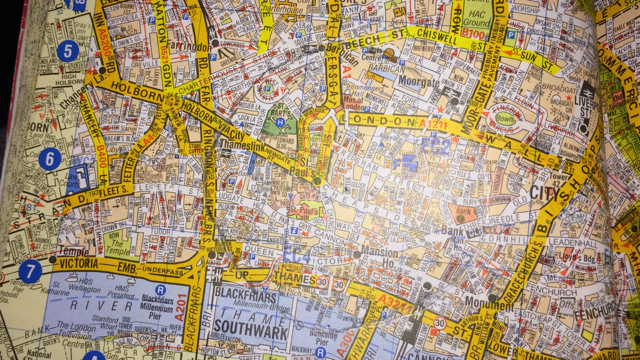
I recall how the distances between various destinations, and therefore the shape of the city itself, appeared to change when the London Overground, an orbital railway in the inner suburbs, opened. All of a sudden areas of the city that seemed far away felt much closer: South-East London, previously impossibly far, was now a nearby neighbourhood to where I lived in the North-East.
Such a step-change in the experience of city living demonstrates the transformative power of civil engineering infrastructure. Linking, drawing together, connecting – this is what engineers have been doing for centuries.
Marseille A morning walk up the steep hill to the Basilica of Notre Dame de la Gard granted me panoramic views of the city of Marseille and the sea. I love the peaceful hum that can be extracted from high up of a limbering up for a day of activity.
I underlined these words yesterday in ‘In Search of Lost Time’. The narrator is talking about how his perception of distance was changed when, instead of travelling by rail, he starts to go by car.
‘We express the difficulty we have in getting to a place in a system of leagues and kilometres, which becomes false the moment that difficulty decreases. The art of distance, too, is modified, since a village that had seemed to be in a different world from some other village, becomes its neighbour in a landscape whose dimensions have altered.’
Proust, M. (1921). In Search of Lost Time, Vol 4. Sodom and Gomorrah. (C. Prendergast, Ed.) (Penguin Cl). Penguin Books.
Sophie is an unusual mix of campaigner, practising designer and
Chartered Waste Manager. She’s been working in the fields of sustainable
design, behaviour change and material process for nearly 20 years. I
invited Sophie on to the show to talk about waste and circular design.
In our conversation we get into:
The engineering of linear and circular products, material selection, recycling houses and oil rigs.
Creative strategies for circular designers, and in particular the idea that waste is a design flaw.
And the practical philosophy of someone who has spent so long think about waste.
If you enjoyed this episode then check out this written interview I did with Sophie two years ago as part of a Royal Academy of Engineering-funded project we did at Think Up into the strategies of different sorts of designer.
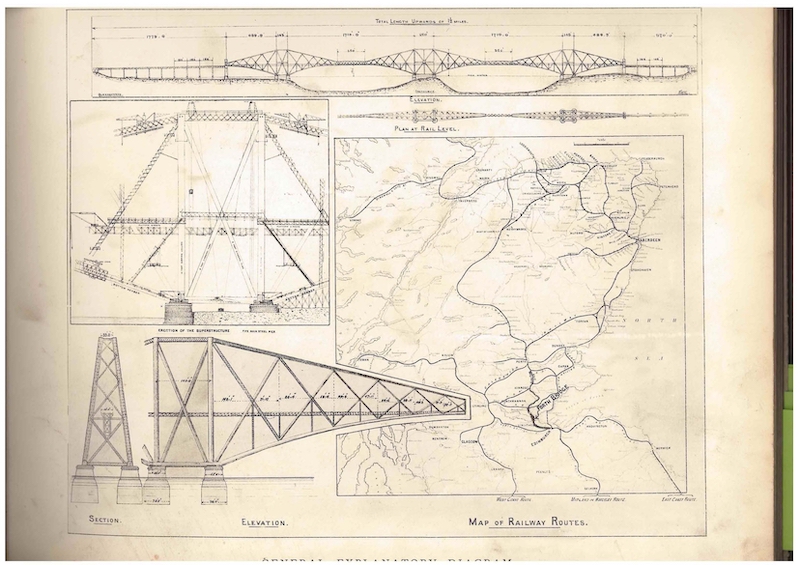
An engineering detour is something engineers do when they go out of their way, usually on holiday, to go and check out a piece of engineering infrastructure. In this episode I take an engineering detour to the mighty Forth Rail bridge. Along the we get into the engineering of the structure, how taking detours can build our creative skills, and on a philosophical note I weigh up facts and figures versus experiential knowledge. Join me for the ride.
Listen on Apple Podcasts , Sticher or by download here.
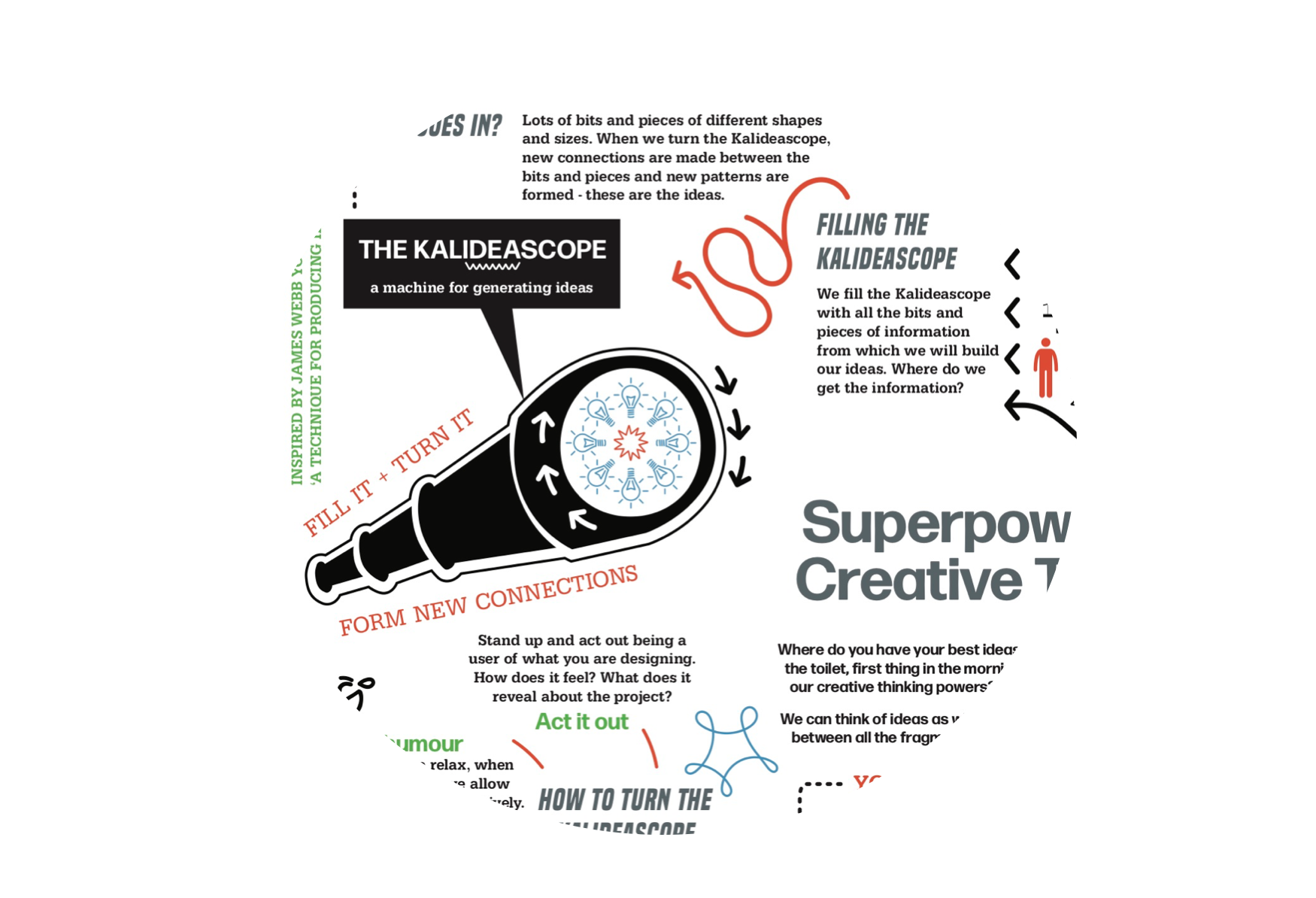
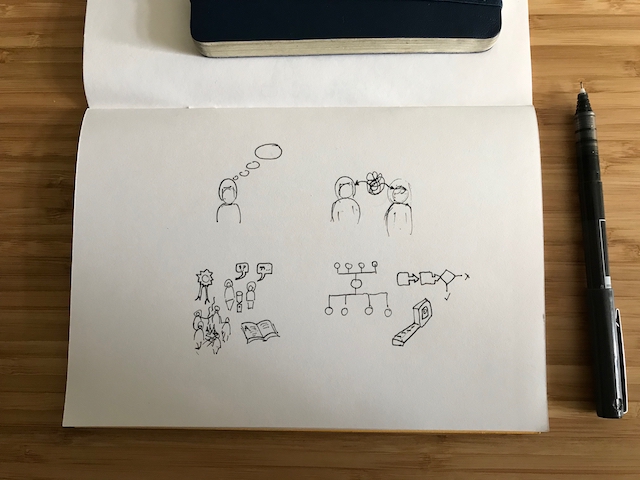
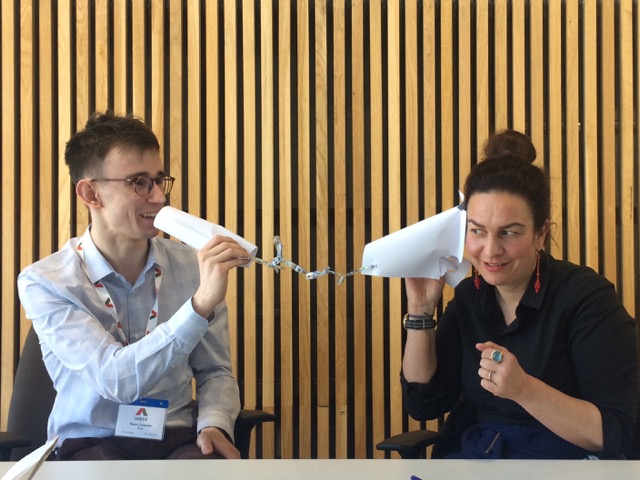
I’m on the road again, this time to the University of Bath where I have the pleasure of running a workshop with first-year students on creative thinking in support of their structural design projects. I’m using the Superpowers for Creative design resource I shared earlier this month – now updated, thanks to the help of my colleague Alexie Sommer, to be in the form of a fold-out zine. The image above is a teaser for what to expect!
I’ll posting a downloadable version of this resource soon.
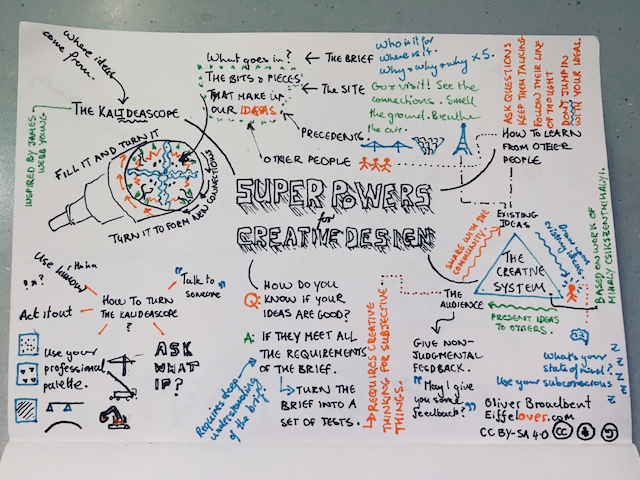
Superpowers for Creative Design is the name I gave to a one-page summary of my undergraduate creativity teaching at Imperial College. This is my first draft. I like the idea of creativity being a superpower. I am sure that people who can channel their creative thinking will have a great advantage in the future.
Drawing this diagram I found a nice interrelationship between all this material. To have ideas we need to draw upon information. That information comes from the things we see, the books we read, the website we look at. But critically it also comes from talking to others. How we interact with one another has a big impact on the quality of thought exchange. With the right interaction, ideas can sparked off of one-another and can be transmitted to others, and form the basis of their ideas.
Underlying it all is behaviours, and within that self-discipline. Mastering that self-discpline is a great strength – a superpower!
I am starting to shift my attention away from creative tools for engineers. Tools are still important. But I’ve realised that you need a creative culture for individual creativity to thrive.
Recently, I rediscovered in Laloux’s ‘Reinventing Organisations‘ the Wilbur four-quadrant model. The model describes how culture, systems and worldviews interact. We can use this model to understand a phenomena in an organisations from four different perspectives:
How the phenomenon can be measured from the outside
How the phenomenon feels from the inside – intuiting how it feels
How the phenomenon appears to the individual
How the phenomenon appears to a group of people.
Like all engineer-friendly models, Wilbur’s is a two-by-two grid. The columns divide the grid into interior perspecitve and exterior perspective. The rows divide the grid into individual and collective perspective. According to Laloux
Wilbur’s insight, applied to organisations, means we should look at: 1) people’s mindsets and beliefs [individual interior perspective]; 2) people’s behaviour [indvidiual exterior perspective]; 3) organisational culture [collective interior perspective]; and, 4) organisational systems (structures, processes and practices) [collective exterior perspective]”
From Reinventing Organisations, Laloux (2016)
Applying the four quadrant model to organisational creativity
I’ve assembled some quick thoughts on how the four quadrant model might apply to understanding creativity in an organisation. I have written the statements for a fictional, ideal case. This difference between this ideal case and reality can give us some suggestions for what we might need to do to build a more creative organisation.
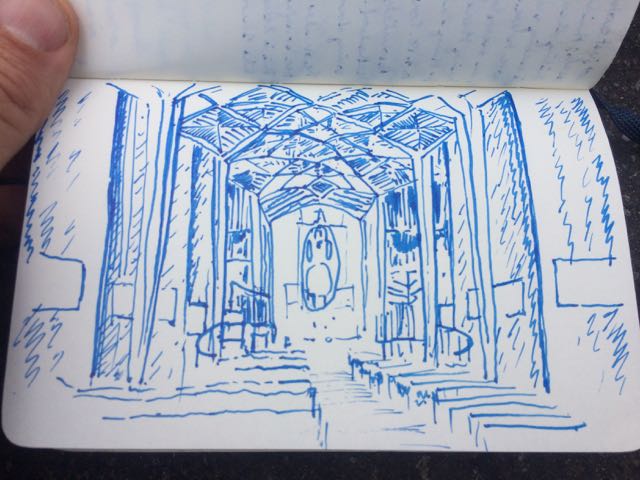
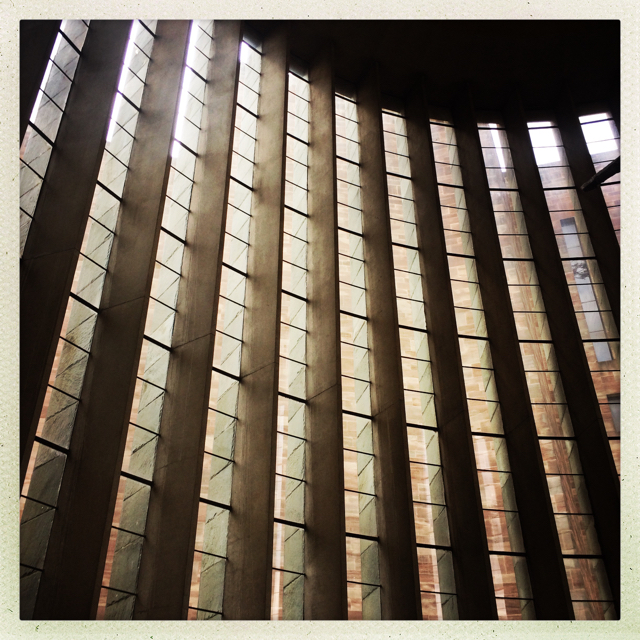
After a recent seminar in Coventry I had an hour to spare and so headed over to the famous cathederal. This sketch doesn’t come close to catching the finesse of the columns on this bold modern design but it serves to remind me of the textiures and feel of the place.
There was great energy at today’s IStructE Academics’ Conference, the theme of which was Creativity and Conceptual Design.
If you are visiting this site for the first time, it may have been thanks to Chris Wise’s kind recommendation in his keynote presentation – thanks so much Chris.
I presented a session on how to have ideas. Usually when I’m billed with this title, I run a workshop on idea generation, but I thought for once, I would stand up and say what I think about the subject. I’m glad I did because it seemed warmly received. It was also a chance to talk through themes that will be included in the chapter I am writing in a book on scheme design – more details to follow.
I am just back from taking part in a Design Thread workshop at Imperial College, the aim of which was to co-ordinate activity between the various design-relevant courses on the undergraduate civil engineering course at Imperial. Here are some reflective notes as I whiz home, during the writing of which I came up with the notion of ‘secretly teaching design‘. (more…)
This post is intended as a reminder for the people participants in last week’s conceptual design workshop. It may also pique the interest of anyone else interested in learning or teaching creativity for engineers.
The workshop was the fifth of five workshops for this cohort of engineers. At the start I asked attendees to list any challenges they face in doing conceptual design that they would like to focus on in the final session. I asked attendees to name the challenge and what kind of progress they would realistically like to make today towards overcoming that challenge. I summarised the challenges everyone shared, and asked participants to prioritise the topics for discussion. The following topics and talking points follow from that prioritised list. (more…)
A very interesting couple of days at the 7th International Symposium of Engineering Education down at UCL. Here’s something I found interesting which I am sharing with colleagues and collaborators.
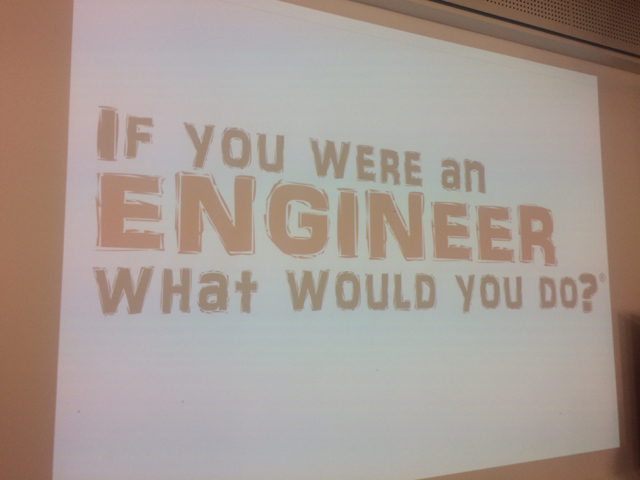
Irrigation reservoirs/ocean plastic cleanup robot/fingerprint recognition keyfinder/light-up bicycle/anti-drinkdrive steering/air-conditioned tie/plant-based academic gradebooster… a maelstrom technology, ideas and solutions proposed by school children who made the final of the Primary Engineerand Secondary Engineer Leaders Award.
In this competition, children interview a practising engineer to find out about problem-finding, problem-solving and creativity in engineering. They then go home, find a problem of their own to solve, and create solutions, answering the question, if you were an engineer, what would you do?’ An astonishing 37,000 pupils entered the competition, from as young as recetpion-age. (more…)
We planted a hedge of lavender on our estate to revitalise a barren patch of soil near our front door. This sunny morning, the enthusastic lavender stems were bobbing up and down laden with bees. There must have been between 20 and 30. I went to count, as part of the Great British Bee Count. And so it was that I had conversations with several of my neighbours about bees, and I was depressed by what I heard.
One complemented me on the lavender, but said the only problem with lavender is that it attracts bees.
A second reported hatred for bees, having been repeatedly stung by that very flower bed, before conceding they had been wasps.
The third, having been complementary about the flowers, reported a bee had dive bombed from twenty metres above delibrately to sting him and concluded they must be evil.
Over the last 9 months at Think Up I’ve been invovled with an engineering education project that has had a really deep philsophical impact on me. The project is called Enginite, an EruasmusPlus-funded programme of graduate training and placements that aims to give graduating engineers extra skills and experience that will make them more employable.
My role has been to collaborate with Prof Søren Willert, of the University of Aalborg, to train project partners in how to design courses using a problem-based learning methodology. PBL flips traditional learning on itself, and holds as its fundamental principle that learning is more effective – in terms of retention, recall and motivation – if students drive the learning process themselves. It is one of those statements that we know to be true from experience, but goes directly against how most education is delivered in engineering education. PBL addresses that dissonance by creating a framework for giving students ownership of the problem. (more…)
I was due there for a four-day meeting and training course, part of the EU Erasmus Plus-funded Enginite project, with partners from Cyprus and Greece. I didn’t have time for the surface journey. In this case I felt the cross-border collaboration benefits outweighed the environmental cost of flying, so I jumped on a plane. But having flown that far, I was determined to have an overland adventure when I got there. I got my chance on the last day.
When I’m asked, you know, at a cocktail party or some other social setting, ‘what exactly do you do’ I say ‘I train engineers to be more creative’. This is a great statement to use because: it feels good to say; it is reasonably close to the truth; and it is short enough to enable my interlocutors to decide quickly if they want to engage further or keep their distance.
For the people that stick around the next question is usually, ‘well how do you do that then’, and I explain I run two courses, ‘how to have ideas’ and ‘how to have better ideas’, the first being a pre-requisite to the second.
This is again only approximatinately true (my course content is usually based on what the learners say they want to cover rather than following a strict syllabus, and the course titles aren’t always as catchy as I’d like) but it keeps the conversation moving.
After further dialogue, I am asked if I have got this all written down somewhere, and this is when I usually get embarrassed, and have to say, ‘no’, because it is all in my head. But not anymore, because now I can point them to the post you are reading, my first attempt to commit an overview of this material to writing.
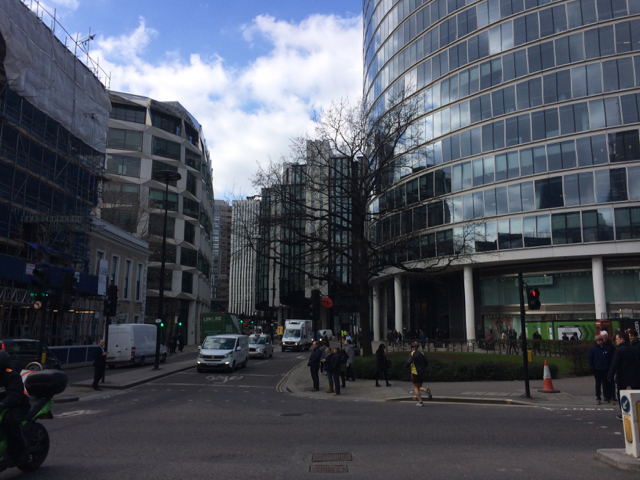
0:00:00 Moorgate and London Wall. Once solid-looking stonewalls are now façades pinned in place by scaffolding while new buildings are constructed behind. In just a few years the streetscape along London Wall has completely changed
0:04:34 London Wall and Copthall Avenue Deep metallic groans sound out from behind these hoardings. I assume the core of the building is being demolished, and the sound is the building complain.
00:09:41 Black Rock The circle leads straight into the offices of Black Rock. I enter the revolving doors and walk through a long dark lobby past whispering clusters of suited men and women. I emerge blinking onto a much quieter street, Tower 42 in the distance.
0:13:31 Copthall Avenue The circle passes straight through the Angel Court building. I attempt to walk through the underground loading bay but I’m turned back by security. There are some places you really aren’t supposed to go.
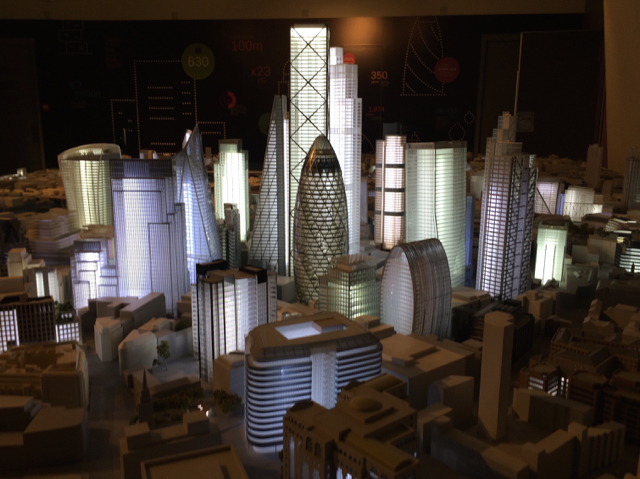
Last night I have a talk at the first ever City of London Showoff called Circling the Square. The event was put on by the City Centre, a fantastic organsiation right at the heart of the City that hosts a fascinatingly detailed 3D model of the City of London. I had been asked to say something entertaining and interesting about engineering in the City. I thought this was a great opportunity to try out and talk about my new hobby, psychogeography. The folllowing is a transcript of my talk (my full data log see my post Dérive #2 – City of London – Logbook)
As an engineer I love going on unconventional journeys: using odd means of transport, exploring forgotten paths, seeing the new from different perspectives. In his book, a Road of One’s Own, Robert Macfarlane instructs us to:
…unfold a street map. Place a glass rim down anywhere on the map and daw round its edge. Pick up the map, go out into the city and walk the circle, keeping as close you can to the curve. Record the experience as you go, in whatever medium you favour: film, photograph, manuscript, tape. Catch the graffiti, the branded litter, the snatches of conversation…Log the data stream…Be alert to the happenstance of metaphors, watch for visual rhymes, conincidenes, analogies, family resemblances, the changing moods of the street. Complete the circle and the record ends. Walking makes for content; footage for footage.
Robert Macfarlne – a Road of One’s Own, cited by Merlin Covereley in ‘Psychogeogrpahy’
Pear-to-pear (it was better than the images I got for peer-to-peer).
As part of my Visiting Professorship at Imperial College I have been asked to think about how peer-to-peer assessment works in group works. Here are my thoughts.
One of the common features of the group-work-based learning experiences that I have been involved with is the need for the participants to be able to give each other feedback. Often in an undergraduate setting there is an emphasis on giving anonymous feedback. I have seen many colleagues cook up clever ways of gathering this anonymous feedback – I’ve conceived a few such systems myself – and processing this feedback in order to find out what is going on in student groups and to enable the teacher to be the arbiter of fairness. Managing such systems of peer-to-peer feedback can quickly become burdensome, and I am never really sure whether you really know what is going in the group or if the students are rigging the system.
As I become more and more involved in problem-based learning, I realise that this approach – anonymity and delegation of confrontation to the teacher – misses the point. If students feel that their peers aren’t pulling their weight in a teaching scenario, then they should be trained in how to confront these issues in themselves. And taking a more positive spin, students should also learn how to give positive feedback too.
I think it should be possible to give students the tools to handle these sorts of interactions themselves, and then for the teaching staff to coach students through the process where difficult situations arise. These are tools that my collaborator Nick Zienau uses in his ‘Leading and Influencing‘ course. The following is how I envisage this could work:
How it would work
The context is an extended student group design session in which a group of six to ten students spend a number of weeks collaborating to deliver a shared group output.
Skills development day: trust, confrontation and non-judgemental feedback.
I envisage a day-long training day for student groups. This would involve a series of group work exercises punctuated with whole-class briefing and feedback sessions.
Contracting – this is the process by which students agree with each other what they can each contribute to the team, what they want from the others, and how through their own actions they might jeopardise the group’s success. Students develop contracts for themselves, present them to one-another, and then agree a contract for the group.
The creation of contracts is a trust-building activity, and it creates a visible set of expectations by which the students can hold each-other to account.
Confrontation – in this session we provide a quick formula for confronting challenges. It involves naming a behaviour that they have seen and saying how it contravenes their individual or group contract. The reference to the contracts makes the terms of engagement very clear. Practising a formula for engagement makes the process something that people are familiar with.
Non-judgemental feedback – we walk students through process where they give each non-judgemental feedback, much of which comes down to language. We show students how to stick to facts, like ‘I have seen you do this’ or ‘when you do that it makes me feel like this’, rather than ‘what you have done is bad, or wrong’.
At the end of the training day, students have contracts for themselves and the group, a language for direct, open and kind confrontation and a mechanism for giving non-judgemental feedback.
Self-regulation during group work
After the initial training day students get on with their group work as normal. They are asked to have a quick daily group feedback session, where they appreciate each other’s efforts and identify any emerging issues. They are also expected to have a weekly structured feedback session, where they tell each other where they are contributing most to the group, and how they could contribute more.
Through the group work, it is expected that the contracts remain in view. They are intended to be a visual reminder to individuals of what they should be doing themselves, and also a way for people to understand other people’s behaviour.
Instructor Intervention
The course instructor makes themselves available say once a week to deal with any issues that students feel they can’t deal with in their own groups. The consultation happens with the whole group and the instructor will ask to see evidence that the teams have been meeting to review their contracts regularly and have been giving each other constructive feedback along the way.
Overall, I believe this approach would empower the students, give them useful life skills and improve the quality of their learning.
My thanks to Nick Zienau and Søren Willert who have significantly advanced my thinking on this topic.
I struggled to find an image to go with this post. When I typed design into my image database, this came up. It is rather fine, isn’t it?
Today at Think Up I am writing a set of questions that can be used as a diagnostic tool to characterise different stages in the design process. The questions will go into an online questionnaire through which we will be trying to establish a link between different types of design problem, the design process they require and techniques and tools that designers use. The aim is to help students understnad what might be suitable approaches to use in response to different design problems.
I am fortunate to be working with my colleague Bengt Counsins-Jenvey who knows a huge amount about design thinking in a range of different contexts. He is working on the other part of the questionnaire that is characterising the design problems.
Here’s some reflections and notes from today’s working:
Reducing long-form answer questions on questionnaires. They are easier to write but I’ve learn the hard way on other projects recently that long-form answer questions take so long to analyse it is really worth taking the time to come up with good numeric-scale or mutltiple-choice questions. Having done an initial round of interviews is helping me determine the right language to use.
How succint can I get the questions? I am trying to weigh up writing questions that everyone can understand and keeping the questions short. Again, having done some initial interviews helps me know what language people are likely to use.
I’ve realised my design world view was initially shaped by ‘blank-piece-of-paper’ designers. My interviews on this project have shown me how few design contexts require blank paper. I hope this process gives me greater understanding of design contexts where the operating context is much more complex.
What number scale to use? I’ve gone for 1-4. I don’t want people to think about their answers for too long and I don’t want them to sit on the fence. It will be interesting to see the impact of this choice.
I have been daunted by putting this questionnaire together, so last night I just set myself a simple target of writing three questions for each of the main stages in the design process. This much less daunting task was easy to do – the questions almost wrote themselves – and then I was easily able to supplement them. Later Greg Downing explained to me that this process is what he calls skeltoning: you quickly put in place the outline and everything else follows.
For more info on this piece of research see this post on the Think Up website.
In Janaury 2018 I decided I would try veganism. I have been vegetarian all my life but in recent years I have found it harder to reconcile concern about the meat industry with eating dairy produce and eggs. In recent years we have eaten very little dairy at home, so this year I decided to try going the full hog and committing myself to a no-dairy no-eggs diet.
Understandably people ask ‘what do you eat?’ Here’s the answer:
7/3/18
Toast with marmite
Lunch: humous and veg sandwiches from platter
Cake time – Vegan banana and coconut bread (Southbank)
Dinner – Turkish mezze at Taz
6/3/18
Leon porridge with blueberries
Elevenses: toast
Lunch: Pure vegan wraps (from platter)
Tea: more toast with humous
1st dinner: Kale and pumpkin one-pot pasta (Anna Jones)
2nd dinner: Roast spiced brassicas with split pea purée (Hugh Fearnley-Whittingstall)
5/3/18
Breakfast: porridge
Lunch: Pret a Manger Spiced chickpea and spinach sandwich
Dinner: Kale and pumpkin one-pot pasta (Anna Jones)
Today I have been reviewing the action learning diaries that half a dozen people have sent me from Greece and Cyprus. They are getting ready for training in problem-based learning that I will be co-leading here in London at Think Up with Prof Søren Willert from the University of Aalborg (see picture) as part of the EU ErasmusPlus-funded Enginite programme, and we have set them some problem-based learning of their own to do before they arrive.
The idea behind problem-based learning is that the student should own the problem and own the process of finding the solution. This approach is diamertrically opposed to the traditional direction of travel for learning. The aim of our approach is to get the participants to experience this problem-based approach for themselves before they start designing such experiences for their students.
The first set of reflective diaries that I have read reveal very different ways of working in our cohort. Some are applying problem-based learning with their students; others, who don’t teach, are adopting this approach with colleagues in their companies, and it is this latter group which is perhaps the most fascinating – because is in fact the sort of environment for which we are eventually preparing students.
At the moment problem-based learning feels like very rich territory to be farming in. The approach itself is a powerful philisophy that has many daily applications, and coaching other people in its use is gives me the chance to witness the daily strategies for sucess that other people use.
One of things that I really enjoy about this project is that is it is open – you can join in yourself if you follow the instructions below – and everyone is learning as they go. For my part I am learning what other people understand problem-based learning to be and become ever more aware of its applications. It is also terrific to be working with Søren, I feel like I learn so much from each of our interactions. Today it has been really interesting to see how he characterises the different types of PBL as described in the reflective diaries. To his words, it is enabling me to notice ‘exemplarities’ that I can look for in other people’s work.
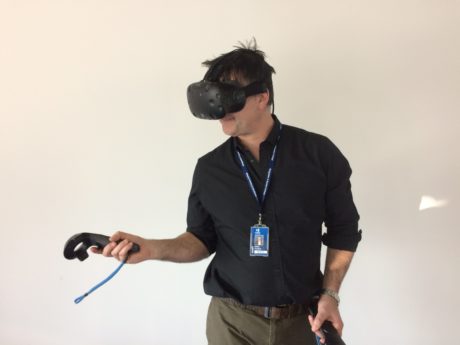
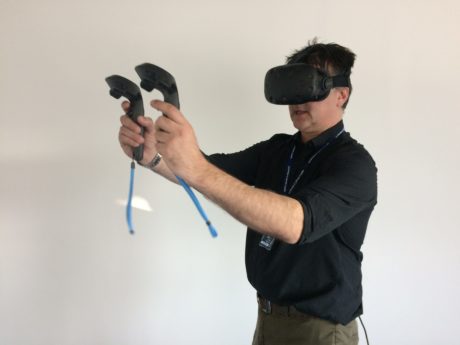
Last week I was down at Bridgwater and Taunton College to check out the tools Stefan Cecchini and his colleagues are going to be using to deliver a revolutionary new engineering degree curriculum that aims to be entirely inquiry-led. There for the first time I tried out a virtual reality (VR) training environment. I put on the VR headset and gloves, and this is what happened (that’s Stefan, by the way wearing the VR gear).
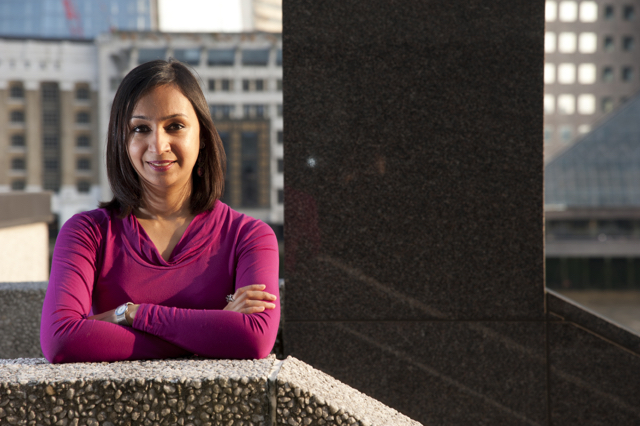
In this episode I bring you a step-by-step guide on how to build a skyscraper with structural engineer Roma Agrawal (@RomaTheEngineer), author of ‘Built, the Hidden Stories Behind our Structures’. We get into the engineering, creativity and philosophy of sky scrapers and their designers. Don’t try to build a skyscraper yourself without listening to this first.
And since engineering education is something I do for my day job, I thought I’d accompany this episode with some additional resources related to the topics of this podcast. I’ll be adding to these over the next few days so stay tuned.
I can’t think of metropolitan landscape that offers more varied and exciting opportunities for designing transport infrastructure than San Francisco, with its steep hills, its bay, its rapidly changing economy and its tantalisingly separated land masses.
In this second episode of the Eiffelovercast from my recent trip to the US (catch the first one here) I catch up San Francisco-based transport engineer and old friend Andrew Kosinski and we geek out on transport-related matters including:
Bridgoff: Bay vs. Golden Gate
Tearing down freeways
Bringing cycling into San Francisco
Is driving a right and it is a freedom?
The phenomenon of ‘parklets’
Tunnelling through ships
Building towers on weak and shifting sands
The creative bubble of silicon valley and the unintended consequences
Autonomous vehicles
Using firms like Uber to replace under-productive bus routes
The final stage in the arc of design thinking workshops that I have been developing at Think Up with my colleague Nick Zienau is developing the ability to convince other people to adopt your design. In these workshops there are three areas we work on with participants: building trust with the client; three elements of content; and giving effective feedback.
Trust
Building trust with your client is absolutely essential if you are going to connivence them of anything. There are two things we concentrate on here. The first is being mindful about the first impressions we create. We all create first impressions, whether we like it or not, but we might not be aware of what those are. In our workshops we help people become more aware of the impressions that they create, and help them think about how to create the impressions they want with clients.
The second thing we concentrate on is developing trust through showing vulnerability. To show vulnerability to someone is to show that you trust them; if you can trust others then they are more likely to reciprocate. In our workshops we help participants explore how they can show their vulnerabilities, such as what they are worried about or where they feel their weaknesses are, and use this as the basis of building trust with others.
Together, managing first impressions and building reciprocal trust with our clients we call ‘gaining entry’.
Three-phase content
For many people, the starting point for any pitch is to work out what they want to say. Aristotle said that for a speaker to convince an audience of anything, then the speaker needs ethos, pathos and logos. Having ethos is to be trustworthy. Having pathos is having a shared sense of their feelings (in particularly their pain). Having logos is to have a logical argument. We can think of these as three phases we need to develop in our pitch.
In my experience, many engineers are most comfortable starting with the logos phase, the logic of the solution. The trust-building that we start the workshop with is an important element for developing the ethos phase, as is the reputation of the companies that participants work for. For many, the hardest phase is developing pathos. To develop good pathos you need good understanding of the client’s perspective, which is easiest to gain if you have a good relationship with them based on trust.
Giving and receiving honest non-judgemental feedback
We now have a plan for getting the content together, but how do we know if the pitch we have put together is any good? Here we rely on feedback from others. But for many, the idea of receiving feedback is dreadful – it isn’t all that fun for the feedback giver either. But when done well, feedback is an invaluable tool for improving our work, and it can be fulfilling for the person offering it too.
To make feedback work really well, we require the person giving the feedback to be really honest, but also non-judgemental. So they should say how something makes them feel, and why that might be, but not to judge it. A judgement is too final and puts the listener on the defensive, whereas talking about feelings offers the person listening the chance to find out more about why what they have done has elicited these feelings.
Equally, good feedback has requirements of the receiver too: they need to be open to receiving it, grateful, and not defensive. The last part is critical if the exchange is going to be useful. If the person receiving feedback can hold off on defending, and instead show interest in the other person’s views, then they can really deepen their understanding.
Taking these tools together, we can build an effective pitch for ideas that says,: ‘trust me, I feel your pain, and I have a plan’.
[This is an adapted version of a post I originally wrote for the Think Up website, posted on 1st November 2017].
I really enjoyed listening to this 99 Percent Invisible podcast called ‘Oyster-tecture‘, which explains how, in the aftermath of Hurricane Sandy, the city is developing artificial reefs on which oysters will be seeded. The oyster beds will defend the city from storm swell and large waves. As the podcast explains, 200 years ago, the southern end of Manhatten Island was one of the greatest sources of oysters in the world, and these oyster beds woudl have defended the coastline from storms. The oyster beds disappeared due to overexploitation, but now designers are working on bringing them back to defend the city against the impact of severe weather events.
I liked this article because it reminded me of the importance of looking to nature to find more collaborative ways of tackling some of our infrastructure challenges. It is also a reminded of the positive impact that imaginative design thinking can have a positive impact on people’s lives.
Today I take my journey home from Münster to London via a different route from my way out. Outbound I came by ferry because it was cheaper; travelling back midweek I can just about afford the Eurostar. The route gives me the chance for a quick stop in Köln and the chance for an engineering detour via the Wupertaal suspended monorail.
Münster to Wuppertal
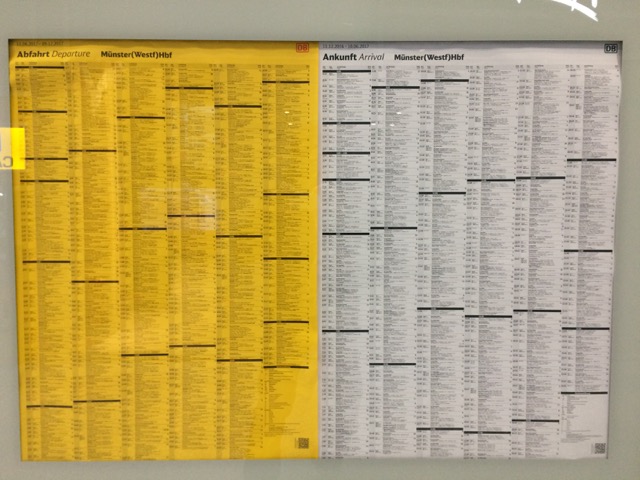
Münster is a beautiful town. I’ve spent the last few days staying with a friend and working on my book in the city library. The cities walls were removed to create a circumferential boulevard that is now tree-lined and a major thoroughfare for bikes and pedestrians. I walk this path one last time and peel off at the Hauptbahnhof.
I ride for twenty minutes on a quiet commuter train to Hamm. The flat landscape is filled with a mixture of fields and factories, with the occasional wind turbine. It reminds me of travelling up the Lea Valley north of London.
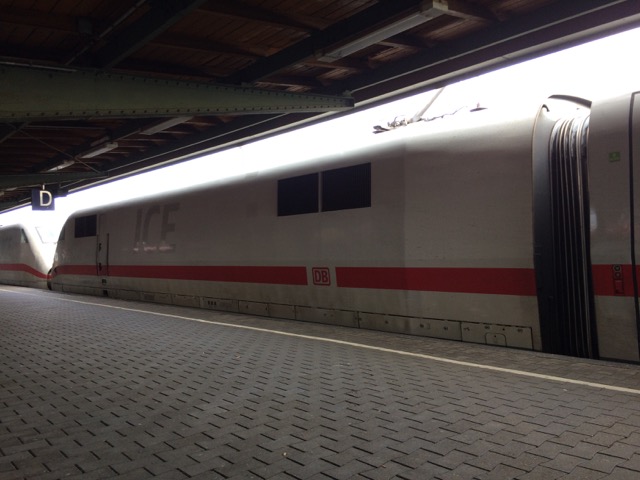
Hamm station feels in the middle of nowhere but its ten unloved platforms are busy with trains of all sorts coming and going. I get to my platform early and see one of the slightly older German high speed ICE trains arriving. Its bright white carriages are like hermetically sealed capsules. You can imagine this train is capable of zooming along the sea bed as easily as over land.
The ICE train is in fact two hitched together. I watch as the two are uncoupled and the front half pulls away. Just in time, I realise the back half is my train to Wuppertal, and I jump aboard. The land becomes more rutted and we follow an industrial valley that is well scored into the valley – it resembles the valley of the Seine as it winds its way north from Paris to Rouen in Normandy.
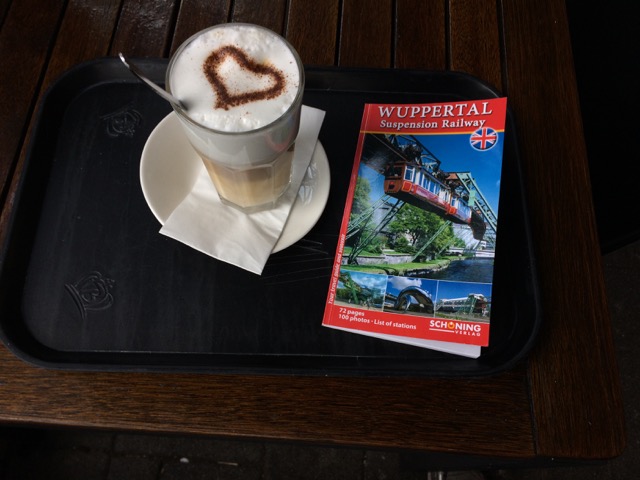
My connection time in Wuppertal is three-and-a-half hours; that was deliberate to give me time to make an engineering pilgrimage to a highly unusual railway, the Schweibebahn, Wuppertal’s suspended monorail. More details of that in a separate post.
Wuppertal to Köln
I’m blown away by the monorail – a great piece of railway engineering integrated into the city. With hindsight, three-and-a-half hours was a bit too long for my engineering excursion and I struggle to find the inspiration to explore the town further. It’s nothing against Wuppertal: I’m just keen to get on. I wait impatiently at the platform for my next train.
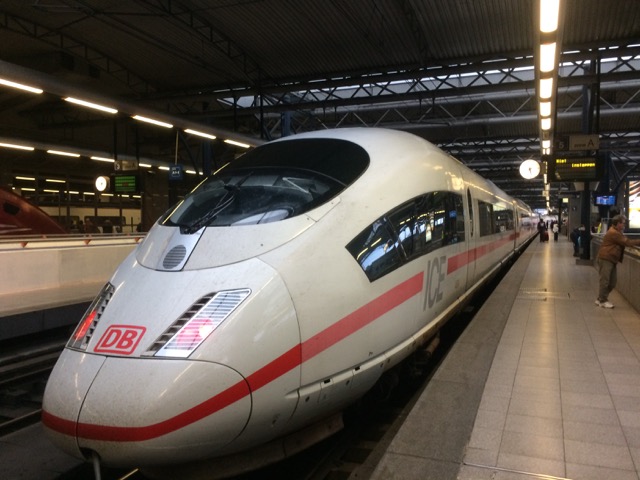
If the last ICE train I took looked like it could be amphibious, this train, a next generation edition, looks ready for space flight, with it’s pointed nose and sleek black-and-white lines. It’s a short twenty-minute ride to Köln and before I know it we are rumbling across the bridge over the Rhine. Köln Hauptbhahnhoff is covered by a wide arching roof; beneath, trains come and go from across Germany – and I see my first French train, the Thalys service to Paris.
I have fifty minutes between trains so I visit the magnificent cathedral which is surprisingly right next door to the station – almost on top of it. It’s quiet pews are better than any waiting room I can think of.
Köln to Bruxelles Midi
I get on board another of the sleek new DB ICE trains and settle in. I don’t remember much about this 2-hour leg as I slept most of the way. The day before long journeys I rarely sleep well as I worry about missing my train, and last night’s wakefulness just caught up with me. As we slow down on the approach into Brussels I see some fairly grotty looking commuter trains and I realise these are the oldest trains I have seen since I left the UK. All the trains I’ve taken over the last few days in Germany or the Netherlands, whether high speed or slower, were well looked after. I am reminded why I don’t ever get that excited about train travel through Belgium. I may however just be prejudiced against Belgian railways because they were responsible for putting the DB night train to Berlin out of business when they put up the transit fees they charge other countries for their overnight services.
Bruxelles Midi to London
Bruxelles Midi is an endless warren of tunnels where the light at the end never seems that appealing. I have an hour and a half before I can check in; I bought tickets for a later train because it would save me £50. The beer in the cafe is half the price of the tea, which is a shame as I’ve just decided to give up alcohol for a few days.
The journey flies by; before I know it I am back in St Pancras. As I walk down the long platforms I am struck that in all the stations that I have been through on either my outbound or my return journey in the UK, the Netherlands, Germany, Belgium and France nothing quite compares to the experience of arriving under the magnificent Midland Blue-coloured soaring arch of St Pancras station. A fantastic piece of engineering lovingly re-invented for a different century.
For generations it has been a tradition on the French side of my family to spend summer evenings out in the garden looking at the stars. I happen to know that this is something my great-grand parents were doing from at least their retirement in the 60s, and it is what other families in the village were doing too. When televisions arrived, neighbours didn’t give up their stargazing; they simply opened the windows wide, put the TV on inside and watched it from outside, while still inclined heavenwards.
By the time of my childhood in the 80s, I have no memory of seeing other families outside gazing upwards in the evenings. I wonder if the people watching televisions from their gardens had switched to sitting inside and watching TV with the window open so they could see the stars, to eventually shutting out the stars altogether. But my grandparents, to their credit, shunned the phosphorus screens for the slower moving celestial entertainment.
It is for this reason that I have spent hundreds of nights staring at the same patch of sky from the same particular orientation. I know where the first star usually shines from; where the great bear appears over the horizon; where to expect to see different clusters and motifs of stars. But despite hours of dedicated study, I, nor any of my ancestors seems to have had any definitive knowledge of what any of the stars or constellations actually are. There has been much speculation and debate. That flickering red dot just above the horizon early in the evening must be mars/ no it can’t possibly be mars because it is always in the same place/ it’s actually called Beetlejuice. Our collective space ignorance is further demonstrated when we try and point out to one another where a satellite may be seen crossing the sky: you see that bright star, straight above? Go left a bit to the next bright star, then to that square of really dim stars, then go west about twelve inches, and you’ll see the satellite heading towards to the house.
I share all this to give a sense of the utter familiarity to me of this particular sky-scape, like someone who knows the view from their childhood bedroom window so well that it is impossible that anyone could show them anything new; a scene that is understood through layers of explanation, agreed between generations but never verified, so that you will appreciate the impact on me of downloading for the first time a star identification app and pointing it at the sky. It was as if I had been given a new set of glasses without ever having known that eyes were blurry.
All of a sudden, constellations stretched out in front of me. Scorpio reclining on the horizon, the diving fish of Pisces leaping over the trees in the east. I am looking at the same sky but I am seeing new things – this is augmented reality. That red star of which we had spent so many evenings arguing turns out to be the centre of the galaxy – incredible. I really felt ecstatic. We call out to each other, pointing out new things that we can see with more excitement and intensity than we have mustered for years from these seats.
The next evening, we return to the garden excited to return to our star-gazing. But I sense a subtle shift has come over us. The focus is on the screen and not on the sky; on the augmented reality rather than boring old reality. When the app loses its calibration, I start to believe what the screen tell me rather than what I can see with my eyes, even when the two clearly don’t line up. When I’ve got bored of looking at the app, I start to look at other apps: since I’ve got my screen out why not check my messages quickly. And at this moment the spell of stargazing is broken.
Very quickly the situation seems to be changing from one in which we sat under the cloak of the stars, sometimes in conversation, sometimes in silence, but always together, to one in which we are close-by but in separate worlds. I wonder if in a few years’ time a natural evolution of this scenario will be for us to sit inside where the light is better and check our messages there – with the windows open so we can still see the stars, like our predecessors did two generations ago with their televisions.
This future scenario that I present is of course by no means a foregone conclusion, but it has the characteristics of a pattern that I see myself falling into: using digital technology to solve or augment a particular situation, but in doing so, introducing a set of unintended behaviours, that overall serve to diminish the situation.
Of course none of this information is new. The Greeks new about these constellations. We just needed the technology to help us remember. Now that I know what I am looking at, I need to remember to turn my phone off again.