I was due there for a four-day meeting and training course, part of the EU Erasmus Plus-funded Enginite project, with partners from Cyprus and Greece. I didn’t have time for the surface journey. In this case I felt the cross-border collaboration benefits outweighed the environmental cost of flying, so I jumped on a plane. But having flown that far, I was determined to have an overland adventure when I got there. I got my chance on the last day.
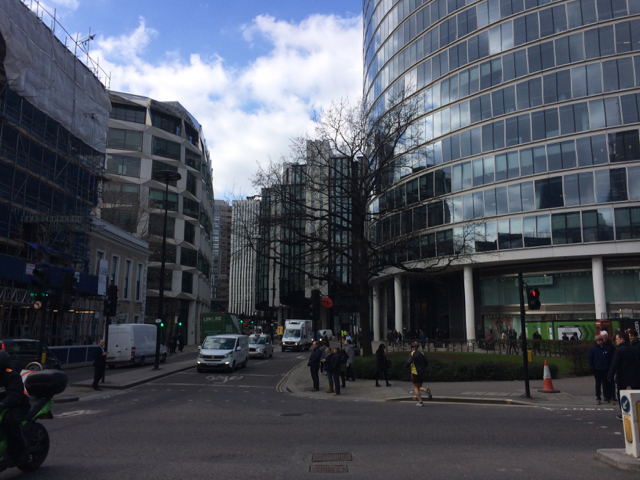
0:00:00 Moorgate and London Wall. Once solid-looking stonewalls are now façades pinned in place by scaffolding while new buildings are constructed behind. In just a few years the streetscape along London Wall has completely changed
0:04:34 London Wall and Copthall Avenue Deep metallic groans sound out from behind these hoardings. I assume the core of the building is being demolished, and the sound is the building complain.
00:09:41 Black Rock The circle leads straight into the offices of Black Rock. I enter the revolving doors and walk through a long dark lobby past whispering clusters of suited men and women. I emerge blinking onto a much quieter street, Tower 42 in the distance.
0:13:31 Copthall Avenue The circle passes straight through the Angel Court building. I attempt to walk through the underground loading bay but I’m turned back by security. There are some places you really aren’t supposed to go.
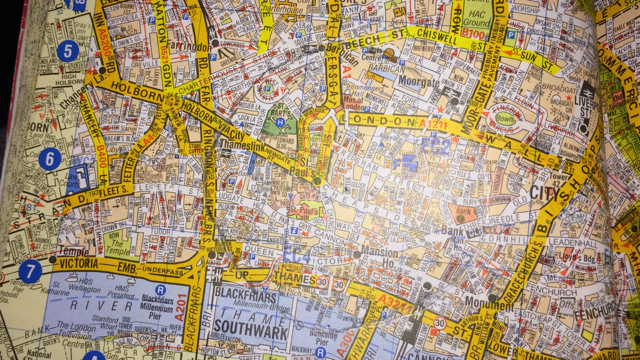
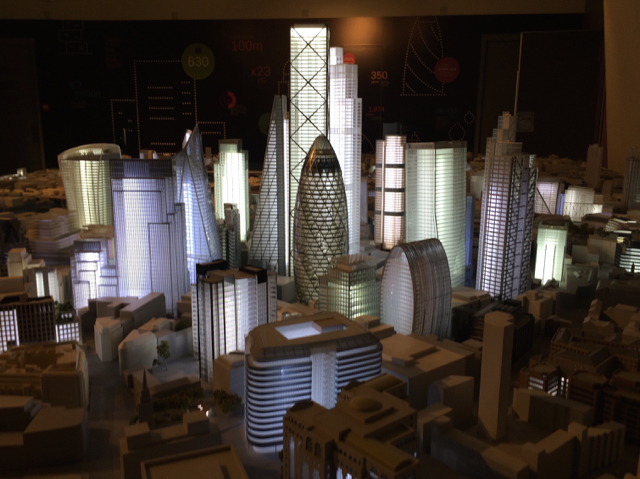
Last night I have a talk at the first ever City of London Showoff called Circling the Square. The event was put on by the City Centre, a fantastic organsiation right at the heart of the City that hosts a fascinatingly detailed 3D model of the City of London. I had been asked to say something entertaining and interesting about engineering in the City. I thought this was a great opportunity to try out and talk about my new hobby, psychogeography. The folllowing is a transcript of my talk (my full data log see my post Dérive #2 – City of London – Logbook)
As an engineer I love going on unconventional journeys: using odd means of transport, exploring forgotten paths, seeing the new from different perspectives. In his book, a Road of One’s Own, Robert Macfarlane instructs us to:
…unfold a street map. Place a glass rim down anywhere on the map and daw round its edge. Pick up the map, go out into the city and walk the circle, keeping as close you can to the curve. Record the experience as you go, in whatever medium you favour: film, photograph, manuscript, tape. Catch the graffiti, the branded litter, the snatches of conversation…Log the data stream…Be alert to the happenstance of metaphors, watch for visual rhymes, conincidenes, analogies, family resemblances, the changing moods of the street. Complete the circle and the record ends. Walking makes for content; footage for footage.
Robert Macfarlne – a Road of One’s Own, cited by Merlin Covereley in ‘Psychogeogrpahy’
Today I take my journey home from Münster to London via a different route from my way out. Outbound I came by ferry because it was cheaper; travelling back midweek I can just about afford the Eurostar. The route gives me the chance for a quick stop in Köln and the chance for an engineering detour via the Wupertaal suspended monorail.
Münster to Wuppertal
Münster is a beautiful town. I’ve spent the last few days staying with a friend and working on my book in the city library. The cities walls were removed to create a circumferential boulevard that is now tree-lined and a major thoroughfare for bikes and pedestrians. I walk this path one last time and peel off at the Hauptbahnhof.
I ride for twenty minutes on a quiet commuter train to Hamm. The flat landscape is filled with a mixture of fields and factories, with the occasional wind turbine. It reminds me of travelling up the Lea Valley north of London.
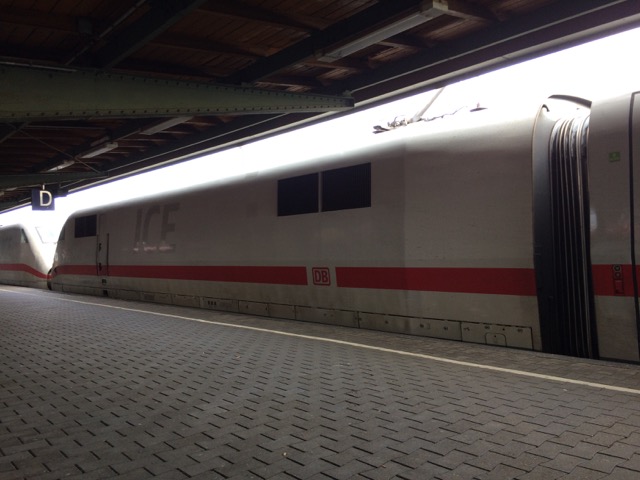
Hamm station feels in the middle of nowhere but its ten unloved platforms are busy with trains of all sorts coming and going. I get to my platform early and see one of the slightly older German high speed ICE trains arriving. Its bright white carriages are like hermetically sealed capsules. You can imagine this train is capable of zooming along the sea bed as easily as over land.
The ICE train is in fact two hitched together. I watch as the two are uncoupled and the front half pulls away. Just in time, I realise the back half is my train to Wuppertal, and I jump aboard. The land becomes more rutted and we follow an industrial valley that is well scored into the valley – it resembles the valley of the Seine as it winds its way north from Paris to Rouen in Normandy.
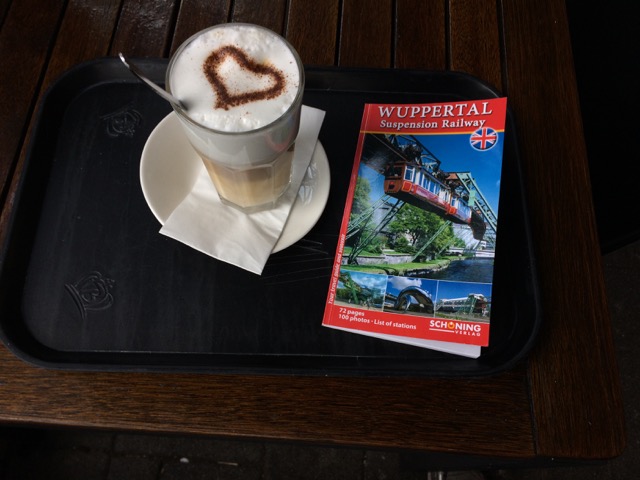
My connection time in Wuppertal is three-and-a-half hours; that was deliberate to give me time to make an engineering pilgrimage to a highly unusual railway, the Schweibebahn, Wuppertal’s suspended monorail. More details of that in a separate post.
Wuppertal to Köln
I’m blown away by the monorail – a great piece of railway engineering integrated into the city. With hindsight, three-and-a-half hours was a bit too long for my engineering excursion and I struggle to find the inspiration to explore the town further. It’s nothing against Wuppertal: I’m just keen to get on. I wait impatiently at the platform for my next train.
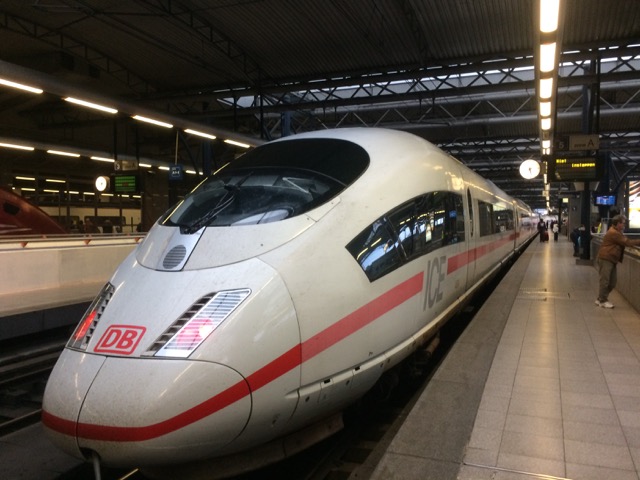
If the last ICE train I took looked like it could be amphibious, this train, a next generation edition, looks ready for space flight, with it’s pointed nose and sleek black-and-white lines. It’s a short twenty-minute ride to Köln and before I know it we are rumbling across the bridge over the Rhine. Köln Hauptbhahnhoff is covered by a wide arching roof; beneath, trains come and go from across Germany – and I see my first French train, the Thalys service to Paris.
I have fifty minutes between trains so I visit the magnificent cathedral which is surprisingly right next door to the station – almost on top of it. It’s quiet pews are better than any waiting room I can think of.
Köln to Bruxelles Midi
I get on board another of the sleek new DB ICE trains and settle in. I don’t remember much about this 2-hour leg as I slept most of the way. The day before long journeys I rarely sleep well as I worry about missing my train, and last night’s wakefulness just caught up with me. As we slow down on the approach into Brussels I see some fairly grotty looking commuter trains and I realise these are the oldest trains I have seen since I left the UK. All the trains I’ve taken over the last few days in Germany or the Netherlands, whether high speed or slower, were well looked after. I am reminded why I don’t ever get that excited about train travel through Belgium. I may however just be prejudiced against Belgian railways because they were responsible for putting the DB night train to Berlin out of business when they put up the transit fees they charge other countries for their overnight services.
Bruxelles Midi to London
Bruxelles Midi is an endless warren of tunnels where the light at the end never seems that appealing. I have an hour and a half before I can check in; I bought tickets for a later train because it would save me £50. The beer in the cafe is half the price of the tea, which is a shame as I’ve just decided to give up alcohol for a few days.
The journey flies by; before I know it I am back in St Pancras. As I walk down the long platforms I am struck that in all the stations that I have been through on either my outbound or my return journey in the UK, the Netherlands, Germany, Belgium and France nothing quite compares to the experience of arriving under the magnificent Midland Blue-coloured soaring arch of St Pancras station. A fantastic piece of engineering lovingly re-invented for a different century.
London – Harwich – Hook of Holland – Den Haag – Enschede – Münster
Six trains, two buses and a ferry.
Leisure
365 miles.
£90.
When I first imagined doing this journey I thought it would be a straight-forward case of taking the Eurostar to Brussels, a fast train to Köln and then a slower train to Münster. That is indeed is a feasible route but becomes expensive when you leave booking to the last minute, especially for a trip on the first day of the half term holidays, so I had to find an alternative plan.
Then I remembered the Dutch Flyer, a rail and boat service that goes from London Liverpool Street to Harwich, then on a ferry to Hook of Holland, and then, included in the ticket, to any station in the Netherlands. It’s a great overland (and sea) route if you are heading anywhere in Northern Europe.
Londond Liverpool street to Harwich
I take two empty local trains to get me to Liverpool Street for the 6:30am train to Harwich, only to realise that I could have had an extra half-hour in bed had I picked up the Harwich train from Stratford on it’s way out of town. Travelling this way is always an experiment though and you work out travel hacks like this as you go for use next time.
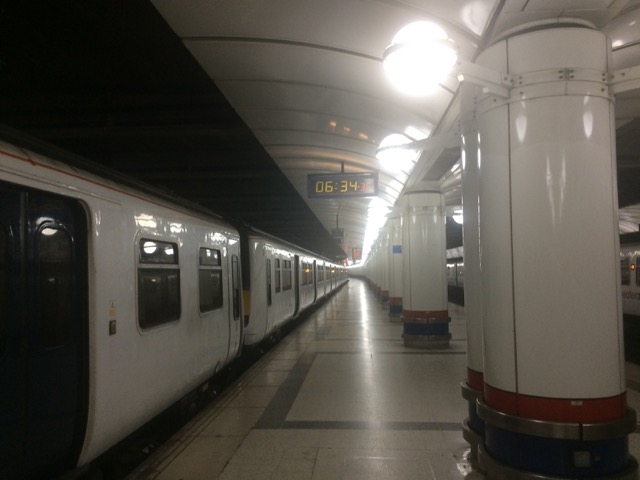
The Harwich train leaves from a dimly lit platform in the upper teens at Liverpool Street. It looks like any other shabby commuter train; nobody onboard seemed to realise they were on the first leg of the Dutch Flyer – or if they did they were concealing their excitement as clattered through the Essex countryside.
Darknesses gave way to an overcast morning. The train made a strange ticking noise when it stopped at stations.We reached beautiful Dedham Vale and as we rolled along the estuary the horizon on the other side was punctured by occasional steeples.
Harwich International is not as glamorous as it sounds, and it doesn’t even sound that glamorous. But the station couldn’t be more convenient for the ferry port: you climb the stairs from the platform and walk straight into the terminal building – integrated transport!
The building seems oversized – presumably designed for some long passed heyday of the ‘Dutch Flyer’. It has six check-in desks but only one booth was open for the three customers I was among. We went on through passport control, with a similar booth count redundancy of five, and onto a bus that drove me 50m from the shore, up a ramp and onto the ferry.
Harwich to Hook of Holland
The boat trip is a good seven or so hours at sea. I installed myself in the lounge and settled in for a day of writing. Around me people were settling in for a day of drinking. It was 8:45am and the bar was open before breakfast was even being served. The onboard drinking was a bit alarming as the majority of passengers seemed to be drivers. It now struck me that they were getting their pints in early so that their bodies could process them before we got to the other side.
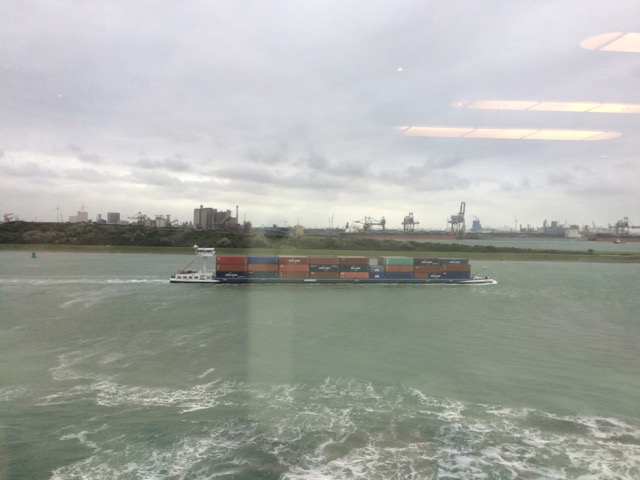
The sea between Harwich and Hook of Holland is a busy place. There are container ships everywhere. We are following another ship eastwards, and there is another on our tail in the shipping lane. And all the while we are avoiding the impressive arrays of wind farms in the sea. Storm Brian is whipping up in the UK and strong tail winds are sending big rolling waves past us.
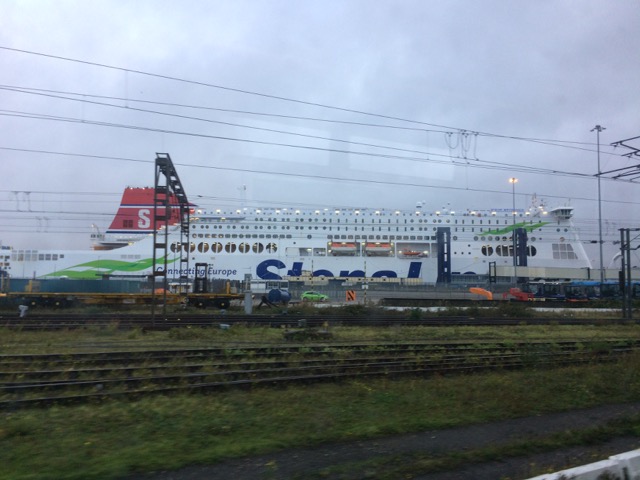
Eventually we arrive at the port at Hook of Holland, an industrial spot complete with flaring oil refineries in the distance. The ferry passenger terminal is slick and modern. It has an exhibition of models of old Stena Ferries in the waiting area that make me think of the Science Museum.
Crossing the Netherlands
Included in the Dutch flyer ticket – which is only £55 – is a rail pass to anywhere in the Netherlands. But before you can get anywhere you have to find the trains. A new rail link is being built between Hook of Holland and the nearby rail hub of Schiedam Centraal, and so I waited twenty minutes on the windy dockside for the bus.
This leg of the journey is a cross-section through industrial flower production. There are acres upon acres of glass houses, some lit up, many apparently heated, filled with flowering plants, there are huge processing and packing factories, and then eventually we reach snazzy looking management buildings and distribution centres. I’ll never look at a cut flower for sale again the same.
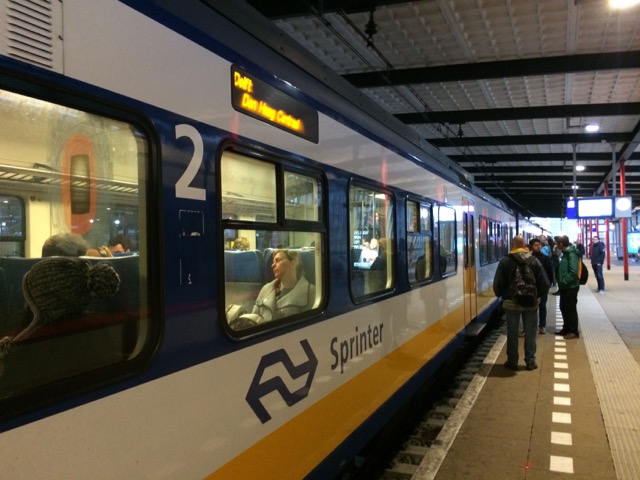
For me Dutch railways are about good modern design rather than high-speed, although they are fairly rapid too. The large stations I travel through are modern with a restrained elegance. Take Schiedam Centraal, from where I picked up a train to Den Haag. It has six platforms covered by an elegant roof that cantilevers out on both sides from a central spine. That central spine runs the length of the middle platforms, and while it necessarily an imposing structure because of all the load it carries, has large opening in it to let in lots light.
Spectacular roof at Den Haag Centraal
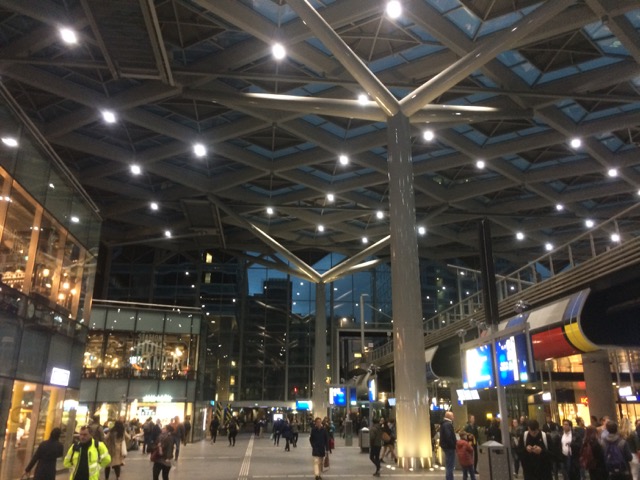
I change trains at Den Haag Centraal, a magnificent rail terminus, with towering steel columns that splay out at the top to support a distant roof. By now it is dark again, and as I take my next express train, I can no-longer pick out any features of the countryside I am travelling through.
From the border to Münster
At Enschede I change trains one last time. I am now on a Deutche Bahn service. Somewhere along this leg we cross into Germany, although there is of course no evidence of the border. The only difference is I can understand a small amount of the announcements, which I couldn’t in the Netherlands.
Finally, at 22:45, some seventeen hours after I left the house, I arrive in Münster to be greeted by my host at the station. This has felt like a long journey it has also been very satisfying; I was able to get a day’s work done on the ferry, and read the newspaper cover to cover on the train; and for the first time I feel I have a mental map forming of how the Netherlands and North West Germany relate to each other, and where major cities in this area sit with respect to one another. I look forward to discovering further this corner of Europe.
Ever since I saw my first one zoom past as a boy I’ve loved TGVs. In January I travelled from one side of France to the other and back by high-speed train to get to a conference, and used the chance to try to capture some of what I love about fast trains in France. It’s a mash up of travel diary, interviews and engineering history, all stitched together with familiar SNCF noises. I hope you enjoy.
I love packing. But until four years ago, I hated it. I would put off packing my bags, leave it to the last minute, forget things, bring the wrong things, and make the same mistake again next time. Packing became a lot more complicated when I started to pack for a child too.
Then one day I realised I needed to create a master list, a go-to reference that could be honed over time. From that day, I started writing, collecting and comparing my packing lists. Fifteen festivals, a dozen trips abroad and countless weekends away later, I have arrived at something pretty solid, which I share now for people who hate packing as much as I did, or who agree with the lifestyle design principle of improving situations which regularly annoy us.
It is probably worth mentioned a couple of drivers in the choices I have made:
I usually travel car-less – in fact I actively seek out ways of not going by car to take me off the beaten track – so I like to travel light.
Wherever I go, I often end up teaching swing dancing, which means that even in my regular kit I have some dance paraphernalia.
These previous two points mean there is usually a mixture between high-tech lightweight stuff, and heavy vintage stuff. Lightweight vintage stuff is the holy grail.
I hate luggage that you tow. Just saying.
As Seneca said, ‘May your faults die before you do’. I’ve got many left to fix, but being bad at packing is now safely interred. I even enjoy it.
The master packing list
This list is made up of a core which rarely changes, then a series of bolt-ons, which are groupings of things I commonly find I have to add for certain types of trip. There is some duplication between different bolt-ons so beware.
The core
Clothes
(Starting from the top)
A flat cap – I used prefer a wide-brimmed number like a Panama but it just gets in the way and falls off when dancing.
Sunglasses – usually really cheap ones so I don’t get annoyed when I lose them.
Coat (eiher a ski jacket or waterproof + fleece)
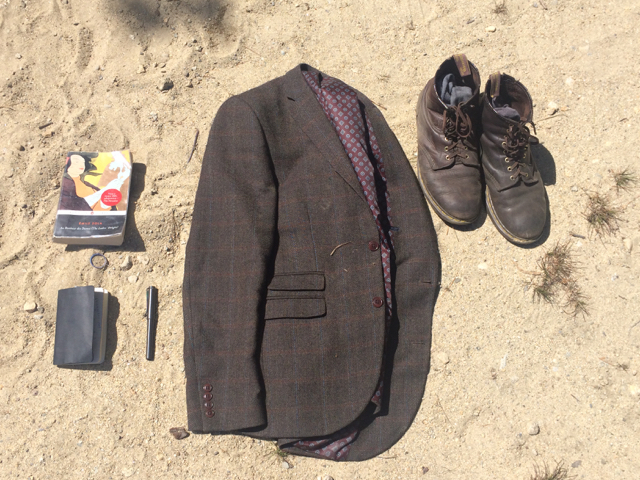
Tweed suit jacket – works for work, and for swing teaching. Really handy for docs when travelling.
Long-sleeved lightweight smart shirt.
Tie
Cravat (good accessory for swing gigs)
2x t-shirts.
Thin jumper.
Belt
Underwear
Swimming/running shorts
Jeans – lightweight Rohan jeans – dry super quickly. Work for smart/casual.
Lightweight trousers – only sometimes – something light to perform in, or hang around a festival.
Thermal underear – takes no room, can use for PJs or to keep warm in sleeping bag.
Waterproof trousers – sometimes.
Socks
DMs/converse
Flip flops.
Equipment
Diary + pen&ink, pencil.
Book
Phone + charger
Wallet
Computer/iPad + charger
Headphones
Speaker for teaching
Water bottle
Coffee cup.
Washbag
Wipes
Credit card swiss army tool
Travel towel.
Mudflappers business card
Swing teaching bolt-on
Garland
Hawaiian shirtWhite short-sleeved shirt (Mudflappers standard issue)
Brown smart waist coat
Dancing waist coat
Big grey trousers + braces
Big black trousers – possibly
Dancing shoes – possibly
Cable for connecting ipod to soundsystem.
Cycling bolt-on
Helmet
Gloves
Pump
Repair kit + multitool
Lights
Locks
iPhone holster
Bungee
Camping bolt-on
Tent
Sleeping mat
Sleeping bag
Liner – sometimes
Hot water bottle – sometimes
Torch
Camping cooking bolt-on
Large collapsable water carrier
Plastic bowl
Plastic spork
Mini chopping board
Sharp knife
Bag for left-overs
Trave wash and scrubber
Jet boil, cafetiere plunger, gas and stand.
Coffee
Three-year-old daughter
Hats – sun hat for the day and warm hat for the evening
Every time I go to the woods I find new insight or inspiration that I can use in my teaching. Today’s comes from deer tracks.
I know the main tracks that criss cross Hazel Hill Wood well. I could probably draw a reasonably accurate map of the place from memory. In a sense, I’m a bit sad that as I have got to know the wood better, I don’t get lost there any more.
But there’s a whole different level on which the wood can be explored, and on which I can lose myself. If you pay attention as you wander down any of the main tracks, you’ll see thin paths going off into the undergrowth. They are easy to miss at first because no sooner than they are off the main path they dive off under low branches. These are in fact deer tracks, and they criss-cross the wood on a different plane – about two feet high. When you start to look for them you’ll spot them everywhere.
For me these deer tracks are an invitation to go off track, to go into the unknown and see to where you end up.
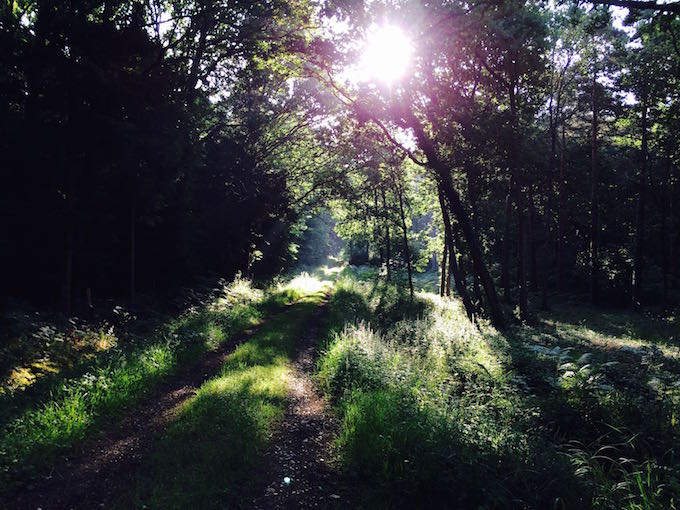
I followed such a track this morning and it led me through dark pine trees and then suddenly I was into a patch of widely-spaced silver birch pushing up through a carpet of lush muss. The place had a sort of magical green light. I had been to this place once before but would not have known how to find it.
To follow deer tracks you have to go off course, you have to pay attention – it’s not the easiest path. The tracks take you via unknown, sometimes-secret places, and bring by new routes to places you already know. And because the journey is different, the destination is not the same.
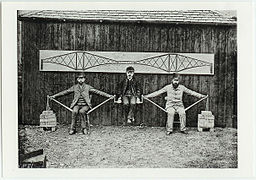
For my first time on stage at Science Showoff back in November 2011, I decided to recreate the famous public demonstration conducted by engineer Benjamin Baker to reassure the public that his planned Forth Rail Bridge would stand up. For me, this demonstration captures both the engineering daring-do and the showmanship of the period.
In Baker’s experiment, two stout volunteers sitting several metres apart represent the enormous pylons of the Forth Bridge, their arms out-stretched to represent the top chords of the structure, broom sticks stretching from hand to foot representing the bottom chords of the structure. On a seat suspended between the human pylons a slighter fellow sits representing the weight of a train passing from one structure to the next. What stops the two human pylons from see-sawing in towards the middle under the weight of the central load are the brick counterweights attached to their outer arms. These counterweights represent the massive weight of the approach gateways on either side of the bridge, and show how these gateways play an integral to the stability of the bridge.
The demonstration is beguilingly simple; recreating it on stage was not. Given the restricted performance space, I had to align the human bridge on the diagonal. Whereas the original experiment was conducted against a wall, mine was done mid-stage, without the benefit of the lateral stability that a wall would have offered. In placed of the broom sticks I created four wooden armatures to represent the bottom booms of the truss so that I could make the necessary connection with the pub chairs – these wooden arms were less sturdy than I had hoped. Finally, as I had arrived at the venue by bicycle, I needed on-site counterweights. The pub were unhappy about me using beer kegs, so one end of the structure was tied down to the underside of the stage, while the other was attached to a hefty base amp.
The rules of Science Showoff are clear: 9 minutes only on stage. Without the benefit of any rehearsal time, I took to the stage. Three volunteers were selected; all were given fake moustaches for authenticity. Everything was in position, but it all looked very shaky. With a few seconds left, the volunteer in the middle riding the bridge nervously lifted her feet from the floor. Without any wall to lean against, the whole structure began to wobble out of plane, but for a few seconds at least the span was achieved.
Sadly no photos were taken, but it is a moment I won’t easily forget. I would love to repeat this experiment, but next time I’d build more sturdy armatures designed to actually fit the seats at the venue, I’d do it on a wider stage…and I’d do it against a wall.
I didn’t know the Science Showoff team at the time, but they have since told me they were scared. Daring do indeed.
I know it is not often that you hear people say this, but I do really like Euston station – from an interpreted transport perspective, it is a good example of a well-thought through hub. (more…)
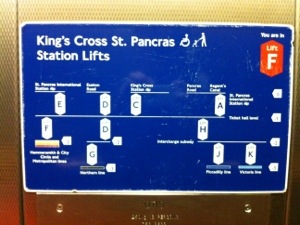
Pushing a pram, as is my new daily habit, has made me much more aware of the relative accessibility or inaccessibility of London. Today I decided the best option for step-free interchange was to be at Kings Cross, where upon arriving I was presented with the lift schematic shown in this photo. Step-free, no doubt – and that is an achievement in itself – but by no means simple. I had to help two other sets of travellers interpret the map as we processed around the station.
While I may criticise, the Underground is significantly more accessible to buggies than the Paris Metro, where there are simply no prams to be seen.
I am of course fortunate that my access requirements are such that, should it be necessary, I can carry the buggy down the stairs. But pursuing step-free access around London does cause me to try out new routes, and to discover bits of stations that I’d never noticed before (at London Bridge, in particular). Perhaps not very profound, but another example of how parental leave is giving me a new perspective on things!
This week we took our 5-month old by Eurostar to Paris. The experience of travelling with a baby is adding a new perspective to my journeys. Long-distance train travel with a baby is by no means impossible. The couple travelling opposite us on the Eurostar last Friday were on their way to Florence by night train, having recently travelled to Venice and to Madrid by sleeper with their well-travelled toddler. Most things still feel possible – I just feel I want to know a little more in advance. So this post is for the benefit of other people seeking reassurance about travelling on Eurostar with a baby. (more…)
This is only the second time I have taken a night train as part of a business trip. As we slip into Edinburgh in the early morning, having left London Euston at midnight, I feel this journey has gone rather well (my trip by sleeper to Turin for work in 2008 was less successful). (more…)
I feel like a bit of a wally standing here in the rain at Clapham High Street Overground station. There are many shorter ways to get me home, which is diametrically across London from here. I could for example slice straight through the middle on the Northern Line. But I want to take the slow circumferential route simply because for the first time, I can. (more…)
Last year for Cloud Cuckoo Land and this year for Shambala, I’ve taken the train most of the way, and covered the final leg by bike. Often the most difficult bit of festival transport is the bit near the site itself, as country lanes groan under the weight of traffic they were never designed for. Even public transport, where available, struggles as it competes with cars.
For all the publicity in London about the opening of the new Eurostar terminal at St Pancras, passengers leaving Paris on its inaugural day wouldn’t have been any the wiser. The lack of Parisian interest in the new London terminal was underlined by the ticket prices: while it would have cost me over £100 to book a place on a train leaving St.Pancras that day, the cost of a ticket in the other direction was just £29! I can forgive the lack of excitement from that end of the line however. When it comes to high speed train networks, France’s is in its late twenties whilst Britain’s is still teething.
Until yesterday, once the tunnel had been crossed and England reached, passengers were treated to a short stretch of tantalizing high-speed rail (the first part of the new link has been in use for some time now) before the trains slowed to a dismal trundle on the old line. Well, no more. Unfortunately it was dark so I did not get to see all that pristine Kent countryside that had seen routes for the line changed so many times. Before I knew it, a tunnel under the Thames, then we appeared to be over-ground and then back under again. We popped up for air again at what I guess was the building site for Stratford International before tunneling our way under North London. I remember five years ago a friend of mine living in Highbury had complained of rumbling under his basement flat for a period of about a week or so. He found out, from the council I believe, that those noises had been the tunnel digging machines digging those very tunnels that I was zooming through significantly faster.
The train popped of the ground one last time and we were cruising into the magnificently lit train station. Words do not do justice to what an amazing site the new station is. Passengers off the train for the first time on these platforms walked in eerie gob-smacked silence. The train shed, with its arches of ‘heritage Barlow blue’ which soar over the tracks to support 18 000 panes of self cleaning glass, makes for quite a destination. Indeed there were plenty of people there who had just come for the opening. At the end of the platforms they posed for photos beneath the 9m tall sculpture of a couple kissing. Europe’s longest champagne bar was not long enough to accommodate the masses who came to toast the new station.
I was grabbed for an interview by BBC Radio London who were broadcasting live from the concourse. I think I ticked a few of their boxes: not only had I just stepped off a train from Paris, but I was an enthusing engineer (and, as a bonus, someone whose father had arranged the medley of French songs played that afternoon by the LSO Brass section as part of the opening celebrations). On air, I was asked about how long it must have taken to paint the roof, a question to which I had no answer but assured them that it must take less time than that for the Forth Rail Bridge.
For me, St Pancras represents the first completed major engineering project university colleagues of mine have been involved with during their summer placements. St Pancras celebrates the engineering of a bygone era, is a fine example of how old can become new, and puts international rail travel back into the national consciousness. Not a bad start!
Last Tuesday evening I bid farewell to Waterloo International, the last day that Eurostar will serve this station before it transfers to St Pancras ‘in the (other) heart of London’. Before I even arrived I had fears that the Eurostar staff had packed up and gone as all the signs directing travelers from the Underground up to the terminal had already been whited out. How wrong I was. I arrived on the main station concourse to the sound of live music and the sight of dazzling lights. In the sunken entrance level to the Eurostar terminal, a stage had been set up and a band were playing, none too aptly, “Waterloo Sunset”.
I am happy to admit that I am a station spotter and have long been. It is cooler than being a train spotter as you get to talk about architecture, your subject doesn’t move so you don’t have to stand their waiting for it, there are plenty of food shops so no packed lunches required, and you can wear any clothes you like. This last advantage makes the station spotter hard to spot. I have blended in all these years and have simply thought that I was alone in my pursuit, unaware that other station spotters were all around me. That is until that evening when they showed their true colours and, in droves, they headed down to Waterloo International to wish it farewell.
The police had crowd control measures in place to stop people pushing into the sunken entrance area. If your name wasn’t on the list (read, if you didn’t have a ticket) you weren’t getting in. By the time I got in, the show was wrapping up, leaving only video footage of the new station projected onto the wall. It felt like mass train station hysteria; one woman had a tear in her eye. Staff stood around beaming, journalists were interviewing. With all the publicity for the new St. Pancras terminal, international train travel has recaptured the public’s imagination. But from this train station 81,891,738 travelers over the last thirteen years have already trained it, internationally. And so one can understand people being sad to see it go.
But go where exactly? It is all very well to wish a station farewell but it is not going anywhere. What are they going to do with it? Scuttle it? The plan as I understand it is to make the platforms available for comunter trains to use. But what of the long arrival and departure concourses? When I was twelve or so, I saw an architectural model of the terminal with it’s snake-like blue roof. It is hard to believe that this structure will now lie largely obsolete.
The party was over on the other side of security (the real bouncers). The place has felt tatty for a while now. I can’t imagine the maintenance budget has been kept up in recent months. Shops lay half empty of stock which was annoying as I badly wanted an adaptor. There were girls handing out free cake. Just like at the end of a party.
The squashed arch roof of the Hauptbahnhof in Berlin
I rode the escalator up to the platforms beneath their wonderful blue roof. This Grimshaw structure arches over the three platforms. Like that of the Hauptbahnhof (photo above) in Berlin the curving roof is made from a squashed arch which means that the roof in both Waterloo and at the Hauptbahnhof can cover the tracks without having to rise to high. By contrast the un-squashed arch of St Pancras’ roof soars high above the cityscape. Squashing the arch induces bending in the structure. In both cases the structure follows the exact form of the bending moment diagram giving a very pure structural aesthetic. At the Hauptbahnhof the arch is four-pinned and symmetric. At Waterloo, the designers chopped a third off this symmetric arch, giving it its asymmetric shape.
With the fanfare far behind, I boarded the train and as we pulled out was reminded that it was not the station that was the problem but the line. As the train bumps through Vauxhall, the carriages bottom-out their suspension. We creaked round a sharp left turn and then screeched through Brixton, presumably deafening those on the platform. By Herne Hill, the train slowed further to skateboard speed. However, after forty minutes of this bumping and grinding, a reminder of what the new route will bring, as the the Eurostar joins the already-open section of high speed track and accelerates towards France.
And so Waterloo must close. I am sure that station spotters such as myself will get over it soon enough. The start of services to St Pancras, for example, might offer a suitable distraction. With this opening I am certain that a whole new generation of station spotters will be inspired into being
Every omelette* has a story to tell. The first omelette was in Istanbul. It was on a Wednesday morning, having just arrived by train by a round about route from Paris. I was due to be meeting Dan outside the Agia Sofia mosque at some point in the afternoon, but didn’t feel like sightseeing in between, so I installed myself in front of a tiny street-corner cafe and killed three hours explaining to the owner that I was vegetarian using freshly garnered phrases in Turkish.
Omelette number two was rustled up in Coffee Nadiri. After spending our first night in Tehran in a soulless 4 star hotel, we relocated to a much more friendly place down the road, hotel Nadiri. During afternoons and evenings, the tea room underneath is humming with young people. It is a pleasant respite from Tehran’s bustling streets. But if you are looking for a dose of coffee before noon then is to the sister establishment Coffee Nadiri in an alley around the corner that you must go. It is in this small tiled room that we first saw an omelette cooking technique that we would see all over Iran. Omelette was apparently the only foodstuff on Coffee Nadiri’s menu, and the smart khaki-trousered proprietor had all the components and tools laid out before him. Arriving at opening time, as we did, we got to see the chef/manager’s entire routine. After sweeping out the tiled floors and feeding the budgie, the delicious corrugated bread is delivered. The tea samovars are prepared (Dan will surely write his own post about the tea routine), tomatoes are diced and onions are chopped and the cooking starts. Into an aluminum pan goes butter, the eggs and the tomatoes. The pan is tossed about using a spanner and then when the concoction is just ready, the hot pan is put on a tray with a hunk of delicious bread. Simple but very tasty.
Omelette number three was out East. We had arrived in Gorgon and felt a long way off the tourist track. We had found the town’s bazaar and over the road a tiny cafe with a spiral staircase up to a balcony overlooking the market. By now we had our Persian ordering phrases down to a T, so to speak, and a tomato ‘kuku’ was sent up to us. Here, the same delicious corrugated bread, but this time accompanied by some raw onion. Eating the onion was a mistake – I didn’t speak to a girl for almost a week!
Omelette number four was part of a wonderful spread cooked up for us by Katy’s mother. We had met Katy and her family on the train down from Istanbul and they had invited us to spend several days with them in their home city Shahrud. We took them up on the offer, and Katy’s mum had plenty of time to cook up an unending supply of vegetarian food to expand our stomachs. The omelette in this spead is vegetable flavoured and situated over to the left. In the middle is a leeky rice dish. It is cooked in a butter-lined pan in the oven so that the outside forms a tasty crust. The whole lot is turned over when served up. Bottom left is a soft flat bread. It appears that when we crossed the mountains between Gorgon and Shahrud, the corrugated bread got left behind. Just off to the right is my favourite iranian dish, kashka bademjum. Bademjum is aubergine, and kashka appears to be untranslatable but available in Iranian shops in London I am told. Also of note is the bowl of green leaves at the top, made up entirely of fresh herbs. And in the jug at the top right, doukh, a sour yoghurt drink. We stayed with Katy for three days, and each mealtime, a spread of these proportions was unveiled. Quite incredible!
Omelette number four in this hall of fame was found in a posh hotel in Yazd. I say found because it took us a long time to track one down. We had been up early touring this extraordinary desert town’s streets before the tourist hoards hit and were suddenly hit by a burning hunger. But none of the restaurants we found would sell us anything vegetarian. We were directed down the street to a breakfast place that looked like it would never arrive. In the end we gave up and walked into the brand new and completely empty Hotel Dad. We asked the receptionist if an omelette could be prepared for us even though we weren’t guests. They were only to happy to pamper us and direct us to this enormous and empty dining room. There we sat for half an hour ( I am sure that they were waiting for the eggs to be laid ) while at least five different waiters brought out drinks and bits of cutlery one by one. Eventually, our food arrived, but rather than the queen of omelets that we had been expecting, a fired egg in tomato sauce arrived. I would say I was a little disappointed not to score an omelette but it was the tastiest fried egg in tomato sauce that I have ever had.
Omelette number five signalled our return to Europe. I had tried to return to the cafe in Istanbul where I had spent three hours ordering my meal last time. This time I tried to speed things up by showing the man a picture on my camera of the omelette that he had cooked me four weeks before, but he just didn’t get it and kept trying to take a photo of me instead. So it was that we had arrived in Budapest after two days of train through Bulgaria and Romania and were pretty desperate for an egg fix. Budapest being the train hub that it is, I had past through the city several times on my travels and without a map, I have always been able to find my way through the back streets to this luxurious breakfast place. That morning was no exception, and in travel-grimey clothes we sat amongst the well groomed and ate an omelette that must have cost more than all the omelettes we had in Iran combined.
Omelette number six was a rather sad affair. Not only was it on the last day of our trip, in Zurich, it was also rubbish. Just look at the bread! Give me Coffee Nadiri any day of the week!
*Being a vegetarian traveller in Iran is not impossible but it is not either. Omelette was about the best source of protein we could lay our hands on. Hence the obsession.
*posts about will also appear on the blog Tehran Taxi which we will soon have underway
Since my last post, I have been rather busy! The lack of posts on this blog since then can be attributed in part to the large amount of work my final year project has required in order to get it finished. The project has changed direction many times along the way and even the end point of the project had not been set until my final week at the company where I had my placement. But as of Friday it has all been wrapped up.
But it hasn’t all been work. In between we have managed visits to Brittany’s gale-force wind-lashed coast, Bratislava and Alsace as well as to marriages in the UK and Madrid.
And now the summer beckons. My plan is to travel with a friend from Paris to Iran and back by train. The route takes me from Paris via Strasbourg to Zurich and then overnight to Zagreb and then Belgrade. The next leg from Belgrade through Macedonia brings me to northern Greece on the second day. After a couple of days rest, the overnight train takes me to Istanbul where I will be meeting Dan for our onward journey across the Bosporous and into Asia. The direct train from Istanbul to Tehran takes three days. After two days crossing Turkey, the train reaches lake Van in the east of the country where we must board a boat across to the other shore where we pick up the train again down to the Iranian capital.
Once in Iran, we will spend three weeks visiting the major cities of Tehran, Isphahan, Shiraz, Yazd and Mashad before heading back along the Caspian Sea coast back into Turkey and back along the Black Sea coast to Istanbul and back through Europe.
So many people have asked me why Iran? The trip itself is the end product of an itinerary that looked very different at the beginning of the year. But my interest in Iran is manyfold. All I have read about the country tells me that it is a beautiful place with some unmissable places to visit. Iranian friends I have told about the visit are at pains to emphasise just how well we will be welcomed. And yet, this impression of the country is a far cry from that held by those who rely on western media for any ideas about the country. This difference in points of view is one of the reasons that I want to go to Iran and experience the country and its hospitality myself.
And why go by train? Well, apart from the enormous carbon footprint associated with flying, I find it hard to imagine going by any other means. The journey from Europe to Iran by land is one that dates back to the silk route. Travelling by land is a way of feeling physically connected to a land that in the press feels far away. Ok, so six days of travel is not exactly close, but these trains do go slowly! And I am looking forward to seeing how the landscape, climate, architecture, people and language change along the way. Flying can’t give you that.
I am also lucky that I have the time to make such a journey. The website seat61 and Thomas Cook international rail timetable are in part responsible for my choosing this route. It also turns out that I am taking the same route as that described in Paul Theroux’s Great Railway Bazaar in which he describes his journey to and from Singapore by train. He made his journey in the 1970s. Since then, a lot has changed along his route, and I look forward to comparing notes.
I will be writing up my journey on this website upon my return, and will be publishing it on this blog.
Going home from work is always such a pleasure when it’s such a beautiful day…
On my way home through Gare de Lyon I saw three stilt walkers dancing avant-garde style to music played by a live saxophonist. They were all wearing green and white clothes, the colours of the new TGV est eurpoéen. I really wish I could have been at the marketing meeting when they came up with this idea.
This Monday I did “le pont”, which is when French employers give their staff an extra day off between the weekend and a bank holiday, in this case, on a Tuesday. But rather than have a lie in I put myself on the 06h50 train to Lyon for a day in a city that I have wanted to visit for many years. France‘s first TGV line was built between Paris and Lyon linking France‘s two largest centres of population in just under two hours.
I had two sites of design interest on my wish list. The first is the awe-inspiring Calatrava -designed TGV station at St.Exupery, Lyon‘s airport. Trains running directly to the centre of Lyon do not in fact stop here as St Exupery is on the branch that bypasses the city and heads down to the Med; in order to get there I had to catch a train to Marseille and remember not to fall asleep. The station was conceived to fulfil three roles: as a show piece to mark the opening of the newly built TGV line to the Med, as an entrance to the airport and thirdly as a symbolic gateway to the Rhone-Alps region.
When I stepped off the train at 8h30, I was virtually the only person there and it felt I had the entire station in all its magnificence to myself. I took photos of the magnificent train concourse and of the arching atrium over the ticket hall, but it was only by sketching different views of the building that I was able to decompose the anthropomorphic structure and understand its underlying logic. In the end I spent the rest of the morning there and I hope you will see why from the photos that I will post over the next week.
I arrived in the centre of town about 13h00 with no map and no plan. I found a FNAC and bought a guide, and then made it my first task to walk up the very steep hill just next to the town centre and get an overview of the city. Lyon is built on the confluence of Soane and the Rhone rivers. The city centre is on the long spit of land known as the presque-ile which reaches out to where the two rivers eventually join. From the top I was able to see all this and beyond.
Then it back downhill and up again in the district called Croix Rousse. In this area was based Lyon‘s formerly booming silk weaving industry. The district is full of secret passages that link streets and buildings up and down the hillside. Unfortunately there was too little time to discover any and if ever I go back, a return to this fascinating area will at the top of my list.
Back in the centre, I positioned myself in a café in front of the Opéra de Lyon which had its extension designed by Jean Nouvelle. Unfortunately the building was closed for the bank holiday which was a shame as I would have liked to have taken a tour of the new rehearsal spaces at the top from which, the view is apparently amazing.
Late afternoon was spent drinking coffee with a friend in the town by the town hall, followed by a tour of the campus of the Ecole Normal Supérieure. The tranquil wilderness of the glade in the middle of architect Henri Gaudin’s plan for the school makes for such a pleasant respite from the hustle and bustle of the city beyond its walls.
As evening drew in, there was just enough time for a beer on a floating bar before the thunderstorms rolled in, forcing me to take shelter in a pizzeria opposite the central station.
I really enjoyed my visit to Lyon. It is a city that seems charged with youthful energy and it is in the middle of a region of France that I would really like to get to know better. My visit was rathe quick, but it will serve as a good taster for when I go back, for I am sure that I will do.
It’s not just about the trains. It’s about the track, the gentle curves, the tunnels, the soaring bridges…
click this link to fly the route of the TGV Est Européen from Paris to Strabourg in 5 minutes, stopping at all the major bridges along the way, naturally…
Choose life, choose reducing your carbon footprint, choose highspeed train travel instead of flying
Thank you SNCF, for making trainspotting cool, at least for a day. Yesterday, a especially modified train with bigger wheels and go-faster stripes set a new train speed record of 578 kmph. The only thing that is faster on rails is the Maglev train, which doesn’t even touch the rails, and at that, only goes a few kilometres per hour faster.
It is fair to ask whether this record attempt was worth the 30 million Euro price tag. Travelling along France’s more minor train routes, there the decay and tattiness to be seen that is indicative of the large sums of money that have been diverted into the TGV programme. That said, France’s highspeed network is a great asset: where there are highspeed lines, flying simply takes longer. The development of the highspeed network has also pumped large sums of money into structures research, especially in the domain of bridge design. This record is in part another stage of that research process. The data recorded from sensors on the trains, tracks and bridges will help improve the understanding of these components under the intense vibrations that a train travelling at these sorts of speed can generate.
There is no doubt however that a significant reason for spending so much money on this attempt is the hard sell. France wants to export highspeed technology to South Korea and even to the United States. It is just possible that a train that travels at over 300mph is enough to make even the US, where internal flights rule the day, sit up and take notice.
Check out this trainspottingtastic coverage from France2:
As part of the preparations for the eagerly anticipated TGV Est-Européen, which will operate from June 10th between Paris and Strasbourg, the SNCF are hoping to break their previous high-speed train record. As might be expected, in France this is a media event. I heard it mentioned twice on the breakfast time news and it will be broadcast live on the lunchtime news. Read more here…
Also, I spotted this on the arrivals board last night at the Gard de Lyon. Anyone waiting for a friend on the 19h06 train might be waiting a long time…
The platform at Sofia station from which my train was due to leave was lit only by the dingy light coming from the carriages. Onboard I was greeted by a big friendly sleeping car attendant. I had stumped up the few extra euros to pay for a bed in a three bunk compartment and to my delight it seemed I would have all three bunks to myself. My accommodation for the night was more deluxe than the previous night’s, coming with more kitsch features such as the fold out basin in the corner and a full length wardrobe. It was a real luxury to be able to hang out my clothes albeit for a few hours.
As I ate my dinner of Serbian bread and tomato paste accompanied with Bulgarian pickles from a jar, I tried to make some sense of my day. I think that the hassle at the station in the morning had set me off on a bad foot and then nothing else that I saw or experienced really cheered me up. A few hours in a place is not enough to form any valid opinion – I would need to stay much longer there to do so. Unfortunately, my experience is unlikely to inspire me to choose to go back to Bulgaria in a hurry when there are so many other places that I want to visit.
At around midnight the train reached the border. This time there were five different groups of officials who came into my cabin. One, quite young looking official just came in and stared at me for what seemed like an eternity before I said to him “I have nothing to declare” and then he went away apparently satisfied. I was left wondering what all these people will do when Romania and Bulgaria are both members of the E.U. and these borders become completely open.
I woke up half an hour before the train was due to arrive at Bucharest Gara de Nord. Outside the was nothing but blackness. There was not a light to be seen in the Romanian countryside. I dozed off for a bit and awoke with a jolt at the station. I couldn’t afford to miss my stop, much as I wanted to stay onboard to the train’s final destination: Moscow!
Regular readers of this blog may be either frustrated that I have not posted any entries recently. Or thy may think I got lost in Sofia and have never come back. But no no, all is well, and I’ve just been a bit busy. You know how it is…
So back to Sofia…
When I got off the train I was not really prepared for the crowd of people around the door all offering me help. Most were wearing badges that bore their photo and the words “Official Information”. Very convincing. Thinking that I could do without their help I bounded off down the subway into the quite overbearing and immense communist era station complex. Its enormous hall is decorated along its length on one side by a twisted steel fresco depicting eagles and stars and all sorts of Soviet fun. Accidently going to the wrong ticket counter (I was immediately buying my ticket to leave – not because I had already written off Sofia but because I was only meant to be staying one night there and I didn’t want to miss the train that evening) I was clearly identified as a lost tourist and was pounced upon.
Fair enough, I was a bit lost, and my new-found friend insisted on walking me to the international tickets booth, then to the currency exchange place when it turned out the ticket booth didn’t take plastic, then to his mate when it turned out that his mate offered a significantly better exchange rate than the official one, then underground to the locker room where I was shown a locker to put my stuff in, guarded by another of his mates. And then I was asked to give them money for their assistance. Aware that we were alone in this underground space, I didn’t really feel like I had much choice, but it is true that they had helped me find the things I needed in half the time it would otherwise have taken me. I agreed to give them some money but only upstairs as I needed some change (when I needed a one bulgarian monitary unit piece for the locker and only had a fiver, they had taken my fiver, given me the one and pocketed the difference!)
With so little time and no guide book, I reckoned upon doing little more than wander around the town centre and warming myself with regular doses of food and coffee. The centre is a twenty minute from the station along a bleak suburban boulevard. When the mobile phone shops gave way to important looking buildings with flags atop, I was reassured that at least I was heading in the right direction. Feeling the cold, I dipped into a shopping centre for lack of any other shelter. Though Bulgaria is not quite yet in the E.U., the western chains of shops are already well installed, from Miss Sixty through to Timberland and Zara, all of which was quite depressing to see especially when the products are being sold at Parisian prices despite the poverty I had seen coming into town. I quickly left.
Giving up the main streets, I found a friendly and, best of all, warm looking bar selling food. I was feeling low on account of the weather, the hassle at the station and maybe because of a touch of loneliness – nothing however that a beer and an enormous pizza for 1.50€ couldn’t fix. Recharged and re-inspired, I set off again into the snow that was falling thick but not yet settling. I walked through the beautiful houses of the embassy district, I resisted the temptation to buy an accordion from a man in the street, and sat for a while in the serene confines of the basilica.
In a leafy neighborhood bordering the centre I found a shop selling scarfs. Using my best Bulgarian (a language which is closely related to Serbo- Croat) I was able to ask for a scarf that matched my orange shoe laces. The shopkeepers were surprised to hear that it was colder in Sofia than it had been in Belgrade. That scarf however made all the difference, I was toasting!
When I did venture to take my camera out, it was in front of the beautiful state theatre. I was immediately pounced upon by a man who said he had seen me a few blocks back and had been following me to see if I could sell him any currency. It took my some time to shake him off. As night started to fall, I went back to the station, all the time paranoid that my friends from that morning had kindly taken my backpack off of my hands.
Of course, when I got to my locker, all my worldly goods were where I had left them. I later encountered the only tourists that I would see in Bulgaria: a group of Americans and Canadians who hadn’t even planned to come to Sofia. They had been on a night train from Istanbul to Zagreb and had been turfed off at the Macedonian border because they didn’t have the right visas. They had had to spend the night in a prison cell before being put on a train to Bulgaria where they were allowed without a visa.
My last act in as a tourist in Sofia was to buy a bottle of water, to understand the price as it was said to me in Bulgarian, and to manage to use up the last of the tiny coins rattling around in my pocket.
Half an hour later than expected the Belgrade Sofia express night train creaked its way out of the station in the pouring rain. Out of the window I could see signalmen in their signal boxes crowding round televisions to watch the football. To save a bit of cash I had opted for a six-person sleeping compartment (compartments tend to come in twos, threes or sixes, with privacy varying inversely proportionately to beds). As luck would have it however, I had the entire six-person compartment to myself. I took pleasure in using all the little kitsch features in my moving hotel room for the night: the little hooks, reading lights, built in radio and light switches everywhere. Bizarrely I had to ask the attendant for permission to change bed even though I was the only one in the cabin.
I awoke at 4am to bright headlights shining into my cabin from both sides. I had forgotten to close my curtains, and dazzled by the lights, I scrambled to close the curtains without compromising my modesty. Anticipating that we had arrived at the frontier I lay there for some time, maybe half an hour, waiting for the border guards to come into the cabin to check my passport. Being quite drowsy it took me a while to notice the dull metallic clicking sound coming from outside. Finally I got up to find out what was going on. It transpired that my carriage was in fact stopped midway across a level crossing – hence the lights shining in from both sides. The train had hit a car which I could now see shunted over to one side of the road. The clicking sound was the sound of the alarm to warn people that train was coming.
I was able to ascertain that the while hurt, the driver of the car had not been killed. It was a rather unsettling spectacle. My mobile hotel room had unexpectedly arrived in their high street. I felt like an invader; a morbid tourist. There was little else to do except go back to sleep.
When I woke again it was eight and we still hadn’t crossed the border. The train cut its way through steep-sided valleys and as we climbed the rain that been falling since we left Belgrade turned to sleet. We arrived at Dimitrovgrad, the last stop before the border, six hours later than expected. There was little to distinguish this station from a goods yard save for the fact that most of the passengers on board got off here. Shuffling along the ground between the high-sided goods trains, the alighting travellers struggled with heavy suitcases in the sleet, which was now turning to snow – the sinister side of this spectacle didn’t escape me.
With the border guards happy, the train left an hour later towards the frontier. On the road that followed the tracks, a traffic jam of lorries stretched for what must have been several kilometres leading up to the customs point. Sights such as this demonstrate just how much easier trade must be within the Schengen zone. Finally we left the mountains of Serbia and made headway into the brownish high plains of Bulgaria, the rhythm of the rattle of the train on the tracks have changed when we changed country.
Apart from the odd isolated village and an enormous open mine, there was little to see in that barren landscape until the train started to approach Sofia. I could see the city appear on the horizon. First there were tower blocks, but before we reached these, the train went past fields just filled with rubbish. These fields gave way to ramshackle houses typically made up of a solid core supporting lean-tos and tarpaulins. The sight was quite unlike anything else I have seen in Europe. We went past train sidings where carriages stood with trees growing out of them. The train slowed and on either side I could see people walking along the tracks in the direction of the train. Seven hours later than expected, I arrived in Sofia
Wednesday 1st November
Having decided upon taking a detour via Bulgaria, I embarked upon finding out some basics about the country before my train that evening. My first port of call was the Architecture faculty where I met Barabara who was able to get me on line. An hour of searching yielded a map of Sofia city centre, a vocabulary list, an article about Bulgaria’s president (who if I remember correctly is the only democratically elected European head of state who has also been the king of the same countrt) and a key piece of advice from Barbara: in Bulgaria one nods to say “no” and shakes the head from side to side to say “yes”. This latter point proved a bit of a challenge for the old neuro-linguistic programing.
Later that afternoon we met Ana, and after some divine tasting cakes (that ensured I wouldn’t be eating again for at least two days) we scoured that capital for an English language guide to Bulgaria. The main shopping street’s many book shops are well stocked with lonely planets to anywhere you could think of – the Azores, Vietnam, Jamaica, Vancouver Island – everywhere it seemed except Bulgaria. It seemed extraordinary that I couldn’t find any information about the country next door! On the one hand, the prospect of going somewhere off the not-so lonely planet beaten path (as it appearded to me from Serbia) was quite exciting. On the other, it did leave me wondering why so few people, judged purely on the relative number of books detailing the deligts of other local capitals, seem to head next door.
My tireless and ever-resourceful guides took me on a tour of the disused dock area down by the river Salva just before it joins the Danube. The dockside buildings are in the process of being converted into super-trendy galleries and a bar. We had drinks on an almost floating bar – that is to say, it wasn’t floating but on dry land, but from its windows one might think one is afloat- the nearby real floating bar having been booked out for a private function. To help us believe that our bar was in fact floating, we drank coffee laced with booze. It worked.
By early evening, the cold dry spell had given way to rain. I tried to buy my train tickets to Sofia down at the train station, only none of my cards wanted to work. Ana was able to lend me the cash, but I was suddenly worried that I would arrive in Bulgaria with not a euro cent. I tried to do the sums in my head. With the 100€ in my pocket, I might just have been able to buy tickets to take me as far as Budapest from where I already had tickets home booked, as long as I only ate apples along the way. It didn’t bode well.
Luckily however, just when my worst fiscal nightmares had flashed before me, a cash machine finally decided to be nice and give me the dough. Stocked with food for the journey it was time to wait on the dark and dingey platform for the train to take me away. I was sad to be leaving Belgrade. I had had such a great time with my friends and I was in no mood to continue on my own. Ana and I plotted when we would see each other next. When we first met in Ljubljana the year before, it hardly seemed possible that we would meet again, such is the distance from the UK to Serbia. But with two visits to Belgrade since then already in the travel log, the city doesn’t feel that far away. Roll on our next encounter, Paris in the spring…
I first went to Belgrade in this summer enroute to Greece with Mary so I already knew bearings in the city. After a very agreeable lie in I met Ana and Barbara for the start of a more comprehensive tour. We started in their favourite and super trendy coffe shop “Greenet”. We then made our way over to a street on which each of them, as part of a group project on their architectural course, had a house to redevelop. The street has some buildings which are derelict and some which are still inhabitted. The principal question was whether or not to keep any parts of the old buildings or to start afresh.
We continued through the neighbourhood. Belgrade has some beautiful old buildings, some of which are in desparate need of repair. It also has some quite oppressive concrete architecture in a greyey-brown darker than I have seen anywhere else. Down some more side streets and up to the Orthodox Church, the largest (or 2nd largest??) Orthodox church in Sebia. It is still under construction but we were able to stroll inside beneath its souring arches. It looks beautiful from the outside, but what is incredible is the sheer volume contained beneath it’s concrete vaults. Huge slabs of marble lay to the sides waiting to be bolted onto the walls. High above us, workers were busy in the dome above our heads. It was only then that I realised we had happily strolled into the middle of a building site with materials being moved around thirty metres above us and we had no hard hats. Still, if a lump of marble falls on you from that height, there is not a lot a hard hat is going to do…
We traversed back across town and back across the main shopping area to a much older part of town. Enroute we passed the site of another project site for the faculty of architecture. This time it was a busy junction with trams cars and people intersecting in a very tight spot. The project had been to untangle as best as possible the mess. From what Ana and Barbara said, there are a great many architectural contests in the city which must make Belgrade a great place to study architecture. Unfortunately only a handful of them are built as there is just not the money.
Ana had picked out a cosy restaurant for lunch. Ever since arriving in Vienna I had been a bit on the chilly side. I really hadn’t reckonned upon it being this cold, a symptom I suppose of the apparently mild autumn we have been having in Paris. As we ate we were accompanied by a traditional Serbian band comprising a clarinet, accordeon, guitar and double bass. The band would improvise on one tune, and then all of a sudden the accordeon player would change tune and a few moments later, the rest of the band would catch on.
I was left to my own devices while Ana and Barbara went to a design workshop. I spent some time rethinking my itinerary for the rest of the week. I had been due to take the train the next day to the Romanians mountains where I intended to do some hiking, but I was feeling more and more apprehensive about this plan. I was concerned about turning up in northern Romania and finding all the hostels shut. I was also a little nervous about the train connections I would have to make, including one change in the middle of the night in the middle of nowhere with a two hour wait in between. With all this mind I had another trawl through the timetables and another plan came to mind. It was thus that I decided to go to Bucarest (not orginially on my itinerary) and to go via Sofia. The plan had the advantage that I wouldn’t have to worry about accomodation as I would be sleeping on night trains (ultra cheap in this region). There was also the added bonus that I could spend an extra half a day in Belgrade.
That evening we undertook a tour Belgrades night spots including a very cool cocktail bar hidden down an alley, up a stair case and behind a very plain looking door that you had to buzz to open before making your way into the brightly lit lounge. While Ana and I were up for a party, I think the rest of Belgrade went to sleep early that evening but that didn’t stop us having a great night chatting until the rather small hours.
I must have slept well in my reclining seat as I completely slept through Munich and Saltzburg, although I had been aware of many different people having sat beside me during the night. When I awoke the train – still the Orient Express – was pulling out of Linz. When I had gone to sleep I had been surrounded by people with coats pulled up over their heads to help them sleep but by the time we left Linz these had all been replaced by smart Austrian commuters tapping away at their laptops. It was all rather disconcerting. Between Munich and Vienna the train snakes along the foothills of the Alps, a beautiful site to wake up to. Leafy suburbs appeared and then Vienna rolled into view, looking pristine in the morning sunshine. With an hour and a half to kill I stretched my legs in the vicinity of the station. The first thing that stuck me was how cold the air was and I was cold wearing both of the coats that I was travelling with. Only they day before I had been in Paris wearing a t-shirt!
Wien Westbahnhoff is a bright and airy mordernist station with large windows that bathe the quitely ciruclating masses in morning sunlight. All around me seem very relaxed, almost noislessly moving from platform to platform. Time for a coffee and to stock up on provisions and then it was straight onto my next train, the 10am “Avala” to Belgrade.
In contrast to the western side of Vienna the landscape to the Danube Valley to the east is wide and flat. Between the capital and the border I saw hundreds of windturbines slowly turning over in the breeze. At the border with Hungary I caught sight of the river and on the opposite bank, Slovakia. On the Hungarian side of the border, the river continues eastward for about an hour afterwhich, then it makes a sharp right and heads south to the capital. By 1 o’clock we’ve arrived at Budapest Keleti station.