Having spent his whole professional career performing and recording symphonic music, my father, Nigel Broadbent, is a font of knowledge about composers’ creative methods. For engineers (and other humans), there’s a lot we can learn from these strategies for ‘music design’.
This week, I am running a workshop on how we can harness sleep and the subconscious in the design process.
Sleep is a powerful part of the creative process, and many composers know—or have known—this.
Nigel says he composes his best music early in the morning, before he has spoken a word to anyone.
Benjamin Britten had a strict cycle of composing that integrated time at his desk, exercise, play, and sleep.
Apparently, he would take a walk in the afternoon, and ideas would come to mind. In the evening, he would socialise and improvise tunes at the piano for his friends based on the afternoon’s ideas. He would then sleep and, after waking in the morning, turn the sleep-processed material into output.
Sleep does wonderful things. Think about how you could make the most of the power of sleep. In fact, don’t—sleep on it instead.
It is a loop that begins with observing a situation, then establishing a brief for your work, developing ideas, and testing those ideas—trying them out in some way and observing what happens.
Then we are back to observing again. Except we aren’t back in the same place, because the system has changed. It now includes your idea.
The second time around, we are observing a changed world—a world altered by our developing and testing of ideas in response to a brief.
Now, we can update the brief to create a better set of requirements—a set informed by what happened the last time we went around the loop.
Each conversation with a client about needs and possibilities is a journey around the design loop.
Each time we share sketches with the design team, we go around the loop once more.
Assembling tender drawings and receiving tender responses—another orbit.
Early contractor input, detailed design, on-site meetings to resolve design issues—all further revolutions.
Every time we loop the loop, we learn something more about the system we are working in and how we are changing it.
In the coming weeks I’m going to be talking quite a lot about the Regenerative Design Lab because we have a new cohort starting next week. Some of you will know all about the Lab, some will know nothing, so, this quite long post is to help fill in the gaps.
Beginnings
Back in 2022, I was the recipient of the Sir Misha Black bursary and had the opportunity to develop my design teaching in new areas. I wanted to explore regenerative design. From what I already knew I realised that this exploration would be better done as a group, and so we set up the first Lab for that purpose.
Working with Alexie Sommer, we put together the original advert, and 20 brave people gave us their trust and signed up. About that time I also met Ellie Osborne, a brilliant facilitator, and the two of us have been co-facilitating the Lab ever since.
The first cohort ran from March to October 2022. Our first cohort of participants from across the built-environment spectrum started digging into regenerative design. Our aim, to explore its principles and translate these into practice for industry.
Right from the start we have delivered the Lab with the support of Engineers Without Borders UK. Being regenerative is one of their four key principles for globally responsible engineering. We will be collaborating with Engineers Without Borders UK to share the findings of the Lab in the educational policy space.
Growing
Since then, with funding through my 1851 Fellowship in Regenerative Design, two more cohorts have completed the Lab process. We have over fifty Lab alumni who between them are spreading the ideas of regenerative practice across industry. The conversations from these cohorts heavily informed the book James Norman and I co-authored, The Regenerative Structural Engineer.
Regenerative design challenges the way we approach design. It’s not just a new flavour of design, but questions the goals, the motivations and how we show up. And so during the Lab, we consider regenerative design from a wide range of angles – including mindsets, systems thinking and how we collaborate.
A key part of the Lab is spending time in a thriving, living system, which is why we take our participants on three residential visits to Hazel Hill Wood. We see the wood as one of the facilitators, providing an example to us of thriving, a place for congregation and focal point for considering the wonder of this living world that we want to protect.
Evolving
Our fourth cohort begins next week, and for the first time we are delivering this Lab in partnership with another host organisation, the Sustainability Accelerator at Chatham House. The focus for this cohort will be on how to create policy that delivers regenerative design. For the first time, this Lab cohort will have two homes, with one foot in the woods and the other in the centre of a city.
We are already beginning planning for our fifth cohort, for which we will be partnering with Watershed in Bristol. This cohort will focus on exploring regenerative design with a project context with particular emphasis on inclusion, diversity and power. Cohort 5 will kick off in September 2025.
I spent most of yesterday afternoon up to my middle in waves learning to surf. (I’ve got a long way to go). So it is no coincidence that today’s post is about waves. Not necessarily physical waves but the waves we experience as humans.
As James Norman and I set out in our book, the goal of regenerative design is for humans and the living world to survive thrive and co-evolve. If we are thinking about human thriving then we should consider how we, and the people around us, experience a whole series of waves through our lives. The daily cycle of night and day, the menstrual cycle, the seasonal cycle and the cycle through the different phases of life. These cycles are waves with peaks and troughs. Trying to flatten them or ignore them by pretending that all things are constant stresses the system. Maintaining a high level of work when there is no energy in the system can be damaging. Equally having an abundance of energy and no means to dissipate it can also cause damage.
Much better is to try to work with energy of a system when it is available and use the downtime to recover.
Imagine a graph showing the power of two systems over time. One system has moments of high power and low power. The other system just operates at a constant power level that is the midline of the peaks and troughs.
The total area under these two graphs (which represents energy of each system) is the same.
If we have a system that is trying to run with oscillating levels of available energy and we try to flatten it, we risk damaging the system without gaining any more energy.
When we are thinking about how to organise our own work and how we collaborate with others, it is much better to ride the wave of available energy. Whether that’s through tuning in to our own daily, menstrual, seasonal or life cycles. Or through providing allyship to how others experience theirs.
Riding the wave is also much better for surfing. Sadly, I’m a long way off riding it for very long.
It is a simple question. What if every time we built something the world got better? Not just in the places we construct but in all the places affected by our construction activities. If we could meet this apparently simple ask, then we would shift the construction industry from a paradigm of extraction and damage to a paradigm of healing and repair.
In our groundbreaking new book, James Norman and I explore what it would take for the construction industry to make this shift and what role structural engineers have to play in this transition. In short, what it would mean to be a regenerative structural engineer?
I’m just noticing that I’m entering that perfect groove of Friday afternoon. I’ve stopped travelling for the week and I’m back at my desk. My head is buzzing with ideas from the week’s accumulated activities. I have got Fip.fr on the radio and for a precious few moments, there’s no barrier between me and the page.
I talk quite often in my creativity training about finding the right moment to do the right kind of work. A few years ago I heard Tim Ferris interview Dan Pink about his book ‘When’. Pink was writing about trends in what kind of work suits what times of day for different people. If memory serves correctly, he was suggesting that for many people, the morning is a more analytical time, the early afternoon is a post-lunch slump (ideal in my mind for doing expenses) and the late afternoon and early evening are ideal for more creative thinking.
He doesn’t say this is true of everyone, but says it is a common for many.
In my thinking about regenerative design, the idea of working with living cycles comes up often. I see this tuning into what work suits what time of day as another manifestation of this idea of a living cycle. Right now as I settle into my Friday afternoon groove I know that I’m working with the cycle, everything aligns and it is little extra effort to carry on moving forwards.
For me the questions are: where are we working with the direction of a system and when are we working against it. Sometimes we need to against the flow to make change. But working constantly against the flow is hard work and comes with an energy cost that one day we must repay.
The only problem I have with listening to Fip.fr in the afternoon is that the times are in French and every so often I forget and think it is one hour later than it really is.
I was in Cambridge again yesterday to deliver the second workshop in a new cycle of material on conceptual design for the Interdisciplinary Design for the Built Environment Masters programme.
This cycle of teaching starts with the unpicking what is a design brief. I called it things to think and feel about a design brief because there are skills we need to understand a brief, but it is helpful to question our whole attitude towards what a design brief is.
A brief can sound like something that is fixed. But I see it more as a signal of intent. Design is a journey of discovery. If it doesn’t involve discovery, it isn’t design. And so, like with any exploratory journey, we can have an intent for setting off, but what we find on the way can and should inform the direction of travel.
In this workshop we discuss the Designer’s Paradox and the 5 Elements of a Brief, and then we delve into how we can use the brief to test the quality of our ideas. And, critically, how to do it quickly – not with the benefit of multi-dimensional analysis, but with sufficient confident to admit an idea into the domain of the possible.
Our summer tour continues. From Batz-sur-Mer we took a TER train to Nantes. No cycle reservation necessary. And then from Nantes, an Intercité train to La Rochelle. This is the only service on our whole tour for which we did need a cycle reservation. At this point in the Tour I am now preferring the idea of having to make a reservation because at least you are guaranteed a place. Of course what we need is much more provision on trains for bikes.
From La Rochelle station we cycled straight through the old town, out of town and over the magnificent Île de Ré viaduct to the island where we would be staying for six nights. The following are selected Eiffel Over highlights.
Île de Ré bridge
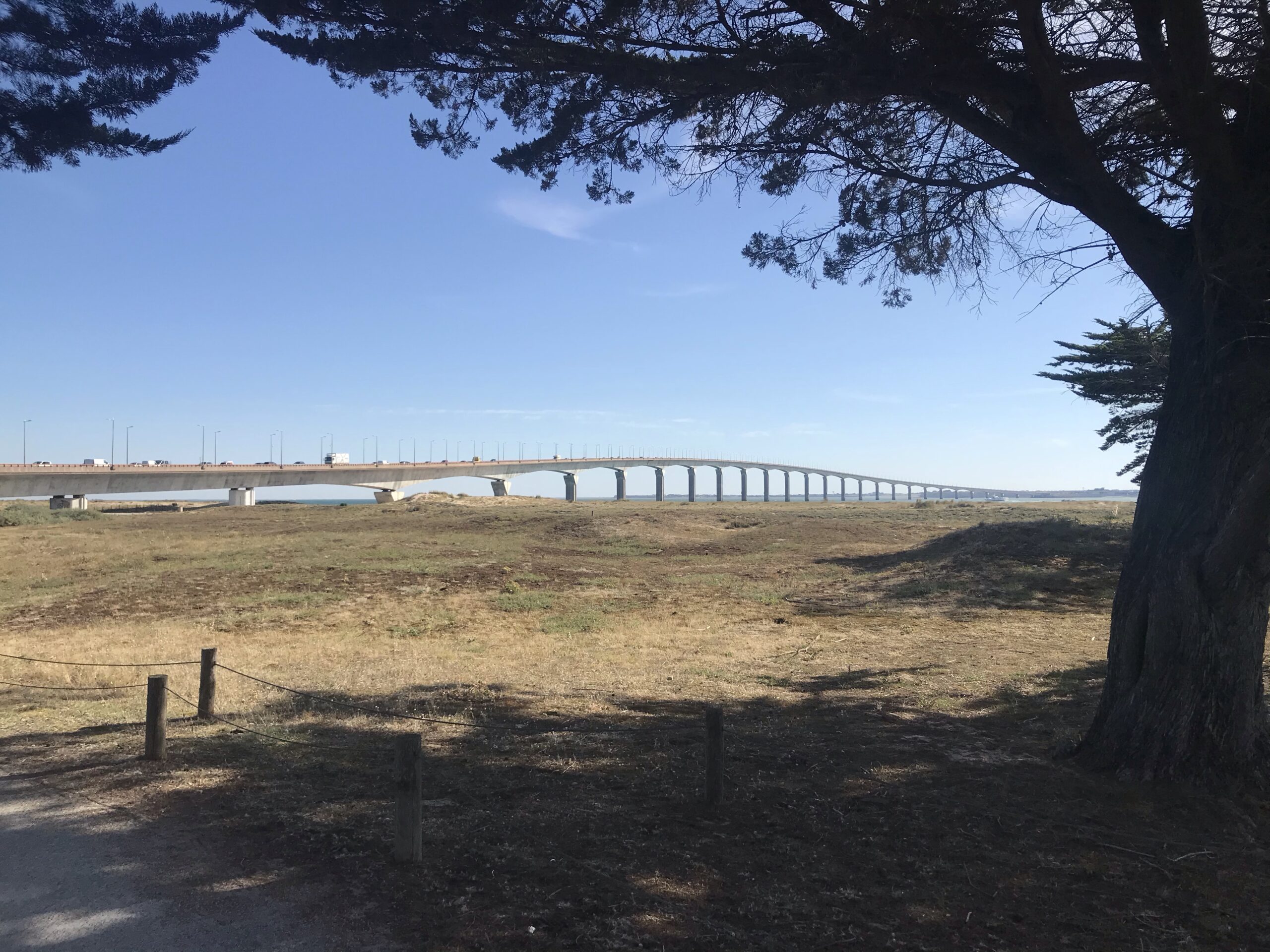
View from the island side of the Île de Ré viaduct
This is the 2.9km bridge linking the mainland to the Ile de Ré. Get all the facty stuff here from Wikipedia.
I find its curve on plan as well as on elevation very graceful.
There is a segregated cycle path which is a much better way to cross than to sit in a 2.9km jam with all the cars.
Very elegant columns too.
Impressive to see this structure marching out across the sea.
A significant portion of the tolls are spent on improving transport infrastructure on the island – see below.
Cycling on Île de Ré
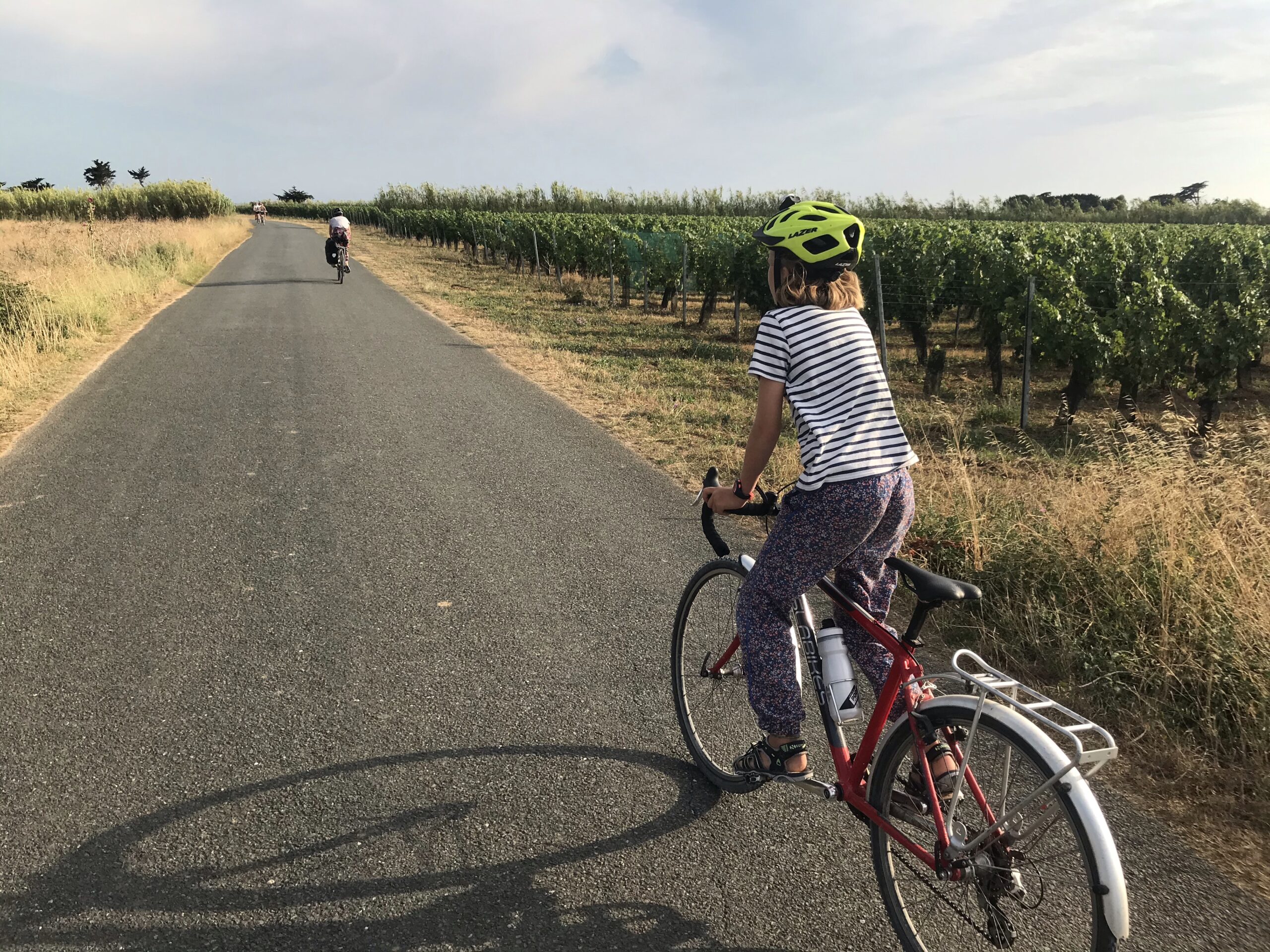
Cycling between vineyards on the Île de Ré
The local authority has invested heavily in promoting cycling on the island to the extent that it is a victim of it’s own success. There is a very comprehensive network of cycle lanes crossing the island. And these are very crowded in places because they are so popular. It is as if the island could do with doubling again the cycle infrastructure.
Stone fishing ‘écluses’
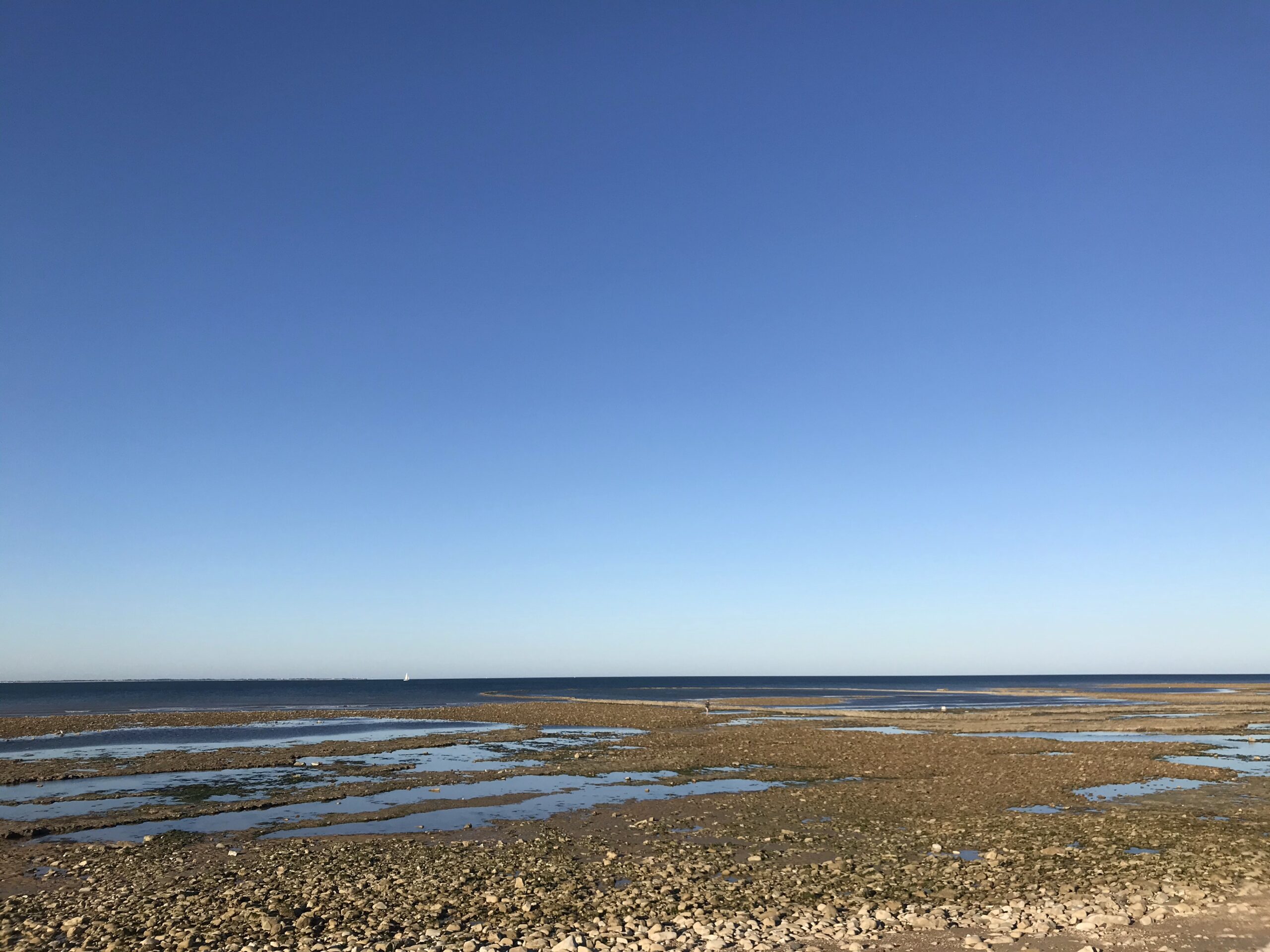
The dry stone wall of an écluse can just be seen arcing out to sea in the top left of this picture from the Île de Ré.
For centuries it has been traditional to build tidal lagoons on the beaches that fill with water at high tide and then which slowly drain at low tide, enabling local fishers to scoop up the fish left behind. The lagoons are created by building a large circular dry-stone wall on the tidal flat. Local laws forbid the use of concrete – these walls are carefully built by hand and maintained to create this once important source of food. Their French name is ‘écluses’, the same word for a lock on a canal.
In the eighteenth century local officials destroyed the écluses to stop this source of food and forcing local men to sign up to join the navy.
More unbelievably, in the second half of the twentieth century, the commercial fishing industry lobbied to have them destroyed again so that they wouldn’t eat in to potential markets for commercial fishing.
In recent years there has been an effort to repair some of the écluses. We saw some people fishing in the one shown above at low tide.
Like the salt flats they are an example of infrastructure managed in common to create an honourable harvest – to use Robin Wall Kimmerer’s term – from the local ecosystem.
Final thoughts on the Île de Ré
The Île de Ré is a fascinating place but the early August heat was almost unbearable and the summer crowds relentless – although in the further reaches of the island where M explored there were places where no one was to be seen. There is lots to find out about how people have lived in this island. And not just humans. For instance, two thirds of European bird species have been spotted here, it being a major stopping off point for migration. The sea life is also fascinating to explore at low tide.
The visit makes me want to visit more wild islands. Maybe ones that are not connected by bridge to the mainland.
After six days we were ready to cycle back over the bridge and head on south.
The highlight of our visit to Nantes was standing next to the Great Elephant as it set off for one its walks around the former dock yards. The 45-tonne steel and wood sculpture is part of the Machines de L’Île creations. At the centre is the workshop where engineer-artists create mechanical creatures that replicate real animal movements. The concept is that the creatures escape from the workshop to create the exhibits around the dockyard site.
I find the whole place a wonderful combination of humour, heart, engineering, spectacle and wonder and reverence for creatures big and small. Definitely worth a 3 star engineering detour.
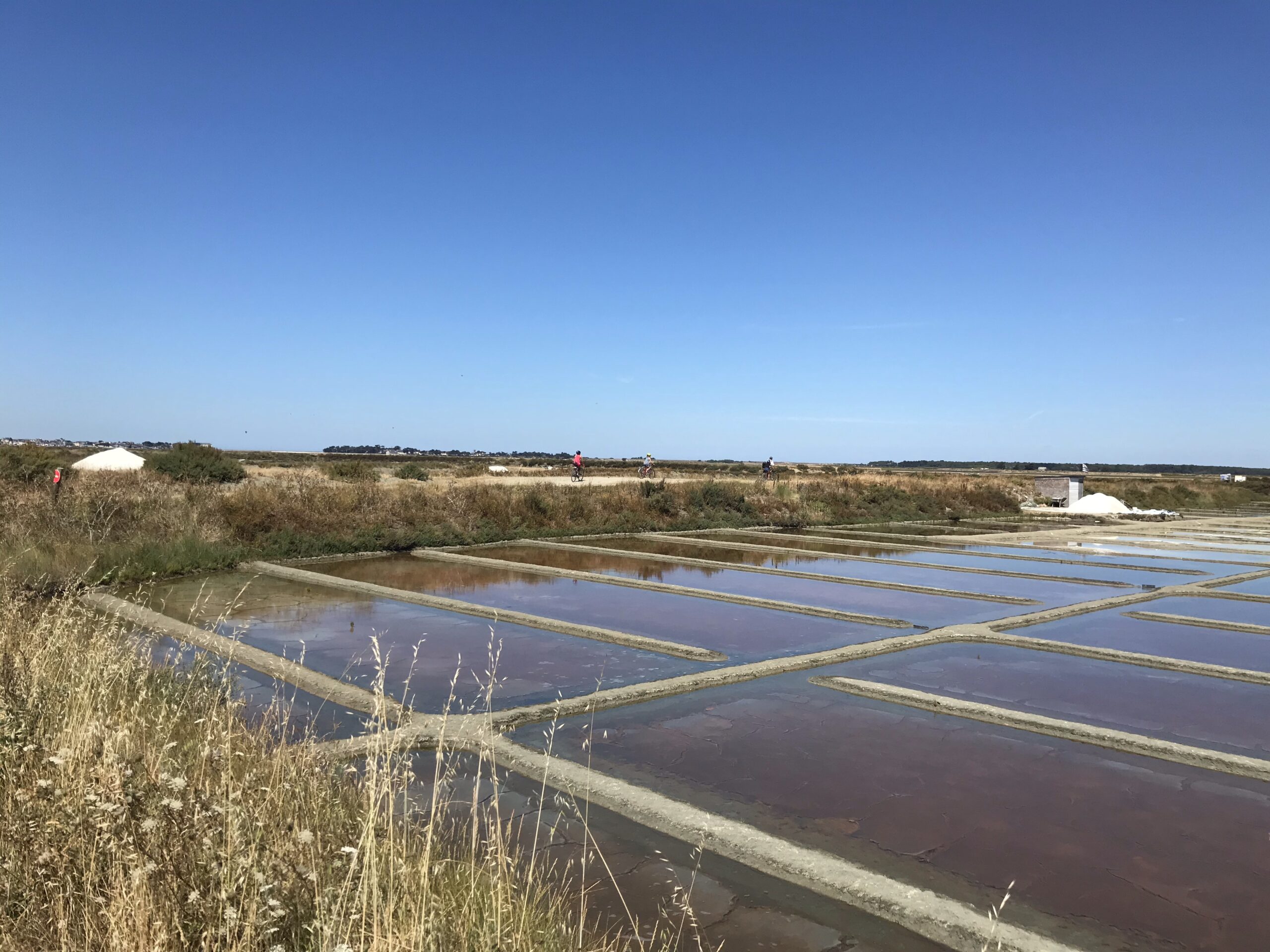
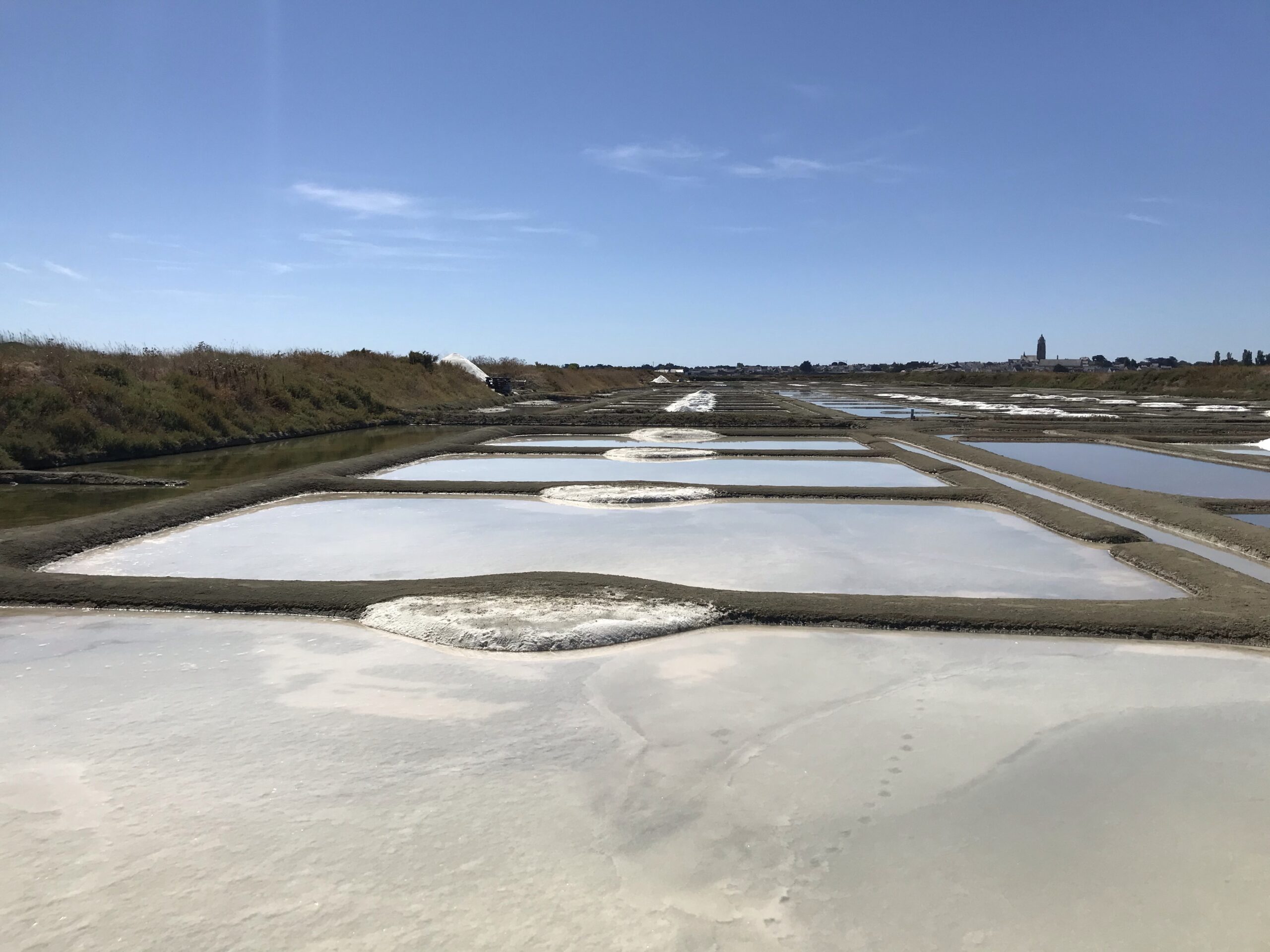
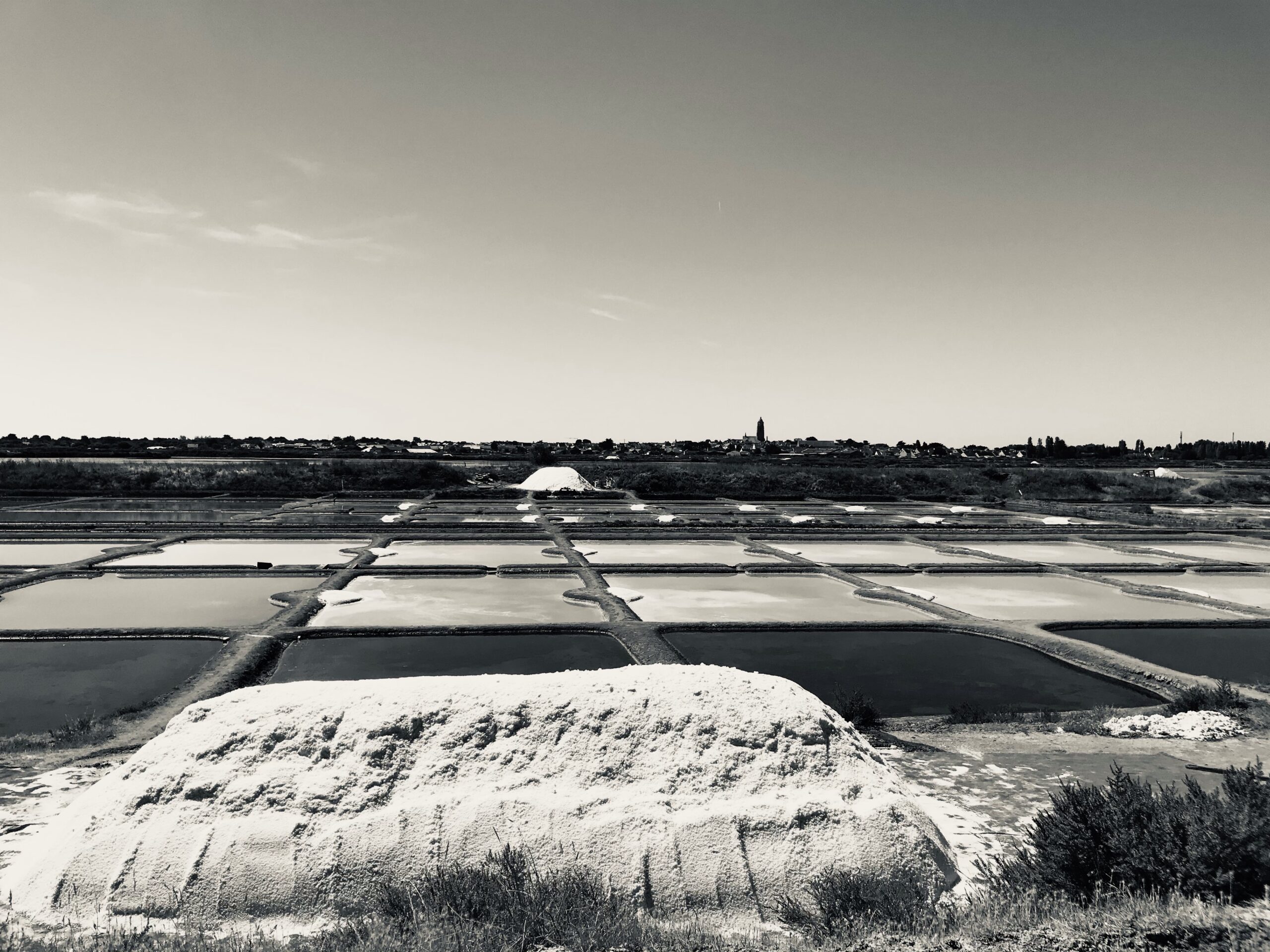
Salt has been harvested in the bay between Le Croisic and Guérance on the edge of Brittany for centuries. The industry had been in decline but in more recent decades has started to grow again with the local attainment of a ‘red label’ quality status for its salt products.
We had the privilege of getting a tour of the salt beds with my old friend from Paris days, Ronan when we stayed with his family in the house he grew up in in Batz-sur-Mer. It was a welcome two-day stop on our Summer Tour.
As Ronan explained:
At high tide, sea water flows into reservoirs that stock the water for the day of salt harvesting.
This salt water is then directed by an intricate network of channels to blocks of salt beds.
Each salt bed is about the size of a typical English allotment. In a salt bed the water from the channels flows in and the flow reduced to almost a stand-still.
During the heat of the day, the water evaporates and salt crystals form. There are two salt products: the purer ‘fleur de sel’, which accumulates on the surface; and the darker ‘sel gris’ which accumulates on the bottom.
Morning and evening salt harvesters walk out to their salt beds and gently scrape the two types of salt out of the beds and pile them up on the side. Single bed can produce a wheelbarrow-full every day in high summer.
The salt harvesters transfer their salt to larger communal salt piles, which are then taken to the town cooperative.
Individuals and families have harvesting rights over a specific beds.
I find the salt beds a fascinating example of engineering and commoning. This is a common resource which requires shared infrastructure to harvest. What we take out is bountiful, but requires a shared responsibility for preserving the purity of the resource. Similar to the water irrigation channels that I saw in Mirenna in Spain many years ago.
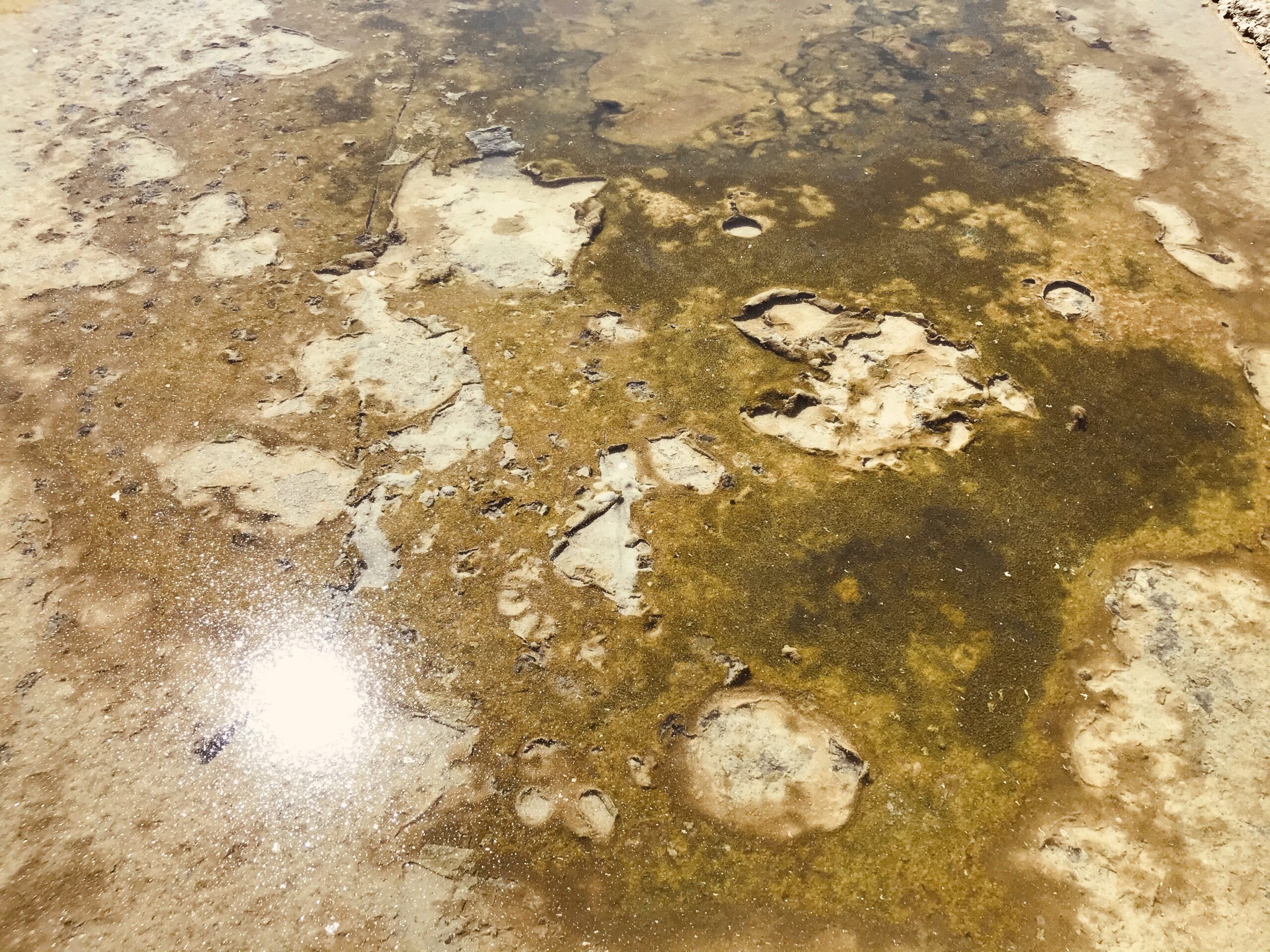
The salt beds also create wonderful colours. The colour depends on the salt concentration and the angle of the sun.
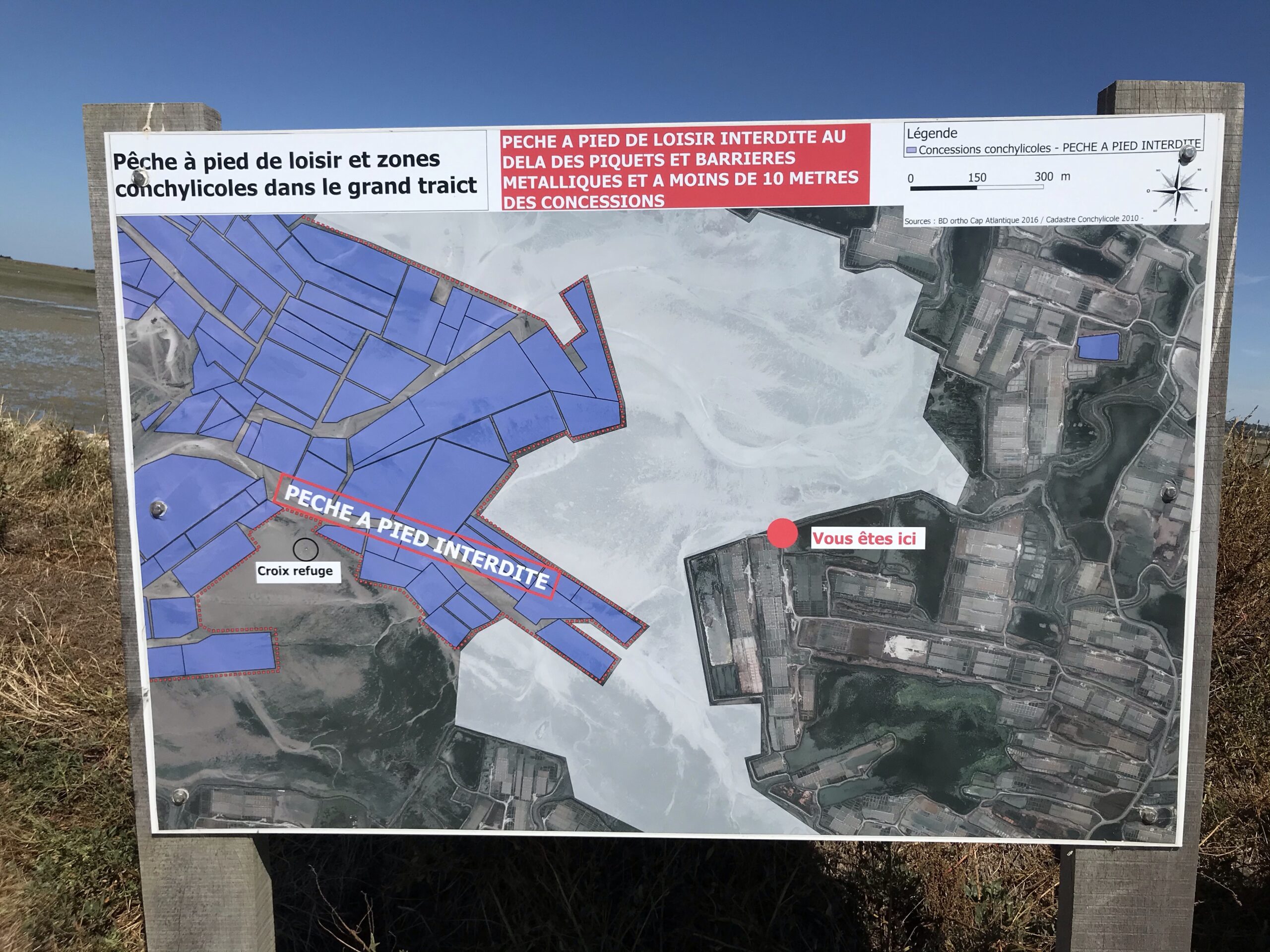
A group of salt beds at Batz-sur-Mer The morning’s harvest of fleur de sel is gathered up against the wallThe individual harvests are collected together The colours of a salt bedMap of the salt beds of Batz-sur-MetThe very slow flow of water through the salt beds – watch carefully.
The last leg of our journey along the Loire à Vélo cycle route, à 35km flat run into Nantes. It was misty as we covered the early morning ground, keen to get to Nantes with enough time to wander around the Machines de l’Île. After breakfast in uninspiring Mauves sur Loire, the feel of the cycle path changes: it is more like we are cycling through a city park. We are in the outskirts of Nantes.
We arrive at Nantes train station, which has a new terminal built high across the tracks with tree shaped columns beneath that splay out into oak-tree like branches within the concourse to provide shade for the travellers.
Reflections on Orléans to Nantes via the Loire à Vélo
We were using the cycle route more as a means of getting from Paris to the Atlantic coast rather than planning a dedicated trip to do the Loire à vélo route – and while I thought it would be fun I enjoyed it even more than I expected.
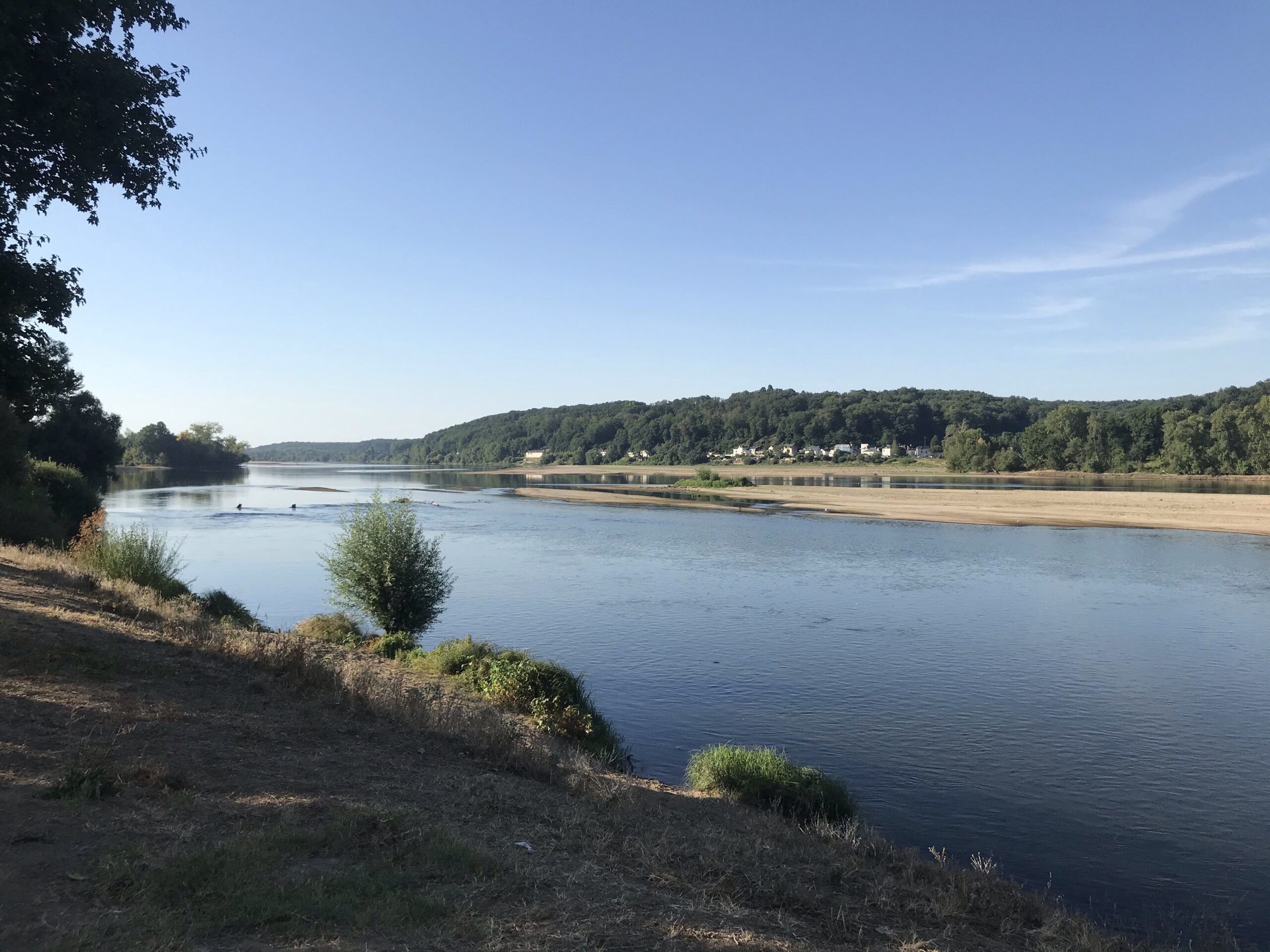
The Loire is much wilder than say the Rhone or the Garonne. It is not used as a major inland shipping route and so feels less industrialised. The water is able to follow a more natural course as reflected in the various channels that weave their way through the landscape, and the sand banks that are a haven for birds.
That said there are levées to cycle along, albeit set back so that the flow is less interrupted, and these are great to cycle along.
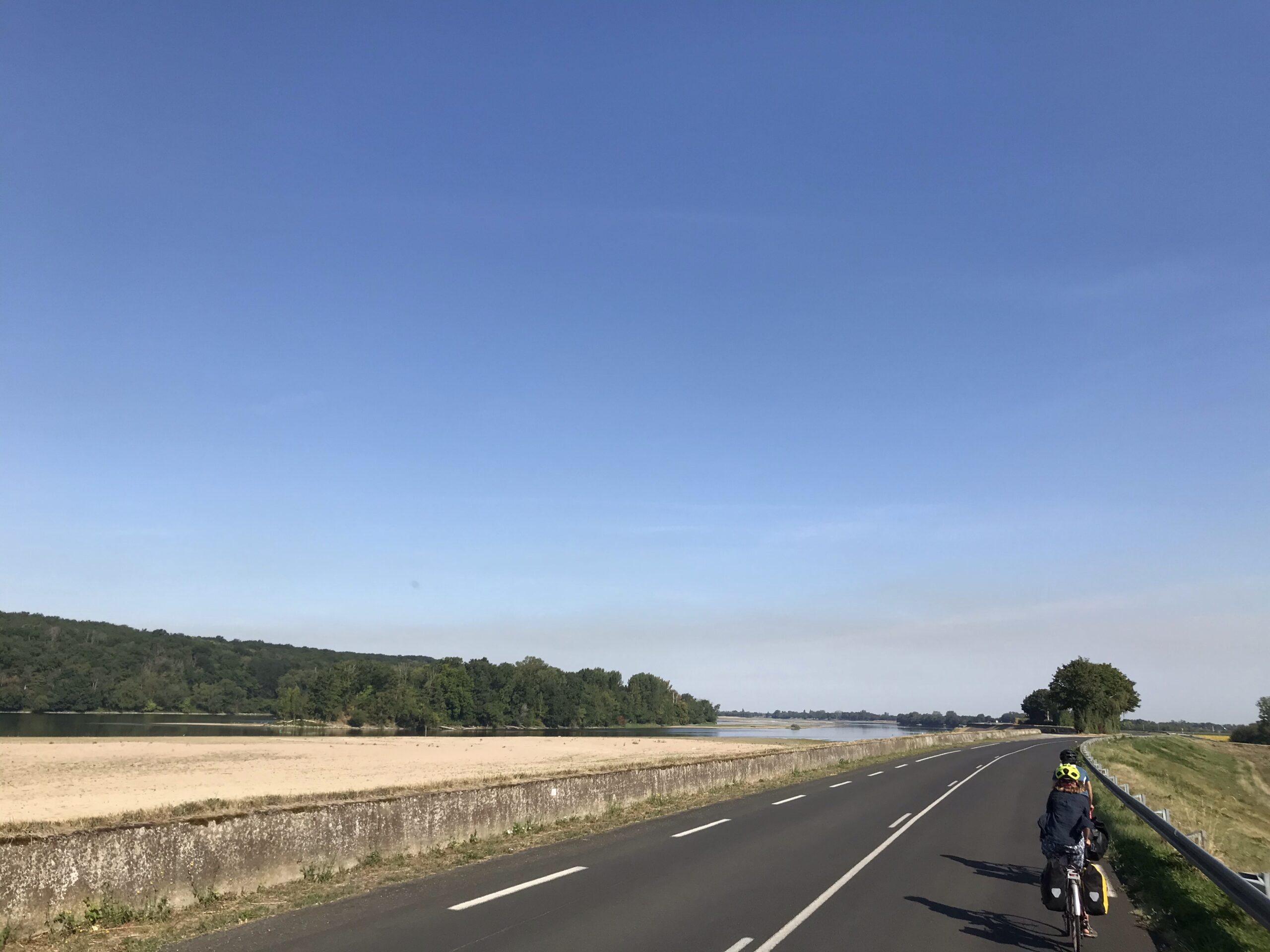
My favourite sections were when the levee road is quiet, and we are able to get some speed up while watching the river landscape change in the channel below.
My least favourite where the river approaches a city. Tours in particular seemed to have turned its back on its rivers.
There is a great atmosphere on the path. You meet cyclists going the length of the Loire à vélo path, and some beyond towards Basel and towards the Black Sea.
The riverside guinguettes were great to stumble across and make the most of to eat at en route or chill out at in the evening.
I wouldn’t bother visiting the out-of-town chateaux. They represent an accumulation of wealth extracted from the local landscape and local people that is somehow not reconciled, not addressed. Just a place to drive to. The middle of town chateaux of Blois and Amboise are a bit more connected to the towns, are more interesting and don’t require a detour.
The route is well signposted, there’s lots of campsites en route. The highlights were the Slow Village in Pont de Cé, and wild camping under the stars.
Onward journey
We are now leaving the Loire à vélo cycle path and making a little detour out to Batz sur Mer in Brittany before heading south by train towards the Ile de Ré, cycling to Arcachon, train to Biarritz, then making our way by some means or another to Santander in Northern Spain.
A day for integrated travel! 70km from Ponts de Cé to Ancenis, and then 10km by kayak, our bikes carried to the downstream dock in a van, then cycling up the final 2km out of the valley and into our warm-showers accommodation in Champtoceaux.
I remember a forward to a Department for Transport report in which John Prescott set out his vision for ‘integrated transport’, journeys made possible by joining together different modes of travel. I’ve always liked this idea, but I try to mix it with a bit of the spirit of adventure of Jules Vernes and Around the World in 80 Days. Mixing cycling and kayaking definitely fits into this category.
We ate breakfast at a riverside market at Bouchedemaine, where the Maine river joins the Loire. We’ve skirted Angers, but all the surrounding places we’ve visited have been so friendly that I imagine I’d like the city too.
We really had to get the kilometres in early today to get to the kayak in time. This is the first time we’ve really had to cycle in tight convoy to keep the pace up and stay motivated that we are covering the ground.
At Saint Florient, I saw this plaque showing distances measured from the bridge. It was created at the start of a period of measuring and controlling the Loire after devastating floods. Measure it, control it, exert power over it. Except compared to other big rivers I’ve seen in France, the Loire still feels quite wild. Not the freight transport artery I was expecting.
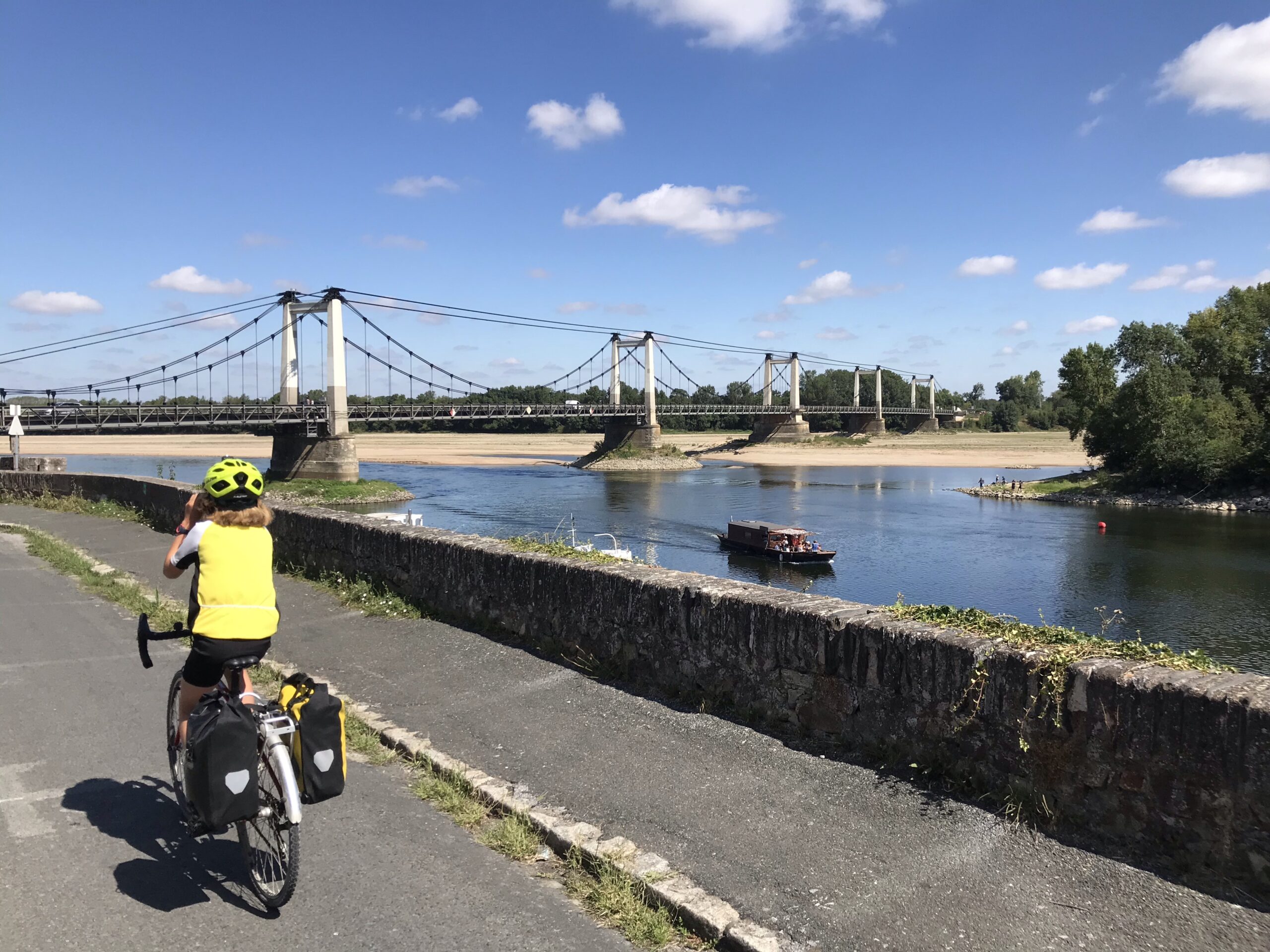
At Ancenis we see our first major suspension bridge across the river. This is where M & I crossed the Loire on our first cycle trip in France from Saint Malo to Agen in 2008.
We rendezvous with the kayaks and head downstream. Wonderful to be in and on the water, travelling with the flow. The current is strong but it is safe to moor up behind the groynes that reach out into the river and create little beaches behind. We climb out on a beach and swim for the first time in the warm river water.
A stop at a guinguette, recover our bikes, then do the final climb to our hosts for the evening, a lovely couple who welcomed us to their self-built home, where we camped next to their guinea pigs. We stayed up talking about their travels with a trailer and a tandem through Sardinia, Scilly, Greece and the Adriatic, and then about how they built their house.
The next leg of our cycle trip along the Loire took us from Saumur to Ponts de Cé, a town a little south of Angers.
Again the river landscape has changed here. Now wider, another notch up in scale. The islands are longer. The curves more sweeping.
The Loire downstream of Saumur
As the cycle path was getting a little bumpy we decided to cycle in convoy along the fast road that follows the top of the flood dyke. This was to be a strategy we used more and more to cover the kilometres on longer stages of our ride. We had roughly 60km to cover and we wanted to get most of them done by lunchtime.
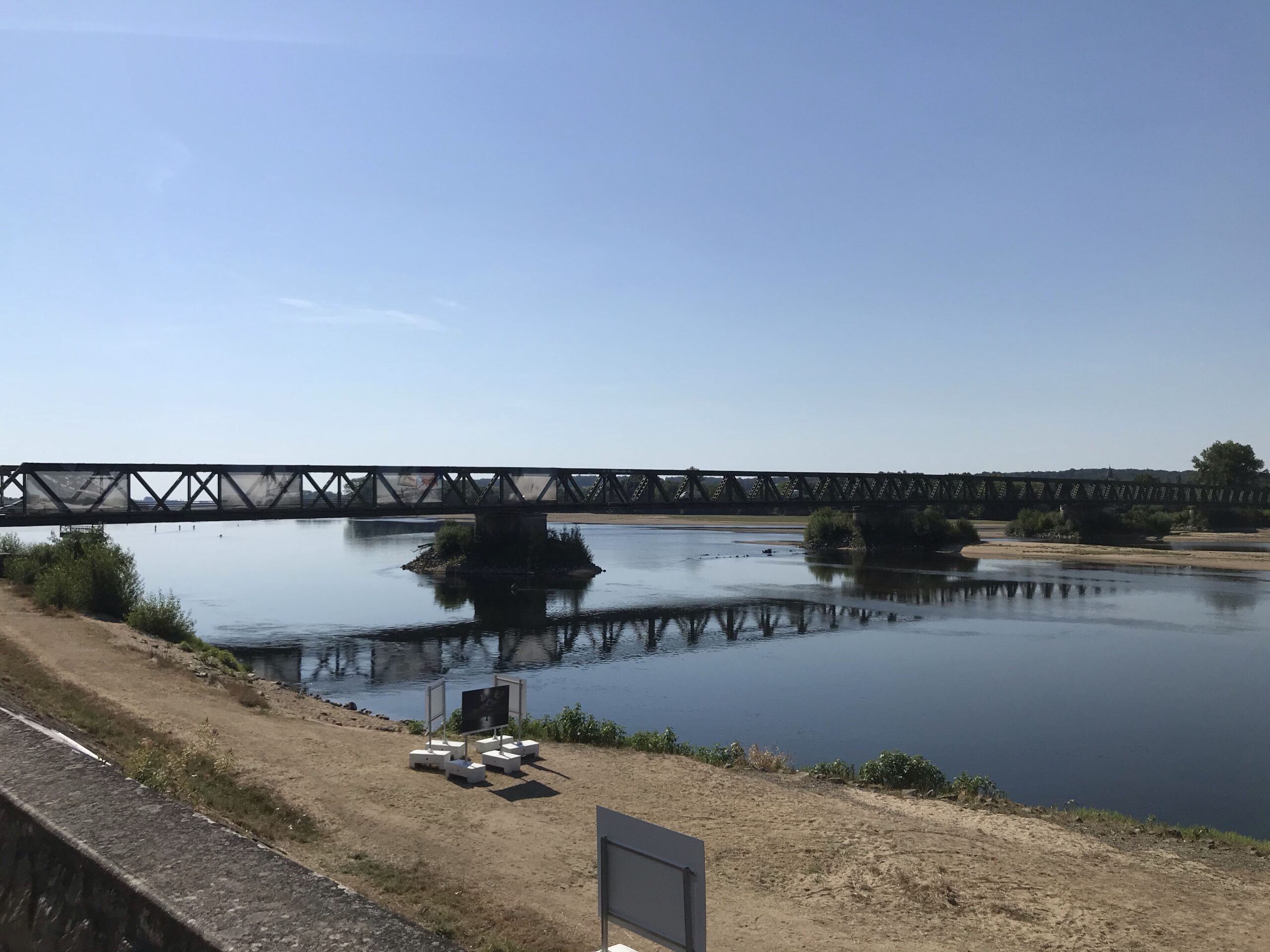
Much of the riverbed is dry, with the flow restricted to one part of the channel.
We can start to predict where good watering holes will be by seeing in the distance where the river crossings are. We had a refreshing stop by this typical truss bridge.
We arrived in Ponts de Cé early afternoon and made our way to the very relaxed and comfortable Slow Village campsite. It was a relief to reach our destination before the heat of the day reached its maximum. A chance to do some washing, repack, chill out.
A had a typical altercation with a swimming pool attendant who found my swimming shorts not stretchy enough to conform to the swimming rules. Mysteriously my well-used cycle shorts were perfectly acceptable.
We spent the evening at the best guinguette so far of our trip. Good food and wine at reasonable prices and friendly staff. After dinner we walked out across the dry river bed to channel on the other side and waded in the warm waters.
The one night we decided to sleep with out a tent and it rained. Only a few spots at around 5am, but enough to wake me and wonder if we should abandon camp. It was still dark. I decided to hope for the best and go back to sleep. Half-an-hour later we were woken by torch lights. This time fishers hoping to find a quiet spot for an early stint with the rod. I think were as surprised by them as they were by us. We got up and watched the dawn light up the water for two hours.
We cycled 10km to find breakfast, the morning still a welcome cool temperature and overcast. We were happy to reach Bréhemont, perched on the dyke above a sweep in the Loire. Since the confluence with the Cher the river has changed character. A bit wider with sand banks that make great habitats for birds. We saw bird watchers along the banks with their telescopes.
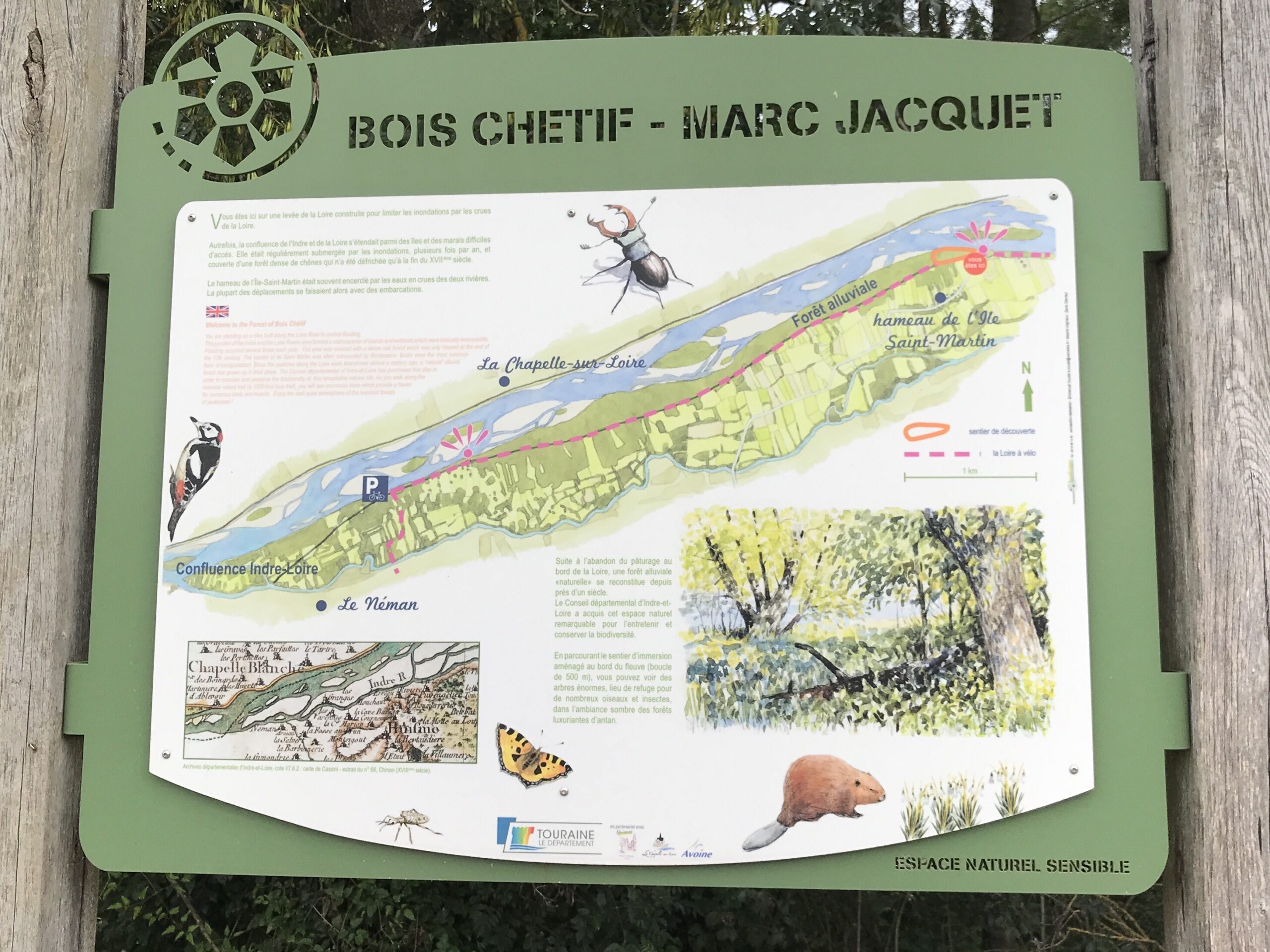
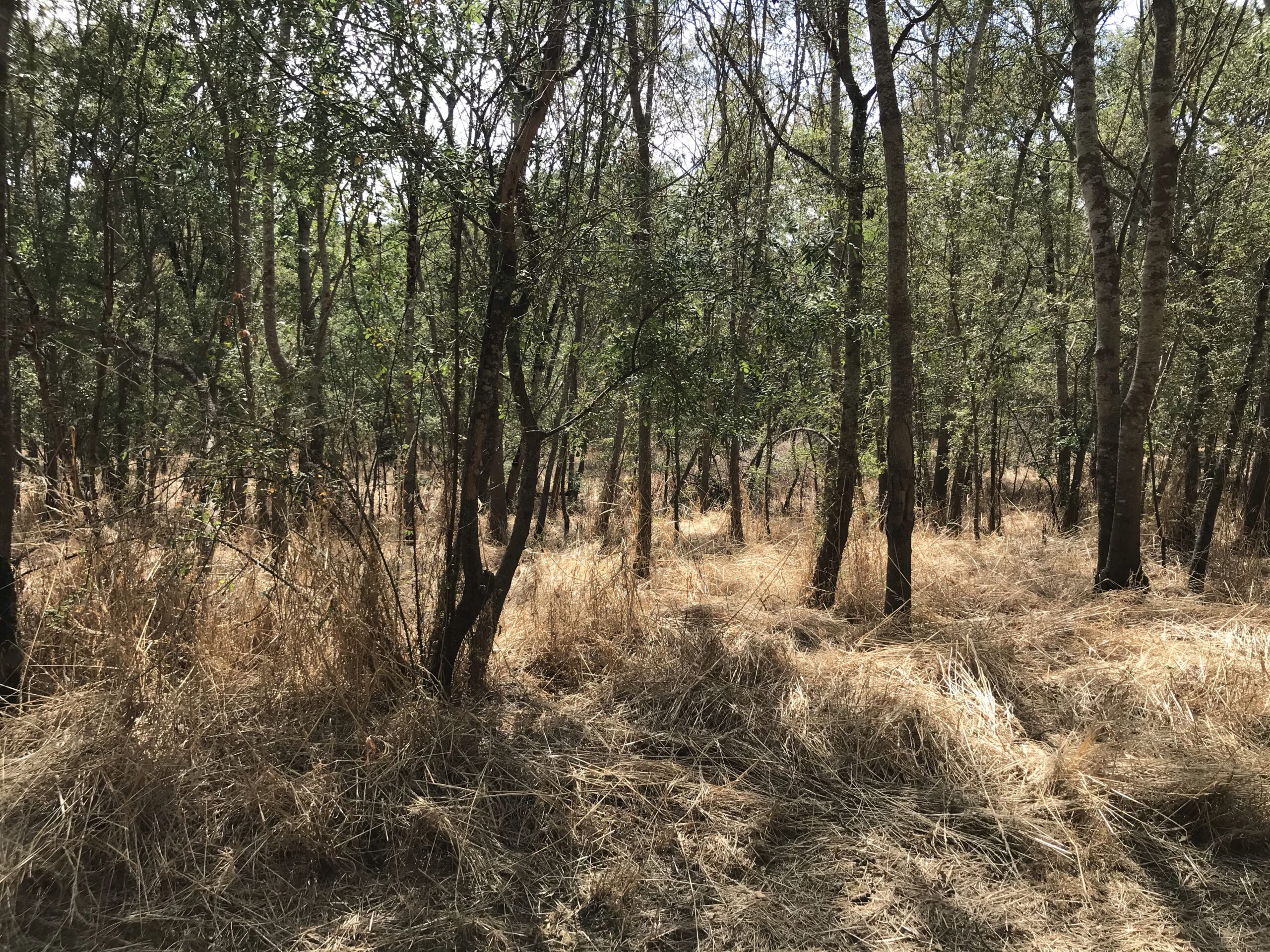
The next section of path passes through a reforested area of land between the dyke and the river. Long ago the river borders were marshy woodlands that would flood several times a year. The marshes were drained to make agricultural land but now the terrain is being left to return to rich woodland. The space is cool and lush. We followed an enormous bird of prey which glided down the cycle path ahead of us through the trees.
Boos Chetif- Marc Jacquet
Lunch in Avoine, a great example of a town that has invested in its public spaces to create an environment that attracts visitors and supports civic life as well. A lovely town square, well appointed with cafe, tabac, supermarket, boulangerie and street market. Spaces for parking bikes and doing maintenance. A water feature.
We cross the Indre river, a tributary of the Loire, and enter the valley of the next tributary, the Vianne. We find a friendly looking campsite, very laid back with furniture out by the river, and we wade in the Vianne’s waters- colder than the Cher last night.
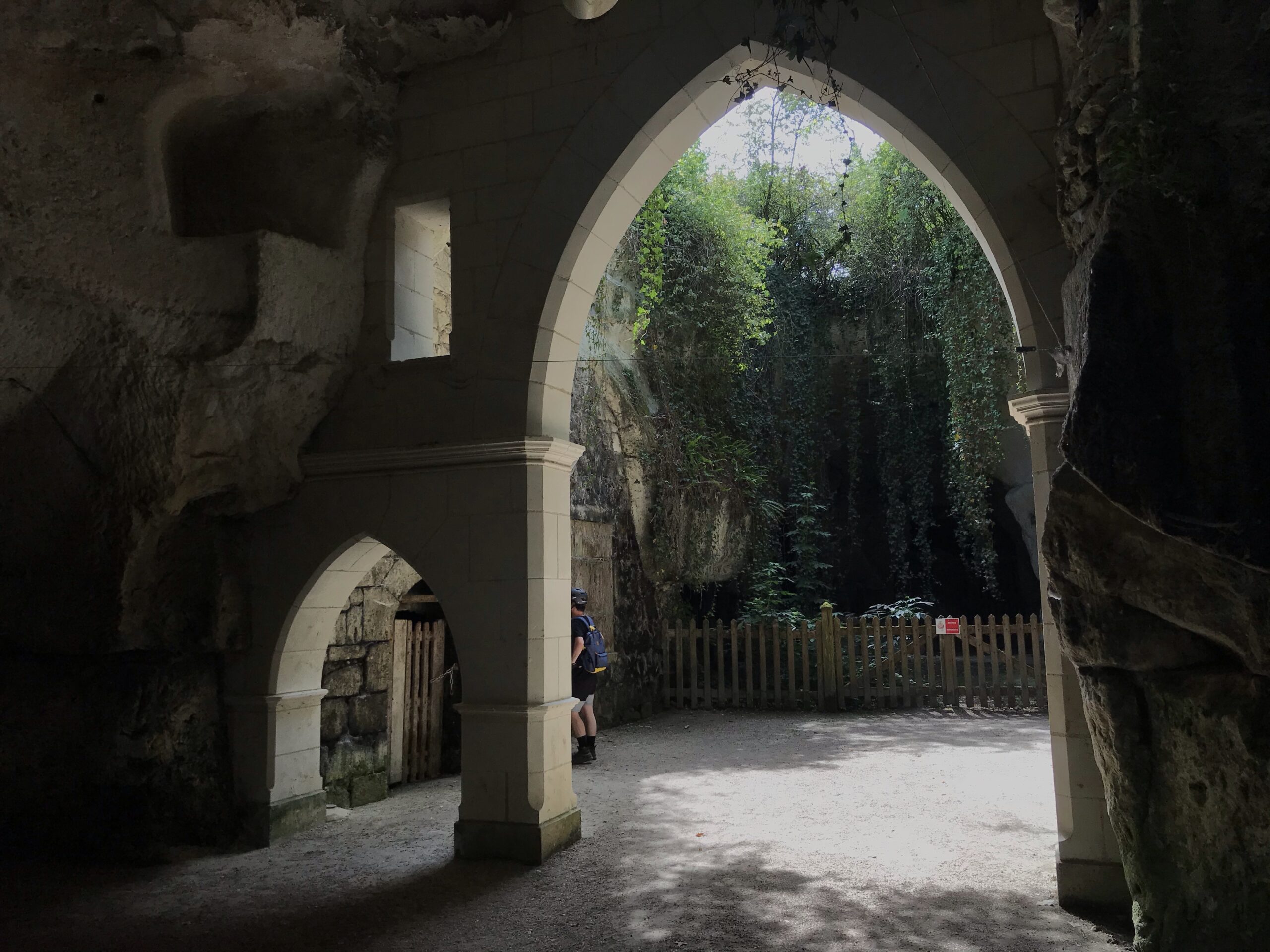
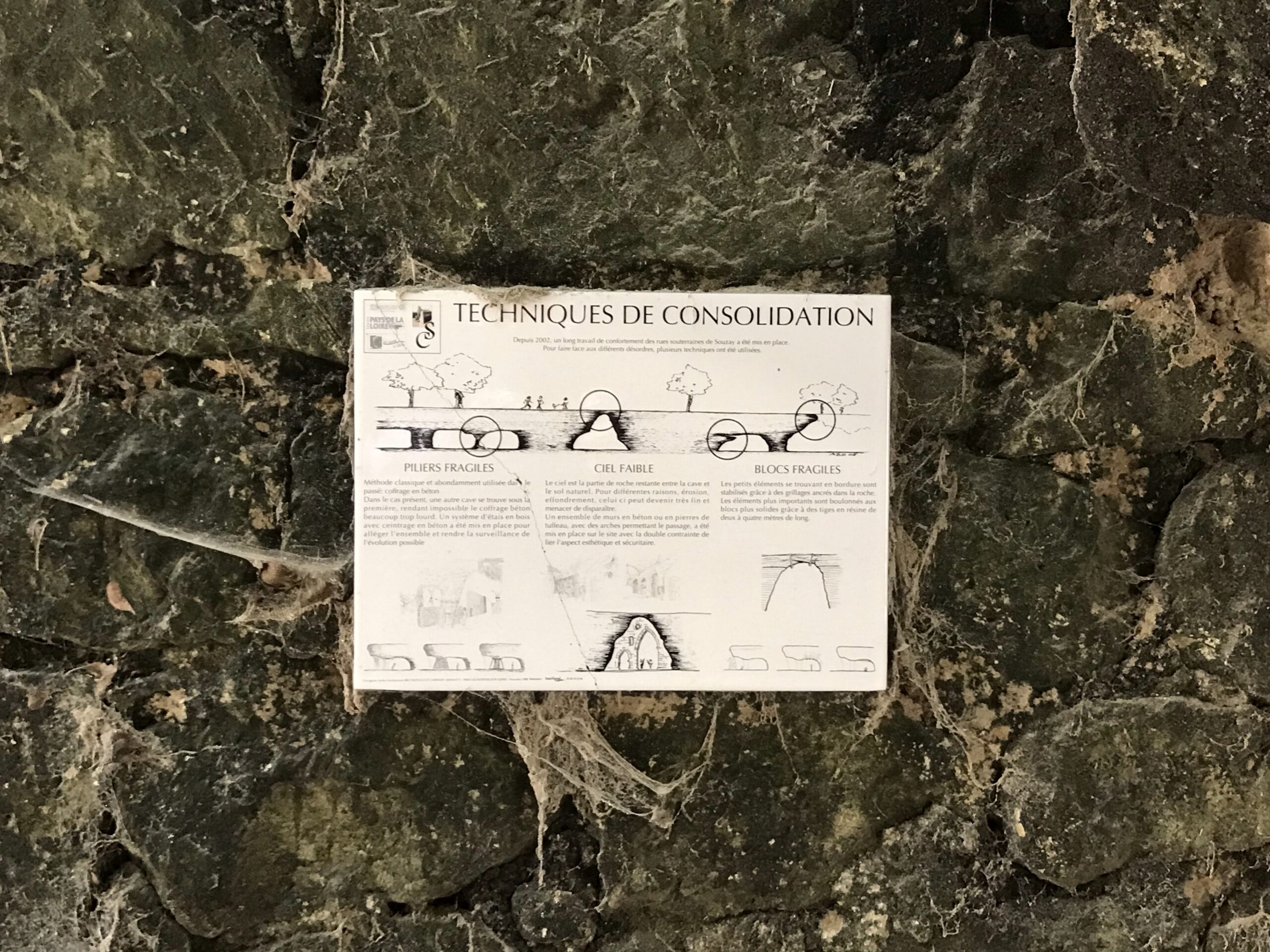
Approaching Saumur, we climb up the valley sides to the plateau above where the regions famous grapes are grown. The path then winds down again and suddenly takes you underground into a recently-restored subterranean village. Not long ago the village high street was in a deep canyon in the limestone. The shops were in eroded and excavated caves to either side. Plants hung down from above, adding additional shade to prevent the sun overhead from heating the space too much. After the heat of the hills the space was so refreshingly cool.
These incredible underground spaces are from the past but they could be the future too. All around us the signs of a climate heating up are increasingly obvious. It feels almost unbearable to be out in the midday sun and yet here is a way to live in the cool in the hottest place in the valley that uses just the shade and the coolness of the earth to create habitable conditions.
As if to emphasise the impact of climate heating locally, we cycled out of the underground village and almost immediately into a bone-try forest. But this isn’t the south of France, it’s the middle bit. This is not normal.
In Saumur we camped on the island in the middle of town. Camp sites on islands in rivers close to big towns seems to be a common format of civic infrastructure in France. Perhaps it is common more widely to European countries with wide rivers running through them. I enjoy being able to step out from your tent, cross the bridge and absorb the evening atmosphere.
The strange feeling we had though in Saumur is of a place that is in the middle of a heat crisis but no one seems to mind. As long as the wine is cold.
We left Amboise, climbed the out of the valley of the Loire and over into the Cher, which runs parallel to the Loire and would be what we followed for the rest of the day. First stop le chateau de Chenonceau, which is sits across a river on arches. I always thought this would be my favourite of the Loire chateau but again I felt disappointed. I think mainly because it so heaving with visitors, which, obviously we are too. (are you stuck in traffic or are you traffic?)
We knew we would have a hot day of cycling. 70km to our destination. We could see the city of Tour from afar, and the river gradually widened as we approached. Tour sits between the Cher and the Loire rivers but largely seems to ignore them both. We found it hard even to find a place to leave the river path and get up over the levee. We cycled into town hot and hungry and ended up eating expensive pizza. It’s one of those situations where you feel like you haven’t quite got this right and you pay through the nose for it.
I was pleased at least to have seen Tours, with its medieval centre. One of those places that I’m unlikely to visit again so pleased at least to be able to have put a brief experience to the name. But I was pleased to leave too. The way out, like the way in was not trop évident.
We cycled through the afternoon heat. We found our way to Savionières which had a ganguette. Coffee and ice cream while we waited for the heat to pass.
We were due to be staying in a garden further downstream, arranged through Warmshowers.com but as we cycled along we noticed a quiet, picturesque sweep in the river and wondered if we could wild camp. We picked our way through the trees and discovered we were at the point where the Cher river joins with the Loire. There was a beach we could swim off and a shelter point to sleep. We didn’t even need to put up a tent.
S and I went swimming in the Cher. The flow in the Loire looked a bit fast so we didn’t venture into its waters. Bright green frogs leapt out of the undergrowth. The water was so warm. Overhead egrets patrolled the skies and waded in the water. Opposite a whole herd of cows came down to the water and waded in the shallows. We fell asleep to the sight of bats a few metres overhead and the occasional rattle of trains on the Tours Nantes line crossing the viaduct opposite.
The second day of cycling along the Loire. A relatively flat 70km that would get steadily heavier going as the day heated up. The cycle path along the Loire is well signed, well routed through towns and villages to ensure you can get provisions. It also has lots of attractive river-side places to stop for a beer and for kids to play in a playground.
Our day began in Loir-et-Cher and at some point we crossed into Indre-et-Cher. French départements were created to enable a horse rider to reach any part from the central préfecture in a day. It’s probably the same distance as if you were travelling by bicycle.
This has been a day of castles. First, Chambord, the famous opulent palace. Then Blois, situated on its battlements in the town centre over looking the river. Finally Amboise, an astonishing fortress which is also where Leonardo Da Vinci is buried.
My recent reading about commons and land ownership means that I can’t see these places and not think about how the wealth needed to create them is made in part from confiscating land and taxing them local populations. This isn’t news, but these sights are often held in isolation from the story of their creation. At Chambord Europe’s longest stone wall kept the locals out of the forest to stop them hunting and foraging on land that would have been theirs on pain of death.
These are of course stories of rulers and social injustice from 100s of years ago. Arguably France had a conversation about this imbalance of land ownership in through the Revolution, but in the UK we never have. Consequently we still have owners of massive parcels of land who derive this ownership from William the Conqueror. As we think about how we use local resources to support local economies, we need to have a conversation about returning common land to them communities that surround them.
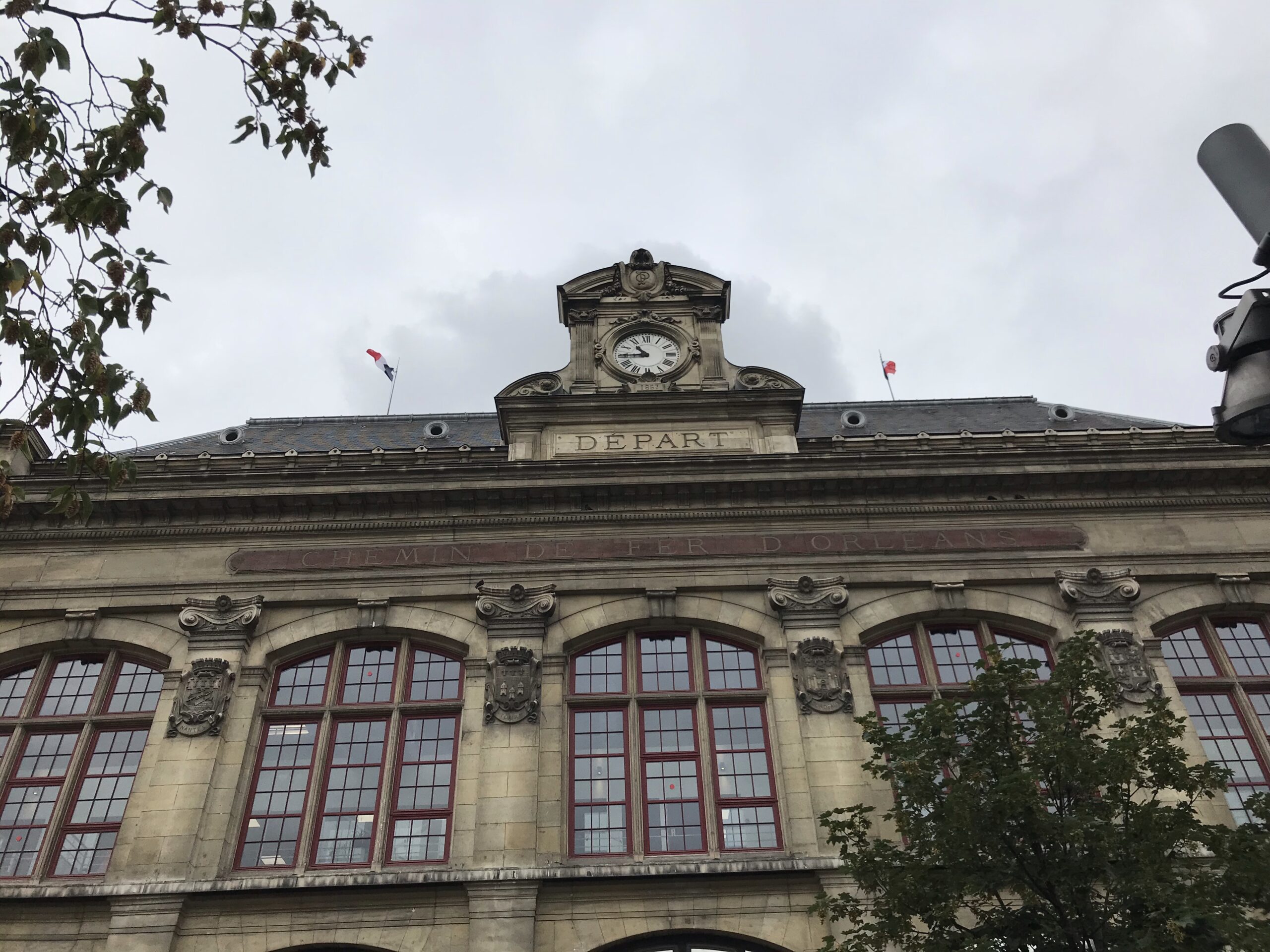
Today our trip shifted gear, away from the city and on the road again. We left paris from the Gare Austerlitz, which feels like it has been under reconstruction for 15 years. I can’t believe how much concrete must have been poured to create the podium that is spanning over the platforms. I wonder if attitudes to using concrete are shifting in France like they are shifting in the UK?
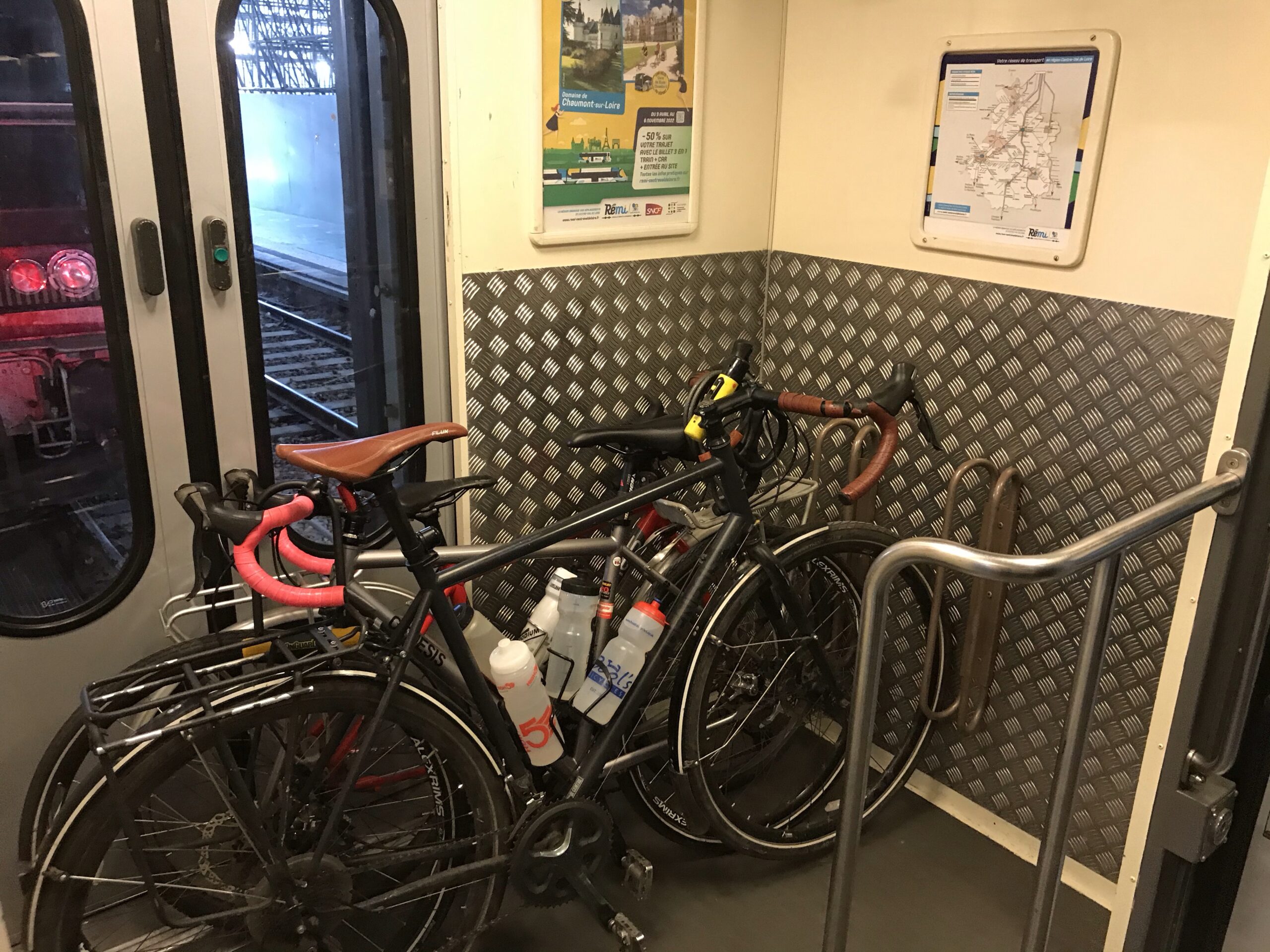
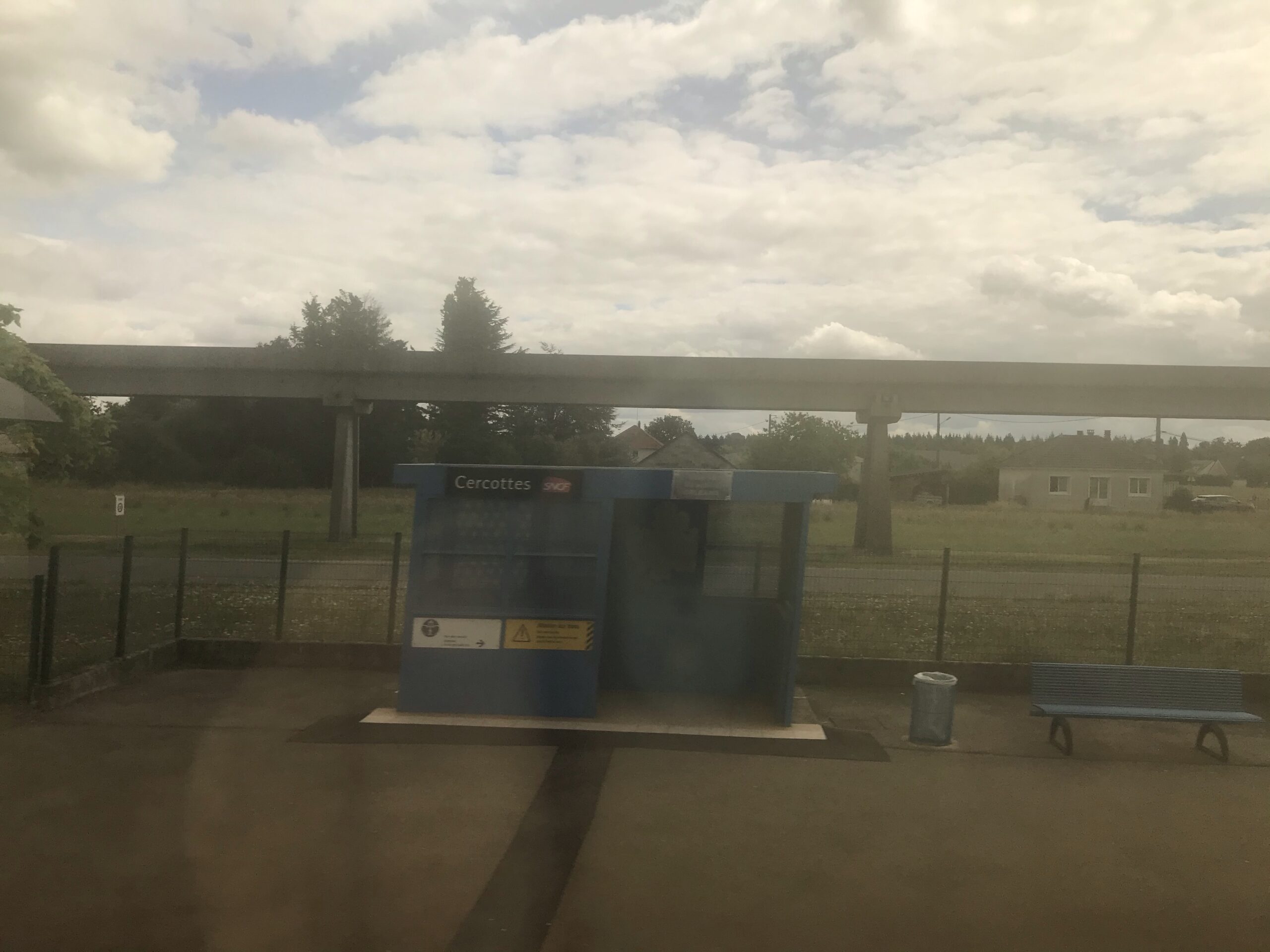
It’s a short ride to Orléans from Paris in one of those old intercity trains like the ones I’d see go humming past on the railway line below my grandmother’s house. There’s plenty of space for bicycles, albeit after you have lifted them up the high steps. On the way I spotted the remains of a test track for an aborted hover train project, a competitor to the British schemes being tested in Ely in the 1970s, neither of which came to fruition.
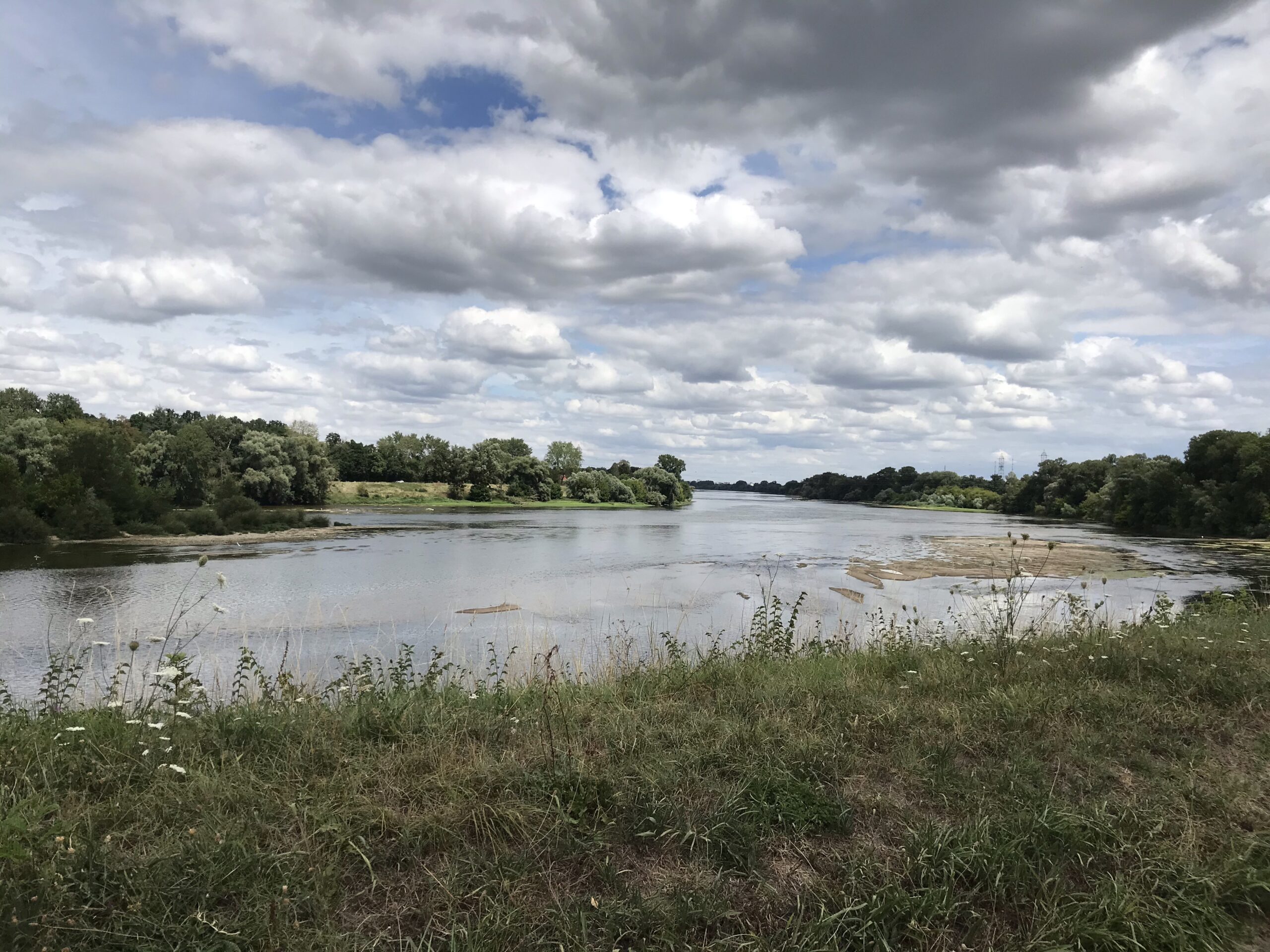
After a few days in city it feels a relief to reach the Loire, which stretched out before us left and right as we ate our picnic lunch on the banks. We now have six days of cycling down it’s wide cycle paths atop flood dykes.
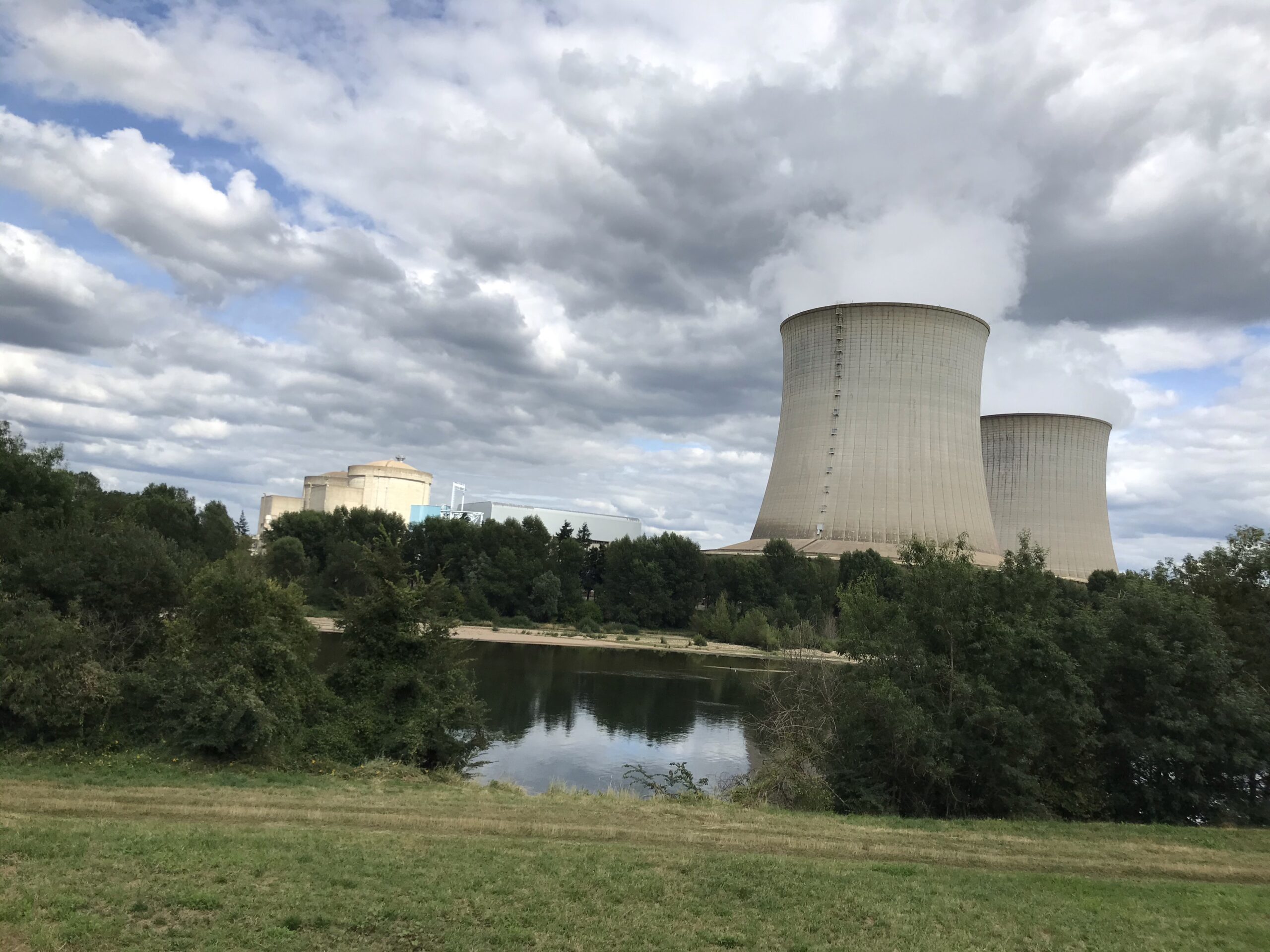
First nuclear power station of the trip
Last night we drank in a packed street bar in Paris, today our beers are in a riverside campsite ganguette. I am enjoying the change.
From stage one of the Tour de Femmes in Paris to a very different stage two finish in Provins. The stage in Paris was of ceremonial importance, but I think the stages between more regional towns are more characteristic of the overall tour experience.
Unsure whether to go the night before, we looked up the finish town of Provins on the race website. And sure enough it is a UNESCO world heritage sight. This is what the Tour is for: showing off bits of France. Having lived here and traveled widely for a year I’d never heard of Provins. And so we set off for a day of sightseeing and cycle watching.
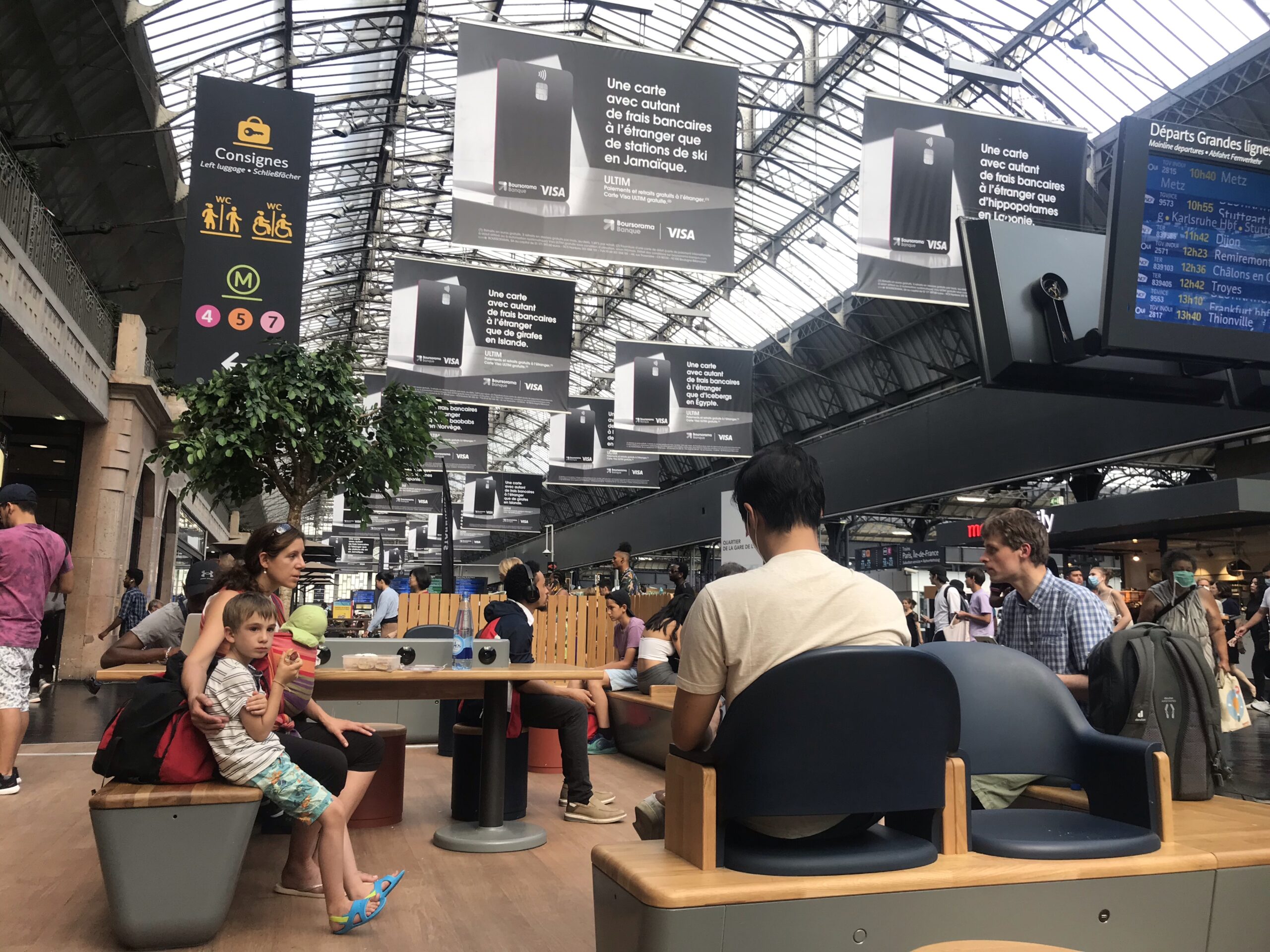
I was happy to find that our route to Provins was a direct train from the Gare de l’Est. I used to come here and imagine the journeys you’d be able to take when they would open the TGV Est Européen in 2007, connecting Paris at high speed to Strasbourg, Cologne and Frankfurt. It is a very wide terminus station with brightly lit, glazed concourse that runs the width of the platform ends. It’s not as imperious as Gare du Nord, not as concrete as Montparnasse, not as complicated as Saint Lazare. It’s like a dinner table set out for lots of European friends with a nice bright table cloth and plenty of elbow room. I also appreciate the abundance of seating without obligation to sit in a cafe.
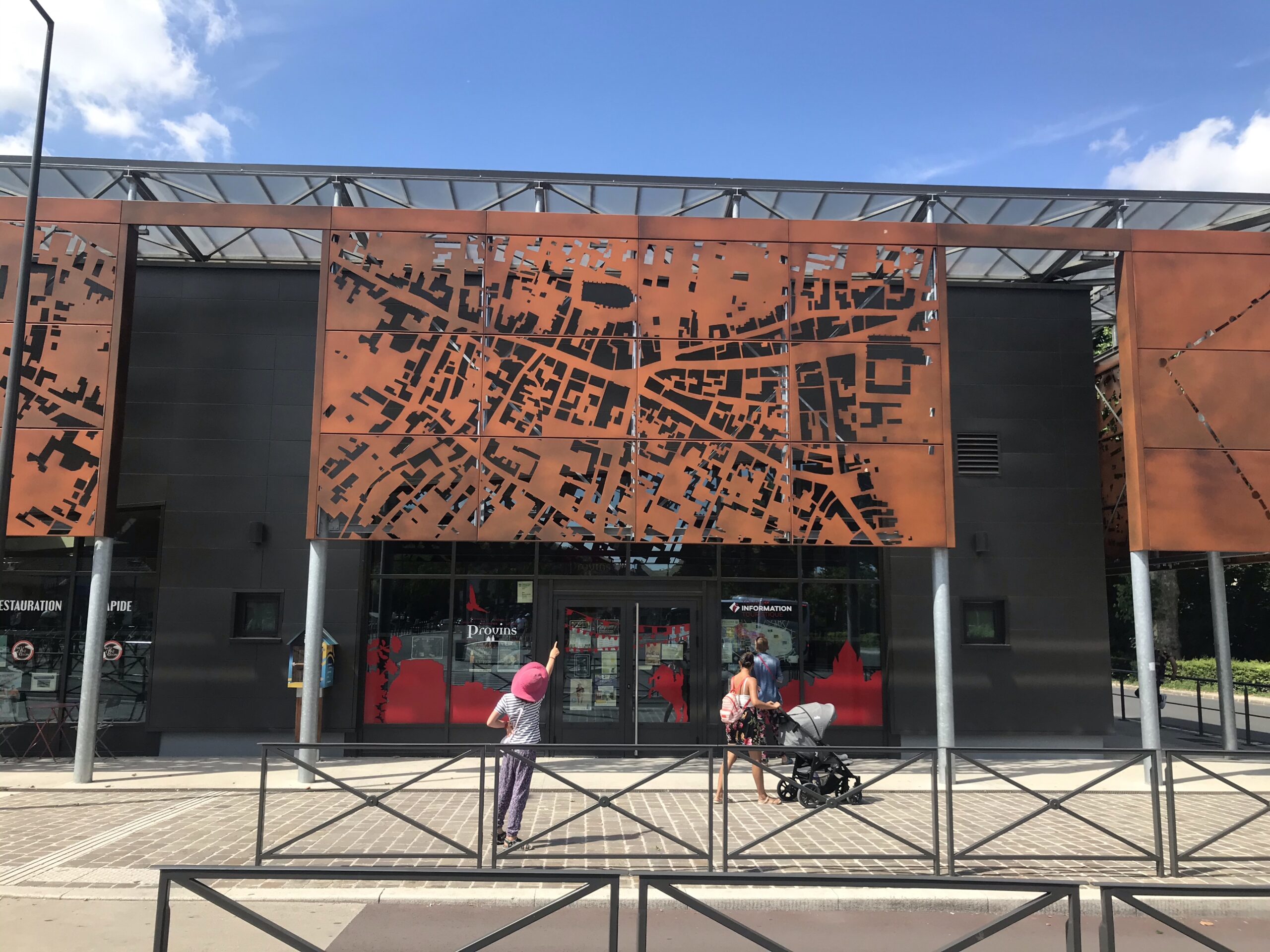
From one end of the Transilien line P to the other, at Provins station the most striking thing is the Office de Tourisme which had an elegant Coreten facade with the map of the city carved out of it to make dappled shade on the building front.
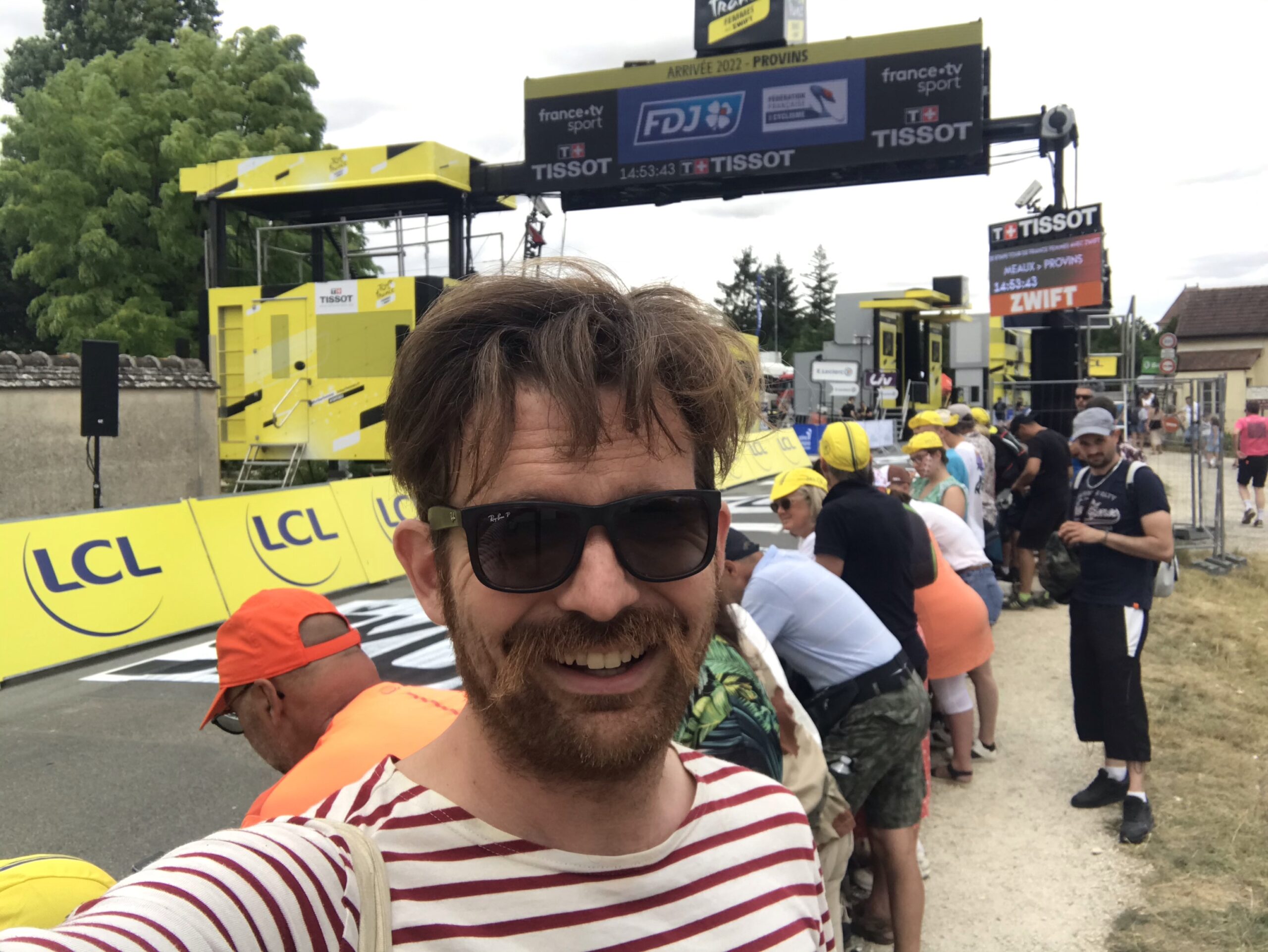
We walked down the medieval streets, had a relaxed lunch in a restaurant, spotting Tour lanyard wearers all around us. Gently, imperceptibly at first, the pedestrians, the residents started all walking in one direction. We followed them round the ancient streets, through the impressive ramparts and then there it was: the ‘permanance’ – the collection of vehicles which is the travelling caravan of the Tour. We passed the winners’ podium, the commentators box and then there was the finish line. All of these bits of infrastructure are so familiar from watching over a hundred stages from the television, and there they were just in front of us. Smaller, and bigger, in real life.
I think one of the most surprising things about the Tour is that all this infrastructure is moved from town to town every day. It is literally a travelling circus. It is life on the road, not just for the riders but for the logistics entourage.
We knew we’d get a good chance of standing near the finish, but we didn’t expect to get five metres from the line. We found our spot and waited the two hours or so for the race to pass. I did this watercolour of the finish line. I appeared to be the only person taking pictures with this choice of medium.
A brave local commentator was keeping the crowd interested, and i learnt a lot about what a big deal it is for a region or département to host the tour. We heard about the local cycle clubs and rising stars. We heard about all the local people who had worked to bring the Tour to Seine et Marne and to the town of Provins. All the folk who had assisted in getting the barriers in place early in the morning. I had the feeling that lots of people watching weren’t into pro-cycling, but that this was the travelling spectacle coming to town that they had to see.
An hour before the race came the travelling caravan of sponsors vehicles handing out free stuff. I know that this is what the Tour is all about on one level, marketing opportunities for these big French brands. It is awful in terms of waste stuff given out and it is laughable. From the cars freebies are thrown out and the crowd go wild for them. Key rings from the gendarmerie, T-shirts, the famous hats, processed meat from one of the sponsors. I am sorry to say I didn’t get a pink Zwift that but glad that my daughter got one.
And then it was on to watch the racing. As I found yesterday it is actually quite hard to follow the race when you are there, but being near the end we could see the big screen. I was watching when three pretty awful looking crashes happened. These were made all the more graphic when we saw the injured riders limp to the line later.
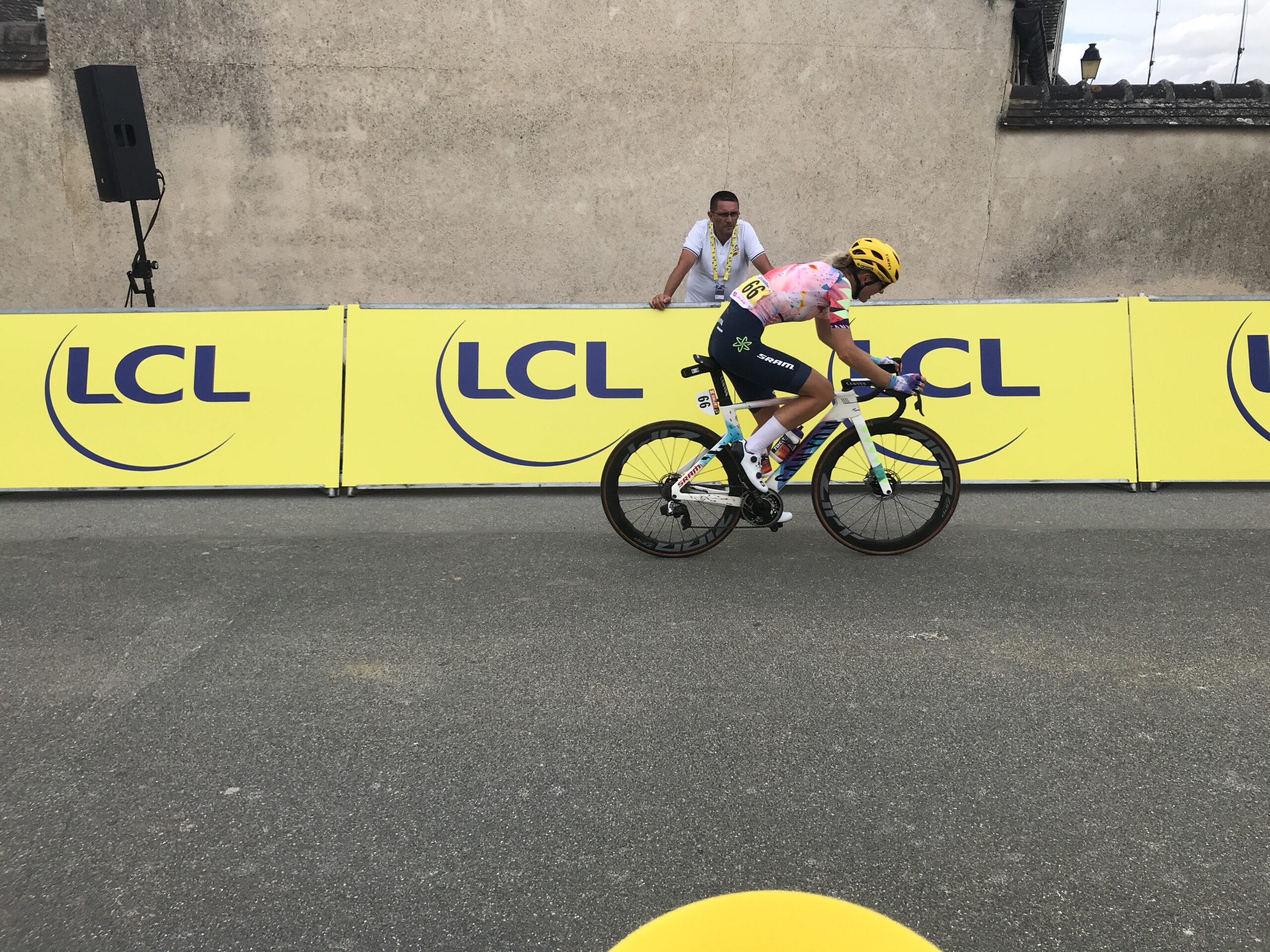
The riders passed the finish twice. First for an intermediate sprint, and then round a 15km loop which brought them back for the finish. After the sprint a breakaway group formed of Elisa Balsamo, Elisa Longo Borghini, Marianne Vos, Niewiadoma, Silvia Persico and Makia van der Duin. But in the final sprint to the line Marianne Vos broke away from this group and zoomed ahead to cross the line. Incredible to see possibly the best cyclist in the world win her 241 stage win and with it the Yellow Jersey.
Seeing the racers close up makes the whole thing feel more human. They are much smaller in real life. Their pain is more real. And their power as they cycle past.
And then fascinating to see how the end of race proceedings are orchestrated. While one racer is collapsed on the ground getting medical help, other people are getting on with the medal ceremony. This stage is done, and the juggernaut must roll on.
One of the anchor points for our trip this summer is to catch the start of the Tour de Femmes, which coincides with the end of the Tour de France.
It is so exciting to be able to see the first women’s tour, of proper scale, kickoff. following the tour feels like a bit of a family guilty pleasure, that a guilt subdued a bit now that there is a women’s tour of decent scale, but there’s still a long way to go. Interestingly it seems some of the women’s teams were set up by pro-men who wanted decent cycling opportunities for their daughters.
From the Rue de Rivoli we stood on the railings to watch the eight laps of the women’s peleton, struggling to identify who was whom, relying mostly on the live updates from the website. Despite my preference for analogue experiences, it really is a sporting day out that is enhanced by having a live feed in your pocket.
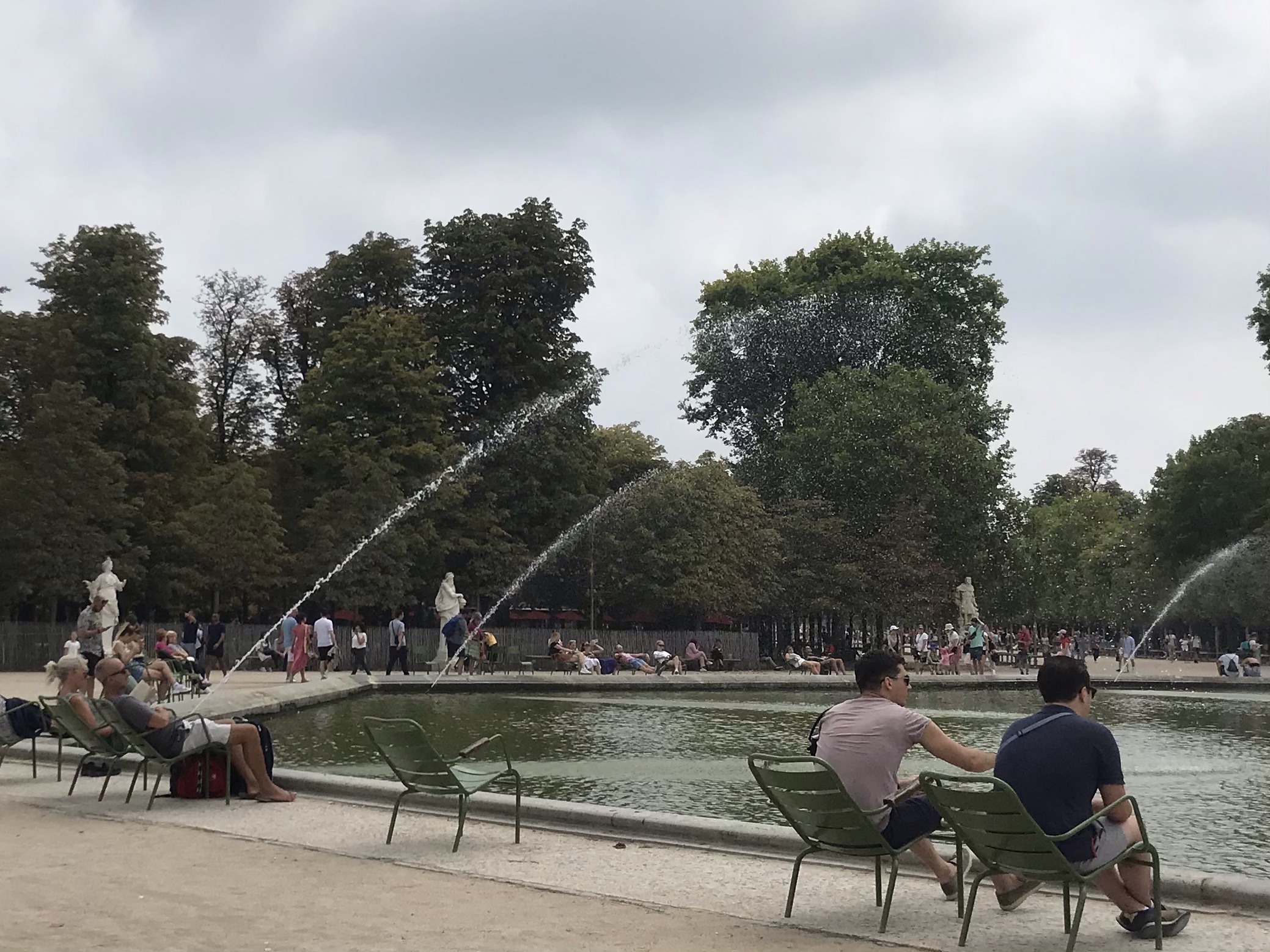
When the women had gone by we crossed the Jardin de Tuileries to the Orangerie to wait for the Men’s peloton. Having watched the men’s tour on the TV for so many years it was really exciting to be seeing the spectacle close up. It’s like with anything that you have watched on television the scale of things looks very different in real life. Things are at once much smaller because you don’t get the close-up camera shots, and then very large when people do get close.
The Tour de France peleton on its penultimate lap of the Tuileries
It’s such a thrill to see these riders who have been up and down mountains all around France, not to mention their excursion to Denmark, end up right in front of us. It is quite a spectacle. We enjoyed having it with a group of British cycling fans, and were interested to see how little our Paris friends cared for the race. This corroborates a newspaper article yesterday about the Tour’s growing international reputation and the increasing ambivalence for it among the French.
Tomorrow we head out into Ile de France to see stage two of the Tour de Femmes. It’ll be interesting to see how the atmosphere changes on a smaller stage in a more rural spot.
Tips for watching the Tour de France in Paris
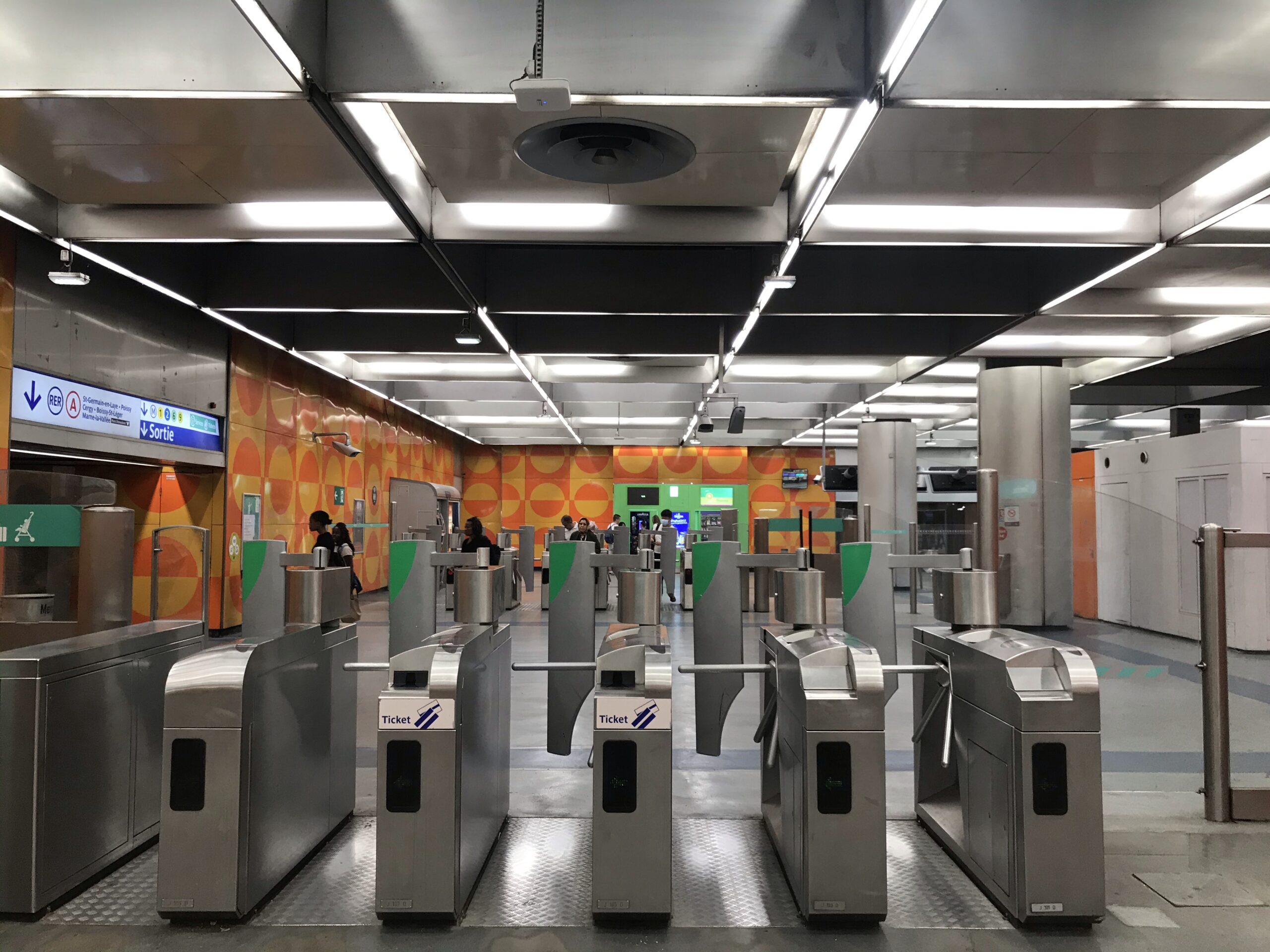
This is what we did in 2022 and what we’d do again. Both the women’s and men’s Tour do loops of the Jardin de Tuileries and the Champs Elysées. Access to metro stations in the area is limited. So we arrived an hour early and entrees the area via Metro Palais Royale Louvre. From there you can walk straight in to the gardens. There was also an access point by the Pont Solferino.
We watched the Women’s Tour from behind the railings along the Rue de Rivoli, which is where the close up photo I took above is taken from. A good shady spot but you don’t get long-distance views.
We watched the Men’s Tour from the terrace outside the Orangerie. This was well shaded while waited during the day but was in full sun for the last hour wait and during the laps. Come prepared if you go there.
Next time we’d go to the banks of the Seine opposite the Orangerie which stayed in shade throughout but which had a good view. Note this area had a police bag check point as it is closer to the track and we didn’t think we’d get through with our picnic knives!
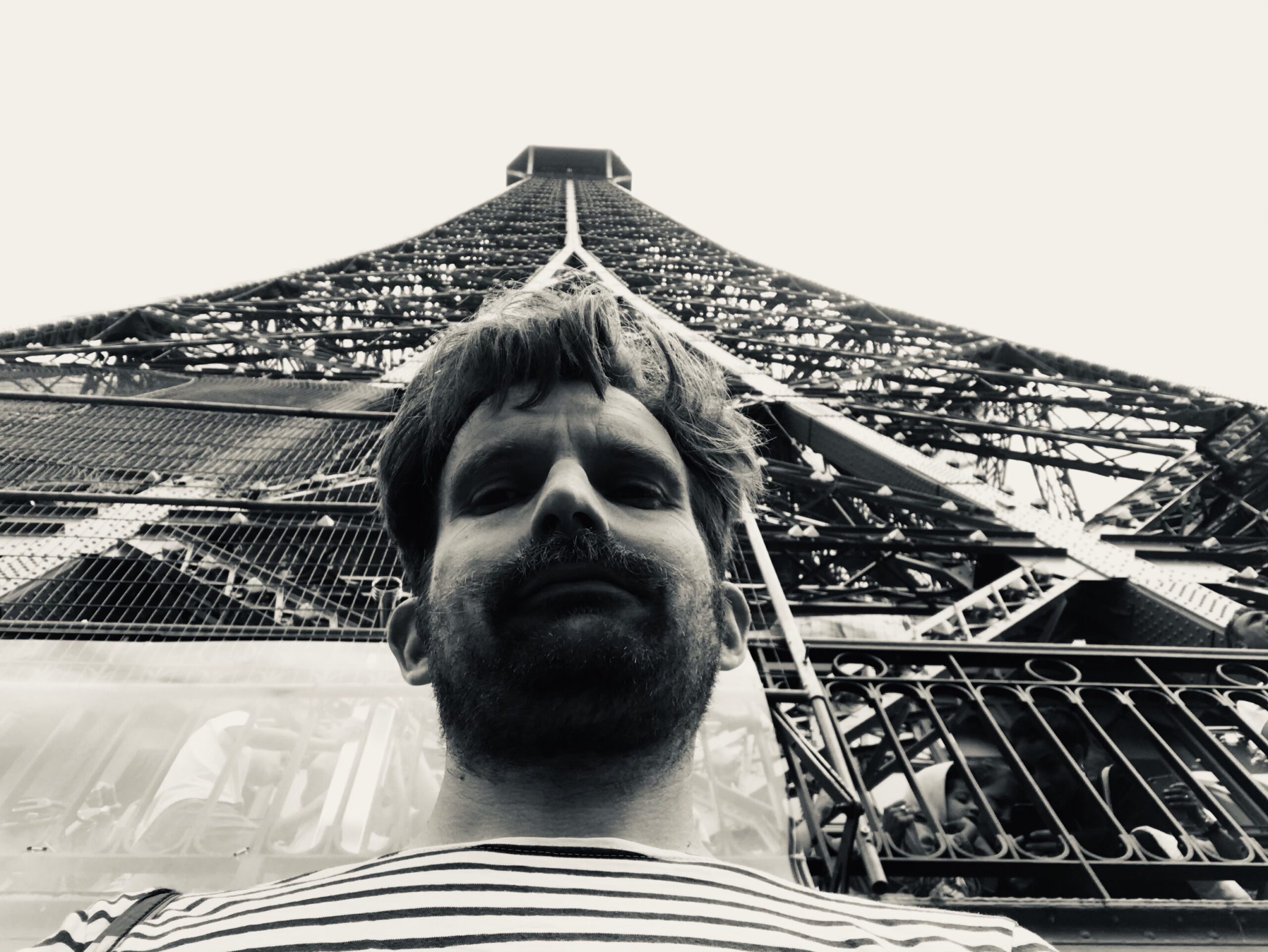
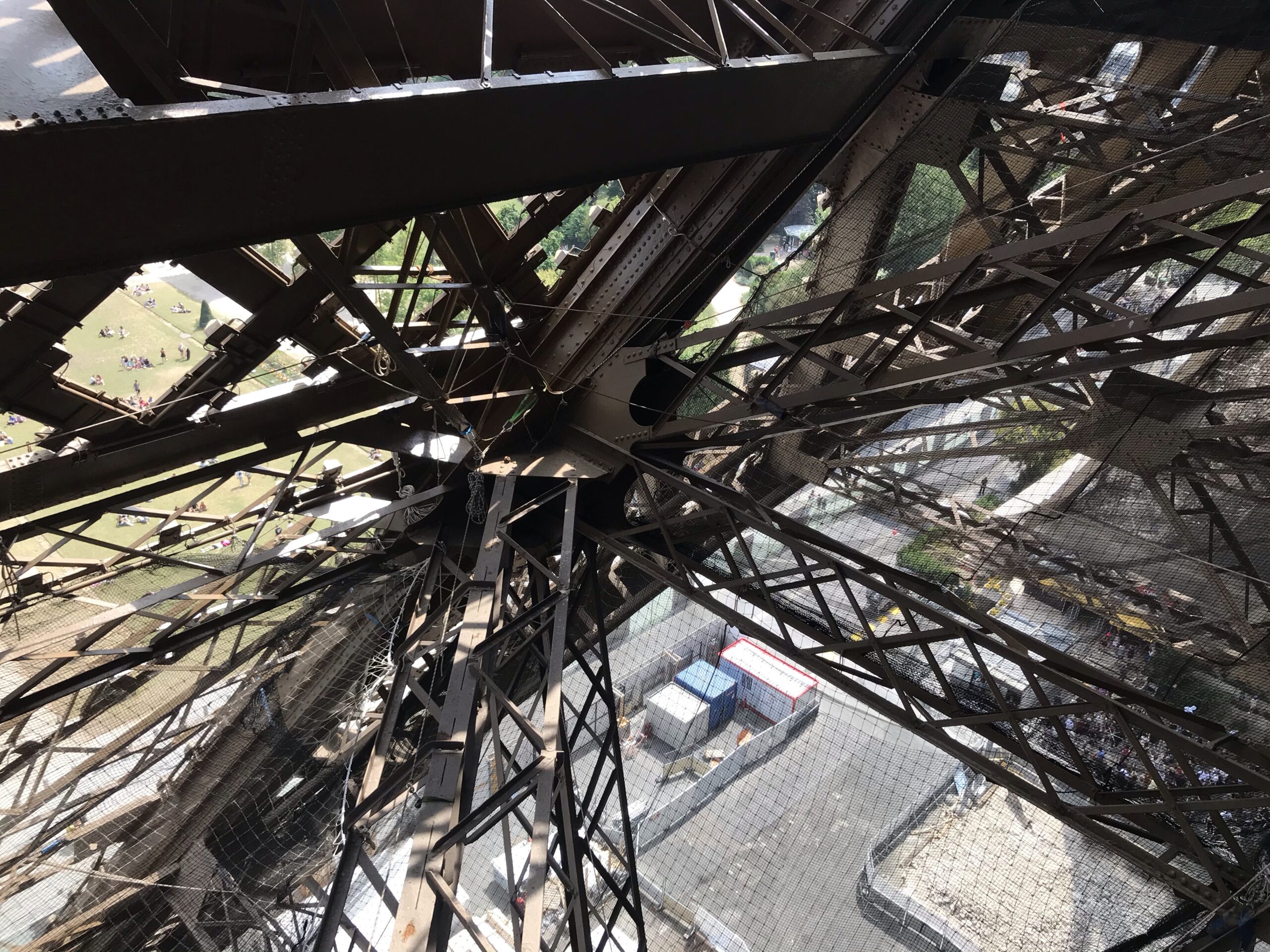
Today we had a proper tourist day in Paris. We’ve been numerous times with our daughter but now she’s old enough to remember we decided to take in some sights. And you know, it’s good to do these things every so often even in the places you call or once called home.
Main mode of transport was the Bateau Bus. I love the ferry ride. I often wonder why boats aren’t used more in cities to get around. We had three great rides along the river to get us to right across town.
Here are some snaps
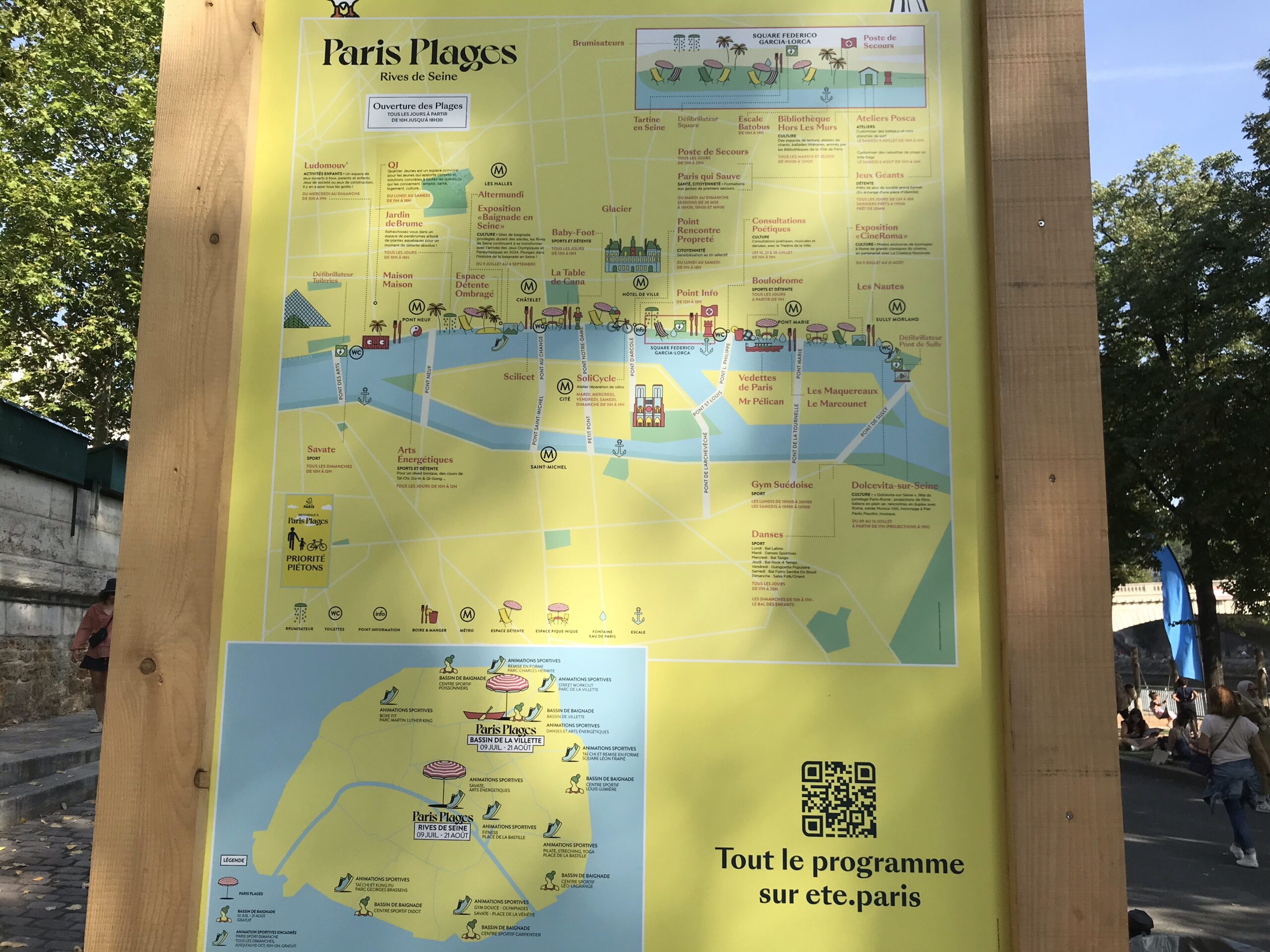
Nation Station – I have always loved the futuristic from the past look of this station. The peeing fountains are always a giggleThe eponymous tower in all its glory and ridiculousness Complicated node connectionParis PlageThe plan of Paris Plage activities Beach bar and football areaClimbing wall and water misters to keep everyone cool
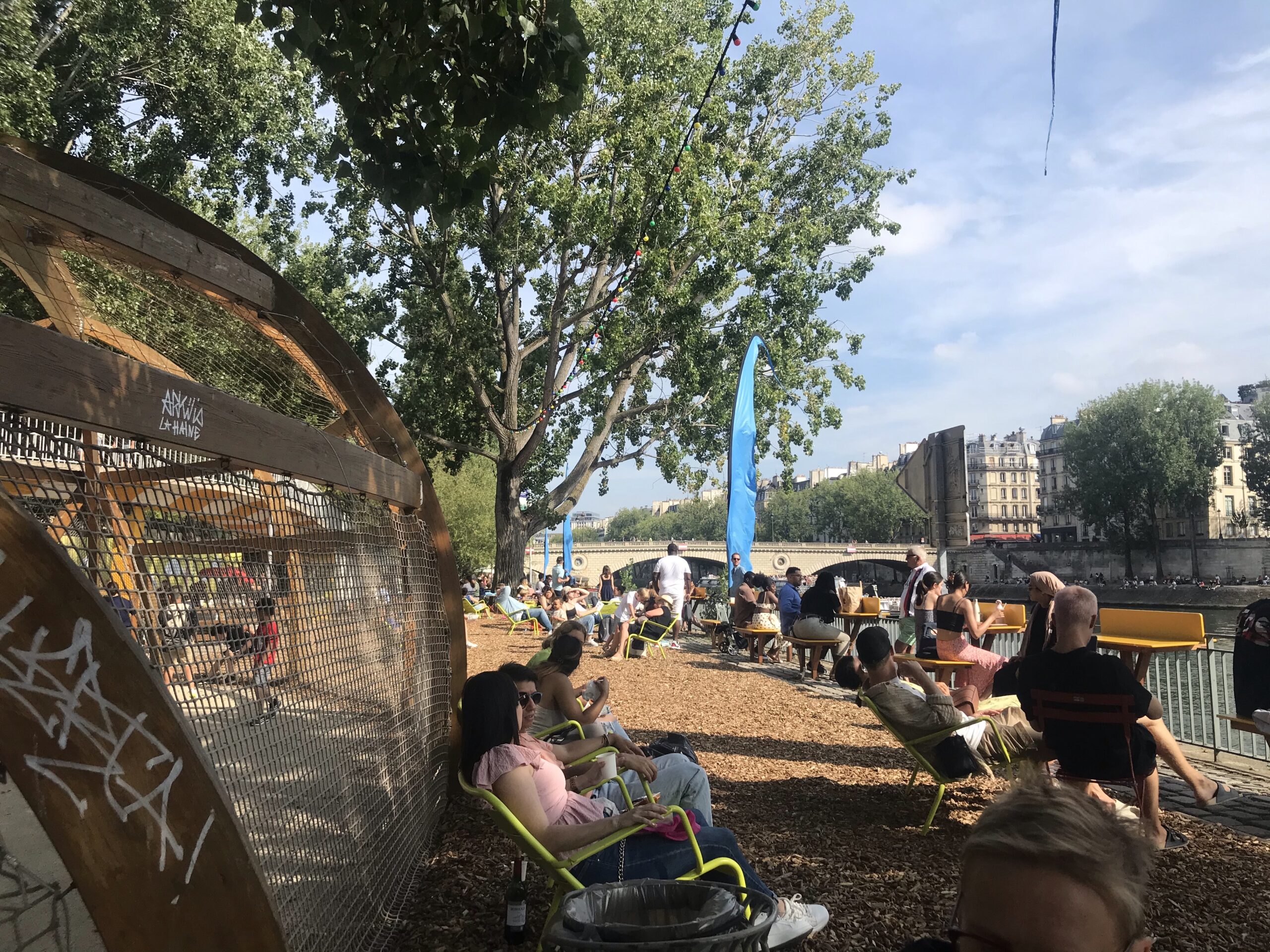
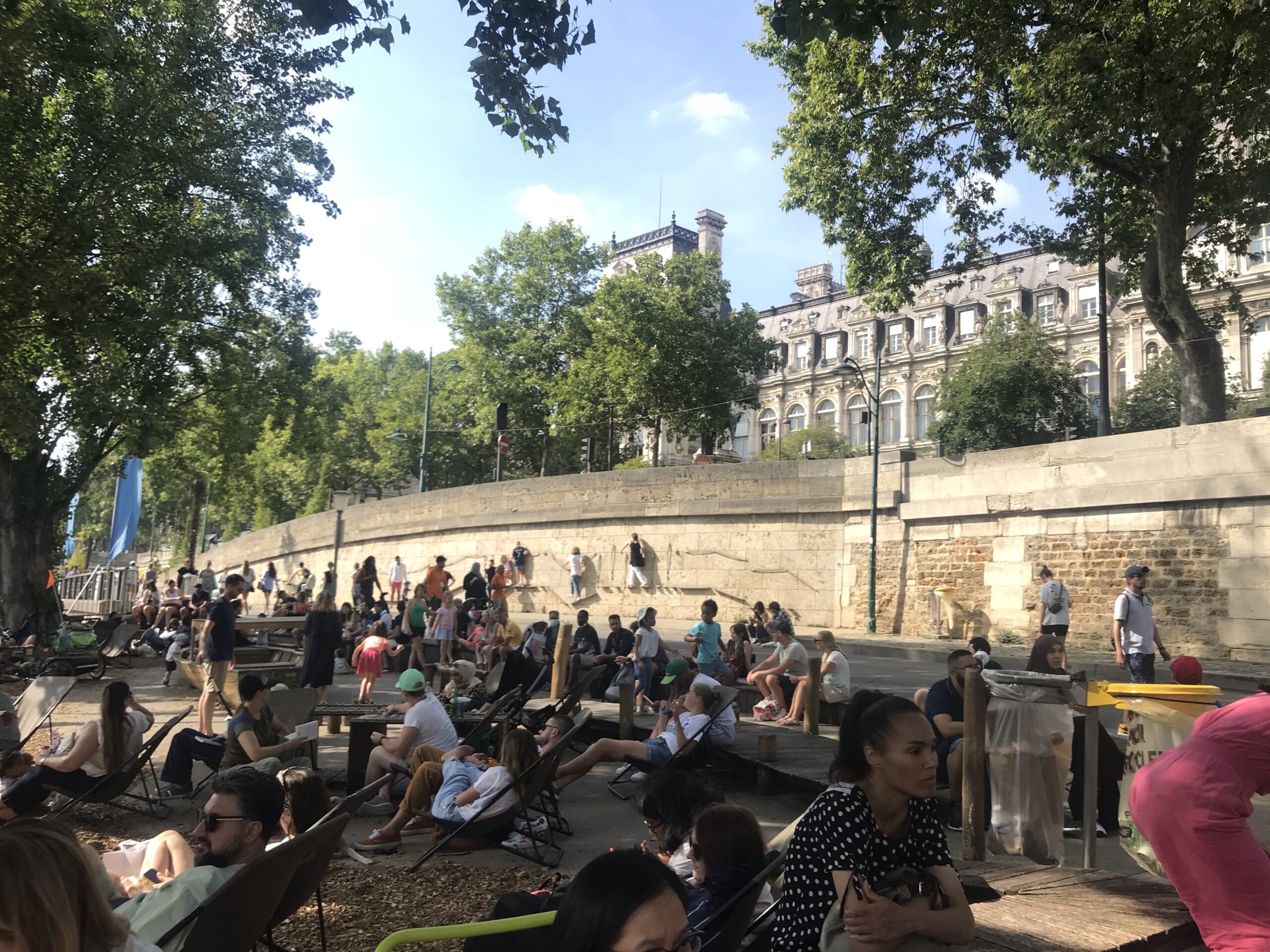
Paris Plage
Paris Plage is Paris’s beach. Created by closing a busy road along the banks of the river. The fully pedestrianised area is a mixture of beaches, at areas, games areas and just generally space to hang out. It’s not commercial. It’s there to enrich the life of people. A fantastic example of shared public abundance.
The port of Ouistreham is about 15km from the city of Caen. Journey today began with a cycle along the canal de Caen à la Mer. The canal is a major import terminal for tropical hardwoods from West Africa. And we could see the timber being stacked up on the opposite banks of the canal.
Downtown Ouistreham
We cycled under a heroic motorway viaduct and then arrived by well appointed cycle path in the middle of town. We only had about 45 minutes to spend in town so we found a high point to hang out: in this case the castle right in the city centre.
Heroic viaduct outside Caen
Other city centre castles I have enjoyed: Belgrade, Budapest, Blaye. I like when you can simply cycle up from the town below and straight into the gates.
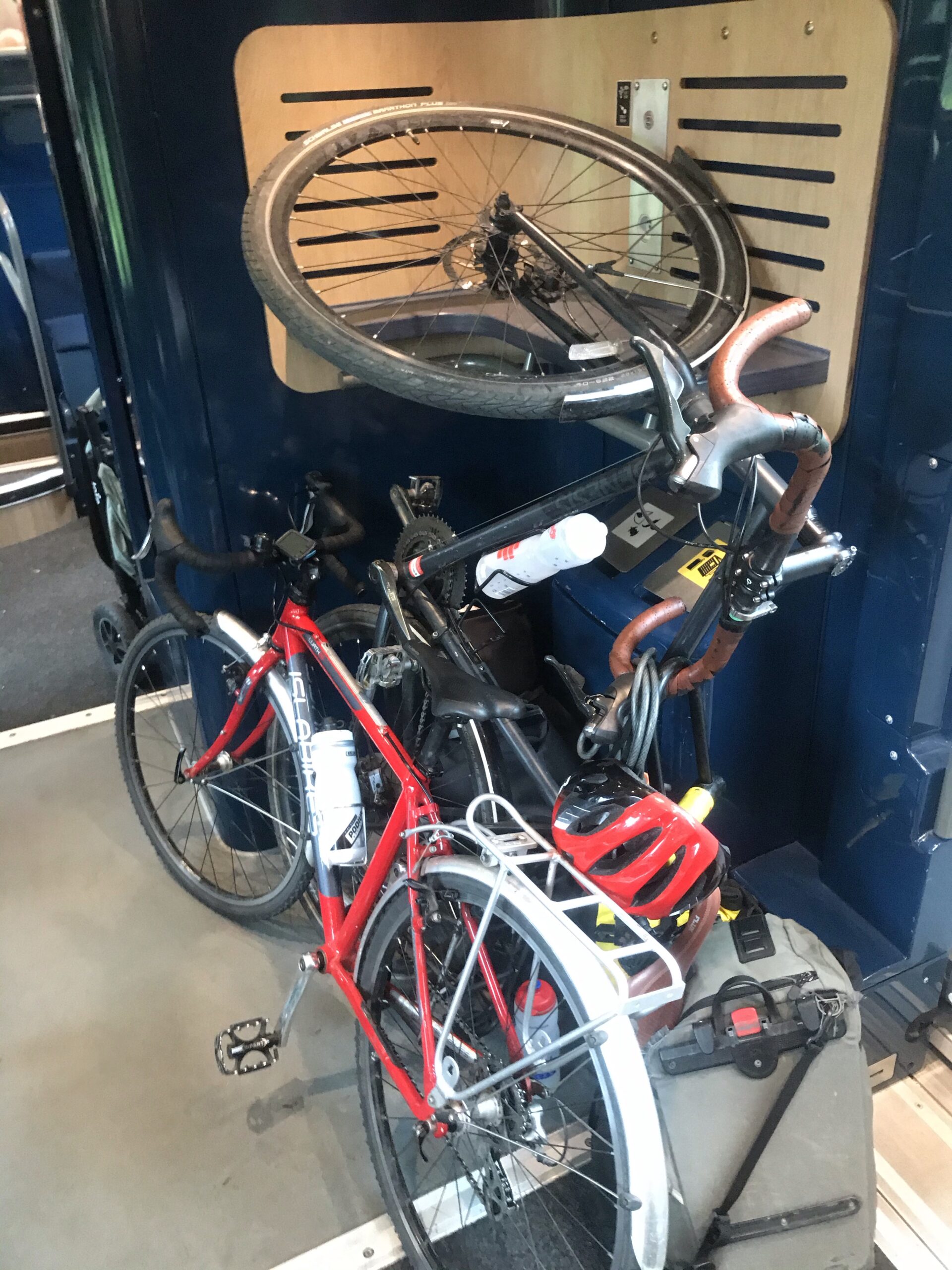
Our train from Caen to Paris St Lazare was a squash and a squeeze with our bikes. The service has unreserved bike spaces, but these were full and the service busy. Lots of people boarding and getting off with luggage got stuck with us in the bottleneck of the doors. I ended up lifting my bike up on its rear wheel and squeezing on. Somehow I miraculously managed to balance it on a pile of panniers so that when I let go it stayed upright.
Miraculously balanced bicycles
From Paris St Lazare to the 20th arrondissement we cycled the route of the Metro Line 2, following the cycle paths through the boulevards. This infrastructure went in when we lived here in 2006. Now it feels really hectic to use, with e-scooters, mopeds and delivery vehicles competing for space. As is offering the case though when I feel squashed using cycle infrastructure, I shouldn’t bemoan the other users: they are doing the right thing and it’s fewer cars that we need.
With all the alternative, shared transport infrastructure, I think Paris is now ready to ban cars altogether. Maybe with rising fuel costs and renewed focus on the climate crisis due to recent heat waves, banning cars in Paris might happen soon.
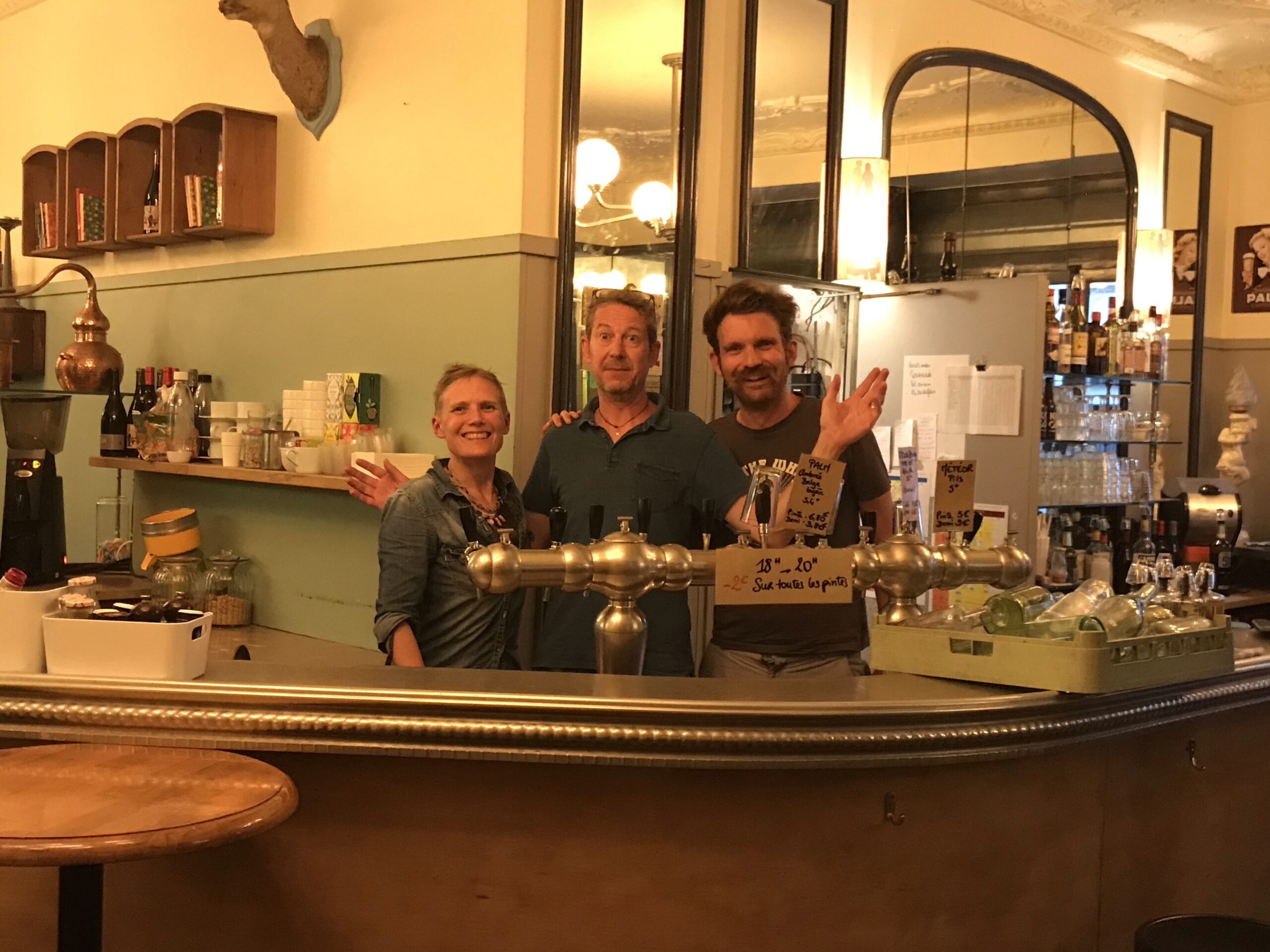
We finished the day with our friend and proprietor of our old local the Piston Pelican, Stéphane. The bar was closed but he welcomed us in for pizza and wine and an insight on what it’s been like trying to run a Paris bar through Covid. We talked about the heat wave and the climate crisis, and what people in their position can do.
I told Steph that running a bar like theirs is an important thing to be doing in a time of crisis because it builds community cohesion and resilience. I’m not sure how reassuring that was though as my climate French vocab is a bit ropey: turns out I’d been referring to the climate crisis all evening as the ‘central heating crisis’!
A multimodal stage on our journey through France, with 70km by bike, 7km by kayak and another 2km uphill to finish the day.
We crossed the Maine river at Bouchemaine, where we stopped for the market and breakfast by the river. The scene looked like we could be in the Netherlands.
I remember little about the rest of the ride other than it was hot and we cycled in a tight convoy to keep a steady pace and cover the ground.
We crossed to the north side of the Loire over a more substantial suspension bridge than we’ve seen so far. Minor aside on suspension bridges. The Loire is the first place I’ve seen multispan suspension bridges with a post tensioned top cable to keep the towers an equal distance apart.
At Ancenis we boarded two kayaks and our bikes were taken downstream in a van. There was a big difference in river flow rate across the width of the channel and finding the fast flowing sections was quite tricky.
We were advised we could moor up and swim behind any of the groynes built out into the river. Behind each, the river water swirls in a great rotating eddy that you have to paddle through to reach the beach. This was where we had our only swim in the Loire. It was so warm.
We arrived at the drop off point, refreshed ourselves as the guinguette and climbed the hill up to our accommodation, a family home we found on warmshowers.com
Our hosts live in a beautiful, self-build home. We enjoyed hearing the details of the construction, their water conservation measures and meeting their guinea pigs.
Warm Showers is a great tool for cheap travel, but it does require quite a lot of on-the-go administration.
Restorative and regenerative are two words I am hearing used interchangeably. Both are relevant to engineering and design. Both are approaches to design that are valuable. But they need differentiating.
On a recent trip to the Alps I took Robert MacFarlane‘s breathtaking ‘Mountains of the Mind‘. In it I found this delightful tale about Mark Twain taking his family up on to a glacier in the Alps – a fashionable thing to do in the mid-nineteenth century. In short:
Sunday morning we cycled through Bristol and up to Leigh Woods. We took the ‘high route’, choosing to climb up through the wealthy streets Clifton. Everywhere oozes money and wealth. The cavernous houses, gleaming cars, manicured front gardens and then the tiny shops of Clifton Village. Humans and their worldly possessions are all I can see.
And then, all of a sudden, release. The ground gives way and we are soaring high over the Avon Gorge. As the Clifton Suspension Bridge leaps from one cliff to the other, I feel like I am looking at a giant fracture in the Earth’s crust, looking back in time through rock layers laid down millions of years ago. The scale changes. Humans are tiny again, a tiny feature of the surface. Nature and all the evidence of all its forces spread out before me.
I yell ‘hello planet earth, and good bye planet money’, and we are off towards the woods.
Dad heart melt moment. My daughter asked, “how do I have interesting conversations with people?” I said, well, a good place to start is finding out what people are interested in. Works for me.
‘Act it Out’ is my favourite technique for shifting creative thinking from the mind to the body. This post is another in my series on Turning the Kalideascope, ways to form new connections in the creative process.
Engineering has important roots in Enlightenment thinking. The Enlightenment put us firmly in our heads, as abstract, rational thinkers. We take inputs from the outside world, process them and develop a reasoned response. Through this approach, humans have made great progress on some fronts. But this separation from our bodies and our environment comes at a cost. We forget that we are not apart from but in and part of a physiology that itself is situated in an ecosystem.
I’m sharing today my notes on the fuel crisis and what it reveals about how the government is acting in the wider context of climate breakdown.
Defending fossil fuels
Fossil fuels are a dying out. One way or another, their use will dwindle. But for now at least the government is prepared to ensure their supply by using the army to distribute supplies. What is so striking is the use of the armed services to prop up the dying system rather than directing these resources towards tackling the far larger crisis: how to massively reduce our dependence on fossil fuels in the first place. It is a sign of how committed the government is to the status quo rather than to find a path away from the bigger problem.
In a related tactic, the government is willing to bend the rules to fast-track HGV licenses and visas for drivers, but we don’t see it acting to legislate to promote the rapid development of solutions that will reduce our dependence on fossil fuels.