Blog
-

Embodied perception and the Bristol Swing Festival
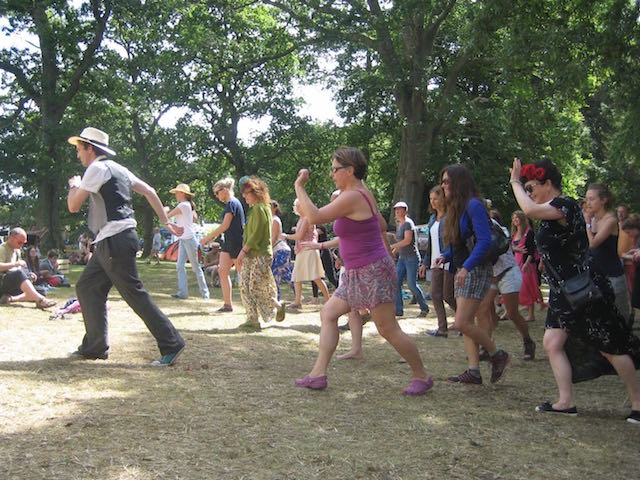
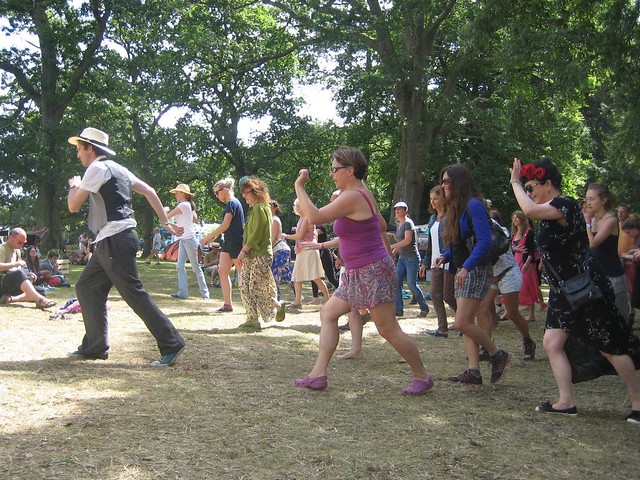
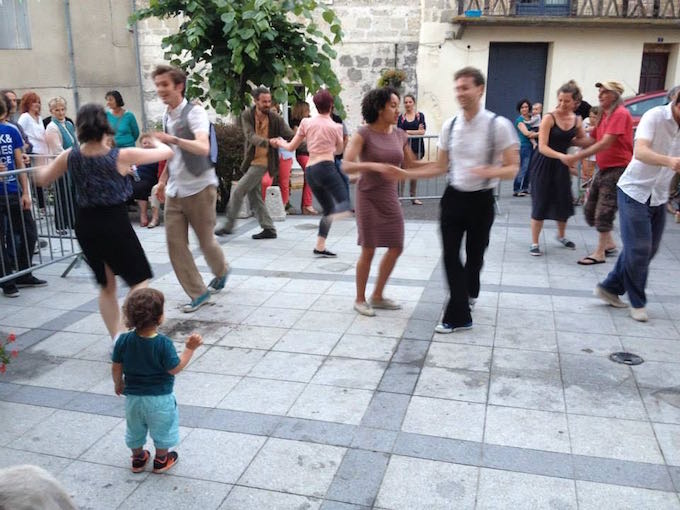
Bristol Swing Festival is unique among swing dancing festivals because it offers the chance to learn circus skills alongside learning to dance. One of the things that I love about coming to Bristol for the swing festival every year is the way it makes me feel grounded in myself and the connection it gives me to other people and the world around me. In the past, I haven’t had a philosophical framework to help me interpret these experiences. But this year I think I found it in Matthew Crawford’s book The World Beyond Your Head. Reading the second chapter, ‘Embodied Perception’, I recognise many of the phenomena that he describes in my experiences here at the festival.The key idea Crawford introduces is that we think through our bodies: our bodies are an integral part of our thinking process and thinking doesn’t occur just within the confines of our skulls. Before I think about the consequences of this idea I want to first relate the pieces of evidence that he puts forward for this notion of embodied perception to the experiences I have here at the festival. Before we go on I should just say a little more about what goes on at this festival. As the name suggests people coming to this festival to learn to swing dance but what what makes it unusual is that you also learn circus skills alongside those dance skills. On a typical day you’ll spend the morning and early afternoon learning dance steps and then the rest of the afternoon trying out different circus techniques such as tumbling, handstands, tight rope walking, juggling and clowning. It is therefore a very physical environment and one in which you make a lots of physical and mental contact with other people.The first piece of evidence that Crawford sites in support of embodied perception is what happens when we use a stick held in the hand to explore a space we can’t see. When we use the stick to rummage around in the unseen space, we are aware of the stick jostling around in our hand as the other end moves over the contours of the hidden space; however, after a while we stop noticing the stick’s pressure against our hands changing and focus instead on what is happening at the tip of the stick. As he describes, it is as if we see through the stick right to the tip. Our awareness has shifted from our hands and is focused instead on what is happening at the tip of the stick. To use his words the probe itself has become transparent – it disappears. He goes on that the crucial fact that makes this integration of the prosthetic possible is it there is a closed loop between action and perception: “what you perceive is determined by what do you, just as when we make use of our own hands.You can see this happening as people start to develop dancing and circus skills. The stiltwalkers are initially very aware of the contraptions they have strapped to their legs but as they gain confidence and familiarity with the sensations they receive through these prosthetics about their relationship to the physical world on the ground it is as if the stilts disappear from view. They have become incorporated into the body from an attentional perspective and what the stiltwalker senses is the ground at the at the bottom of the stilts and not the stilts themselves. I think the same can be said of the sensations that two people feel when they learn to dance with one another. When they begin they are very aware of all the places where their two bodies touch: the connection between their arms, between the sides of their bodies. To beginners this connection with the other dancer is something that they think about a lot. But as the familiarity with this dance hold increases it is if the notion that there are two separate bodies holding onto each other disappears and they experience the dance as one conjoined unit. To re-emphasise Crawford’s words this integration of the stilt or the other dancer into our own bodies is only possible because there is a feedback loop between action and perception. The sensory information we receive when we are dancing with someone is that associated with a four-legged organism with a centre of gravity that exists at some imaginary point between the two dancers’ ribcages and so based on this sensory information we no longer perceive ourselves to be two separate beings but rather one entity.So that was the first piece of evidence in support of extended perception:tThe way we integrate tools and prosthetics and even other people into our bodies. The second set of evidence relates to how we interpret the world around us based on sensory information. He explains that the traditional model of perception has it that our eyes supply our brains with a two dimensional representations of the world. When I look at the beer can in front of me what I see is a 2-D representation. But from memory I have images of the can from other perspectives. What my brain does is a sort of three-dimensional rendering in order to create a 3-D model of the can in front of me. This model seems to imply a great deal of processing happens in the head whenever we wish to perceive a 3-D object. That model however, as Crawford explains is being challenged by and alternative approach. That approach takes as its starting point the fact that our eyes are located in eye sockets in which they can swivel. Those eye sockets are located in a head seated up on a neck that can look from left to right up and down. Those eyes, head and neck are attached to a body that is connected to legs that can propel the body forwards, backwards, left and right and up-and-down. To repeat the quote that Crawford uses, vision is not the purely mental processing of sensory inputs but rather the way in which we use our body to extract invariants from the stimulus flux. In other words, we explore and understand the world around us by moving through it and seeing things from different perspectives and critically this allows us to identify things that remain the same from different perspectives. Movement through the world is therefore critical to understanding it.Here at the festival we learn lots about movement and moving in different ways, so it is possible that this altered locomotion offers us new perspectives on the world. In the handstand classes we spent time moving around on all fours and connecting our hands to the ground. In solo jazz we learn to slide, hop and skip through a space, filling it in new ways. In tumbling classes we run, we jump and we fall (gracefully). All of these activities reveal the world to us from new perspectives, and remind us how narrowly we perceive the environments that we commonly inhabit.When I look out of the window from the cafe at which I am writing this post at the streams of people walking to work, walking the same direction as each other, walking the same way as each other, to go and sit in office environments that are probably very similar to one another. If we move through (or rather remain sedentary) in very similar ways, what does that say about diversity of thought?Crawford concludes this part of the chapter with a reflection on how toddlers learn to walk. When they are learning they are experimenting to see what movements of their bodies produce what effects. Initially this takes lots of concentration, but eventually the commands can be carried out with thinking about them. The child’s attention shifts away from the body toward the world that can now be explored through movement. Through mastering a new skill, their world has grown, and their attention and perception reaches out beyond the body. Invoking Nietzsche, Crawford says that joy is the sense of one’s power increasing. As we master a new physical skill, frustration gives way – their attention shifts from their body to the world beyond – and they feel a sense of joy.So what do I take from all of this? Why does going to the Swing Festival feel so good. I think that there are four things at play here:The first is that for many, myself included, our primary stimuli during the day are visual and audio – all from the head and little from the body. At the festival, the stimuli are much more physical. This gives our brains a break, and perhaps puts us back into a sensory environment to which are perhaps better evolutionarily suited.The second is that many of the skills we learn at the festival allow us to move through the world in new ways, giving us new ways of perceiving it and understanding it. Turning upside down may seem a trivial thing to do, but when we do so much of our thinking the right way round, flipping things provides a refreshing change.A third thing I’ve noticed is that spending a few hours a day doing bodily-focused classes seems to make people more physically playful outside those classes. It’s as if we are given permission to rediscover our world through physical play, to rediscover that intrinsic joy that children find when they run around, swing from branches, balance on walls, wrestle with one another or just give each other hugs.And finally, the festival gives us a tiny taste of the power we could feel if we could master a circus skill: when we might one day stop looking at our hands and watch the juggling balls dancing in front of us; when we might one day feel the lightness that comes with the perfect handstand.To conclude with one of Crawford’s phrases, ‘we think through our bodies’. Bristol Swing Festival gives me new ways to think through my body, and that’s why I enjoy being there so much. -

#7: Musician and composer Ellie Westgarth-Flynn on creative strategies, instruments as an extension of our bodies and creative feedback
Ever since I was a kid my Dad has been sharing musical composition strategies with me, so I think music has been a lens thorugh which I’ve thought about creativity for a long time. And so I jumped at the opportunity to interview my friend Ellie Westgarth-Flynn, pianist, singer, composer and performer about our shared interest in creative techinques for composition. As in many of these podcast interviews, I think that creative techinques from one domain can easily be transported to another, and so I hope that whatever your domain of work, you find something useful in the creative techinques that Ellie and discuss. In this episode, we get into:
- The tension between technical mastery and creative freedom.
- The freedom that rhythmic and harmonic templates or restrictions bring to our compositions.
- Building up composition from motifs and building blocks.
- The importance of feedback in the creative process – acting on feedback is where change takes place.
- There comes a point at which you need to leave yourself out of it and get on the with the job of writing the music.
- Three creative techniques for anyone trying to get into song writing.
-

Eiffelovercast #6 – Riding the Northern Line Ghost Train
In this episode of the podcast I attempt a sonic recreation of a part of the London Underground that never got built, a stretch of the Northern Line that would have run from Moorgate to Alexandra Palace. En route I reflect on the transport infrastructure shapes our experience of the city and the difference between what engineers plan and what actually gets built. I really loved making this podcast – it features my mother, Anne Soutry, as Northern Line announcer, making the most of her skills as a continuity announcer for BBC Radio Manchester many years ago. Also, as part of my research, I got a ride in the cab of a Northern Line train with my friend Stuart McGee – thanks Stu. So, have a listen, and I hope you enjoy the ride.
- Listen to it on iTunes
- Stream by clicking here
- Download as an MP3 by right-clicking here and choosing “save as.”
If you liked this podcast then you’d definitely enjoy:
-

Analogue skills: fogotten powers
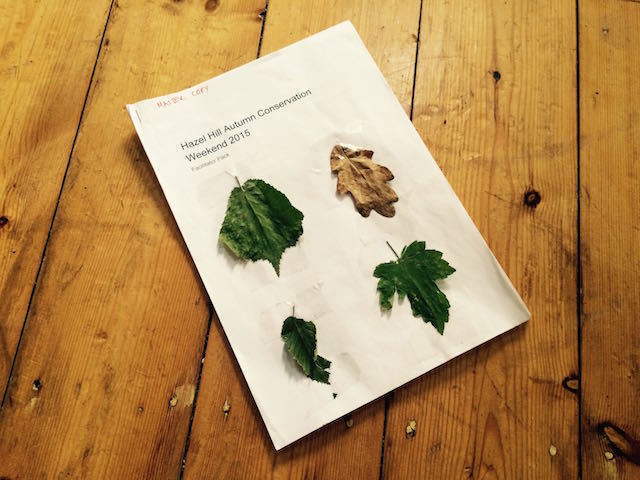
We live in a time of rapid and accelerating technological change. It is the age of digital, big data and smart technology. The digital zeitgeist is presented with a benign face: faster, more connected, more megapixels, do more, see more. But over the last couple of years I’ve had a feeling that in the race to embrace these new digital tools we are forgetting pre-digital ways of doing things which might turn out to have been more useful, more sustainable and better for us. Things like how to communicate face-to-face, how to communicate in written long-form (even the long email is a thing of the past), how to read a map, how to spell, how to sketch, how to make an appointment and keep to it, how to concentrate, how to make things, and even how to take notice of our physical environment.The name I am giving to this pre-digital ways of doing things is ‘analogue skills’. As an on-going project, I plan to explore what analogue skills it would be worthwhile keeping hold of, and to interrogate the digital tools at our disposal to see how to make good use of those without detriment impact to our well-being or to the planet. I hope the outcomes of this project will be to produce some suggestions for how we can use the tools at our disposal, both analogue and digital to improve our experience and quality of life.Of course, there are many ways in which digital tools empower us: wide-spread and long-distance communication; access to information and knowledge sharing; access to an almost unlimited range of media; online commerce and sharing economies; increased connectivity through social media – and I benefit from all of these.But there are also costs. More screen time means less time experiencing the physical environment.The flip side to the benefits of social media is the social anxiety in can cause, fear of missing out – so called FOMO. The huge choice of media that the Internet offers can lead to a sense of being overwhelmed and lower levels of engagement with the content. Digital consumption is dependent on technologies over which consumers have decreasing amounts of control – no longer are we necessarily the masters of our tools – and with built-in obsolescence, these technologies have a large environmental impact.Around me, I increasingly see the signs of digitial discontent. Friends talk about digital detoxes and commit ‘Facebook suicide’. At Hazel Hill Wood, where I co-lead conservation weekends, there is no mobile phone reception. Most participants are relieved for this enforced time offline. But there are usually one or two users per group who anxiously spend time at the one spot in the wood where they can get a feint signal and wave their handsets around in the air, like some ritual dance to the digital deity, in a desperate attempt to connect.At this point I need to make a full disclosure: I write this post on an laptop, using notes that I made while walking along the street on the memo app on my iPhone, cross-referencing that with notes that I made in Evernote almost a year ago, which I will post to a website, which I will then share on social media. So yes, I am fully-signed up user of digital technologies. But there are plenty of digital things that I don’t use. For example, for the last year I have been trying to minimise the distractions of social media by removing notifications from my phone, and by limiting my screen time. For certain, I’ve been sceptical for some time about the digital panacea. This project is an attempt to martial these thoughts, to change my skills and habits and hopefully to help other people along the way.I am fascinated by really cutting edge technology, the innovation that goes into it and the possibility it offers. But I do think that older technologies allow us to interrogate the new; indeed one of the most fascinating things about older technologies is finding out how the engineers of the day were using great ingenuity to extend what was possible within the limits of the technology of the time. Of course, digital technologies are here to stay, and in many ways for the better. What I think is important is making sure that is us who are smart and not just the technology.Related posts
-

Eiffelovercast #5 – Nick Cobbing: photographing the Arctic
Photographer and photojournalist Nick Cobbing talks about photographing the Arctic, what happens to photographic equipment at minus 38 degrees, using drones to take photos, the role of the audience in the creative process, being reduced to tears by the beauty of the planet, the best places to swing dance north of the Arctic, life hacks for creative people working on their own and whether penguins tango or waltz.- Listen to it on iTunes
- Stream by clicking here
- Download as an MP3 by right-clicking here and choosing “save as.”
-

Everyday Creativity for Blues Dancers
This is the second workshop I have run in the ‘Everyday Creativity for…’ series, this time for blues dancers in the London blues scene. A huge thank you to Ellie and the Sunday Shake Off crew for inviting me down.
The premise is that blues dancing is an inherently creative activity (maybe even more so than lindy hop?), and by interrogating what we are doing when we are dancing blues we can find creative strategies and techniques that we can use in other parts of our lives, from personal projects to professional work.
This workshop was a truncated version of the full workshop that I run for swing dancers. Into an hour we managed to squeeze in:
- Thinking of creativity as a system, and understanding the parts of that system
- The influences we draw upon in our swing dancing and in our professional work
- Generating connection with your collaborators and your audience
- Strategies for stimulating divergent thinking
- The value of doing really silly things.
Keep an eye out on this site for dates when I’m planning on running the full workshop again.
Related posts
-

Eiffelovercast #4 – Crossing France very very fast: a paean to TGVs
Ever since I saw my first one zoom past as a boy I’ve loved TGVs. In January I travelled from one side of France to the other and back by high-speed train to get to a conference, and used the chance to try to capture some of what I love about fast trains in France. It’s a mash up of travel diary, interviews and engineering history, all stitched together with familiar SNCF noises. I hope you enjoy.
- Listen to it on iTunes
- Stream by clicking here
- Download as an MP3 by right-clicking here and choosing “save as.”
If you enjoy the interview then please let me know in the comments thread below.
-

Eiffelovercast #3 – Andrew Scoones – is there is such a thing as engineering culture?
We are trying to define the heritage of the future – the creativity and ideas in engineering that people will look back on – Andrew Scoones
Andrew Scoones is a filmmaker specialising in the built environment. Andrew seems to have interviewed or met almost all of my engineering design heroes, and so I was equally delighted and nervous when he agreed to let me interview him! In this podcast we explore one of Andrew’s passions, the identification and celebration of engineering culture. Along the way way we get in to some great stories about designers, what they design and how they do it.
Andrew is director of the Engineering Club, set up over twenty years ago to host events about the broad culture of engineering in an informal setting. In this podcast he shares some of his favourite stories from Engineering Club guests, which illustrate different aspects of engineering culture.
En route we get into bicycle design, designing trainers, whether there engineering culture includes creativity, and whether there is room for creativity in industrialissed systems. We talk about some great engineers and their projects. And we talk about building your own dishwasher.
Please enjoy this interview with Andrew Scoones and let me know what you think in the comments below.
-

Pre-stressed concrete: lessons for swing dancers

TGV Bridge at Avignon by John is available under CC 3.0 Recently in beginner’s swing dancing classes I’ve described the connection between lead and follow when dancing side-by-side Charleston as being a bit like how pre-stressed concrete works. I promised a longer explanation. Here it is.
Starting with reinforced concrete
To begin we need to understand how reinforced concrete works.
When you build a beam in a building and you stand in the middle of it, the beam sags, albeit ever so slightly. To understand what is happening, you can simulate a simple beam by interlacing your fingers in front of you, palms down. Now imagine what were to happen if someone were to balance a bag of sugar on your knuckles: your hands would sink down, the skin on the underside of your fingers would stretch, and the skin on the top would pucker up. That’s because the skin underneath is going into tension, and the skin that is on top is going into compression. This tension-compression couple is what supports the load resting on the back of your hands.
For a video illiustration of this deomonstration, see this video I helped to script a few years ago at Think Up.
Now let’s imagine what happens if we were to build that beam out of pure concrete instead. Concrete is strong in compression, and so would have no difficulty in resisting the compressive force in the top side of a bending beam. But it has virtually no tensile strength, and so as soon as the underside of that beam starts to stretch it would suddenly crack and catastrophically fail.
So for about 130 years now, engineers have been embedding reinforcing steel in the bottom of concrete beams to carry that tension which arises when a beam bends. Steel is strong in tension (think of the steel cables in a suspension bridge). In a beam reinforced with steel, the steel rods act like stiff elastic bands which resist the tensile loads that are generated when the beam bends.
The importance of depth
Reinforced concrete is a popular building material. To work, the beams need to have a certain depth to them. To illustrate we can think what happens when we bend a 30cm ruler. If you hold the ruler out in front of you flat side facing down, and try to bend it downwards, it bends easily. But if you hold the ruler out in front of you edge-downwards, and try to bend it downwards, it is almost impossible. What’s the difference? It’s the difference in distance between the top and bottom fibre that determines the stiffness.
So, deeper beams are stiffer, and can span further between supports.
Pre-stressed concrete
The problem with deeper beams is that they require a deeper floor void between the ceiling of one level and the floor the level above. Building designers usually want to minimise the floor depth so that they can fit in as many levels as possible within a given height. More levels means more rent.
Pre-stressed concrete is an evolution of reinforced concrete which enables shallower beams and slabs to be used in buildings. In pre-stressed concrete, the steel bars of reinforced concrete are replaced with steel cables which run through the middle of the beam and are attached to a plate at either end. When the concrete is set, this steel cable up is tensioned up squeezing either end of the beam, putting the entire thing into compression.
The effect is similar to when you pick up a row of books simply by squeezing from either end. If you squeeze hard enough, you can pick up say 15 paper backs without any of the middle ones slipping out.
For an illustration of this principle, see another video that I helped to make a few years back at Think Up:
Now imagine you were picking up a row of books in this way, squeezing from either end, and someone were to put a bag of sugar on top in the middle, as long as you were squeezing hard enough, you could probably support the weight of the bag of sugar.
So what is happening here? In fact, the same thing is happening here as when the sugar was placed on our interlaced hands. The top of the books are squashed together, and the bottom split apart a bit. The difference is that because these bending forces are applied to a set of books that is already being compressed together from either end, the bottom edge never goes into tension: it is just a little less compressed. Similarly the top of the books are more compressed because of the sugar they are supporting.
Putting pre-stressing cables into a concrete beam puts the whole thing into constant compression, making the whole thing stiffer.
What’s that got to do with swing dancing?
In teaching beginner swing dancing classes there often seems to come a point where we have to move learners from simply dancing a choreography to leaders leading and followers following. The key to that is the connection between them, which works in different ways depending on the dance.
When dancing side-by-side Charleston, the leader has their arm around their follower’s waist. The follower needs to sit back into this arm slightly, and the lead needs to push against their follower’s back. This creates a slight compressive force between them, which is equal and opposite.
To signal to the follower that the leader wants to move forwards, the leader moves forwards themselves, and in doing so, increase the compression in the connection, which causes the follower to accelerate forwards.
To signal to the follower that the leader wants to move backwards again, the leader moves backwards themselves, and in theory, this reduction in compression should cause the follower to accelerate backwards.
In practice, what we see is leaders moving backwards, and become disconnected from the followers. This disconnection reveals that they never had that matched compressive force in the first place: the pre-stress was missing.
If that compression is there to start with, if one person reduces the compression by pulling away, the other starts moving towards them. If there is no compression, and one person reduces the compression by pulling way, the two simply separate from each other.
So, to get the connection right, get the pre-stress right.
Related posts
-

The Margherita Principle for decision-making

Pizza (altough not quite a Margarita) I’ve been promising friends this post for some time, especially those that have eaten in a restaurant with me recently. In the season of good will and consumption, this rule of thumb helps us make better menu choices. But as a decision-making tool, it goes much deeper, helping us (re)discover the real value in things.
The principle is simple: the best value pizza in a restaurant is the one at the top of the list, usually the Margherita.
This realisation first came to me last year at a pizza restaurant by the Canal St Martin in Paris. The 6€ Margherita offered: a delicious and filling meal – the prototypical pizza; a nice warm place to sit; the atmosphere of the restaurant; banter with the waiter; a view over the canal; a small basket of bread and a bottle of tap water; and chilli oil.
The next pizza on the menu was the Fungi. At 7.50€ I was getting everything the Margherita offered plus a chopped mushroom. At 1.50€ that’s a bad value-for-money mushroom. And from there on down – Fiorentina, Vegetarian, Quatro Staggione – the value just keeps on going down.
The cheapest thing on the menu usually gives you the most, the rest are opportunities to spend more money with diminishing returns. (Incidentally, as Tim Harford explains in his book ‘the Undercover Economist’, menus are usually structured in ways to give customers the opportunity to spend as much money as they want to.)
The benefits of the principle
- By applying the Margarita principle not just to pizza but also drinks and coffee, I was able to have a pizza, a glass of house red and a shot of espresso for 10€ all in.
- It’s a training in simplicity, which as Thoreau argues in Walden, is the route of happiness.
- It’s a training in looking for the real value in things.
What about non-linear effects?
My colleague David pointed out to me that the principle may not be applicable if the combination of extra ingredients amounted to a taste that was greater than the sum of it’s parts – a sort of non-linear taste progression.
I concede that this sort of topping alchemy may be possible, but in reality it would have to deliver significant extra value to be anywhere near as valuable as the initial Margherita. Besides, another colleague of mine, who is also Italian, claims the Margarita is the best tasting pizza anyway – so why add anything more?
Broader application
The Margaherita Principle is a sort of mix of the Pareto Principle and the Law of Diminishing returns, and has applications beyond pizza choice. It helps get greater clarity of thought when making decisions.
For example, I was recently agonising over the order in which to publish various blog posts. But then a realised that the greatest value outcome was just to get the post published. There may be some marginal benefit to publicising them in a certain order; however that was much less than the value of just getting the material online and circulated. Worse, the time I was spending worrying about the order to publication was time that I wasn’t spending writing – and I might have ended up publicising nothing at all.
Another example related to the branding of a training course that I am involved with developing. At this stage, we are not sure how the course is going to evolve, and so it was difficult to decide what direction to take the branding. But, applying the Margarita Principe, I realised that the most important thing is to at least get something published, which we could then revisit as started to run and iteratively develop the course.
The fallacy of menu choices
As I write, I realise that we often have less control over our experiences than we think. A restaurant is probably quite a high control scenario: we choose what we want to eat and drink; choose our company; and with care, the topic of conversation; and things usually go to plan. In reality, we often have less control over the projects that we manage than we think. The branding example above illustrates this. It is very hard to know what the best way to describe a training course is until you run it and see how the content evolves in practice. With this sort of thing, the best approach is make quick decisions, see how they work in practice, and then re-evaluate along the way.
In a restaurant situation, this is akin to not ordering your main course until you have finished your starter, and then waiting until later to order dessert. This is decision making on the basis of feedback – literally!
The horror of advanced menu choices
Given all of the above, the worst possible decision-making scenario with regards to menus is when you are sent dinner options for a conference or a corporate meal a month in advance and you have to choose then. How on earth are you going to know what you want to order that far in advance?
In these situations, Margheritas are rarely available, so here I apply the Tiramisu principle: always choose the first option as long as it is vegetarian, and along is it isn’t Tiramisu, which is the food of the devil and should be avoided at all costs.
-

Sorting out your lego – the Eiffelover guide
If you own a big pile of Lego, then sorting it into separate boxes for different sorts of parts makes it much quicker for you to build anything you want to. I have found that the creative potential my haul of lego is multiplied manyfold by the simple act of separating it out. All of a sudden, when I can see what types of pieces I have, the ideas flow much more quickly, and the time lag between having the idea, and it manifesting itself in physical form is much reduced.
The question is knowing where to start. There are so many types of pieces, it doesn’t work to have a pot for every single type. I’ve probably completely sorted my Lego three times in my life (so far), and I think the categories that I have now are pretty effective. So to save you thre trouble, here they are.
Helpfully, since the first time I sorted my Lego, the Internet has been invented, and so it is now much easier to find commonly agreed names for pieces. In the lists below I’ve included some links to to photos of the pieces that I am talking about. I’ve organised the following list according to the size of tub I needed for each part. It’s the relative size that’s important here.
8L tubs
Base plates
- Lunar landscapes
- Road pieces
Miscellaneous- Train buffers
- Rigging
- Pirate ship hull
- Pirate ship sails
- Pirate ship masts
- Monorail track and pylons
- Train track
4L tubs
BricksThese are your standard building bricks. You would think that the protypical lego brick would be the most common, but compared to other bits I have relatively few of these. 2 by X bricks (X>1)Wheels and tyresThis is for wheels of all shapes and sizes, their tyres and the plates with axle stubs attached onto which little wheels and wagon wheels can be fixed. This is the biggest tub of all.Large platesFor those large base plates that are at least 4×4Narrow long bricksThese are like beams. These are 1 bx X bricks where X>3, but with no side holesNarrow long bricks with holesAs above but with holes in so you can push through axles.Small bricksThis is probably the modal category of my lego bricks. You are much more likely to find one of these than a standard 2×2 brick. Includes:- 1×1 bricks
- 1×2 bricks
- 1×3 bricks
- 1x1x5 bricks
Wide platesI think of these as planks 2 x X where X>1Narrow platesThese are thin plates – 1x X where X>32L tubs
Automotive paraphernalia- Specialist pieces for making cars, such as
- Steering wheel
- Seat
- 1×2 grille
- Wheel guard
- 1×2 textured brick
- 2x4x2 windscreen
- 2x4x2 sloped windscreen
- Chassis
Space paraphernaliaPieces for making space rockets and space stations, such as- Joystick
- Propeller with 4 blades
- Propeller with 2 blades
- 1×2 plate with side bars
- 3×8 angled plate
- 2×2 printed slope
- Loud hailer
- 3×4 double angled plate
- 1×2 plate with jet engine
- Spiral tubes
- 1×6 curved bar with studs
1L tubs
Little platesThese are among the smallest pieces- 1×1 plates
- 1×2 plates
- 1×3 plates
- 1×2 jumper plate
Slopes and archesThere are lots of variations of arches and slops, and the nomenclature can become a bit confusing.- 1×2 slope
- 1×2 inverted slope
- 2×2 slope
- 2×2 inverted slope
- 1×3 slope inverted slope
- 2×3 slope
- 2×3 inverted slope
- 4×3 slope
- 1x2x3 inverted slope
- 1x5x4 half arch
- 1×6 arch
- 1×3 arch
Round bitsThere is some ambiguity as to whether some of these pieces should really go under space paraphernalia.- 1×1 cones
- 1×1 round brick
- 2×2 cone
- 1×1 round plates
- 2×2 round plates
- 2×2 round brick
- antenna
- 2×2 curved brick
- 4x4x2 cone
HingesWhen I was a kid, hinges were my favourite part. Now I have a whole box full of them. They include:People and their accessoriesA box full of Lego people is always fun just to play with on its own. I throw in all the accessories too such as:- Shield
- Spear
- Sword
- Cutlas
- Lance
- Torch
- Knight’s helmet flame
- Musket
- Pistol
- Oar
- Spanner
- Hammer
- Broom brush
Pirate/medieval- Horse harness
- Flag with 2 clips
- Streamer (type of flag)
- Barrels
- Treasure chest
- Treasure
- Canon
- Castle panel sides
- 3×3 angled corner brick
Windows and doors- Includes hinges for windows and shutters too.
TownParts for building suburbia- Mailbox with door
- 2×4 winch
- Street furniture
- Car wash pieces
- Long fencing
- Petrol station parts
- Emergency services parts
- Roadworks parts
Flora and forna- Small tree
- Conifer
- Flowers and stem
- Palm tree leaf
- Sharks
- Monkeys
0.5L tubs
HoldersPieces for clipping things too, like personal accessories- 2×3 curved plate with hole
- 1×1 plates with vertical clip
- 1×1 plate with horizontal clip
- 1×2 plate with vertical bar
- 1×2 tile with top bar
- 1×2 plate with handled bar
- 2×2 brick with ball joint
Wall elements- These are the pieces that make up the walls of castles and the sides of vans and trucks
Lattice fences- 1x4x1 lattice fence
- 1x4x2 lattice fence
Lights- Transluscent pieces usually used for making headlights and tail lights
Light holders- 1×1 brick with 1 side stud
- 1×1 plate with side ring
Small tiles- 1×1 tiles
- 1×2 tiles
- 2×2 tiles
Long tiles- 1xX tiles where X>2
Angle plates- 1×2/1×4 Angle plate
Turntables- 2×2 turntable
- 4×4 turntable
Axles- Cross Axles
- Threaded cross axles
Things that go on cross axles- Gears
- Right angle axle connector
- Collars
Pins- Half pin
- Grey pin
- Black pin
-

Use these 5 apps to create distraction-free time.
We need distraction-free time to make progress on our creative projects. At the same time, we rely on online networks and information to nourish our ideas. The trouble is, spending time online is rarely distraction-free. So, is it possible to get the best of both worlds?
The short answer is yes. In this post I share the strategies that I have adopted to maintain distraction-free time while working online. These include five apps that I regularly use to manage what information I see and when.
This post follows on from my previous post 9 ways to build creativity in your organisation, focusing on steps that individuals can take to manage their own creativity. Expect more from me on this theme in coming posts.
Principles
There are four principles that underpin my approach:
1 – Know your mode
In his book ‘Getting Things Done‘, David Allen tells readers not confuse time when you are processing actions with time when you are completing an action. The same is true for working online. Be clear about whether you are meant to be processing emails/tweets etc, completing an action or, importantly, spending time reading.
2- Avoid the inbox
Enter the inbox, get all the information you need out of there, and then leave. If you return when you are in the middle of something else, don’t be surprised if you get distracted.
3- Reduce the back-and-forth
Just because we can respond instantly, doesn’t mean we have to. Instant responses lead to communication inflation, and erode time to ourselves.
4- Remove notifications
Until the last 100 or so years, toothache must have been the bain of adults lives – always nagging, never leaving us in peace. Today, in the age of modern dentistry, what nags us instead, what disrupts our peace, are social media notifications. If we set regular times to look at our various feeds, we don’t need notifications.
5 apps
I am being generous with the definition of ‘apps’, here to mean both ‘app-lications’ and ‘app-roaches’.
1 – Task management – use Bullet Journal
The first app isn’t an app at all, it’s an instead-of-an-app. For years I’ve been playing around with lots of different apps for managing tasks. My favourites are OnmiFocus and Trello. The trouble with even the best of these tools is that they allow you to create never-ending lists of tasks that you could never get done.
Bullet Journal is different. It is no more than a set of rules for using a paper notebook to manage your tasks. It’s simple, and it works. Each day you write down the tasks you need to complete. At the end of the day, you either forward incomplete tasks to the next day, by physically writing them out again, or your forward it to a page for the week or even month ahead, again physically writing down the tasks. It works because every time you re-write something you end up saying to yourself, ‘come on, am I actually going to do this?’
I’ve been using it for four months now and I’m hooked. Here’s a great intro video for using Bullet Journal.
2 – Information storage and online workspace – Evernote
Evernote is a great tool for storing information and for working online. Here’s how I use it to minimise distractions.
- As I am processing emails, if I find something that I need to refer to later for a particular project, I forward it to Evernote (which you can do straight from your email), adding meta tags in the subject line so that Evernote can file it for me.
- When I am working on a project, I can then look through the notes filed in Evernote that have that project tagged. It’s a great way to get to the information without being distracted by something new in the inbox.
- I do all first drafts of longer emails in Evernote – I can even send them from Evernote without having to go back into my inbox.
One really neat feature of Evernote is that as you use it more and more, it starts to recognise when something you are writing is similar to a previous note – this has the added bonus of making connections that I hadn’t otherwise seen.
3 – Online reader – Instapaper
Until I discovered Instapaper, I had basically stopped reading the articles that people were sending me online. This happened as a consequence of being rigourous about not spending more than two minutes processing any email that someone had sent me. If a correspondent had sent me something to read, I would forward it to a folder called ‘browsing’ where it would then languish unread.
And then I discovered Instapaper, an app that you can forward reading informaiton to. When you open the app, all your articles are there but with the formatting stripped away. What’s left is really clear to read.
Since then I usually make at least one time a week when I sit down with a cup of coffee and read my articles for the week on Instapaper. It is really refreshing to spend time reading longer articles from end to end.
If I like what I read, I forward it to Evernote, tagged for appropriate interests. If I want to share it with other people, I forward it to Buffer – see below.
4 – Schedule social media posts using Buffer
I know from looking at the analytics that most of the people that follow me are online at times when I’d rather not be. To get round this I use Buffer to schedule some of my social media posts to maximise the chances that the people I want to see the post do. Buffer allows you to set up daily posting schedules for all your social media channels. You can save time by posting to several channels simulataneously. Buffer will tell you what times your audience members are interacting with your contact, and can adjust your posting schedule to suit.
5 – Clear yesterday’s messages today
This is a great rule of thumb that I only came across recently in the Guardian (thanks Jenny for the recommendation!). I’ve long abandoned the idea of having an empty inbox – as a strategy it takes too much time and I think can actually lead to more email traffic. In this approach, on any given day, you should only aim to deal with yesterday’s emails. You are still responding within 24 hours, which is a reasonable timeframe, but your response has to be carefully written as you have to empower your correspondent to act without hearing from you againfor 24 hours.
Conclusion
My Dad once quoted the following to me (I am hoping he can remember where it came from and can tell us in the comments to this post): getting information from the internet is a bit like trying to take a sip of water from a fire extinguisher.
Yes, we need access to online information and networks for our creative projects – we just need to manage the flow.
Related posts
- 9 ways to build creativity in your organisation
- The Happy Grid: prioritise your action list in a more fulfilling way
- Does going for a walk improve design?
Image credit: Fire Extinguishers by Claudio González is available under CC-BY-2.0
-

The Happy Grid: prioritise your action list in a more fulfilling way
The Happy Grid is a technique I devised a few months ago to help me use short and long-term happiness as a guide for daily decision making. Since I’ve been using it, it has had a hugely positive impact on me: I am better at prioritising work that makes me more fulfilled, and hopefully the people I collaborate with get more out of working with me.
In this post I’ll explain how to set up your own Happy Grid. I’ll also go through the four different task types that make up the grid, and what these can tell you about the pressures that influence how you use your time. It’s a long post, but stick with it as I think there’s a lot of useful stuff here.
Background
The story begins at the end of a busy week. I had ticked off all the most important actions on all my major projects. I should have been feeling happy, but I felt quite depressed and that depression extended into the weekend. It was confusing because this was supposed to feel good – to have not sucumbed to distraction and to have done the things on which other people were depending on me. Yet I didn’t feel any payback for getting to the end of the list.
A few weeks before I had been on holiday. One of the things that I do when I have some time away is write two lists in my journal: the first, a list of goals for the year ahead; the second a list of things I feel happy doing – a list of things that bring happiness in the moment.
I decided to map my ‘done’ list against my lists of goals and things I enjoy doing. The result was very revealing.
The Happy Grid Diagnostic Test
To help you get the most out of reading this post, I suggest you do the following quick diagnostic test right now. Do it quickly on a piece of paper. You can always go back and do it more thoroughly. I am going to ask you to write down four lists.
Current goals
First, write down a list of your current goals. Think of goals on a say a 3- to 6-month horizon. Include in your list the sort of state you want to find yourself in. So for instance one of my goals was to spend more time doing face-to-face teaching. Another is to spend time with people who positively influence my thinking. Neither of these goals are to do with attaining some kind of status. Think broadly. Do you want to spend more time inside or out? Are there things you want to learn?
Anti-goals
The second list of of things you don’t want to achieve. Think of these as anti goals. For instance I don’t want to spend more time in front of a computer screen. I don’t really want to get involved with teaching projects where I don’t have influence over the content. I don’t really want to get involved in building a new knowledge management system for the business, even though this is something I’ve done before. Knowing what you don’t want to do is as important as what you do, but is sometimes harder to elucidate.
Enjoy doing
The third list to write down is a list of things you enjoy doing.. Think of things that make you go into a state of ‘flow’ when you do them, when time just flies by because you are enjoying yourself, but equally which keep you challenged. Think of things that you get a buzz out of because you enjoy doing them. My list includes things like teaching and coaching, writing new teaching material. But it also includes travelling by train, cycling, spending time with family and friends, spending time outside.
Drag list
The fourth list to write down is things that you don’t enjoy. These are things that feel like a drag. For me that list includes small-scale management of projects. This is something that I don’t enjoy and recognise that there are other people who do this much better than me. It also includes the opposites to the things I enjoy doing – so I don’t enjoy being inside all the time, I don’t enjoy being alone for too long.
You are now ready to create your own Happy Grid.The four types of tasks
I reasoned that the tasks on my to-do list fitted into one of four categories, which I labelled and described as follows:
- Type-1 tasks – Tasks that are goal-aligned and enjoyable. These are things we should prioritise because they feel good to do, and because they are contributing to a goal.
- Type-2 tasks – Tasks that are not goal aligned, but nevertheless enjoyable. It feels good to do them but it doesn’t help us reach one of our goals.
- Type-3 tasks – Tasks that are goal-aligned but unenjoyable. We generally need to do them for long-term happiness but doing so doesn’t feel good.
- Type-4 tasks – Tasks that are neither goal-aligned nor enjoyable. Doing these doesn’t feel good in the short- nor the long-term.
Creating your Happy Grid
Create a 2×2 grid and label the four quadrants as follows.
Type 1 Type 2
Type 3 Type 4Now, go through each entry in your current to-do list, and write it down in the quadrant of the grid to which it corresponds.
When I categorised and wrote down my list of completed tasks for the previous week, I found that the majority of what I had got done were Type 4 tasks: tasks that are neither enjoyable nor contribute towards longer-term aims, with a smattering of Type 3s and Type 2s. Revealingly I didn’t have anything written down in the Type 1 quadrant, the one that feel good to do and contribute towards some positive goal.
I felt I had landed upon a key prioritisation tool for the week ahead.
Understanding the four tasks categories
Clearly we don’t have the luxury of only doing Type-1 things. But categorising things in this way can at least help us be more aware of the nature of the list of tasks before us, and can help us make more fulfilling choices about what we do. And beyond being simply aware, we can actively make decisions to help us spend more time doing things that we enjoy.
Let’s explore each of these categories in turn.
Type-1 tasks – goal-aligned, enjoyable tasks
In an ideal world, we’d spend the majority of our time doing these sorts of tasks. Half the trouble is simply knowing what these goal-aligned, enjoyable tasks are. The aim of the happy grid is to help us identify the sorts of things we enjoy doing and that are goal-aligned, and to make sure we are spending at least some of everyday doing things that are likely to make us happy.
By regularly repeating the diagnostic exercise described at the start of this post, you can start to recognise Type-1 tasks. Identifying and writing down type-1 tasks is the first step to making sure you spend more time doing what makes you happy. The second step is managing and steadily reducing the time you spend doing Type-2, Type-3 and Type-4 tasks.
Type-2 tasks – non-goal-aligned, enjoyable tasks
Type-2 tasks are enjoyable in the moment but don’t necessarily contribute to what you want to achieve long-term. The worst Type-2s are tasks that you enjoy doing but that lead you towards anti-goals, the things you really don’t want to be achieving.
Browsing the web, flicking through social media and sharpening your pot of colouring pencils generally fall into this category. Another word for this type of Type-2 task is procrastination. For procrastination Type-2s, you would be better off doing something from your Type-1 list. If you set up your Type-1 list appropriately, you will always have something more enjoyable to do. But also falling into this category without being procrastination are Type-2 tasks that you might enjoy doing in their own right, but that doing too often will steer you off course from the goals you do want to be aiming towards.
To give a personal example, I enjoy developing concepts for online learning tools, but it would be a non-goal to build a career in which I end up having to spend more time in front of a computer. On the contrary, my goal is to spend more time doing more face-to-face teaching and to minimise screen time, and so spending time developing proposals for online learning tools, while enjoyable in the moment, is not necessarily getting me any closer to where I want to be.
This is a very common scenario in the workplace. The organisations that we work for tend to reward us for doing things that help the organisation meet its aims. Less enlightened organisations do it by fiduciary means; more enlightened organisations might try to align individual goals with organisational goals, but in practice this is hard, and in reality tasks get allocated on the basis of best person for the job, rather than best job for the person.
As Peter Drucker points out in his book, ‘How to manage oneself’, it is up to us as individuals to tell managers what work we do well and how we do it best, and not up to our managers to guess.
By definition, Type-2 tasks are enjoyable, and so on any particular day, doing lots of Type-2 tasks isn’t a problem. But over time, time spent on Type-2s is at the expense of time on Type-1 tasks. So how should we reduce the Type 2s?
Minimising the Type-2 tasks
For the procrastination Type-2s there are lots of options for reducing distraction, which I will cover in another post. As for the more structured work-based Type-2 tasks you can:
• Avoid taking them on in the first place. Before you take on a new task, look at where it will go on your Happy Grid. If it’s a type 2, consider politely turning it down.
• Try delegating – after all, just because a task doesn’t align to one of your goals, it might align to someone else’s.
• Try to find a way to recast the task so that it does align to one of your goals.Type-3 tasks – goal-aligned, unenjoyable tasks
If you don’t get Type-3 tasks done then you won’t meet your goals. But the chances are you are unlikely to do Type-3 tasks because, by definition, you don’t enjoy doing them.
Here you have two options: either delegate the task, or set up a regular routine that ensures you get them done reliably and in as short a time as possible in order to liberate your time for Type-1 tasks. A personal example of such a routine is that time I set aside each week to deal with expenses. I don’t enjoy it, I need to do it, and I do it the same time on Wednesdays without fail. Then the rest of the week I don’t have to think about it.
It is important to be disciplined about carrying out the routine so that you be confident the rest of the time that these Type-3 tasks can wait until the next time you carry out your routine.
Type-4 tasks – non-goal-aligned, unenjoyable tasks
These are the tasks that we want to minimise. We don’t enjoy doing them and they aren’t getting us any closer to any of our goals. As I discovered, a week full of Type-4 tasks is an unhappy week.
As well as not making us feel good, Type-4 tasks come with an opportunity cost: they are preventing us doing any of the other 3 types of task, all of which would make us happier, not least of all, Type-1 tasks. We should make it our business to try and reduce as far as possible the Type-4 tasks on our list.
Minimising the Type-4 tasks
We can start the Type-4 purge using the techniques we used for Type-3s and Type-2, in decreasing order of preference:
- Avoid taking them on in the first place – once we know what counts as Type-4, we can spot it before we say yes.
- Try delegating – as above, there may be someone else for whom the task is more enjoyable or for whom the task is more goal-aligned.
- Set up a strict routine for getting this type of task done quickly. See the notes above for Type-3 tasks. If you take this approach, experiment with running the routine as infrequently as possible so you don’t let the time spent doing it creep up too much.
- Just don’t do the task and see what happens. It is very easy to think that a task is important when we are caught up in the moment, but given some distance and time, some tasks can just go away. Either someone else does them, or, because it isn’t done, alternative options open up. You may well end up being thought of as unreliable, but better that than being reliable at doing something you don’t want to.
If having worked through the above options, and you decide you can’t’ simply not do the task, then it is time to start asking some serious questions about the sort of activities that you do. But saying that is not so gloomy as this process gives you a constructive way to talk about what it is you do want to do.
Prioritisation using the Happy Grid
Setting up your first Happy Grid should be revealing in itself. But it is also meant to be a decision-making tool. Having distributed your tasks into the grid, what should you do first?
For grown-ups, I don’t think the get-your-homework-done-before-you-go-out-to-play approach counts any more because there are so many factors influencing us to get things done to meet other people’s aims. You need to start prioritising your own goals. So I would recommend starting the day with either a Type-1 or Type-3 task. Let the happiness that you derive from getting that thing done first then set the tone for the day ahead.
Reflective use of the Happy Grid
I am finding that the more times I use the grid, the better I am getting at understanding my own motivations and goals, and the more adept I am becoming at making sure I am not getting lumbered with things that I don’t enjoy doing.
I believe being more aware of these things is better for everyone. As Peter Drucker says, we are much more likely to perform well doing work that we enjoy and that we are motivated to do. More philosophically, Seneca said ‘Life is long if you know how to use it’. It is up to us to positively decide how to use our time in a way that will make us happy.

-

Podcast Episode 1 – Engineering, creativity and practical philosophy
I’ve been thinking about creating an Eiffelover podcast for over a year. Last week at Port Eliot festival I saw John-Paul Flintoff (@jpflintoff) give a great talk on creativity in which he challenged us to name one creative project that we want to do, and commit to taking the first step…
And so this is it, the Eiffelover podcast, the first of what I hope will become a regular digest of matters engineering, creative and practically philosophical garnered from the people I meet, the workshops I run and the material I read. I hope you find it useful.
To kick off, I created my first episode here at Electromagnetic Field camp, a non-profit UK camping festival for those with an inquisitive mind or an interest in making things: hackers, artists, geeks, crafters, scientists, and engineers.
In this podcast I meet some of the fantastic people here at EMF camp and their imaginitive creations, I dig around to find out what makes these creative people tick, and I get into a fascinating conversation with Richard Sewell about ‘Thingness’, a term he and his colleague coined to talk about the power of making things. Listen now to learn more.
People mentioned
- Anna Ploszajski – @AnnaPloszajski – and her Reubens Tube
- Steve Cross – @scienceshowoff
- Helen Leigh – @helenleigh
- Richard Sewell – @jarkman
-

Packing lists are sexy
I love packing. But until four years ago, I hated it. I would put off packing my bags, leave it to the last minute, forget things, bring the wrong things, and make the same mistake again next time. Packing became a lot more complicated when I started to pack for a child too.
Then one day I realised I needed to create a master list, a go-to reference that could be honed over time. From that day, I started writing, collecting and comparing my packing lists. Fifteen festivals, a dozen trips abroad and countless weekends away later, I have arrived at something pretty solid, which I share now for people who hate packing as much as I did, or who agree with the lifestyle design principle of improving situations which regularly annoy us.
It is probably worth mentioned a couple of drivers in the choices I have made:
- I usually travel car-less – in fact I actively seek out ways of not going by car to take me off the beaten track – so I like to travel light.
- Wherever I go, I often end up teaching swing dancing, which means that even in my regular kit I have some dance paraphernalia.
- These previous two points mean there is usually a mixture between high-tech lightweight stuff, and heavy vintage stuff. Lightweight vintage stuff is the holy grail.
- I hate luggage that you tow. Just saying.
As Seneca said, ‘May your faults die before you do’. I’ve got many left to fix, but being bad at packing is now safely interred. I even enjoy it.
The master packing list
This list is made up of a core which rarely changes, then a series of bolt-ons, which are groupings of things I commonly find I have to add for certain types of trip. There is some duplication between different bolt-ons so beware.
The core
Clothes
(Starting from the top)
- A flat cap – I used prefer a wide-brimmed number like a Panama but it just gets in the way and falls off when dancing.
- Sunglasses – usually really cheap ones so I don’t get annoyed when I lose them.
- Coat (eiher a ski jacket or waterproof + fleece)
- Tweed suit jacket – works for work, and for swing teaching. Really handy for docs when travelling.
- Long-sleeved lightweight smart shirt.
- Tie
- Cravat (good accessory for swing gigs)
- 2x t-shirts.
- Thin jumper.
- Belt
- Underwear
- Swimming/running shorts
- Jeans – lightweight Rohan jeans – dry super quickly. Work for smart/casual.
- Lightweight trousers – only sometimes – something light to perform in, or hang around a festival.
- Thermal underear – takes no room, can use for PJs or to keep warm in sleeping bag.
- Waterproof trousers – sometimes.
- Socks
- DMs/converse
- Flip flops.
Equipment
- Diary + pen&ink, pencil.
- Book
- Phone + charger
- Wallet
- Computer/iPad + charger
- Headphones
- Speaker for teaching
- Water bottle
- Coffee cup.
- Washbag
- Wipes
- Credit card swiss army tool
- Travel towel.
- Mudflappers business card
Swing teaching bolt-on
- Garland
- Hawaiian shirtWhite short-sleeved shirt (Mudflappers standard issue)
- Brown smart waist coat
- Dancing waist coat
- Big grey trousers + braces
- Big black trousers – possibly
- Dancing shoes – possibly
- Cable for connecting ipod to soundsystem.
Cycling bolt-on
- Helmet
- Gloves
- Pump
- Repair kit + multitool
- Lights
- Locks
- iPhone holster
- Bungee
Camping bolt-on
- Tent
- Sleeping mat
- Sleeping bag
- Liner – sometimes
- Hot water bottle – sometimes
Torch
Camping cooking bolt-on
- Large collapsable water carrier
- Plastic bowl
- Plastic spork
- Mini chopping board
- Sharp knife
- Bag for left-overs
- Trave wash and scrubber
- Jet boil, cafetiere plunger, gas and stand.
- Coffee
Three-year-old daughter
- Hats – sun hat for the day and warm hat for the evening
- Festival headphones
- Jumper
- Hoody
- Fleece
- T-shirts
- Long-sleeved t-shirt
- Leggings
- Trousers
- Underwear
- Dress
- Shorts
- Tights
- Wellies
- Crocs
- Onezee for sleeping in/evenings.
- Sun glasses
- Swimming costume
- Nappies
- Wipes
- Face paints
- Lego
- Books
- Sticker book, pens
- Colouring book
- Fancy dress stuff
- PensBubbles
Happy travels everyone!
-

HS2, Seneca and the art of persuasion
Persuasion is an important skill for designers: to convince the audience of an idea is it to allow it take root and evolve. Unfortunately, I never have been convinced of my persuasive powers, which is why I am always on the look out for useful tools of persuasion. The following two approaches from very different sources caught my attention this week. Add them to your thinking toolkits if you think they are of use.
The case High Speed 2 and the Overton Window
I first read about the concept of the Overton Window in Owen Jones’s excellent book, ‘The Establishment’. The Overton Window is the range of ideas that the public will accept. This range is not necessarily fixed and can be stretched or shifted one way or the other. Jones argues that the UK ‘establishment’ has successfully shifted the Overton Window in the UK by supporting pressure groups that consistently present in the media opinions to the right of popular acceptability. Over time and exposure these once-extreme views become more acceptable, shifting the Overton Window to the right. In this article from the US National Review the author claims the Overton Window in the US is moving the other way, although I can’t say I agree.
From an engineering design point of view, it is interesting to see how the high-speed rail Overton Window has shifted, as described by Simon Jenkins in his article ‘HS2: the zombie train that refuses to die’. When the first enthusiasts started proposing high-speed rail in the 80s, the railways were in decline – it was an extreme view. Then, little by little, things nudged the terms of the debate towards acceptability: the construction of the channel tunnel; the lack of high-speed line to the tunnel; the eventual opening of the first high-speed line to the tunnel; how high-speed rail could see off the need for a third runway at Heathrow. Eventually, the terms of the debate shifted from whether or not to have a high-speed line, to which route it would take.
And so, there we have persuasive tool number one. It is possible to shift an audience to your way of thinking by consistently and repeatedly advocating ideas that are just beyond acceptability and looking for small wins that slowly shift the Overton Window in your favour. Think of it more as a stopping train than a high-speed approach.
Seneca says don’t be scruffy
My second persuasive tool is not so much a technique but a starting point and comes from Seneca’s ‘Letters from a Stoic’. In his fifth letter he advises his correspondent to
“avoid shabby attire, long hair, an unkempt beard, an outspoken dislike of silverware, sleeping on the ground and all other misguided means to self-advertisement”
The aim of his advice is to make his friend, a fellow philosopher, more acceptable in appearance to his audience so that he may may have more influence over them. He goes on,
“Let our way of life be not diametrically opposed to, but better than that of the mob. Otherwise we shall repel and alienate the very people whose reform we desire”.
And so there we have our second tool of persuasion: don’t be so extreme as to put people off. Be of them, be recognisable to them so that they might accept you.
Acceptable unacceptability?
I encountered these two approaches in the same week, and initially thought them opposed: one is to champion views from the extremes and draw people towards them; the other is to champion views from a position of acceptability. So which is better?
Seneca anticipates and resolves this paradox for us by recommending that,
“one’s life should be a compromise between the ideal and the popular morality. People should admire our way of life but they should at this time find it understandable.”
So perhaps where these approaches meet, and where designers should aim for is acceptable unacceptability.
Related posts
-

3 safety valves for high-pressure decisions
One of the things that I’m learning through the design and creativity coaching sessions that I am running with engineers is that it is not a lack of design skills but rather other factors which impede their ability to do good design. One such factor is making decisions under pressure. So I’ve put together this three-part process to help relieve the pressure. It is written with engineers in mind but as you can see this approach is much more widely applicable.
Decision-making, of course, is an important part of design: a designer has to continually choose between multiple options; to decide whether an idea is an appropriate response to a brief; to decide whether or not to proceed. But beyond the design process itself, our decisions also affect how much time we have to do design, or do to do anything else we want to spend our time on.
In the workplace, we are often forced to make decisions under pressure: “Can you make a quick decision for me so that we can move ahead?” “I know it’s not what we originally agreed, but could you just a spend a bit of time working out how to do this for me?” “This situation has arisen, I need you to quickly decide which of these two options to go for. If we get this wrong, we will be pouring money down the plughole, blocking sewers and causing effluent to back up and flood streets with a tide of… ” Sound familiar?
So here are three pressure valves to try. They won’t work all the time, but hopefully something in here will serve as a reminder to help you buy more time.
1. Change the rules of the game in your favour
This is the pre-emptive bit. Is there anything you can do to avoid being put into a situation where you have to make high-pressure decisions in the first place? Here are some things to think about.
- Create the rules – in many organisational contexts there are usually rules in place to dictate how much time you have to respond to a query. These are there in part to ensure quality of service, but also, to make sure you have the time to think carefully about your response. Is it always necessary to respond straight away?
- Be clear about response times – you can often look ahead in a project and see when people are going to be asking you make decisions. Pre-empt the process by being clear about how much time you will need to respond to queries, and perhaps even set a time after which you won’t be able to accept any more.
- Limit access – are you being asked to make the decision because you are the most available person? If you were less available, would the people asking you to make a decision actually figure out the problem for themselves? When I spent a year working in a research laboratory for my Masters degree, as hand-in time loomed, the leader of the research group made it very clear when he would be answering queries and when we wouldn’t, and we made very sure we carefully prepared our questions for him before his door would shut.
- Avoid making decisions altogether – decisions are hard work. Maybe if we made fewer of them, we might have more energy to make the important ones correctly? For more on this theme I highly recommend Tim Ferris’s post ‘The Choice-Minimal Lifestyle: 6 Formulas for More Output and Less Overwhelm’
2. Unload the emotional baggage
We are not fully rational beings. Our brain functions evolved in a very different environment. (Sometimes I wonder how we might have evolved had natural selection taken place in the modern open-plan workplace – maybe a blog post for the future?). Naturally, emotions influence our decision-making.
As Daniel Goleman explains in his book Emotional Intelligence, the part of our brain which engages with higher level thinking is also the part that has the job of suppressing our more deep-seated emotional reactions. If that pre-frontal cortex is busy surpressing that little voice in our head that is telling us we are in trouble, then it is not available to work on problem solving. He suggests that this is the original of the phenomenon of not being able to think straight. Here’s some things to try out to help unload the emotional baggage that is stopping us from thinking straight.
- Is this really your problem? – before you start exercising your decision-making faculties, ask if this is even your decision to make in the first place. Sometimes all the person asking needs is someone to talk to about the situation, afterwhich they can make the decision themselves.
- Be upfront about the emotional angle – sometimes it is best to be upfront about the emotional consequences of being asked to make a decision. For example, when a client asks you to make a difficult decision on a job, you could just say, look, this decision is going to be difficult for me because I feel this or that. Your interlocutor may have had no idea about the way you were feeling about the situation and may easily be able to offer much more clarity or even change what they are asking.
- Is the decision reversible? – If it is, then don’t get stressed over it, especially if it frees up your mind to think about the things that really are important to you (see again the Tim Ferris post mentioned above).
- Talk through your concerns with someone – talking through the situation with someone can help you more objectively assess the issues at hand and perhaps diffuse some of the emotional content of the decision. I often find that when I have a mental block about a decision, it is often because I am scared of consequences that I have conjured up which, on talking it through, I realise are imaginary.
- Is it just bad luck that the decision has landed on your desk? – sometimes, despite the best planning, fortune is not smiling on you and you have to make a difficult decision. This realisation can at least remove the guilt factor so that you can get on with thinking about the right solution.
- Perhaps there is no right answer, and that’s not your fault – I have just started reading Senneca’s Letters from a Stoic, and it immediately reminds me that we are sometimes faced with situations which are just outside our control. It takes emotional discipline, but if we can recognise when we are faced with such a situation, we can get over the emotional reaction and try to think about what the best, or least worst, solution is.
3. Open the decision-making toolbox
Unnecessary decisions avoided, emotional baggage checked in, here are some of my favourite tools to help with making decisions.
- Ask someone else what they would do – this sounds obvious, but something that I have observed recently is that this technique helps even if you disagree with what they propose. I recently had a difficult work decision to make regarding a customer. I had a roughly formed view, and wanted a second opinion. My colleauge argued a different course of action, but when I heard their reasoning, I was more convinced that my own approach was the right one.
- Go back to the brief – the brief or the project objectives are there to provide guidelines on how to make decisions in the project – use them.
- How would you feel about this in the future – this comes straight from Chip and Dan Heath’s book Decisive, which has a range of great decision-making tools in it. They suggest trying to take the long view on a decision. Thinking how you might regard your decision in ten years’ time helps to remove you from your daily milieu and encourages you to think about broader factors which might influence the decisions.
- Invert the problem – Ask yourself what decision would lead to the worst possible outcome for everyone. Sometimes thinking about problems from the opposite way round can give you insights which you never saw from the other side.
If you have any suggestions of your own about how to take the pressure out of high-pressure decisions, then please share them with other readers by commenting below.
Related posts
-

9 Ways to Build Creativity in your Organisation
Creativity doesn’t happen on its own, it happens in a social context. So if we want to build creativity in organisations, we need to focus not only on the individual but also on the overall system within which creativity takes place. So argues leading creative thinking psychologist Mihally Csiskzentmihalyi in his article ‘The Implications of a Systems Perspective for the Study of Creativity’, which appears in Robert Sternberg’s Handbook of Creativity. I’ve been working on a longer post in which I extend his systems model to explore design as a whole. That post is becoming a bit theoretical, and so I offer up this post as a series of practical suggestions that can be applied by anyone who would like their organisations to benefit from more creative thinking.
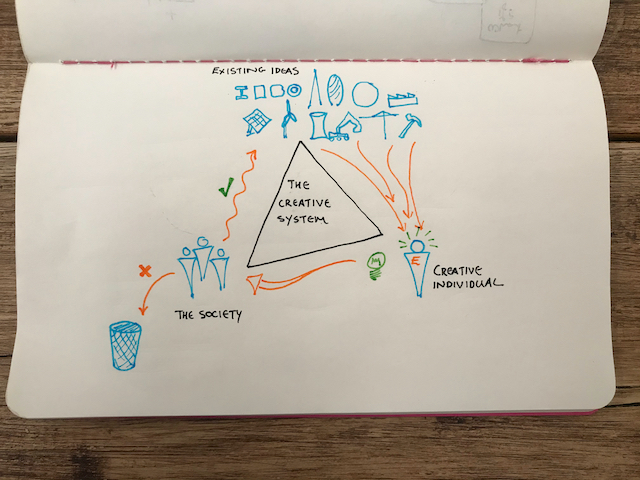
The systems model of creativity contains three elements: the creative individual; the domain, which is the pool of existing ideas; and the field, which is the people who decide whether or not an idea is a good one. Using this model, the individual creates new things by adapting ideas that have gone before (things in the domain). These novel outcomes are then judged to be acceptable or not by a third party (the field), say colleagues, a client, a design jury etc. If the idea is judged to be good then it enters the domain – that is, it becomes recorded somehow and can then become the seed of another idea.
This model is useful from an organisational development perspective because it offers three areas to focus on for stimulating more creative outputs. I have seen that in practise, certainly in engineering, Csikszentmihalyi’s terms ‘domain’ and ‘field’ can be confusing, so I propose ‘database’ and ‘audience’, respectively.
The following is a series of practical suggestions for how to develop each of these components of the creative system in organisations.
Building the creative database
1) Seek out innovation
If you want to your organisation to be at the creative forefront of a particular domain, then make sure your people have ready access to the latest thinking in that domain. Contact with the existing thinking on a topic can promote thinking about the next iteration.
I recently vistied a school where the principal wanted to encourage his staff to start thinking creatively about how to furnish their classrooms. To seed their thinking, he ordered in some innovative new chairs designed to improve the way children study in classrooms. He just put them out in his office. When members of staff asked about them he said try them out. Staff members then started experimenting with these chairs in different configurations. In the end, they ended up using completely different models that they’d researched in configurations that suited their own needs. This creative thought had been stimulated by allowing them to dip their toes into the domain of chair design – which then prompted them to dive in.
2) Become a hub for different ideas and ways of thinking
As Csikszentmihalyi points out in his paper, cities that have been trade hubs have commonly been centres of innovation because ideas and ways of thinking from completely different domains can come together.
Find ways to turn your organisation into a hub for different ways of thinking. Invite people in with completely different backgrounds and areas of expertise to talk about their work, what innovation is in their domain, and how they approach problems. Doing so will widen the available categories in your database from which ideas can be drawn.
3) Record your existing ideas
It’s hard to make a change to something which isn’t already described.
For example, so much of what we do in organisations, particular in knowledge-based organisations, is not written down. Doing so doesn’t feel very creative. But doing so is a necessary starting point for creating new approaches to how we might work.
Recently I was worried that I wasn’t being very imaginative about the way I spent time with my daughter. So I started by writing down all the things that we already do together that we particularly enjoy, and quickly, starting from this list, I was able to create a load of new suggestions.
Get the existing thinking down on paper so that it can seed the next creative iteration.
Building creative individuals
4) Collate
This is about the creative individual engaging with the database; about building a palette from which they can paint their ideas. Song-writers collect lyrics and interesting chord progressions. Chefs collect recipes.
I collect facilitation techniques by always asking people I know after they’ve attended a workshop what techniques they enjoyed. I write them down in Evernote, and refer to this list when I am designing a workshop.
The thing about the process of collation is that it requires attention, more than just a passive engagement with the content. I believe this attention makes it easier to recall useful information in the moment of creation.
Identify the area in which you want to be creative, and build your scrapbook.
5) Create distraction-free time
There are times when we need to focus our attention on generating ideas. There are other times when we let our mind wander, when the subconscious chews on the problem, and then the idea spits up. Both of these thought processes can be jeopardised by distraction. But in the modern workplace, distraction is everywhere: from notifications on every screen we use, to the interruptions that ensue from open-plan offices.
In the coaching conversations I have with people about developing design skills, the lack of distraction-free time is one of the commonest barriers to creative thinking.
For individuals, creating this time has two components. The first is mastering the technological distractions, getting rid of the notifications that keep us flitting from one place to the next. The second component is identifying and persuing activities that let your mind wander.
Organisations that want to create distraction-free time for their staff should consider developing work processes that don’t rely on staff being permanently plugged in. They should also allow their staff to work at the time and places in which they are most creative.
6) Generate and communicate
The creative process works through interaction between the creative individual and the audience. It is a dynamic relationship.
To start with, the individual needs to be creating ideas. There are a range of techniques for stimulating this divergent thinking, which will be the subject of another blog post.
But having the ideas alone is not enough, they need to be effectively communicated to the field. Draw ideas, write them down, pin them up where they will be seen, talk to people about what you are thinking, and you will give your ideas the chance to grow.
Building the creative audience
7) Produce surplus energy
This comes straight from Csikszentmihalyi. If a group of people are spending all their energy fighting for survival then they don’t have the energy for creative activity.
Most organisations could probably prioritise their activities in such a way as to make more energy (time, money) available for creative thinking. Creativity is a social affair: everyone has a role to play, either as the conceiver of ideas, or as the audience. Therefore it is important that everyone feels there is enough fuel in the tank to justify time spent on creative pursuits.
8) Build a culture of listening
It is through dialogue with the relevant audiences that the creative individual can assess the merit of their ideas.
As Nancy Kline describes in her book ‘Time to Think‘, we often do our best thinking in conversation with others, but this requires careful attention on the part of the listener, letting them develop their thoughts without interruption.
Talking about ideas should be a hallmark of creative organisations.
9) Build a culture of challenge
There is a lot of evidence for intrinsic motivation supporting creative thought (a summary of this to come in a future blog post, no doubt).
One way to build intrinsic motivation is through identifying in conversation challenges that need addressing. If the challenge feels like their challenge then they are more likely to be intrinsically motivated towards tackling it.
Another technique for building intrinsic motivation is to challenge individuals to reach further in their thinking, and helping them to remove hurdles which may have been holding them back.
To conclude, creativity doesn’t happen in isolation in people’s heads, it happens in a context. To create more creative organisations, we need to work on the context as well as the individual.
Related posts
-

Hazel vs. Hornbeam (the fate of best-laid plans)

Cutting back the Brambles at Hazel Hill Woods A recent weekend of conservation work Hazel Hill Woods has revealed to me another woodland analogy for the struggles of daily life, and how we might overcome them. I am calling the analogy, Hazel vs. Hornbeam (the Fate of Best-laid plans).
It emerged when a team of us at the woods were cutting back an area of regenerating hornbeam trees in a clearing. In this patch the hornbeam had shot up to a dense crowd of 6ft-tall finger-thick stems, knitted together with a head-height mat of bramble. Our conservation aim had been to cut these back to chest height to stop them from encroaching on an important butterfly corridor through the woods.
As we slowly cut our way into the dense thicket we started to discover small trees in protective tubes that were being crowded out by the hornbeam and strangled by the bramble. As we uncovered more hidden trees in tubes, we realised that there was a whole array of them that had once been planted. We found hazel, oak, ash, holy and blackthorn struggling to grow in their protective tubes. They had been planted on another conservation weekend years ago but had been forgotten about, and were now being smothered by the naturally regenerating growth.
The woodland context
There is a hundred-year plan at Hazel Hill to transform the forest ecosystem from that of a commercial wood, in which just a few species grow, into a much more biodiverse environment, which is much more likely to be resilient to changes in climate. The area in which we were working had previously been occupied by sycamore trees. This undesirable species had been cleared with a grant from the forestry commission, and in the clearing created, a range of broadleaf species had been planted (the hazel, oak and ash), along with shrubs (the holly and the blackthorn) to create ground-level growth, which had been absent in the commercial forest.
Left to its own devices however, naturally regenerating hornbeam and bramble had quickly grown up and overtaken the planted trees. The former were on the way to winning, the battle for light, already killing some of the latter , and leaving the others struggling. In the short-run there is nothing wrong with hornbeam and bramble, but their short-term success was putting at risk the long-term resilience of the wood by preventing the development of a diverse tree species.
Best laid plans
For me, those broadleaf trees in their little tubes represent best laid plans that were being left unattended because of short-term factors. There are competing conservation priorities in the woods, and these planted trees had been left unattended. Our attention is the light that enables our best-laid plans to flourish. But too often we are forced to direct our attention towards short-term priorities: the deadlines that need to be met, the clothes that need to be folded, the colleagues that need to be briefed, the clients that need to be satisfied.
In the short-term these more immediate matters flourish as they benefit from our attention, but they don’t necessarily lead us to where we want to be. As you wade into the thicket of regrowth, all is lush and green at the top, benefiting as it does from the light of the forest clearing, but underneath, all is brown – there is no diversity. Down there is where our best-laid plans languish.
The feeling of being surrounded
At one point, four of us were working simultaneously and in close proximity in the same thicket. Though we were probably only a few metres apart we couldn’t see each other for all the hornbeam branches and briars that surrounded us. At times, our repeated cuts didn’t seem to be making a difference. I’d turn around and the path that I had driven would have closed in behind me.
This is what it can be like when we feel overwhelmed with matters competing for our attention. After some struggling, my strategy became to just to keep going in one direction. After a sustained, focused effort the lattice of branches and brambles would suddenly give way. A sense of being surrounded turned into a sense of direction; of liberation: I felt freer, able to pause and choose where to go next.
Cutting back our brambles
As I type, I still have some small scratches on my arms from cutting back the brambles. Clearing away some of the things which grab our attention can hurt. There is the pain of letting someone down, or the fear of getting into trouble. But what I noticed as I cut through barbed branches was that they fell away to nothing; untangled and trampled they lost all of their strength, freeing a way through to the trees in tubes.

Personal conservation strategies
Conservation work gives you time to think, and so I set my mind to thinking up strategies for protecting our best-laid plans.
Log what you planted
It sounds simple, but creating a map of what trees we planted where might help us to remember to tend to them every so often. During conservation weekends in which we are planting trees, getting the trees in the ground is a big achievement. It seems unnecessary to create a map of where we planted them. Surely we won’t forget? Inevitably we do. Simply noting down our plans gives us a fighting chance of remembering what we intended.
Regular tending
Once we know what we planted, one strategy is to make time to regularly tend our saplings. It would only take a small amount of systematic attention to keep the hornbeam and brambles in these area in check.
Occasional clearouts
Sometimes though, we don’t have the luxury of being able to provide these things with regular attention. The alternative is to do what we did this weekend – every so often, go in there and cut back all the distractions and bathe our best laid plans with the totality of our attention. In daily life this might amount to a digital detox. Or, for a more substantial clear out, we might consider taking what Daniel Pink calls ‘Sagmeisters’ – regular sabbaticals interspersed in our working lives.
Get real
Our aim wasn’t to clear out all the hornbeam and bramble. Hornbeam regeneration is a natural part of the woodland ecosystem, as are the brambles that weave their way amongst them. We just need to create a bit of space for those slower-growing but ultimately very beneficial species to establish themselves. Similarly, short-term matters are part of the humdrum of daily life – we just need to carve out enough time to give our long-term plans the attention they deserve.
Get things established
Ocourse, the aim of all this cutting back is to enable the hazel, ash, oak, holly and blackthorn to establish themselves. As they start to mature they can look after themselves, and the hornbeam and brambles will subside. This is the point that Steven Covey makes in his book ‘The Seven Habits of Highly Successful People’ when he talks about what happens when we prioritise the important over the urgent. If we make time for the important things, we should see the number of urgent things we need to deal with reduce.
One day, decades after the scratches on my arms have healed, we’ll be able to sit under the shade of these broadleaf trees and know that our efforts to tend to them were worth it.
-

Does going for a walk improve design?

Taking a walk at Port Eliot Festival I have just read an interesting piece on the Stanford university website, ‘Stanford study finds walking improves creativity’ (article found via this news piece on the Hazel Hill Wood website). The article describes research that has for the first time investigated the impact of ‘non-aerobic walking on the simultaneous creative generation of new ideas and then compared it against sitting’. I had an intuitive idea that going for a walk improves the quality of my ideas – an example that springs to mind is a catchy tune I wrote on short walk back from the library at college. This research shows that ‘creativity levels were consistently and significantly higher for those walking compared to those sitting.’ What’s more, they stayed high for a short period after sitting back down again.
But the striking thing revealed by this research is that the walking environment doesn’t seem to make a difference. I had assumed that going for a walk outdoors in the woods would be good for my creative thinking, but this study shows that the boost to creative thinking is just as powerful when you take a walk on a treadmill in a featureless indoor room!
This result has obvious implications for how we set ourselves up to do good design, but there is another significant finding reported further down in this news article that also has important implications for design. While walking helps to boost divergent thinking, it is shown in this study to impede ‘more focussed thinking, characteristic of insight’.
So how can we use these findings when think about how we do design work?
In the design training that we have been developing at Think Up, we describe design as a process that starts with identifying a need and establishing a brief, that moves through idea generation and testing, and moves on to choosing the best ideas. These stages are linked by iterative loops which take you back through the process many times.
The obvious place for divergent thinking is in the idea generation phase, but there are others. Right at the start when we are identifying the need, we often need to think around the problem to check if it has been framed properly. We also need to have an open-minded view of the client brief if we are to unpick the unwritten and implied elements of what the client wants. We also need to apply some divergent thinking to enable us to think of all the factors that are going to determine whether our ideas are good ones, rather than simply relying on the usual tests we apply.
There is also an obvious place for convergent thinking: at the part of the design process where we are refining our ideas, and when we are testing them for adequacy against the brief. But there are other places where we need insight: when we are trying to choose the factors in the brief that are going to dominate the design; and when we are trying to make a decision based on hard-to-compare factors.
So there is a place for walking and a place for sitting in design.
Unfortunately, from what I have observed in design offices, we tend to do too little of the latter and not enough of the former. What we could learn from this research is to be more mindful of the type of thinking that is required at any one time and to move or stay still as appropriate.
We should also beware of metaphorical trip hazards. There’s no use in going for a divergent thinking walk if we are distracted by our smart phone en route. Turn it off! And our creative reverie stands a good chance of being extinguished if when we return to our desks we find a set of monthly sales figures demanding our attention. In other words it is probably a good idea to think about that environment you will be returning to at the end of your walk.
Related posts
- Designers – turn off your mobile phone and harness the wandering mind
- What makes a good conceptual design statement?
- Taking inspiration from Jackson Pollock
-

Choppin’, loppin’, circus and swing – notes from Hazel Hill Autumn Conservation weekend 2015
Last weekend 38 people came down to Hazel Hill for our annual Autumn Conservation weekend for two days of woodland conservation and human restoration. We design the weekend to be a mixture of invigorating outdoor conservation work and relaxation in the woods, with a dose of entertainment thrown in too.
Building on what we learnt from last year, we began the conservation work on the Saturday with a series of activities that would make an immediate and visible difference in the woods. An on-going conservation priority at Hazel Hill is the creation of butterfly rides, which serve two purposes. The first is to create the sort of wide path through the woods that enable the many rare species of butterflies that inhabit the surrounding fields to pass freely through the foerst. The second is to allow light in to the lower levels of the wood in order to increase the biodiversity.

Widened butterfly ride leading to the Forest Ark This year we began our work by significantly widening the ride that runs from the forest ark to the southern cross, which had become significantly encroached upon by regenerating hornbeam. In the process we uncovered and liberated around twenty-five broadleaf trees in tubes that had previously been planted and which were being smothered by the hornbeam. I remember planting some of these trees myself on my first conservation weekend six years ago, and so I am pleased to see them being rescued. Any of this weekend’s participants returning to this spot in the wood in ten years time are now much more likely to find ash, oak and hazel trees maturing, thanks largely to their work this weekend.
-

Designers: turn off your phone – harness the wandering mind

Fireside reflection at Hazel Hill wood. Photographer: Peter Clarkson I recently read Daniel Goleman’s excellent book Focus, and I have been thinking about how our ability to focus affects our ability to design. This thinking was the basis of a workshop session that I recently wrote about harnessing ‘wandering mind’, that mode in which the brain roams freely and forms new associations which are the basis of creative thought. I piloted this material as part of Think Up workshop on creativity that we ran at Hazel Hill wood in July, which seemed to go down well, so I am sharing it here.
Below is a modified extract from some of the course materials associated with this activity. I’d be interested to know if anyone reading recognises these phenomena or tries the approach I am recommending.
In his book Focus, emotional intelligence pioneer Daniel Goleman explains that the brain can really be understood as having two distinct sets of circuitry: the lower brain and upper brain. The lower brain whirs away in the background working on solving problems without us even noticing. Its activity only comes to our attention when it produces an idea as if from nowhere. The upper brain by contrast is the seat of self-control and is the part of the brain that we actively focus on a problem.
In evolutionary terms, the lower brain is the older part. The lower brain is the source of our impulses and emotional reactions. The upper brain can repress these impulses, but at the cost of diverting our attention from the design challenge on which we want to actively direct our focus. In this instance, the lower brain circuitry is causing a hindrance to creative thinking.
However, the lower brain does have a crucially important role to play in design. Research shows that in the moments before people achieve creative insight, their lower brain has been in a state of open awareness. In this state, the mind wanders freely, widely and without judgment to create new associations. When these new associations are made, the upper brain then locks in on them and fishes them out into our active attention.
In order to harness our wandering minds as part of the design process, our upper brain needs to be ready to spot a good idea when it emerges. To do this we need to do two things. The first is to make time in which we stop actively thinking about things and let out thoughts come to us, for example, going for walk or even going on holiday. The second is to minimise distractions, which divert our active attention away from spotting new ideas as they emerge from the lower brain. In other words, making time we when turn off our smart phones and blocking out interruptions.
-

Are you doing a French Mazurka?
I’m writing this on the train home from Towersey Festival to which I had been invited by my friends Nat and Sophie to help out with some swing teaching and performing for the Shooting Roots line-up. Towersey was my introduction to folk festivals, and it felt like a gateway to a fascinating world of music and dancing to discover. Nat and I were there to teach a 1 hour Lindy hop class and to do some dancing with a band in the evening (see the gig notes below for info).
Towersey felt quite unlike any festival I’d been to before, and I think the main difference is the way in which people are engaged with the music and dance that is being performed. The crowds are attentive; they really listened in our lesson; they were really paying attention in the band performances. People are having a great time but there is none of the rowdiness, (except for being kept awake by a choir singing in four part harmony at 1am in the campsite). I love the way people carry around instruments, and there is space for people to jam. There was also the largest selection of real ales I’ve seen at any festival. And what’s more people walk around with their own tankards, which as far as I’m concerned is the best way yet to reducing festival waste.
-

What makes a good conceptual design statement? – working notes
Today I am working on course material related to defining what is a good conceptual design. I think, in construction at least, it is quite difficult to identify good conceptual design from the finished project. One can judge a finished project on the basis of the final outcome, but unless you have had an overview of the whole design process, it is hard to know how much the final project resembles the original concept design.One clue is in competition sketches, if they are available. It is tempting to suggest that if a simple early-stage sketch exists that closely resembles the final project, then we have a good conceptual design. Good examples might include Paxton’s sketches on a napkin for Crystal Palace or the Utzon’s competition sketches for the Sydney Opera House. But (and I’m not suggesting it was the case for these two examples) it is not beyond designers to create a post-rationalised concept diagram. And while this idea of the simple sketch is also beguiling, it is much more appropriate for projects that resemble a sculpted object, rather than a complex system.From a training perspective, if we were to stand in front of a building and seek to judge the quality of the conceptual design without knowledge of the early-stage design process, I think we’d be on shaky ground. The approach we will adopt instead is to spend time defining what a good conceptual design statement looks like so that designers can judge the quality of their conceptual designs at the start of the project.There are lots of definitions of what a good conceptual design statement is. My colleague Ed McCann has pointed me towards a helpful description from the world of interior fit out. In his book Shaping Interior Space, Rengel describes the three elements of a good conceptual design statement as:1. Talking more about the solution than the problemThe place for the statement of the problem is in the brief.2. SelectiveHere he means it talking about the dominant factor which is going to define the design approach. Is it a question of how a long span is going to be achieved, huge forces are going to be resisted, or what the human experience is.3. EconomicalCareful use of words to pack the most into the fewest words.These three elements are something I can work on with a group of learners. We might begin by asking them to compare different conceptual design statements, and get them to elucidate these rules; and then get them to create their own statements.One key modification I will make to this set of rules to make them equally applicable to sketching as to words.If you are reading this and have either your own definition of good conceptual design statements that you use, or particularly good examples of conceptual design that you’d like to share, then please comment below. -

Workshop inspiration from Jackson Pollock
Today I went on a recce to the Tate Liverpool for a course we are designing at Think Up for a client. As I left the event hosting space I was left to wander the Jackson Pollock exhibition. The show will still be running when we hold our event, which great because I can see three ways in which this exhibition can be used to support the learning on our course.1. Working with the subconscious
One of the features of the model of idea generation that I will be introducing is the important role of the subconscious in creativity. In Daniel Goleman‘s book Focus, he describes (more elegantly than I am doing here) how the ‘active’ brain is always on the lookout for useful stuff that the wandering brain generates. On this theme, I picked up some useful quotes from the exhibition notes:‘Pollock’s aim to work directly from the subconscious led to a radical process of dripping and pouring paint over large canvasses placed flat on the studio floor…”the modern artist…is working and expressing an inner world – in other words expressing te energy, the motion, and other inner forces.”Then, this from another section:‘Although there was an element of chance Pollock frequently spoke of the importance of decisions over the merely accidental.’My intention is to use Pollock’s work to emphasise the link between the conscious and subconscious in creative work.2. Relating to your audience
Engineers often have to communicate ideas to audiences with different value sets. One place where there is commonly a clash of values is around aesthetics. Engineers typically get little training in aesthetics, compared, say, to architects. Therefore it is unsurprising that engineers can find themselves cut out of such conversations with the client when an architect is at the table. In the course that we are creating, we are not trying to run training on aesthetic appreciation, but simply intending to make the point that you need to understand the perspective of the audience you are dealing with.To help make this point, I think there is a role-play example that we can create that involves Pollock’s work, given the bumpy relationship he had with his audiences. One idea might be to get engineers to take on the role of Pollock’s agent, and to get them to persuade a critical viewer of the merits of his work.3. Thinking Hard
Pollock reflects that ‘his new works require a lot from the viewer’. I find this exhibiton forces me to think hard, and not merely to engage with the surface, and I think the same can be said of good creative thinking. You need to think hard.To conclude, as ever, I’ll have to see if there’s time in the programme to fit in these ideas. I hope that there is. -

Follow the deer tracks, who knows where they’ll lead
Every time I go to the woods I find new insight or inspiration that I can use in my teaching. Today’s comes from deer tracks.
I know the main tracks that criss cross Hazel Hill Wood well. I could probably draw a reasonably accurate map of the place from memory. In a sense, I’m a bit sad that as I have got to know the wood better, I don’t get lost there any more.
But there’s a whole different level on which the wood can be explored, and on which I can lose myself. If you pay attention as you wander down any of the main tracks, you’ll see thin paths going off into the undergrowth. They are easy to miss at first because no sooner than they are off the main path they dive off under low branches. These are in fact deer tracks, and they criss-cross the wood on a different plane – about two feet high. When you start to look for them you’ll spot them everywhere.
For me these deer tracks are an invitation to go off track, to go into the unknown and see to where you end up.
I followed such a track this morning and it led me through dark pine trees and then suddenly I was into a patch of widely-spaced silver birch pushing up through a carpet of lush muss. The place had a sort of magical green light. I had been to this place once before but would not have known how to find it.
To follow deer tracks you have to go off course, you have to pay attention – it’s not the easiest path. The tracks take you via unknown, sometimes-secret places, and bring by new routes to places you already know. And because the journey is different, the destination is not the same.
-

Teaching le Charleston Stroll – the Port Sainte Marie Method
Teaching the Charleston Stroll has become the mainstay of the Mudflappers’ festival swing dance teaching. I think there’s three reasons why it is so popular with crowds: the footwork is easy to pick up, which means that people can quickly overcome their fear of not being able to dance; the fantastic feeling you get from being in a large group of people all moving in sync with each other and the music; and finally there’s the snowball effect whereby a group of people dancing together keeps drawing more and more people in.
This year, the Mudflappers performed in the village of Port Sainte Marie in the south-west of France as part of the country’s national Fete de la Musique. We had already performed four routines and the crowd wanted a lesson. Le Charleston Stroll was the obvious choice. But rather than teach the usual set of variations (fearing being incomprehensible after one-too-many peach juice-infused presssions) we came up with a cunning teaching method. We prominently stationed one Mudflapper on each of the four corners of the crowd, standing on, say, a bench. The crowd did the basic routine facing me and then turned to face the bank, where that Mudflapper would do a variation and everyone would copy. They would then turn to face the town hall where another dancer demoed another variation, and so on, until we faced the front again. Holding the microphone, all I had to do was shout, ‘vers la banque’, ‘vers la mairie’, ‘vers la route’ and ‘vers la Garonne’ – using my best beginner French.
And it worked. At 11:30pm in the heart of a sleepy French village in which in all my life I have never seen more than four people congregate, we had 50-odd people doing the Charleston Stroll. The Port Sainte Marie technique as it will henceforth be called is now standard issue in the Mudflappers manual – coming soon to a festival/soirée musicale near you.
-

Reflections on video selfie training
Yesterday at Think Up I ran a workshop training engineers in how to use selfie movies to tell communicate to people about engineering. The aim of the workshop was to inspire and give the participants the skills to use video as a medium to share interesting engineering stories. The attendees were a group of engineering students from UCL and Imperial and a couple of graduate engineers from Expedition Engineering.
The content I had to deliver was in two parts: the technical skills – talking to camera, framing the shot, etc; and storytelling – figuring out what to say.

In my experience people are nervous to talk to camera, so I kicked off the workshop with asking people to film a selfie introducing themselves and sharing two surprising facts about themselves. It turned out to be a great way to kick off the exercise. I think it worked because people had to confront their fears straight away. We used these examples as a context for talking about what makes a good selfie. I then showed them a selfie I had made that morning, and asked them what was good and bad about it (below).
We then moved on to storytelling. I had thought that the participants would find the storytelling easier than the technical material, but it was the contrary. I asked individuals to think of a subject that they are passionate about, and to find one particular intriguing aspect of that subject that could form the kernel of their story. That bit was mostly easy, the challenge was finding the language that helped weave a compelling yarn. In the end the way round this was for me to suggest linking phrases or expressions and to show them how they could be used, and then for the individuals to weave those phrases into their stories.
The impact was stark: once they had a compelling story to tell, and they knew how to say it, even the least confident sounded a lot more confident on camera.
In the end I saw some really quite moving videos being produced. As homework I asked the participants to polish their performances and upload a video to the Think Up Facebook page. I’ll have more to write on this depending on whether they do or don’t post anything!
There are some important things that I take away from delivering this workshop:-
- This is another reminder that there is no substitute in learning for getting people to do. Forcing the participants to make a film straightaway was probably scary for most, but once they were ‘doing’ it was easier to talk about how to do it better. I had a similar experience in a communications workshop I ran last week on difficult conversations in engineering projects. We talked about the ideas, but it was only when I forced participants to role-play the scenarios (which they seemed reluctant to do at first) that the learning really seemed to sink in.
- I haven’t previously appreciated the value of good storytelling, though many of the people I work with do. Perhaps because it is something I think I’m good at, I don’t recognise how other people find it a challenge. This is a theme that I would like to develop in more training for engineers.
- This event was about confidence building, and I used a lot of the confidence building techniques I know from swing dance teaching – lots of applause for one-another’s efforts; keeping the momentum up and the tone positive – and it seemed to pay off.
-

Notes on ‘Teaching Design in the first years of a traditional mechanical engineering degree: methods, issues and future perspectives’
From the latest edition of the European Journal of Engineering Education (Vol 40 (1)) I have just read the very interesting paper ‘Teaching Design in the first years of a traditional mechanical engineering degree: methods, issues and future perspectives’ by Silva, Fontul and Henriques. This blog is to capture my thoughts.I am conscious that while I and my colleagues at Think Up have been involved for many years now in changing the way design is taught in civil engineering degree courses, we have written relatively little on what we have been up to. This paper is a good introduction to some the issues associated with integrating design teaching into the first year of mechanical engineering degree courses. It offers some parallels to civil engineering teaching (I will look in due course for papers directly related to civil engineering)The authors describe how mechanical engineering is traditionally taught through a series of separate courses with little cross-over and little opportunity for interdisciplinary design and open-ended problem solving. They describe a pilot project in which a design project is spread across three early modules in the course. Briefly, during two modules on technical drawing students design a simple innovative product, and create a prototype; and then in a subsequent course on materials they have to choose a material to manufacture it from. Some of the benefits are that learning is massively enhanced because students have to build something. Students learnt that iteration is a necessary and valuable process and not an admission of failure. And interestingly, students become aware of what they don’t know, which motivates them to learn in later courses. One of the challenges that this form of teaching throws up is that it takes much longer to facilitate.Reflections on relevance to civil engineering teaching- I haven’t yet seen a survey on how design is taught on civil engineering courses, but I have a reasonable idea. For the last ten years or so design has become a feature of most courses; however it seems often to exist as a stand-alone module at the end of the year, or a task within a module, tackled from the perspective of that course only. The innovation here is that one design project is taken as the common thread across three separate courses. During each course that design project is tackled from the perspective of that course but due attention needs to be given to the perspectives adopted by the other disciplines of the other courses. A parallel in civil engineering would be for instances to spread a hydroelectric dam design project across a geomatics, fluid mechanics and geotechnics course.
- The challenge with teaching design in civil engineering is that it is difficult to build what students design at a meaningful scale. I haven’t yet found the answer to this, but it regularly occupies my thoughts. It is possible at an elemental scale, for instance Ahmer Wadee’s plate girder make and break course at Imperial College; but harder at a greater scale. The Constructionarium is an example of a place where students get to build civil engineering structures at a meaningful scale, but students don’t get the chance to design what they are building.
- In the report which we wrote on experinece-led learning we strongly advocated taking an approach in which students try to define what knowledge they would need to know in order to become a professional engineer. As my experience with Engineering Knowledge Club has shown , the process needs a lot of facilitated discussion as students initially have very little idea of what information they need. Reading this paper it seems that setting a design project early in the course might be an alternative way of meeting this aim.
- I have previously written that interdisciplinary working is a skill that supports sustainable design, and this paper reminds me that interdisciplinary working can of course be achieved by running an interdisciplinary design course.
- The authors note that this type of project takes time. In my seminars with lecturers in civil engineering departments this factor is a common complaint. My response is that we have to look at course content and evaluate what is more important, the ability to solve open-ended problems and design more effectively, the skill which industry is looking for, or the mastery of specific technical skills to a high level, often higher than what is needed for practice.
The paper also points to a number of other publications that I want to check out. In particular:- Dym et al (2005) Engineering Design Thinking, Teaching and Learning – Journal of Engineering Education – A summary of designing thinking, teaching and learning, including an analysis of first-year cornerstone design courses and curriculum dispersed design courses.
- Marra, Palmer and Litzinger (2000) – The Effects of a First Year Engineering Design Course on Student Intellectual Development as Measured by the Perry Scheme – 2000 – Journal of Engineering Education.
- Haungs et al – 2001 – “Improving Engineering Education through Creativity, Collaboration and Context in a First Year Course” – ASEE Annual Conference & Exposition, Pittsburgh PA – Three major factors influencing negatively affecting creativity and retention rates in first year students:
- 1) hard for students to see how course material relates to real-world applications
- 2) students perceive engineering as an individual endeavour rather than an activity with peers
- 3) engineering assignments are overly constrained
- Bedard – 1999 – advocates a hands-onapproach to promote creativity in engineering education despite the risk of developing a reflex that trial and error can solve most problems and reduce student respect for the analytical component of engineering.
- “Enhancing Student Creativity and Respect for the Linkages between analysis and design in a first year engineering course.
- Hargreaves (2008) – Inherent balance between exposing students to challenge, and thus risk, and current higher education models of quality assurance that are risk-averse and thus potentially limit the scope of creative learning and teaching strategies.
- Meinel and Leifer 2011 – “Design Thinking: Understand – Improve – Apply. Berlin: Springer.- report on the HPI-Stanford Design Thinking Research Programme where students are taught the basic rules of design.
- Hirsch et al (2001) – “Engineering Design and Communication – the case for interdisciplinary collaboration” – International Journal of Engineering Education 2001 – How teaching design and communication at the same can enhance the students’ ability to tackle future engineering courses and career.
-

A systems engineering approach to parenting
In 2012, as I was preparing to begin my parental leave, one of my colleagues told me about an engineer he knew in New Zealand who quit their job in order to become a full-time parent. As the story goes, within a few months that engineer had all the household systems optimised freeing up lots of time to play golf. Now, knowing very little about the circumstances of the parent in question, their parenting style or their support network, so I took the story with a pinch of salt, but it did plant the seed of the idea in mind that all those processes and routines that make a household tick can be thought of as a series of systems which can be optimised.
One of the big changes I’ve noticed in becoming a parent is a shift in mindset from one in which it is possible to complete a task and move on to the next, to one in which you are constantly in the middle of getting lots of things done. The GANTT chart for being a parent would show a series of overlapping tasks that repeat for years at time within a programme time-frame that lasts around twenty. You are always planning the next thing, or two things ahead, at the same time as clearing up the last.
It is a paradigm shift. You are constantly in operational mode, with very little downtime – tiny variances can cause the system to wobble; winter vomiting bugs can send the plant into meltdown – but you do have some freedom in how you operate that system. And that is what the engineer in me muses on, usually when doing the washing up or hanging out wet nappies. Of course any optimisation process requires a target variable to minimise or maximise. It is tempting to assume, as the anecdote above implies, that target variable should be free time; however I think that fulfilment is a better thing to aim for, because there is plenty in parenting that is enjoyable. The system optimisation should take things that are unenjoyable and either reduce time spent on them, or make them more enjoyable. The system optimisation should also increase time spent on more fulfilling tasks.
In short becoming a parent replaces unstructured time with routine. The aim is to make that routine as enjoyable as possible for you, and to make it resilient enough so that you can every so often throw it to the wall and go to the seaside for the day. Now before I go any further, I don’t mean to say that our system is fully optimised, although I think we are doing ok! But I do want to chalk up a minor victory today, which has prompted me to write this post.
Monday is washday
I noticed a few months back that we were always doing washing. There was always some to wash; some to hang out on the line; some to bring in; some to put away. So, wearing my systems hard hat a few months ago, I decided I would try and crack this nut. Here are the parameters:
- The volume flow-rate is about five washing machine loads per week, sometimes six depending on the number of nappies we use.
- The fixed time factor is the wash time, roughly 2 hours per load.
- Drying time is a variable factor, especially if we put it on the washing line. In the summer washing can be dried in an afternoon, in the winter it can take a few days, or may never dry at all. Then there is the hanging out time, which is enjoyable in the summer, but less so in the winter, in the dark.
I’m a firm believer in batching things to do them more efficiently, so I decided that my Mondays at home with my daughter would become wash day. The idea was to line up all the loads of washing back-to-back in the washing machine, with no downtime between loads, and then to take the whole lot to the launderette for drying in the winter. In the summer there will be a washing line version of this plan.
While the washing bit works fine, the plan throws up a considerable transport challenge: how to get five loads of washing to and from the launderette with a toddler in tow at about 5pm when the clock is ticking before bedtime. I’ve been struggling to overcome this challenge for weeks now, and not for want of trying different approaches:
- I’ve tried waddling down the road with two laden Ikea bags and a pushchair but the bags are so heavy that this is actually quite painful. A few weeks ago one of the bags split spilling clean washing onto the wet pavement. Sub-optimal.
- I’ve strapped my daughter into the bike trailer and piled washing up around her, but the capacity is quite limited, so it defeats the object (but she loves being surrounded by warm washing on the way home)
- Rather than using a push chair, I’ve tried tried to let the little one go by scooter, with me following behind with my laden bags, but the little bean is so slow on her three-wheeled mobile that it took us an age to get there and I had to completely abandon dinner at home and get a pizza next to the launderette.
- My most extravagant approach: to load all the washing up in the trailer, to attach a separate bike seat to my bike to carry S, and then for us to set off like a mighty laundry tractor trailer down the streets of Highbury. It was fun but it took ages to set up, lock up, unlock, reload and come home.
Then, the solution emerged in two parts. One of the stressful bits is doing all of this to-ing and fro-ing close to the little one’s bedtime. So now I do all the washing on Sunday night and early Monday morning so that we can take it up around 10am. While it is whirling round and round we go off to a music session in Finsbury Park. When the music’s done, the washing is dry.
But the real winner came today when I brought an old shopping caddy into my service. I can just about bag up all the washing and fix it to the caddy with bungees. It is then a doddle to push the pushchair with one hand, and tow the trailer with the other.
So, system improved, which means I’ve got a little more time to spend doing things like writing blog posts.
Related posts