Blog

  • Connection with nature through drawing

    Connection with nature through drawing

    I drew this ash tree at Hazel Hill Wood last weekend. Though it rises opposite a bench where I like to have a morning coffee, I have never paid it much attention. But doing a twenty-minute sketch I am discovering the tree. Climbing the trunk that rises without foothold for a third of its height. Noticing for the first time its rhythm – the trees spatial ordering. How one trunk becomes a thousand twigs, like a trachea transitioning to countless alveoli.

    As I draw I see a space in the canopy to the left, one that I would not have noticed otherwise. I presume it is a space left by another tree that is now fallen, on the ground but leaving its imprint in the sky.

    (more…)
  • Fear holds back my imagination

    Fear holds back my imagination

    I had a revelation this morning as I walked down the hill to the newsagent: fear holds back my imagination. A fear of imagining the impossible; fear of saying, hey I want this wonderful thing and other people laughing. It was a meta-level realisation of the lid that fear was putting on my imagination.

    (more…)
  • Why isn’t Lands End called Lands Start? – parenting with the weather pages

    Why isn’t Lands End called Lands Start? – parenting with the weather pages

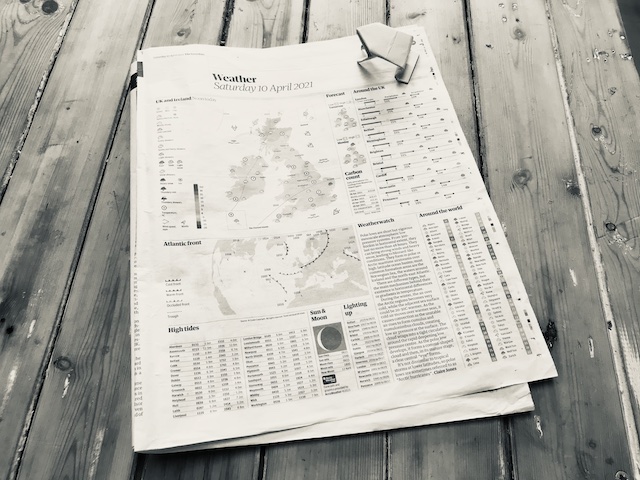
    From hospital waiting rooms to long-distance train journeys, the weather page is a great conversation starter for my daughter and me, full of questions about geography, mathematics, history, about language…

    (more…)
  • Planting parking spaces is a dismal affair

    Planting parking spaces is a dismal affair

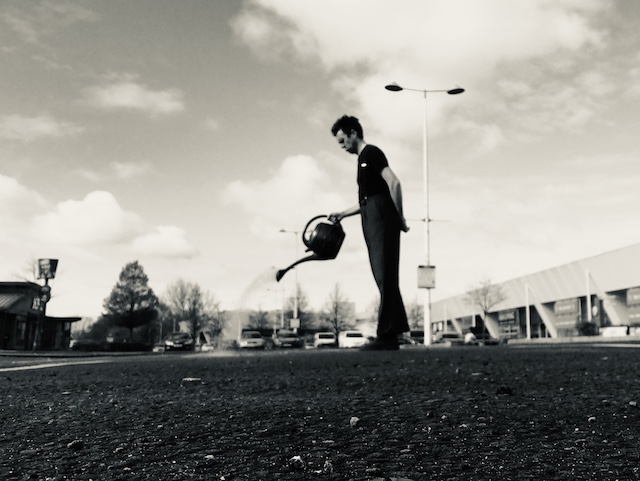
    Planting parking spaces is a dismal affair.

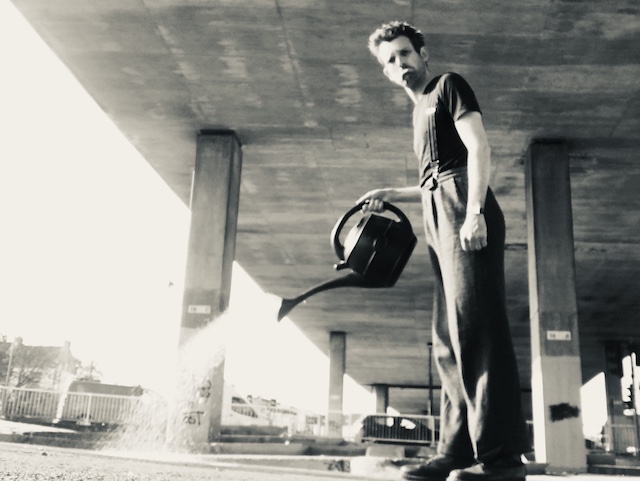
    When you water them, the water just drains away.

    The rich soil underneath is capped.

    Parking spaces don’t flower; don’t make nectar, don’t produce fruit that we can eat.

    Insects stay away; birds fly over.

    Never do they grow, rise up from the ground, spread their branches to oxygenate the air.

    No one returns in 30 years time and says I planted that parking space.

    No generation thanked the last for planting more.

    (more…)
  • Questions to ask your colleagues in the biodiversity emergency

    Questions to ask your colleagues in the biodiversity emergency

    The biodiversity emergency requires us to change how we value and relate to the ecosystems that support us.

    Values shift when we change our habits. Habits are the rituals and routines that form part of an organisation’s culture. Work the habits to shift the culture.

    We see it in Toyota’s Improvement Kata, which uses habit to reinforce behaviours around improvement, adaptation and innovation. We see it in the ‘safe-start’ procedure used for meetings in safety-critical industries.

    And so I’m wondering what might be questions that we might routinely ask each other of our projects in organisations that have declared a biodiversity emergency?

    (more…)
  • Will you always own a car?

    Will you always own a car?

    By asking this question I make a choice about where the centre ground is. By framing the question I put the position ‘I will always own a car’ at the extreme. At the other extreme is ‘I will never own a car’.

    The middle ground becomes some partial version of car ownership. I will own a car for a bit. I’ll think about selling it in a few years. Maybe, I will own my car with other people . I will join a car club.

    Given what we know about air pollution, the contribution private transport makes to carbon emissions, the number of people killed each year by cars, and the damage caused to our communities by busy roads, why is private car ownership still considered the norm?

    (more…)
  • Rethinking our relationship with our ecosystem

    Yesterday I was writing about what to do after declaring a biodiversity emergency. My conclusions was that the process starts with rethinking our relationship to our ecosystem. Not how can we do something to our ecosystem but how can we work with it. Today I want to get into more ways that we can achieve this shift in the way we think.

    (more…)
  • What to do after declaring a biodiversity emergency

    Many people I am speaking to are wondering what to do about the biodiversity emergency. The climate emergency has felt easier to understand. Crudely, we need to achieve net zero carbon emissions very quickly. Carbon gives us a variable that we can work with. After declaring a climate emergency, engineering firms have occupied themselves with minimising carbon. But what to do after declaring a biodiversity emergency?

    (more…)
  • What if we had a seasonally adjusted workweek?

    This week I wrote about observing the seasons and how these might cause us to reflect on the patterns we adopt in our lives. Yesterday, I was exploring the idea of the pattern of the workweek as a cultural phenomenon. Today I’m exploring the idea of a seasonally adjusted workweek, and how this might help us understand the ecological crisis.

    (more…)
  • The working week as a cultural phenomenon

    The working week as a cultural phenomenon

    As someone who runs their own small business, I have to figure out how to work with fluctuating levels of client work. There are times when there is more to do and I have to put in the extra hours, and others when there is down time.

    I’m a stronger believer in avoiding work for work’s sake. There is the work that needs to be done: work in the home; paid work; work in the community. But then it is important to rest, to find balance, to find joy outside work.

    But if your rest time corresponds with when everyone else is working, I find it feels very difficult not to feel like you should be doing something.

    (more…)
  • Inspiration from balance : when the day = night

    Inspiration from balance : when the day = night

    This week day equalled night.

    I see the seasons as sine and cosine waves. Peaks and troughs for different phenomena offset from one another.

    At the summer solstice, the hours of day light peak, but the rate of change of day light is zero. Nothing much seems to change.

    At this time of year the hours of daylight are only half way between their winter and summer extremes, but the rate of change is at its maximum.

    For an instant everything is in balance, when day equals night. But there is no pause. This is also the time of maximum change. We are now moving away from balance at the highest rate of the year.

    Close up it is moving rapidly but taking the longview there is dynamic equilibrium.

    I find lots I can draw inspiration from in my creative and design work at this time of year.

    (more…)
  • Turning the brief into requirements we can test

    In my last post I asked how do I know if my ideas are any good? My answer was that a good idea is one that meets the requirements of the brief. In this post I turning the brief into requirements we can test – and how the process can be surprisingly creative.

    (more…)
  • How do I know if my ideas are any good?

    How do I know if my ideas are any good?

    It’s a simple question. When I ask people what they want to get out of a training course with me on design or creativity, a common answer is ‘greater confidence that my ideas are good’. But how do I know if my ideas are any good? In this post I provide an answer that is simple, but that has deeper consequences.

    (more…)
  • The Structural Elements Song

    Inspired by Tom Lehrer’s The Elements, I wrote the Structural Elements Song to be an itinerary to an educational world tour of structural form. Like The Elements, it is set to the tune of a Modern Major General by Gilbert and Sullivan.

    (more…)
  • From would you think to what do you think – avoiding hypothetical feedback

    Today I’m sharing a principle of workshop design about how we gather feedback in workshops. But the principle also applies more widely to how we get feedback in design.

    (more…)
  • What is conceptual design?

    What is conceptual design?

    This post has moved and along with my other conceptual design teaching tools is now hosted on the Constructivist website here.

  • How describing design as a process helps teach design

    How describing design as a process helps teach design

    This post has moved and along with my other conceptual design teaching tools is now hosted on the Constructivist website here.

  • The Designer’s Paradox – the key to unlocking the brief

    The Designer’s Paradox – the key to unlocking the brief

    For me the Designer’s Paradox is a key concept in helping people understand what the process of design is. The term was coined by my colleague at Think Up Ed McCann.

    The Designer’s Paradox states that the client doesn’t know what they want until they know what they can have

    Ed McCann – see Think Up (2018). Conceptual Design for Structural Engineers (online) – notes and resources. Available here [Accessed: January 2021].

    In this post I’ll explain why I think this observation is so useful and how we can use it.

    (more…)
  • Thinking book mark: handedness

    One way I use this blog is a jotter for ideas that I’m mulling over and discussing. By having all these musings in one place, I’m creating a sort of written Kalideascope. This weekend I’ve been thinking a lot about left-handedness.

    (more…)
  • Ticket to ride winning strategies – weekend engineering works

    This week’s Weekend Engineering Works post is about Ticket to Ride winning strategies. The game involves racing against other players to build a network of railway lines across different counties and continents. What I find exciting about the game is the recreation of an age of bold and adventurous engineering: the railway era. I particular enjoy building routes that I have travelled down in real life. But what I enjoy most is dreaming up winning strategies, and then testing them out.

    In this post I describe my few of my more successful Ticket to Ride wining strategies. Alongside, as you might expect from this blog, I’ve also provided some wider musings on their philosophical implications.

    (more…)
  • Oliver’s Mantra for Facilitation

    The facilitator comes with nothing and leaves nothing

    The participant comes with something and leaves with much more

    Oliver Broadbent
    (more…)
  • How do you know if your idea is any good?

    I regularly ask this question on my ‘How to Have Better Ideas’ workshops (the sequel to ‘How to Have Ideas’). It’s a short question that triggers a wide range of answers. But the one I am looking for is this:

    ‘A good idea is one that meets the brief’

    My aim is marrying up the brief and the idea. I want to emphasise that the two should match. If the idea doesn’t meet the brief, then we have three consequences:

    (more…)
  • The email that knocks out creative surplus

    You are in a state of flow. The next action flows from the previous. You are in the moment. Then boom, in comes an email that sets off a chain reaction of anxiety and worry. At least that’s what just happened to me. Your creative surplus – time and attention – gets burned on managing your personal response to that email. You are back to zero. What do you do next?

    (more…)
  • Merely create something today instead of worrying

    Merely create something today instead of worrying

    When then there’s too much going on to do your creative work then merely create something. I picked up this term ‘merely’ concept from Seth Godin in this interview with Tim Ferris.

    Sometimes not doing something takes up more effort than quickly doing it. As Godin explains, there’s a voice that says what we might produce might not be good enough. We spend time and direct our attention towards worrying about not being able to do something good.

    (more…)
  • Apply the OOOOOO

    In my second post on building creative surplus – the time and energy we need to invest in creative thinking – I describe the OOOOOO, an approach for overcoming organisational overwhelm and takes away our creative time,

    (more…)
  • Creative surplus and how to get some

    Creative surplus is what you invest in order to create new ideas. Like operating surplus – or profit – it is what is left over when an organisation or individual’s basic operating needs are met, which is available to invest in growth of the next project. Rather than pounds and resources, creative surplus is the mental space and energy available to you to think creatively. Unlike profit, I see that creative surplus is something that most organisations spend little time thinking about.

    (more…)
  • I want to be a ski-lift engineer when I grow up

    That’s what my 8-year-old daughter said to me yesterday. Truth be told, I’d been talking earlier in the week about ski-lift engineering as a job that combines so many of her passions: rocks and minerals: climbing; being outdoors; skiing (following a single trip to a dry ski slope); making Lego zip lines; drawing. No wonder she likes the idea. So do I. In fact, wonder if it is too late to apply?

    (more…)
  • Does your project need a creative boost?

    Here’s four things you can do straight away to give your project a creative boost.

    1. Write down the brief. What are you trying to do? Who are you serving?
    2. Write as many things as you can about the project in a big piece of paper. I recommend using the following three headings as prompts: Information, Questions, Ideas. Stick it on the wall near where you work.
    3. Talk through your ideas with someone. Ask them just to listen and not say anything until you are done.
    4. Try to ignore the project for a day (I bet you can’t), and then the next day, write down five new ideas that will inevitably have emerged.
    (more…)
  • Start building daily creative habits today

    You are a world class performer at living your typical day. No one else has practised the precise set of habits, in the same precise sequence that makes up your typical day and with same ease as you. From how you wake up to, to how you speak to family or friends, to the first thing you think when you arrive at work to what you do in the evenings.

    Our experience of life is what we do every day. Habit, developed over time, adds terrific momentum to our routines until they become a hard-to-stop force in our lives (I might need to do a dimensional analysis on that statement).

    (more…)
  • What is more important than how

    It’s a phrase I picked up a long time ago from Tim Ferriss and it has stuck. What you do is much more important than how you do it. More and more I notice lots of organisational energy being spent tweaking how something is done rather than addressing what needs to be done. Here are some ways that it is showing up for me at the moment.

    (more…)